Saturday, November 30, 2013

北京日记 Beijing Diary: Zai Jian!

Monk in the Lama Temple, Beijing, photo Luise Guest
I am finding it difficult to believe that nine weeks in Beijing have come to an end. Despite the various vicissitudes and dramas, despite the air pollution, despite the occasional overwhelming awareness of the challenges of navigating "big bad Beijing" I have really come to love this city, and my neighbourhood of Tuanjiehu in particular. This afternoon the toothy street cleaner in his orange overalls sweeping up after the morning market told me my Chinese was "bu cuo" (not bad) after shamelessly eavesdropping on my purchases of mandarins and bananas at the fruit market. And the sky has been a brilliant blue for several days, wiping away memories of waking to a toxic metallic smell and grey clouds of pollution. When Beijing is good, it is very, very good. So I shall return!

Hutong Doorway

I have spent the last few days seeing the "big sights" under clear blue skies, hoping to persuade my husband (initially dubious) of the delights of Beijing. I am not sure whether I have succeeded on that score, but walking on the Great Wall at Mutianyu is always a memorable experience, as is the Forbidden City, the Lama and Confucius Temples, the Drum and Bell Tower, and the remaining hutongs.

The artists I have met, the people I have encountered, the extraordinary juxtapositions, contrasts and contradictions of a society in great flux - all so memorable and so unlike anywhere else in the world - will continue to astonish me every time I think about my time here.

In the meantime, here is an extract from my article about my encounter with the very extraordinary Bingyi Huang in her converted Yuan Dynasty temple in Beijing, published on The Culture Trip 

Between Heaven and Earth: 

Bingyi's Meditative Ink Paintings

With a new international interest in contemporary interpretations of Chinese ink painting, reflected in the number of exhibitions in major museums and galleries around the world, the practice of brush and ink has caught the attention of the international art market. But for Chinese artist Bingyi Huang it remains deeply personal and meditative, a means of reaching the sublime
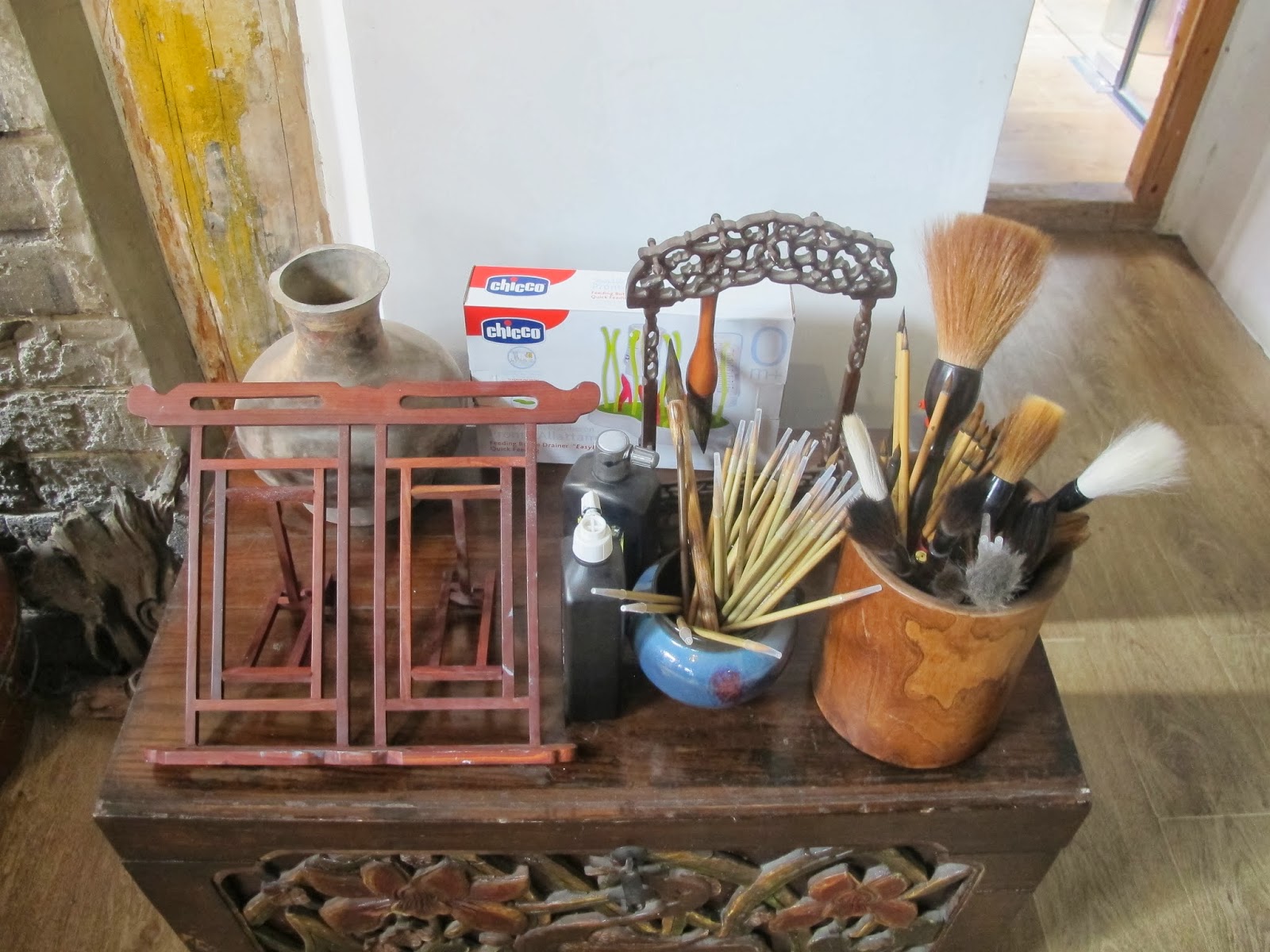
Bingyi's brushes, photo Luise Guest

In the tradition of Chinese ink painting, which most art historians agree began during the Tang Dynasty, the artist’s aim was to capture the spirit of the subject, rather than to create a realistic representation, or likeness. Today, discussions about ink painting are at the centre of global discourses about contemporary art in China, and the practice itself is in flux.
James Elkins, in his essay ‘A New Definition of Contemporary Ink Painting’, describes this highly contested and increasingly controversial form as ‘a Chinese art practice with an unparalleled density, complexity, and historical depth of reference…ink painting connects to a tradition that has been traced back to Han dynasty (206 B.C. – A.D. 220) tomb reliefs, and even to cave paintings and the decorations on Shang( ca. 1600 – 1050 B.C.) bronzes...No other genre of Chinese image making draws on such significant history or requires so much knowledge and experience on the part of the viewer.’ He goes on to make the point that his is not a visual description, nor an account of a method of making. The art could have ink, brushwork and paper, or use video, performance, sculpture, or other media; it may not even look like a traditional ink painting at all.’ It is this layering of past and present, of tradition and its constant transformation, that distinguishes contemporary Chinese art and provides much of its fascination for both Western and (increasingly) Chinese audiences.
Bingyi Huang in her studio
Bingyi Huang in her Beijing studio/Photo by Luise Guest; reproduced with permission of the artist
In fact, it seems that ink itself is no longer necessary for a work to be defined as ‘contemporary ink painting’. The gesture or the mark is sufficient, even in the form of sculpture, video or photography. From Xu Bing’s re-interpretations of literati masterpieces using debris and rubbish behind backlit screens, to the digital multimedia works of Yang Yongliang, the ‘Family Series’ of Zhuang Huan, the gunpowder works of Cai Guo-Qiang, and the recent cartographic works of Qiu Zhijie, the label of ‘Contemporary Ink’ is being applied to the works of many artists who may themselves not always agree with the interpretation. The Wall Street Journal has identified contemporary ink painting as the ‘next big thing’. A major exhibition at the Metropolitan Museum in New York, Ink Art: Past as Present in Contemporary China opens in December 2013, and will include Xu Bing’s installation ‘A Book from the Sky’ (1989), and Ai Weiwei’s ‘Map of China’ (2006), which is constructed entirely of wood salvaged from demolished Qing dynasty temples. Sotheby’s and Christies have recently gone head to head with sales of contemporary ink works in Hong Kong.
Even the most casual observer of Chinese contemporary art cannot fail to notice the myriad ways in which Chinese artists are working within and reinterpreting these traditional forms. New interpretations of a ‘Shui Mo’ (ink and water) tradition pose a challenge the hegemony of oil painting, which has dominated the art world in China since the rise of the avant-garde painters in the early 1990s. One might take a cynical view and suggest that there is a great deal of marketing going on.

In the work of one Beijing artist, however, the tradition of brush and ink has become a way to express deeply personal, spiritual, cultural and even political concerns. Bingyi Huang(usually known simply as ‘Bingyi’) lives and works in a Yuan Dynasty temple building on the ancient central axis of Beijing, near the Drum and Bell Towers. The vast space of her studio, with its enormous pillars and antique furniture, orchids and birds fluttering in large cages, is a tranquil oasis. Once across the stone threshold and inside the heavy wooden doors the shouts of street vendors, and the honking horns of motorcycles and cars navigating the narrow laneways of the hutongs, seem very far away.
When I met Bingyi in October she had just returned from a period of some months painting in the mountains a few hours outside Beijing. Her assistants carefully unrolled a 30-meter long painting to show me how she has developed a unique approach, fusing ink painting with land art, installation art and even performance art. I ask her what she thinks about the current international interest in renewed traditions of ink painting, and she laughs, saying, ‘I could not care less.’ I am doubtful, asking again why she thinks western audiences are so intrigued by the contemporary interpretations of this ancient art form, but she says again, emphatically, 'I couldn’t care less about the art market, about auction prices, it’s boring. In my case it’s not about reinterpreting Chinese traditional ink painting. If you are truly ‘Shan Shui’ you don’t need to think about it. If you are the being, you don’t need to think about the being. You just are.’ She describes her work in an intensely spiritual manner, ‘It’s the universe working through me,’ she says, ‘and sometimes it’s that space between human hand and God’s hand.’
Bingyi Huang, Journey to the Centre of the Earth
Bingyi Huang’s assistants unroll part of 'Journey to the Centre of the Earth'/Photograph by Luise Guest.
Becoming a practising artist only six years ago, after an extraordinarily diverse career, in which she switched from biomedical engineering to art history, along the way also studying computer programming, music and finance, she has created a painting idiom which she describes as a search for the sublime. This is not the European Romantic sublime of the human being as a passive observer of the power of nature, however, but rather a specifically Chinese notion informed by Buddhist beliefs and by her years of art historical research into the Han Dynasty. Bingyi completed her PhD at Yale in 2005. ‘I lived with the Han Dynasty for seven years,’ she says, ‘I was them!’ And what she learned from the years researching her dissertation was that through art, ‘one can embody the notion of eternity. If you can feel and express eternity and transience, then you are approaching a much higher level of metaphysics.’ She tells me that she began painting in her mother’s living room in 2006. ‘What drove you to become a practising artist after a successful academic career?’ I ask. ‘I always wanted to,’ she says. ‘What lies in the heart of humans is a desire to express. We all wish to express, but the question becomes “What is your embodiment? What is your medium?” It was completely inside of me, completely contained… One could say that it’s fate, but we Chinese have a different way of perceiving that.’
Her recent work, Journey to the Centre of the Earth, created for a site in Essen, Germany, a mining region of dramatic mountainous landscapes, is an ink painting of 150 metres in length – a length which equals the depth of the shaft of the first mine. It is developed from meticulous research. Weather, geology, geography, history and sociology are all elements that Bingyi investigates in the planning process for a project such as this. She began the research in Germany and then moved into the mountains outside Beijing for two months, camping in 45 degree heat, in order to physically create the work. Working with four assistants, she worked on the painting section by section, applying the ink to the paper with a variety of techniques and tools that would astonish the traditional literati painters. In an exhaustive and painstaking process her assistants even created a man-made pond large enough to make the sheets of paper that are joined end to end to create the vast scroll.
Bingyi Huang quote
‘I was standing between the heaven and the earth,’ says Bingyi. Dealing with the extreme physical discomfort of the conditions, she says, and even finding herself covered with mosquito bites, was all an important element of her practice. ‘I could feel I was no different than a mosquito, I was no different than a toad. That’s eternity – you are so minimal, you are nothing. And that is the sublime.’ She explains that this process is entirely different than traditional notions of landscape art or Chinese ‘Shan Shui’ (water and mountain painting) in which the artist observing and recording nature. ‘Nature is just a projection of the universe.’ This is not landscape painting in either its western ‘sublime vista’ guise or the Chinese ‘Shui Mo’ (water ink) tradition. ‘It’s conceptual, it’s land art, it’s performance art,’ says the artist. ‘It’s a ritual I perform between Heaven and Earth. I am not a shaman, I am just a human, but this ritual is relational between the universe and the individual, it’s a kind of sublime. It’s intensely primal. It raises questions about our fundamental being – what is pain, what is suffering, what is loneliness.’
Bingyi, ‘The Shape of the Wind: in Fuchun Mountains” (2012) ink on Chinese paper, 2.65 x 160 m, image courtesy the artist
Bingyi, ‘The Shape of the Wind: in Fuchun Mountains' (2012) ink on Chinese paper, 2.65 x 160 m/Image courtesy the artist.
To read the rest of this article, click HERE

Tuesday, November 26, 2013

北京日记 Beijing Diary: the floating world of Guan Wei

I have long been fascinated by that group of Chinese contemporary artists who dispersed after 1989 and found themselves working (and sometimes also driving taxis, washing dishes in restaurants, or drawing tourist portraits around Sydney Harbour or Manhattan) in places far, far from home. Xu Bing in New York, Huang Yong Ping in Paris, and of course, Guan Wei, Jin Sha, Ah Xian, Shen Jiawei and many others in Sydney. A new diaspora. Many have since returned to China, either full or part time, and some, like Xu Bing, now occupy elevated positions in academia or the museum world here in Beijing. 

Thus it was that on a cold, windy day recently I found myself waiting for Guan Wei in the surreal environment of the big outlet malls on Beijing's outskirts, which look more Rodeo Drive than Chang'An Avenue. When he pulled up beside me he assured me he has never been inside them - and the idea of him shopping among the fake designer brands and factory seconds of Burberry and Louis Vuitton (or perhaps Burberrk - yes I have really seen this one - or Louis Vuillon) is a little hard to imagine. He is a larger than life figure with an infectious laugh and an engaging turn of phrase. I was intrigued to find out more about his life now, as he moves between his Sydney and Beijing studios. He told me he prefers Beijing in the winter as Sydney summer heat is too much for him.
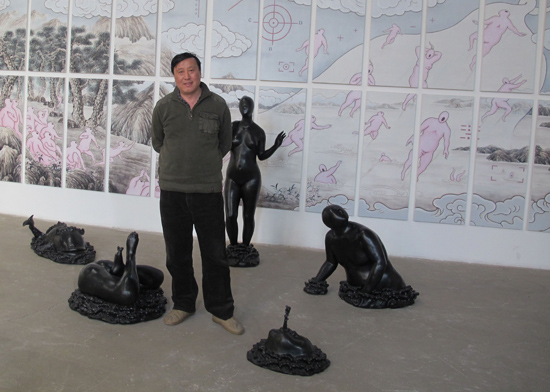
With Guan Wei in his Beijing studio, November 2013

What follows is an account of my interview with him, published in 'The Art Life' today.

Guan Wei is a story-teller, a myth-maker and a social commentator. He is also a fabulist who blends real and imaginary histories, both Chinese and Western, in order to create a parallel universe, a floating world which invites us to question our cultural certainties. He has said that he likes to work in the space between imagination and reality, and his work is deeply personal, reflecting his unique experience of the world, and of a hybrid identity, moving between cultures. He is perhaps the most significant artist currently working between Australia and China, showing regularly in Sydney, Melbourne, and Adelaide as well as Beijing, Suzhou and Shenzhen. His characteristic imagery of pink fleshy faceless people, Chinese clouds and swirling seas, mythological beasts and disembodied Buddha hands is well known and distinctive. However, he is not an artist who stands still, nor is he content to merely repeat what has brought him success, as I found when I visited him this month in his Beijing studio.
Image 6 Guan Wei in his studio
Guan Wei in his studio, photograph Luise Guest.
Guan Wei has had the same small studio in Sydney’s Newtown since 1994, but in China artists know there is no certainty in any rented space. Studios are summarily demolished with little notice and no opportunity for negotiation, to make way for new developments. His current large, airy Beijing space, ironically located close to the vast outlet malls filled with the real and fake big-name brands beloved of Chinese shoppers (where he assures me he has never been) is his third studio since his return to China in 2008. Filled with paintings and sculptures from different phases of his life, it is also now the space where he is experimenting with ink painting, screen printing, lithography, and painting on ceramics created with artisans in the famous porcelain centre of Jingdezhen. It is also home to his collection of sketchbooks, filled with intricate drawings and plans for works – paintings, sculptures and the designs he intends to paint onto the new ceramic works. The tiny drawings in these books, delicate and deft in execution, are like storyboards for a film. In some ways his work is cinematic – narrative, often epic in scale, and featuring multiple overlapping plotlines. Guan Wei’s sense of humour, as well as his keen awareness of both Chinese traditional practices and the contemporary artworld underpins his practice. His work is deeply moral, frequently dealing with injustice and repression; yet also calmly reflective, and highly attuned to a sense of the ridiculous. There is a disarming lightness of touch which actually lends greater weight to the seriousness of his purpose.
Image 1
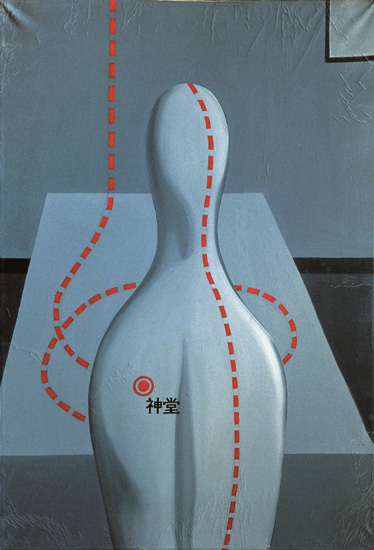
Guan Wei, Acupuncture point - Temple, 1985, oil on canvas, 60 x 75cm. Image courtesy the artist.
His story as a member of that group of artists who made Sydney their refuge after the events of 1989 is well known in Australia. This diasporic personal history plays out in all his work, with its focus on issues of migration, and imagery relating to the journeys of both the colonisers and the dispossessed. It is often assumed that he came to Australia as a direct result of the student uprisings and their culmination at Tiananmen Square in June of 1989. In fact, he arrived in January of that year with artist friends Ah Xian and Lin Chunyan as a result of a chance meeting with Professor Geoff Parr to take up a 2-month residency at the University of Hobart’s Tasmanian School of Art. During that time, he tells me, he completed thirty three paintings in his ‘Acupuncture’ series, working in his early style of grey, black and red with overtly political themes. He realised that Australian audiences, despite their unfamiliarity with contemporary Chinese art at this time, were able to understand his intended meanings and the political concerns about the lack of human rights and democratic freedoms in China that he expressed in these works.
Returning to China in April of that year, despite the concern of his Australian friends, he discovered what was happening with the student pro-democracy demonstrations in Beijing. These events and the resulting repression of artists, writers and intellectuals, made him reconsider his position. He says it made him feel “very badly and sadly about the situation in China, (with) so many intellectuals and students leaving.” In August 1990 Guan Wei returned to Hobart, having been given strong support by numerous individuals including Professor Geoff Parr and Bernice Murphy, at that time Deputy Director of the Museum of Contemporary Art, and by the Australian Government. Later, after a year in Hobart, came residences at the Museum of Contemporary Art in Sydney, the Canberra School of Art at the Australian National University, and then his productive relationship with Sherman Galleries in Sydney. I wonder aloud what it must have been like for an artist from Beijing to find himself in Hobart, of all places, at the start of the 90s. He laughs and says, “I got two culture shocks. When I arrived in Hobart I got a culture shock; it was so beautiful but so very quiet. After five pm nobody on the streets! When I go back to China after four years (to visit) I got another culture shock because of the pollution. So dirty, even in daytime you could not look clearly. (So) when I went back to Australia I changed my subject. For a couple of years I did a lot (of paintings) about the environment.”
At this time he began to use maps in his work, initially with the idea of creating maps of the apocalypse, and later as a way of exploring ideas about colonisation and nationalism. It was at this time, also, that he began to introduce scientific and biomedical elements into his work, with the ‘Test Tube Babies’ series. Later, he says, “I did a lot of Australian political stories, like refugee and migration stories – mixing indigenous stories and colonisation.” “Are you also thinking of your own journey, and more generally the diasporic experiences of so many Chinese artists in these works?” I ask. “Yes, of course!” he says. Guan Wei points out, though, that he feels a responsibility, living in Australia, to tell Australian stories in his work. “I am different to other Chinese artists living in Australia. My many Chinese artist friends, like Shen Jiawei, are doing Chinese histories, but I am doing Australian histories. If you live in Australia you must serve Australian audiences; that is my opinion. That is why I am interested in Australian history, Australian politics and culture. I did a big show at the Powerhouse Museum called ‘Other Histories’ [2006 ‘Guan Wei’s Fable for a Contemporary World’ was his first foray into large scale mural painting] about the Chinese discovering Australia. It’s maybe not true!” “A parallel ‘Guan Wei’ universe?” I suggest. “Yes!” he says.
His ambitious wall mural, ‘The Journey to Australia’, commissioned for the new entrance to Sydney’s Museum of Contemporary Art reveals his continuing interest in themes of diaspora and migration. The painting, which shows a fleet of boats heading towards Australian shores, is a pointed reference to the continuing debates about immigration and, in particular, about boat arrivals. He has in the past described his work as a kind of “bearing witness” to these themes. As with other, earlier, paintings, he is interested in layering indigenous history, colonisation, Chinese history and recent political discourses about refugees and border protection. With his distinctive iconography of lyrical floating clouds, map coordinates, and meteorological patterns; and references as diverse as Chinese astrology, necromancy, traditional medicine and 21st century science, he is able to create works which cleverly comment on contemporary paranoia, yet also reflect the universal themes of journeying, so prevalent in ancient Chinese texts, and literati paintings of wandering scholars in misty landscapes of clouds and mountains.
Image 2 A
Image 2 B
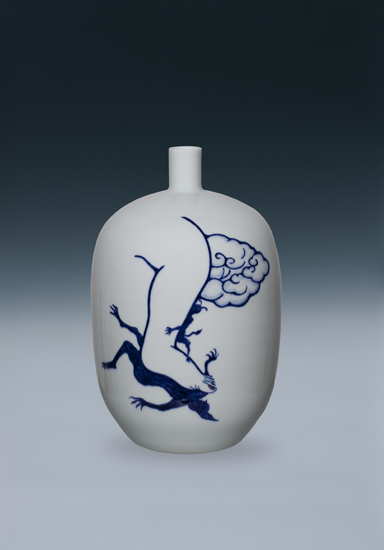
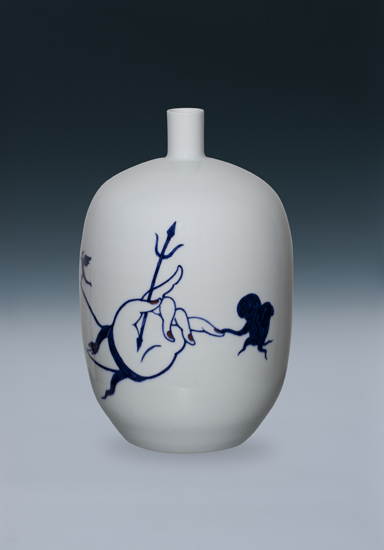
Guan Wei, Subdued Demons vase, 2012. Ceramic, H37cm x Dia20cm. Image courtesy the artist
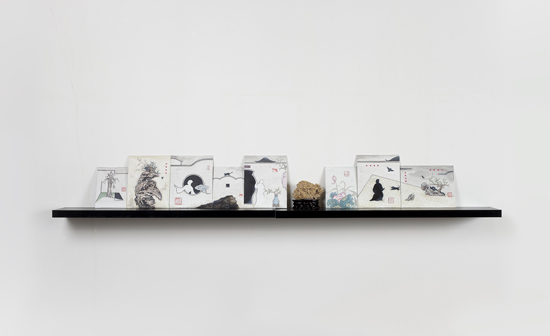
A recent exhibition in Suzhou, Enigma Space, at No. 8 Gallery in Suzhou Industrial Park, represents a new direction in his practice. Small installations of acrylic paintings on boards include found objects such as rocks, bonsai trees and tea, arranged horizontally on narrow shelves. Referencing the Chinese classical design of the garden as a refuge, a spiritual space for contemplating nature in its most perfect form, these works extend his particular visual language in a more overtly narrative manner. Guan Wei has always worked in series, and the paintings move beyond that convention to create tiny landscape vistas which evoke the experience of reading a Chinese scroll. In the catalogue for this exhibition he says, “In our daily lives gardens provide us refuge and spiritual comfort. They are a wonderland within the physical world.” Like many other contemporary Chinese artists, it seems, Guan Wei is reconsidering the traditions of literati painting and the mastery of representing idealised version of nature with ink and brush. In the chaos and confusion of the contemporary world, the artist is continuing to work with deeply felt ideas about the environment, and about the relationship between man and nature.
Image 3
Guan Wei, Enigma Place No.1, 2013. Acrylic on board & rock?30 x 200 cm, 8 panels. Image courtesy the artist
Since 1994 Guan Wei has visited China regularly, making the significant decision to set up a studio in Beijing in 2008. “Why return?” I ask. He gives his characteristic laugh and says, “So many reasons.” Firstly, he tells me, the decision was prompted by the transition of Sherman Galleries to its new incarnation as the Sherman Contemporary Art Foundation and the fact that he was thus no longer represented (at that time) by a Sydney gallery. Secondly, he was invited to produce works for the cultural component of the Beijing Olympics. Thirdly, he says, “Since 2002, each year when I come back to visit family and friends I see big changes; big art communities; many of my artist friends have big studios. I feel very excited! And many of my Chinese artist friends were already back in China.” And, finally, and perhaps most importantly, he wanted to bring his young daughter back to China, to learn about her Chinese culture and background. And of course, he adds, in Beijing it is easy for him to communicate with colleagues, technicians, fabricators and galleries; he has access to spaces, assistants and materials that would be impossible, or impossibly expensive, in Sydney. This has allowed him to explore new possibilities – the bronzes, the ceramics, the current installation of shelf works in Suzhou, that city of beautiful gardens.
Image 5 Ocean
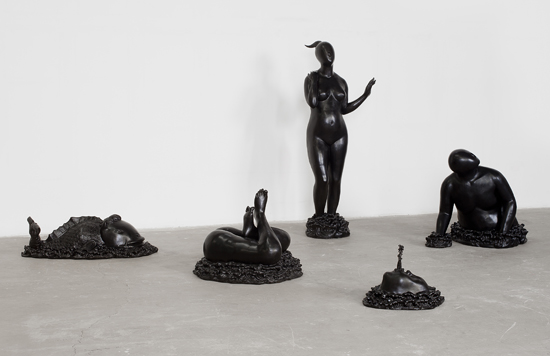
Guan Wei, Ocean, bronze sculpture, 2013. Image courtesy the artist
For his 2013 show at Martin Browne Fine Art, he completed the paintings in Sydney but the bronze sculptures, large and small, were made in China. The complexities and logistics of this kind of global practice are not to be underestimated. In these works too, the complex layering of Chinese and Western references are clear. The solid weighty forms remind me of the female figures of the 19th century sculptor Aristide Maillol, yet their heaviness is belied by the fact that they are frolicking in water, like the pink figures in his paintings which reference the joyful hedonism of Australian beach culture. The stylised water in these bronze works is a reference to the lotus seat of the Tathagata Buddha. The body in water, unencumbered by its own weight, is able to enter a state of complete liberty. His paintings in this show reinforced the palpable awareness of Australia as an island continent, of a place with edges, and permeable borders. Figures cluster on shorelines, or traverse oceans and seas in tiny boats. The series ‘Twinkling Galaxies’ with its emphasis on constellations and heavenly bodies in the endless darkness of the night sky, reveals the sense of place and the careful observation of particular locations that is so evident in his work, as well as his interest in mythology and science. And, as he said to me with a laugh, he always gets a shock when he returns from Sydney to Beijing and realises that he cannot see any stars through the haze of pollution.
At the end of our conversation he is most animated when he shows me the samples of his ceramics from Jingdezhen. It will be too cold during the Chinese winter to go there to continue the project, he says, so he is impatiently waiting for the moment when he can return to work with the porcelain craftsmen and apply his lyrical human figures, demons and mythological creatures to the seductive curved surfaces of the vessels and bowls. Guan Wei is an artist who never stands still. Just as he continues his regular journeying between Beijing and Sydney, so too his work continues to evolve

Friday, November 22, 2013

北京日记 Beijing Diary: "Tuhao" or not "Tuhao"

Scary children's ride in Tuanjiehu Park
Three items from today's China Daily which evoke the general strangeness of China:

  1. Five junior high students in Jishou were forced to eat paper trash off the floor as a punishment for dropping paper after an exam. Their teacher has now been forced to apologise
  2. Tuesday was 'world toilet day' and there have been numerous news items about the state of public toilets and how people should (and should not) use them. Given that this afternoon I saw a police officer casually urinate in bushes outside a public toilet I can only say that despite improvements there is still some way to go.
  3. Officials are now forbidden from exchanging gifts such as fireworks, cigarettes and alcohol (a rather unsafe combination, one feels) bought with public money, during the New Year and Spring Festival holidays, says the Central Commission for Discipline Inspection of the Communist Party of China
And there appears to be much excitement that the Oxford English dictionary might include a Chinese neologism, an example if ever there was one of how language must change to reflect changing realities. The word "tuhao" has gone viral to describe the vulgarity of the newly rich. I first heard it from a young translator who asked me to define the Australian term "bogan". I confess. I struggled. When I asked him to tell me what the Chinese equivalent might be, he came up with "tuhao", telling me it applied to people with money but no class. 

How do you say "nouveau riche" in China? Tuhao.
As in, "The Real Housewives of Beverly Hills" are tuhao. Covering the inside of your Rolls-Royce with jade is tuhao. Or, the most popular use, the new gold iPhone 5s is now known in China as the "tuhao gold iPhone."


Meanwhile, in Tuanjiehu Park, which is emphatically NOT 'tuhao' the dancers, singers, musicians, card players, Qi Gong disciples, and water calligraphers go about their self-appointed tasks. People out to run, listen to radios (loudly) read out loud to themselves as they walk, do various vigorous forms of exercise or just sit in the sun are there in force each day. It is a tiny microcosm of Chinese life. As one Tuanjiehu resident said to me, "If you want to know about China and the Chinese, don't read a book, come to the park."
Enthusiastic singers, Tuanjiehu Park
Great spot for a morning chat


In the last week I have returned from a weekend trip to the wonderful city of Chengdu where I attended the opening of an exhibition of collaborative works by Australian artist (and longtime China resident and director of China Art Projects) Tony Scott, and Chengdu artist Dong Xiaozhuang. We stayed at the Art Hotel Chengdu and were treated as honoured guests by the artist's son, visiting the impressive space of the new Chengdu Modern Art Museum, and eating hotpot with local artists. I hadn't expected to find myself making a speech at an art opening to more than 100 people, following a line-up which included the Australian Consul General, Nancy Gordon (a lovely woman with enviably fluent Chinese) and a bunch of Chengdu politicians (who looked like every Chinese official you ever see in a news photograph - I think there is an assembly line somewhere) and artists and academics from the Chengdu Academy of Fine Arts. It was a surreal moment to add to all my other surreal China moments. I had to give the speech in English, with a translation sentence by sentence, so I thought the only thing I could do was to start in Chinese with an apology and an explanation for why I couldn't give the whole speech in Chinese - at least that got a laugh.
Tony Scott with work created collaboratively with Dong Xiaozhuang in the exhibition 'Two Voices'
Sichuan Opera performance in a Chengdu restaurant includes fire breathing - or is that the result of the hotpot?
The doors of the Chengdu Museum of Modern Art

I have finished six weeks of Chinese classes, with very little appreciable advance in my fluency of speech or my ability to read. This might be a lost cause. I have days where I feel at least vaguely competent to communicate and others where it all just goes pear-shaped. When I went to the post office today various officious post office employees were shouting a whole lot of instructions and I couldn't understand a single word in the torrent of verbiage flying at me. I maintained my usual tactic, which is to nod and smile in the hope that eventually people will do things for you, even if only in an exasperated desire to get rid of the stupid laowai. This usually works. Whether my letters will ever reach Australia is another matter though. 

I have had a second interview with the wonderful Ma Yanling at her studio in Songzhuang, sitting in front of an open fire as they have no heating. And a highlight of this week: meeting Yin Xiuzhen after her successful solo show at Pace Beijing, returned from installing shows in Korea, Philadelphia and the Moscow Biennale, and seeing the studio out near the Great Wall where she works collaboratively with husband Song Dong. I enjoyed hearing about her transition from ten years as a high school art teacher, where by all accounts she was in constant trouble from the school authorities for such infractions as allowing her students to listen to music while they were painting. 
Ma Yanling with friend
Ma Yanling in her studio
Ma Yanling, Jiang Qing, image courtesy the artist and White Rabbit Gallery
In addition to writing an article about my interview with Bingyi Huang, and one about Guan Wei (watch this space!) and thinking about how to structure my account of the fascinating women I have met in Beijing,  I have done a little bit of wandering around, looking and listening and enjoying the rare blue sky days and sunny afternoons. One more week in Beijing then on to Shanghai - it will be difficult to leave!
21st century offering - a can of coca cola


Monday, November 18, 2013

北京日记 Beijing Diary: Food, Learning Chinese, People - and Art


As I come to the final weeks of my residency I have been savouring some of my favourite Beijing moments. And they're not all food-related, but I have to say that food has figured largely in the fascination of my time here in China. That includes those foods which are immediately appealing and wonderful, and those which I am adding to my list of things to avoid. Joining the donkey pastrami and the boiled goats' feet of Xi'an I can now add the grilled duck tongues of Chengdu. The visual richness of street vendors of all kinds is a feature of any walk in Beijing, and the foods on offer have changed as the weather has grown colder - grilled corn, chestnuts and walnuts, congee and pancakes and baozi, sweet potato and cakes. Beijingers love their 'Xiao Chi' (literally, little food, i.e snacks)


So here's a list of other things I have enjoyed seeing and experiencing of late

  • I am amused and impressed by the fur-lined sleeves that have appeared on bikes and motorbikes - very necessary and so ingenious!

  • The tiny mandarins in the markets with their leaves attached - so cheap and so sweet - as well as pineapples and other strangely tropical fruits in this cold climate

  • Pomegranate juice from the street stalls

  • The woman who takes her microphone and amplifier into the park each afternoon and sings opera and Chinese folk songs in a pavilion beside the lake

  • The people both young and old who practise their saxophones, flutes and clarinets seated on benches in the park
  • Tiny children bundled into so many layers that they are completely spherical
  • The massive army greatcoats and hats with fur earflaps worn by men collecting recycling
  • The way that people love to gather in groups and add their opinion to whatever is happening, whether that's a car accident, a mahjong game, a dispute over the price of vegetables, or the technique of the water calligraphers and dancers in the park


Among many possible candidates for a favourite English shop name, my current favourite is definitely "Bing Bing Decently", a small emporium selling 'scholar rocks' and ornately carved pieces of timber and "jade" (I suspect definitely of the inverted commas variety) in the Chaoyang Cultural Market. But there is also this one, which definitely falls into the WTF category:


  • The frustration but also the joy of starting to be able to read Chinese characters continues - I forget as many as I learn, but it is a revelation to me in gaining a greater understanding of the people, culture and history. And Chinese characters are just so beautiful, even in subway signs or scrawled graffiti. I often trip over steps and walk into posts as I am so occupied in staring at billboards and street signs and trying to work out what they say.

I have been meeting so many interesting artists, including Guan Wei and Lin Jingjing, and continuing my series of interviews. As this research continues I've had many conversations with these artists, with my interpreters, with curators and with friends both western and Chinese about ideas relating to gender in China right now. It is often at the forefront of public discourse, and certainly forms a subtext to much policy debate and media angst. 


With artist Bu Hua in her studio, October 21
Lin Jingjing in her studio, November 14
With Guan Wei in his studio, November 11

Here are my first thoughts about this, in relation to three of the eighteen artists I have spoken with to this point. The article, 'Material Girls, Super Starlets, and Girls with Swagger'  was published in The Artlife last week, and this is an extract:


Late Autumn in Beijing alternates glorious blue sky days with others on which the pollution levels soar into the ‘alarming’ zone and people with masks covering their faces are glimpsed through mist and fog on grey streets under grey clouds. The schizophrenic weather conditions mirror something of the paradoxical nature of contemporary China. On one street you see old men in Mao suits playing mah-jongg on the corner, while in the next you are as likely to find a Lamborghini showroom as a snack cart selling dumplings. These paradoxes extend into the art world too. The pace of change in China has been so swift and dislocating that each new generation of artists essentially inhabits a different country, with different experiences, ideas and beliefs. On every construction site billboards loudly proclaim: “This is my Chinese Dream.” This dream, and what it might entail for different generations in China – and what that might imply for the rest of the world - is definitely contested territory.
I have been fascinated to discover these generational dissonances as I have met with artists during a two-month stay in Beijing. My particular project has been to interview female artists. Just as the social forces in China have swept away old certainties, so too have ideas about gender and the roles of women been changing, albeit in ways quite different from what one might expect.
Recently this has come to the forefront of public discourse, as the term “sheng nu” (“left-over women” - defined as single women over the age of 27) has gained increasing traction in the media. The following delightful piece was published on the website of China’s state feminist agency, the All-China Women’s Federation:
“Pretty girls don’t need a lot of education to marry into a rich and powerful family, but girls with an average or ugly appearance will find it difficult. These kinds of girls hope to further their education in order to increase their competitiveness. The tragedy is, they don’t realize that as women age, they are worth less and less, so by the time they get their M.A. or Ph.D., they are already old, like yellowed pearls.”
Despite the gender imbalance created by the One Child Policy and a preference for boys resulting in an over-abundance of men seeking wives, it seems that contemporary Chinese culture punishes women for being over-educated, over-ambitious and financially independent.
In street fashion, advertising, and, yes, even in the hallowed space of art galleries, I have been observing a kind of hyper-femininity. Representations of the feminine in some of the less illustrious galleries in the 798 Art Zone range from imperial maidens and concubines, reflecting nostalgia for a patriarchal past and its certainties, to fibreglass stilettos covered in spikes, an indication of current anxieties. Young men are nervous. They feel enormous pressure to be rich enough, and successful enough, to attract girls and find a wife. The famous quote from a TV dating show, from a young woman who said she would rather weep in the back of a BMW than laugh on a bicycle, is cited often as evidence of women’s materialism.
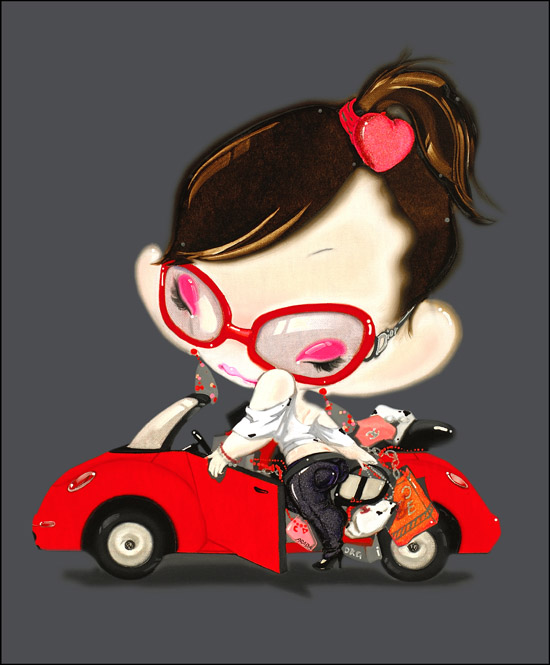
1. Travel Alone 60+50cm oil on canvas 2007
Han Yajuan, Travel Alone, 2007. Oil on canvas image courtesy the artist.
To find out more, I spoke with three artists who explore some of these ideas in their work.
I met Han Yajuan in her bright apartment and studio in the new area of Wangjing, where she looks down over block after block of high-rise apartments and sweeping expressways, a view she describes as “depressing”. Her work has been seen recently in Australia in the ‘Go Figure’ exhibition, curated by Claire Roberts from Uli Sigg’s collection at the National Portrait Gallery, and in ‘Far East Duet’ at the ACAF Project Space in Melbourne. She is represented in New York by Eli Klein Fine Art.
Born in 1980 in Qingdao, Shandong Province, and earning her MFA from the Central Academy of Fine Arts in Beijing, she is sometimes described as an artist whose works embody the collective unconscious of her generation, which seems rather a heavy burden. Her paintings reveal her interest in Japanese design and animation, as well as fashion, and reflect the culture of ‘cuteness’ (in Chinese, “Ke’ai”) prevalent in contemporary pop culture. In China, young (and even not so young) women are expected to behave in ways which are winsome, even child-like. ‘Travel Alone’ depicts a cute, big-headed, bling-adorned cartoon girl climbing into her red sports car wearing Dior glasses. She carries bags labelled Prada and Chanel. Fake or real, they reflect the current obsession with designer brands as symbols of wealth and success. Han Yajuan reveals the current anxiety about the lives of young women, the ‘material girls’ who want it all, and want it now. ‘Fashion Week’ represents the frantic busy-ness, but also the emptiness, of this world. In response to my suggestion that her paintings are a critique of contemporary life and materialism, she says, “I was just trying to present what I see…what exists. Twenty years ago a bicycle was a luxury, but things change. There is so much pressure; the speed (of life) is so fast. I am trying to present my point of view and also to give people an opportunity to see their own lives.” Her generation have not experienced the hardships of the past, and are experiencing the loneliness, as well as the material comforts, of an entirely different kind of society.
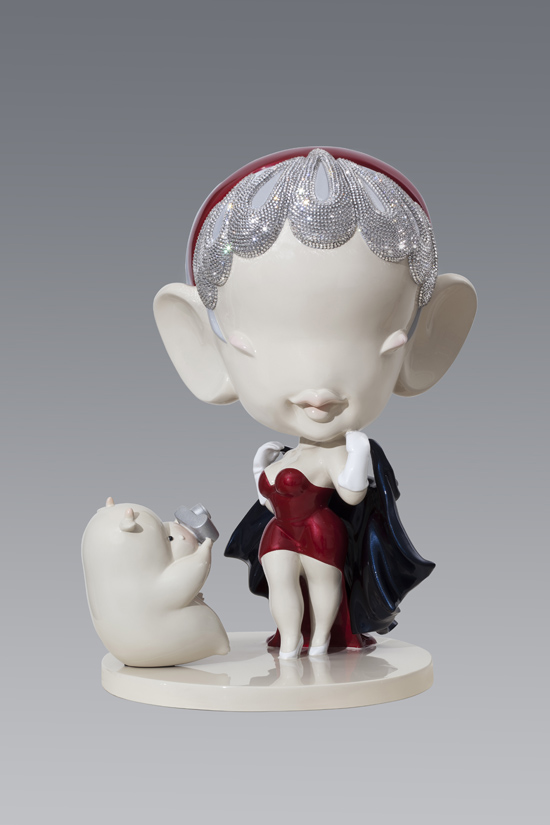
In sculptural works such as ‘Super Starlet 6’ the cloying cuteness is undercut by a disturbing sense of identity crisis – these are essentially faceless beings, literally from the assembly line. Looking at these works before I met the artist, I wondered what she intends to communicate about the lives of Chinese women today. Are the creatures she represents victims of new social pressures, or are they empowered and materially successful beings? Is it celebration, or criticism? The answer, as is so often the case in China, is equivocal. Han Yajuan’s female figures are, and also are not, self-portraits. She is a participant in, as well as an intelligent observer of, the culture in which she finds herself. Self-possessed and confident, with her deep voice and disarmingly infectious laugh, she is fully aware of the dark side of the glamorous world she depicts: a world of corruption and karaoke bars; mistresses and designer handbags. But she is pragmatic. “From a very primitive perspective,” she says, “it relates to the uncertainties of life – we should pursue the things that make us happy. It’s personal. It’s about what makes me happy. There is a part of me in all those figures.”
2. Super Sterlet 6 out of 6
Han Yajuan, Super Starlet 6, 2011. Color paint on tin bronze, crystals, 45 x 36 x 40 cms. Image courtesy the artist
“I am from the eighties generation”, she says, identifying the strictures of the Chinese education system as well as the Japanese cartoons she loved as a child as key influences on her thinking. “My early works are about individualism and uncertainty. Later I changed my perspective to stand on a higher point and look down upon a whole complex and contradictory world.” When she began to create these elaborate multi-dimensional compositions, she was initially filled with self-doubt and uncertainty. Working towards a solo show in New York next April, she says, “I am trying to connect doubt and uncertainty with very concrete things. You can see the materialism, you can see the fashion, but this is just recognition. I know why I am doing this. I know what I try to achieve. It is for people who maybe don’t have the time to see this, to look at these things.”
Rather surprisingly, given their apparent celebration of consumerism, Han sees her practice as relating to Zen philosophy and to Qing Dynasty paintings in which multiple perspectives depict a whole universe, both microcosm and macrocosm. We discuss the famous scroll representing an entire town in which every person depicted is doing something different. In ‘Perfect Ending’, a parallel universe of tiny cubicles is filled with girls and consumer products - espresso machines, laptops, mobile phones, shoes and handbags. They strike me as extremely sad. A tiny world appears about to implode under its own pressure. “This is still a male-dominated society,” she says, in response to my query about whether it is more difficult for female artists in China. “But I’m a human being first, then a woman, then an artist.” And, she adds, if you just keep on doing good work, people will have to take notice.
3. Perfect Ending 360+180cm 2010
Han Yajuan, Perfect Ending, Oil on canvas. Image courtesy the artist
Bu Hua was born in 1973, graduating from the Institute of Fine Art, Tsinghua University, Beijing, (formerly the Central Academy of Fine Art and Design) in 1995. Coming from a family of artists, with a father who was a distinguished printmaker, she “learned the language of lines” at an early age. Her work is represented in the collection of the White Rabbit Gallery in Sydney.
Bu Hua is best known as one of the pioneers of digital animation in China, discovering the expressive possibilities of Flash software and its potential to convey emotional truths about contemporary life in an immediately engaging and dynamic way. During our conversation she tells me about an artist whose name she cannot remember, discovered in the late 90s at Kassel Documenta, who created wonderful, complex, highly political animations with charcoal drawing. “William Kentridge?” I ask. “Yes, yes, yes!” she exclaims. Seeing his work in Germany was the impetus that made her want to combine drawing, painting and animation. In recent years she has developed a character, a key protagonist in both video and still images, who is based on herself as a child - a defiantly feisty but definitely cute Young Pioneer. She bravely navigates the surreal landscape of the 'new' China, encountering strange beasts, mystical forests, hideous pollution and rapacious developers, somehow emerging victorious. She is a girl with 'swagger', according to Bu Hua, and a more confident version of the artist herself - a fearless alter ego. In ‘Savage Growth’ she wanted to express this anxiety and fuse western and eastern traditions of art and design. “In modern China, how could you not be influenced by this fusion of West and East, this cultural invasion and ‘soft power’? I am just reflecting this reality,” she says.
attachment
Bu Hua, The Water is deep here in Beijing I (2010). Image courtesy the artist.
The girl who skips and jumps through her animations, woodblock prints, paintings and digital images is based on the artist's memory of herself as a schoolgirl in Beijing in a simpler era. She thinks about herself cycling to school at a time before the recent explosion of wealth and development with a certain degree of nostalgia. Past, present and future collide in the imagined adventures of this 'Beijing babe' who functions as a voyeur, a means by which we can see the craziness of the contemporary world.
5. Bu Hua AD 302 - 8
Bu Hua, AD3012-8,2012, giclee print on paper. Image courtesy the artist.
To read the rest of the article, click here: HERE