The ongoing thoughts of an art teacher in China - and home in Sydney

A continuing diary about my travels in China, and thoughts about China and Chinese art from home and abroad
Showing posts with label shoufay derz. Show all posts

Sunday, December 20, 2020

Watching the Moon: The end of a terrible year

Pixy Liao, 'Things We Talk About', 2013, image courtesy the artist


In normal times at this tail end of the year I would write a kind of  'best of'' list of the art, the exhibitions and the most memorable artworld moments of 2020. I know, I know, it's kind of lame and a cliched media trope, but I have always enjoyed looking back over my calendar and sorting through all the many and varied experiences. Well, as we all know, these are not normal times, and this year there are vanishingly few things to talk about. The lasting experience of 2020 is of solitude mixed with uncertainty, boredom, and occasional lapses into existential despair. Life became very small as I encountered my students and colleagues mostly on Zoom, and seized precious socially distanced opportunities to see family and friends. I have tried to be more aware of the natural world, the turning of the leaves, the singing of birds in the garden, the sunsets and the moon - but frankly I'm often reading or watching Netflix and shamefully I see the moon and the sunsets in other people's Instagram photos more often than in reality. And as for art.....

The final exhibition I saw before the onset of Sydney's lockdown in March, somewhat nervously due to the increasingly serious pandemic, was 'Xu Zhen: Eternity Vs. Evolution' at the National Gallery. I felt that the visceral spectacle of the works, which had been so evident in the major survey exhibition at Beijing's UCCA and in various shows at White Rabbit Gallery, was somehow diminished inside the rather dark concrete spaces of that Brutalist Canberra building. 

XU ZHEN® "Hello", installation view, Photograph: Luise Guest

The best critical account of that exhibition is by Alex Burchmore, in Randian. Of the snake-like, moving Corinthian column activated by visitor movement he writes: ''the voluptuous coils of ‘“Hello”’ (2019) take pride of place in ‘Eternity Vs Evolution’, towering over the viewer and following their every move with a baleful gaze that threatens consumption by the emptiness of the void (and note the inclusion of quotation marks in the title). The caption for this work draws attention to the historic prestige of the Corinthian column that Xu has chosen for the body of his serpent, ‘first created in ancient Greece [as] a symbol of power, prestige and western civilization.’ Yet the flaccid immobility of this automated guardian, save for the hesitant and creaking sway of its pediment-head when activated by the approach of the viewer, inspires more pity than dread. Carved in soft and yielding Styrofoam, this is a column devoid of all function, a structural support incapable of supporting its own weight, spectacular in scale but hollow within. As such, ‘“Hello”’ offers a clue to the underlying message of the exhibition: that which seems invulnerable and eternal is often little more than an artfully contrived illusion, while the evidence of our own eyes is rarely as straightforward as it seems and inevitably colored by the assumptions that structure our view of the world.'' Read the full article here. 

Lindy Lee, 'Moonlight Deities', installation view, photo: Luise Guest

Lindy Lee, No Up, No Down, I Am the Ten Thousand Things, 1995/2020, installation view, Lindy Lee: Moon in a Dew Drop, Museum of Contemporary Art Australia, Sydney, 2020, photocopy, synthetic polymer paint, ink on Stonehenge paper, dimensions variable, image courtesy the artist, Sutton Gallery, Melbourne and Museum of Contemporary Art Australia, Sydney and © the artist, photograph: Anna Kucera

I managed to briefly see a small part of Brook Andrew's Biennale of Sydney before it closed and then, once museums re-opened, enjoyed a visit to an almost empty Museum of Contemporary Art to see 'Lindy Lee: Moon in a Dewdrop' (about which, more later). Apart from those experiences, months apart, the wonderful 'Indonesia Calling' at 16 Albermarle Project Space turned out to be one of those increasingly rare experiences - an exhibition that was curatorially coherent and visually and conceptually exciting. John McDonald's curation of an exhibition of work by extraordinary (and eccentric) ink painter Li Jin for Vermilion Art, 'To Live [It Up]', was also interesting, providing a different view of the artist's work than the big survey show of his career that I had seen at Ink Studio in Beijing in 2019. It's great to know that a number of works were acquired from this exhibition for the collection of the Art Gallery of New South Wales. 


Works by Li Jin shown at Vermilion Art in November

So, in this globally calamitous and personally very challenging year, how to make some sense out of the chaos and confusion? Is it even possible in this year when the president of the United States is advocating a literal military coup to contest an election he lost, and when so many of us have lost faith in our governments' responses to the pandemic that has devastated the globe. We are increasingly divided, angry, sad and cynical.

Among the many losses of the year, a bright spot for me was the realisation that it was still possible to continue my conversations with Chinese artists, albeit (sadly, and who knows for how long) not face to face in their studios. I've spoken with Pixy Liao, Cao Yu, Liu Xi and Shoufay Derz via email, Facebook and Wechat and have had articles published in a range of print and online journals that I've referenced in previous blog posts, including most recently an article in Art Monthly Australasia.

Pixy Liao, 'Ít's Never Been Easy to Carry You', 2013, image courtesy the artist


These conversations were interesting and thought-provoking, challenging some of my assumptions about art, feminism and China, which is always a good thing. I take these ideas now into the chapter for a book that I am working on, so watch this space! Here is the opening section of the Art Monthly piece.  In the extract below I've left out the footnotes and references, just to make it more readable in this blog format:

 'Public Bodies, Private Lives: the work of Cao Yu and Pixy Liao'

In the cold Beijing winter of 2012, I interviewed Lin Tianmiao – often described as one of very few feminist artists in China. She told me bluntly, ‘There is no feminism in China. It’s a Western thing.’She meant, I think, that Euro-American feminism/s were not especially relevant to the experiences of Chinese women – and also that she resisted being silo-ed in a still-patriarchal Chinese artworld as a ‘woman artist’. It is generally acknowledged, as Shuqin Cui recently argued, that ‘few Chinese women artists would welcome the label of feminist art or categorize their work as feminist art even if the feminist dimensions of their work were clearly evident.’ Nonetheless, many artists grapple with issues of gender and challenge heteronormative stereotypes. A feminist self-identification is not especially significant, as art historian Joan Kee noted: The question is not whether women artists from Asian countries identify themselves as feminists, or whether their work imparts feminist messages. Instead, the issue concerns the logic of interpretation’. Feminism is embodied in nuanced and culturally specific ways in the practice of many contemporary Chinese artists – even if they disavow the label.  When I spoke with multi-disciplinary artists Cao Yu and Pixy Liao, they expressed reservations about being pigeonholed, yet their work powerfully challenges essentialist notions of the ‘feminine’.

Cao Yu, 'Mother' series, installation view, image courtesy Cao Yu and Urs Meile Beijing/Lucerne


Cao Yu, 'Everything Will Be Left Behind', installation view (above) and detail (below), image courtesy the artist and Urs Meile Beijing/Lucerne

You will find the whole article in the Summer 2020/2021 issue of Art Monthly Australasia.

Perhaps, at the end of a year that has been so terrible for so many across the globe, at the mercy of a virus (and I don't mean the one in the White House) we come back to the knowledge of our tiny insignificance in the vastness of the universe. Lately I am finding that comforting rather than frightening. The title of Lindy Lee's exhibition 'Moon in a Dewdrop' is a reference to the writings of 
Dōgen, the 13th century Zen monk who brought Buddhism from China to Japan. Lee is a practising Buddhist and the philosophy informs her life and art. I think of the artists I know in China whose study of Daoism similarly inflects their work, and their reactions to the world and its suffering. We too are the 'ten thousand things' - everything under heaven - in a constantly fluxing relationship with the world and everything in it - light and dark, health and illness, solitude and companionship. Well, I'm working on that level of acceptance. Mostly failing. It's a process.

Lindy Lee, Buddhas and Matriarchs, 2020, installation view, Lindy Lee: Moon in a Dew Drop, Museum of Contemporary Art Australia, Sydney, 2020, flung bronze, image courtesy the artist, Sullivan+Strumpf, Sydney and Singapore and the Museum of Contemporary Art Australia, Sydney with the assistance of UAP and © the artist, photograph: Anna Kucera

As Dōgen said of himself watching the moon:

‘Sky above, sky beneath, cloud self, water origin’


Tuesday, March 11, 2014

山水 Shan Shui - musings on mountains, water and all things Chinese

Hua Tunan. Fluorescent Impression Shanshui, 2013; spray paint; 300 x 500 cm. Image courtesy of the Artist.
There is a small mountain of stacked books beside my bed and another on my desk. Unsurprisingly, almost all of them have some relationship to China or to Chinese art. As is my usual habit I have been immersing myself in all things Chinese, from books to art to political news  - in fact pretty much everything except doing my Chinese language homework. I have managed to avoid this every night this week. It consists of re-writing, in characters I barely understand and won't remember by tomorrow night's class, a riveting text about the history of the bicycle in China, and the construction of sentences using words such as 'bicycle lane', 'air pollution' and 'health and fitness'. Currently I just cannot force myself to do this. Maybe after some junk TV, and a stern talking to - of myself, by myself....Add to this the fact that my new teacher has (to my ear) a somewhat impenetrable Shanghai accent and continually corrects my Beijing pronunciation, and it's all a recipe for a demoralising Wednesday evening. Eating bitterness, one might say. However he does like to interrupt the lesson to provide us with new "4 character idioms" and Chinese stories, including one about the Emperor being astride sky, mountain and river at the one time - and some very bad Chinese jokes about how much women like to shop. "Tongyi bu tongyi?" (Agree or disagree?) he says. I didn't endear myself by saying loudly "Bu tongyi!" (A lie, really, as I am quite partial to a bit of retail therapy - especially in China!)

I have been reading two books written by travellers to China in the late1980s, and marvelling over the dramatic changes in the last thirty five years. Paul Theroux (grumpy old thing) riding the Iron Rooster is invariably cynically disappointed in pretty much everything, and the British writer Colin Thubron is even more disapproving. And I frankly don't believe that all the detailed conversations that both writers report were carried out in fluent Mandarin without any minders or interpreters, especially as Thubron says in Chapter 1 that he spent the year (ONE year!!! Ha ha!) learning Chinese before his journey. That puts me in my place - three years on and my spoken Mandarin is still essentially "taxi Chinese." I have decided that they are clearly both fantasists of the first order. However, both books are fascinating in their own way as the writers observe at  first-hand the impact of Deng's "reform and opening" and the flourishing of markets and small businesses, as well as the human cost of the ending of the "iron rice bowl" and its cradle to grave guarantee of income (albeit small) and health care.

I have also re-read John Garnaut's account of the machinations of Bo Xilai in Chongqing, "The Rise and Fall of the House of Bo." It was rushed hastily into print before what were essentially two show trials - of Bo himself and of his wife Gu Kailai (or, was she? So many conspiracty theories about the identity of the woman who actually faced the court.) However, his obvious knowledge of the way that the system of reciprocal obligation and corruption has played out in recent years in a way surely little different to imperial times makes for a riveting read. And essentially it is a dynastic story - his account of the Cultural Revolution tribulations of Bo Xilai's father, Bo Yibo, who, with Xi Jinping's father, was one of the "eight immortals" of the Communist Revolution, is especially fascinating.

Meanwhile, I have been writing about the revival and reinvention of ink painting, and seeing it in various guises and places including, perhaps surprisingly, the Penrith Regional Gallery and Lewers Bequest, in an exhibition of Chinese and Australian artists entitled 'Wondermountain.' The exhibition was curated by Joanna Bayndrian, who is also responsible for an interesting new website (for which, in the interests of full disclosure, I should say I am a contributor of articles about Chinese contemporary art) Creative Asia. Apart from new work by Shoufay Derz, my favourite works in Wondermountain were by Yang Yongliang, Wang Zhibo and the surreal fog-filled landscapes of Svetlana Bailey. My review of the show (for Daily Serving) was published today. Here is the start of the article.

Subverting the Sublime: 'Wondermountain at the Penrith Regional Gallery'

Liu Yuan, In the Likeness of a Mountain, Digital Print, image courtesy the artist
It seemed entirely appropriate that my journey to see Wondermountain at the Penrith Regional Gallery and Lewers Bequest was through rain, a concrete landscape of freeways and overpasses obscured by my windscreen wipers. I arrived beside the swollen Nepean River, the Blue Mountains shrouded in mist, reflecting on the continuing importance of shanshui (mountain/water) painting. A poetic approach to representing landscape evolving from the Tang Dynasty, the genre has continuing currency in the work of contemporary artists responding to dramatic changes in the natural environment, in China and elsewhere. Subtitled Landscapes of Artifice and the Imagination, the exhibition brings together works by thirteen Chinese and Australian artists, exploring curator Joanna Bayndrian’s interest in the endurance of some of shanshui’s core principles and  “the transient spaces of supermodernity.” Bayndrian wanted to explore the relationship between humans and the natural environment, the artistic appropriation of signs and symbols that have come before, and the visualization of imagined landscapes. These things, so central to traditions of Chinese art, are all relevant to young artists working today.

A number of works depict dystopian landscapes, rather than the sublime vistas imagined by the literati painters in their gardens, or wandering scholars traveling in misty mountains. Yang Yongliang’s animated Phantom Landscape, at first sight a Song Dynasty scroll painting, is a melancholy vision of the fate of Chinese mega-cities. The mountains are actually stacked skyscrapers surmounted by cranes and pylons, while a torrential waterfall becomes a river of cars. Philjames appropriates a picturesque landscape into an image of the Three Gorges Dam in a comment on development and “progress.” Hua Tunan uses the language of street art and spray-can graffiti to reimagine shanshui in vivid fluorescent color far from the restraint and serenity associated with the conventions.
Cindy Yuen Zhe Chen, 'Soundscape Karaniya Metta Sutta (detail) 2012 ink on wen zhou paper 72x230.5cm
Cindy Yuen Zhe Chen. Soundscape Karaniya Metta Sutta (detail), 2012; ink on wen zhou paper; 72 x 230.5 cm.
Shoufay Derz explores the sublime and ephemeral in works that focus on liminal states. Ash Upon the Moon documents the act of throwing ash into the mountainscape of Taiwan’s Caoshan. The artist describes her process as akin to traditional Chinese stories of the wandering scholar “looking, but not finding.” Her photographs record a kind of drawing in which she references the calligraphic mark of the ink painter. She says, “The ash is to the landscape what ink is to paper.” Jason Wing’s Xucun Village, an installation of recycled bricks with gold leaf, leads us to contemplate the continuing cycle of destruction in China. Not new, of course—each successive dynasty destroyed the temples, tombs, and palaces of the previous rulers—but unparalleled in its scope and impact. To read on, click HERE
Shoufay Derz, Ash Upon the Moon, 2014, Pigment Print on Cotton Rag Paper, 67 x 82cm Image courtesy the artist and Penrith Regional Gallery
Shoufay Derz. Ash Upon the Moon, 2014; pigment print on cotton rag paper; 67 x 82 cm. Image courtesy of the Artist and Penrith Regional Gallery.

Monday, December 30, 2013

Art in Review, 2013: The Good, the Bad and the.....

 It's the end of 2013, another year over and a time to look back. Every writer of every description is doing their end of year roundups (aka "quick, make a list, rather than actually write something of substance") and "who am I to disagree?" to quote Annie Lennox and the Eurythmics. And that's always appropriate. Returned from a Chinese winter, exposing my startlingly white skin to the Australian sun and walking along the beach, instead of more practical and useful tasks I have been deciding on my top ten gallery experiences of the past year. I could have been thinking about New Year's resolutions such as, oh, I don't know, losing 10 kilos, going to the gym more often (or, in actual fact, ever), doing intensive Chinese homework every single week, being kinder and less impatient, being less of a workaholic. But instead, I decided to write a list of the aforesaid gallery moments of wonder and awe. And here they are:

1. Song Dong, Waste Not, at Carriageworks, Sydney, January 2013. This was magical and moving, a testament to family, to memory, a profoundly human elegy to the artist's mother and to times past.


Song Dong, Waste Not, photographs Luise Guest
When I wrote about this installation, which I had always wanted to see, I found it hard to express my own feelings of sadness that linked me directly with my own very complex relationship with my mother. Here is the start of my review for 'The Art Life'.

The Ancestral Temple: memory and mourning in the work of Song Dong

Ten thousand objects collected by the artist Song Dong’s mother Zhao Xiangyuan, over the course of her adult life, are arranged in neat rows and grids on the ground at Carriageworks. During the Cultural Revolution, a period of extreme uncertainty and privation, she began hoarding – drying out and keeping even her allocated bars of soap for fear of future soap shortages. Continuing right through to her last years, Zhao saved everything, in a process called “wu jin qi yong”, translated as “waste not”. This is the latest incarnation of Chinese artist Song Dong’s extraordinary installation, itself entitled ‘Waste Not’.
Song Dong Waste Not - main image 1_web
Song Dong: Waste Not (detail, installation view) Photograph by: Jane Hobson Courtesy Barbican Art Gallery.
Entering the vast space one first sees a row of old chairs, and beyond them the reconstructed frame of Zhao’s traditional timber home. Radiating from the skeleton of the house, the possessions it once contained are laid out on the floor: among them 4 TVs, 3 record player turntables, numerous clocks and watches, broken toys, lamps, old umbrellas, plastic buckets and tin washing tubs, rows of shoes, coat hangers, threadbare face washers, stacked quilts and blankets, polystyrene food containers, empty plastic bottles and their lids, and hundreds of plastic bags folded into neat triangles. They are unbearably poignant in their sheer ordinariness. To read the rest of my review in The Art Life, click on this link: theartlife.com.au/2013/the-ancestral-temple-memory-and-mourning-in-the-work-of-song-dong/

2. Liu Zhuoquan, Chang'An Avenue, at Sydney Contemporary, August 2013

Liu Zhuoquan. Chang'An Avenue (detail) image courtesy the artist and China Art Projects
I have loved the 'neihua', or 'inside bottle painting' installations of this artist from my first encounter with him at his Beijing studio early in 2011. A major installation at the MCA for the 18th Biennale of Sydney in 2012 gave Sydney audiences a sense of his ambition and range. His recent work, shown here for the first time at the Niagara Galleries booth at the inaugural Sydney Contemporary Art Fair, is an indication of the way his practice is continuing to develop.
Here is the catalogue essay that I wrote for this work, which I just wish an Australian museum had the foresight to acquire: http://www.chinaartprojects.com/liu-zhuoquan-essay/

3. 'Serve the People', curated by Edmund Capon at White Rabbit Gallery, Sydney, August 2013

Each show at the White Rabbit Gallery of Contemporary Chinese art presents us with intriguing new works as well as old favourites in new juxtapositions. Edmund Capon, retired (liberated?)  from his role as Director of the Art Gallery of New South Wales, curated this show and it was excellent. Even the gallery spaces themselves looked different and the works were selected and arranged to elucidate his narrative, which related very strongly to his own memories of China during the Cultural Revolution. And why read John McDonald's review if you can read mine?
Jin Feng, History of China's Modernisation, Volumes I and II, 2011, rubber, marble, ricepaper installation, image courtesy White Rabbit Gallery

Shen Shaomin, Laboratory - Three-Headed, Six-Armed Superhuman, 2005, bone, bone meal, glass, glue, dimensions variable, image courtesy White Rabbit Gallery
Chen Wenling, Happy Life - Family, bronze with vehicle duco, 2005, (with Gonkar Gyatso Buddha at rear), image courtesy White Rabbit Gallery
Here is the start of my review for The Art Life:

Serve The People

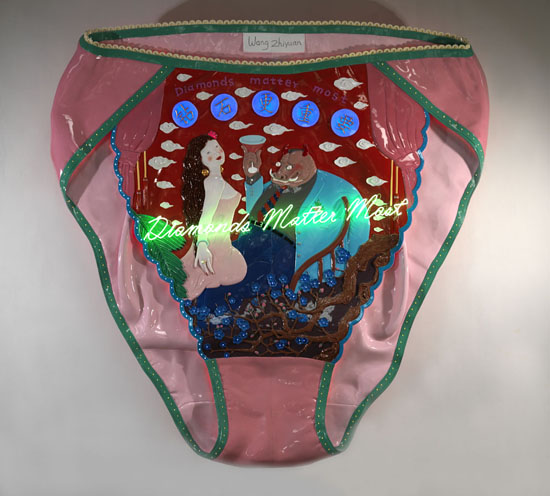
Wang Zhiyuan - Object of Desire, 2008, fibreglass, lights, sound, 363 x 355 x 70 cm (1)
Wang Zhiyuan ‘Object of Desire’, 2008, fibreglass, lights, sound, 363 x 355 x 70 cm image courtesy the artist and White Rabbit Gallery
In Mao Zedong’s famous exhortation to the Red Army at the 1942 Yenan Forum on Art and Literature, he emphasised the close relationship between art and revolution, stressing that art must ‘serve the masses’. He probably wasn’t envisaging a gigantic pair of gaudy pink knickers made of fibreglass and car duco; a three-headed conjoined baby skeleton in a scientific bell jar; vegetables growing in an illicit Shanghai garden engaged in a sexually explicit conversation courtesy of Chen Hangfeng’s video installation; or a baby stroller customised with spikes on the wheels, symbolising the fierce struggle for success that characterises parenthood in today’s China. Imagine the bewilderment of Mao and his revolutionary comrades in an encounter with these works and others in the new exhibition at White Rabbit Gallery. ‘Serve the People’ has been curated by former director of the Art Gallery of New South Wales, Edmund Capon, from Judith Neilson’s impressive collection of contemporary Chinese art.
The notion of how art might “serve the people” has an entirely different resonance in today’s China. Artists born before Mao’s death in 1976 cannot help but look back and attempt to reconcile their life experience with the strangeness of the present day. The dislocations of social transformation, globalisation, demolition and urbanisation which have swept away the revolutionary past, ushering in a world filled with uncertainty, have rendered many of the tropes of the first 1990s wave of contemporary Chinese art passé. A new visual language is emerging, with which artists can respond to the strangeness of their contemporary world, in which enormous disparities of wealth, education and personal freedom are creating new schisms in the social fabric. It is in reflecting this 21st century world back to audiences, both within China and in the West, that artists ‘serve the people’ today. If you want to read on, click on this link: http://theartlife.com.au/2013/serve-the-people/
4. Shoufay Derz, Owen Leong and Cyrus Tang, Phantom Limb, UTS Gallery, September 2013
Shoufay Derz, On the other hand (detail), concept image for sculpture, 2013. Natural Indigo, blown borosilicate glass fountain pens, gold plated nibs, sandblasted black granite, black Chinese ink. Image source http://www.cofa.unsw.edu.au/events/archive/935
Three really interesting artists in an exhibition which explored "disembodiment and the attempt to bridge a physical or metaphysical divide."
In the interests of what politicians like to call 'full disclosure' I have to declare that Shoufay Derz is a friend and colleague, however that does not alter the fact that I consider her unequivocally one of the most interesting artists working in Sydney right now. Her commitment to a deeply philosophical practice based on her research and investigation of religion, philosophy, art and cultural history and the embodiment of materiality is impressive. She followed this exhibition with a show at Artereal Gallery (link here: http://arterealgalleryblog.blogspot.com/2013/11/luise-guest-on-shoufay-derz.html) and is currently completing a residency in Taipei. I look forward to seeing what she will do next.

Shoufay Derz, I Am Death, Destroyer of Worlds, image courtesy the artist


5. Yin Xiuzhen, 'Nowhere to Land' at Pace Beijing, October 2013
Song Dong and Yin Xiuzhen at their Beijing studio, November 2013, photograph Luise Guest
Yin Xiuzhen, Portable Cities, Biennale of Sydney 2003, image courtesy the artist
I have loved her work since I saw the whimsical 'suitcase cities' at the Biennale of Sydney many years ago (seen again this year at the Moscow Biennale.) This exhibition was a revelation - her use of old discarded clothing is powerfully evocative and I particularly loved the moody, atmospheric paintings of Beijing streetscenes on cement road barriers. She combines whimsy and wit with a passionate and intelligent focus on issues and ideas. After I saw the exhibition, on my first visit to 798, I was determined to find a way to meet the artist. It took until the end of my residency, in the very last week, before we managed to arrange a time, and it was a highlight of my time in China. I just hope to have the opportunity at some point to see the wonderfully witty 'Collective Subconscious', shown at MOMA in 2010.
Installation view: Yin Xiuzhen. Collective Subconscious. 2007. Minibus, stainless steel, used clothes, stools, music. Collection of the artist. © 2009 Yin Xiuzhen. Photo: Jason Mandella.
When I met Yin, with her husband Song Dong, at their studio out near the Great Wall, she told me that her intention with these painted works was to reflect on China's appalling and worsening air pollution. She fears for her daughter, and sometimes feels hopeless and despairing. She said, "They (these paintings) may look beautiful and misty, but in fact they are poisonous." The visit was not without drama. Mr Zhang, my driver, nearly had a heart attack when he saw the complicated directions in their text message, which took up 3 or 4 screens and went along the lines of: "After you leave the expressway, drive past a group of dead trees, then when you see a factory with a red gate, take the next road on the left over a small bridge. Drive for a while. You will see a blue sign on a fence. Turn right at the next village....etc." We got lost many times, asking directions from farmers, factory workers, and women riding bicycles along the dusty road. The drive from central Beijing took nearly two hours and the drive back, in traffic that caused the usually placid and unflappable Mr Zhang to swear continuously and viciously, took three. As we left,and Song Dong and Yin Xiuzhen were waving us goodbye from their gate, he asked dubiously, "Tamen youming ma?" (Are they famous?) I said, "Dui ah, tamen shi zhende hen, hen, feichang youming yishujia!" Which is bad grammar but gets the emphatic point across.


Yin Xiuzhen, Traffic Barrier, Chang'An, from solo show 'Nowhere to Land' at Pace Beijing, image source: ocula.com
6. Qiu Zhijie 'Satire' at Galleria Continua, 798, Beijing, November 2013
Weird and slightly incomprehensible, but oddly fascinating as this artist always is. When I went to his talk at the MCA last year and he presented his concepts for the Shanghai Biennale, I left the lecture theatre thinking that either I am very, very stupid ( always a possibility) or else that Qiu Zhijie is a very charming but alien being from a far far galaxy. His exhibition confirmed for me that while he may not actually be an extraterrestrial, he certainly doesn't think like other people.


Qiu Zhijie, 'Satire' at Galleria Continua, Beijing, installation views, photographs Luise Guest
7. Yinka Shonibare at Pearl Lam Hong Kong in December 2013
To tell the truth, the major Yinka Shonibare show at the MCA in Sydney some years ago left me a little cold - I thought the messages about postcolonialism were obvious and a bit trite. The new show at Pearl Lam was different - multiple meanings and some witty and satirical views about Hong Kong's obsession with wealth and status as well as the fabulous characteristic use of textile patterns.


8. Do Ho Suh at Lehmann Maupin Hong Kong, December 2013
What can I say? His work is profound, beautiful and spellbinding, even in the context of this extremely swanky gallery where I had trouble attracting attention to ask for a catalogue because they were very busy doing a high pressure sales pitch to a glamorous, designer-clad, Chinese buyer.


9. No Country: Contemporary Art for South and South East Asia, Asia Society Hong Kong, December 2013
This was unexpectedly fantastic. One of the best curated exhibitions I saw in 2013, in fact. Curated by June Yap under the auspices of the Guggenheim UBS MAP Global Art Initiative , the exhibition included some artists whose work I know (Shilpa Gupta) and others who were new to me. My favourite was Bangladeshi Tayeba Begum's 'Love Bed' - a little bit Mona Hatoum, a little bit Lin Tianmiao, a little bit Ed Kienholz but without being merely derivative. And absolutely chilling.

Love Bed, 2012. Stainless steel, 31 1/4 × 72 3/4 × 87 inches (79.4 × 184.8 × 221 cm). Solomon R. Guggenheim Museum, New York, Guggenheim UBS MAP Purchase Fund, 2012, 2012.153. © Tayeba Begum Lipi. Installation view: No Country: Contemporary Art for South and Southeast Asia, Solomon R. Guggenheim Museum, New York, February 22–May 22, 2013. Photo: Kristopher McKay

The catalogue provided insight without empty 'artspeak'. 
"For the artist, the nation’s political state forms the backdrop to another critical political concern: the gendered violence that was rife during both partitions. Her works reflect on both the double bind of the personal and the political, expressing and accentuating a sense of unease through a public form of gendered expression that also speaks to challenges faced by the artist and her contemporaries. In Bizarre and Beautiful (2011), exhibited at the inaugural Bangladesh Pavilion at the 54th Venice Biennale, she transformed mock stainless-steel razor blades into the fabric of a feminine undergarment. Attractive yet threatening, the article is converted into a hard, gritty form, possessing the qualities of armor or a shield.
Razor blades return in Love Bed (2012), in which the shared space of domesticity, affection, and bliss glints with both threat and invitation. The blade here represents not merely the violence implied by its sharp edge, but also the object’s function as a basic tool to aid in childbirth in the absence of other medical support, a circumstance that the artist recalls from childhood. Printed on the blades is the Bengali name Balaka, a well-known Bangladeshi brand. Coming from a large family, the artist associates the strength of steel with the tenacity of the women who surrounded her as she grew up, individuals who defied the odds to keep their families and communities together. Yet these works resist interpretation according to simple binary opposition along historical, religious, social, or gendered lines. As much as the skeins of razors draped across the bed frame warn against our approach, they also, paradoxically, join together into a productive space for connection and dialogue."
Zhou Hongbin, image courtesy the artist and China Art Projects

10. Two exhibitions at the CAP Project Space in Sheung Wan, Hong Kong which neatly bookended my 3 months in China - the first, 'Aquarium' by Chinese photomedia artist Zhou Hongbin (definitely someone to watch) and the second, a show of new artists from Sri Lanka, 'Serendipity Revealed'. This last contained the extraordinary images of Anoli Perera.
Anoli Perera, 'Protest', black and white photograph
I also enjoyed 'I Am Your Agency', Jing Yuan Huang's November solo show at Force Gallery in 798, and 'I Love Shanghai', a group show at Art Labor Gallery which included works by Lu Xinjian, the ubiquitous Island6 (Liu Dao) collective - are they actually literally everywhere? - Emma Fordham (she's an art teacher - yay!) and a stunning photograph of the transformation and loss of old Shanghai, by Greg Girard.

Image source for Emma Fordham and Greg Girard: http://www.artlaborgallery.com/pages/artists/gourp_i%20love%20shanghai.html#

I also loved the concept behind Redgate Gallery's November show, which paired printmakers with significant Chinese poets. 'River on Paper' included some of the printmakers that I had met earlier in the month at the Xi'an Academy of Fine Arts, and it was a delight to discover some of the poems as well.
River on Paper - Dialogue between Poetry and Prints
Lies, Poet: Zhai Yongming, Artist: Kou Jianghui, 2013, Lithograph, 56 x 38 cm, part of the River on PaperPortfolio, 2013, Boxed, 61 x 42 cm, image Redgate Gallery http://www.redgategallery.com/Exhibitions%201991%20-%202013/River_on_Paper/index.html

Earlier in the year I really loved Tianli Zu's work at 4A Centre for Contemporary Art in the group show 'In Possible Worlds'. And who could forget John Kaldor's '13 Rooms' - not all fabulous but the re-creation of the Marina Abramovic piece was extraordinary as was Xu Zhen's 'Blink of an Eye'.

Xu Zhen, 'In the Blink of an Eye', image source: www.smh.com
I won't be negative and focus on the disappointments. But they included, most especially, the Hugo Boss Asian Art Awards at the Rockbund Museum Shanghai - this left me completely cold and utterly disengaged. So disappointing, as the show there last December which included Huang Yong Ping was one of my 2012 highlights. I was left unexcited by much of the Asia Pacific Triennial early in the year as well - unexpected as every previous show has been fantastic. I suspect that sourcing so many artists from Micronesia and Central Asia and pretty much ignoring China may have been one of the factors that left me less than impressed there. Not that I am biased or anything. And to even the balance, the new Fang Lijun show in 798 was very, very dull. I don't think he should bother returning to Jingdezhen to do any more slumped, fallen, collapsed ceramic pieces, frankly.

What am I looking forward to? Cai Guo-qiang at the Queensland Gallery of Modern Art next week - watch this space!  Christian Boltanski at Carriageworks in January. And Beijing Silvermine at 4A Centre for Contemporary Art - intriguing!

What were your highlight exhibitions this year?

Happy New Year! 新年快乐!Xinnian Kuai Le! 
May 2014 (the year of the horse) be filled with interesting art, and fascinating conversation.

Monday, June 10, 2013

Depart Without Return

I was delighted to see the work of the fabulous Shoufay Derz included in a rather strange exhibition at the Casula Powerhouse, 'Pigeon Auction'. The curatorial premise of this show purported to be all about suburbia and its secrets. It was always going to be a stretch to accommodate Derz, whose work borders on the mystical and evokes the sublime. And hey, I lived in Sydney red brick suburbia growing up, and again for almost ten years bringing up small children and, while it has many positives, sublime it aint! 

Since seeing Derz's Blake Prize-winning works - mysterious and evocative images open to many readings - I have admired the young artist's dedication to her rigorous and uncompromising practice.

Shoufay Derz, 'Transportation Love Song' shown at 4A Centre for Contemporary Asian Art,
image courtesy the artist

I  reviewed the show for Daily Serving, despite some misgivings about the juxtaposition of some very different artists in the service of a rather trite curatorial narrative. 

Here is what I had to say:
Driving the bleak stretches of highway to south-western Sydney to see “Pigeon Auction” at the Casula Powerhouse, an arts centre housed in a post-industrial relic between a polluted river and a railway line, I had time to reflect on the curatorial premise for the show. An examination of ‘suburban subcultures’ is fertile ground for contemporary art.  I was intrigued to see how a coherent narrative could emerge from elements as diverse as graffiti and skateboarding, indigenous identity, the raising of chickens and silkworms, punk subculture, and gun clubs. “Pigeon Auction” celebrates the cultural diversity – and sheer eccentricity – of suburban Australia. Curator Toni Bailey saw a sign taped to a power pole which simply said “Pigeon Auction Today,” causing her to think about the substrata of suburbia: all the hobbies and interests, passions and desires which float below the surface; all the secrets behind fences and closed front doors.
Garry Trinh, Our Spot Year Made - Miller, 2008, Digital C type print, 65x47cm each. There are 9 images in this series: Miller, Moorebank, Fairfield, Bondi, Allawah, Castle Hill, Punchbowl, Leichardt, Cabramatta
Garry Trinh’s series of photographs, “Our Spot,” recalls a youthful obsession with his skateboard, travelling hours on public transport to get to skateboard parks in far flung suburbs. He shot  images of long-abandoned skate parks on an old light-leaking camera using expired photographic film, giving the photographs a hallucinogenic, strangely romantic feeling. These are elegies to youth, to that intoxicating mixture of aimlessness and purpose that characterises adolescence. Melbourne artist Tony Garifalakispresents a series of ‘new age’ statements taken from sources such as positive affirmation cards, self-help books and bumper stickers, printed across paper shooting targets. The most memorable of these, printed in a hot pink cursive font across a black balaclava-clad male pointing an assault weapon, reads, “I am a beautiful being of light.” These photographs disrupt the connection between image and text, creating dissonant messages intended to expose deep anxiety and paranoia.
Melbourne-based indigenous photographer Bindi Cole writes an astonishingly confessional blog. Her time in prison, her relationships, her miscarriages, her heartaches and her spirituality; it’s all there, heart well and truly on sleeve. Her series “Not Really Aboriginal” was produced in 2008, the year that the Australian Prime Minister issued a formal apology to members of the ‘Stolen Generation,’ Aboriginal people who as children were forcibly removed from their families and placed in institutions. Cole’s own experiences as a light-skinned Aboriginal woman directly informed this series, in which she plays on the racist traditions of minstrel shows. She presents us with a series of seemingly banal vignettes – a group of people in their lounge room, a couple posed on the banks of a river. In each case they are wearing blackface. They have become the black  ’other,’ now entirely defined by the colour of their skin, thus confronting our easy assumptions about other human beings and exposing a deep substratum of racism in Australian society.
Bindi Cole, Wathaurung Mob 2008-2012, Pigment print on rag paper 94 x 130cm Edition of 5, image courtesy the artist and Nellie Castan Gallery VIC
Matthew Bradley’s sculptures are inherently interesting. His absurdist neo-classical observatory, designed to be used as a chicken coop, is part of a complex narrative work entitled “Space Chickens Help Me Make Apple Pie.” Bradley made a connection between his neighbour’s chickens and an interstellar constellation nicknamed ‘Space Chicken’ for its apparent resemblance to a chicken’s head. Funny in a kind of obscure neo-Beuysian manner, maybe. Unfortunately Bradley’s work suffers from the contemporary disease whereby artists think that lengthy tract-like texts are essential for their ideas to be understood.
Matthew Bradley, Chicken Observatory from ‘Space Chickens Help Me Make Apple Pie’, 2012, assorted found timber, telescope and lights, L210 x D125 x H150cm, courtesy the artist and Greenaway Art Gallery
The standout work is “Depart without Return” by Sydney artist Shoufay Derz. Her installation transports us to a very different world, a place removed from the banalities of daily life. A glowing blue glass sarcophagus with beautiful, flowing script inscribed on its side is lit by solar panels. Silk moths flutter across the mouth and eyelids of a blue painted face. A pregnant woman walks slowly across sand dunes, yards of indigo-dyed cloth trailing behind her. Derz scrutinises the encounters and occurrences of the everyday to search for deeper meanings buried deep within them. From Sufi poet Rumi to Rainer Maria Rilke, from Samuel Beckett to Christian, Buddhist, and Daoist texts, her work has at its heart her interest in writers, mystics, philosophers and artists who, like herself, are fascinated by the way that language and memory shapes us. Evoking presence and absence, silence and speech, stillness and journeying, her works are deceptively simple. For this particular work, which came over the course of its creation to be imbued with an ever greater sense of mourning due to events in the artist’s life, she has created an installation consisting of numerous connecting elements – still and moving images, panels of glass, pure indigo pigment, and the life cycles of silk moths.
Shoufey Derz, In widening circles (after Rilke), 2011, 41 x 56 cm (x3), C-Type print, custom-made cedar wood frame, stained natural indigo
With a similar level of obsessive patience to the ‘pigeon fanciers’ – a dying suburban subculture – who inspired the exhibition, Derz has raised generations of silk moths on mulberry leaves, learned how to spin silk, and made her own indigo, that most resonantly symbolic of substances. Like the silk filaments teased from the cocoon in this ancient process, Derz’s work is a continuing thread which emerges slowly, over time. The blind silk moths fluttering on her indigo painted face in “Depart Without Return” embody the cycles of transformation to which we are all subject. Whether her work can be neatly slotted into a curatorial narrative about suburbia and its secrets is debatable. It transcends any such limitation, and speaks a universal language of love and loss. The exhibition, however, is given far greater depth and significance through the inclusion of this body of work.
Shoufay Derz, Not This Not That from "Depart Without Return," Giclee print on archival cotton rag, custom made cedar frame, stained natural indigo 152 x 92cm, image courtesy the artist