The ongoing thoughts of an art teacher in China - and home in Sydney

A continuing diary about my travels in China, and thoughts about China and Chinese art from home and abroad
Showing posts with label Bai Yiluo. Show all posts

Tuesday, September 9, 2014

Noun or Verb? "COMMUNE" at the White Rabbit Gallery

I must have really loved the new curated show of Judith Neilson's collection of contemporary Chinese art because I have managed to write two different reviews for two very different publications published within a week of each other.
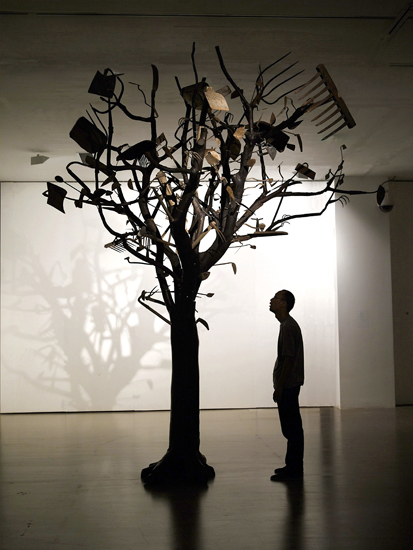
Bai Yiluo. Spring and Autumn 1, 2007; wood, metal, farm tools. Courtesy of White Rabbit Gallery.
Here is an extract from the article now up on the Daily Serving website:

COMMUNE at White Rabbit Gallery of Contemporary Chinese Art

The word commune, whether used as a noun or a verb, has complex connotations. From earnest Utopianism to grim, state-enforced collectivism; from familial relationships and networks to our connection with the natural world—all of these possible associations are present in the new show at Sydney’s White Rabbit Gallery of Contemporary Chinese Art. From Judith Neilson’s impressive collection, curator Bonnie Hudson has selected works by twenty-three artists. They include representatives of the older generation that emerged in the 1980s and ’90s, characterized by transgressive experimentation and a merging of the local and global in their practice, through to young (in some cases, very young) artists whose work reflects their experiences growing up in the “new China.” Theirs is a world of chaotic energy, the newly globalised world into which Chinese people were catapulted by Deng Xiaoping’s socio-economic reforms, the transformative effects of which continue to convulse every aspect of Chinese life. As you might expect, an exhibition that explores this world has moments of both darkness and light. The artists examine the complex, shifting realities of contemporary China, including changing structures of family life, relationships between old and young, and the conflict between self-actualization and the collective past.
Xia Xing. 2010, 2010-2011; oil on canvas; 35 x 50 cm (x 60). Courtesy of White Rabbit Gallery.
A series of paintings by Xia Xing embodies these paradoxes. The artist collects press photographs from the Beijing News, a mass daily with a circulation of 450,000. In 2007 he was working as a reporter at the paper and became fascinated with how it shaped public opinion and represented only selected aspects of daily life in a time of flux and change. Trained as an oil painter, Xia had found his subject. He began to paint the images he saw on the front page of the newspaper. For 2010, he reproduced one photograph for every day of the year, emulating the commercial printing process in a painstaking application of layers of cyan, magenta, and yellow. There is no caption, no headline; from the sixty closely cropped paintings shown here, we must guess what the images represent. Each alludes to a private joy, tragedy, or conflict that has been made—all too fleetingly—public. By preserving these ephemeral images, Xia Xing documents a particular time in China’s history, structured as a series of apparently unconnected fragments. We encounter the man whose hands were amputated by a criminal against whom he had given evidence, the parents of missing children, the forced demolitions and removal of people from their homes, the polluted rivers and lakes. We sense the artist’s horror at a never-ending catalog of disaster and anguish. The artist as witness—a continuing theme in China’s contemporary art.
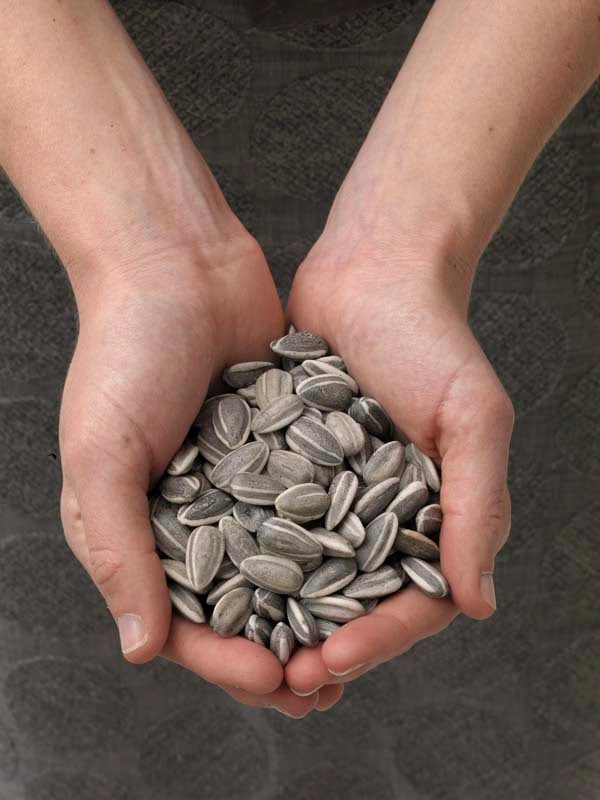
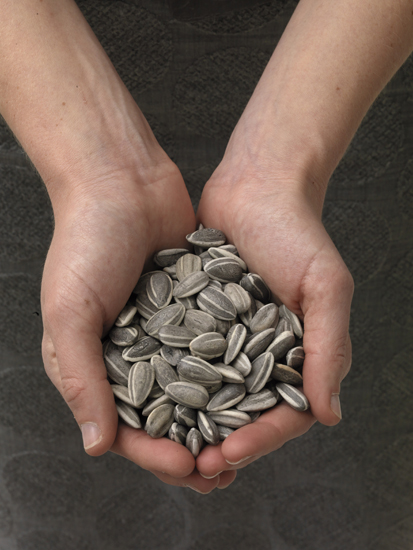
Ai Weiwei. Sunflower Seeds, 2010; porcelain, 500 kg. Courtesy of White Rabbit Gallery.
Bai Yiluo’s Spring and Autumn 1 (2007)  is juxtaposed with these paintings. A life-size tree with branches fashioned from old farming implements, with outstretched rakes, shovels, and pitchforks poignantly evoking the dependence on the seasons, the rhythms of nature, the times of planting and harvesting that dictate the lives of those who farm the land. One is also reminded of the obsession with rural agriculture of Mao’s revolutionaries: the ill-fated campaigns to eradicate the sparrows during the Great Leap Forward that caused enormous hunger and hardship; the rustication programs that sent urban “educated youth” to toil on communal farms and “learn from the peasants.” The work is very beautiful, and in its restrained use of weathered, rusted found objects, it is reminiscent of Ai Weiwei’s continued use of the “things” that evoke China, from ancient urns to three-legged stools and Qing Dynasty tables. Ai himself is represented by a pile of his porcelain sunflower seeds, that street snack shared among friends in hungry times in the past. These sunflower seeds have multiple meanings. They may be read as a comment on the ancient traditions of porcelain manufacture and its significance in trade with the West, or as a critique of mass production in China, “the world’s factory.” The realization that each seed, apparently identical, is actually different, reminds us of the weight of China’s population. The seeds also allude to Maoist iconography, which represented Mao as the sun, the Chinese people as sunflowers turning toward him. This is a subtle and clever acknowledgement of the tensions even today between individualism and collectivism.
Click HERE to read more

Saturday, September 6, 2014

COMMUNE-ing at the White Rabbit Gallery

人民 公社 (Renmin Gongshe) is what my Chinese dictionary suggests as the most appropriate translation for the word "Commune". A "People's Collective" of the kind introduced in China in the later 1950s as amalgamations of collective farms. This is the title of the new exhibition at Sydney's White Rabbit Gallery, although the curator is playing her cards close to her chest about whether her intention was to think of the term as a noun or a verb, or possibly both. As is usual with shows at this Sydney gallery, a museum privately funded by the Neilson Foundation and exhibiting works drawn from Judith Neilson's impressive (and growing) collection of contemporary Chinese art, the works and their juxtapositions have much to tell us about China.

Here is an excerpt of my review of the show, published in The Art Life yesterday:
The unveiling of a new exhibition at the White Rabbit Gallery is always an eagerly anticipated event. After the sombre mood of ‘Serve the People’, curated last year by Edmund Capon, and this year’s thought-provoking ‘Reformation’ the new show provides quite a different experience. Curator Bonnie Hudson has selected works which create a complex narrative about collectivism versus individualism; about the joys and sorrows of family; and about the ways in which the past pervades the present.
In the Imperial past, the Confucian ideal of filial piety placed family at the centre of Chinese life. Duty to family was far more important than the desires or freedoms of an individual. Under Mao, collectivism defined each person as a member of their group, whether that was a rural communal farm or an industrial “danwei” or work unit. From the cradle to the grave, the well-being of the group took precedence – people were told who to marry, what university course they were permitted to study and where they could work. Today, very few of those strictures remain. Even the much-hated “hukou” - the household registration system which dictates where people can live and work - is being dismantled, and so is the one-child policy.
1. Ai-Weiwei-Sunflower-Seeds-2010-ceramic-dimensions-variable
Ai Weiwei, Sunflower Seeds, 2010, ceramic, dimensions variable, image courtesy White Rabbit Gallery
Despite the greater freedom today it can sometimes appear as if the idealism of the revolutionary past has been replaced by a cynical belief in the inevitability of corruption; collectivism by a competitive culture of crass materialism. Young people have no experience of the hardships suffered by their parents and grandparents, and as a consequence there is more than the usual tension between generations. COMMUNE features twenty-three artists, from significant international figures now aged in their fifties, such as Ai Weiwei and Hu Jieming, to younger practitioners such as Gao Rong and Wang Cheng. Together, in clever curatorial juxtapositions, they explore some of the tensions and contradictions of contemporary China. Beyond that, though, the exhibition weaves a narrative about family, belonging, and connectedness. There is a bitter-sweet character to this show that I found immensely moving.
2, Bai-Yiluo-Spring-and-Autumn-1-2007-wood-metal-farm-tools-400-x-350-x-350-cm
Bai Yiluo, Spring and Autumn 1, 2007, wood, metal, farm-tools, 400 x 350 x 350 cm, image courtesy White Rabbit Gallery
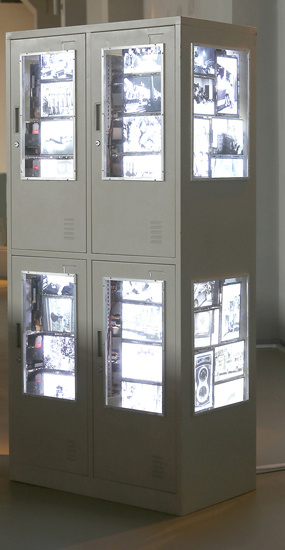
On the top floor of the gallery, new media pioneer Hu Jieming’s ‘Remnant of Images’ fills the gallery space with the sound of filing cabinet drawers and doors sliding open and closed again, symbolising the selective and transient nature of memory. Institutional metal cabinets are filled with flickering animated photographs from China’s past and present. Hu Jieming uses new technologies and media to reveal how we are all now inter-connected in a digital world. “It’s like a socialism of the future,” he told me when we met in his Shanghai studio. His work often reflects China’s past and its uncomfortable and dramatic trajectory into an entirely new society. By combining his own photographs of friends and family with iconic Mao-era imagery, and adding random photographs found on the internet, Hu evokes the presence of history in the now, the interrelatedness of past and present.
5. Hu-Jieming-The-Remnant-of-Images-2013-cabinets-LED-screens-photographs (1)
Hu Jieming, The Remnant of Images, 2013, cabinets, LED screens, photographs, image courtesy White Rabbit Gallery.
What unites the diverse artists represented in this exhibition is an awareness that the past is not “another country” - although it often seems that way – in fact, it shapes our current reality and the ways in which we connect and re-connect with others. Whether you choose to interpret the title of the exhibition as a noun or a verb; as a reminder of the socialist past or as an exhortation, COMMUNE is profoundly moving. Don’t miss it!
To read the whole review, click HERE!
The show includes one of my current favourite artists, Gao Rong, and a beautifully elegiac video by Zhu Jia entitled 'Waltz', embodying in one clever, absorbing and beautifully cinematic work so many of the themes I find in contemporary art from China: a pervasive melancholy, a layering of  past and present, a mixture of nostalgia with an acknowledgement of the betrayal of idealism, a deep cynicism.  There is joy too of course, and it is present here in many works. But 'Waltz' is just beautiful and it haunted me long after I had left the gallery and was walking the currently bleakly rainswept Sydney streets.

Wednesday, March 6, 2013

Smash Palace at the White Rabbit


A new show opening at White Rabbit Gallery is always exciting - and 'Smash Palace' is no exception.
It's a very, very different mood than that of their previous exhibition - quite dark and disturbing in part, with a sensibility that echoes a prevailing view among many Chinese artists that the world is so absurd, and politics so preposterous, that surrealism is the only sane response.
Here is the start of my review, published this week in 'The Art Life'
Made-In, 'Under Heaven' image courtesy the artist and White Rabbit
Smash (verb): shatter - break - crush - crash - dash - demolish - crack
Smash (noun): crash - clash - collision
Intrigued by the title for this new show of contemporary Chinese art at the White Rabbit Gallery, I wondered at first what curatorial narrative could possibly connect such diverse works. From artists working with oil paint applied with a cake decorator’s nozzle, to drawings made with biro, to collections of miniaturised possessions, to mechanised French railway tickets, to sculptures made with a 3D laser printer the works illustrate the diversity and in many cases the technical virtuosity and conceptual complexity of contemporary art in the People’s Republic and Taiwan.
Zong  Ning, 'Slum', 2008 Inkjet Print, image courtesy the artist and White Rabbit
Bai Yiluo, Recycling, image courtesy the artist and White Rabbit
Seen together they tell a story of today’s China which ironically echoes Mao Zedong’s exhortation to “Smash the Four Olds” – customs, culture, habits and ideas. The “smashing” taking place today relates to the dramatic and fast-paced change being wrought by global capital and modernisation. This has resulted in mega-cities housing upwards of 20 million citizens; the social upheaval, barely contained and controlled, of the largest migration in history of workers from rural villages to the factory towns of southern China; and the transformative possibilities of communications technology as people begin to demand greater freedoms. The genie is well and truly out of the bottle in this last instance – a news story this week reported Chinese netizens’ responses to a People’s Dailystory listing the names of the 2987 ‘representatives’ attending the National People’s Congress. Howls of fury, savage mockery, cynicism and disenchantment erupted on Sina Weibo, the Chinese micro-blogging site which now has twice as many users as Twitter. Most of the comments were variations on “Who the hell are these people and how did they come out of nowhere to represent me?” Others wondered how long it would take for corruption scandals to unseat them, while @?? tweeted, “I refuse to be represented. In this information age, I speak for myself.” This prevailing sense of unease and anxiety at the dark side of the increasing wealth and power of China is expressed by many of the artists in this exhibition.
Wang Guofeng, Ideality No 3, digital photograph, image courtesy the artist and White Rabbit

On the ground floor Bai Yiluo’s 2008 ‘Recycling’, an enormous fibreglass human heart tied onto the back of a tricycle of the kind used to transport materials and recycled paper in Chinese cities, suggests the ways that our human needs for love and kindness are disposable in the rush to acquire material wealth. There are also suggestions of the deeply contentious and disturbing trade in human organs in China. Juxtaposed with a panoramic photograph by Jin Feng, ‘Appeals Without Words’, depicting a row of ‘petitioners’ – rural villagers bringing petitions about corruption and land seizures to the attention of provincial officials – the two works represent some of the problems endemic to a nation undergoing seismic systemic change. The petitioners in this staged photograph are painted gold because they will wait so long to be heard that they may as well be statues, and their petitions are blank sheets of paper because no-one will ever listen to their pleas for justice. The corruption of venal local officialdom is legendary, and was ever thus. “The mountains are high and the Emperor is far away,” in the words of the ancient proverb. Jin Feng powerfully draws our attention to the disparities of power and wealth in China, where mega-rich ‘red princes’ race their Maseratis and Porsches in Beijing and Shanghai whilst migrant workers sleep in makeshift tent homes beneath the freeways they are constructing. Similarly, Jin Shi’s ‘Mini-Home’, seen recently at the Art Gallery of New South Wales in the 18th Biennale of Sydney, makes visible the unseen lives of poor urban migrants, living in the cracks of the cities – alleyways, demolition zones, underneath bridges and beside freeways. The artist represents the contrast between the poverty of their reality and their aspirations by miniaturising the chaotic and cluttered temporary dwelling and all the random objects it contains. These lives are literally ‘made small’ by the inequalities of wealth and power that have emerged following the demise of the ‘iron rice bowl’ system.

If you want to read the rest of my review, click HERE