The ongoing thoughts of an art teacher in China - and home in Sydney

A continuing diary about my travels in China, and thoughts about China and Chinese art from home and abroad
Showing posts with label Bu Hua. Show all posts

Wednesday, June 22, 2016

Bu Hua: Beijing Babe Loves Freedom

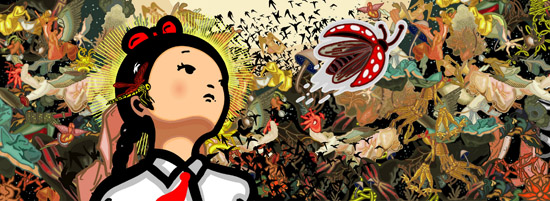
Bu Hua, Beijing Babe Loves Freedom No. 2, 2008, giclee print, 100 cm diameter,
image courtesy the artist and White Rabbit Gallery
With the arrival of my first grandchild (4 weeks old and, of course, completely gorgeous) I have been in a reflective frame of mind. A new baby throws you back forcibly to the long nights you spent cradling your own infant children, and even much further back in time to your earliest memories. Waving knitted toys and rattles at my tiny grand-daughter to amuse her (or, perhaps, just to entertain me), I began thinking about the power of childhood objects to evoke primal responses. 

Before language, before logical thought, these things are imprinted. Digging through cupboards I found rattles, teething rings and slightly moth-eaten teddy bears from the childhoods of my two daughters, and even an antique doll of  my own, with a 1950s plastic perm, eyes fallen back inside its head. It's a kind of time travel, this generational remembering, and it recalled my experience of visiting Bu Hua's extraordinary studio last year, where every wall and flat surface is crowded with old dolls, mechanical and wind-up tin toys, train sets and puzzles. Every conceivable childhood totem is here somewhere, arrayed like devotional objects in a shrine. Indeed, it is a shrine - to the artist's memories of a Beijing long gone, before eight-lane highways tore through the city and the hutongs were almost entirely demolished. 

In Bu Hua's studio, 2015, photo Luise Guest
I have wanted to write a piece about Bu Hua for a while, with a focus on her use of memory, and her nostalgia for her Beijing childhood.


Bu Hua in Beijing, 2015, photograph Luise Guest
1960s meets 1990s in Bu Hua's studio, photograph Luise Guest

Bu Hua was born in 1973, during the Cultural Revolution, but her focus is on a Beijing of memory: bicycles and willow trees; hutong laneways and tight communities. There are certainly dangers in romanticising the past , and Bu Hua's teenage years were times of dramatic change as China opened to the world marketplace, but like many Chinese people, she now sees an unrecognisable place of monstrous greed and unstoppable corruption. It is not surprising that people look back to a time of greater simplicity with a degree of regret.
Bu Hua, Sami, giclee print, 100cm diameter, image courtesy the artist
(I chose this work for an exhibition 'Half the Sky: Chinese Women Artists' shown in Hong Kong and Beijing in April 2016. The Hong Kong Gallery were most upset at the subject matter, but in Beijing it didn't raise an eyebrow!)


Growing up surrounded by artists, Bu Hua ‘learned the language of lines’ from earliest childhood. Her father was a printmaker, painter, and a professor of Fine Arts in Beijing. Connected to the renaissance of printmaking that took place in the years following the Cultural Revolution, influenced by German Expressionists such as Kirchner and Kollwitz, he expected his children to follow in his footsteps. Bu Hua studied the techniques of ‘shui mo’ (water and ink) painting, and attended a specialist art high school before studying at Tsinghua University’s Institute of Fine Art. After her father’s death, she travelled to Germany for a major exhibition of his work. During her European travels, visiting galleries and exhibitions, she discovered the work of international contemporary artists, completing postgraduate study in the Netherlands.
Bu Hua, World 6, 2014, Acrylic on Canvas, 120 x 360 cm, image courtesy the artist
Japanese cartoons were newly available to Chinese TV audiences in her childhood, and Bu Hua loves the vintage nostalgia of ‘Astroboy’, and the wonderful animations made at the Shanghai Film Studios during the 1960s, such as ‘Havoc in Heaven’, an adaptation of the traditional tale of the Monkey King. One of her favourite films is ‘Fantastic Planet’, a French/Czech stop motion animation about a planet ruled by giant humanoid aliens. Now recognised as a significant figure in the vanguard of digital animation in China, an innovator with vector graphics software, she adapts and blends influences from Surrealism, Japanese anime and manga illustration with the strong flat planes and linear qualities of woodblock prints and traditional Chinese folk art. Bu Hua’s practice adroitly navigates the sometimes perilous boundaries between ‘high art’ and popular culture, fine art and graphic design, cuteness and satire. 
Bu Hua, As Soon as China has a Space Station on the Moon, it can Begin to Consider Establishing a Communist Party There, No.3, 2008, giclee print, 100 cm diameter, image courtesy the artist and White Rabbit Gallery
Bu Hua’s happy memories of a secure Beijing childhood provide the source of much of her imagery today. The red corridors and grey walls of traditional architecture, and the white bridges and willow trees of her city recur in her paintings, digital prints and animations. The same protagonist appears in many of her works: a defiantly sassy, pigtailed ‘Young Pioneer’, with her red scarf flying as she navigates a strangely dystopian universe, she represents the artist herself as a child. In Beijing dialect this character is ‘sa mi’ () – a feisty girl with kick-ass attitude. She swaggers and pouts through animations such as Anxiety (2009) and LV Forest (2010), confronting monstrous machines and strange hybrid beasts. Sometimes she takes aim with a slingshot at flocks of birds that morph into fighter jets, sometimes she rides a dinosaur through lush jungles, and in other works she stares into the middle distance, nonchalantly smoking a cigarette.


Bu Hua, What is Left Belongs to You, Acrylic on Canvas, image courtesy the artist
Bu Hua communicates her anxiety about the social transformation and ecological destruction of China, and what she sees as the growing selfishness and narcissism of its citizens, fusing western and eastern traditions of art and design. The rising or setting sun is a recurring motif, reminding us that Mao Zedong was often depicted in propaganda posters, framed by the rays of the rising sun. In Bu Hua’s ironic vision, though, darkness is coming. Her fearless young protagonist, a lonely child in a terrifying universe, confronts a nightmare landscape of marauding machines and hideous skeletal beasts. In Vowing not to Attain Buddhahood until all are salvaged from Hell No.3 (2008) she stands astride the skeleton of a deer in a desolate landscape lit as if by the flash of a nuclear explosion. Red fronds of foliage hang from above like tentacles. Birds, beasts and insects dart around the circular composition, an ironic inversion of the traditional Chinese moon window, designed to frame the serene beauty of a scholar’s garden. In this work only the naked child is calm and unmoved, a witness to the apocalypse.
Bu Hua, Vowing Not to Attain Buddhahood Until All Are Salvaged from Hell No. 3, giclee print, image courtesy the artist
Savage Growth (2008) is an animated allegory of industrialisation, pollution and militarisation. Bu Hua’s Young Pioneer stands atop a building, conducting a flock of birds that morph into pairs of white gloves, flying above a devastated landscape in which distorted trees grow out of pools of oil. Other birds become military aircraft, casting ominous shadows over an abandoned amusement park as they shoot down the flapping hands. A row of sexy foxes (fox spirits, in Chinese folklore, are dangerous seductresses) dance backwards and forwards to a sound track that evokes the rhythmic metallic noise of a factory assembly line. Bu Hua represents the environmental devastation wrought by rapid development in China, the unintended consequences of urbanisation and greed. In contrast, Bu Hua also wants to show beauty and tenderness, through the innocence of a world of memory, of small animals and clockwork toys, harking back to a simpler time.

You can read more about Bu Hua in my book ''Half the Sky: Conversations with Women Artists in China", Piper Press, Sydney, 2016. A detail of her feisty protagonist graces the cover, beautifully designed by John Dunn, an unmistakeable representation of the power of female ambition and achievement against a sometimes stacked deck. 


The book is available in selected bookstores in Sydney and Melbourne, in Beijing through Beijing Bookworm (http://beijingbookworm.com/) and online through the Queensland Art Gallery HERE


Thursday, October 15, 2015

北京日记: Air, Art and Artists

Beijing Door - Xingfu Cun Lu (Happiness Village Street)
The grey is back. After a few glorious blue sky Autumn days, by late this afternoon the sun was an ominous red disk in a murky sky and people were wearing masks once again. Some young women are sporting masks with lace trims and floaty chiffon wisps that trail over their faces like an orientalist fantasy yashmak from "I Dream of Jeannie". The general disquiet about air quality doesn't extend to cigarette smoke though - I talked with an artist yesterday afternoon while he chain smoked for two hours. We sat in front of his expensive air purifier.

Despite the clammy metallic air, this evening on my way back to my hotel I saw that people were still eating stacks of dumplings and chuan'r (skewered lamb - maybe!) at roadside tables outside Mr Shi's Dumplings and children played around all the apartment compounds. Two pigtailed girls on the backs of their mothers' bicycles sang at the tops of their voices. Elementary school kids in red Young Pioneer scarves rode home on the backs of motorscooters, or in some cases up front while a baby was carried on the back. No child is strapped in anywhere, I note, and most babies are carried in arms - it seems that prams and strollers are accessories of the very upwardly mobile. Babies seem generally contented and are rarely fretful, I would think as a result of the constant cuddling and contact. But I won't romanticise; twice in one week I have seen parents chasing wailing small children down the hutong, threatening them with a broom. Babies are everywhere I look, although statistically few city people have taken advantage of the relaxation of the One Child Policy - raising a child in Beijing or Shanghai is expensive.

High schoolers in their shapeless brightly coloured track suits loitered - loudly - at the snack cart on the corner, in the time-honoured tribal ritual behaviour of teenagers everywhere. The bicycle repair lady was having a shouted altercation with a customer, and motor scooters and tiny tin can "beng beng" taxis wove their way in and out of the traffic, often driving on the footpath. Bicycles are often left unlocked, casually leaning on their stand or lying on the ground, although everyone has stories to tell of stolen bikes. People ride whilst smoking, and making calls on their mobile phones. One night I crossed the road at around ten thirty and saw a most beautiful young woman, like a young Gong Li, black plait flying in the wind, riding high above the traffic seated on a giant stack of recycled cardboard, while her husband pedalled the three wheeled vehicle carrying it all. She looked like a goddess, surrounded by every imaginable kind of wheeled vehicle.
Cell phone addiction on Gongti Bei Lu - on the footpath
In addition to my continuing attempts to learn the language (tilting at windmills, that!) and interviewing artists for a new book project, I am also trying to see as many exhibitions as possible. Here in Beijing I enjoyed the show of young emerging artists at Red Gate Gallery, 'Surge',  (more about that in a later post.) I found very slim pickings in the once-exciting 798 Art District, but was interested to see Liu Xiaodong's paintings from his time in Mongolia, recording the encroachment of urbanisation. I loved the David Diao exhibition at Ullens - he is an artist I now want to know much more about. An emigre to Hong Kong as a child, and then a participant in the New York artworld in the 1970s and 1980s, his works are visually and conceptually exciting. Sardonic links with the way Abstract Expressionists appropriated Chinese calligraphy as pure mark-making, in particular, interested me,as did his constant referencing of Malevich.

David Diao, "Let a 100 Flowers Bloom"
David Diao, "Pardon Me Your Chinoiserie is Showing"

David Diao - Kline and Malevich
I reviewed the show at Ullens Centre for Contemporary Art by emerging video artist Tao Hui, who has just won a major prize at Video Brasil, for Daily Serving. You can find the link to that article HERE. At the Arte Nova Art Fair (held in the spartan Soviet style surrounds of the Agricultural Exhibition Centre) where ten galleries had each been asked to select ten artists, I enjoyed the woven ribbon works of Dai Dandan, and an installation by Li Lin of tiny, old school desks, with an imaginary landscape like a tiny diorama contained within the space under the lid of each one. Completely charming and surreal, they reminded me a little of the exquisite miniature worlds inside shopping bags created by Yuken Teruya.
Li Lin, Decameron


A child enjoys Dai Dandan's installation at the Arte Nova Art Fair
Also highly memorable was an installation of classical black marble busts whose heads had been replaced by twirling, moving gilt mechanical toys. Nightmarish and intriguing.


In my visits to studios, in Shanghai, Hangzhou, Chengdu as well as Beijing - 18 so far with more to come - I have had fascinating encounters with many artists, including Wang Guofeng and Wang Qingsong on the eve of the opening of the Beijing Photo Biennale at the CAFA Art Museum, Qiu Xiaofei preparing his show for Pace New York next year and reflecting on his childhood in far north, frozen Harbin, Bingyi and Bu Hua (both of whom feature in my book about women artists in China) and Liu Zhuoquan who is thinking about his exhibition in Melbourne next year and planning a new installation project of more than 6000 of his painted bottles. Liu says he thinks of his bottles as a library containing everything in the world.
Liu Zhuoquan in his Beijing studio, photo LG, reproduced with permission of the artist
The writer with Bu Hua in her studio filled with her collection of antique dolls and tin toys, image reproduced with permission of the artist
In Shanghai I was interested to see the exhibition of women artists at Pearl Lam - and delighted to see that it included Zhou Hongbin, who is included in my book 'Half the Sky', and some beautiful and lyrically evocative video works by Yang Fudong at the Yuz Museum, but the highlight was at Rockbund. I was moved and overwhelmed by the Chen Zhen exhibition, "Without Going to New York and Paris, Life could be Internationalized". Paris-based, in the last ten years of his life Chen returned to his native Shanghai over and over again, recording and representing the extraordinary and tumultuous changes his city was undergoing. The resulting installations are dramatic, theatrical and poetic. I wrote about the show for Daily Serving:
Chen Zhen, who died (much too young) in Paris in 2000, was a significant artist with a hybrid Chinese and European identity. Although after 1986 he essentially lived and worked in Paris, his personal history and deep cultural roots lay in China, and specifically in Shanghai. From the mid-1990s he returned over and over to a city on fast-forward. Shanghai was undergoing a massive, controversial transformation, in the process of becoming the global megalopolis it is today. The current exhibition at Shanghai’s Rockbund Art Museum presents works from this period, which curator Hou Hanru explains reveal a balance between Chen’s examination of a dramatic external reality and a conceptual criticality. Sometimes witty, sometimes profoundly beautiful and melancholy, Chen Zhen’s works are steeped in his identity as a Chinese artist at a historical “tipping point.” As the artist said in his online project Shanghai Investigations, “without going to New York and Paris, life could be internationalized.”
Chen Zhen, Purification Room, 2000 - 2015. found objects, clay, approx 850 x 1100 x 450cm, image courtesy Rockbund Museum and Galleria Continua, San Gimignano/Beijing/Les Moulins
Chen Zhen. Purification Room, 2000-2015; found objects, clay; approx. 850 x 1100 x 450 cm. Courtesy of Rockbund Art Museum and Galleria Continua, San Gimignano/Beijing/Les Moulins.
Entering the Art Deco spaces of the Rockbund Museum, visitors encounter the rather spectacular Purification Room (2000–2015), a large space filled with everyday objects—sofas, TVs, chairs and tables, bicycles and shopping trolleys—all entirely coated with mud, as are the walls and floor. Traditionally, Chinese medicine used mud to cleanse and detoxify, and Chen Zhen thought of it as representing purity, simplicity, the natural world, and the peace of being laid to rest. The experience is one of stillness and silence, as if we have entered a mysterious unknown civilization revealed by an archaeological excavation. The quotidian artifacts of our modern daily lives seem to have a greater significance, becoming unfamiliar and strange.
Chen Zhen, Crystal Landscape of Inner Body, 2000, crystal, iron, glass, 95 x 70 x 190cm, image courtesy Rockbund Museum and Galleria Continua San Gimignano/Beijing/Les Moulins
Chen Zhen. Crystal Landscape of Inner Body, 2000; crystal, iron, glass; 95 x 70 x 190 cm. Courtesy of Rockbund Art Museum and Galleria Continua San Gimignano/Beijing/Les Moulins.

Click HERE to read the rest of that review.

And read my next post to find out about Huang Yong Ping at the Red Brick Art Museum, Ai Weiwei at Galleria Continua, and more!


Wednesday, September 2, 2015

Hour of the Rat and Year of the Fire Monkey

Bu Hua, World 6, 2014, acrylic on canvas, 360cm x 120cm, image courtesy the artist
I am preparing to return to China in two weeks for more artist studio visits and interviews, researching artists who are represented in the significant private collection of Judith Neilson and her White Rabbit Gallery, and another quixotic attempt at intensive language acquisition - dear Heavens, will I never learn?! I always hope that by some as yet undiscovered miracle I might suddenly become fluent. "Yi kou liuli de Hanyu" ( a mouth full of fluent Chinese) is what I really long for. In my dreams I am confident - even loquacious - in colloquial fast Chinese. With a suitably piratical rolled-"r" Beijing accent, of course. Waking, I realise sadly that my speaking ability is as stumbling and inadequate as ever. And as for reading...
Bu Hua, Microcosmos, Acrylic on Canvas, 2014, 100cm diameter, image courtesy the artist
I am planning to meet with artists ranging from Yang Yongliang and Xu Zhen in Shanghai to Jin Shi in Hangzhou, Shi Jindian in Chengdu and Li Hongbo, Wang Qingsong, Bu Hua and Bingyi in Beijing. And so many more - watch this space! Some are almost old friends by this stage - I will look forward to catching up with Gao Ping, Liu Zhuoquan, Lin Jingjing and Huang Jingyuan in Beijing. A number of the artists who feature in my book 'Half the Sky: Conversations with Contemporary Women Artists in China' are also represented in the White Rabbit collection and their work will form part of my research for the gallery. About to launch into an exciting but somewhat terrifying new venture, my discovery that I am born in the Year of the Fire Monkey seems appropriate: apparently I have rash tendencies, am passionate but ambitious, competitive and reckless. Oh dear! Perhaps all this excess of energy and optimism is also why I love China and feel at home in Beijing, despite all its chaos and craziness.
Bu Hua, Beijing Babe Loves Freedom, Giclee Print, Image courtesy the artist and White Rabbit Gallery
Serendipitously, browsing online books and looking for "serious" material on Chinese history, economics and art, I found a series of crime novels set in Beijing (and Yunnan and Guilin) featuring an embittered, battle weary, PTSD suffering American expat, a veteran of Iraq and Afghanistan. So far so conventional: "Down these mean streets a man must go who is not himself mean," yada yada yada. (Although I am absolutely a sucker for a taciturn Raymond Chandleresque hero - ridiculous, as in real life silent men are incredibly annoying.) But in this case, our damaged American war veteran is a woman, Ellie McEnroe. She's got a limp, and an endearingly foul mouth in both English and Chinese; she likes a beer or several, and she represents dissident contemporary artists in Beijing.

I have dived into the latest in the series, 'Hour of the Rat', which amongst the fast paced chase, a few shootouts, and the tasering of the heroine, features the solving of a puzzle involving a missing American environmental activist wanted by both the FBI and the Chinese secret police, and a missing artist. Writer Lisa Brackmann manages to paint a truly alarming and fairly accurate picture of the environmental apocalypse that many Chinese fear is coming. From the beauties of Yangshuo and Guilin Ellie finds answers to her mystery in towns where children are poisoned by the toxins leaching from electronic waste, where the farmers can no longer trust the food they grow in poisonous soil, with GM seeds purchased from multinational companies. Artist Bu Hua would agree with the sentiments - she lives in a new apartment building where the air is centrally filtered and the living room when I visited was filled with play equipment so that her small son could always play inside, protected from the Beijing 'airpocalypse'.
Bu Hua, Beijing Babe Loves Freedom, Giclee Print, Image courtesy the artist and White Rabbit Gallery
For me this is pretty much the perfect book: crime, China, Chinese slang, Chinese art, Chinese politics - and dumplings. Lisa Brackmann, you made my day - and thank God you've written a few. Please don't stop! A Californian by birth, Brackmann says she went to China by accident in 1979, and never quite left. I totally understand her connection to a place, a culture and a language that grabs you, rattles your foundations, and then never quite lets you go.

Lisa Brackmann's website: http://www.lisabrackmann.com/

Tuesday, January 13, 2015

Ten Artists, Ten Conversations, Ten Stories

My most recent article for The Culture Trip introduces ten of the fascinating artists that I have interviewed for my book, "Half the Sky: Conversations with Contemporary Women Artists in China". Here are the first three.

Ten Contemporary Chinese Women Artists You Should Know

Chinese contemporary art is ‘the flavour of the month’ in the West, but there are fascinating stories as yet insufficiently told: the stories of contemporary women artists. The ten artists introduced here are members of a generation who grew to adulthood in the 1980s and 1990s. Born into a post-Mao China that was entirely and disconcertingly different from the world of their parents, they have been forced to adjust to a tsunami of change.

Bu Hua Beijing Babe Loves Freedom No 6, 2008, Giclee Print, Image courtesy the artist and White Rabbit Gallery

Bu Hua

Bu Hua was born in 1973, graduating from the Institute of Fine Art, Tsinghua University, Beijing, (formerly the Central Academy of Fine Art and Design) in 1995. In her strong imagery and flat, decorative backgrounds we can see a trace of the traditional woodblock prints of the revolutionary period, and also her love of Japanese art and design. Often described as a pioneer of digital animation in China, Bu Hua was one of the first to use animation software in an art context, creating surreal narratives about contemporary life. Her animations and still images often feature a feisty, sassy pigtailed child dressed in the uniform of the Young Pioneers, a Communist Party youth group. A clever combination of innocence and knowing, cuteness and cunning, playfulness and cynical parody, she swaggers through Bu Hua’s invented world. ‘I felt that this character is an actual person living in real life but [she] is really also an idealised version of myself. She knows this universe and the rules of this society like the back of her hand,’ says the artist. ‘Savage Growth’ employs her characteristically crisp graphic style to create an allegory of industrialisation, pollution and militarisation. Her heroine, armed only with a slingshot, takes aim at flocks of white birds which prove, on closer examination, to be military aircraft. Twisted trees grow out of pools of oil, and a row of sexy foxes (‘fox spirits’, in Chinese lore, are dangerous seductresses) sway backwards and forwards to a mechanical sound track like the rhythmic metallic noise of a factory assembly line. Bu Hua says, ‘people in China pay a lot of attention to the past and the future, but it’s really kind of forbidden to pay a lot of attention to what is happening now, in real life…I am showing what is happening in China at this exact moment, what is happening now.’

Cui Xiuwen, Existential Emptiness No. 3, 2009 C-Print, (85 x 450 cm) Courtesy Klein Sun Gallery, NY. © Cui Xiuwen

Cui Xiuwen

Cui Xiuwen’s 2002 ‘Lady’s Room’ caused the first lawsuit in Chinese contemporary art, when a professor in Guangzhou took exception to its frank documentation of prostitution in the ‘new’ China. With a hidden video camera in the bathroom of a swanky Beijing nightclub she recorded young hostesses changing their clothes, counting their money and arranging their next liaisons with their clients, exposing the seedy underbelly of China’s economic miracle. Born in 1970 near Harbin, Cui Xiuwen trained as a painter, graduating from the Central Academy of Fine Arts in 1995. In the mid-2000s Cui produced a body of work featuring young girls dressed as Young Pioneers and posed in the Forbidden City, dwarfed by claustrophobic walls and gates representing Chinese tradition. ‘Angel no. 3’ features the same girl, nightmarishly replicated as a crowd of adolescent clones, sleepwalking towards us with arms outstretched. The work evokes the deliberate erasure of bitter memories – a collective amnesia. ‘This is about my own life experience,’ Cui says. ‘I would wake up and see the sky filled with this huge grey cloud which made me feel as if there was no hope.’ Cui Xiuwen returned to the countryside near Harbin to shoot ‘Existential Emptiness’. Like misty ink and wash ‘shan shui’ scrolls the series depicts a living girl and a life-sized doll, a shadow version of the living girl, a puppet figure. The figures are tiny in the vast landscape, like solitary scholars in the mists of a literati painting.
Dong Yuan, Grandma’s House and Bosch’s Garden, installation view, oil on separate canvases, image courtesy the artist

Dong Yuan

Dong Yuan paints objects which represent cultural and personal memory with meticulous realism, creating installations of multiple separate canvases. Born near Dalian in 1984, Dong studied at the Central Academy of Fine Arts in Beijing. As a student, inspired by Western still life painting and Giorgio Morandi, she painted literally everything she owned. Small canvases depict her shoes, rolled up quilts, books, a rice cooker, a bath towel hanging on the back of a door, a teapot, even a box of tissues. ‘Home of Paintings’ and ‘Sketch of Family Belongings’ record, on 59 and 186 canvases respectively, the tiny apartments in which she lived as a student. ‘Grandma’s House and Bosch’s Garden’ consists of 855 canvases, a surreal juxtaposition of the fantasy world imagined by Hieronymus Bosch and the rural Chinese world of her grandmother. The gods of happiness, prosperity and longevity are juxtaposed with images of Mao and the stars of TV game shows. Furniture, teacups, textiles, traditional New Year hanging scrolls and everyday possessions intermingle. The humble courtyard house where Dong Yuan had been happy as a child would, inevitably, be demolished. Dong Yuan believes it is her duty and obligation to paint these memories, slowly and intensively completing one room at a time. The project took the artist more than two years. She describes the process as ‘fixing it in memory,’ - an elegy to a lost world. ‘It’s hard to know how many things have to disappear before people find their hearts settled down,’ says the artist.
To find out about the other 7 - click HERE

Monday, November 18, 2013

北京日记 Beijing Diary: Food, Learning Chinese, People - and Art


As I come to the final weeks of my residency I have been savouring some of my favourite Beijing moments. And they're not all food-related, but I have to say that food has figured largely in the fascination of my time here in China. That includes those foods which are immediately appealing and wonderful, and those which I am adding to my list of things to avoid. Joining the donkey pastrami and the boiled goats' feet of Xi'an I can now add the grilled duck tongues of Chengdu. The visual richness of street vendors of all kinds is a feature of any walk in Beijing, and the foods on offer have changed as the weather has grown colder - grilled corn, chestnuts and walnuts, congee and pancakes and baozi, sweet potato and cakes. Beijingers love their 'Xiao Chi' (literally, little food, i.e snacks)


So here's a list of other things I have enjoyed seeing and experiencing of late

  • I am amused and impressed by the fur-lined sleeves that have appeared on bikes and motorbikes - very necessary and so ingenious!

  • The tiny mandarins in the markets with their leaves attached - so cheap and so sweet - as well as pineapples and other strangely tropical fruits in this cold climate

  • Pomegranate juice from the street stalls

  • The woman who takes her microphone and amplifier into the park each afternoon and sings opera and Chinese folk songs in a pavilion beside the lake

  • The people both young and old who practise their saxophones, flutes and clarinets seated on benches in the park
  • Tiny children bundled into so many layers that they are completely spherical
  • The massive army greatcoats and hats with fur earflaps worn by men collecting recycling
  • The way that people love to gather in groups and add their opinion to whatever is happening, whether that's a car accident, a mahjong game, a dispute over the price of vegetables, or the technique of the water calligraphers and dancers in the park


Among many possible candidates for a favourite English shop name, my current favourite is definitely "Bing Bing Decently", a small emporium selling 'scholar rocks' and ornately carved pieces of timber and "jade" (I suspect definitely of the inverted commas variety) in the Chaoyang Cultural Market. But there is also this one, which definitely falls into the WTF category:


  • The frustration but also the joy of starting to be able to read Chinese characters continues - I forget as many as I learn, but it is a revelation to me in gaining a greater understanding of the people, culture and history. And Chinese characters are just so beautiful, even in subway signs or scrawled graffiti. I often trip over steps and walk into posts as I am so occupied in staring at billboards and street signs and trying to work out what they say.

I have been meeting so many interesting artists, including Guan Wei and Lin Jingjing, and continuing my series of interviews. As this research continues I've had many conversations with these artists, with my interpreters, with curators and with friends both western and Chinese about ideas relating to gender in China right now. It is often at the forefront of public discourse, and certainly forms a subtext to much policy debate and media angst. 


With artist Bu Hua in her studio, October 21
Lin Jingjing in her studio, November 14
With Guan Wei in his studio, November 11

Here are my first thoughts about this, in relation to three of the eighteen artists I have spoken with to this point. The article, 'Material Girls, Super Starlets, and Girls with Swagger'  was published in The Artlife last week, and this is an extract:


Late Autumn in Beijing alternates glorious blue sky days with others on which the pollution levels soar into the ‘alarming’ zone and people with masks covering their faces are glimpsed through mist and fog on grey streets under grey clouds. The schizophrenic weather conditions mirror something of the paradoxical nature of contemporary China. On one street you see old men in Mao suits playing mah-jongg on the corner, while in the next you are as likely to find a Lamborghini showroom as a snack cart selling dumplings. These paradoxes extend into the art world too. The pace of change in China has been so swift and dislocating that each new generation of artists essentially inhabits a different country, with different experiences, ideas and beliefs. On every construction site billboards loudly proclaim: “This is my Chinese Dream.” This dream, and what it might entail for different generations in China – and what that might imply for the rest of the world - is definitely contested territory.
I have been fascinated to discover these generational dissonances as I have met with artists during a two-month stay in Beijing. My particular project has been to interview female artists. Just as the social forces in China have swept away old certainties, so too have ideas about gender and the roles of women been changing, albeit in ways quite different from what one might expect.
Recently this has come to the forefront of public discourse, as the term “sheng nu” (“left-over women” - defined as single women over the age of 27) has gained increasing traction in the media. The following delightful piece was published on the website of China’s state feminist agency, the All-China Women’s Federation:
“Pretty girls don’t need a lot of education to marry into a rich and powerful family, but girls with an average or ugly appearance will find it difficult. These kinds of girls hope to further their education in order to increase their competitiveness. The tragedy is, they don’t realize that as women age, they are worth less and less, so by the time they get their M.A. or Ph.D., they are already old, like yellowed pearls.”
Despite the gender imbalance created by the One Child Policy and a preference for boys resulting in an over-abundance of men seeking wives, it seems that contemporary Chinese culture punishes women for being over-educated, over-ambitious and financially independent.
In street fashion, advertising, and, yes, even in the hallowed space of art galleries, I have been observing a kind of hyper-femininity. Representations of the feminine in some of the less illustrious galleries in the 798 Art Zone range from imperial maidens and concubines, reflecting nostalgia for a patriarchal past and its certainties, to fibreglass stilettos covered in spikes, an indication of current anxieties. Young men are nervous. They feel enormous pressure to be rich enough, and successful enough, to attract girls and find a wife. The famous quote from a TV dating show, from a young woman who said she would rather weep in the back of a BMW than laugh on a bicycle, is cited often as evidence of women’s materialism.
1. Travel Alone 60+50cm oil on canvas 2007
Han Yajuan, Travel Alone, 2007. Oil on canvas image courtesy the artist.
To find out more, I spoke with three artists who explore some of these ideas in their work.
I met Han Yajuan in her bright apartment and studio in the new area of Wangjing, where she looks down over block after block of high-rise apartments and sweeping expressways, a view she describes as “depressing”. Her work has been seen recently in Australia in the ‘Go Figure’ exhibition, curated by Claire Roberts from Uli Sigg’s collection at the National Portrait Gallery, and in ‘Far East Duet’ at the ACAF Project Space in Melbourne. She is represented in New York by Eli Klein Fine Art.
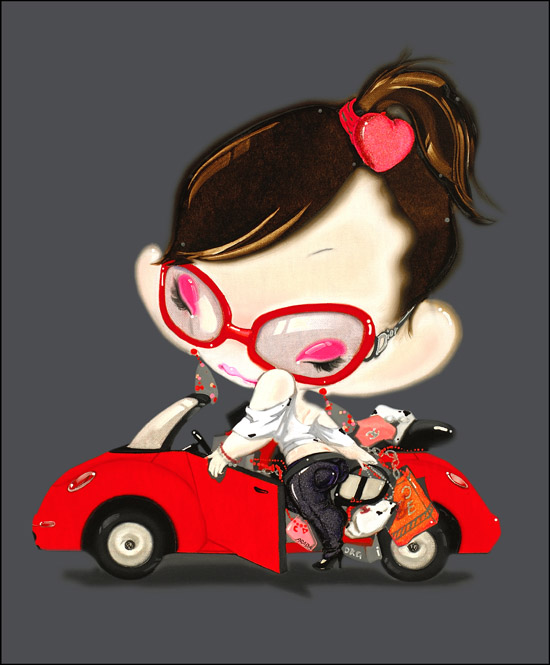
Born in 1980 in Qingdao, Shandong Province, and earning her MFA from the Central Academy of Fine Arts in Beijing, she is sometimes described as an artist whose works embody the collective unconscious of her generation, which seems rather a heavy burden. Her paintings reveal her interest in Japanese design and animation, as well as fashion, and reflect the culture of ‘cuteness’ (in Chinese, “Ke’ai”) prevalent in contemporary pop culture. In China, young (and even not so young) women are expected to behave in ways which are winsome, even child-like. ‘Travel Alone’ depicts a cute, big-headed, bling-adorned cartoon girl climbing into her red sports car wearing Dior glasses. She carries bags labelled Prada and Chanel. Fake or real, they reflect the current obsession with designer brands as symbols of wealth and success. Han Yajuan reveals the current anxiety about the lives of young women, the ‘material girls’ who want it all, and want it now. ‘Fashion Week’ represents the frantic busy-ness, but also the emptiness, of this world. In response to my suggestion that her paintings are a critique of contemporary life and materialism, she says, “I was just trying to present what I see…what exists. Twenty years ago a bicycle was a luxury, but things change. There is so much pressure; the speed (of life) is so fast. I am trying to present my point of view and also to give people an opportunity to see their own lives.” Her generation have not experienced the hardships of the past, and are experiencing the loneliness, as well as the material comforts, of an entirely different kind of society.
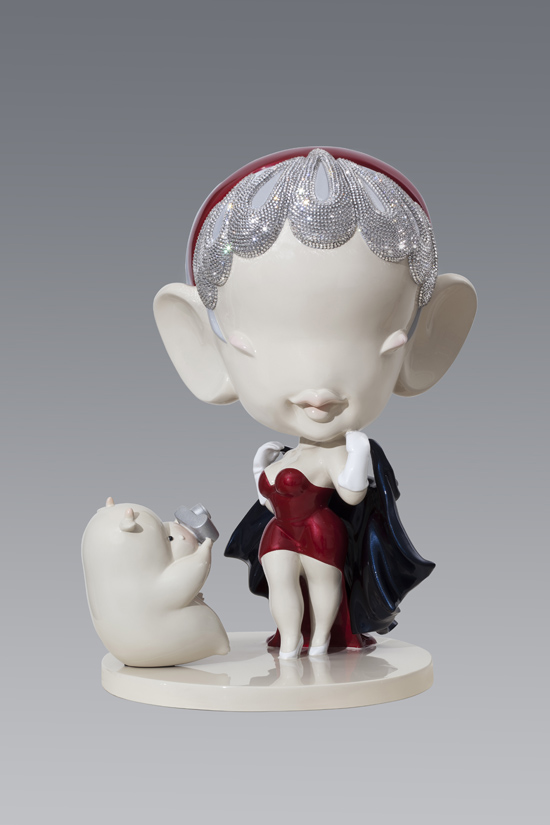
In sculptural works such as ‘Super Starlet 6’ the cloying cuteness is undercut by a disturbing sense of identity crisis – these are essentially faceless beings, literally from the assembly line. Looking at these works before I met the artist, I wondered what she intends to communicate about the lives of Chinese women today. Are the creatures she represents victims of new social pressures, or are they empowered and materially successful beings? Is it celebration, or criticism? The answer, as is so often the case in China, is equivocal. Han Yajuan’s female figures are, and also are not, self-portraits. She is a participant in, as well as an intelligent observer of, the culture in which she finds herself. Self-possessed and confident, with her deep voice and disarmingly infectious laugh, she is fully aware of the dark side of the glamorous world she depicts: a world of corruption and karaoke bars; mistresses and designer handbags. But she is pragmatic. “From a very primitive perspective,” she says, “it relates to the uncertainties of life – we should pursue the things that make us happy. It’s personal. It’s about what makes me happy. There is a part of me in all those figures.”
2. Super Sterlet 6 out of 6
Han Yajuan, Super Starlet 6, 2011. Color paint on tin bronze, crystals, 45 x 36 x 40 cms. Image courtesy the artist
“I am from the eighties generation”, she says, identifying the strictures of the Chinese education system as well as the Japanese cartoons she loved as a child as key influences on her thinking. “My early works are about individualism and uncertainty. Later I changed my perspective to stand on a higher point and look down upon a whole complex and contradictory world.” When she began to create these elaborate multi-dimensional compositions, she was initially filled with self-doubt and uncertainty. Working towards a solo show in New York next April, she says, “I am trying to connect doubt and uncertainty with very concrete things. You can see the materialism, you can see the fashion, but this is just recognition. I know why I am doing this. I know what I try to achieve. It is for people who maybe don’t have the time to see this, to look at these things.”
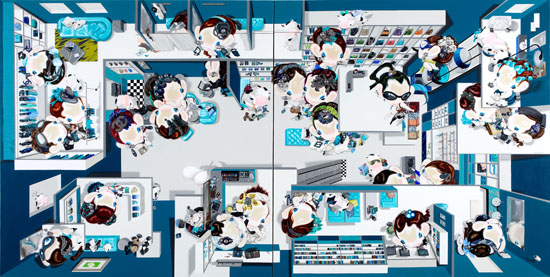
Rather surprisingly, given their apparent celebration of consumerism, Han sees her practice as relating to Zen philosophy and to Qing Dynasty paintings in which multiple perspectives depict a whole universe, both microcosm and macrocosm. We discuss the famous scroll representing an entire town in which every person depicted is doing something different. In ‘Perfect Ending’, a parallel universe of tiny cubicles is filled with girls and consumer products - espresso machines, laptops, mobile phones, shoes and handbags. They strike me as extremely sad. A tiny world appears about to implode under its own pressure. “This is still a male-dominated society,” she says, in response to my query about whether it is more difficult for female artists in China. “But I’m a human being first, then a woman, then an artist.” And, she adds, if you just keep on doing good work, people will have to take notice.
3. Perfect Ending 360+180cm 2010
Han Yajuan, Perfect Ending, Oil on canvas. Image courtesy the artist
Bu Hua was born in 1973, graduating from the Institute of Fine Art, Tsinghua University, Beijing, (formerly the Central Academy of Fine Art and Design) in 1995. Coming from a family of artists, with a father who was a distinguished printmaker, she “learned the language of lines” at an early age. Her work is represented in the collection of the White Rabbit Gallery in Sydney.
Bu Hua is best known as one of the pioneers of digital animation in China, discovering the expressive possibilities of Flash software and its potential to convey emotional truths about contemporary life in an immediately engaging and dynamic way. During our conversation she tells me about an artist whose name she cannot remember, discovered in the late 90s at Kassel Documenta, who created wonderful, complex, highly political animations with charcoal drawing. “William Kentridge?” I ask. “Yes, yes, yes!” she exclaims. Seeing his work in Germany was the impetus that made her want to combine drawing, painting and animation. In recent years she has developed a character, a key protagonist in both video and still images, who is based on herself as a child - a defiantly feisty but definitely cute Young Pioneer. She bravely navigates the surreal landscape of the 'new' China, encountering strange beasts, mystical forests, hideous pollution and rapacious developers, somehow emerging victorious. She is a girl with 'swagger', according to Bu Hua, and a more confident version of the artist herself - a fearless alter ego. In ‘Savage Growth’ she wanted to express this anxiety and fuse western and eastern traditions of art and design. “In modern China, how could you not be influenced by this fusion of West and East, this cultural invasion and ‘soft power’? I am just reflecting this reality,” she says.
attachment
Bu Hua, The Water is deep here in Beijing I (2010). Image courtesy the artist.
The girl who skips and jumps through her animations, woodblock prints, paintings and digital images is based on the artist's memory of herself as a schoolgirl in Beijing in a simpler era. She thinks about herself cycling to school at a time before the recent explosion of wealth and development with a certain degree of nostalgia. Past, present and future collide in the imagined adventures of this 'Beijing babe' who functions as a voyeur, a means by which we can see the craziness of the contemporary world.
5. Bu Hua AD 302 - 8
Bu Hua, AD3012-8,2012, giclee print on paper. Image courtesy the artist.
To read the rest of the article, click here: HERE