The ongoing thoughts of an art teacher in China - and home in Sydney

A continuing diary about my travels in China, and thoughts about China and Chinese art from home and abroad
Showing posts with label Lam Tung-pang. Show all posts

Friday, May 10, 2013

Landmines in the Gardens of the Literati

I have been thinking about the ways in which contemporary artists in China continue to use and be informed by the traditional forms of ink painting such as the continuing references to Shan Shui (mountain / water) painting which seem to be everywhere right now, and by the scholarly traditions of calligraphy. Sometimes in obvious ways, sometimes subtle. Sometimes overt, sometimes nuanced. Sometimes in order to pay homage to the long history of the Chinese prior to the humiliations visited upon them by western powers in the 19th century and the chaos of the revolutionary period. Sometimes to combine that respect for tradition with a wry or downright satirical view of the contemporary world. But always there is this looking back - at times almost wistfully - to a time before the landscape was covered in advertising hoardings for mobile phones and fast food. This may be perverse - after all ordinary Chinese citizens enjoy a measure of moderate prosperity now that was unimaginable thirty years ago, let alone in the distant past when those who passed the imperial examinations became scholar officials, and developed their passion for painting and calligraphy. But nevertheless it is a consistent feature of so much contemporary art being made in China today that it clearly reveals something of significance about the 'zeitgeist' (whatever the Chinese term for that may be! Google Translate provides this: 時代精神 - someone might tell me if this is even remotely accurate.) And not just in the PRC, but in Taiwan and Hong Kong too. Past and present - always layered in rich and sometimes surprising ways.

Yang Yongliang, 'A Bowl of Taipei', source http://www.yangyongliang.com/index.htm
Lam Tung-pang in his studio with works in progress, photograph Luise Guest
Lam Tung-pang, Horse and Rider, charcoal, acrylic and ink on plywood, double-sided work on wheeled panel, photograph Luise Guest, image courtesy the artist
In Hong Kong artists such as Lam Tung-pang revere the traditions of the Chinese ink painting masters, and refer to them constantly. Lam spends long hours in the Hong Kong Heritage Museum working from their collection, however the historical images are transformed to become works in a new idiom in his own unique medium of charcoal and acrylic on plywood. Lam uses the themes of landscape to reflect on what is happening to his beloved homeland. Wong Chung-yu, likewise, admires the tradition of ink painting and some years ago he decided to reinvent it using his skills as a computer programmer. His works often involve the audience and use real-time video.
Lam Tung-pang installation view, image courtesy the artist
Lam Tung-pang, Travel and Leisure series, detail, image courtesy the artist

Lam Tung-pang, small detail of commissioned work, image courtesy the artist
Wong Chung-yu, When Time Flows Away 2011, water, digital projections and web cam operating in real time
image courtesy the artist
In Wong Chung-yu's ‘When Time Flows Away’, two screens are hung one above the other. On the top screen a traditional ink grinding stick is activated when an audience member takes a ladle of water and pours it into the vessel below the screen. A computer program designed to calculate the effect of ink infiltration then interacts with the water in real time. Virtual ink begins to flow downward into the second screen, ‘washing away’ images from the last 100 years of Chinese history, including the Japanese occupation, Mao Zedong, Cultural Revolution propaganda, Deng Xiaoping and images of the 1997 handover. The ink grinding represents China and the ebb and flow of its history, and the work involves the audience in its alteration. Wong believes that ink painting expresses the deepest beliefs and philosophies of the Chinese people: “What I am interested in is how to reinterpret Chinese traditional art in a new way,” he says.

In Shanghai, Yang Yongliang also works with video and digital media, creating works which initially appear to be tranquil Shan Shui paintings, until you realise that everything in the misty landscape is in motion - the mountains are made up of towering skyscrapers, cranes reach their arms into the air, cars travel on Jetsons-style freeways and planes criss-cross the sky. These works are very disconcerting - beauty juxtaposed with the uncertainty of modern life. In China the only certainty is change and these works certainly reflect that.
Yang Yongliang, Phantom Landscape, Blu-Ray HD, source http://www.yangyongliang.com/video.html

Yang Yongliang, Viridescence, Ultra Giclee Print on Epson Paper
source http://www.yangyongliang.com/Photography/35.html?a=5
It is in Shanghai, too, that Shi Zhiying experiments with the removal of colour from her vast canvases depicting oceans, expanses of grass, the raked spirals of Zen Gardens, as well as the humble objects of everyday life. In Shi's case, there is a specific reference to Buddhist belief.
Shi Zhiying's brushes, photograph Luise Guest reproduced with permission of the artist
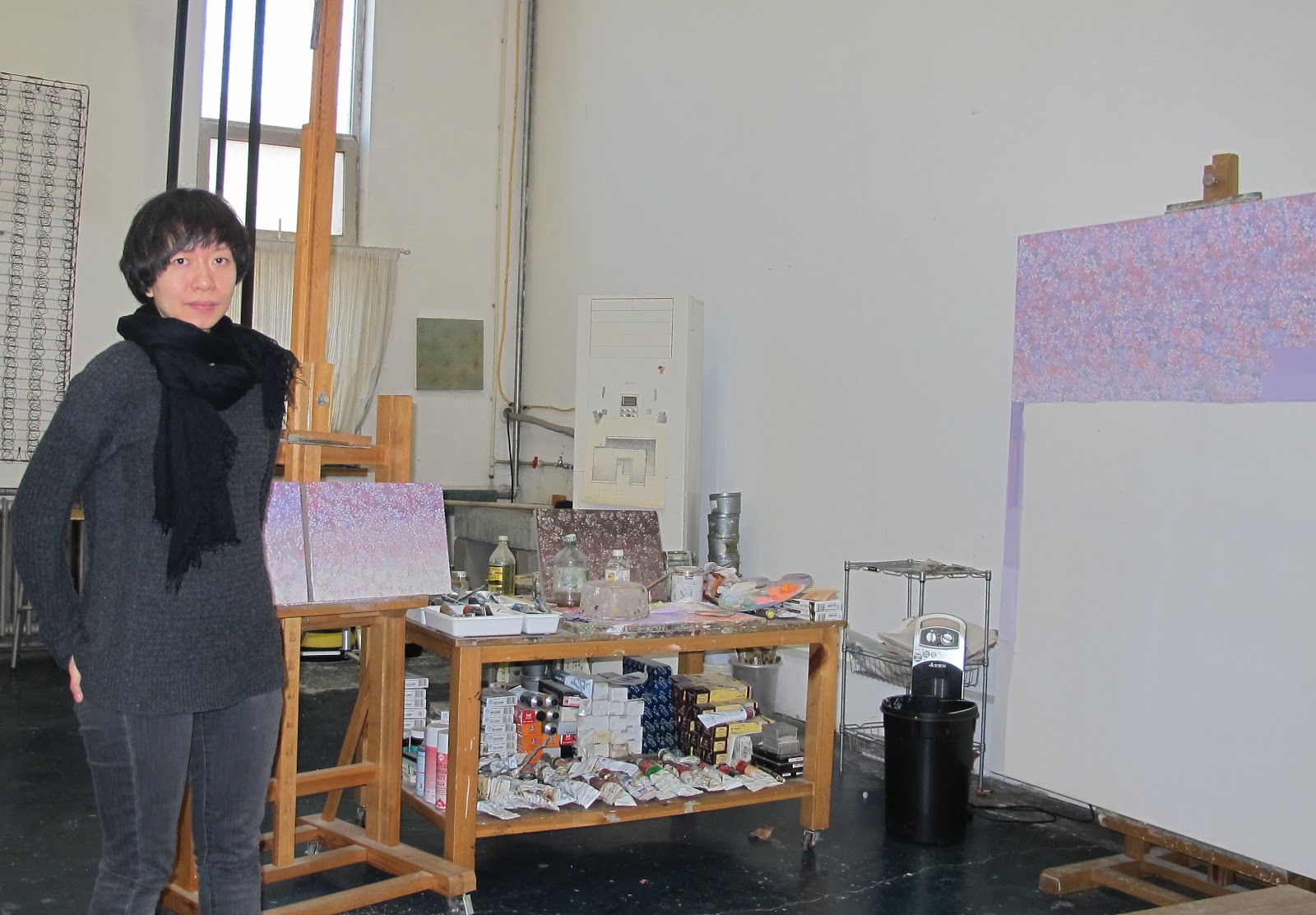
Shi Zhiying in her Shanghai studio, photograph Luise Guest reproduced with permission of the artist
Work in progress photographed in Shi Zhiying's studio, photograph Luise Guest reproduced with permission of the artist
Some might attribute the continued focus on ink painting and Confucian or scholarly tradition as an aspect of Chinese nationalism, with all the implications and complications that suggests. Others see it as a welcome reversal after 30 years of Maoist policies of 'Smashing the Four Olds' and breaking with tradition (literally, in so many instances of the destruction of artworks, artifacts and buildings.)  Some, like artist Jin Sha, a painter of 'contemporary gongbi' works, see ink painting as a later version of Chinese culture which is not truly Chinese at all! Like everything else in China, it is complicated, contested and open to multiple interpretation.

So thinking all these thoughts about the enduring nature of - and in fact the increasing interest in - Chinese traditions, I wrote an article for a new web site peek365.com/ about how this plays out in the work of Monika Lin, a painter and performance artist based in Shanghai, whom I met first in April 2011 and again in December 2012; and the photographer/painter/sculptor Huang Xu and his very interesting and somewhat enigmatic wife, Dai Dandan, whom I interviewed in their Beijing studio.

Here is an extract:

Monika Lin is an American-born artist of Swiss and Chinese heritage, living and working in Shanghai, who focuses on socio-political and historical issues in her paintings and performance works. Lin is simultaneously part of the Chinese world and also, by virtue of her ‘foreign-ness’, separated from it. She views contemporary China with a clear and critical eye and in the performance ‘Ten Thousand’, presented last year at the Performance Art Institute in San Francisco, she reflected on Chinese history. In Imperial China, scholars who passed the Imperial Examinations were appointed to administrative positions overseeing populations ranging from small villages to entire provinces. Many of these scholarly civil servants – the literati – devoted themselves thereafter to the practices of the fine arts. An uncomfortable truth often overlooked, Lin says, is that their privileged life of contemplation depended on the work of innumerable peasants.
Monika Lin performance, 'Ten Thousand', image courtesy the artist

For the performance, Lin decided she would write the character for ‘rice’ – 米 – 10,000 times. Ten thousand as a numerical denomination (‘yi wan’) is unique to the Chinese language and signifies ideas about eternity and infinity. Lin chose the character for rice in part for its beauty and simplicity but also for its ironic resonance: rice was produced by peasant farmers who were taxed on it, but could not afford to eat it. Lin wanted to work in a physical way to connect herself to the labours of the peasantry rather than the literati. Influenced by endurance-based performances by artists such as Marina Abramovic and Kiki Smith, the result was 833 sheets of paper. The act of placing each sheet down on the gallery floor was so physically challenging that it appeared to some observers akin to the act of planting rice.
Monika Lin, Ten Thousand, image courtesy the artist
The American audience perceived Lin’s silent enactment of the act of calligraphy, an act that she describes as unspeakably arduous and emotionally powerful, as ‘beautiful and tranquil’. Lin told me that she saw this as an orientalist interpretation of her work, a misreading of her intentions. It was the backbreaking physical labour of the peasants, which made possible the countless hours (represented by the symbolic number 10,000, or万) that the literati were able to spend contemplating nature in their gardens, perfecting their calligraphy and painting. Is there a resonance here with the position of artists as privileged elite? Lin suggests, perhaps, that the contemporary artist, like the scholar in his garden, is seeing a convenient constructed version of the ‘natural’ world. She is wary of romanticising Chinese history, of falling into the kind of Chinoiserie that westerners living in China can fall prey to. Lin’s other works have dealt with the oppression of women in Imperial China, the ‘lotus feet’ resulting from foot-binding, and the ‘flower houses’ or brothels in Shanghai.
Monika Lin 'On the Way to the Imperial Examinations' - sculptures created from the 'mi' covered paper after the performance. These were shown in a curated exhibition at OV Gallery in Shanghai, 'Learning from the Literati'
In Beijing, photographer Huang Xu often represents ‘scholar rocks’, traditional subjects for Chinese painting for their natural perfect forms that echo Taoist philosophy. However Huang’s rocks are photographs of decaying plastic bags. They evoke the sublime, but also suggest the destruction inherent in China’s social and political transformation – the demolition of entire neighbourhoods, the emptying out of rural villages in the largest mass migration in history of workers to the factory towns of southern China, and the growing fears about air quality, pollution, food safety and environmental degradation. Floating plastic bags are ubiquitous in Chinese towns and cities. Luminous and beautiful, Huang’s works are dramatically lit like the billowing drapery of Baroque paintings, while they also recall the silk cloth of imperial China. Huang studied traditional painting from the age of twelve and he continues to emulate its ethereal qualities and its mastery of space and form in his photographic practice.
Huang Xu, Plastic Bag #1, C-print, image courtesy China Art Projects
Huang Xu, Plastic Bag #20, image courtesy China Art Projects

Huang’s most recent work is an installation in collaboration with his artist wife, Dai Dandan, who has recently turned to art practice following a career in television. In her own Duchampian act of transgression, she purchases rocks, probably intended for fish tanks, from the markets, decorating them with rhinestones and fake jewels in order, she says, ‘to perfect them’. A reference to the beauty of imperial gardens, and a nod to the rich traditions of Chinese art, but also, perhaps, a satire of the imposition of global branding onto Chinese culture, and the nouveau preference for ‘luxe’ consumer goods over the values and beliefs of the past. It is appropriate then, that her work with its ironic edgy glamour also featured in a curated show at Shanghai gallery Studio Rouge’s new branch in Hong Kong, on Hollywood Road, where art meets commerce and many of the Chinese antiquities in the shops are of dubious provenance.
Dai Dan Dan, Crystal Rock, image courtesy China Art Projects
The recent collaborative work between Dai Dandan and Huang Xu (the artist couple is an intriguing feature of the contemporary Chinese art scene) is titled ‘Mr and Mrs Huang in the Humble Administrator’s Garden’. It features Huang’s plastic bag scholar rock images together with his subtly erotic flower photographs and new button pavilion sculptures, juxtaposed with Dai’s ‘assisted ready-mades’. ‘Mr and Mrs Huang’ take traditional Chinese philosophy and aesthetics as their starting point and lay subversive landmines of the kitsch and the banal in the garden of the literati.

To read the whole article, click this link: artists-subverting-scholarly-traditions-in-contemporary-china-2#
'Mr and Mrs Huang' (Huang Xu and Dai Dandan) in thei Beijing studio,
photograph Luise Guest reproduced with permission of the artists


Sunday, December 16, 2012

Zhong guo "Zai Jian" - for now

A large wall text at the entrance to the "Andy Warhol - 15 minutes eternal" exhibition currently showing at the Hong Kong Art Museum reads, " Making money is art and working is art and good business is the best art". This is curiously appropriate in Hong Kong, a city where, artist Celia Ko told me tonight, "money is the only language that everybody speaks."

Hmmm. Money and art. Who knew? Always a hugely problematic nexus, and ideas about the relationship of one to the other are contested bitterly. In Beijing there is no denying that a number of artists became seriously wealthy in the art boom of the late 90s and early 2000s. And cynical views are expressed by some in the artworld that everything and everyone have been corrupted by that.

However while everybody needs to earn a living and artists are not exempt from the normal kinds of greed and desire for comfort and ease that we are all heir to, I am prepared to go out on a limb and say that each of the seventeen artists I have interviewed on this trip are absolutely and seriously dedicated to making art that expresses deeply felt ideas and beliefs, and work incredibly hard to develop their practice and pursue a goal of excellence, whatever the art market might be doing.
Gao Ping, oil on canvas, image reproduced with permission of the artist and China Art Projects
Gao Ping told me, "Every year I want to find something new in my work" and added, "The drawing is my heart". Lin Tianmiao said, "Being an artist is a very personal thing. We are the people who raise the questions - the critical thinking is the most important thing". You can read a more detailed account of my interview with this iconic figure, currently showing at Lelong in New York, here: http://dailyserving.com/2012/12/holding-up-half-the-sky-an-interview-with-lin-tianmiao/

Lin Tianmiao, thread winding work viewed in the artist's studio,
 photograph Luise Guest, reproduced with the permission of the artist
Liang Yuanwei, who spent three months in Berlin after a less than happy experience representing China at the Venice Biennale, said. "My work is like a tunnel between myself and the world. It must be true."
Liang Yuanwei in her Beijing studio, December 2012
Photograph Luise Guest, reproduced with permission of the artist
Liang Yuanwei, Flower Study for the Golden Notes series, oil on canvas
Photograph Luise Guest reproduced with the permission of the artist
Liu Zhuoquan makes very beautiful works that contain within them some carefully coded meanings about issues in China today. Wu Meng makes works in the public space in Shanghai at considerable personal risk to herself and her family, raising issues of vital concern such as the suicides of workers in the factories of southern China, or the unfair treatment of migrant workers. And Lam Tung-pang in Hong Kong, whose work is currently showing at Saatchi in London, makes works which reflect his feelings of anxiety and distress about what is happening to his beloved city, and his search for quietness and repose in a re-examination of the traditions of ink painting.
Lam Tung-pang in his studio, Hong Kong December 2012,
photograph Luise Guest  reproduced with the permission of the artist
Lam Tung-pang, studio view
Lam Tung-pang, 2 sided work based on Tang Dynasty horse, photographed in the studio
Photograph Luise Guest reproduced with the permission of the artist
Lam Tung-pang, exhibition of work at Goethe Institut, Hong Kong, installation view
image reproduced with permission of the artist
I have interviewed painters and performance artists, photographers and sculptors, artists who work with found objects and found images, those who reinvent traditional Chinese forms such as ink painting or gong bi style painting and those who seek an entirely new visual language. I have met famous and revered artists, and artists newly graduated from art academies. I have met curators and gallery directors and critics.
Monika Lin, "On the Way to the Imperial Examination",
performance piece in which the artist wrote the character 'mi' (rice) 10,000 times
Image reproduced with permission of the artist
Shi Zhiying in her Shanghai studio,
Photograph Luise Guest, reproduced with permission of the artist
I have also met two wonderful and inspirational art teachers with whom I hope to collaborate on some projects with our respective art students - art that crosses national boundaries and limitations of culture and language, that sounds good!

I have learned enough to make my brain feel as if it is overflowing with new information, enough for a book! We'll see... I have loved the experience of travelling with this sense of purpose and in a spirit of enquiry, and have been warmly welcomed everywhere. I have sat in ice cold freezing studios in old 'Shikumen' houses in the French Concession in Shanghai, and in Caochangdi and Songzhuang artists' villages on the outskirts of Beijing. Today, after visiting Lam Tung-pang in his new studio in Fo Tan, I caught a local mini bus to Sha Tin Station, blaring Chinese opera all the way.

From the sublime to the truly ridiculous, Hong Kong has it. Yesterday I saw an eagle floating, suspended, high above the clustered apartment buildings as I rode down the hills from the Peak on the top deck of a bus. Today, in the shopping mall above the Sha Tin MTR station, I came across a brand of handbags and wallets called 'Shag Wear' - I swear this is true! Yesterday, in Canton Road, two young men in the jostling crowd carried sandwich boards advertising 'The Battery Operated Nasal Aspirator".

I have been observing - sometimes feeling like a voyeur - the people in each city as they go about their lives, Old men and women playing cards, mahjong, chess, doing Tai Chi, ballroom dancing, playing bowls. Such constant activity! And here in Hong Kong have been touched by the way tiny, wizened old ladies are led gently by daughters and grand-daughters down jostling Kowloon streets. And also by the general tenderness shown in every  city I have visited to babies and children. Not surprising in the land of the one child policy, changing though that may be. Often in Australia I observe parents respond to their small children with exasperation and impatience as their default position. Not so in China.

It is perhaps ironic that part of my purpose here has been to discover what the effect of international dialogues, residencies and exhibitions has been on the work of Chinese artists, and how they have been changed by these experiences. A lot more remains to discover on that topic, but in the meantime the person most changed by the dialogue is me.
Zhongguo - Zai Jian!

Friday, April 8, 2011

Past and present, power and politics - heat and humidity!

Guangzhou Art Museum Sculpture Garden

It feels good to be back in Hong Kong, and coming towards the end of this adventure - although I am regretful as well, as this has been quite extraordinary. There have not been enough hours in every day to do all the things I wanted to do, and meet all the people that I wanted to meet. But when I think about the last 4 weeks, I have done a lot! It's interesting also to realise that now I can access Facebook, and this blog, and I am inundated with news about the detention of Ai Weiwei. Watching CNN News on TV in Shanghai the other day, the announcer said, 'Fears are growing for Chinese artist Ai Weiwei.......' then the screen went black and transmission was cut.

Hong Kong is hot and humid, and seems so ordered in comparison to the mainland - people actually stop at red lights! And don't push and shove to get on the train before people can get off! And no-one is spitting in the street! Funny how you get used so quickly to things that seem extraordinary at first. I have been musing over how to make sense of all my experiences in some coherent form, and I think the key is the idea that has been expressed to me by so many artists in China - the layering of past and present. This idea is inescapable in China, as you are always aware of the weight of 5000 years of history, and the recent (often unspoken) past as well. And the present spins into the future so fast that who could keep up? I think this is the issue with the schools I have visited as well - both local and international schools are also dealing with the pace of change, and the questions raised about pedagogy,  technology, culture and how to equip students to live in this world.
 4th Grade students at Guangzhou Nanhu International School
 At Guangzhou Nanhu International School yesterday I watched classes of 3rd and 4th grade students work happily and independently on sculptural and painting projects with their dedicated and enthusiastic teacher. These small people, from so many different cultural backgrounds, and their families who have moved to Guangdong Province for work opportunties from all over the globe, represented to me the face of 21st century schooling. This school was the most multicultural I have seen in China, a country which is essentially very monocultural. Schools such as this are consciously and thoughtfully preparing  students to enter a fluid and changing world, and even the cultural and ethnic mix of the classrooms and the teachers are part of this preparation. We need to ask ourselves some big questions in Australia, I think, about how schools can meet the needs of students, families and societies for the future, without repeating some of the same old mistakes (for example, a naive faith in the power of testing alone to miraculously improve results!)

In 'Factory Girls' Leslie T Chang observes the new 'commercial' and 'self improvement' colleges attended by migrant workers in factory towns like Dongguan, "Dongguan learning took place in humble settings. Classrooms were bare and dim and plagued by power cuts, and computers so grimy and ancient they looked like archaological finds...Almost none of the instructors had a proper degree; many, like Teacher Deng, trailed a string of failed businesses behind them. But for all that, they were revolutionary." She compares the ruthless testing and competition, the authoritarianism, and the conservative and limited curriculum of the Chinese school system, with its traditional emphasis on rote learning and writing (the corner stone of traditional scholarship) with these often dodgy and makeshift, but vital schools which essentially teach people how to transform themeselves and become someone new. "As I sat through a semester of White-Collar classes I realised I was witnessing a secret revolution in Chinese education. The rejects of the traditional school system were given a second chance. The factory floor of the world was also in the business of molding people. These classes had no grades and no tests and that was as it should be. The test was the world outside the classroom; the test was life." If nothing else, being in China has made me think about the nature of the education we provide for a generation who will grow up to enter a world that is nothing like the one we currently inhabit. The pace of change in Australia may not be as fast as that of China, but it will increase and it takes a particular kind of resilience to cope and even to flourish.

One of my translators was a young woman in her thirties who feels old  because she is not yet married. She grew up in a Xian work unit with parents who had been denied an education due to the Cultural Revolution, left school,  became a welder in the same factory, but  became convinced that education was the key to a better life, a life unlike that of her parents. She supported her own studies in a local college for eight years, all the while working in the factory, majoring in English. She wants to be an interpreter, but most of the time she works as a tour guide. However she has transformed her own life, and has travelled to the United States and Australia on her own.

This is a woman whose grandmother had bound feet. What a novel could be written about the three generations of her family.

I find that kind of personal courage and determination so admirable, and I saw the same qualities in many of the artists and the teachers that I met over the course of the last month. She told me a saying from her home town: "A woman should have long hair but short vision" - summing up the traditional Chinese attitude to the place of women in the world!


Tung-Pang Lam in his Fo Tan studio

I spent an interesting couple of hours in the Fo Tan studio of Tung-Pang Lam this afternoon, an artist who like so many others combines his training in the traditional techniques of calligraphy and ink painting with a contemporary and conceptual idiom. His studio is on the 6th floor of one of the old industrial buildings found in suburbs like Fo Tan and Aberdeen which are now used for storage and artists' and designers' studios, as essentially all manufacturing and heavy industry has moved over the border. Through the window are views of the mountainside, high rise apartments, and industrial buildings pressing in close together.  His young assistant, a first year student from his class at the Chinese University, is painting a large canvas with gesso. Other canvases are stacked in piles around the walls. Shelves are sagging with the weight of Chinese and Western art books, as befits this scholarly artist's practice.

Tung-Pang usually works on large sheets of plywood, using images taken from Tang, Yuen and Qing dynasty paintings, but applying them as stencilled images, working with charcoal and acrylic, or sometimes attaching tiny plastic model figures and trees like those from a boyhood model train set. In studying for a Masters Degree at St Martins College in London, he began to ask the question, 'What shaped the way I see the world?', and turned to the Chinese literati painters, scholars who retreated from the world.

A quiet, gentle and thoughtful character, he tells me he is interested in the work of artists such as Sigmar Polke, the Belgian Michael Borremans, and also a Chinese painter, San Yu, who lived and worked in Paris in the early twentieth century.  He loves the tiny background landscapes found in medieval and early Renaissance paintings, and shows me a book of Italian frescos by Giotto and Piero della Francesca, which he sees as quite similar to  the tiny details of traditional Chinese landscape painting.  He wrily comments that in Hong Kong his work is defined as western painting, but in London he was defined as a Chinese painter. This confusion of identities is troubling, and is something he continues to focus on in his work. Lam feels that western painting is like opening a window in order to look out, but Chinese painting is like opening a space inside oneself to escape from the outside world. "I want to be in Fo Tan and face the mountain, but at the same time I have to face the issues in the world" he says. One of those issues is the freedom of artists to work without constraints - the topic of Ai Weiwei is on everyone's mind this week.

Another Chinese saying: "All crows are black". Loosely translated this is a pessimistic view of humanity and suggests that nobody is to be trusted. Tung-Pang has produced a conceptual work called 'Where is the White Crow?'. This consists of 365 small square canvases with a different black crow painted in a calligraphic manner on each one, one completed each day for a year. In itself this practice is akin to meditation. As he translates the saying for me "There are no good guys". Except, of course, there are, and it is my good fortune to have met so many of them in the last month.