The ongoing thoughts of an art teacher in China - and home in Sydney

A continuing diary about my travels in China, and thoughts about China and Chinese art from home and abroad
Showing posts with label Celia Ko. Show all posts

Wednesday, October 30, 2013

Finding Poetry in Wan Chai: 4 Women Artists in Hong Kong

Jaffa Lam, an installation in the Hong Kong Contemporary Art Awards at the Hong Kong Art Museum
On the way from Sydney to Beijing I had 4 days in Hong Kong in which to criss-cross the city (Star Ferry, MTR, red minibuses, trams and taxis, as well as a LOT of walking) visiting artists' studios in Fo Tan, Kennedy Town and on university campuses; and galleries in Central, Chai Wan and other locations. I have been interested for a long time in the way in which contemporary art in Hong Kong differs from that on the Mainland, and the much more limited opportunities that artists there are afforded. In the past some have told me bitterly that they feel they are regarded as insufficiently Chinese to interest collectors. I wondered whether that is changing, after the big Saatchi 'Hong Kong Eye' show and all the hoo-ha about the development of West Kowloon into a massive cultural centre, incuding M+ which will house Uli Sigg's very significant collection of contemporary Chinese art.

On past trips to Hong Kong I have met and interviewed Lam Tung-pang, Hanison Hok-shing Lau, Wong Chung-yu and Carol Lee Mei-kuen - all fascinating artists and all passionate about Hong Kong and its history. 

Carol Lee Mei-kuen, 'Little Lace Frock', 2011, sun on paper, image courtesy the artist

I specifically wanted to meet female artists on this visit as that is the focus of my current project in China. I intended to ask them about their practice, their views on the Hong Kong art scene, and also that thorny question which Chinese artists on the Mainland often find so hard to respond to - "is it harder for women to sustain a successful art career, and if so, why?" Responses I have had in the past to this question vary from a very terse "Of course it's harder, China is still a patriarchal society!" and "There is no feminism in China - it's a western construct" (both responses from very famous artists in their 50s who shall remain nameless for now) to "No, it's easier for me because I don't have to support a family" and "No, it's easier because there is more pressure on men to be successful" (both responses from young - and currently childless - artists in their late 20s and early 30s) to a blank "I don't understand this question." The other day a translator told me in the midst of my interview with an artist that she could not translate the word "feminism" into Chinese. This surprised me a little since both my dictionaries and even Google Translate seem to have no problem with it. I had to say, "But I think you can, actually!", and then give her a rather long-winded explanation.

Hong Kong is a very different place however, and I was fascinated to discover the highly sophisticated and aware understandings of contemporary critical theory and art practice in the work of 4 very different artists. Here is the start of my article about those recent encounters, published today on theculturetrip.com I have added a few additional images to this post.


When people talk about contemporary Chinese art they are invariably referring to art from Mainland China. Despite recent international exhibitions, even in Hong Kong itself few people seem to be aware of the interesting contemporary art being produced there. Initially it can seem less dramatic, less extraordinary, than the work produced by artists trained in the powerhouse PRC art schools such as Beijing’s Central Academy of Fine Arts. However, on closer inspection the fascinating subtleties of a liminal place with a complex postcolonial identity emerge. Hong Kong has been something of a transit zone since the days of the Treaty Ports and the British seizure of its harbour at the end of the first Opium War in 1842. Its unique history results in contemporary art quite unlike the current shape of art from China’s mainland.
Some facts about contemporary art in Hong Kong:
- More than 60,000 people attended the inaugural Art Basel Hong Kong Art Fair in May this year. And more than half of the participating galleries came from the Asia Pacific region.
- 7,000 people visited Song Dong’s exhibition in 3 weeks during January this year.
- Major international galleries such as Gagosian and White Cube now have a Hong Kong presence, as do Edouard Malingue, Pékin Fine Arts and Pearl Lam.
- The West Kowloon Cultural District when complete will comprise 17 arts and cultural venues.
- Hong Kong is now the world’s third largest art market by auction sales.
Clearly, there is a hunger to see contemporary art. But what does it mean for Hong Kong artists? There is a sense that artists who live and work there are the 'poor relations' of the art stars from Beijing. Despite recent exhibitions such as Saatchi Gallery’s Hong Kong Eyewhich featured the work of 18 artists never before shown outside Hong Kong, it is still difficult for local artists to find gallery representation, partly due to prohibitively huge gallery rents.Liminal, at K11 Art Mall by young artists Kenny Wong and Marco de Mutiis conveys the anxieties so evident in Hong Kong - lack of space, the pressure of sky-rocketing rents, anxieties about cultural identity, and 'big brother' watching from just across the border – through the metaphor of computer operated ‘drones’ equipped with video cameras observing and recording unaware passers-by outside the gallery. The Hong Kong Contemporary Art Awards also reveal a rich diversity of practice. The fact that so many artists in Hong Kong see their work as a form of social activism is often unacknowledged: they are engaged with their city and its myriad concerns in a way which distinguishes their work from other artistic centres. Artist Annie Lai-Kuen Wan says, 'For me the social issues are overwhelming.' Ivy Kin-chu Ma’s work ‘Cambodia / Tuol Sleng Genocide Museum / Numbers Standing Still’ exemplifies this seriousness of purpose. A series of ghostly sepia numbered tags suggestive of labels attached to a person’s clothing are arranged according to the Fibonacci sequence, bearing marks of erasure and over-drawing on the archival prints.
Ivy Kin-chu Ma, Cambodia / Tuol Sleng Genocide Museum / Numbers Standing Still, 2012, Pastel Graphite and Ink on Archival Print, set of 11, each 79 x 60 cm, image courtesy the artist and Hong Kong Art Museum.
To find out more, I spoke with four very different artists in Hong Kong. They all happen to be female. In an art world which is still somewhat testosterone-fuelled this is just one more factor to add to the difficulties experienced by local artists in a place which tends to look beyond, rather than within, its own borders.
Sculptor and installation artist Phoebe Man works with materials some would see as not only unorthodox but confronting. Most notoriously these have included sanitary napkins and fingernail clippings. She engages her audience in participatory works, blurring the boundaries between artist and viewer. Man has made works which could be viewed as overtly feminist, dealing with sexual assault and violence against women; and is planning a piece in Taiwanin which she will work with the remaining WWII ‘comfort women’. She sees these now very elderly survivors as extraordinarily brave for bringing what was once a shameful secret into the light of day.

Phoebe Man, TIme Regained, papercutting, image courtesy the artist


Annie Lai-Kuen Wan, ‘Looking for Poetry in Wan Chai’, relief sculpture comprising ceramic moulds. Image courtesy of the artist.
Annie Lai-Kuen Wan works in highly unconventional ways to reflect on the changing nature of her city. Often using moulds, as a way of 'mapping reality', she examines our relationship to the material world and its meanings. Her work ‘Looking for Poetry in Wan Chai’ recorded the fabulous tapestry of text in the oldest parts of Hong Kong, a visual landscape of signage that is under threat from development. Currently showing in the Hong Kong Art Museum, ‘Crafting a Reverse Scenario for a Lost Sheep is an investigation of time’s actions on organic substances. Ceramic sheep figurines are sealed in glass containers, together with wet clay and bean sprouts, creating enclosed micro eco-systems, surreal landscapes of growth and decay in miniature.
Monti Wai-Yi Lai works with materials found in the natural environment, in particular with pigments she creates from ground leaves, once again reflecting on Hong Kong’s very particular social and environmental issues. Lai uses the traditional tile patterns found on post-war Hong Kong apartment blocks as an organising principle and key design element in her ephemeral, often participatory, site-specific works. She wants to make works in which her own memory of growing up in a semi-rural area of Hong Kong, now rapidly submerged in the urban megalopolis, connects with significant issues both local and global. She thinks that an authentically Hong Kong voice is increasingly being heard. 'Artists and audiences are looking for that!' she says.
Annie Wan, Time Regained, Installation View, image courtesy the artist
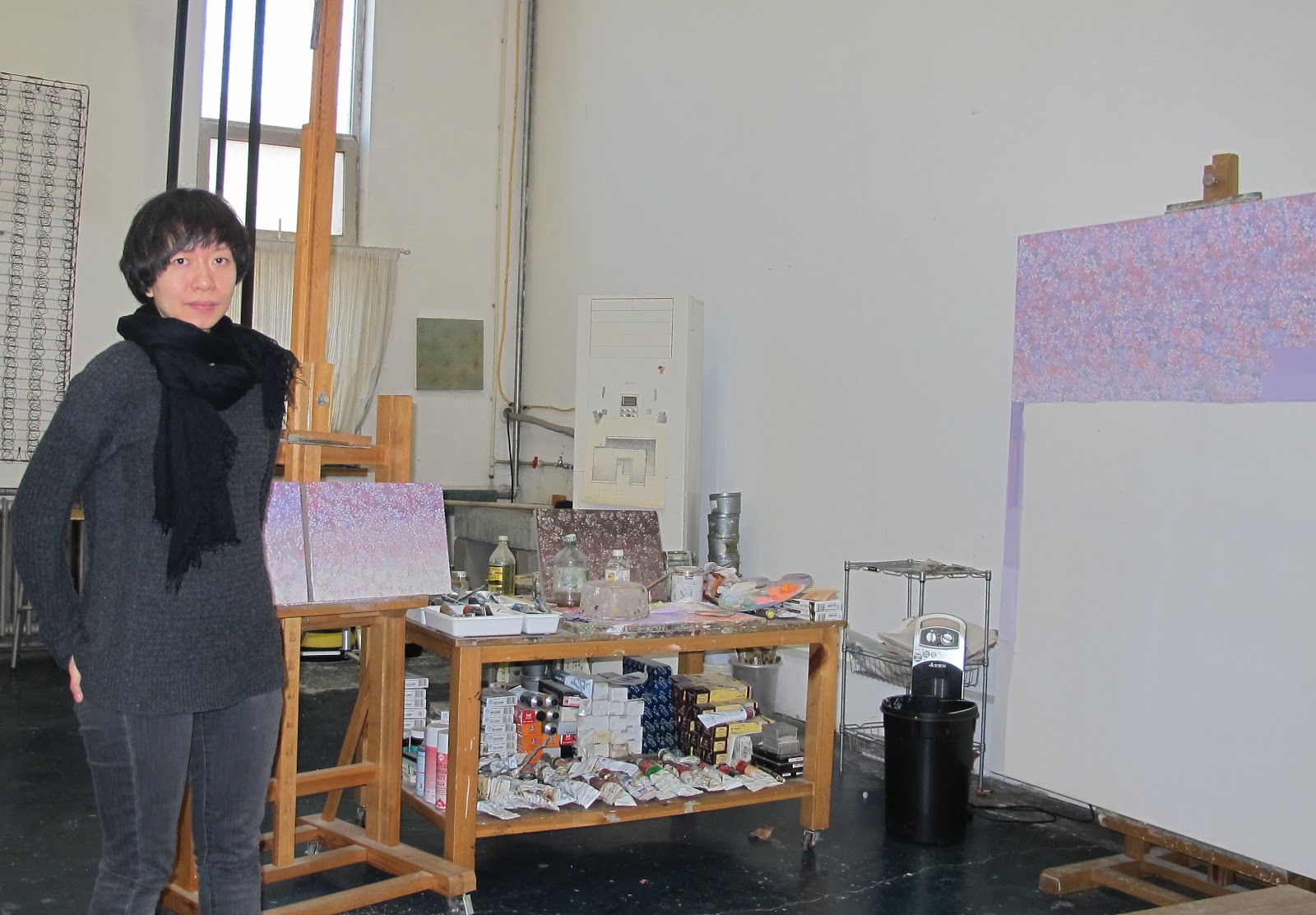
Celia Ko, a painter trained in the conventions of academic realism, adapts Baroque and Renaissance conventions and iconography to create highly theatrical staged images. She reflects on the relationships between her protagonists and their contemporary lives, as well as on her own history and cultural identity. Some works focus on her grandparents and the significance of family in traditional Chinese culture; others on the complex hybrid identities and relationships which emerge in the contemporary city.
With Celia Ko in her studio, September 2013
To read on, and find out more about each artist and her practice, click HERE

Sunday, December 16, 2012

Zhong guo "Zai Jian" - for now

A large wall text at the entrance to the "Andy Warhol - 15 minutes eternal" exhibition currently showing at the Hong Kong Art Museum reads, " Making money is art and working is art and good business is the best art". This is curiously appropriate in Hong Kong, a city where, artist Celia Ko told me tonight, "money is the only language that everybody speaks."

Hmmm. Money and art. Who knew? Always a hugely problematic nexus, and ideas about the relationship of one to the other are contested bitterly. In Beijing there is no denying that a number of artists became seriously wealthy in the art boom of the late 90s and early 2000s. And cynical views are expressed by some in the artworld that everything and everyone have been corrupted by that.

However while everybody needs to earn a living and artists are not exempt from the normal kinds of greed and desire for comfort and ease that we are all heir to, I am prepared to go out on a limb and say that each of the seventeen artists I have interviewed on this trip are absolutely and seriously dedicated to making art that expresses deeply felt ideas and beliefs, and work incredibly hard to develop their practice and pursue a goal of excellence, whatever the art market might be doing.
Gao Ping, oil on canvas, image reproduced with permission of the artist and China Art Projects
Gao Ping told me, "Every year I want to find something new in my work" and added, "The drawing is my heart". Lin Tianmiao said, "Being an artist is a very personal thing. We are the people who raise the questions - the critical thinking is the most important thing". You can read a more detailed account of my interview with this iconic figure, currently showing at Lelong in New York, here: http://dailyserving.com/2012/12/holding-up-half-the-sky-an-interview-with-lin-tianmiao/

Lin Tianmiao, thread winding work viewed in the artist's studio,
 photograph Luise Guest, reproduced with the permission of the artist
Liang Yuanwei, who spent three months in Berlin after a less than happy experience representing China at the Venice Biennale, said. "My work is like a tunnel between myself and the world. It must be true."
Liang Yuanwei in her Beijing studio, December 2012
Photograph Luise Guest, reproduced with permission of the artist
Liang Yuanwei, Flower Study for the Golden Notes series, oil on canvas
Photograph Luise Guest reproduced with the permission of the artist
Liu Zhuoquan makes very beautiful works that contain within them some carefully coded meanings about issues in China today. Wu Meng makes works in the public space in Shanghai at considerable personal risk to herself and her family, raising issues of vital concern such as the suicides of workers in the factories of southern China, or the unfair treatment of migrant workers. And Lam Tung-pang in Hong Kong, whose work is currently showing at Saatchi in London, makes works which reflect his feelings of anxiety and distress about what is happening to his beloved city, and his search for quietness and repose in a re-examination of the traditions of ink painting.
Lam Tung-pang in his studio, Hong Kong December 2012,
photograph Luise Guest  reproduced with the permission of the artist
Lam Tung-pang, studio view
Lam Tung-pang, 2 sided work based on Tang Dynasty horse, photographed in the studio
Photograph Luise Guest reproduced with the permission of the artist
Lam Tung-pang, exhibition of work at Goethe Institut, Hong Kong, installation view
image reproduced with permission of the artist
I have interviewed painters and performance artists, photographers and sculptors, artists who work with found objects and found images, those who reinvent traditional Chinese forms such as ink painting or gong bi style painting and those who seek an entirely new visual language. I have met famous and revered artists, and artists newly graduated from art academies. I have met curators and gallery directors and critics.
Monika Lin, "On the Way to the Imperial Examination",
performance piece in which the artist wrote the character 'mi' (rice) 10,000 times
Image reproduced with permission of the artist
Shi Zhiying in her Shanghai studio,
Photograph Luise Guest, reproduced with permission of the artist
I have also met two wonderful and inspirational art teachers with whom I hope to collaborate on some projects with our respective art students - art that crosses national boundaries and limitations of culture and language, that sounds good!

I have learned enough to make my brain feel as if it is overflowing with new information, enough for a book! We'll see... I have loved the experience of travelling with this sense of purpose and in a spirit of enquiry, and have been warmly welcomed everywhere. I have sat in ice cold freezing studios in old 'Shikumen' houses in the French Concession in Shanghai, and in Caochangdi and Songzhuang artists' villages on the outskirts of Beijing. Today, after visiting Lam Tung-pang in his new studio in Fo Tan, I caught a local mini bus to Sha Tin Station, blaring Chinese opera all the way.

From the sublime to the truly ridiculous, Hong Kong has it. Yesterday I saw an eagle floating, suspended, high above the clustered apartment buildings as I rode down the hills from the Peak on the top deck of a bus. Today, in the shopping mall above the Sha Tin MTR station, I came across a brand of handbags and wallets called 'Shag Wear' - I swear this is true! Yesterday, in Canton Road, two young men in the jostling crowd carried sandwich boards advertising 'The Battery Operated Nasal Aspirator".

I have been observing - sometimes feeling like a voyeur - the people in each city as they go about their lives, Old men and women playing cards, mahjong, chess, doing Tai Chi, ballroom dancing, playing bowls. Such constant activity! And here in Hong Kong have been touched by the way tiny, wizened old ladies are led gently by daughters and grand-daughters down jostling Kowloon streets. And also by the general tenderness shown in every  city I have visited to babies and children. Not surprising in the land of the one child policy, changing though that may be. Often in Australia I observe parents respond to their small children with exasperation and impatience as their default position. Not so in China.

It is perhaps ironic that part of my purpose here has been to discover what the effect of international dialogues, residencies and exhibitions has been on the work of Chinese artists, and how they have been changed by these experiences. A lot more remains to discover on that topic, but in the meantime the person most changed by the dialogue is me.
Zhongguo - Zai Jian!