The ongoing thoughts of an art teacher in China - and home in Sydney

A continuing diary about my travels in China, and thoughts about China and Chinese art from home and abroad
Showing posts with label Judith Neilson. Show all posts

Sunday, February 17, 2019

Shoes & The City: Lu Xinjian, Nike and the White Rabbit Collection

So here is my second blog post for the new website that covers White Rabbit Gallery, the White Rabbit Collection and its archive, and the new Research Library at Dangrove - it's about artist Lu Xinjian and his collaboration with Nike. What it doesn't tell you is that Lu Xinjian's paintings were some of the very first that I saw in a gallery in Beijing, on my first visit to China as a recipient of the NSW Premier's Travelling Scholarship. I was utterly clueless, totally lost in Caochangdi, and walked into a gallery where I got talking to the very lovely Shasha Liu - now a friend - who told me that an Australian collector called Judith Neilson had just acquired two of the paintings. A lot has happened since then!


Read on ...

In early 2011 two paintings by an emerging Chinese artist were acquired for the White Rabbit Collection. They used an unusual technique derived from the aerial mapping of cities to produce large, apparently abstract canvases with grids and formalist designs. Critics noted they recalled the paintings of Piet Mondrian and the early Modernist de Stijl artists and designers. The artist was Lu Xinjian, a Shanghai-based painter who had indeed studied in the Netherlands and had loved Dutch design since he was a young student in Nanjing. The two paintings, from his important early City DNA series, turned out not to be abstract at all, but rather represented aerial views of Beijing and Venice. Sources for his imagery included maps and satellite views of each location, as well as photographs, but the artist sees his work as philosophically complex and multi-layered. He believes cities are built and defined by history, culture and language as much as by geography; each is distinct and unique, despite the homogenising impact of globalisation.
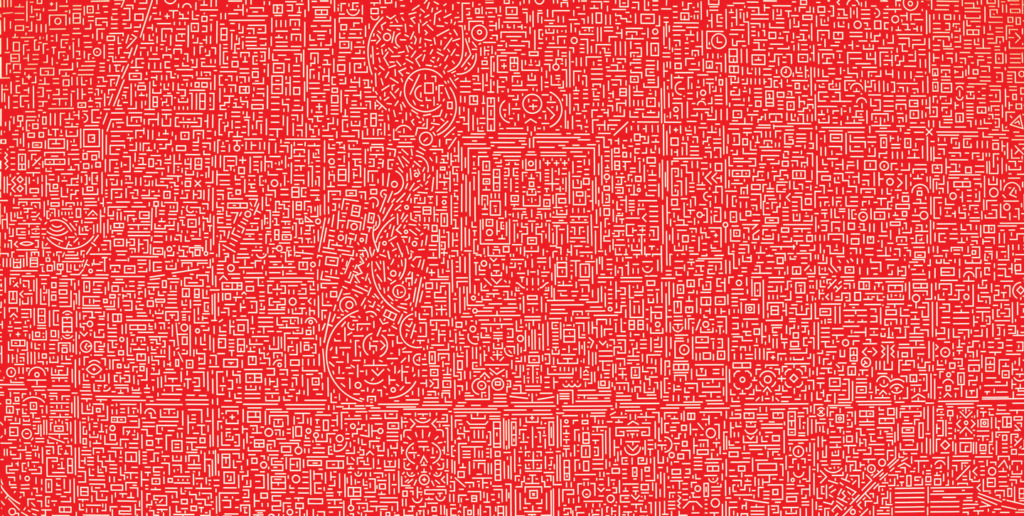
City DNA Beijing, 2010, oil on canvas
City DNA: Beijing (2010) shows the symmetrical axis of the Forbidden City, its surrounding 
lakes and the jumble of historical hutongs and courtyards in lines and dashes on a scarlet ground. 
The artist’s source imagery is scanned into a graphics software program to create a vinyl stencil, 
from which each shape must be carefully unpeeled before he can paint over it, in colours selected 
from national or city flags. The process is repetitive and exhausting – it can take up to four days 
to peel off each line from the stencil over one large canvas. The annotated print-outs from Google 
Maps that Lu donated to the Judith Neilson/White Rabbit Collection archive reveal how he begins 
the laborious process of designing these complex compositions.
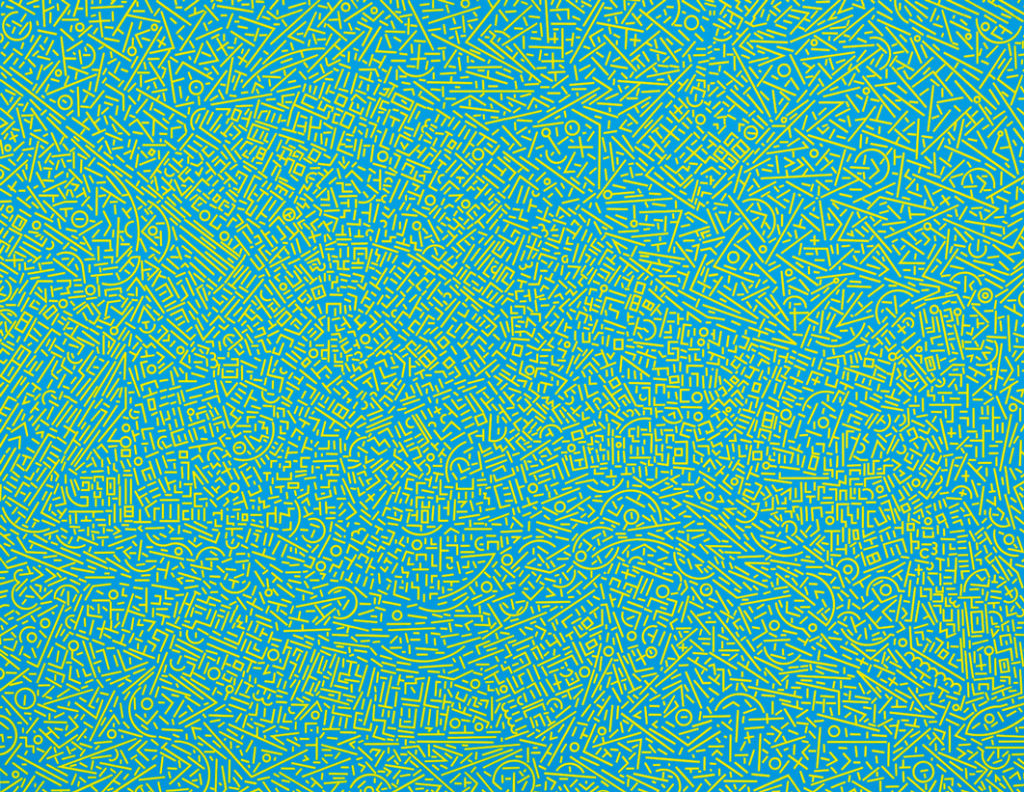
City DNA Venice, 2010, oil on canvas
Lu Xinjian sees his slow, methodical practice as connected to meditation or the calming 
practice of Qi Gong, despite the frenetic contemporary hustle and bustle of his urban subjects. 
He says, ‘Coming from a small peasant village where nothing changes and the cultivation of tea 
marks the rhythms of life, the dynamism of the urban landscape has always fascinated me.’
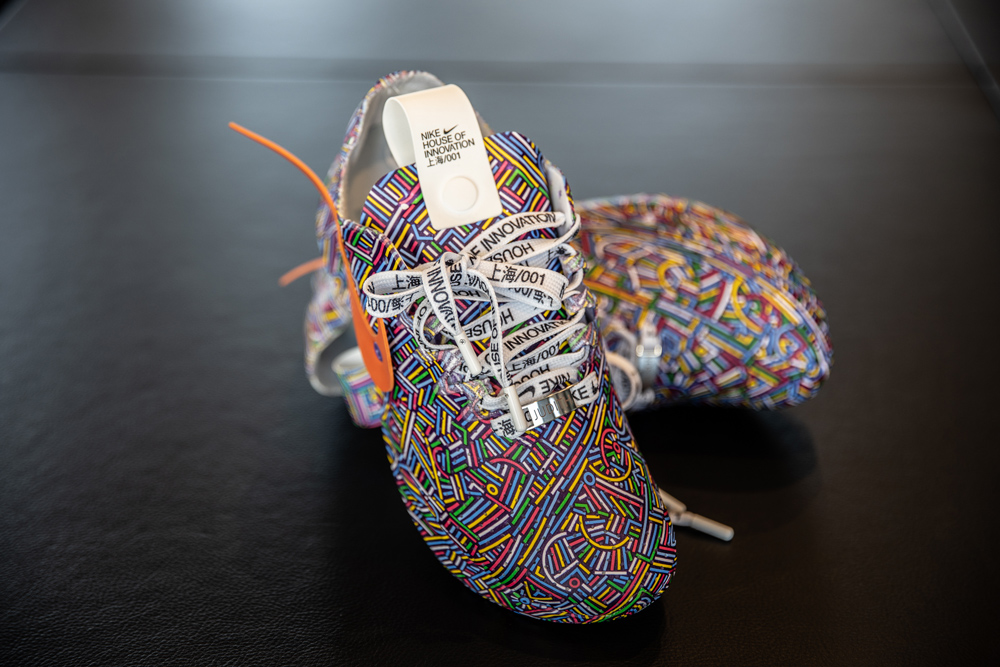
Fast Forward to 2018. Lu Xinjian, now an extremely successful artist on the international 
stage, collaborates with Nike on a remarkable project: transferring new City DNA designs to a
limited edition shoe, initially one especially designed for the current marathon world record holder 
Eliud Kipchoge. Asked about the connection between artist and runner, Lu explained: 
‘He runs through cities, crosses them, lives them, takes them step by step. Instead, I paint the cities
 – not only the shapes on the canvas, but also the speed, the noise, the atmosphere.’ 
Only 300 pairs of shoes were produced, released at the first Nike flagship store in Shanghai. 
Their designs are based on the map of  Shanghai, with the Huangpu River at its centre. 
Two pairs of these extraordinary shoes are now in the research library at Dangrove, evidence of 
the enduring link between contemporary art and design that has been embraced by Chinese artists. 
Here, researchers can find interviews, plans and diagrams in the archive, books and catalogues 
in the library, and of course the works themselves in the collection.
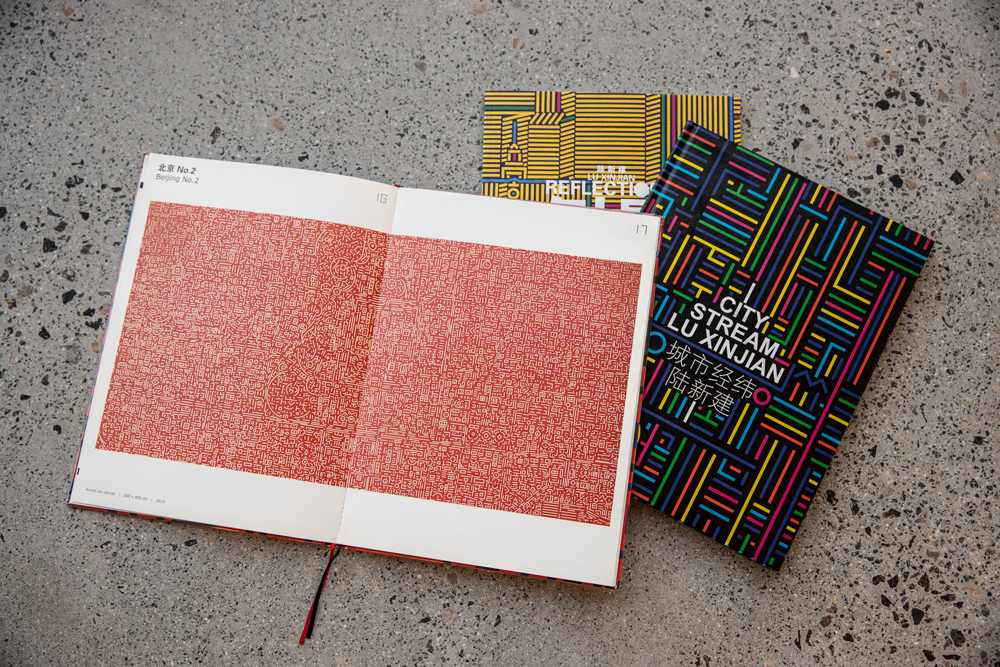
Check out the whole website HERE - navigate to the 'Dangrove' section for information about the 
White Rabbit Collection and its archive.


Wednesday, May 10, 2017

Lu Xinjian: Looking for Harmony in the City


Shanghai-based painter Lu Xinjian has invented his own visual language with which he represents his experiences of urban life. In several interviews for the White Rabbit Collection since 2015 in Shanghai and in Sydney (Judith Neilson was one of the first collectors to see his early 'City DNA' paintings in Beijing, in 2011), he talked with me about his early life as a boy in rural China, and his surprising metamorphosis into a highly successful contemporary artist on the global stage.
Lu Xinjian and a painting in his 'City Stream' series, image courtesy the artist
These interviews were compiled as a profile of the artist published this week in 'The Art Life', together with a video interview conducted at White Rabbit Collection late last year. It goes like this:

Lu Xinjian’s early life seemed an unlikely background from which a successful artist might emerge. Born in 1977 into a poor farming family in a rural village in Jiangsu Province, by his own account his childhood was spent running wild, looking after ducks and chickens. After school he studied computer graphics and graphic design, despite his love of painting, knowing that a poor boy making his way in the world needed a more secure income than that of an emerging artist. 
Lu Xinjian with his mother, image courtesy the artist
But a chance encounter changed everything: in 1998 the influential Dutch design company Studio Dumbar had an exhibition at the art museum in Nanjing, where Lu Xinjian was studying. He didn’t have the money to buy a ticket to enter the gallery, but stood entranced in front of the posters, absorbing their structures, colour, line and form, their use of the Modernist grid. Returning to the college library, he began to read everything he could find about European design, determined that one day he would go to study in the Netherlands. It took four years after graduation to save the money, but in 2005 he graduated from the Design Academy in Eindhoven, and in 2006 from the Interactive Media and Environments Department at the Frank Mohr Institute of Hanze University of Applied Studies.
Lu Xinjian in the studio, image courtesy the artist
In Eindhoven and Groningen Lu Xinjian found himself at the centre of a particular Modernist tradition. To that point he had loved the work of Keith Haring and other contemporary American painters, but now the work of artists of the European ‘Zero’ movement of the 1950s and 1960s, such as Heinz Mack, Gunther Uecker and Otto Piene inspired him. They believed that art should be a ‘zone of silence’ devoid of personal expression. Lu Xinjian saw in this philosophy a link to Buddhist traditions of restraint and simplicity, harmony and quietude. After early experiments with figurative expressionist painting, an influential teacher, Petri Leijdekkers, introduced him to de Stijl and the work of Mondrian. He had been at an impasse, lonely and depressed during a residency in Korea, when he began to draw views of the night sky, the edges of buildings as lines and the stars as dots. The dots and dashes found in the ink drawings of Van Gogh, the grid structures of Dutch and German early twentieth century design, and the cool abstraction of Mondrian coalesced to form a new way of thinking. This epiphany was the start of his important City DNA series.
Lu Xinjian, City DNA – Beijing, 2010, acrylic on canvas, 200 x 400 cm, image courtesy White Rabbit Collection
From this point Lu Xinjian began to paint in more abstract ways, using aerial perspectives of iconic metropolises: New York (irresistibly recalling Mondrian’s Broadway Boogie Woogie) Beijing, Shanghai, Rome, Paris, London, Los Angeles, and Venice. The first in the series, however, was the Dutch university town of Groningen, where he had taken photographs from the top of the tower in the centre of the town before returning to China. Sources for his imagery included maps and satellite views of each location, as well as photographs, but the artist sees his work as philosophically complex and multi-layered. He believes cities are built and defined by history, culture and language as much as by geography; each is distinct and unique, despite the homogenising impact of globalisation. Lu Xinjian tells the story of each city in a visual language of his own invention that merges western abstraction with simplified forms that recall the Bauhaus and Dutch graphic design, in combination with computer coding. The picture planes appear to pulsate with energy, despite their flat, brightly coloured grounds. Struggling to find a name for this body of work, Lu Xinjian suddenly saw the lines and dashes as akin to a diagram of a human genetic code. Cities, too, have a kind of DNA structure, a term borrowed from architectural practice, conveying something of the unique and complex social and architectural systems of the modern metropolis.

TO read more in 'The Art Life' , click HERE

And here is the video interview with Lu Xinjian 


Lu Xinjian in Conversation with White Rabbit from White Rabbit Collection on Vimeo.
Shanghai-based painter Lu Xinjian discusses his 'City DNA' series, his interest in Mondrian and Dutch design, and how a boy from a poor rural farming family became a successful contemporary artist