The ongoing thoughts of an art teacher in China - and home in Sydney

A continuing diary about my travels in China, and thoughts about China and Chinese art from home and abroad
Showing posts with label Sherman Contemporary Art Foundation. Show all posts

Tuesday, July 21, 2015

Why art education matters: and what it's got to do with Ai Weiwei

Last week I took a group of 30 senior high school students to the exhibition of works from the Sherman Collection of Contemporary Asian Art, 'Go East' at the Art Gallery of New South Wales. (I reviewed the show for 'The Art Life' - click here for my thoughts.)
Jitish Killat, Public Notice 2 (detail)  in Go East, image The Gene & Brian Sherman Contemporary Asian Art Collection and the Art Gallery of New South Wales
I was curious to see their responses to a show which is in many ways quiet and cerebral, opening with Jitish Kallat's (admittedly visually overwhelming) tribute to Mahatma Gandhi's famous Salt March speech, in which every word is represented with letters made out of replica bones, arranged on narrow ledges on a wall painted the colour of turmeric. The students were fascinated, responding thoughtfully - even tired, at the end of a long day, very close to final exams, and close to the looming deadline for the submission of their own bodies of work. Their willingness to look for the conceptual intentions and possible meanings behind each new artwork they encountered was heartening.

They have spent the last two years with me, immersed in contemporary art from around the globe. At first they had been frankly sceptical - we'd had a few of those "But how can that be art?" conversations that every teacher knows. So it delighted me to hear their earnest discussions of Song Dong's endurance performance, in which he lay prostrate on the winter-cold surface of Tiananmen Square, and then upon a frozen lake, discovering (rather to his surprise) that in that location his warm breath had no discernible effect on the ice. They talked about the subtle symbolism - and clever satirical intent - of any Chinese work produced after 1989 that uses the potent location of Tiananmen. Some saw a comment on the continuing elemental power of the natural world in comparison to the puny efforts of humanity. Others discerned a comment on the failure of artists and pro-democracy demonstrators to change the tragic course of events 26 years ago.
Zhang Huan
Family Tree, 200
C-type prints. Suite of 9 images
Edition 2/3
227 x 183 cm (Framed)
Image courtesy: The Gene and Brian Sherman Collection, and Sherman Contemporary Art Foundation, Sydney
Photo: the artist
They looked with interest at Zhang Huan's 'Family Tree', reading it variously as the overwhelming power of written language and traditional culture over individual desires and freedoms, or alternatively as the sadness and loss of diaspora. Charwei Tsai's quietly meditative Buddhist sutra written on a mirror reflecting the ocean enthralled them, as did Tibetan artist Nortse's installation of the robes of Buddhist monks, arranged as if the seated monks have vanished into the blowing sand that covers the hem of each robe, overturned yak butter lamps indicating the overturning of tradition, religious practices and - again - the loss of language. Some knew about the practice of self-immolation, and others were completely horrified to learn of these acts of desperation.
Nortse, Zen Meditation, 6 monks' robes, butter lamps, Chinese money, scriptures, sand, metal frames,
image courtesy the Gene and Brian Sherman collection
The work that caused the most intense discussions, however, was by Ai Weiwei. Familiar with many of his works, from the iconoclastic smashed Han Dynasty urns to porcelain sunflower seeds, from 9,000 school backpacks representing young lives lost in the Sichuan earthquake to the recent (and I must confess, a little disappointing) installations on Alcatraz Island, my class were excited to see 'An Archive' - a work newly commissioned by Gene and Brian Sherman, and generously gifted to the Art Gallery of New South Wales.
Ai Weiwei, 'An Archive', huali wood, xuan paper, edition of 2 + 1 AP, image courtesy the Gene and Brian Sherman collection and Art Gallery of New South Wales
We had discussed its possible references and the artist's intentions before we went to the gallery, reading a little about the work, watching an informal video of Ai talking about it (and endearingly dropping the video camera, so the end footage is upside down). Nothing prepared them for the size of the beautifully constructed huali wood box, and its contents of 6000 large sheets of rice paper with every (banned) blog post and tweet made by the artist since around 2005. I had deliberately made no reference to it, wanting that first immediacy of seeing the actual, physical object to be a memorable and palpable experience: a salutary reminder of the power of an encounter with the original work of art rather than its reproduced 'shadow image'.

 I listened to their impassioned discussions in response to my question - why a wooden box? Why stacks of paper that cannot be read? Why transcribe something so essentially ephemeral as tweets? I cautioned them against identifying Ai Weiwei as a secular saint - the patron saint of free speech according to some western observers, or alternatively as a giant ego who "hoovers up all the oxygen" in the Beijing artworld, according to others. And with four (yes - four!) concurrent shows at four major Beijing galleries, nobody could say he's invisible, or unheard, even despite the continuing and constant surveillance to which he is subjected. Nevertheless, polarising though he might be, his practice provides rich and fascinating opportunities for my seventeen and eighteen-year-old students to hone their artwriting chops. I confess I would be a little happier if I didn't occasionally read responses that told me that Han Dynasty urns were important artefacts of the Cultural Revolution, but hey, you can't have everything!

At the end of the day, the bizarre rite of passage that is the Higher School Certificate examination aside, what I take with me from this afternoon is the genuine interest my students showed in looking carefully, slowly and with keen intelligence at contemporary art that is not easy or quick to decipher. Even more importantly, that critical ability to make connections, to "join the dots", to make informed inferences and logical deductions, as well as those all too rare intuitive, imaginative leaps that make the heart sing. “So if you set a model of what it means to look hard at something, think a while about it before you open your mouth, and then articulate it carefully—you will have done your job as a critic," said  Robert Storr, Dean of the School of Art at Yale. He was talking about art criticism, but what a principle for an intelligent, interesting and thoughtful life!  I believe that my students (maybe not all, but certainly most) will take this with them into their adult lives, and be the richer for it. And THAT is why an academically rigorous and challenging art education matters.

Ai Weiwei, 'Overcoat', military coat and 2 digital prints, image courtesy the Gene and Brian Sherman collection

Monday, May 25, 2015

Go East

Jitish Kallat, Public Notice 2, 2007,
image courtesy the Gene and Brian Sherman collection and the Sherman Contemporary Art Foundation,
Photo: Hangar Biocca, Milan

Important works from the private collection of Gene and Brian Sherman are revealed to the public in Sydney in an exhibition across two spaces: 'Go East', curated by Suhanya Raffel at the venerable and slightly staid Art Gallery of New South Wales, and Yang Zhichao's monumental performance installation, 'Chinese Bible' at the Sherman Contemporary Art Foundation. The Shermans have given this work, and another significant installation by the Indian artist Jitish Kallat, to the museum. In comparison with the wonderful collection of contemporary art from Asia in the permanent collection of the Queensland Gallery of Modern Art, the holdings of AGNSW are rather woeful: it is to be hoped that these two very significant and generous gifts may kickstart a more dynamic acquisitions program that acknowledges the significance of Asian art, and our place within Asia.
Yang Zhichao
Chinese Bible, 2009 (detail)
3,000 found books
Dimensions variable
Image courtesy: The Gene and Brian Sherman Collection, and Sherman Contemporary Art Foundation, Sydney
Photo: Jenni Carter, AGNSW
My review of the exhibition, in which I was thrilled to encounter familiar works by Lin Tianmiao and Yin Xiuzhen, artists I have interviewed in China in the last two years, seeing them in a new light, was published today on The Art Life:

To title an exhibition of contemporary Asian art ‘Go East’ might seem deliberately provocative, given the geographical reality that Asia is not, in fact, to our east. It hints at Orientalism, at ‘Otherness’, at post-colonialism, as curator Suhanya Raffel acknowledges in her excellent catalogue essay. But it also acknowledges another reality: since the 1980s, despite many a political and diplomatic hiccup along the way, Australia has, in fact, turned to the metaphoric and cultural (if not the geographical) east.
Lin Tianmiao, 'Badges', 2009, white silk satin, coloured silk threads, gold embroidery frames made of stainless steel, sound component: 4 speakers with amplifier, dimensions variable, image courtesy the Gene and Brian Sherman Collection and the Sherman Contemporary Art Foundation, Sydney, Photo: Galerie Lelong, New York


The history of our engagement with contemporary art from Asia is filled with significant exhibitions, strong private and public collection programs, and cultural exchanges, of which ‘Go East’ is an important example. Since the Sherman Contemporary Art Foundation’s first commissioned project with Ai Weiwei in 2008, many of these discourses have been instigated by Gene Sherman. Through subsequent projects Australian audiences have been introduced to works by Chiharu Shiota, Charwei Tsai, Yang Fudong, Alfredo and Isabel Aquilizan andDinh Q. Le, to name just a few. ‘Go East’, an exhibition of works from the Gene and Brian Sherman collection at the Art Gallery of New South Wales, features these artists and others from China, India, Indonesia, Japan, the Philippines, Taiwan, Thailand, Tibet and Vietnam. It presents compelling evidence that an artistic ‘pivot to Asia’ will continue to enrich, provoke, and delight audiences.
Meanwhile, at the Sherman Contemporary Art Foundation in Paddington, Yang Zhichao’s ‘Chinese Bible’ fills the space recently vacated by Shaun Gladwell’s watery ‘Lacrima Chair.’ A sea of red, interspersed with flashes of blue, yellow and green, ‘Chinese Bible’ comprises three thousand personal notebooks and diaries collected by the artist in Beijing’s Panjiayuan ‘Dirt Market’, revealing a hidden history. Showing in tandem with ‘Go East’, the work represents the tsunami of change weathered by ordinary Chinese people over the fifty turbulent years from 1949 to 1999. Exhibitions, Gene Sherman told her audience at the opening of ‘Chinese Bible’, are “primary sites for the construction of art history. Exhibitions tell the story of art. They reveal untold or forgotten aspects of history - not just art history - and they shine the light on social injustices. Exhibitions are where artworks meet audiences.”
Yang Zhichao
Chinese Bible, 2009 (detail)
3,000 found books
Dimensions variable
Image courtesy: The Gene and Brian Sherman Collection, and Sherman Contemporary Art Foundation, Sydney
Photo: Jenni Carter, AGNSW
These humble notebooks and diaries, rescued from oblivion, washed and presented as found objects, are filled with self-criticisms, transcribed passages of compulsory ‘Mao Zedong Thought’, mechanical diagrams, even (forbidden) personal reflections, poetry, knitting patterns and recipes. Laid out in symmetrical rows on a raised platform, the almost uniform red of their covers presents an allusion to the modernist grid – another kind of failed utopian vision. Their cover designs reflect periods of recent history, with pictures of animals, temples, traditionally costumed characters, and dancers disappearing in the years of collective madness between 1966 and 1976, when the Cultural Revolution made every element of an individual’s dreams, desires or memories suspect and taboo. Those covers are plain red, or adorned with images of Mao.

Better known for provocative performance works involving bodily mutilation and even surgery (most notably having tufts of grass from his home province surgically implanted in his back) Yang has found a new calm and quietness. Like other transgressive artists of the period such as Zhang Huan (whose ‘Sydney Buddha’ featured at Carriageworks over the summer) Yang Zhichao appears to be reflecting on his own and China’s history. I asked the artist about this change in his practice. “It relates to the introduction of performance art into China – in 1989 it was a very new thing, and was introduced into China from outside,” he said. “From 1995 to 2005 it was kind of a ‘golden age’ of Chinese performance art - it was an art form that put the artist in opposition to a variety of things: to society in general, to living conditions, to governmental regulations, and of course to the artworld itself. It was such a meaningful practice. In the period 2005 – 2015 there has been significant change in China that has also contributed to a change in art practice. Looking back over the last ten years… in general it has changed to a less confrontational mode.” And, he added, somewhat ruefully, “Also, artists have aged!”
To read more, click HERE.

Sunday, May 17, 2015

Physical to Metaphysical: Cui Xiuwen's Buddhist Formalism

Cui Xiuwen, Angel no. 3, 2006, photograph, image courtesy the artist
The artist whose video work prompted a notorious lawsuit, whose photomedia works explored the forbidden territory of sexuality and repressed memories of a different China, has reinvented herself as an abstract painter. Her show at Klein Sun Gallery in New York reveals the extent of this transformation.

Last December I met Cui Xiuwen in her Beijing studio for a long conversation about the dramatic shifts in her practice. At the risk of being accused of shameless self-promotion (OK, I plead guilty) she is one of the artists who features in my book about contemporary women artists in China. When I saw the images from her New York show this month, I replayed the tape of that interview, listening once more to the artist talk about her artistic metamorphosis, punctuated by the noise of barking dogs in the lane outside - an inevitable aural accompaniment in any visit to a Beijing studio.
The writer with Cui Xiuwen in Beijing, December 2014
I had particularly wanted to meet Cui, often described as one of very few feminist artists in China, because of her evocative photographic images of young girls in the forbidding surrounds of the Forbidden City - red walls, red scarves and a disturbing atmosphere of claustrophobic sexuality. I was even more intrigued when I realised that an early video work, 'Lady's Room', shot in the toilets of a swanky Beijing karaoke bar, where the 'hostesses' are not just selling their company and their singing, had caused the first lawsuit involving contemporary art in China. For details, you will have to read my book!
Cui Xiuwen, 'One Day in 2004', photograph, image courtesy the artist
From early notoriety as a painter of male nudes and fairly graphic depictions of sexuality (nudity is still, even now, somewhat taboo in China) to experimental video and photomedia works, Cui Xiuwen has charted the autobiographical territory familiar to many artists of her generation. Struggling to forge an identity in a country convulsed by change, trying to marry her experience of the collectivist past with the aspirational, individualist present, Cui like others turned to childhood memory for her image-making. Her crowds of sleepwalking girls in works such as 'Angel' represent a country that had been asleep, oblivious to repression and enforced conformity. Now, however, Cui has turned to a cool, minimalist abstraction - a visual language of line and shape that echoes the post-painterly formalism of the sixties and early seventies. She describes this transition as emerging from a renewed interest in Buddhism.
Cui Xiuwen, 'Awakening the Flesh', installation view, image courtesy Klein Sun Gallery
In recent years, she has become more interested in the spiritual, the ineffable; seeking ways to represent her experience of reading Buddhist texts. She has moved from the physical, to the psychological, to the spiritual and she uses the metaphor of climbing a staircase to describe this process. In doing so, she has found an abstract language that connects her with an interesting aspect of the Chinese artworld zeitgeist: a rediscovery of the possibilities of formal abstraction is an emerging trend there, just as it is internationally. Overwhelmingly, Chinese painting is figurative, with art schools training thousands of students every year to paint in the traditions of French and Soviet realism. Chinese-trained artists can paint like pretty much no-one else in the world today, and abstraction has not been a significant element in the contemporary art that emerged in the last 30 years. There are exceptions, of course, including Shanghai painters such as Ding Yi, or the young rising star, Li Shurui, who uses an airbrush to create almost psychedelic explosions of light and colour. There is a new interest in modernist and postmodernist abstraction, and many discussions of its possibilities in new media and sculpture, as well as in painting. Agnes Martin, Gerhard Richter, and even Barnett Newman are names that have emerged in my conversations with Chinese artists.

But there is another aspect to this new zeitgeist, or 'shidai jingshen'. In Beijing last December almost every conversation seemed to turn (unprompted by me) to Buddhism. Friends at dinner mused about the spiritual malaise they feel has infected Chinese society. Zhang Xiaotao told me his dearest hope for China was for a Buddhist renaissance. Feminist performance artist He Chengyao, returned from a year in a Tibetan monastery, spoke of her new practice creating abstract, meditative works on paper. Even the 'bad boys' of Beijing's East Village Artists' community have changed. The artists who shocked the artworld with their raw, masochistic performance works in the 1990s, featuring acts of self mutilation and abnegation, have turned to a newly reflective practice. Zhang Huan's 'Sydney Buddha' made of ash from the prayers burned in temples, and Yang Zhichao's beautiful 'Chinese Bible' installation at the Sherman Contemporary Art Foundation in Sydney both reflect elements of this transformation.
Cui Xiuwen, 'Reincarnation No.10, acrylic on canvas, 2014, image courtesy the artist
Works from Cui Xiuwen's 2014 abstract series are currently also showing at the 'Si Shang' Art Museum in Beijing, in  'Breaking the Image', an exhibition intended (somewhat didactically) to provoke discussion about how contemporary artists in China respond to international art discourses. Since the beginning of this century, access to global contemporary art is immediately available on the internet (albeit in virtual form) and many artists are also able to travel for residencies and study overseas. This has led to a revitalisation of previously marginalised forms such as abstract painting. Curator Libin Lu says, rather plaintively, "Many more artists have quietly explored this issue, looking for new possible forms of self-contained artistic language. Due to limiting factors as well as objective reasons from artists, this exhibition exhibits only a fraction of works by artists working within this vein." He hopes it is a continuing trend, and worries about the co-option of abstraction by the market since its emergence as a style in 2006: "But within less than ten years, we are grieved to discover that the majority of abstract art has become “decorative painting” or simply a “conceptual painting tool"

Cui Xiuwen arrived at her own spare visual language via a transitional series of photographs shot in bleak, snowy landscapes around her birthplace of Harbin, from which all the vivid colour of her early works has been removed, in a deliberate reference to the disciplined marks of  'Shan Shui' ink painting. The next phase was a move to pure abstraction. Cui Xiuwen speaks passionately of her desire to transcend the everyday, and to express profound truths in installations of painting that provide immersive experiences for the viewer. Despite the anxiety of the Si Shang curator she could not be accused of 'decorative painting'.
Cui Xiuwen, 'Reincarnation No.15, Varnished Aluminium and Acrylic on Canvas, 2014,
 image courtesy Klein Sun Gallery  

© Cui Xiuwen
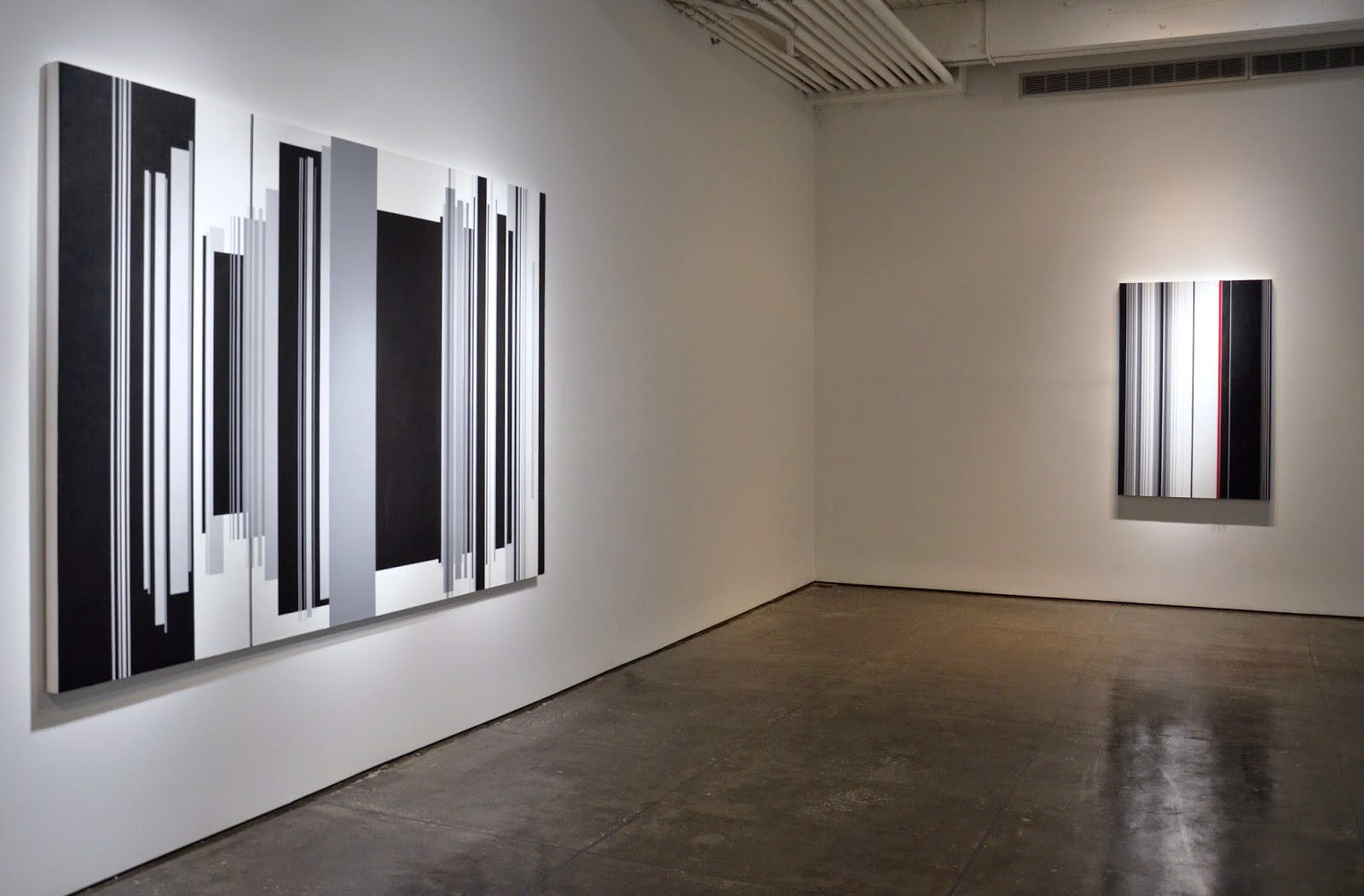
So what do we see in Cui Xiuwen's new exhibition, 'Awakening of the Flesh' in New York? The title is provocatively paradoxical - any fleshly concerns here are so pared back as to be unrecognisable. All the elements of her typical iconography - the schoolgirls, iconic Chinese architecture, dolls and landscapes - have been stripped away. There is almost no colour. These new works, often created with aluminium and acrylic on canvas, are minimalist surfaces featuring repeated forms and lines. Cui is finding new ways to convey ideas about mysticism, meditation and a higher plane of consciousness. The works are severe, yet tranquil, and in paintings such as 'IU no. 4' there seem to be echoes of Malevich and the Russian Suprematists. Metallic, slightly brittle, they are the antithesis of her earlier lyrical, narrative photographic works.
Cui Xiuwen, 'IU No.3, Acrylic on Canvas, 2014, image courtesy Klein Sun Gallery  © Cui Xiuwen
Lit in the darkened space of the Chelsea gallery, they appear to glow. Is there more than surface beauty? 'Reincarnation No 9' suggests that the artist has one foot firmly on the ground, and although she may be operating in the rarefied plane of  'wu wei' she is still interested in responding to worldly concerns. Unlike the calm horizontal layers appearing in other works, this painting's variegated vertical bands remind us forcefully of a bar code. Intentional or not, it suggests the inevitable tensions and slippages between the desired state of elevated spiritual awakening, and the forceful imperatives of the flesh, especially those manifested in commerce and consumerist desire.

A full account of Cui Xiuwen's practice appears in 'Half the Sky: Conversations with Contemporary Women Artists in China', to be published by Piper Press in October.

Sunday, May 3, 2015

Writing Makes You Fat! 写作会让你更胖!

Gao Rong, Guangzhou Station (detail) copy handbag, embroidery thread, fabric and foam, dimensions variable,
 image courtesy the artist
I have discovered a sinister and hitherto little known (at least to me) connection between writing and obesity. As I enter the final dark days of editing, wrestling my unwieldy and intractable beast of a book into submission in the attempt to create a leaner, meaner version ready for print and publication by October, any pretence of a commitment to fitness and exercise has flown right out the window. Writing in the early mornings before work, in the late afternoons as soon as I get home, and late into the night, carving out chunks of time on weekends, and lying awake thinking about it in the middle of the night, whilst also continuing to worry about my students and take home vast piles of marking has taken its toll. By this point it has resulted in a state of physical torpor so marked that my gym has now stopped sending me those annoying emails that begin cheerily, 'Luise, we haven't seen you for x weeks!' Am I feeling guilty? Of course. There's a direct correlation between the length of my book and the size of my arse. And now, as my book gets leaner, I seem to be getting larger.

There should surely be websites dedicated to this - maybe useful K-Tel products could be advertised on weird late night TV channels. Perhaps a treadmill which you could operate whilst typing might be the go. I tell myself - every week - that this week will be different. I will walk each morning at sunrise, I will go to the gym, I will go to all those yoga classes I've paid for already. I will not eat chocolate (ha ha) and I will not drink wine (ba ha ha!) And my final vain resolution, every single week, is that I will do an hour of Chinese study every day. Sad to admit, none of this has happened. But there is light at the end of the rainbow and a silver lining at the end of the tunnel. (Which, come to think of it, could well be a Chinese maxim.) Each day is a new beginning and the East is red.....

There is also the fact that the solitary occupation of writing has to be balanced with all the competing demands of daily life. When I read all those stories of male writers who shut themselves away in their studies and emerged only for meals that had been cooked and served by women, I used to think, 'Those bastards!' Now, I think, 'Those lucky bastards...' I am looking for inspiration in other stories of women like PD James who rose before the sun every morning and completed a few hours of writing before going to her job as a senior civil servant. Or Mary Wesley, whose first book was published after she was 70. It did, after all, take me until I was 58 before I had that all important "room of one's own."

The book will, I suppose, eventually, be finished. Afterwards I will return to China, study Chinese each day while I am in Beijing, and embark on a project for a whole new adventure that begins at the end of September. I am looking forward to my encounters with artists such as Li Hongbo, Xu Zhen, Lu Xinjian and Wang Qingsong, and to broadening my field of research. I will travel to Chengdu to visit some artists' studios, and return to Hangzhou, where I was able to spend only one day with Wang Zhibo last December. My experience of China is so limited, and I want to see cities other than Beijing and Shanghai, wonderful though they are.
Lu Xinjian, City DNA Beijing, 2010, acrylic on canvas, 200 x 400 cm, image reproduced courtesy of White Rabbit Gallery
Many of the artists included in my book have recently shown new work in China and internationally, or are about to do so: Cao Fei at Hong Kong Art Basel and the Venice Biennale, He Chengyao and Tao Aimin at the International Expo in Milan, Cui Xiuwen's second solo show at Klein Sun Gallery in New York, and Liu Shiyuan at Whitespace in Beijing, just for starters. Yin Xiuzhen's 'City Suitcases' and the feminist 'Badges' that Lin Tianmiao explained to me when we met in 2013 are in an important exhibition, opening later this month, of works from the Gene and Brian Sherman Contemporary Asian Art Collection at the Art Gallery of New South Wales, 'Go East'. This promises to be intriguing. As Ai Weiwei said, 'Everything is art, everything is politics,' and with works from Dinh Q. Le, Alfredo and Isabel Aquilizan, Song Dong, Zhang Huan and Yang Fudong, among others, this will be an exhibition not to be missed, of works by artists who engage with the most significant issues of our time. So while I am sad to miss the exhibition of Xu Zhen and his Madein Company at the Long Museum in Shanghai (a visitor to his studio recently described it as 'like Andy Warhol's Factory, but with less sex and drugs') and I can only sigh over the impossible dream of getting to the Venice Biennale, I can at least console myself with the knowledge that Chinese contemporary art is now everywhere, and Sydney is no exception.
Lin Tianmiao 'Badges' 2009 white silk satin, coloured silk threads, gold embroidery, frames made of stainless steel, sound component: 4 speakers with amplifier, Dimensions variable, Image courtesy the Gene and Brian Sherman Collection and Sherman Contemporary Art Foundation Sydney, Photo: Galerie Lelong New York
 In the meantime, I am enjoying working with my students on their own writing about contemporary artists ranging from Ai Weiwei and Xu Bing to He Xiangyu, Ah Xian and Shen Shaomin. They continue to surprise me with their thoughtful interpretations and their interest in the ways in which contemporary artists can embed meaning into their choices of materials. Most recently they have been writing interpretations of Ai Weiwei's latest installations on Alcatraz Island, particularly 'Blossom', the installation of white porcelain flowers with which he has filled the tubs, toilets and washbasins of the abandoned psychiatric hospital wing. Now they can talk knowledgeably about Mao's cruelly deceptive 'Let 100 Flowers Bloom and 100 Schools of Thought Contend' policy of the 1950s, no mean feat for Australian kids who could not tell you anything at all about China and its history only one short year ago.

Even the little ones in Year 7 have done some writing about Cai Guo-Qiang's beautiful circle of animals around a waterhole, 'Heritage', and Year 8 are writing imaginary wall texts for an exhibition of Gao Rong's fake designer handbags embroidered with stains and filled with unlikely embroidered objects, ranging from a sausage to a giant oozing tube of toothpaste; from a packet of laundry powder to builders' tools. I will be intrigued to see what they make of this work, entitled 'Guangzhou Station' and shown at the Moscow Biennale in 2013.


Gao Rong, Guangzhou Station, (details) copy bags, embroidery thread, fabric and foam, dimensions variable, image courtesy the artist

'Half the Sky: Conversations with Contemporary Women Artists in China' will be published by Piper Press in October 2015.