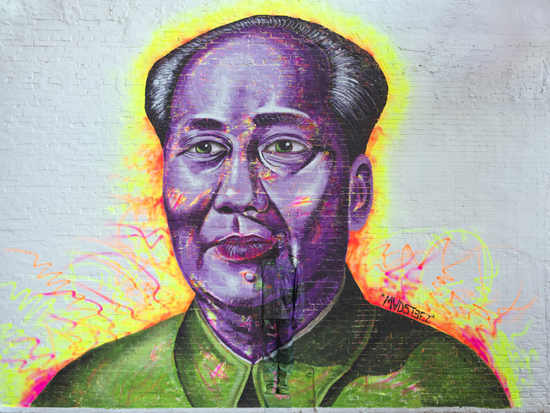
I have just returned from two weeks in New York, where somehow I still managed to be immersed in all things Chinese, from the Liu Bolin exhibition at Klein Sun Gallery, to the very beautiful exhibition of Chinese albums at the Metropolitan Museum, to Prune Nourry's 'Terracotta Daughters' showing in the new downtown China Institute and a fabulous and fascinating show entitled 'Mao's Golden Mangoes and the Cultural Revolution' at the older uptown China Institute. More of these in a later post. Meanwhile, here is my review of the Liu Bolin show, published this week on 'The Art Life'.
Cloaks of Invisibility: Liu Bolin in New York
Invisibility, erasure, disappearance, camouflage. This is the preferred territory of Chinese artist Liu Bolin (Liu Bolin at Klein Sun Gallery for more images of his work), whose ambiguous works make us question the “real” world, revealing it to be a mere painted illusion.
Best known for his ‘Hiding in the City’ series, in which he literally paints himself into various backgrounds, in cityscapes as diverse as Beijing, New York, London and Paris, Liu Bolin is sometimes called “The Invisible Man”. He is a master of a complex trompe l’oeil technique which allows him to examine the paradoxes and slippages of the contemporary world. Wearing a specially designed suit, the artist is painted by a team of assistants, in a painstaking and sometimes physically challenging ordeal, to merge almost seamlessly with his background. A disappearing trick; the artist as conjurer. No mere pop culture gimmickry, Liu Bolin’s process of erasure examines issues of contemporary culture and social justice, never more so than in his most recent exhibition in New York, at Klein Sun Gallery, ‘A Colorful World?’ In the lyrics of pop diva Cece Winans, “It’s a colorful world, it’s a beautiful world that we live in/ It’s a colorful world…” Well, perhaps, but Liu Bolin is interested in what happens when saccharine sentiments are juxtaposed with contemporary realities.
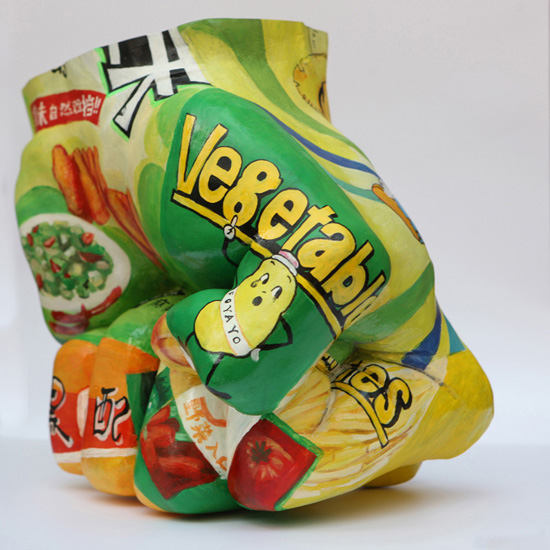
Liu Bolin ‘In Junk Food No.5, 2014. Acrylic on copper 36x36x26cm. Courtesy Klein Sun Gallery, NY. © Liu Bolin
Here we see works from the ongoing ‘Hiding in the City’ series, and new works created for the show. Liu also involved New Yorkers - 100 volunteers - who spent many excruciating hours being painted by the artist and his assistants for a new ‘Target’ series. Camouflaged into backgrounds of new $100 bills and a traditional Chinese ink painting, they were required to hold poses inspired by Renaissance paintings. The artist questions the ways in which people are made the passive recipients of consumerism, and the victims of political forces beyond their control. Underlying ‘Hiding in the City’, too, is the omnipresent smog and haze of pollution in Chinese cities, which Liu sees as rendering their inhabitants partially invisible, both literally and metaphorically.
Liu Bolin Head Portrait’ 2012. Courtesy Klein Sun Gallery, NY. © Liu Bolin
The first works in this series, created in Beijing, in Tiananmen Square or in the rubble of his studio, overtly reference to the need for artists to “camouflage” themselves in order to avoid the unwelcome attentions of the authorities. Ideas about appearance and disappearance inform all his work. Artists in China, including Liu himself, engage in a delicate game of cat and mouse, due to the unpredictable and sometimes apparently random nature of political censorship. Liu began this series after his studio in a Beijing artist village was forcibly demolished, creating photographic documentation of his performances. He represented hidden stories of Chinese history, and more recent inversions and varnishings of the truth. Blurring the boundaries between performance, painting and photography, the stillness which is such a striking feature of these images creates a silent protest. Later works in which he has painted himself into scenes of supermarket shelves displaying packaged food or plastic bottles of soft drink refer to issues of food safety and corruption in China.
More recently, Liu’s concerns have become global in their scope. A key image from this show is a life-size standing sculpture, cast from the artist’s own body and covered with brightly coloured food packaging logos. The figure assumes the submissive pose required by airport security in the full body scanner. The posture is one of surrender, capitulation. What is more symbolic of the contemporary world (and the international world of the contemporary artist, in particular) than the airport, that liminal zone of ever more authoritarian surveillance juxtaposed with ever more shiny shopping opportunities? What pose could be more appropriate for the current moment? Klein Sun assistant director, Willem Molesworth, pointed out to me that the pose is also the bitterly ironic “Don’t shoot” stance of black youth protesting in Ferguson, a viral internet phenomenon and a new cultural trope which instantly traversed the globe. In subsequent weeks it was to be echoed by the Occupy Central demonstrators facing police teargas in Hong Kong.
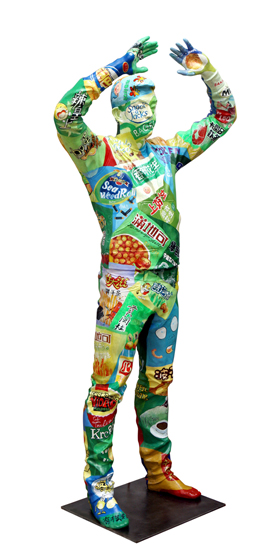
Liu Bolin, Security Check No.2, 2014, 205x95x55cm. Courtesy Klein Sun Gallery, NY. © Liu Bolin
Sculpted clenched fists, ‘Junk food’ No. 3 and No. 5, are copper painted with acrylic, covered in garish Pop Art junk food packaging. An echo of his massive steel fist shown at the Paris Art Fair – monumental, authoritarian, repressive – these smaller versions may be read as inverted symbols of triumph or protest. Liu Bolin was trained as a sculptor, turning to his practice of photographic documentation only after the demolition of his studio. He has been at pains to point out that his work is not a Warholian celebration of glamour and consumerist desire. Rather, he is driven by the rapid transformation of his world – and ours. He examines issues of food safety, environmental destruction, the transformation of China into the world’s factory – and the world’s shopping mall – and the inscribing of global brands onto our bodies and our psyches.
Amongst a number of powerful works in this show the most compelling is ‘Cancer Village.’ This large photograph shows twenty three people, rural villagers from one of China’s notorious “cancer villages”, where industrial pollutants have created unprecedented rates of cancer, even among children. These sites are considered so politically sensitive that they are absolutely off-limits to journalists, artists and film-makers. The villagers (who all willingly volunteered to take part, at considerable personal risk of retribution from local authorities) have been rendered invisible, painted into their toxic fields, and thereby written out of the official story of China’s remarkable economic success. A chemical factory in the background is the source of the 100% increase in the rate of cancer within this rural area. By concealing these people in the contaminated landscape, Liu reveals their plight, and the great cost of China’s rapid industrialisation and wealth.
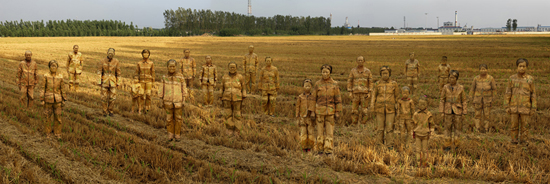
Liu Bolin, Cancer Village, 2013. Photograph. Courtesy Klein Sun Gallery, NY. © Liu Bolin
Liu Bolin is interested in the ways in which our identity is hostage to the interests of global corporations, transcending all previous notions of nationhood and culture. A series of relief works in which a cast of the artist’s head is layered with magazine mastheads is a literal representation of the post-structuralist notion that we exist as a web of texts. These texts, he suggests, are the brands of media barons. We are what we consume, and the notion of “truth” becomes infinitely flexible. In ‘Red Door’ the artist disappears into what seems to be a traditional Chinese timber door, studded with brass spheres. A closer look reveals both the hidden figure of Liu and also the padlock and hasp which show the door to be a modern metal imitation. The individual subsumed by the overwhelming conformity of Chinese tradition and the weight of cultural history? Perhaps the subversive suggestion here is that this history and culture are in themselves suspect – faked - much as the famous tourist sites of Beijing such as the Forbidden City and the Summer Palace are repainted every year, in garish colours.
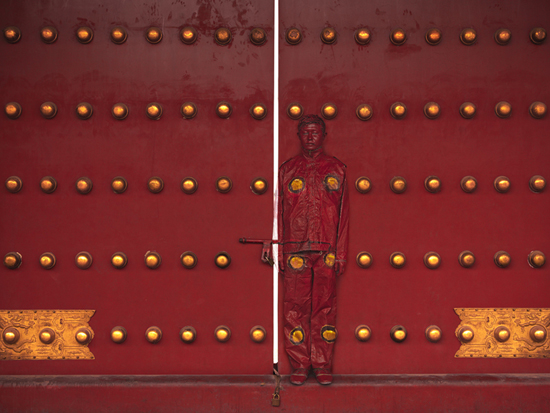
Liu Bolin, Red Door, 2012. Photograph. Courtesy Klein Sun Gallery, NY. © Liu Bolin
‘Hiding in the City: Art No. 1’ camouflages the artist in a Jackson Pollock painting. In actual fact the work in the background is a reproduction. Liu has said that he wanted to pay tribute to the oeuvre of a great master, and yet in the context of his practice we are irresistibly drawn to conclusions about the branding of art and the insatiability of the market. He is also represented “hidden” in a monumental mural of Chairman Mao, in the General Assembly at the United Nations, and in Tiananmen Square, with all its dark connotations. A photograph depicting Liu camouflaged in a wall of meat cleavers references very recent events. After the terrifying attacks carried out in Kunming in March this year, allegedly by Xinjiang separatists, Chinese citizens are now prevented from purchasing these previously ubiquitous utensils, a staple of every kitchen. These works deal with fear. In a world in which terror can appear suddenly amidst the banal environs of the railway station, the shopping mall and the airport, we all experience constant mistrust and a heightened level of anxiety. It’s fertile ground for the artist. The title of his show, complete with its question mark, is darkly ironic.
 |
| Liu Bolin, Kitchen Knives, 2012. Photograph. Courtesy Klein Sun Gallery, NY. © Liu Bolin |
Liu Bolin: A Colorful World? continues through to November 1 at Klein Sun Gallery, 525 West 22nd Street, Chelsea, New York.
In Sydney, Liu Bolin is represented by McLemoi Gallery. Works from the ‘Hiding in the City’ series can be viewed by appointment between October 24 and December 8.