The ongoing thoughts of an art teacher in China - and home in Sydney

A continuing diary about my travels in China, and thoughts about China and Chinese art from home and abroad
Showing posts with label Zhang Huan. Show all posts

Saturday, January 2, 2016

The List: Ten Moments that Mattered

Cruising lazily out of the choppy seas of 2015 and into the uncharted waters of 2016 I have been reviewing experiences of Chinese art, and China, and doing that very cliched thing: making a list. I've read so many of these in the last few days. Lists of the best and worst of the year are metastastizing everywhere, from movies and music to food fads (kale is gone, you'll be glad to know) to the most over-used words of 2015 (''bae'', apparently, and I am sadly so out of touch with popular culture that I could not tell you what it even means) The list mania appears to be contagious. I decided to launch into my own "best of" compilation of art highlights - and a few lowlights. It's entirely personal; my retrospective musings over a year filled with art, mostly Chinese.

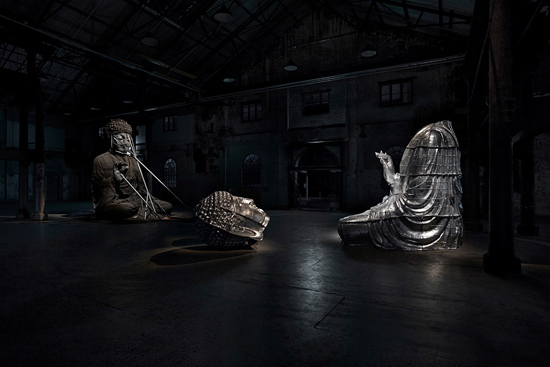
1 January saw Sydney audiences enthralled by the ever-so-slowly crumbling face of a giant Buddha made of ash from the burned prayers of temple worshippers in China and Taiwan. Zhang Huan, having reinvented himself entirely from his earlier persona as the bad boy of '90s violently masochistic performance art, presented this latest iteration at Carriageworks. And it was rather wonderful. I wrote about meeting the artist and encountering the silent presence of 'Sydney Buddha' for The Art Life. Click HERE for the story.
sydney buddha 3
Zhang Huan, 'Sydney Buddha'' installed at Carriageworks, image courtesy the artist and Carriageworks

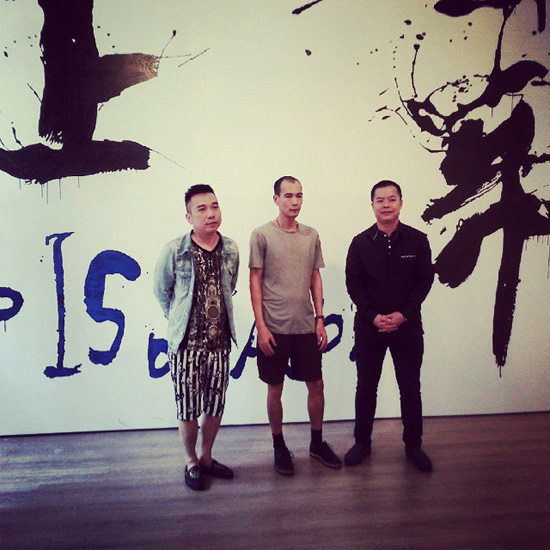
2 January also saw some younger Chinese bad boys hit town - the Yangjiang Group arrived with their unique brand of artistic anarchy for a crowd-funded project, 'Áctions for Tomorrow',  at 4A Centre for Contemporary Asian Art. Along with a bunch of other bemused scribes I had tea with the artists. So. Much. Tea. It was an artwork, and we were part of the art. Previously their performances of 'Fan Hou Shu Fa' (After Dinner Calligraphy) had involved prodigious feats of alcohol consumption, but they now stick mainly to tea, which they had brought with them from their home in Guangdong Province. What did we see in the gallery? Wax dripped over a shop full of mass produced clothing to create a frozen monument to retail therapy? Check. An installation of the remains of 7,000 sheets of paper covered with text from Marx’s Das Kapital in Chinese calligraphy, over which simultaneous games of soccer had been played? Check. A 24-metre mural juxtaposing expressive Chinese characters with scrawled English text reading “God is Dead! Long Live the RMB!”? Check. When I presumptuously asked if this last had a connection with their views about a materialistic new China, Zheng Guogu shook his head sadly at my outdated desire to find meaning. That's entirely beside the point, he said. Anti-art? To misquote the Chinese Communist Party’s description of socialism in the global marketplace, perhaps this was “dada with Chinese characteristics.” I wrote about my interview in Daily Serving. Click HERE for the story.
The Yangjiang Group at 4 A Centre for Contemporary Asian Art (Zheng Guogu in centre) photo: Luise Guest

3 In February I was a little bit preoccupied with arranging a wedding, and I have zero recollection of March to April. May brought the Sherman Foundation exhibition of Yang Zhichao's 'Chinese Bible'. Yang is another Chinese performance artist becoming a little less inclined in middle age to punish his own body with the surgical insertion of various objects - reputedly at the insistence of his daughter. Chinese Bible is a beautiful and important installation - part art, part anthropology, part social action. Not unlike his good friend Ai Weiwei, Yang Zhichao made a formalist, minimalist arrangement of found objects, some dating from the Cultural Revolution. 

Historical experience is written in iron and blood,” said Mao Zedong. In Chinese Bible, historical experience is written in thousands of humble, mass-produced notebooks once owned by ordinary Chinese people, their worn covers testament to the weathering of time and the vicissitudes of social change. Ai Weiwei says, “Everything is art. Everything is politics,” and Chinese Bible reveals a similar approach to art as a form of social engagement. I interviewed Yang Zhichao at SCAF with the translation assistance of Claire Roberts, who curated the show and had written a most wonderful catalogue essay. They told me that after the installation, on their way to a celebratory lunch in Chinatown, they asked their Chinese taxi driver if he would like to see the exhibition. He said he could not possibly, his memories are so painful it would make him weep. Later, in October, I met sculptor Shi Jindian at his home and studio in the mountains outside Chengdu. Disarmingly humble, polite and hospitable, as the day wore on he was becoming monosyllabic and I was worrying about why my interview with this artist was proving to be such hard going. He suddenly said, "I have lived through every period of recent Chinese history, and it was all terrible. I don't want to talk about the past." Like the Sydney taxi driver, and for so many others of his generation, there are just too many bitter memories. You can read the article and my interview with Yang Zhichao  HERE.
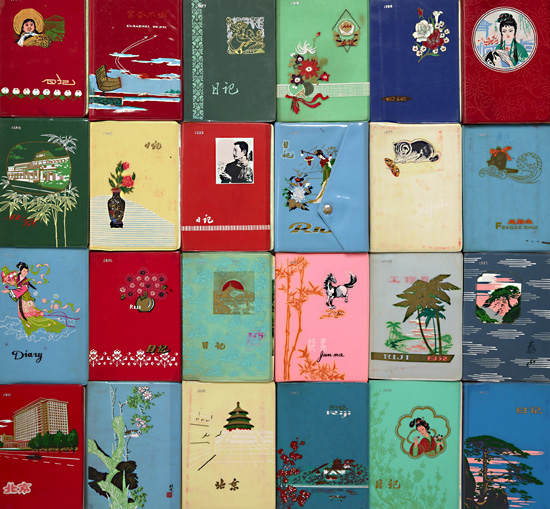
Yang Zhichao Chinese Bible, 2009 (detail) 3,000 found books Dimensions variable Image courtesy: the Gene and Brian Sherman Collection, and Sherman Contemporary Art Foundation, Sydney Photo: Jenni Carter AGNSW
Yang Zhichao, Chinese Bible, 2009 (detail, 3,000 found books, Dimensions variable
Image courtesy: the Gene and Brian Sherman Collection, and Sherman Contemporary Art Foundation, Sydney
Photo: Jenni Carter AGNSW
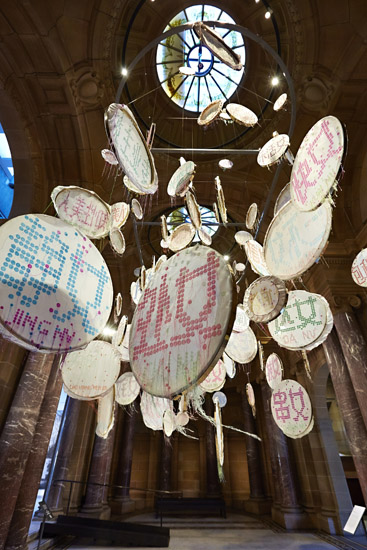
Lin Tianmiao, Badges 2009 White silk satin, coloured silk threads, gold embroidery frames made of stainless steel; sound component: 4 speakers with amplifier. Dimensions variable, diameters range from 25 cm - 120 cm, 266 badges total. Image courtesy: The Gene & Brian Sherman Collection, and Sherman Contemporary Art Foundation, Photo: Jenny Carter
4 In the second part of this exhibition, 'Go East' at the Art Gallery of New South Wales, curated from the Sherman collection by Suhanya Raffel, it was wonderful to finally see Lin Tianmiao's 'Badges' hanging in the imposing domed vestibule. Visiting her studio in 2013, I had watched her assistants stitching the texts, words describing women in Chinese and English, onto embroidery hoops. I had wondered what they were thinking as their nimble fingers stitched words like "Slut", "Whore" and "Fox Spirit" (a terrible name for a woman in Chinese.) I was amused in Sydney, where all the badges were Chinese,  to encounter shocked groups of Mandarin speaking tourists making their children look the other way. In this show, in addition to works by Zhang Huan and Song Dong, Yin Xiuzhen's 'Suitcase Cities' were a highlight. A newly commissioned work by Ai Weiwei intrigued my students. An Archive’ is a collection of the artist’s blog posts, banned since his efforts to name the children killed in the 2008 Sichuan earthquake attracted the attention of the authorities, presented in the form of traditional Chinese books in a beautiful timber box. A clever and more than usually subtle representation of Ai's resistance to the censorship and constraint that saw him confined to Beijing without possession of his passport, constantly under surveillance, until 22 July this year.


Kawayan De Guia. Bomba, 2011; installation comprising 18 mirror bombs, sputnik sound sculpture; dimensions variable. Collection of Singapore Art Museum. Courtesy of Singapore Art Museum
5 In July, in Singapore, I saw 'After Utopia: Revisiting the Ideal in Asian Contemporary Art ' at the Singapore Art Museum, confirming my suspicion that after 'the sublime', 'Utopia' was THE buzzword of the 2015 artworld. It was an excellent and intriguing riff on the theme, featuring familiar works by Shen Shaomin and The Propellor Group with others that were new and wonderful discoveries. I loved 'Bomba': Eighteen sparkling 'bombs' hung in a darkened space. Terrifying disco balls promising destruction, they cast shards of light onto the Stations of the Cross that still adorn the walls of what was once the chapel of a Catholic school. Beautiful and menacing, Kawayan De Guia’s installation specifically references the bombing of Manila in World War II, but it also evokes the horrors of more recent conflicts, contrasting the glittery lure of hedonism with a dance of death. After that, Shen Shaomin's embalmed dictators lying in their glass coffins were an added bonus.
Shen Shaomin. Summit (detail) silica gel simulation, acrylic and fabric, dimensions variable, Singapore Art Museum collection, image courtesy Singapore Art Museum
Shen Shaomin. Summit (detail – Ho Chi Minh), 2009; silica gel simulation, acrylic, and fabric; dimensions variable. Singapore Art Museum collection. Courtesy of Singapore Art Museum.
6 August was about planning and organising my own reinvention, from one kind of life to another, and in September I went to China for 5 weeks, to interview artists for a new project, which (of course) provided more highlights. Of these, perhaps the most remarkable was my visit to the studio/manufacturing hub of Xu Zhen and the MadeIn Company, in Shanghai. You would have to have been wearing a blindfold or lived in a cave to remain unaware of Xu Zhen, who appears to have taken on the mantle of Andy Warhol (although he told me that his favourite artists are Jeff Koons and Matthew Barney.) His enormous installations merge art and commerce, art and design, east and west, past and present, and any other form of post-internet hybridity you care to mention. He will feature in the 2016 Biennale of Sydney, and the work of the artist and his company of assistants and employees has been seen simultaneously in almost as many locations as the ubiquitous Ai Weiwei. (Although Xu Zhen himself does not fly, so everything is arranged and organised, and all research outside of China completed, by teams of MadeIn employees.) A focus artist at the 2014 New York Armory Show, and one of my top picks of last year for the spectacle of his retrospective exhibition at Beijing's Ullens Center for Contemporary Art, Xu Zhen is given to gnomic Warhol-like utterances. "Chinese contemporary art nowadays is a farce filled with surprises," he told Ocula. 'Eternity' has been wowing audiences at the White Rabbit Gallery since early September. And watch out Sydney, there is a promise of more to come! 
Xu Zhen by MadeIn Company, Eternity, 2013-2014, glass-fibre-reinforced concrete, artificial stone, steel, mineral pigments, 15 m x 1 m x 3.4 m image courtesy White Rabbit Collection
7 And so to Shanghai in late September, and a major highlight of my year: the exhibition of an artist who should be a household name. Chen Zhen died (much too young) in Paris in 2000. Although after 1986 he essentially lived and worked in Paris, his personal history and deep cultural roots lay in China, and specifically in Shanghai. From the mid-1990s he returned over and over to a city on fast-forward. Shanghai was undergoing a massive, controversial transformation, in the process of becoming the global megalopolis it is today. The exhibition at Shanghai’s Rockbund Art Museum presented works from this period. Sometimes witty, sometimes profoundly beautiful and melancholy, Chen Zhen’s works are steeped in his identity as a Chinese artist at a historical “tipping point.” As the artist said in his online project Shanghai Investigations, “without going to New York and Paris, life could be internationalized.” To finally see 'Crystal Landscape of the Inner Body' was a revelation - both sad and beautiful. HERE is the whole story.
Chen Zhen, Crystal Landscape of Inner Body, 2000, crystal, iron, glass, 95 x 70 x 190cm, image courtesy Rockbund Museum and Galleria Continua San Gimignano/Beijing/Les Moulins
Chen Zhen. Crystal Landscape of Inner Body, 2000; crystal, iron, glass; 95 x 70 x 190 cm. 
Courtesy of Rockbund Art Museum and Galleria Continua San Gimignano/Beijing/Les Moulins.
With Wang Qingsong in his Studio, October 2015, Caochangdi, Beijing

8 is for Beijing, in October, and meetings over three action-packed weeks with a ridiculous number of interesting artists, all represented in the White Rabbit Collection. Old friends and new faces: Bu Hua, Bingyi, Li Hongbo, Zhu Jia, Wang Qingsong, Wang Guofeng, Liu Zhuoquan, Qiu Xiaofei, Lin Zhi, Huang Jingyuan, and Zhou Jinhua. Dinners with friends, long walks through the hutongs and the never-ending struggles of language learning. I journeyed through the smog to studios on Beijing's far outskirts, collecting stories and looking at extraordinary work, as I had done the previous week in Shanghai and Hangzhou. I left China with a kaleidoscope of impressions that are just starting to crystallise into the possibility of words. I saw Liu Xiaodong at the Faurschou Foundation and Ai Weiwei at Continua, but disappointingly missed Liu Shiyuan in Shanghai at the Yuz Museum. One of the youngest artists I interviewed in 2013 and 2014, her work will next show at the Fondation Louis Vuitton in Paris, in an exhibition curated by Philip Tinari, among others, called 'Bentu: Chinese Artists in a Time of Turbulence and Transformation.'


9 is another repeat of one of my 2014 picks. The rather bizarre Red Brick Museum (practically empty on each occasion I have visited) on Beijing's northern outskirts was showing work by the artist who first inspired me to make Chinese art my focus of research, teaching and writing. Huang Yong Ping's fabulous thousand armed goddess of mercy was an unexpected delight when I visited in December of 2014. Again, in 2015, a new exhibition, curated by Hou Hanru (also the curator of the Chen Zhen show in Shanghai) presented a version of Baton - Serpent, seen in a previous Asia Pacific Triennial in Brisbane. Not quite the 'words fail me' experience of seeing Leviathanation at Tang Gallery in 2011, or the 'Thousand Armed Guanyin' at the Shanghai Biennale in 2012, but nonetheless extraordinary. And all the more wonderful for being encountered in the deserted echoing spaces of one of China's newest museums.


10 And here we are, washed up on shore, arrived at the final, dog days of 2015. 

November to December, hmmm. What to pick? NOT 'Ai Weiwei and Andy Warhol' at the NGV. If you have read my review (Click HERE if you want to) you know I had some issues with that exhibition - although I wish I had seen the London show at the Royal Academy. I admire Ai enormously for his genuine commitment - particularly his establishment of a studio on Lesbos to make art relating to the current refugee crisis. But boy oh boy did I hate those Lego portraits. And absolutely NOT the 'Rain Room' at the Yuz Museum in Shanghai - an empty spectacle. Nor anything at the major Sydney galleries - I cannot get excited about a few Renaissance works from Scotland, and Grayson Perry, whilst interesting, does not float my boat. 

Image 1 [Digital Photography_Colour Photograph] Dwelling - Moment III small file


YUAN GOANG-MING Dwelling - Moment III 2014. Digital Photography / Colour Photograph. 
120 x 180 cm Edition of 8. Image Courtesy of the Artist and Hanart TZ Gallery.

 I'm giving my Number 10 highlight spot to Yuan Goang-ming at Hanart TZ in Hong Kong. In this show, entitled Dwelling, we were presented with the uncomfortable intersection of the real and the apparently impossible. In the gallery space, an elegant table was laid as if for a dinner party, with crystal glasses and an ornate dinner service. Every now and then a loud clanking noise disrupted the silence, and the table shook as if the building had been hit by an earthquake. In the title work, Dwelling, (2014) the focus is a blandly modern living room, the only oddity the rather slow riffling pages of a magazine on the chair, a book on the coffee table. A breeze wafts the curtains. Suddenly, and without warning, the entire room explodes. Slowly, languidly, the wreckage of the room drifts back until the room once again regains its ordinary appearance. Filmed 
underwater, although it takes a while to realise this, the movement of every object seems dreamlike. Yuan suggests that what we accept as stable and fixed is in fact entirely unpredictable. In a split second, the apparently impossible can disrupt everything we take for granted. 

In my own 2015 version of the impossible becoming possible, I have changed careers, started new research and writing projects, and - in a total triumph of optimism over bitter experience, I enrolled in a new term of Chinese language classes.

Oh. And I have written a book. Out in February. 


Tuesday, July 21, 2015

Why art education matters: and what it's got to do with Ai Weiwei

Last week I took a group of 30 senior high school students to the exhibition of works from the Sherman Collection of Contemporary Asian Art, 'Go East' at the Art Gallery of New South Wales. (I reviewed the show for 'The Art Life' - click here for my thoughts.)
Jitish Killat, Public Notice 2 (detail)  in Go East, image The Gene & Brian Sherman Contemporary Asian Art Collection and the Art Gallery of New South Wales
I was curious to see their responses to a show which is in many ways quiet and cerebral, opening with Jitish Kallat's (admittedly visually overwhelming) tribute to Mahatma Gandhi's famous Salt March speech, in which every word is represented with letters made out of replica bones, arranged on narrow ledges on a wall painted the colour of turmeric. The students were fascinated, responding thoughtfully - even tired, at the end of a long day, very close to final exams, and close to the looming deadline for the submission of their own bodies of work. Their willingness to look for the conceptual intentions and possible meanings behind each new artwork they encountered was heartening.

They have spent the last two years with me, immersed in contemporary art from around the globe. At first they had been frankly sceptical - we'd had a few of those "But how can that be art?" conversations that every teacher knows. So it delighted me to hear their earnest discussions of Song Dong's endurance performance, in which he lay prostrate on the winter-cold surface of Tiananmen Square, and then upon a frozen lake, discovering (rather to his surprise) that in that location his warm breath had no discernible effect on the ice. They talked about the subtle symbolism - and clever satirical intent - of any Chinese work produced after 1989 that uses the potent location of Tiananmen. Some saw a comment on the continuing elemental power of the natural world in comparison to the puny efforts of humanity. Others discerned a comment on the failure of artists and pro-democracy demonstrators to change the tragic course of events 26 years ago.
Zhang Huan
Family Tree, 200
C-type prints. Suite of 9 images
Edition 2/3
227 x 183 cm (Framed)
Image courtesy: The Gene and Brian Sherman Collection, and Sherman Contemporary Art Foundation, Sydney
Photo: the artist
They looked with interest at Zhang Huan's 'Family Tree', reading it variously as the overwhelming power of written language and traditional culture over individual desires and freedoms, or alternatively as the sadness and loss of diaspora. Charwei Tsai's quietly meditative Buddhist sutra written on a mirror reflecting the ocean enthralled them, as did Tibetan artist Nortse's installation of the robes of Buddhist monks, arranged as if the seated monks have vanished into the blowing sand that covers the hem of each robe, overturned yak butter lamps indicating the overturning of tradition, religious practices and - again - the loss of language. Some knew about the practice of self-immolation, and others were completely horrified to learn of these acts of desperation.
Nortse, Zen Meditation, 6 monks' robes, butter lamps, Chinese money, scriptures, sand, metal frames,
image courtesy the Gene and Brian Sherman collection
The work that caused the most intense discussions, however, was by Ai Weiwei. Familiar with many of his works, from the iconoclastic smashed Han Dynasty urns to porcelain sunflower seeds, from 9,000 school backpacks representing young lives lost in the Sichuan earthquake to the recent (and I must confess, a little disappointing) installations on Alcatraz Island, my class were excited to see 'An Archive' - a work newly commissioned by Gene and Brian Sherman, and generously gifted to the Art Gallery of New South Wales.
Ai Weiwei, 'An Archive', huali wood, xuan paper, edition of 2 + 1 AP, image courtesy the Gene and Brian Sherman collection and Art Gallery of New South Wales
We had discussed its possible references and the artist's intentions before we went to the gallery, reading a little about the work, watching an informal video of Ai talking about it (and endearingly dropping the video camera, so the end footage is upside down). Nothing prepared them for the size of the beautifully constructed huali wood box, and its contents of 6000 large sheets of rice paper with every (banned) blog post and tweet made by the artist since around 2005. I had deliberately made no reference to it, wanting that first immediacy of seeing the actual, physical object to be a memorable and palpable experience: a salutary reminder of the power of an encounter with the original work of art rather than its reproduced 'shadow image'.

 I listened to their impassioned discussions in response to my question - why a wooden box? Why stacks of paper that cannot be read? Why transcribe something so essentially ephemeral as tweets? I cautioned them against identifying Ai Weiwei as a secular saint - the patron saint of free speech according to some western observers, or alternatively as a giant ego who "hoovers up all the oxygen" in the Beijing artworld, according to others. And with four (yes - four!) concurrent shows at four major Beijing galleries, nobody could say he's invisible, or unheard, even despite the continuing and constant surveillance to which he is subjected. Nevertheless, polarising though he might be, his practice provides rich and fascinating opportunities for my seventeen and eighteen-year-old students to hone their artwriting chops. I confess I would be a little happier if I didn't occasionally read responses that told me that Han Dynasty urns were important artefacts of the Cultural Revolution, but hey, you can't have everything!

At the end of the day, the bizarre rite of passage that is the Higher School Certificate examination aside, what I take with me from this afternoon is the genuine interest my students showed in looking carefully, slowly and with keen intelligence at contemporary art that is not easy or quick to decipher. Even more importantly, that critical ability to make connections, to "join the dots", to make informed inferences and logical deductions, as well as those all too rare intuitive, imaginative leaps that make the heart sing. “So if you set a model of what it means to look hard at something, think a while about it before you open your mouth, and then articulate it carefully—you will have done your job as a critic," said  Robert Storr, Dean of the School of Art at Yale. He was talking about art criticism, but what a principle for an intelligent, interesting and thoughtful life!  I believe that my students (maybe not all, but certainly most) will take this with them into their adult lives, and be the richer for it. And THAT is why an academically rigorous and challenging art education matters.

Ai Weiwei, 'Overcoat', military coat and 2 digital prints, image courtesy the Gene and Brian Sherman collection

Friday, January 9, 2015

Two Buddhas in Sydney and Some Thoughts About Writing

Tuanjiehu Window - looking at the Beijing Youth Daily
In the sweaty midst of a Sydney summer, to the shrill backdrop of children shrieking in neighbourhood swimming pools, droning cicadas, barking dogs and the inevitable inner-west renovation sound track of drills and hammers, I am writing the final chapters of my book. It is hard to believe that just three weeks ago I was in the bitter cold of Beijing, driving from artist studio to frigid artist studio, completing the last interviews for 'Half the Sky: Conversations with Contemporary Women Artists in China.' This quixotic - some might say utterly mad - project has occupied me since the middle of 2013. I have now interviewed 34 female artists, covering the alphabet from Bingyi to Zhou Hongbin. And it does seem a bit surreal, transcribing those final interviews and being transported back to those studios. Often the recorded conversation is punctuated by barking dogs (they roam the villages on Beijing's outskirts) and the sound of pouring tea. Never have I drunk so much tea as in my meetings with Chinese artists! And never have I been so cold as in unheated studios in Shanghai and Hangzhou.
With He Chengyao in her studio, a converted greenhouse
With Gao Ping in her new studio
For these few final weeks before the beginning of a new school term I have developed a routine that suits me perfectly: a walk around Blackwattle Bay or a swim in the morning, then writing for the rest of the day. A break for dinner is followed by more writing till as late as I can manage. OK, I confess, there is time for an episode or two of 'Southland', my current favourite gritty LA cop show. It's a weirdly solitary hiatus from the frenzy of real life. I go to sleep reading books that relate to my research - and have been known to almost knock myself unconscious by dropping my i-pad on my face - I wake up in the middle of the night thinking of better turns of phrase, I decide on opening paragraphs while I am walking in the park or floating in the harbour, and I find it hard to concentrate on conversations. I am a bad friend and an even worse mother right now. (Well, they are grown-up. So I think that's OK.)

I veer from despairing that I shall never finish the damn book to elation when I think that finally I have found the right way to express an idea about one of the artists. I have a gazillion windows open on the computer at any one time, with frequent shameful episodes of resorting to Google Translate when I need to send an artist yet another email because their works appear to have multiple titles. I have enormous tottering stacks of books and journals piled on and around my desk, and frequently realise I am muttering to myself: "I know it's in here, come on Wu Hung, where did you write that?!" Every day begins with essentially re-writing what I have written the day before. I really truly am trying to cut down my adjective habit. Truly. That moment of awful clarity when you open your computer and think, "My God that's terrible" happens every day at the same time. Writing is an excruciatingly slow shuffle forwards, like a very, very old person trying to cross a busy road clutching a walking frame. Continuing the forward movement must indicate either great optimism or blind obstinacy. I imagine my friends and family might think - both.

In the midst of all this OCD stuff, there has been room for some other things - although inevitably they are also connected with China and Chinese art. I have enrolled in yet another Chinese language course, with a New Year's Resolution that it's time to get serious or give up. My improvement in fluency is glacier-like, which is hard to accept when I want it so badly. I have read Sheng Keyi's new book 'Death Fugue', an allegory about an imaginary land - a thinly disguised China - and the struggle of her characters to deal with an incident 25 years ago in which an enormous pile of shit appeared in the centre of the city of "Beiping" - a veiled reference to Tiananmen. Sheng Keyi is trying to understand the dichotomy between China then, in the nascent struggle for democracy, and China now. I found the book awfully hard going. Her brand of magic realism is not for me, I have decided. However, stylistic reservations aside, her intentions are interesting and any attempt by Chinese writers to deal with that time is a fascinating development. Click HERE for a very intelligent and considered review by Nicholas Jose, who knows a thing or two about China.

 As proof that Chinese art really is everywhere, Zhang Huan is here in Sydney to install his monumental installation of two Buddhas at Carriageworks for the Sydney Festival. Next week the Yangjiang Group arrive for a major project at 4A Gallery for Contemporary Asian Art. Watch out for my piece in Daily Serving following what promises to be an interesting encounter with the artists!

My response to Zhang Huan and his installation was published in The Art Life today. Here is the start of my article:

Zhang Huan and 'Sydney Buddha'

Portrait of Zhang Huan with Sydney Buddha, 2015. Image: Zan Wimberley.
Two weeks ago, in Beijing, new media artist Zhang Xiaotao told me that he is hoping for a “Buddhist Renaissance” in China, as an antidote to the sickness of materialism and the headlong rush to acquire wealth that has overwhelmed traditional values. In the same week, in separate conversations, three other contemporary artists – a painter, a photographer, and a performance artist – spoke of their immersion in Buddhist practice and philosophy. It seems there is something in the zeitgeist (in Chinese “shidai jingshen” – the spirit of the times.) Today Zhang Huan’s installation for the Sydney Festival was unveiled. ‘Sydney Buddha’ looms out of the shadows of the vast industrial spaces of Carriageworks with an undeniable presence. Like its previous iterations in Taiwan and Florence, the work consists of two giant Buddha figures, each over 5 metres tall, facing each other. The first is constructed of aluminium, the second of ash. The ash Buddha will gradually disintegrate over the course of the exhibition, evoking permanence and transience, life and death, past and present. The work is still, solemn, and very beautiful.
sydney buddha 3
Zhang Huan, Sydney Buddha, 2015, ash and aluminium. Presented by Carriageworks in association with Sydney Festival, courtesy PACE Gallery, New York. Image: Zan Wimberley.
The hollow aluminium Buddha figure acts as a mould to form the second Buddha, created from 20 tonnes of ash collected from temples in Shanghai, Jiangsu Province and Zhejiang Province over three years. Two of Zhang Huan’s studio assistants supervised the construction and installation of the piece at Carriageworks. The ash, mixed only with water, was pushed into the mould, compressed as tightly as possible, a painstaking and physically challenging process which took days. At the opening of the exhibition the final supports and the mould covering Buddha’s face will be removed by the artist. He suspects that the face will immediately fall away, releasing all the prayers and wishes embodied in the ash into the air. Often connected with the veneration of ancestors and with funerary ritual, the incense and paper burned in the temples which creates the ash is sacred. Zhang Huan says it embodies “the collective memories and hopes of all Chinese people.”
Zhang Huan, Sydney Buddha, 2015, ash and aluminium. Presented by Carriageworks in association with Sydney Festival, courtesy PACE Gallery, New York. Image: Zan Wimberley.
In 1994, as a radical young performance artist in Beijing’s Bohemian East Village artists’ community, Zhang Huan covered himself in fish oil and honey to attract flies, and sat naked in the foul stench of the communal latrine in a feat of endurance called ‘Twelve Square Metres’. In the same year, Zhang suspended himself in metal chains from the ceiling of an East Village hut, while his blood from a cut on his body dripped into a heated metal bowl. These provocative works arose out of the experiences of his generation, who had emerged from the madness of the Cultural Revolution into a very different China. It seems hard to reconcile the author of those transgressive early works with the gentle and softly spoken artist who arrived from Shanghai this morning and went straight to Carriageworks to check on the installation of his monumental installation. I asked Zhang Huan to comment on the dramatic change in his practice. “This change is natural – and also destiny,” he replied through a translator. “Like the philosopher says, you cannot stand in the same river twice. When I was young I was afraid of many things. But now I fear [even] more – I can see my destiny. There is a Confucian doctrine which states that at the age of 50 you know your destiny. I am 50 now!” He is thinking about mortality, memory and the revival of important spiritual traditions in China.
Click HERE to read the rest.


Tuesday, September 11, 2012

A 'double take' and some cognitive dissonance...

Old and new China, Shanghai, April 2011, photograph Luise Guest

So as usual I am attempting to immerse myself in all things Chinese and all things contemporary Chinese art. This sometimes leads to some strange cognitive dissonance. This week I am reading three books at once and jumping backwards and forwards from one to the other. The first is Jonathan Fenby's 'Tiger Head Snake Tail: China Today, How it Got There and Where It is Heading'. As you might guess from the title, this book delivers rather less than it promises. Despite being genuinely interesting, many chapters are essentially a series of lists and factoids in search of a narrative which could make sense of them. There are some great quotable bits and pieces though, like the story of the 6 year old child on a TV quiz show who was asked what she wanted to be when she grew up. 'An official', she said. 'What kind of official?' 'A corrupt official', she said. The book certainly paints a fascinating picture of a nation on fast forward with all the excitement and the inevitable problems that entails. The second is Tani E. Barlow's 'The Question of Women in Chinese Feminism' which I am earnestly and optimistically dipping into and then  putting down with a sense of exhaustion. The third is a book that surely must have been written just for me: A crime novel in an affectionate homage to the hard-boiled private eye genre, with a female protagonist (an American born Chinese) set in New York, with a plot centering around the Chinese contemporary art market. For me this already ticks all the boxes. And S J Rozan can really write. I totally love Lydia Chin!

And of course meanwhile I am neglecting to do my Chinese homework - I should be learning how to discuss the weather in Chinese for my class on Thursday but the 'tianqi yubao' (weather forecast) is so far failing to fascinate. And I make such tiny baby steps towards some kind of minimal level of competence that it is just depressing. Especially when I hear westerners speaking fluent Chinese and think 'But how did you GET there?!'

Meanwhile I have just got home from an absorbing and illuminating conversation held by the Power Institute at the University of Sydney, between Chinese curator Pi Li and Sydney art academic Thomas Berghuisen. Pi Li is here for 'Go Figure!', the big Contemporary Chinese Portraiture show opening at the  Sherman Foundation and the National Portrait Gallery later this week. He is in transition between Boers-Li Gallery and the Central Academy of Fine Arts in Beijing, and his new role at M+,  the new Museum of Visual Culture housing Uli Sigg's collection in the West Kowloon Cultural precinct in Hong Kong.

Pi Li gave a history from his own personal recollections of the development of contemporary art from the early 1980s in China, with all the many transformations and developments along the way. One of the fascinating things he commented on was the profound influence of the Sensation Exhibition and the yBa artists such as Hirst and Emin on a new generation of Chinese artists seeking another path following the commodification of the 90s wave of Cynical Realist and Political Pop painters. He identified Qiu Zhijie, Zhang Huan and Yang Zhenzhong among those who saw the use of ephemeral artforms, and rotting or impermanent materials as a way to reignite the avant garde. There was also some very interesting discussion of the impact of the returning diaspora of artists. When I met Yang Zhenzhong at his studio in Shanghai last year he was re-editing his iconic work 'I Will Die' into an 8 hour version for a European exhibition. He was the very model of the contemporary Chinese artist - essentially a global brand. But with an interesting and hugely significant body of work.

Yang Zhenzhong in his Shanghai Studio, April 2011, photograph Luise Guest
 (the artist  trying to give directions to my taxi driver on his way to pick me up from the studio - quite a challenge!)


Last Friday night saw the opening of the new White Rabbit exhibition 'Double Take'. It is clever and thought provoking and a wonderful chance to revisit some familiar works, such as paintings by Liang Yuanwei, painted 'neihua' bottles by Liu Zhuoquan, and even some of Ai Weiwei's sunflower seeds. I have written at greater length inhttp://theartlife.com.au/ and you can read more about my responses to the show here: Double Take at White Rabbit

A favourite work from the show? Gao Rong's fabulous simulacra of her Beijing basement apartment entrance, entirely fabricated from fabric and embroidery.

Gao Rong, Level 1/2, Unit 8, Building 5, Hua Jiadi, North Village (2010) fabric, thread, sponge, metal, image reproduced courtesy of the artist and White Rabbit Gallery.