|
| Cui Xiuwen, Angel no. 3, 2006, photograph, image courtesy the artist |
The artist whose video work prompted a notorious lawsuit, whose photomedia works explored the forbidden territory of sexuality and repressed memories of a different China, has reinvented herself as an abstract painter. Her show at
Klein Sun Gallery in New York reveals the extent of this transformation.
Last December I met Cui Xiuwen in her Beijing studio for a long conversation about the dramatic shifts in her practice. At the risk of being accused of shameless self-promotion (OK, I plead guilty) she is one of the artists who features in my book about contemporary women artists in China. When I saw the images from her New York show this month, I replayed the tape of that interview, listening once more to the artist talk about her artistic metamorphosis, punctuated by the noise of barking dogs in the lane outside - an inevitable aural accompaniment in any visit to a Beijing studio.
 |
| The writer with Cui Xiuwen in Beijing, December 2014 |
I had particularly wanted to meet Cui, often described as one of very few feminist artists in China, because of her evocative photographic images of young girls in the forbidding surrounds of the Forbidden City - red walls, red scarves and a disturbing atmosphere of claustrophobic sexuality. I was even more intrigued when I realised that an early video work,
'Lady's Room', shot in the toilets of a swanky Beijing karaoke bar, where the 'hostesses' are not just selling their company and their singing, had caused the first lawsuit involving contemporary art in China. For details, you will have to read my book!
 |
| Cui Xiuwen, 'One Day in 2004', photograph, image courtesy the artist |
From early notoriety as a painter of male nudes and fairly graphic depictions of sexuality (nudity is still, even now, somewhat taboo in China) to experimental video and photomedia works, Cui Xiuwen has charted the autobiographical territory familiar to many artists of her generation. Struggling to forge an identity in a country convulsed by change, trying to marry her experience of the collectivist past with the aspirational, individualist present, Cui like others turned to childhood memory for her image-making. Her crowds of sleepwalking girls in works such as 'Angel' represent a country that had been asleep, oblivious to repression and enforced conformity. Now, however, Cui has turned to a cool, minimalist abstraction - a visual language of line and shape that echoes the post-painterly formalism of the sixties and early seventies. She describes this transition as emerging from a renewed interest in Buddhism.
 |
| Cui Xiuwen, 'Awakening the Flesh', installation view, image courtesy Klein Sun Gallery |
In recent years, she has become more interested in the spiritual, the ineffable; seeking ways to represent her experience of reading Buddhist texts. She has moved from the physical, to the psychological, to the spiritual and she uses the metaphor of climbing a staircase to describe this process. In doing so, she has found an abstract language that connects her with an interesting aspect of the Chinese artworld zeitgeist: a rediscovery of the possibilities of formal abstraction is an emerging trend there, just as it is internationally. Overwhelmingly, Chinese painting is figurative, with art schools training thousands of students every year to paint in the traditions of French and Soviet realism. Chinese-trained artists can paint like pretty much no-one else in the world today, and abstraction has not been a significant element in the contemporary art that emerged in the last 30 years. There are exceptions, of course, including Shanghai painters such as Ding Yi, or the young rising star, Li Shurui, who uses an airbrush to create almost psychedelic explosions of light and colour. There is a new interest in modernist and postmodernist abstraction, and many discussions of its possibilities in new media and sculpture, as well as in painting. Agnes Martin, Gerhard Richter, and even Barnett Newman are names that have emerged in my conversations with Chinese artists.
But there is another aspect to this new zeitgeist, or '
shidai jingshen'. In Beijing last December almost every conversation seemed to turn (unprompted by me) to Buddhism. Friends at dinner mused about the spiritual malaise they feel has infected Chinese society. Zhang Xiaotao told me his dearest hope for China was for a Buddhist renaissance. Feminist performance artist He Chengyao, returned from a year in a Tibetan monastery, spoke of her new practice creating abstract, meditative works on paper. Even the 'bad boys' of Beijing's East Village Artists' community have changed. The artists who shocked the artworld with their raw, masochistic performance works in the 1990s, featuring acts of self mutilation and abnegation, have turned to a newly reflective practice.
Zhang Huan's '
Sydney Buddha' made of ash from the prayers burned in temples, and
Yang Zhichao's beautiful '
Chinese Bible' installation at the
Sherman Contemporary Art Foundation in Sydney both reflect elements of this transformation.
 |
| Cui Xiuwen, 'Reincarnation No.10, acrylic on canvas, 2014, image courtesy the artist |
Works from Cui Xiuwen's 2014 abstract series are currently also showing at the
'Si Shang' Art Museum in Beijing, in '
Breaking the Image', an exhibition intended (somewhat didactically) to provoke discussion about how contemporary artists in China respond to international art discourses. Since the beginning of this century, access to global contemporary art is immediately available on the internet (albeit in virtual form) and many artists are also able to travel for residencies and study overseas. This has led to a revitalisation of previously marginalised forms such as abstract painting. Curator Libin Lu says, rather plaintively, "
Many more artists have quietly explored this issue, looking for new possible forms of self-contained artistic language. Due to limiting factors as well as objective reasons from artists, this exhibition exhibits only a fraction of works by artists working within this vein." He hopes it is a continuing trend, and worries about the co-option of abstraction by the market since its emergence as a style in 2006: "But within less than ten years, we are grieved to discover that the majority of abstract art has become “decorative painting” or simply a “conceptual painting tool"
Cui Xiuwen arrived at her own spare visual language via a transitional series of photographs shot in bleak, snowy landscapes around her birthplace of Harbin, from which all the vivid colour of her early works has been removed, in a deliberate reference to the disciplined marks of 'Shan Shui' ink painting. The next phase was a move to pure abstraction. Cui Xiuwen speaks passionately of her desire to transcend the everyday, and to express profound truths in installations of painting that provide immersive experiences for the viewer. Despite the anxiety of the Si Shang curator she could not be accused of 'decorative painting'.
 |
Cui Xiuwen, 'Reincarnation No.15, Varnished Aluminium and Acrylic on Canvas, 2014,
image courtesy Klein Sun Gallery
© Cui Xiuwen
|
So what do we see in Cui Xiuwen's new exhibition, '
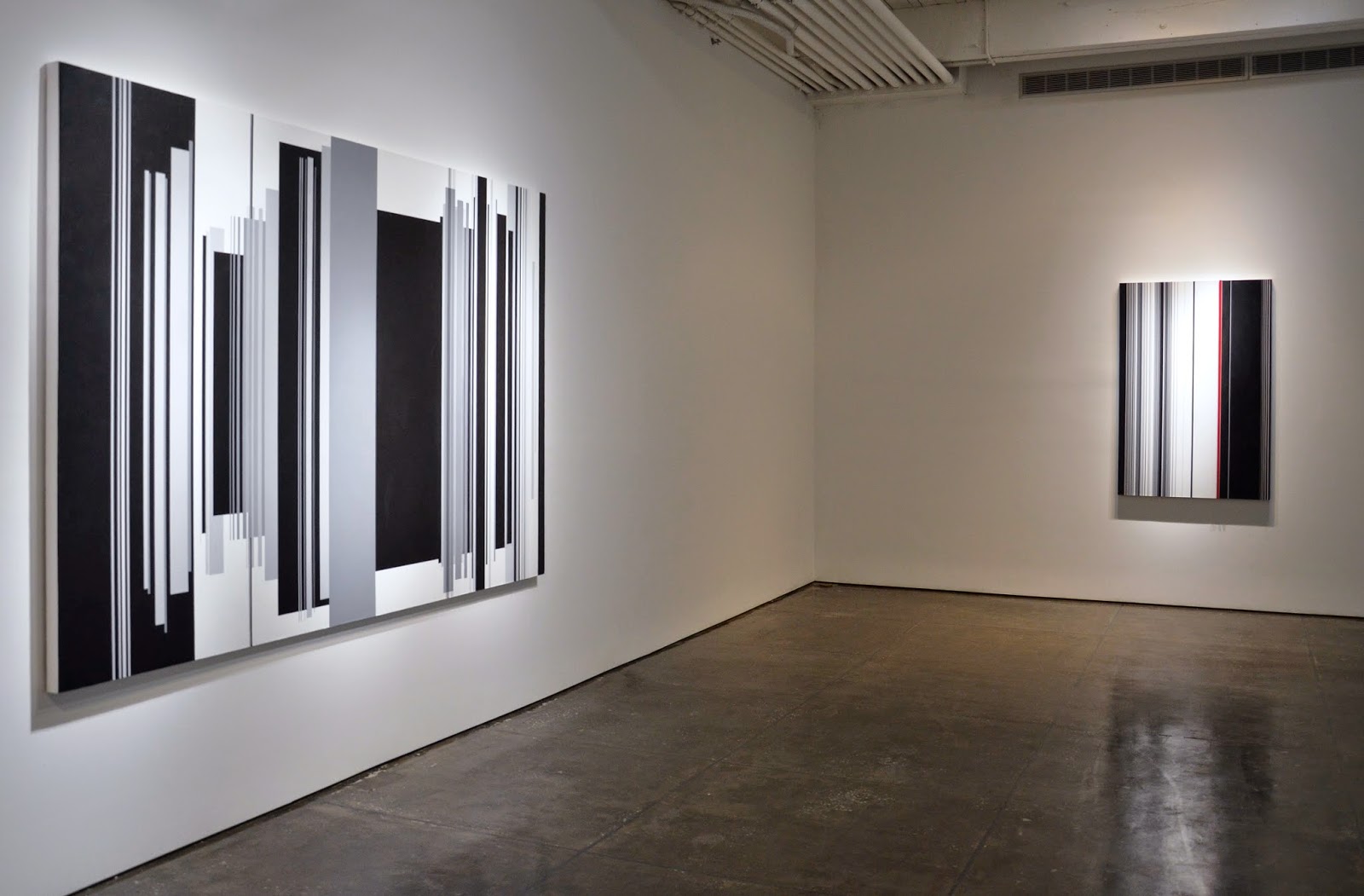
Awakening of the Flesh' in New York? The title is provocatively paradoxical - any fleshly concerns here are so pared back as to be unrecognisable. All the elements of her typical iconography - the schoolgirls, iconic Chinese architecture, dolls and landscapes - have been stripped away. There is almost no colour. These new works, often created with aluminium and acrylic on canvas, are minimalist surfaces featuring repeated forms and lines. Cui is finding new ways to convey ideas about mysticism, meditation and a higher plane of consciousness. The works are severe, yet tranquil, and in paintings such as '
IU no. 4' there seem to be echoes of Malevich and the Russian Suprematists. Metallic, slightly brittle, they are the antithesis of her earlier lyrical, narrative photographic works.
 |
| Cui Xiuwen, 'IU No.3, Acrylic on Canvas, 2014, image courtesy Klein Sun Gallery © Cui Xiuwen |
Lit in the darkened space of the Chelsea gallery, they appear to glow. Is there more than surface beauty? '
Reincarnation No 9' suggests that the artist has one foot firmly on the ground, and although she may be operating in the rarefied plane of '
wu wei' she is still interested in responding to worldly concerns. Unlike the calm horizontal layers appearing in other works, this painting's variegated vertical bands remind us forcefully of a bar code. Intentional or not, it suggests the inevitable tensions and slippages between the desired state of elevated spiritual awakening, and the forceful imperatives of the flesh, especially those manifested in commerce and consumerist desire.
A full account of Cui Xiuwen's practice appears in 'Half the Sky: Conversations with Contemporary Women Artists in China', to be published by Piper Press in October.