The ongoing thoughts of an art teacher in China - and home in Sydney

A continuing diary about my travels in China, and thoughts about China and Chinese art from home and abroad
Showing posts with label Lu Xinjian. Show all posts

Sunday, February 17, 2019

Shoes & The City: Lu Xinjian, Nike and the White Rabbit Collection

So here is my second blog post for the new website that covers White Rabbit Gallery, the White Rabbit Collection and its archive, and the new Research Library at Dangrove - it's about artist Lu Xinjian and his collaboration with Nike. What it doesn't tell you is that Lu Xinjian's paintings were some of the very first that I saw in a gallery in Beijing, on my first visit to China as a recipient of the NSW Premier's Travelling Scholarship. I was utterly clueless, totally lost in Caochangdi, and walked into a gallery where I got talking to the very lovely Shasha Liu - now a friend - who told me that an Australian collector called Judith Neilson had just acquired two of the paintings. A lot has happened since then!


Read on ...

In early 2011 two paintings by an emerging Chinese artist were acquired for the White Rabbit Collection. They used an unusual technique derived from the aerial mapping of cities to produce large, apparently abstract canvases with grids and formalist designs. Critics noted they recalled the paintings of Piet Mondrian and the early Modernist de Stijl artists and designers. The artist was Lu Xinjian, a Shanghai-based painter who had indeed studied in the Netherlands and had loved Dutch design since he was a young student in Nanjing. The two paintings, from his important early City DNA series, turned out not to be abstract at all, but rather represented aerial views of Beijing and Venice. Sources for his imagery included maps and satellite views of each location, as well as photographs, but the artist sees his work as philosophically complex and multi-layered. He believes cities are built and defined by history, culture and language as much as by geography; each is distinct and unique, despite the homogenising impact of globalisation.
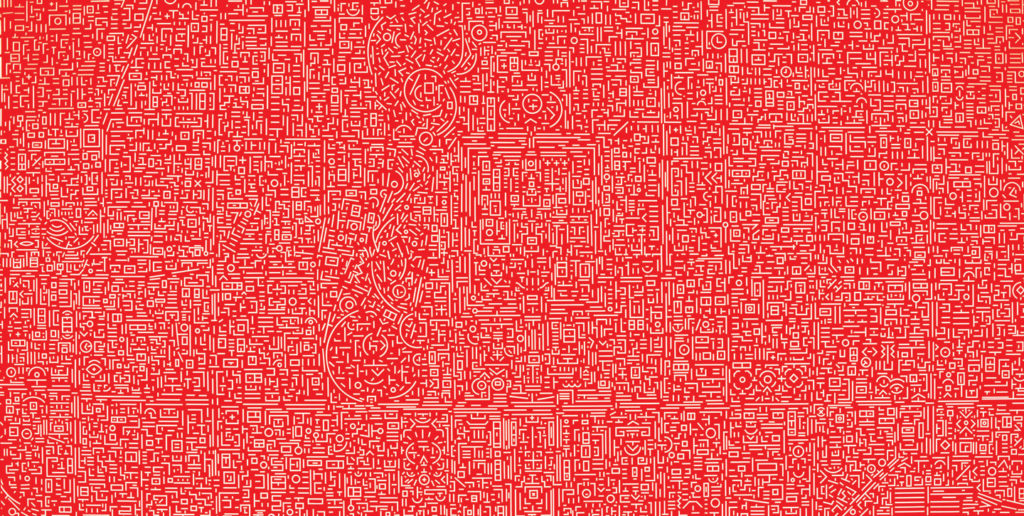
City DNA Beijing, 2010, oil on canvas
City DNA: Beijing (2010) shows the symmetrical axis of the Forbidden City, its surrounding 
lakes and the jumble of historical hutongs and courtyards in lines and dashes on a scarlet ground. 
The artist’s source imagery is scanned into a graphics software program to create a vinyl stencil, 
from which each shape must be carefully unpeeled before he can paint over it, in colours selected 
from national or city flags. The process is repetitive and exhausting – it can take up to four days 
to peel off each line from the stencil over one large canvas. The annotated print-outs from Google 
Maps that Lu donated to the Judith Neilson/White Rabbit Collection archive reveal how he begins 
the laborious process of designing these complex compositions.
City DNA Venice, 2010, oil on canvas
Lu Xinjian sees his slow, methodical practice as connected to meditation or the calming 
practice of Qi Gong, despite the frenetic contemporary hustle and bustle of his urban subjects. 
He says, ‘Coming from a small peasant village where nothing changes and the cultivation of tea 
marks the rhythms of life, the dynamism of the urban landscape has always fascinated me.’
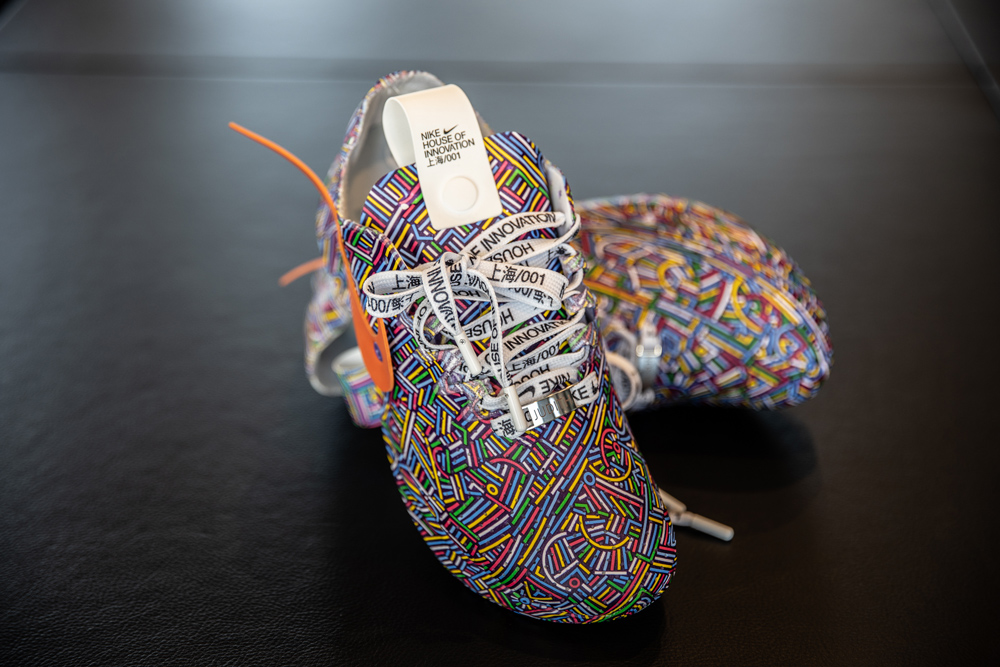
Fast Forward to 2018. Lu Xinjian, now an extremely successful artist on the international 
stage, collaborates with Nike on a remarkable project: transferring new City DNA designs to a
limited edition shoe, initially one especially designed for the current marathon world record holder 
Eliud Kipchoge. Asked about the connection between artist and runner, Lu explained: 
‘He runs through cities, crosses them, lives them, takes them step by step. Instead, I paint the cities
 – not only the shapes on the canvas, but also the speed, the noise, the atmosphere.’ 
Only 300 pairs of shoes were produced, released at the first Nike flagship store in Shanghai. 
Their designs are based on the map of  Shanghai, with the Huangpu River at its centre. 
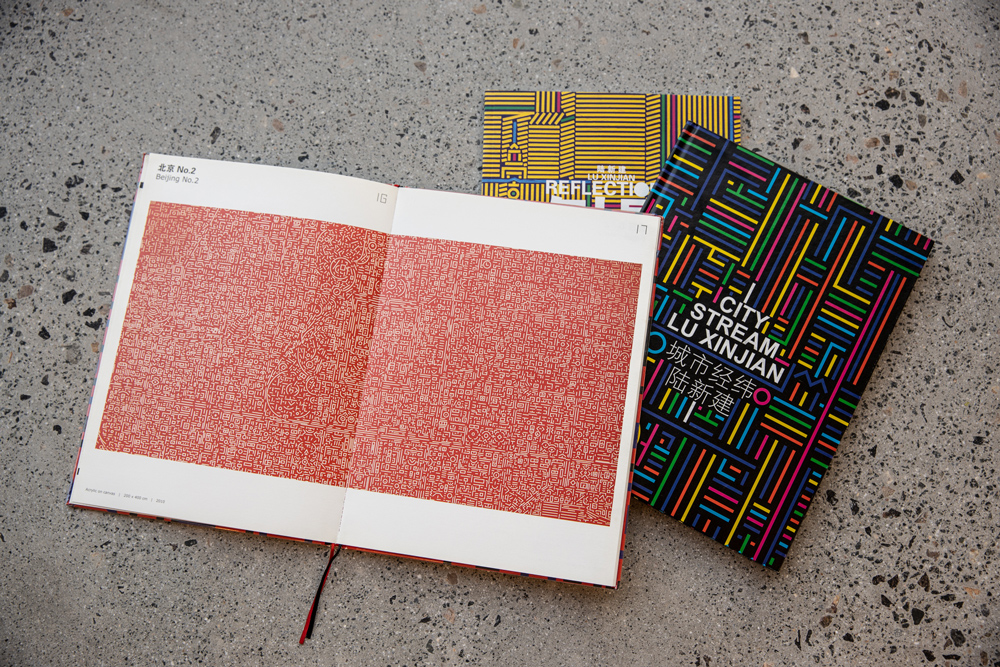
Two pairs of these extraordinary shoes are now in the research library at Dangrove, evidence of 
the enduring link between contemporary art and design that has been embraced by Chinese artists. 
Here, researchers can find interviews, plans and diagrams in the archive, books and catalogues 
in the library, and of course the works themselves in the collection.
Check out the whole website HERE - navigate to the 'Dangrove' section for information about the 
White Rabbit Collection and its archive.


Wednesday, May 10, 2017

Lu Xinjian: Looking for Harmony in the City


Shanghai-based painter Lu Xinjian has invented his own visual language with which he represents his experiences of urban life. In several interviews for the White Rabbit Collection since 2015 in Shanghai and in Sydney (Judith Neilson was one of the first collectors to see his early 'City DNA' paintings in Beijing, in 2011), he talked with me about his early life as a boy in rural China, and his surprising metamorphosis into a highly successful contemporary artist on the global stage.
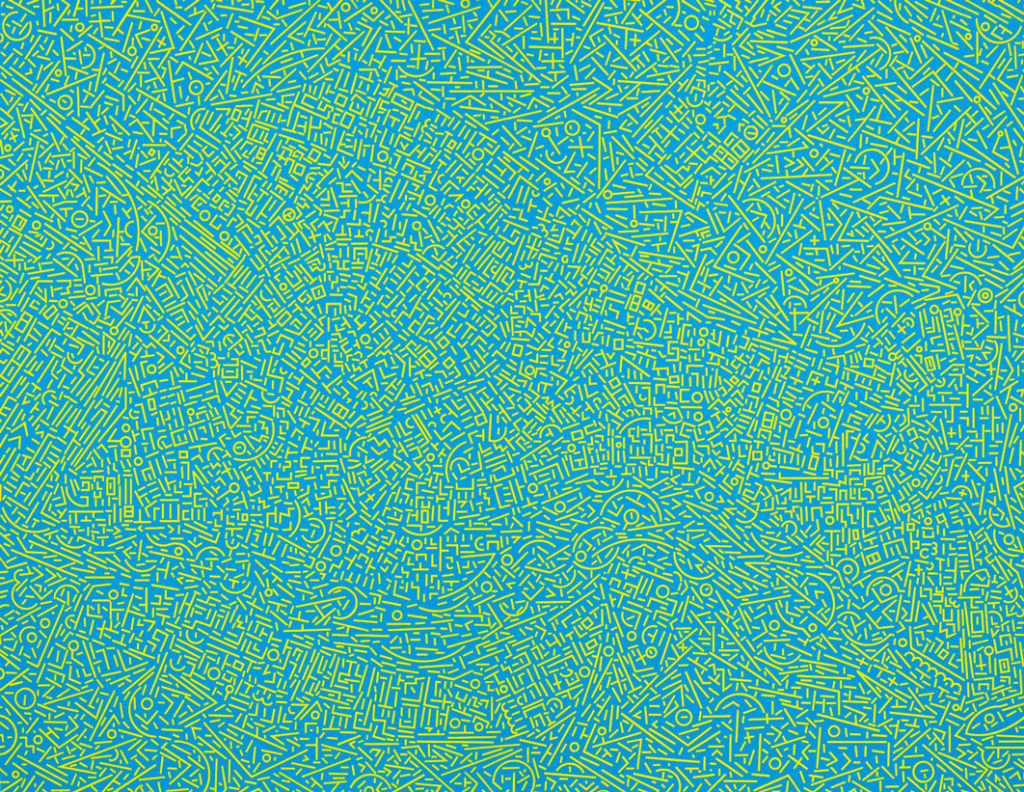
Lu Xinjian and a painting in his 'City Stream' series, image courtesy the artist
These interviews were compiled as a profile of the artist published this week in 'The Art Life', together with a video interview conducted at White Rabbit Collection late last year. It goes like this:

Lu Xinjian’s early life seemed an unlikely background from which a successful artist might emerge. Born in 1977 into a poor farming family in a rural village in Jiangsu Province, by his own account his childhood was spent running wild, looking after ducks and chickens. After school he studied computer graphics and graphic design, despite his love of painting, knowing that a poor boy making his way in the world needed a more secure income than that of an emerging artist. 
Lu Xinjian with his mother, image courtesy the artist
But a chance encounter changed everything: in 1998 the influential Dutch design company Studio Dumbar had an exhibition at the art museum in Nanjing, where Lu Xinjian was studying. He didn’t have the money to buy a ticket to enter the gallery, but stood entranced in front of the posters, absorbing their structures, colour, line and form, their use of the Modernist grid. Returning to the college library, he began to read everything he could find about European design, determined that one day he would go to study in the Netherlands. It took four years after graduation to save the money, but in 2005 he graduated from the Design Academy in Eindhoven, and in 2006 from the Interactive Media and Environments Department at the Frank Mohr Institute of Hanze University of Applied Studies.
Lu Xinjian in the studio, image courtesy the artist
In Eindhoven and Groningen Lu Xinjian found himself at the centre of a particular Modernist tradition. To that point he had loved the work of Keith Haring and other contemporary American painters, but now the work of artists of the European ‘Zero’ movement of the 1950s and 1960s, such as Heinz Mack, Gunther Uecker and Otto Piene inspired him. They believed that art should be a ‘zone of silence’ devoid of personal expression. Lu Xinjian saw in this philosophy a link to Buddhist traditions of restraint and simplicity, harmony and quietude. After early experiments with figurative expressionist painting, an influential teacher, Petri Leijdekkers, introduced him to de Stijl and the work of Mondrian. He had been at an impasse, lonely and depressed during a residency in Korea, when he began to draw views of the night sky, the edges of buildings as lines and the stars as dots. The dots and dashes found in the ink drawings of Van Gogh, the grid structures of Dutch and German early twentieth century design, and the cool abstraction of Mondrian coalesced to form a new way of thinking. This epiphany was the start of his important City DNA series.
Lu Xinjian, City DNA – Beijing, 2010, acrylic on canvas, 200 x 400 cm, image courtesy White Rabbit Collection
From this point Lu Xinjian began to paint in more abstract ways, using aerial perspectives of iconic metropolises: New York (irresistibly recalling Mondrian’s Broadway Boogie Woogie) Beijing, Shanghai, Rome, Paris, London, Los Angeles, and Venice. The first in the series, however, was the Dutch university town of Groningen, where he had taken photographs from the top of the tower in the centre of the town before returning to China. Sources for his imagery included maps and satellite views of each location, as well as photographs, but the artist sees his work as philosophically complex and multi-layered. He believes cities are built and defined by history, culture and language as much as by geography; each is distinct and unique, despite the homogenising impact of globalisation. Lu Xinjian tells the story of each city in a visual language of his own invention that merges western abstraction with simplified forms that recall the Bauhaus and Dutch graphic design, in combination with computer coding. The picture planes appear to pulsate with energy, despite their flat, brightly coloured grounds. Struggling to find a name for this body of work, Lu Xinjian suddenly saw the lines and dashes as akin to a diagram of a human genetic code. Cities, too, have a kind of DNA structure, a term borrowed from architectural practice, conveying something of the unique and complex social and architectural systems of the modern metropolis.

TO read more in 'The Art Life' , click HERE

And here is the video interview with Lu Xinjian 


Lu Xinjian in Conversation with White Rabbit from White Rabbit Collection on Vimeo.
Shanghai-based painter Lu Xinjian discusses his 'City DNA' series, his interest in Mondrian and Dutch design, and how a boy from a poor rural farming family became a successful contemporary artist

Tuesday, September 29, 2015

上海日记: Shanghai Diary Revisited

French Concession Shanghai, photo LG
After 7 action-packed days in Shanghai I have arrived in Beijing - as always struck anew by the stark differences between these southern and northern cities. Reflecting on my week interviewing artists in Shanghai, my impression that the Shanghai artworld is growing ever stronger, and more interesting, is reinforced. The influence of the new private museums, the Yuz and Long Museums, now a major force to be reckoned with, is a significant factor.

Bicycle Repairs, Shanghai, Photo LG
My hotel in Shanghai's former French Concession was in a fabulous location for exploring the city on foot, and for navigating the Metro - wonderfully efficient, although not for the faint of heart during the rush hour. It was, however, of a uniquely Chinese type - on the surface very luxe, with glittery lamps, lots of fairly appalling art (for sale), enormous marble bathroom and pseudo-antique Chinoiserie. The room, however, was pitch dark even with all the lights on and the curtains open, the carpets in the corridors were badly stained and often covered with drop-sheets (Why? Who knows!) and the breakfast was beyond appalling - once tried never repeated, which perhaps is their intention. However, as Chinese hotels go, it all ran pretty smoothly.

My most memorable Chinese hotel experience was in Beijing, in the winter of 2012, at a supposedly swanky "art hotel" (now closed, and no wonder!) I had begun to think I was the only guest, when on my second night at about 11.00pm there was an almighty noise of thundering feet and shouting in the corridor, and then a loud banging on my door. Imagine my astonishment when I looked through the peephole to find a young Chinese man, stark naked, beating the door with both fists. Later, safely home again, I told a gay friend this story and he said, "Give me the name of this hotel immediately!" I, however, was a little alarmed. I called the reception fuwuyuan, who said with apparent resignation, "Oh Miss, what we can do? He drink too much!" I suggested that perhaps in fact they they did need to do something, anything, anything at all! whereupon the manager rang back and told me they would move me to another floor. There was nothing to be done about Mr Naked Guy. Reluctantly I agreed, and waited for the manager to accompany me. He knocked on the door, I opened it, and together we stepped over the naked body of the man who was now completely comatose, lying stretched out across my doorway. The incident was never mentioned again for the rest of my stay. (Except when I told my translator, who refused point blank to believe that it could possibly have been a Chinese man - he told me I must be mistaken, as only a "waiguoren", a foreigner, would behave so badly.)

A more ludicrous (and less amusing) Chinese hotel experience happened in Xi'an, where I sent some clothes to the laundry and then waited for their return. And waited. When I rang reception they were most apologetic and concerned. A farce ensued, where I received knock after knock on my door, with staff from the laundry bearing ever more preposterous items of clothing and attempting to persuade me they were mine: mens' leather jackets, assorted tiny dresses for tiny Chinese ladies, and enormous jeans for enormous men. It culminated around midnight, with a staff member who simply could not accept that a sequin-covered blue suit (think Xi Jinping's wife on a state occasion) was not in fact mine. He became argumentative and kept trying to shove it at me through the door, which I eventually closed in his face. I never did get my best David Jones blue sweater back.

And of course, there are the two most bizarre experiences of all: the "Art Hotel'' in Chengdu where I discovered to my surprise - and horror - that I was expected to make a speech at the opening of an exhibition of an Australian and Sichuan artist. With about two hours to write it and have it translated, and with no fancy clothes in my overnight bag (perhaps I should have taken that sparkly suit after all!) I fronted up and discovered that my speech was to follow the local Party chiefs, the Chengdu Art Academy bigwigs, and the Australian Ambassador. I was introduced as a "famous Australian art critic" (ha!) and began in Chinese with an apology for my poor language skills. The artist's son then translated my speech line by line. I began to see my entire life flashing before my eyes as time seemed to stop and then go backwards. Dripping with sweat, I ploughed gamely on, filmed by three local television stations - thank God nobody is ever likely to see that footage.

But the honours for first place must go to the "Vineyard"- and I use those inverted commas advisedly -  about two hours out of Xi'an, where I was taken to see an artist's work. My lunch with the artist, a property developer, and a returned Chinese movie producer from Hollywood is a story for another time. I will just say that the wine, the wisteria and even the fields of grapes stretching into the distance are all fake. The local farmers have been persuaded to stop growing corn and vegetables and instead grow table grapes so that wealthy city people can come on weekends and go grape picking and stay in the "chateaux". Truly a Marie-Antoinette at Le Petit Trianon experience.
Yang Fudong, still from video at Yuz Museum
But back to Shanghai, and to art! On my first visit to Shanghai, back at the start of 2011, a number of artists told me they felt almost like the poor relatives of their peers in the art centres of Beijing. Now, they talk about their independence from Beijing, their capacity to innovate and the ways that each individual artist can pursue a unique vision. One said that in his opinion Beijing artists indulge in way too much "liao tianr" - too much chat and communal thinking. I am quite sure, of course, that artists in Beijing will tell me an entirely different story! However, the fact remains that with a unique history of European Modernist influence, and a sense that Shanghai is a truly global city, artists here work in distinct ways. I was fascinated to be shown the extraordinary studio of Xu Zhen - the 'MadeIn Corporation' - where with the assistance of 40 artists/collaborators/assistants some incredibly ambitious and monumental projects take shape. Some say, with a bit of a sneer, it's merely "art as spectacle". I say, "Bring it on!"

Xu Zhen, Guanyin and 'Shanghart Art Supermarket' at Ullens Center for Contemporary Art, Beijing, 2014, Photo LG
The massive Xu Zhen retrospective at the Ullens Center for Contemporary Art in Beijing last year was one of the most exciting exhibitions I had seen in years, from his enormous fluoro-coloured Guanyin to the Shanghart Art "Supermarket" where all the packaging is empty, and "grannies" shuffled around in slippers, following you through the aisles. "Eternity",  a sculpture for which 3D printing technology created absolutely accurate moulds for casting the replicas of figures from Greek classical sculpture and ancient Chinese Buddha figures, is currently showing at White Rabbit Gallery in Sydney. The artist agrees, without apparent irony, that he is the successor to Andy Warhol and his "factory". He says, "Andy Warhol made a connection between art and commerce, but we recognise that art IS commerce and we aim to make the commercial, artistic." There is a similarly cool Warholian demeanour evident in conversation with this artist, who turned himself, literally, into a brand, recognising the global reach of the art market. At the same time, Xu Zhen supports young emerging artists with the MadeIn Gallery in Shanghai's M50 art district.

Xu Zhen Éternity' at Ullens Center for Contemporary Art Beijing 2014
Artists such as Yang Yongliang, Chen Hangfeng, Lu Xinjian and Hu Jieming reinvent and recontextualise  Chinese tradition and history in different ways, both subtle and overt. From papercutting to "Shui Mo" ink painting, from Gongbi realism to the revolutionary photography of the 20th century, each is taking elements of the past and making work that is absolutely contemporary and reflecting the realities of our world today. Chen Hangfeng is working on a significant project about the notorious village in southern China where most of the world's Christmas ornaments are made, an industry which has filled its waterways with glitter, tinsel and assorted festive crap. It's a village of great historical importance in China, in a most beautiful landscape where significant poems were written. Chen Hangfeng's work is a metaphor for globalisation, a theme which concerns many of these artists. Yang Yongliang continues to make beautiful digital works, and now also narrative films, relating to the destruction of the environment as Chinese megacities eat the countryside, devouring tradition in their wake. He takes thousands of photographs for each digital animation, often choosing to shoot in Chongqing. And no wonder - the greater municipality of Chongqing is now, by all accounts, the largest city in the world. Lu Xinjian continues his ''City DNA" and "City Streaming" series of paintings, inspired by aerial views, Google Maps and Mondrian. And Hu Jieming has begun several new projects, including one for which he has written computer coding that can take a photograph and reproduce it, making subtle and not-so-subtle alterations. From this he makes a painting, then scans it and repeats the process, over and over again. Each painting is further from the original image, more abstract. He is asking questions about the relationship between human observation and artificial intelligence.

With Lu XInjian in front of one of his "City DNA" series
After seven intense conversations with seven artists, a Saturday morning walk around the former French Concession provided breathing space, and time to re-acquaint myself with the idiosyncracies of Shanghai life, from the wearing of pyjamas as streetwear to the washing hanging on every street corner, and from powerlines and railings: "Shanghai flags." The sun shone, the oppressive humidity vanished, good coffee was readily available, the trees were green and beautiful, and life seemed very good. Visits to exhibitions at as many galleries as I could cram into one day, including Chen Zhen at Rockbund Museum, Yang Fudong at Yuz Museum, and an exhibition of work by women artists at Pearl Lam, provided a visual feast.

Chen Zhen Purification Room, 2000 - 2015, found objects, clay, photo LG
Chen Zhen, Crystal Landscape of Inner Body, 2000, crystal, iron, glass, photo LG
Yang Fudong, still from video work, Yuz Museum
Lin Ran "Lesbos Island" - traditional Chinese medicine cabinet with drawers "filled with gifts and mementoes given to the artist by lesbians" at Pearl Lam Gallery Shanghai photo LG
My Shanghai experience concluded with the Zhou Fan exhibition at Art Labor Gallery - beautiful works that appear marbled, or as if pigment has been gently dripped onto the surface with an eye dropper. The artist told me that every nuanced gradation of colour and finest line has been carefully applied with tiny brushes. Zhou Fan's practice exemplifies the subtlety and thoughtful refinement that co-exists with the chaotic frenzy of life in modern China.

Zhou Fan, Mountain #0003, 2014, Acrylic ink and mineral color on paper, 38.3 x 56.7 cm image courtesy the artist and Art Labor Gallery


Sunday, May 3, 2015

Writing Makes You Fat! 写作会让你更胖!

Gao Rong, Guangzhou Station (detail) copy handbag, embroidery thread, fabric and foam, dimensions variable,
 image courtesy the artist
I have discovered a sinister and hitherto little known (at least to me) connection between writing and obesity. As I enter the final dark days of editing, wrestling my unwieldy and intractable beast of a book into submission in the attempt to create a leaner, meaner version ready for print and publication by October, any pretence of a commitment to fitness and exercise has flown right out the window. Writing in the early mornings before work, in the late afternoons as soon as I get home, and late into the night, carving out chunks of time on weekends, and lying awake thinking about it in the middle of the night, whilst also continuing to worry about my students and take home vast piles of marking has taken its toll. By this point it has resulted in a state of physical torpor so marked that my gym has now stopped sending me those annoying emails that begin cheerily, 'Luise, we haven't seen you for x weeks!' Am I feeling guilty? Of course. There's a direct correlation between the length of my book and the size of my arse. And now, as my book gets leaner, I seem to be getting larger.

There should surely be websites dedicated to this - maybe useful K-Tel products could be advertised on weird late night TV channels. Perhaps a treadmill which you could operate whilst typing might be the go. I tell myself - every week - that this week will be different. I will walk each morning at sunrise, I will go to the gym, I will go to all those yoga classes I've paid for already. I will not eat chocolate (ha ha) and I will not drink wine (ba ha ha!) And my final vain resolution, every single week, is that I will do an hour of Chinese study every day. Sad to admit, none of this has happened. But there is light at the end of the rainbow and a silver lining at the end of the tunnel. (Which, come to think of it, could well be a Chinese maxim.) Each day is a new beginning and the East is red.....

There is also the fact that the solitary occupation of writing has to be balanced with all the competing demands of daily life. When I read all those stories of male writers who shut themselves away in their studies and emerged only for meals that had been cooked and served by women, I used to think, 'Those bastards!' Now, I think, 'Those lucky bastards...' I am looking for inspiration in other stories of women like PD James who rose before the sun every morning and completed a few hours of writing before going to her job as a senior civil servant. Or Mary Wesley, whose first book was published after she was 70. It did, after all, take me until I was 58 before I had that all important "room of one's own."

The book will, I suppose, eventually, be finished. Afterwards I will return to China, study Chinese each day while I am in Beijing, and embark on a project for a whole new adventure that begins at the end of September. I am looking forward to my encounters with artists such as Li Hongbo, Xu Zhen, Lu Xinjian and Wang Qingsong, and to broadening my field of research. I will travel to Chengdu to visit some artists' studios, and return to Hangzhou, where I was able to spend only one day with Wang Zhibo last December. My experience of China is so limited, and I want to see cities other than Beijing and Shanghai, wonderful though they are.
Lu Xinjian, City DNA Beijing, 2010, acrylic on canvas, 200 x 400 cm, image reproduced courtesy of White Rabbit Gallery
Many of the artists included in my book have recently shown new work in China and internationally, or are about to do so: Cao Fei at Hong Kong Art Basel and the Venice Biennale, He Chengyao and Tao Aimin at the International Expo in Milan, Cui Xiuwen's second solo show at Klein Sun Gallery in New York, and Liu Shiyuan at Whitespace in Beijing, just for starters. Yin Xiuzhen's 'City Suitcases' and the feminist 'Badges' that Lin Tianmiao explained to me when we met in 2013 are in an important exhibition, opening later this month, of works from the Gene and Brian Sherman Contemporary Asian Art Collection at the Art Gallery of New South Wales, 'Go East'. This promises to be intriguing. As Ai Weiwei said, 'Everything is art, everything is politics,' and with works from Dinh Q. Le, Alfredo and Isabel Aquilizan, Song Dong, Zhang Huan and Yang Fudong, among others, this will be an exhibition not to be missed, of works by artists who engage with the most significant issues of our time. So while I am sad to miss the exhibition of Xu Zhen and his Madein Company at the Long Museum in Shanghai (a visitor to his studio recently described it as 'like Andy Warhol's Factory, but with less sex and drugs') and I can only sigh over the impossible dream of getting to the Venice Biennale, I can at least console myself with the knowledge that Chinese contemporary art is now everywhere, and Sydney is no exception.
Lin Tianmiao 'Badges' 2009 white silk satin, coloured silk threads, gold embroidery, frames made of stainless steel, sound component: 4 speakers with amplifier, Dimensions variable, Image courtesy the Gene and Brian Sherman Collection and Sherman Contemporary Art Foundation Sydney, Photo: Galerie Lelong New York
 In the meantime, I am enjoying working with my students on their own writing about contemporary artists ranging from Ai Weiwei and Xu Bing to He Xiangyu, Ah Xian and Shen Shaomin. They continue to surprise me with their thoughtful interpretations and their interest in the ways in which contemporary artists can embed meaning into their choices of materials. Most recently they have been writing interpretations of Ai Weiwei's latest installations on Alcatraz Island, particularly 'Blossom', the installation of white porcelain flowers with which he has filled the tubs, toilets and washbasins of the abandoned psychiatric hospital wing. Now they can talk knowledgeably about Mao's cruelly deceptive 'Let 100 Flowers Bloom and 100 Schools of Thought Contend' policy of the 1950s, no mean feat for Australian kids who could not tell you anything at all about China and its history only one short year ago.

Even the little ones in Year 7 have done some writing about Cai Guo-Qiang's beautiful circle of animals around a waterhole, 'Heritage', and Year 8 are writing imaginary wall texts for an exhibition of Gao Rong's fake designer handbags embroidered with stains and filled with unlikely embroidered objects, ranging from a sausage to a giant oozing tube of toothpaste; from a packet of laundry powder to builders' tools. I will be intrigued to see what they make of this work, entitled 'Guangzhou Station' and shown at the Moscow Biennale in 2013.


Gao Rong, Guangzhou Station, (details) copy bags, embroidery thread, fabric and foam, dimensions variable, image courtesy the artist

'Half the Sky: Conversations with Contemporary Women Artists in China' will be published by Piper Press in October 2015.