The ongoing thoughts of an art teacher in China - and home in Sydney

A continuing diary about my travels in China, and thoughts about China and Chinese art from home and abroad
Showing posts with label Li Hongbo. Show all posts

Monday, August 21, 2017

Magician of Paper: Li Hongbo

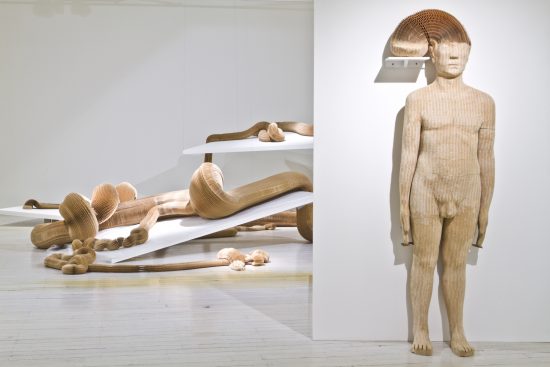
Li Hongbo makes extraordinary, moveable, stretchable, slinky-like sculptural installations from paper: here is the start of my profile for The Art Life based on a long conversation with the artist held in his Beijing studio in 2015. I have to say, I've been in an awful lot of freezing cold artists' studios in China in the last few years, but Li Hongbo's rural barn was definitely the most frigid - I dropped my notebook and voice recorder on the floor several times because without my gloves, my fingers were so numb.

As a little boy in rural Jilin Province, in China’s far north-east –– closer to North Korea and Russia than to Beijing –– Li Hongbo made his own simple playthings from paper, taking pages out of school exercise books to construct toy planes, trucks and trains. Now, as an artist working in Beijing, exhibiting across the globe, he is known for extraordinary large-scale installations such as the two life-sized expanding figures held in the White Rabbit Collection, or ‘Ocean of Flowers’, an installation of brightly-coloured paper guns and weaponry seen on Cockatoo Island at the 18th Biennale of Sydney in 2012. The intimacy of handling paper resonates with childhood memories of folk art traditions and his own hand-made toys. Today, having mastered the art of cutting, gluing and carving thousands of sheets of cheap brown paper to transform this humble material into intricately designed kinetic forms, Li Hongbo says that what he enjoys most, apart from the endless possibilities of the medium, is its accessibility. He believes that Chinese people have a special bond with paper that comes from a deep cultural memory.
Li Hongbo, Paper, 2010, dimensions variable, image courtesy White Rabbit Collection
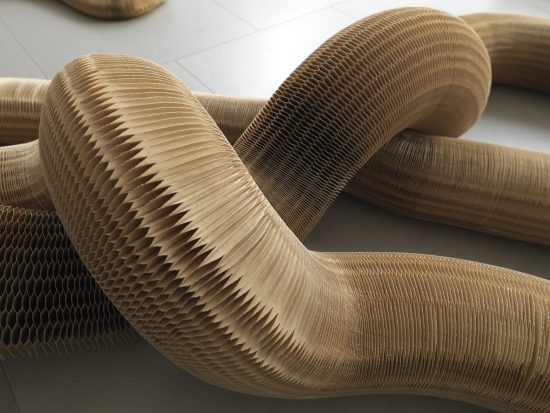
Li’s concertina-like expandable sculptures begin as stacks of paper; until they are stretched and pulled into new shapes they appear as if carved from stone or wood. As a student Li Hongbo researched how paper was used in Chinese folk art, influenced by the significant artist and teacher, Lü Shengzhong, who revived a Chinese craft tradition with his own contemporary papercut installations. Lü’s emphasis on the importance of folk art inspired his students to undertake field research in remote areas of rural China, recording obscure and endangered arts and crafts and learning their techniques. Returning to Beijing, Li Hongbo and his contemporaries sought new ways to embed these traditions into their own art practice: Li experimented with the Chinese ‘honeycomb’ paper folding technique.
In late 2015, I spoke with Li Hongbo in his Beijing studio and asked him what it is about paper that he finds so endlessly fascinating. What follows is an edited extract of that conversation:
Li Hongbo: Firstly, it is because it is very cheap and very common, and accessible to everyone. And it is everywhere, it has a special bond with people. Secondly, Chinese traditional culture has a lot to do with paper. It’s about cultural memory and tradition. People have never stopped their investigation into the endless possibilities of paper. I love paper.
Luise Guest: When, and how, did your interest in the magical possibilities and properties of paper originate?
LH: When we were little a lot of toys were made of paper; toys at that time were very expensive so children would use paper to make things like aeroplanes. They would even tear their textbooks to use that paper to make toys. My handmade toys were very popular with my classmates so I had very good relationships with them! Then later I was a book designer, and I also studied ancient Chinese Buddhist books and wood block printing. So, paper was created long before the Tang Dynasty – more than 4000 years ago – and when I studied the ancient traditions and religious paintings I discovered that paper was a medium that carried history and carried stories. All of this led to my fascination with the endless possibilities of paper.
LG: How did you develop the skills needed to make these extraordinary sculptures?
LH: Originally, I studied Chinese folk art and I am also an expert on Chinese paper culture. The ancient Chinese were very clever; they could make various toys with one sheet of paper that can take various forms. So, I learned how to make my own works in this traditional way.
LG: Is this ‘honeycomb’ gourd technique that you use similar to the method used to make traditional lanterns?
LH: Yes, very much so.
LG: Can you tell me a little about your background – your childhood and student years in Jilin Province before you came to Beijing? I am curious to know about your earliest experiences of art.
LH: When I was young I was very naughty and I liked making toys with my own hands – toys were very expensive so my parents would not buy me toys, and I became very good at it. I liked painting, so I grew very confident in these things. I never stopped painting. At Spring Festival in 2013 I discovered that my mother had collected every artwork I had made since I was a small child, from primary school to college. All of those exercise books were filled with sketches and drawings – but very few notes! In senior high school, I began to learn things and in college I majored in art education. I did not work as a teacher, though, because I wanted a career as an artist, so after graduation I came to Beijing. [In Beijing, Li completed two Masters Degrees at the Central Academy of Fine Arts, in Folk Art and in Experimental Art, over a period of ten years.]
Li Hongbo, Paper, detail.
Read more: Click HERE

Wednesday, October 21, 2015

北京日记 Beijing Diary: 一 日 千 秋 One Day a Thousand Autumns


I've left Beijing and I'm already missing it. Like many, both Chinese and non-Chinese, I have a love/hate relationship with that big bad city - I am already breathing a little more easily after 24 hours, but the "Beijing cough" is still with me. Each time, I leave with a sense of regret for all the exhibitions that I didn't have time to see, the places I didn't have time to explore, and the fluency in speaking Chinese that I failed to achieve. The month-long immersion certainly helped, although my language skills are still woeful. I am in Hong Kong now, and still stopping myself in taxis, shops and restaurants from speaking Putonghua, which does not generally go down well here, where tensions between Hong Kong citizens and mainlanders are high. I feel as if my brain is divided in two - one section is thinking in Chinese (slow, clumsy, yet definitely improving) and the other half is English. And there are just so many words and phrases where the Chinese seems more on-the-money, so a creole mixture is often spoken by expats. To feel a bit unwell is to be "bu shufu" - much more descriptive! Something annoying or troublesome is "mafan", and to do anything immediately (unlikely in China) is "mashang", literally meaning, "on horseback". Something so-so is "ma ma hu hu" (horse, horse, tiger, tiger) although I suspect this is a phrase more said by foreigners than by Chinese. And then there are all the fabulous 4 character idioms, or Chengyu, that in translation can be poetic (三人成虎, Three Men Make A Tiger, or if something nonsensical is repeated enough it is accepted as truth) or rather earthy. Something completely pointless or a waste of time is "like taking your trousers off to fart." New slang, too, usually spread via the internet, is often very revealing: a desirable woman is a "bai fu mei" (white rich pretty.) The insistence on whiteness is evident in the number of skin whitening creams sold in pharmacies, the use of umbrellas to shade your face from the sun, and in the universal contempt shown to the "nongmin" or country-side people (the peasants in the old socialist etymology). At an artist's studio in the mountains outside Chengdu his female assistants from the local village crowded around me exclaiming over the whiteness of my skin (and no doubt my white hair too!) And riches - to reverse the famous Jane Austen line, it is a truth universally acknowledged that a man in search of a wife must be possessed of a good fortune. And all the better if her family is rich too.

Beijing Walls - a palimpsest of erased phone numbers, October 2015, Photo LG
Beijing Hutong Doorway, October 2015, Photo LG
On the plane from Beijing to Hong Kong, I began reading The Porcelain Thief, the tale of an American Chinese journalist's search for the treasure trove of porcelain buried by his great grandfather before the family fled the advancing Japanese army, eventually ending up in Taiwan, then the United States. A bemused first-time traveller to Shanghai, he encounters the anarchy of the roads with a description that made me laugh in recognition. Each time I come to China (and in the last 2 years I have spent 5 months in the neighbourhoods of Tuanjiehu and Dongzhimen) by the second week I have forgotten all about the existence of seatbelts and have stopped flinching when taxis change lanes suddenly, forcing their way into non-existent gaps in fast moving streams of traffic. When I return to Sydney I have to remind myself to wait for the lights to change, to indicate when I change lanes, and not to just walk out into the traffic and expect that it will flow around me if I hold up one hand.

Here is Huan Hsu's description, so accurate that it's worth quoting the full paragraph: "Though the taxi fleets boasted high-tech touch screens built into their headrests with a recorded message reminding passengers (in English) to wear their seat belts, none of the taxis had seat belts in their back seats...City buses swerved into oncoming traffic and cut across two lanes to make their stops. Drivers used their horns so liberally that expats joked about it being the Chinese brake pedal. Drivers could, and did, disobey every explicit and implicit traffic rule on the books. Police, fire and medical vehicles enjoyed no special dispensation on the roads; nor did police seem interested in pursuing reckless drivers. It was common to see cars stopped in the middle of a freeway, crossing elevated medians, or driving long distances in reverse after they'd missed an exit, and in each case the rest of the cars simply purled around the offender like a stream around a boulder. The streets follow a design that can only have been created by someone who didn't drive. (The use of headlights was actually prohibited in China until the mid 1980s, when officials began going overseas and realised it was the norm.)" And now in Beijing, where the Lamborghini showroom on Xindong Lu also has a private plane in the window, the "Fu Er Dai" (second generation rich) drive expensive cars with utterly reckless abandon, often whilst talking on their cell phones, with an attitude of contempt for every other vehicle and pedestrian on the road.
Near Gulou Daijie, Beijing, October 2015, Photo LG
Old Hong Kong is still there! Causeway Bay, October 2015, Photo LG
I already miss Beijing but love Hong Kong too. English writer Fuchsia Dunlop memorably described is as like a "decompression chamber" for those returning to the west from China. Despite the increasing glitziness of the island - how many Gucci and Prada shops can one city possibly accommodate, and does anyone actually buy all this expensive crap? - I am always charmed. I love the rattly trams and the Star Ferry, the chaotic tumbledown streets around Yau Ma Tei and Jordan, and the flocks of schoolgirls in white dresses with coloured belts who fill the streets and MTR stations in the late afternoons. I like the "sitting out places" - tiny oases of calm in a frenetic city - where men sleep on benches with their shoes neatly arranged on newspaper beside them. I like the unexpected Buddhist shrines next to shops, under stairways and under the overpass on Canal Road. Today in the Nam June Paik exhibition in the hushed and tony surrounds of Gagosian Galleries, a cleaning lady bowed with folded hands in front of one his TV Buddha installations.


Each time I arrive from the mainland and see people actually waiting for traffic lights to turn green before they cross the road, I experience a slight shock. Entering a subway car is no longer a life-threatening push-and-shove survival of the fittest, people stand to one side on escalators and actually line up in shops and banks, and nobody is coughing up phlegm and spitting it onto the footpath directly beside you. It's a relief, and yet....

It's the sense of unpredictability in China, the sense that everyone is making it all up as they go along (and in the case of many drivers, that is exactly what they are doing) that is also the source of dynamic entrepreneurialism, creative energy and optimism. People reinvent themselves continually - from the rural teenagers travelling to the factory towns for work to the artists trained in one medium who decide to do something completely different and unexpected working in another. It's that sense that anything is possible, that anything can happen - and probably will - that makes me love China despite all the very real difficulties and the increasingly worrying crackdown on human rights lawyers, activists, journalists and NGOs. The artists' villages - Caochangdi, Heiqiao, Hege, Songzhuang, Feijiacun and Beigao, not to mention others so new that I haven't yet discovered them - are seething whirlpools of creation. Not everything is fabulous, of course, how could it be? But in a converted barn-like space in Songzhuang I found Li Hongbo working on his miraculous expanding paper sculptures for his New York show; in Heiqiao Liu Zhuoquan spoke of his plans to create an installation of more than 6,000 of his "inside bottle" paintings; and I met Wang Lei in a 798 cafe on my way to the airport for my flight to Chengdu. We spoke of his use of Chinese and English dictionaries sliced, shredded and spun to become a textile-like material that can be "knitted" into imperial robes. I told him he reminded me of the dark fairytale where a girl is kidnapped and forced to spin straw into gold - a metaphor for the alchemy performed by each of these artists.
Liu Zhuoquan in his studio, Beijing October 2015 Photo LG
In Hangzhou Jin Shi talked about his wonderfully witty yet poignant sculptures, creating the tiny spaces and makeshift worlds of the rural migrant workers who are building this "new China". In Shanghai Yang Yongliang explained his technique of working with thousands of photographs of the cityscapes of Chongqing and Shanghai in order to create his magically animated versions of  "shan shui" ink paintings. In Chengdu I spoke with Shi Jindian in his house up in the mountains about his intricate, painstaking reproductions in wire of mechanical and natural forms. In her converted Yuan Dynasty temple studio and living space in Beijing, Bingyi had just returned from an early morning photoshoot - she is working on a project that will combine film, drama, poetry, music, still photography and ink painting as a record of the lives and experiences of those living in the last, endangered traditional "hutongs" or courtyard houses of old Beijing. These are just 7 of the more than 20 artists I interviewed in the last month. Each represents an aspect of the vitality of contemporary Chinese art, and the ways in which many Chinese artists are adapting traditional forms to create a contemporary language. These are global artists - their work, and in many cases the artists themselves, regularly criss-cross the globe, participating in group and solo shows and Biennales in Venice, Paris, New York, London and Moscow. Yet their work remains distinctly Chinese.

The first time I went to China I realised I was witnessing something extraordinary and historically significant, and that feeling has only grown stronger in subsequent years. In the last five years I have seen dramatic change, and understood just a glimpse of the disorientation felt by Chinese people, especially those of an older generation. One artist, explaining his refusal to answer any questions about his youth, said, "I have experienced all of recent Chinese history, and it is all terrible." The pace of change is relentless, a source of both distress and excitement: the Chinese paradox. There is of course a chengyu for every occasion. "One Day A Thousand Autumns" (Yi Ri Qian Qiu) meaning that change comes so swiftly that it seems a thousand years passes in one day, fits the bill here: 
一   秋.

Bingyi with ink painting in her Beijing studio, a Yuan Dynasty temple near the Drum and Bell Towers,
October 2015 Photo LG

Sunday, May 3, 2015

Writing Makes You Fat! 写作会让你更胖!

Gao Rong, Guangzhou Station (detail) copy handbag, embroidery thread, fabric and foam, dimensions variable,
 image courtesy the artist
I have discovered a sinister and hitherto little known (at least to me) connection between writing and obesity. As I enter the final dark days of editing, wrestling my unwieldy and intractable beast of a book into submission in the attempt to create a leaner, meaner version ready for print and publication by October, any pretence of a commitment to fitness and exercise has flown right out the window. Writing in the early mornings before work, in the late afternoons as soon as I get home, and late into the night, carving out chunks of time on weekends, and lying awake thinking about it in the middle of the night, whilst also continuing to worry about my students and take home vast piles of marking has taken its toll. By this point it has resulted in a state of physical torpor so marked that my gym has now stopped sending me those annoying emails that begin cheerily, 'Luise, we haven't seen you for x weeks!' Am I feeling guilty? Of course. There's a direct correlation between the length of my book and the size of my arse. And now, as my book gets leaner, I seem to be getting larger.

There should surely be websites dedicated to this - maybe useful K-Tel products could be advertised on weird late night TV channels. Perhaps a treadmill which you could operate whilst typing might be the go. I tell myself - every week - that this week will be different. I will walk each morning at sunrise, I will go to the gym, I will go to all those yoga classes I've paid for already. I will not eat chocolate (ha ha) and I will not drink wine (ba ha ha!) And my final vain resolution, every single week, is that I will do an hour of Chinese study every day. Sad to admit, none of this has happened. But there is light at the end of the rainbow and a silver lining at the end of the tunnel. (Which, come to think of it, could well be a Chinese maxim.) Each day is a new beginning and the East is red.....

There is also the fact that the solitary occupation of writing has to be balanced with all the competing demands of daily life. When I read all those stories of male writers who shut themselves away in their studies and emerged only for meals that had been cooked and served by women, I used to think, 'Those bastards!' Now, I think, 'Those lucky bastards...' I am looking for inspiration in other stories of women like PD James who rose before the sun every morning and completed a few hours of writing before going to her job as a senior civil servant. Or Mary Wesley, whose first book was published after she was 70. It did, after all, take me until I was 58 before I had that all important "room of one's own."

The book will, I suppose, eventually, be finished. Afterwards I will return to China, study Chinese each day while I am in Beijing, and embark on a project for a whole new adventure that begins at the end of September. I am looking forward to my encounters with artists such as Li Hongbo, Xu Zhen, Lu Xinjian and Wang Qingsong, and to broadening my field of research. I will travel to Chengdu to visit some artists' studios, and return to Hangzhou, where I was able to spend only one day with Wang Zhibo last December. My experience of China is so limited, and I want to see cities other than Beijing and Shanghai, wonderful though they are.
Lu Xinjian, City DNA Beijing, 2010, acrylic on canvas, 200 x 400 cm, image reproduced courtesy of White Rabbit Gallery
Many of the artists included in my book have recently shown new work in China and internationally, or are about to do so: Cao Fei at Hong Kong Art Basel and the Venice Biennale, He Chengyao and Tao Aimin at the International Expo in Milan, Cui Xiuwen's second solo show at Klein Sun Gallery in New York, and Liu Shiyuan at Whitespace in Beijing, just for starters. Yin Xiuzhen's 'City Suitcases' and the feminist 'Badges' that Lin Tianmiao explained to me when we met in 2013 are in an important exhibition, opening later this month, of works from the Gene and Brian Sherman Contemporary Asian Art Collection at the Art Gallery of New South Wales, 'Go East'. This promises to be intriguing. As Ai Weiwei said, 'Everything is art, everything is politics,' and with works from Dinh Q. Le, Alfredo and Isabel Aquilizan, Song Dong, Zhang Huan and Yang Fudong, among others, this will be an exhibition not to be missed, of works by artists who engage with the most significant issues of our time. So while I am sad to miss the exhibition of Xu Zhen and his Madein Company at the Long Museum in Shanghai (a visitor to his studio recently described it as 'like Andy Warhol's Factory, but with less sex and drugs') and I can only sigh over the impossible dream of getting to the Venice Biennale, I can at least console myself with the knowledge that Chinese contemporary art is now everywhere, and Sydney is no exception.
Lin Tianmiao 'Badges' 2009 white silk satin, coloured silk threads, gold embroidery, frames made of stainless steel, sound component: 4 speakers with amplifier, Dimensions variable, Image courtesy the Gene and Brian Sherman Collection and Sherman Contemporary Art Foundation Sydney, Photo: Galerie Lelong New York
 In the meantime, I am enjoying working with my students on their own writing about contemporary artists ranging from Ai Weiwei and Xu Bing to He Xiangyu, Ah Xian and Shen Shaomin. They continue to surprise me with their thoughtful interpretations and their interest in the ways in which contemporary artists can embed meaning into their choices of materials. Most recently they have been writing interpretations of Ai Weiwei's latest installations on Alcatraz Island, particularly 'Blossom', the installation of white porcelain flowers with which he has filled the tubs, toilets and washbasins of the abandoned psychiatric hospital wing. Now they can talk knowledgeably about Mao's cruelly deceptive 'Let 100 Flowers Bloom and 100 Schools of Thought Contend' policy of the 1950s, no mean feat for Australian kids who could not tell you anything at all about China and its history only one short year ago.

Even the little ones in Year 7 have done some writing about Cai Guo-Qiang's beautiful circle of animals around a waterhole, 'Heritage', and Year 8 are writing imaginary wall texts for an exhibition of Gao Rong's fake designer handbags embroidered with stains and filled with unlikely embroidered objects, ranging from a sausage to a giant oozing tube of toothpaste; from a packet of laundry powder to builders' tools. I will be intrigued to see what they make of this work, entitled 'Guangzhou Station' and shown at the Moscow Biennale in 2013.


Gao Rong, Guangzhou Station, (details) copy bags, embroidery thread, fabric and foam, dimensions variable, image courtesy the artist

'Half the Sky: Conversations with Contemporary Women Artists in China' will be published by Piper Press in October 2015. 

Wednesday, July 11, 2012

The 18th Biennale of Sydney at Cockatoo Island - mist, mystery and even some magic

Installation View 'Source', Ed Pien with Tanya Tagiq, Cockatoo Island, 18th Biennale of Sydney
I spent a cold winter's day wandering all over Cockatoo Island seeking out the works that I thought would be the most interesting / engaging / beautiful / exciting. Initially I was a little underwhelmed by Fujiko Nakaya's 'Fog' installation, first encountering it from the top of the hill and looking down into the crevice from which the clouds of mist emerge. However, at the end of the day, as I dragged myself wearily towards the wharf, I was engulfed in clouds of mist and fog, and the effect was quite magical. As expected, Li Hongbo's extraordinary folded paper installation, with brightly coloured AK47 machine guns, bullets and weaponry was a highlight. His gigantic 'paper man' was one of the most engaging works shown at the White Rabbit Gallery last year and the Biennale work didn't disappoint.

Li Hongbo, Ocean of Flowers2012 (detail), paper, dimensions variable

Child exploring 'Source' by Ed Pien withTanya Tagaq at Cockatoo Island, 18th Biennale of Sydney
Some of the most wonderful things, though, I discovered serendipitously, having had no idea what they would be like beyond the (rather poor in some instances) catalogue photographs. The Ed Pien installation was one of those. The small child in the photograph above was walking through the maze, her eyes shining in the dim light. As our paths crossed she looked at me and said, "This is magic!" And it was. I also loved the works by Cal Lane (as well as the lace patterns made of sand on the ground, a shipping container cut into flowery domestic lacy patterns) and the giant polystyrene machinery parts by Peter Robinson.

Cal Lane, Sand Lace, installation view, Cockatoo Island
Peter Robinson, Snow Ball Blind Time, polystyrene, installation view
Jin Nu's 'Exuviate 2: Where Have All the Children Gone", last seen in 'Beyond the Frame' at the White Rabbit Gallery, was even more touching and poignant installed in a bedroom of one of the heritage houses at the top of the island. Creepy and compelling, the tiny starched organza dresses appear to be floating in the air, mute testament to lost childhoods. Or an elegy for those that were never born as a result of the one child policy?

Jin Nu, 'Exuviate 2: Where Have All the Children Gone?' installation view at Cockatoo Island

Of course in 49 works on the island - often quite widely dispersed and sometimes hard to locate - there are misses as well as hits. And, frankly, I felt the shows at the Art Gallery of New South Wales and the Museum of Contemporary Art were better, more consistently engaging and at times quite wondrous. Yet overall this Biennale has made me feel optimistic  about contemporary art. It was not a Eurocentric Biennale in any way, and the most exciting works were, unsurprisingly, from Asia - particularly works by Thai, Vietnamese and Chinese artists. 

I have written 2 reviews of this Biennale for Dailyserving where I have talked about all my favourite works, including the fabulous embroidered installation by Gao Rong at the Art Gallery of New South Wales. I hope to visit her at her studio in Songzhuang Artist Village in December. When she spoke about her practice at the White Rabbit Gallery I asked her how her fabric and embroidery works were viewed whilst she was studying in the Sculpture Department at the Beijing Central Academy of Fine Arts (which may, I suspect, be rather heavy on the testosterone). She very charmingly deflected the question, but I would love to know more!
Monika Grzymala and Euraba Artists and Papermakers at the 18th Biennale of Sydney