The ongoing thoughts of an art teacher in China - and home in Sydney

A continuing diary about my travels in China, and thoughts about China and Chinese art from home and abroad
Showing posts with label Liang Yuanwei. Show all posts

Saturday, December 24, 2016

The Year of Transformation

Jingdezhen Chinaware Hotel Courtyard
"So this is Christmas and what have you done/Another year over, a new one just begun..."
I have been intending to write a post covering my most recent experiences in China for some weeks, but the frantic busyness of the year's end  has conspired against me. Now, as I sit at my kitchen table, with food ready to go into the oven in the heat and humidity of an Australian Christmas - yes, we truly are insane - bright parrots noisily swoop on the red flowering gum tree in front of our house, their cries mixed with the noise of neighbourhood children in swimming pools, lawnmowers and the thrum of cicadas, I finally have a moment to look back at the year just past.


Artist residency outside Jingdezhen - clear air and mountains in the distance
And what a year of change it has been.

The first year away from teaching since my second daughter was born in 1990. 

The year of the first grandchild - such joy!

The year my first book was published - a mixture of joy and terror.

The year of my first curated exhibition - ''Half the Sky'' - in Hong Kong and Beijing, and speaking about my book to a packed house at the Beijing Bookworm bookshop.

The year of navigating a new job that challenges me every day, and allows me to focus entirely on contemporary Chinese art.

The year of starting a second graduate research degree - oldest student in captivity?

And a year of three trips to China and my first trip to Taiwan to interview artists who think and work in very different ways to those on the Mainland.


First, my best #onlyinChina moment of 2016:
In a Jingdezhen restaurant we had almost finished eating a wonderfully spicy meal, and had progressed to the too-much-drinking phase of the evening, when I began to hear the word, "laoshu" - ''mouse" (老鼠). Looking up towards the beam running between wall and ceiling, where a few diners had begun pointing, I saw a very long tail disappearing into a crevice in the wall. Then another creature ran along the timber beam above the table. Then another. Then another. And they were not mice. After some amused conversation about what would happen in Australia if large rats were seen running through a restaurant, it was decided to call the waitresses and express some degree of dismay. The Chinese members of our group were completely unperturbed, as were the assembled flowery-aproned fuwuyuan. Their response: "What's your problem? They didn't eat YOUR dinner!"

Back to the art-related highlights of 2016.

In February my book ''Half the Sky: Conversations with Women Artists in China" was published by Piper Press after a 5-year labour of love, researching and writing. The launch at Kinokuniya Bookshop in Sydney, a Q & A with curator Suhanya Raffel, was a moment that I had feared might never eventuate in the end-game struggle to complete the project. More than 40 female Chinese artists invited me into their studios and their lives, and we shared conversations about art, men, children, mothers, Chinese history, and everything else under the sun. I am so grateful to them for their honesty, fearlessness and humour, and regretful that I couldn't include every artist I interviewed. In the end, the book featured 32 of them - and one day I would surely love to produce Volume 2!

In April an exhibition of works by women in the book was shown, firstly at Art Hotel Stage in Hong Kong, and then in a different iteration at Red Gate Gallery, Beijing, curated in collaboration with Tony Scott of China Art Projects.


A Line-Up of Artists at the Opening and Book Launch at Red Gate Gallery: L to R Zhou Hongbin, Cui Xiuwen, Li Tingting, Xie Qi, Australian Ambassador to China Frances Adams, Ma Yanling, me, Bu Hua, Tony Scott, Bingyi, Xiao Lu, Lin Jingjing, Han Yajuan, Gao Ping. Not shown: Gao Rong, Dong Yuan, Tao Aimin, Huang Jingyuan


Gao Rong signs a copy of ''Half the Sky"
In October I travelled to Taiwan to interview artists in the White Rabbit Collection. I especially loved visiting the studio of HsuYung-Hsu, and meeting artists Peng Hung-Chih, Shyu Ruey-Shiann and Mia Wen-Hsuan Liu. I discovered a very different Chinese culture and history, reflecting diverse influences from Portugal, Japan, Hakka culture and indigenous Taiwanese histories. It's not 'China-lite', as some had led me to imagine, but something completely unique, despite all the current ongoing tensions.


A work laid out in Hsu Yung-Hsu's studio


In December I was invited to join a research team for the first phase of fieldwork, for a Leverhulme Trust-funded project called 'Everyday Legend', exploring endangered traditional Chinese craft practices and their reinvention and renewal in contemporary art. The week began at Shanghai's Minsheng Art Museum with the exhibition curated by Jiang Jiehong. 'Everyday Legend' included works by many artists represented in Sydney's White Rabbit collection, including Liang Yuanwei, Zheng Guogu, Shi Jinsong, Sun Xun, He Xiangyu and Zhao Zhao. It was tightly curated and engaging, from He Xiangu's alarming installation of teeth to Liang Yuanwei's simulations of textiles in oil paint, from Liang Shaoji's collaboration with silkworms to Yu Ji's dismembered body parts, as if hacked from ancient sculptures.


Liang Shaoji's chains covered and enrobed by silkworms in Everyday Legend, Minsheng Art Museum
 Zheng Guogu's carved marble, mostly unreadable, text iinstallation n 'Everyday Legend' at Minsheng Art Museum
Installation View, 'Everyday Legend' at Minsheng Art Museum, with Yu Ji's cement body parts on the wall
We travelled from Shanghai to Suzhou to meet weavers and embroiderers, and then to Jingdezhen, where our itinerary was arranged by conceptual artist Liu Jianhua, recently returned to China after installing his work at the Asian Art Museum in San Francisco - earlier in 2016 his work was shown at the V&A and in Tate Modern's Herzog and de Meuron-designed Switch House. As a young boy Liu was apprenticed to his uncle in a Jingdezhen porcelain factory before eventually attending university at the Jingdezhen Ceramics Institute, later teaching in Yunnan earlier in his career. Like many significant Chinese artists, including Zhang Peili, Liu Jianhua still teaches in Shanghai, where he is a professor in the Fine Arts School of Shanghai University. 
''Colouring Tiananmen Square" - porcelain from the 1960s
In Jingdezhen we visited studios, artist residencies, factories, museums and a bizarre ''Cultural Relics Theme Park', as well as the fake market where new wares are carefully aged to appear ancient. Over spicy Jiangxi food we discussed art and Chinese history, and shared ideas for the next phase of the project. We were accompanied by Lv Shengzhong, whose own artistic innovations and profound influence on the curriculum of the Experimental Arts Department at Beijing's Central Academy of FIne Art changed the way that many Chinese artists thought about connections between folk art and contemporary practice. Like a wrinkled grey-bearded elf, wearing a felt hat traditional to Shandong Province, and with an accent so thick you could cut it with a knife, his views on the project and on what we were seeing were fascinating. 
Working a loom exactly the same as those used in the Ming Dynasty

Hiu Man Chan, Jiang Jiehong and Sebastian Liang watch Mr Wang in his embroidery workshop


The group was led by Jiang Jiehong, a professor at Birmingham City University's Centre for Chinese Visual Art, and included Sebastian Liang and Nan Nan from the New Century Art Foundation in Beijing, and Professor Oliver Moore from Groningen University in the Netherlands. The trip finished with a discussion/workshop at Minsheng Art Museum focusing on contemporary art in China and whether artists could or should incorporate material practices from China's past. We were joined by artists Yang Zhenzhong, Zhou Xiaohu and Jin Feng, who were more inclined to dismiss the past than to repeat it, taking a refreshingly idiosyncratic standpoint.


Porcelain worker painting the Immortals, Jongdezhen

San Bao Artist Residency and Studios, Jingdezhen

Porcelain emerging from the kiln, Jingdezhen
Apart from the incident of the rat in the dining room, in Jingdezhen I added to my growing collection of Chinese hotel names in English: the "Waiting Hotel", the "Fishing Post Hotel"(in the middle of the city), the ''Continents La Grande Large Hotel" and my favourite, "The OK Hotel" - which may or may not be truth in advertising. In our own hotel, the Jingdezhen Chinaware Hotel ( excellent by the way) a notice in my room advised that by calling reception I could be provided with red wine, coffee, Red Bull, dried beef, shredded squid, chicken feet with pickled peppers, poker and cigarettes. 


Meats drying from the eaves, Jingdezhen


In the workshop of Mr Wang - Sebastian Liang, Jiang Jiehong, Mr Wang, Lv Shengzhong, Oliver Moore and myself
As for art seen and experienced in 2016, I won't mention the disappointments - but there were a few. My exhibition highlights this year include, in no particular order:

  • Hu Qinwu at Niagara Galleries, Melbourne
  • Liu Zhuoquan at Niagara Galleries, Melbourne
  • 'Ink Remix', a travelling exhibition of works from the PRC, Hong Kong and Taiwan, seen at UNSW Galleries, Sydney
  • Charwei Tsai's installation of incense in the evocative surrounds of Mortuary Station for the Biennale
  • Lee Mingwei's poetic Guernica of sand - and its sweeping away - at Carriageworks during the Biennale
  • Bharti Kher and Chiharu Shiota on Cockatoo Island for the Biennale - although much of the rest here and elsewhere belonged in the disappointments category
  • Zhang Peili at Australia Centre on China in the World, ANU, Canberra
  • The Kuandu Biennale, 'Slaying Monsters' in Taipei, and the Taiwan Biennial in Taichung, well-curated shows that excited and challenged the viewer
  • 'Everyday Legend' at Minsheng Art Museum, Shanghai
  • And, of course, (my partisanship as a newish member of the team freely acknowledged) 'Heavy Artillery' and 'Vile Bodies' at Sydney's White Rabbit Gallery, curated by David Williams from Judith Neilson's extraordinary collection of Chinese contemporary art.
Zhang-Xu Zhan. Inferiority Bat (Hsin Hsin Joss Paper Store Series–Room 003), 2014-2015; 6-channel video animation installation; 5 min. Courtesy of the Kuandu Museum of Fine Arts
In all the misery this year has brought the world, and the fear and despair that many across the globe are now feeling, I look to artists to continue to speak "uncomfortable truths" and to art educators to continue their undervalued work teaching students to think critically and apply their creative minds in unconventional ways. 


Sunday, December 16, 2012

Zhong guo "Zai Jian" - for now

A large wall text at the entrance to the "Andy Warhol - 15 minutes eternal" exhibition currently showing at the Hong Kong Art Museum reads, " Making money is art and working is art and good business is the best art". This is curiously appropriate in Hong Kong, a city where, artist Celia Ko told me tonight, "money is the only language that everybody speaks."

Hmmm. Money and art. Who knew? Always a hugely problematic nexus, and ideas about the relationship of one to the other are contested bitterly. In Beijing there is no denying that a number of artists became seriously wealthy in the art boom of the late 90s and early 2000s. And cynical views are expressed by some in the artworld that everything and everyone have been corrupted by that.

However while everybody needs to earn a living and artists are not exempt from the normal kinds of greed and desire for comfort and ease that we are all heir to, I am prepared to go out on a limb and say that each of the seventeen artists I have interviewed on this trip are absolutely and seriously dedicated to making art that expresses deeply felt ideas and beliefs, and work incredibly hard to develop their practice and pursue a goal of excellence, whatever the art market might be doing.
Gao Ping, oil on canvas, image reproduced with permission of the artist and China Art Projects
Gao Ping told me, "Every year I want to find something new in my work" and added, "The drawing is my heart". Lin Tianmiao said, "Being an artist is a very personal thing. We are the people who raise the questions - the critical thinking is the most important thing". You can read a more detailed account of my interview with this iconic figure, currently showing at Lelong in New York, here: http://dailyserving.com/2012/12/holding-up-half-the-sky-an-interview-with-lin-tianmiao/

Lin Tianmiao, thread winding work viewed in the artist's studio,
 photograph Luise Guest, reproduced with the permission of the artist
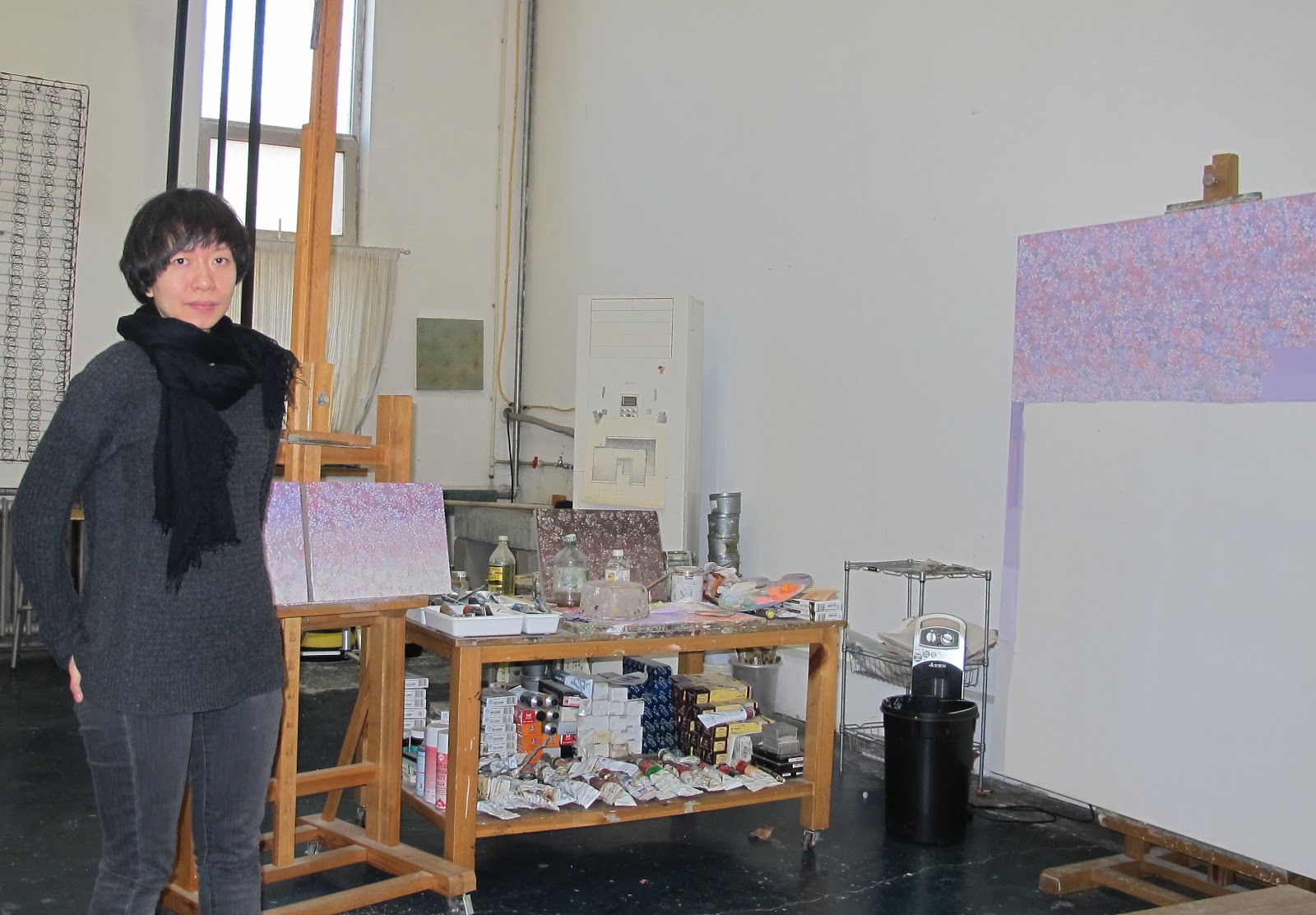
Liang Yuanwei, who spent three months in Berlin after a less than happy experience representing China at the Venice Biennale, said. "My work is like a tunnel between myself and the world. It must be true."
Liang Yuanwei in her Beijing studio, December 2012
Photograph Luise Guest, reproduced with permission of the artist
Liang Yuanwei, Flower Study for the Golden Notes series, oil on canvas
Photograph Luise Guest reproduced with the permission of the artist
Liu Zhuoquan makes very beautiful works that contain within them some carefully coded meanings about issues in China today. Wu Meng makes works in the public space in Shanghai at considerable personal risk to herself and her family, raising issues of vital concern such as the suicides of workers in the factories of southern China, or the unfair treatment of migrant workers. And Lam Tung-pang in Hong Kong, whose work is currently showing at Saatchi in London, makes works which reflect his feelings of anxiety and distress about what is happening to his beloved city, and his search for quietness and repose in a re-examination of the traditions of ink painting.
Lam Tung-pang in his studio, Hong Kong December 2012,
photograph Luise Guest  reproduced with the permission of the artist
Lam Tung-pang, studio view
Lam Tung-pang, 2 sided work based on Tang Dynasty horse, photographed in the studio
Photograph Luise Guest reproduced with the permission of the artist
Lam Tung-pang, exhibition of work at Goethe Institut, Hong Kong, installation view
image reproduced with permission of the artist
I have interviewed painters and performance artists, photographers and sculptors, artists who work with found objects and found images, those who reinvent traditional Chinese forms such as ink painting or gong bi style painting and those who seek an entirely new visual language. I have met famous and revered artists, and artists newly graduated from art academies. I have met curators and gallery directors and critics.
Monika Lin, "On the Way to the Imperial Examination",
performance piece in which the artist wrote the character 'mi' (rice) 10,000 times
Image reproduced with permission of the artist
Shi Zhiying in her Shanghai studio,
Photograph Luise Guest, reproduced with permission of the artist
I have also met two wonderful and inspirational art teachers with whom I hope to collaborate on some projects with our respective art students - art that crosses national boundaries and limitations of culture and language, that sounds good!

I have learned enough to make my brain feel as if it is overflowing with new information, enough for a book! We'll see... I have loved the experience of travelling with this sense of purpose and in a spirit of enquiry, and have been warmly welcomed everywhere. I have sat in ice cold freezing studios in old 'Shikumen' houses in the French Concession in Shanghai, and in Caochangdi and Songzhuang artists' villages on the outskirts of Beijing. Today, after visiting Lam Tung-pang in his new studio in Fo Tan, I caught a local mini bus to Sha Tin Station, blaring Chinese opera all the way.

From the sublime to the truly ridiculous, Hong Kong has it. Yesterday I saw an eagle floating, suspended, high above the clustered apartment buildings as I rode down the hills from the Peak on the top deck of a bus. Today, in the shopping mall above the Sha Tin MTR station, I came across a brand of handbags and wallets called 'Shag Wear' - I swear this is true! Yesterday, in Canton Road, two young men in the jostling crowd carried sandwich boards advertising 'The Battery Operated Nasal Aspirator".

I have been observing - sometimes feeling like a voyeur - the people in each city as they go about their lives, Old men and women playing cards, mahjong, chess, doing Tai Chi, ballroom dancing, playing bowls. Such constant activity! And here in Hong Kong have been touched by the way tiny, wizened old ladies are led gently by daughters and grand-daughters down jostling Kowloon streets. And also by the general tenderness shown in every  city I have visited to babies and children. Not surprising in the land of the one child policy, changing though that may be. Often in Australia I observe parents respond to their small children with exasperation and impatience as their default position. Not so in China.

It is perhaps ironic that part of my purpose here has been to discover what the effect of international dialogues, residencies and exhibitions has been on the work of Chinese artists, and how they have been changed by these experiences. A lot more remains to discover on that topic, but in the meantime the person most changed by the dialogue is me.
Zhongguo - Zai Jian!

Friday, April 22, 2011

Reflecting

Wall in Black Bridge Artists' Village, Beijing

A week ago I was still in Hong Kong, taking photographs of doors, windows and temples in Wan Chai, enjoying the visual chaos and contrasts. Today I felt compelled to go and eat dumplings in one of the Shanghai places in Ashfield to be surrounded by people speaking Chinese, and some of the same clutter and confusion that reminded me of China. I have been thinking about some of the artists I met in the last 5 weeks, and the works that affected me most profoundly, in ways that I am not yet quite able to articulate. In particular, there are works by the painters Hu Qinwu, Liang Yuanwei, and Shi Zhi Ying that I found especially beautiful and thought provoking. The practice of each of these artists seems so securely grounded, informed by their personal histories as well as culture and belief (in the case of Hu Qinwu and Shi Zhi Ying) and a deep knowledge and appreciation of art traditions both Chinese and Western in the case of Liang Yuanwei. Here are some of my favourite works.
Hu Qinwu, 'Earth Grid', reproduced with permission of the artist and China Art Projects
Hu Qinwu, Untitled, reproduced with permission of the artist and China Art Projects

Liang Yuanwei, Study, photographed by Luise Guest and reproduced with permission of the artist
Shi Zhi Ying, work from Sea Sutra series, photographed by Luise Guest and reproduced with permission of the artist
I also love the works of Hong Kong artist Carol Lee, which are both meditative and melancholy. I love their suggestion of 19th century photographic experiments, and the way that her technique of using the effect of the sun on yellowing paper carries within it her meaning of the passage of time, the brevity of life and the unreliability of memory.

Carol Lee Mei Kuen, 'Baby's Wear', image reproduced with permission of the artist

Friday, March 25, 2011

Days 11 and 12 – Spring arrives in Beijing

Outside my open window tonight there is a constant blaring of horns and ringing of bicycle bells, but the air actually smells like spring instead of like choking dust. Just today I have seen more magnolia trees in flower, weeping willows with green buds everywhere and workers in orange uniforms watering the dusty patches that may soon, perhaps, turn into grass. This feels like a different city than the one I arrived in exactly a week ago. Partly perhaps because I have overcome my shock at its immensity, and sometimes when I am in a taxi, or walking, I even know (sort of) where I am, and partly because the arrival of spring has changed the atmosphere in the streets.

I have had an amazing two days, which have been so full that it is hard to know where to begin to describe them. Today, thanks to an introduction from Professor Ian Howard, Dean of UNSW College of Fine Arts, I spent most of the day at the Central Academy for Fine Arts. This was quite extraordinary – an enormous institution which is legendarily difficult for students to get into. They accept only the most gifted of applicants, and in a tour which encompassed the Printmaking, Painting and Sculpture studios, as well as an exhibition of work by First Year Design students, I was utterly astonished at the standard of their work. Chinese art students are taught with an academic rigour that is long vanished in the west. There are many viewpoints about this, yet the artists that emerge from this system, including many of those on the faculty, are at the cutting edge of the avant-garde.

It was exciting to be there, breathing in the (no doubt toxic) fumes in the etching, lithography, woodblock printing and screen printing studios, which reminded me of my own student days, long before OHS and Chemical Safety ruled our lives! I was in a state of extreme envy at the size of the etching presses and the setup of these studios, where students were intently going about their work in a serious and dedicated way. Then to the First Year Painting classes, where students were painting at their easels from 2 models, set up at either end of the room. Studio after studio, down a long corridor, was set up in this way. Their paintings were very, very good. I loved being there – going into painting studios is something I immediately understand and where I feel at home, breathing in the smell of oil paint and solvent fumes – the smell of art! I was invited to join a delegation of faculty and students from the Norwegian Academy of Fine Arts, and we had some interesting discussions over lunch about the relative merits of a ‘free’ and ‘conceptually based’ western system of art education versus the rigorous and academically challenging system which operates in China.
Later, in the fabulous CAFA Museum (which was also showing a large touring exhibition of works from the Uffizi Museum in Florence) I looked closely at an exhibition of work by first year students in the Design Faculty. This was also pretty astonishing in its technical excellence, but also for the way in which the students are encouraged to think creatively in response to the demands of specific design limitations. The curriculum owes much to Walter Gropius and the German Bauhaus, acknowledged explicitly by the Director of the Faculty.

It is probably not surprising that CAFA is a powerhouse of art education – Beijing, after all, is a city in which a reputed 10,000 artists live and work. This is an amazing statistic!

I met two of those artists yesterday.

The first part of Thursday involved another long and hair-raising drive down dusty rutted laneways where dogs (many, many scruffy dogs of every possible shape, size and breed) wander at will, nosing through the rubbish, and cyclists are on what appears to be a suicide mission. Women push their prams straight in front of speeding trucks and buses. Very small children sit unsteadily on the back of bicycles, or sometimes on the handle bars, and teenagers give each other a ride – sometimes 3 kids to one bicycle. I am not sure how we arrive safely at the studio of Liang Yuanwei, in a district called the Black Bridge Artists’ Village, in Caochangdi, but somehow we arrive unscathed. The driver is not happy about his car, however, and is polishing the exhaust pipe with his handkerchief and muttering darkly as Stanley and I enter her studio.
Photographed by Luise Guest and used with permission of the
artist
I first encountered Liang Yuanwei’s work in the collection of the White Rabbit Gallery in Sydney, and was immediately drawn to it. Richly painted impasto canvases simulate pieces of cloth, some patterned with flowers, some with checks or dots. The cloth was collected from friends and relatives, some has a personal significance or a memory attached, but mostly I think it is intended to be quite banal, creating a surface on which the artist can layer rich painterly surfaces. A recent exhibition, the Golden Notes, was said by art critics to resemble Song Dynasty ‘bird and flower’ patterns, referencing Chinese history.

A small, quiet and intense young woman, now heralded by the press as ‘one of the best Chinese painters under thirty five’, which she finds quite amusing, Liang Yuanwei pours green tea and talks about the enormous shift in her life. From unwillingly graduating from the Design department at CAFA because her father would not permit her to study Fine Arts, and having to ‘lose face’ by asking undergraduate students to show her how to stretch a canvas; she is now to show her work at the next Venice Biennale, in the Chinese Pavilion with renowned artist Song Dong. She will then show at the London Art Fair, followed by her 2nd show at Pace Galleries Beijing with iconic artists Sol Lewitt and Agnes Martin. Not someone to blow her own trumpet, she quietly says she hopes not to embarrass herself in the company of such great artists.

The past decade has been lonely. As a self-taught painter, not a graduate from the CAFA Painting Department, she was not accepted in the Beijing art scene, and had to fight for herself and to “act tough”, dealing with gallery directors who ignored her, and one who famously told her “There are already too many female painters”. Liang says she has always been something of a rebel, living ‘in the margins’ in a rock and roll culture. It is ironic perhaps, that as we discuss the current Chinese art world she agrees that in China today many young people aspire to be artists – artists now occupy the space once reserved for rock and roll stars.
Photographed by Luise Guest and used with permission of the
artist
During our conversation Liang refers to artists who have been of great significance to her, such as the pioneering sculptor Eva Hesse, Mark Rothko, and also Wolfgang Tillmans, Sigmar Polke and Gerhard Richter. The most profound influence, however, which I immediately identify and understand when I see her recent minimalist and beautiful installation pieces, was the German artist Joseph Beuys. As a young girl, she always knew she wanted to be an artist, but at that time she knew only of Van Gogh and one or two famous local Chinese realist artists. Only much later did she find out that there was another way to make art. While she was studying Design at CAFA in 1995, some of her tutors returned to China from Berlin, bringing back with them contemporary art, in particular, the conceptual ‘Fluxus’ work of Joseph Beuys.

Liang is a determined and courageous woman, and she is now embarked on a path which she says is a balance of possibilities, between fear and trust – an artistic trajectory in which she is also caught up in China’s transformation and the dramatic changes in its economy, culture and politics. She says the change is so fast that she has had to turn inward, to find a quiet and calm place, and true values.
Photographed by Luise Guest and used with permission of the
artist
This idea is one I hear over and over again from Chinese artists, and from other people that I talk to. My translator, Stanley, I discover today, has quit his well-paid job in a pharmaceutical company because he is unhappy about corporate ethics, and wants to be a writer. He talks knowledgeably about books, poetry, Chinese history and spirituality. He is writing a novel about three generations of a Beijing family, and we talk about his desire to write and to teach. He is unsure what the future may hold for him, but he does not want to go into his family’s pickled meat business, and for the moment prefers to work as a tour guide and translator.

One thing that fascinates me here is that educated people are completely at ease with an identity as an intellectual. The artists I have met are articulate, deeply thoughtful, well-read and conversant with both Chinese and Western history and philosophy. It is most unlike our Australian suspicion and quick labelling of people as having ‘tickets on themselves’ or showing off. From the distinguished 53 year old Wang Jianwei, a former young soldier in the People’s Liberation Army, who as a young man in Sichuan spent a year being ‘re-educated’ in the country; to younger artists such as Liang Yuanwei, artists talk books, writers, history, philosophers and theory with a passionate intensity which is lacking in Australia. Perhaps it is only people who have known what happens when education is removed, as it was for so many during the Cultural Revolution, who can really value it. Liang talks about an important book by the American James Cahill, a reinterpretation of classical Chinese art. Stanley says to me later, “Yes, I have read that book and I agree with Miss Liang Yuanwei that it is very important”.

I am embarrassed to be so ignorant.

Meeting with Liang was just the start of an extraordinary day in which I also met the artist Hu Qinwu, whose work is permeated by Buddhist spirituality and whose gentle demeanour and profoundly beautiful paintings captivate me; visited the studio of Tony Scott, who runs China Art Projects in Beijing; and ended with a dinner in a beautiful restaurant designed to resemble a Qing Dynasty courtyard house.