The ongoing thoughts of an art teacher in China - and home in Sydney

A continuing diary about my travels in China, and thoughts about China and Chinese art from home and abroad
Showing posts with label Liu Xiaodong. Show all posts

Monday, December 31, 2018

This is not a List: My Year in Chinese Art

Yang Fudong film set - a new epic in production at the Long Museum, Shanghai, April 2017
As I've been swimming my (very slow) laps of the local pool over successive lazy Christmas holiday days, the splashing of the water drowned out by the relentless hum of cicadas, I've been thinking back over the year's highs and lows, achievements and regrets. In particular, as I drag myself up and down the pool, I've been remembering inspiring encounters with Chinese artists, and with their work seen in galleries, museums and studios. This year I've also had many opportunities to share ideas about Chinese contemporary art in some strange and wonderful locations. It would be impossible to rank these experiences into a 'Best of 2018' list, so what follows is a highly personal stream-of-consciousness musing on the year behind us.

During an April trip to China I was invited to speak on a panel at the Yenching Global Symposium at Peking University (better known as Beida), talking about the generational differences between older and younger artists in China, and my thoughts about how Chinese art has changed in the last 20 or 30 years. Moderated by Kaiser Kuo, founder of the Sinica Podcast and editor at SupChina - and a rock star/writer/broadcaster/provocateur whom I have admired for years - it was an initially nerve-wracking but ultimately exhilarating experience. In the same week I gave a talk in the odd but beautiful surroundings of the Dongyue Temple Art Museum to a mixed Chinese and non-Chinese audience, and then to a large group of students at China Women's University, where I spoke about my book 'Half the Sky'.


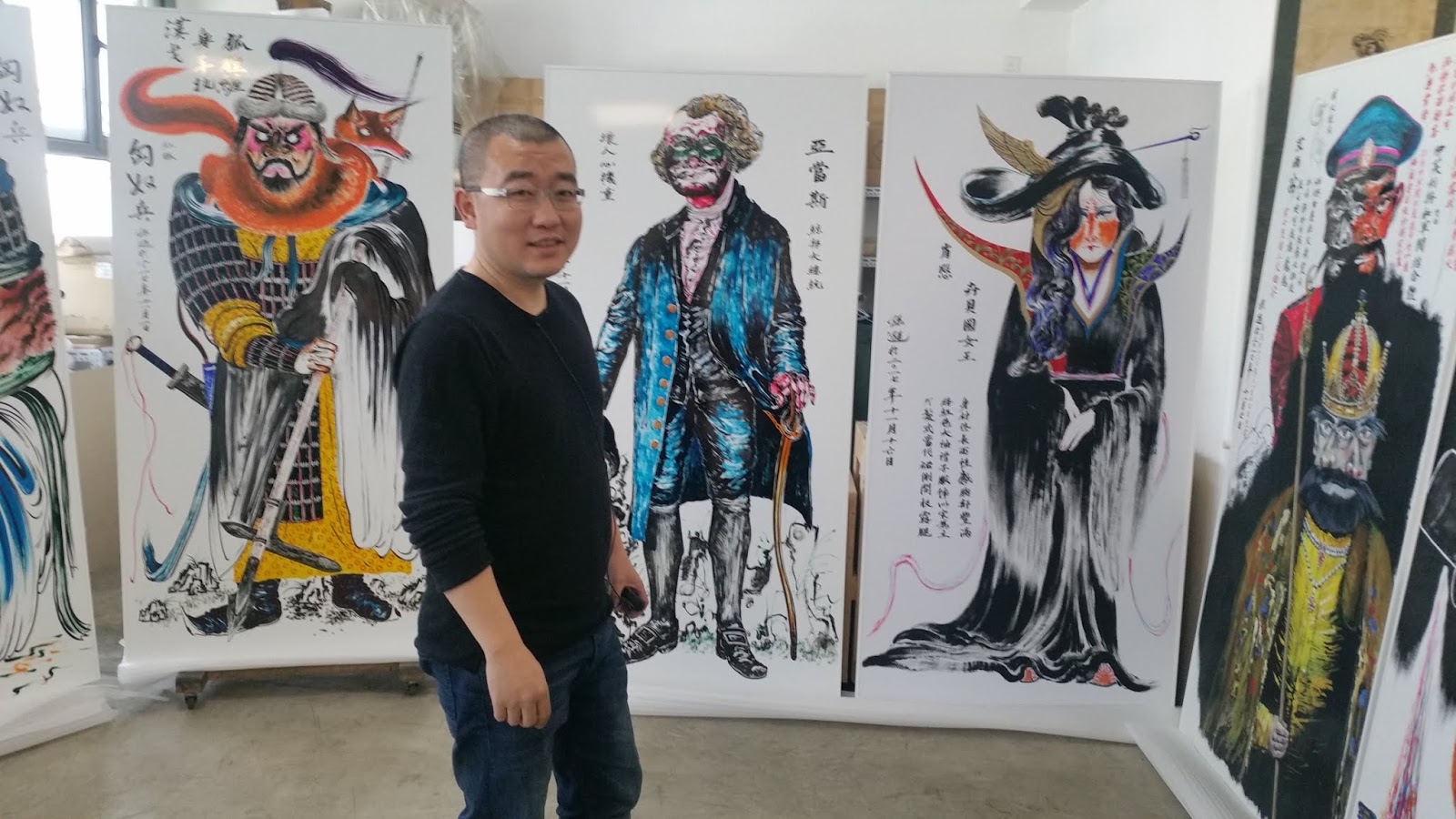
In Beijing, observing the constant reshaping of the city, the bricking-up of ramshackle bars and shops, the 'greyification' of the hutongs, and the dramatic changes seen even in my regular haunt of Xingfu Cun Lu and its little shops and restaurants, I travelled to meet artists every day, recording interviews for the White Rabbit Collection/Judith Neilson Archive. From young artists Chen Zhe and Geng Xue to pioneers such as Wang Jianwei and Feng Mengbo, every conversation was filled with rich and often unexpected treasures of information. Seeing the scale of Sun Xun's studio production was fascinating, especially following the exhibition of his extraordinary 'Republic of Jing Bang' at the White Rabbit Gallery, and prior to his major exhibition at the Museum of Contemporary Art, Sydney. Surrounded by ink drawings of life-size characters in the feature-length film he and his team are working on, we talked about art and life, and his journey from the sooty, smog-filled northern coal-producing city of his birth to the art academy in Hangzhou, and to his current life as a globe-trotting artist.



One rainy afternoon was spent recording a two-hour conversation with Shang Yang, discovering his slow-burning anger at the destruction of the Chinese landscape and the pollution of its air, soil and water in the name of 'progress'. For me, artists like Shang Yang represent the extraordinary resilience of the Chinese people: punished for years for his support of students in 1989, stripped of his teaching position and other roles and honours at Wuhan University, he continued to work, and remained steadfast and uncompromising in his subject matter. Now in his 60s, Shang had only two solo exhibitions in China until his New York show in September. I wrote about that exhibition for The Art Life - click HERE if you want to read more.


The drive back from Shang Yang's studio to the northern centre of Beijing was hair-raising in a violent thunderstorm, the streets running with deep water and the traffic a cacophany of blasting horns and shouting drivers. After three hours in the car, and already quite dark at 7.00pm, my driver reluctantly agreed to let me out as soon as I vaguely recognised the surrounding geography, so I could walk the rest of the way. The next morning he told me it had taken him another three hours to get home. 

Perhaps the biggest thrill for me in Beijing, though, was meeting Xu Bing. I had taught students about his work since discovering his 'New English Calligraphy' installations at the Art Gallery of New South Wales in the late 1990s, and I was completely overwhelmed when I saw his two enormous phoenixes hanging in New York's Cathedral of St John the Divine in 2014. In contrast to the arrogance that often accompanies art megastardom (no names, no pack drill) Xu appears humble and unassuming, talking readily and revealing an ironic sense of humour. After our long conversation about his film 'Dragonfly Eyes' we drank beer and ate spicy noodles at his local Sichuan restaurant in a shopping mall near the studio.


Of all the exhibitions in Beijing galleries large and small, two standouts were Liu Wei's monumental installation and Zhu Jinshi's 'Ship of Time', now in the White Rabbit Collection, at Tang Contemporary. Both were extraordinary and breath-taking, dramatically defining the exhibition space. At Long March Space Liu's mechanical planets slowly orbited the room and I could not tear myself away.


The next week, in Shanghai, my encounters continued, in studio visits with Jin Feng, Ni Youyu, Liu Jianhua and Chen Yujun. Once again I had the opportunity to meet an artist whose work I had taught since the 1990s. Gu Wenda was fortuitously in Shanghai and we were able to meet at his studio. I confess that at moments like these I feel as if I am inhabiting someone else's life - it is such a privilege to be able to engage these artists in conversations about their life and work. And what extraordinary stories I get to hear! Gu Wenda told me about his studies with Maryn Varbanov in Hangzhou, about his work being banned from an exhibition in Xi'an in 1986, and about his early days as a struggling Chinese artist in New York, as well as about his commissioned work for the White Rabbit Collection, a series of marble rocks inscribed with hybrid, partly invented characters relating to the 24 seasons of the traditional agricultural calendar.


In many years of meeting Chinese artists I've seen a lot of remarkable and impressive studios, but Chen Yujun's transformation of a cavernous former factory has created an especially calm and beautiful space - old, weathered doors and windows rescued from demolition sites have been used to partition the enormous concrete spaces into areas for working, exhibiting, reading, chatting and drinking tea. 


I enjoyed a long talk with Liu Jianhua about his use of porcelain. My last encounter with Liu was when he led the 'Everyday Legend' Research team on a field trip to Jingdezhen, where he had worked and studied from boyhood. To see the website of this research project, funded by the Leverhulme Trust, click HERE.


Of all the many exhibitions seen in Shanghai, I especially loved Yang Shen's 'Garden Oddity' at MadeIn Gallery: surreal juxtapositions of images drawn from cartoons and children's textbooks, sci-fi comics and animations and the strangest depths of the artist's imagination.


Back home, work continued on the establishment of the new Dangrove White Rabbit Collection Research Library and the archive, which has been a joy and a delight; I am lucky to work with a fabulous team of colleagues in a beautiful space. We welcomed our first groups of students from various universities to engage directly with the objects in the collection and the archival materials provided by its artists, and continued to film interviews with artists visiting Sydney, including Gonkar Gyatso, Wang Guofeng, Cao Hui, Sun Xun, Yang Wei-Lin. and (forthcoming) Hou I-Ting, Guo Jian and Gao Xiaowu.  The wonderful painters Yu Hong and Liu Xiaodong brought piles of books and catalogues for the library when they arrived in town for a ceremonial switching off of Liu's 'painting machine' installation at White Rabbit Gallery.  Liu Xiaodong's interview can be seen HERE on the White Rabbit Collection Vimeo site, where you will also find many others.


Later in the year, in New York, I visited Lin Yan in her Long Island studio, went to the launch of Barbara Pollack's new book 'Brand New Art from China' (and greatly enjoyed my conversations with her), and saw exhibitions of Zhang Xiaogang, Shang Yang, and Liao Guohe. The Guggenheim show from young star curator Xiaoyu Weng featured Cao Fei’s evocation of a post-human future, Wong Ping’s fabulously eccentric digital tale of an elderly porno addict and new works by Lin YilinSamson Young and Duan Jianyu. The famous koan, ‘one hand clapping’, says the Guggenheim, is a metaphor for how meaning is destabilised in a globalised world.


Now, on the first day of a new year that we all hope will be kinder and less crazy, albeit perhaps without too much optimism, I think about how lucky I am to spend so much time with artists. Art continues to matter in this scary world. To finish with a quote from art critic Jerry Saltz:
"Thank you all the artists I’ve ever known who made me think the way I think."

Saturday, January 2, 2016

The List: Ten Moments that Mattered

Cruising lazily out of the choppy seas of 2015 and into the uncharted waters of 2016 I have been reviewing experiences of Chinese art, and China, and doing that very cliched thing: making a list. I've read so many of these in the last few days. Lists of the best and worst of the year are metastastizing everywhere, from movies and music to food fads (kale is gone, you'll be glad to know) to the most over-used words of 2015 (''bae'', apparently, and I am sadly so out of touch with popular culture that I could not tell you what it even means) The list mania appears to be contagious. I decided to launch into my own "best of" compilation of art highlights - and a few lowlights. It's entirely personal; my retrospective musings over a year filled with art, mostly Chinese.

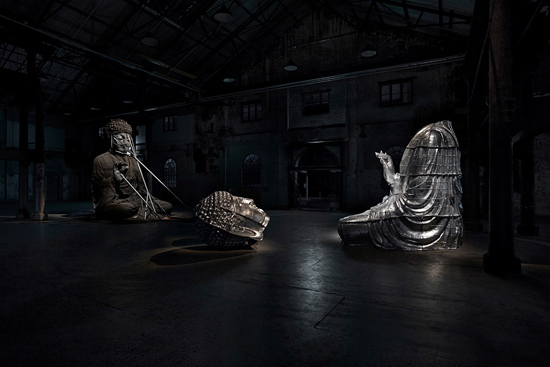
1 January saw Sydney audiences enthralled by the ever-so-slowly crumbling face of a giant Buddha made of ash from the burned prayers of temple worshippers in China and Taiwan. Zhang Huan, having reinvented himself entirely from his earlier persona as the bad boy of '90s violently masochistic performance art, presented this latest iteration at Carriageworks. And it was rather wonderful. I wrote about meeting the artist and encountering the silent presence of 'Sydney Buddha' for The Art Life. Click HERE for the story.
sydney buddha 3
Zhang Huan, 'Sydney Buddha'' installed at Carriageworks, image courtesy the artist and Carriageworks

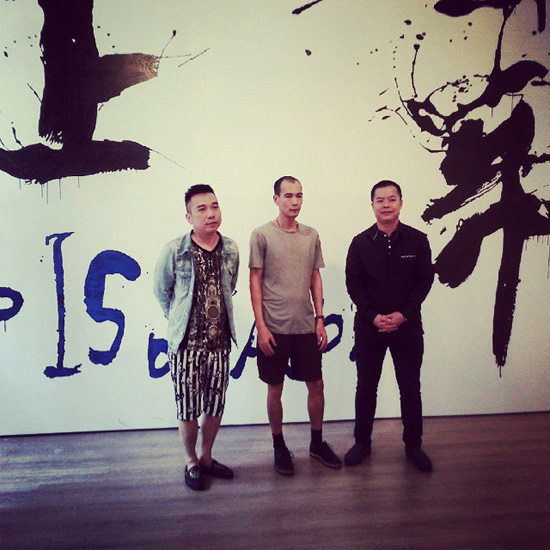
2 January also saw some younger Chinese bad boys hit town - the Yangjiang Group arrived with their unique brand of artistic anarchy for a crowd-funded project, 'Áctions for Tomorrow',  at 4A Centre for Contemporary Asian Art. Along with a bunch of other bemused scribes I had tea with the artists. So. Much. Tea. It was an artwork, and we were part of the art. Previously their performances of 'Fan Hou Shu Fa' (After Dinner Calligraphy) had involved prodigious feats of alcohol consumption, but they now stick mainly to tea, which they had brought with them from their home in Guangdong Province. What did we see in the gallery? Wax dripped over a shop full of mass produced clothing to create a frozen monument to retail therapy? Check. An installation of the remains of 7,000 sheets of paper covered with text from Marx’s Das Kapital in Chinese calligraphy, over which simultaneous games of soccer had been played? Check. A 24-metre mural juxtaposing expressive Chinese characters with scrawled English text reading “God is Dead! Long Live the RMB!”? Check. When I presumptuously asked if this last had a connection with their views about a materialistic new China, Zheng Guogu shook his head sadly at my outdated desire to find meaning. That's entirely beside the point, he said. Anti-art? To misquote the Chinese Communist Party’s description of socialism in the global marketplace, perhaps this was “dada with Chinese characteristics.” I wrote about my interview in Daily Serving. Click HERE for the story.
The Yangjiang Group at 4 A Centre for Contemporary Asian Art (Zheng Guogu in centre) photo: Luise Guest

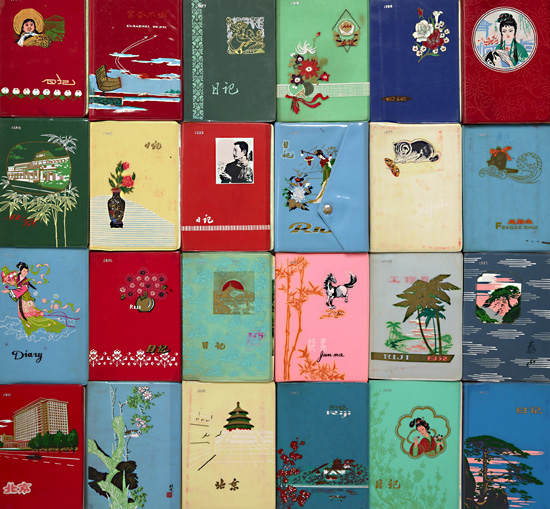
3 In February I was a little bit preoccupied with arranging a wedding, and I have zero recollection of March to April. May brought the Sherman Foundation exhibition of Yang Zhichao's 'Chinese Bible'. Yang is another Chinese performance artist becoming a little less inclined in middle age to punish his own body with the surgical insertion of various objects - reputedly at the insistence of his daughter. Chinese Bible is a beautiful and important installation - part art, part anthropology, part social action. Not unlike his good friend Ai Weiwei, Yang Zhichao made a formalist, minimalist arrangement of found objects, some dating from the Cultural Revolution. 

Historical experience is written in iron and blood,” said Mao Zedong. In Chinese Bible, historical experience is written in thousands of humble, mass-produced notebooks once owned by ordinary Chinese people, their worn covers testament to the weathering of time and the vicissitudes of social change. Ai Weiwei says, “Everything is art. Everything is politics,” and Chinese Bible reveals a similar approach to art as a form of social engagement. I interviewed Yang Zhichao at SCAF with the translation assistance of Claire Roberts, who curated the show and had written a most wonderful catalogue essay. They told me that after the installation, on their way to a celebratory lunch in Chinatown, they asked their Chinese taxi driver if he would like to see the exhibition. He said he could not possibly, his memories are so painful it would make him weep. Later, in October, I met sculptor Shi Jindian at his home and studio in the mountains outside Chengdu. Disarmingly humble, polite and hospitable, as the day wore on he was becoming monosyllabic and I was worrying about why my interview with this artist was proving to be such hard going. He suddenly said, "I have lived through every period of recent Chinese history, and it was all terrible. I don't want to talk about the past." Like the Sydney taxi driver, and for so many others of his generation, there are just too many bitter memories. You can read the article and my interview with Yang Zhichao  HERE.
Yang Zhichao Chinese Bible, 2009 (detail) 3,000 found books Dimensions variable Image courtesy: the Gene and Brian Sherman Collection, and Sherman Contemporary Art Foundation, Sydney Photo: Jenni Carter AGNSW
Yang Zhichao, Chinese Bible, 2009 (detail, 3,000 found books, Dimensions variable
Image courtesy: the Gene and Brian Sherman Collection, and Sherman Contemporary Art Foundation, Sydney
Photo: Jenni Carter AGNSW
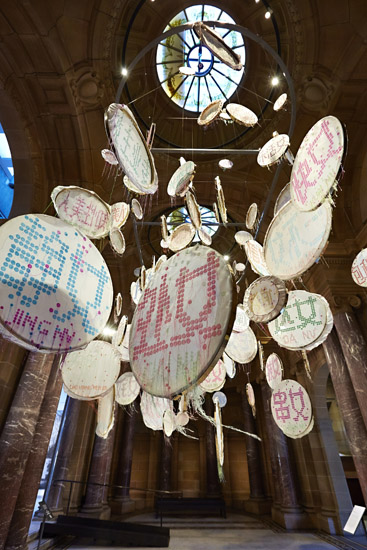
Lin Tianmiao, Badges 2009 White silk satin, coloured silk threads, gold embroidery frames made of stainless steel; sound component: 4 speakers with amplifier. Dimensions variable, diameters range from 25 cm - 120 cm, 266 badges total. Image courtesy: The Gene & Brian Sherman Collection, and Sherman Contemporary Art Foundation, Photo: Jenny Carter
4 In the second part of this exhibition, 'Go East' at the Art Gallery of New South Wales, curated from the Sherman collection by Suhanya Raffel, it was wonderful to finally see Lin Tianmiao's 'Badges' hanging in the imposing domed vestibule. Visiting her studio in 2013, I had watched her assistants stitching the texts, words describing women in Chinese and English, onto embroidery hoops. I had wondered what they were thinking as their nimble fingers stitched words like "Slut", "Whore" and "Fox Spirit" (a terrible name for a woman in Chinese.) I was amused in Sydney, where all the badges were Chinese,  to encounter shocked groups of Mandarin speaking tourists making their children look the other way. In this show, in addition to works by Zhang Huan and Song Dong, Yin Xiuzhen's 'Suitcase Cities' were a highlight. A newly commissioned work by Ai Weiwei intrigued my students. An Archive’ is a collection of the artist’s blog posts, banned since his efforts to name the children killed in the 2008 Sichuan earthquake attracted the attention of the authorities, presented in the form of traditional Chinese books in a beautiful timber box. A clever and more than usually subtle representation of Ai's resistance to the censorship and constraint that saw him confined to Beijing without possession of his passport, constantly under surveillance, until 22 July this year.


Kawayan De Guia. Bomba, 2011; installation comprising 18 mirror bombs, sputnik sound sculpture; dimensions variable. Collection of Singapore Art Museum. Courtesy of Singapore Art Museum
5 In July, in Singapore, I saw 'After Utopia: Revisiting the Ideal in Asian Contemporary Art ' at the Singapore Art Museum, confirming my suspicion that after 'the sublime', 'Utopia' was THE buzzword of the 2015 artworld. It was an excellent and intriguing riff on the theme, featuring familiar works by Shen Shaomin and The Propellor Group with others that were new and wonderful discoveries. I loved 'Bomba': Eighteen sparkling 'bombs' hung in a darkened space. Terrifying disco balls promising destruction, they cast shards of light onto the Stations of the Cross that still adorn the walls of what was once the chapel of a Catholic school. Beautiful and menacing, Kawayan De Guia’s installation specifically references the bombing of Manila in World War II, but it also evokes the horrors of more recent conflicts, contrasting the glittery lure of hedonism with a dance of death. After that, Shen Shaomin's embalmed dictators lying in their glass coffins were an added bonus.
Shen Shaomin. Summit (detail) silica gel simulation, acrylic and fabric, dimensions variable, Singapore Art Museum collection, image courtesy Singapore Art Museum
Shen Shaomin. Summit (detail – Ho Chi Minh), 2009; silica gel simulation, acrylic, and fabric; dimensions variable. Singapore Art Museum collection. Courtesy of Singapore Art Museum.
6 August was about planning and organising my own reinvention, from one kind of life to another, and in September I went to China for 5 weeks, to interview artists for a new project, which (of course) provided more highlights. Of these, perhaps the most remarkable was my visit to the studio/manufacturing hub of Xu Zhen and the MadeIn Company, in Shanghai. You would have to have been wearing a blindfold or lived in a cave to remain unaware of Xu Zhen, who appears to have taken on the mantle of Andy Warhol (although he told me that his favourite artists are Jeff Koons and Matthew Barney.) His enormous installations merge art and commerce, art and design, east and west, past and present, and any other form of post-internet hybridity you care to mention. He will feature in the 2016 Biennale of Sydney, and the work of the artist and his company of assistants and employees has been seen simultaneously in almost as many locations as the ubiquitous Ai Weiwei. (Although Xu Zhen himself does not fly, so everything is arranged and organised, and all research outside of China completed, by teams of MadeIn employees.) A focus artist at the 2014 New York Armory Show, and one of my top picks of last year for the spectacle of his retrospective exhibition at Beijing's Ullens Center for Contemporary Art, Xu Zhen is given to gnomic Warhol-like utterances. "Chinese contemporary art nowadays is a farce filled with surprises," he told Ocula. 'Eternity' has been wowing audiences at the White Rabbit Gallery since early September. And watch out Sydney, there is a promise of more to come! 
Xu Zhen by MadeIn Company, Eternity, 2013-2014, glass-fibre-reinforced concrete, artificial stone, steel, mineral pigments, 15 m x 1 m x 3.4 m image courtesy White Rabbit Collection
7 And so to Shanghai in late September, and a major highlight of my year: the exhibition of an artist who should be a household name. Chen Zhen died (much too young) in Paris in 2000. Although after 1986 he essentially lived and worked in Paris, his personal history and deep cultural roots lay in China, and specifically in Shanghai. From the mid-1990s he returned over and over to a city on fast-forward. Shanghai was undergoing a massive, controversial transformation, in the process of becoming the global megalopolis it is today. The exhibition at Shanghai’s Rockbund Art Museum presented works from this period. Sometimes witty, sometimes profoundly beautiful and melancholy, Chen Zhen’s works are steeped in his identity as a Chinese artist at a historical “tipping point.” As the artist said in his online project Shanghai Investigations, “without going to New York and Paris, life could be internationalized.” To finally see 'Crystal Landscape of the Inner Body' was a revelation - both sad and beautiful. HERE is the whole story.
Chen Zhen, Crystal Landscape of Inner Body, 2000, crystal, iron, glass, 95 x 70 x 190cm, image courtesy Rockbund Museum and Galleria Continua San Gimignano/Beijing/Les Moulins
Chen Zhen. Crystal Landscape of Inner Body, 2000; crystal, iron, glass; 95 x 70 x 190 cm. 
Courtesy of Rockbund Art Museum and Galleria Continua San Gimignano/Beijing/Les Moulins.
With Wang Qingsong in his Studio, October 2015, Caochangdi, Beijing

8 is for Beijing, in October, and meetings over three action-packed weeks with a ridiculous number of interesting artists, all represented in the White Rabbit Collection. Old friends and new faces: Bu Hua, Bingyi, Li Hongbo, Zhu Jia, Wang Qingsong, Wang Guofeng, Liu Zhuoquan, Qiu Xiaofei, Lin Zhi, Huang Jingyuan, and Zhou Jinhua. Dinners with friends, long walks through the hutongs and the never-ending struggles of language learning. I journeyed through the smog to studios on Beijing's far outskirts, collecting stories and looking at extraordinary work, as I had done the previous week in Shanghai and Hangzhou. I left China with a kaleidoscope of impressions that are just starting to crystallise into the possibility of words. I saw Liu Xiaodong at the Faurschou Foundation and Ai Weiwei at Continua, but disappointingly missed Liu Shiyuan in Shanghai at the Yuz Museum. One of the youngest artists I interviewed in 2013 and 2014, her work will next show at the Fondation Louis Vuitton in Paris, in an exhibition curated by Philip Tinari, among others, called 'Bentu: Chinese Artists in a Time of Turbulence and Transformation.'


9 is another repeat of one of my 2014 picks. The rather bizarre Red Brick Museum (practically empty on each occasion I have visited) on Beijing's northern outskirts was showing work by the artist who first inspired me to make Chinese art my focus of research, teaching and writing. Huang Yong Ping's fabulous thousand armed goddess of mercy was an unexpected delight when I visited in December of 2014. Again, in 2015, a new exhibition, curated by Hou Hanru (also the curator of the Chen Zhen show in Shanghai) presented a version of Baton - Serpent, seen in a previous Asia Pacific Triennial in Brisbane. Not quite the 'words fail me' experience of seeing Leviathanation at Tang Gallery in 2011, or the 'Thousand Armed Guanyin' at the Shanghai Biennale in 2012, but nonetheless extraordinary. And all the more wonderful for being encountered in the deserted echoing spaces of one of China's newest museums.


10 And here we are, washed up on shore, arrived at the final, dog days of 2015. 

November to December, hmmm. What to pick? NOT 'Ai Weiwei and Andy Warhol' at the NGV. If you have read my review (Click HERE if you want to) you know I had some issues with that exhibition - although I wish I had seen the London show at the Royal Academy. I admire Ai enormously for his genuine commitment - particularly his establishment of a studio on Lesbos to make art relating to the current refugee crisis. But boy oh boy did I hate those Lego portraits. And absolutely NOT the 'Rain Room' at the Yuz Museum in Shanghai - an empty spectacle. Nor anything at the major Sydney galleries - I cannot get excited about a few Renaissance works from Scotland, and Grayson Perry, whilst interesting, does not float my boat. 

Image 1 [Digital Photography_Colour Photograph] Dwelling - Moment III small file


YUAN GOANG-MING Dwelling - Moment III 2014. Digital Photography / Colour Photograph. 
120 x 180 cm Edition of 8. Image Courtesy of the Artist and Hanart TZ Gallery.

 I'm giving my Number 10 highlight spot to Yuan Goang-ming at Hanart TZ in Hong Kong. In this show, entitled Dwelling, we were presented with the uncomfortable intersection of the real and the apparently impossible. In the gallery space, an elegant table was laid as if for a dinner party, with crystal glasses and an ornate dinner service. Every now and then a loud clanking noise disrupted the silence, and the table shook as if the building had been hit by an earthquake. In the title work, Dwelling, (2014) the focus is a blandly modern living room, the only oddity the rather slow riffling pages of a magazine on the chair, a book on the coffee table. A breeze wafts the curtains. Suddenly, and without warning, the entire room explodes. Slowly, languidly, the wreckage of the room drifts back until the room once again regains its ordinary appearance. Filmed 
underwater, although it takes a while to realise this, the movement of every object seems dreamlike. Yuan suggests that what we accept as stable and fixed is in fact entirely unpredictable. In a split second, the apparently impossible can disrupt everything we take for granted. 

In my own 2015 version of the impossible becoming possible, I have changed careers, started new research and writing projects, and - in a total triumph of optimism over bitter experience, I enrolled in a new term of Chinese language classes.

Oh. And I have written a book. Out in February. 


Friday, February 10, 2012

China and the Zeitgeist

I have been immersing myself in Chinese art to an even greater extent than usual: books and articles about Chinese art, web sites dealing with Chinese cultural issues, and exhibitions of Chinese art, to the point where I am dreaming about Chinese art....strange that suddenly there seems to be so much to look at and write about here in Australia. China is THE hot flavour of the month right now it seems, and all things Chinese, from food to fashion, art to literature, music and film, are suddenly highly desirable.

Song Yi, 'Girl', oil on canvas, image courtesy of Red Gate Gallery, Beijing

During the Sydney Chinese New Year celebrations, which culminated in the rather daggily charming parade that I described in a previous post, the Sydney Town Hall was the unusual site for 'Two Generations: 20 Years of Red Gate Gallery', an exhibition of work by artists from the Red Gate Gallery stable. Brian Wallace, the Australian director of this highly respected Beijing commercial gallery, asked a number of his senior artists to each nominate a young emerging artist for inclusion in the show, and the results were fascinatingly diverse and very impressive. There were  many wonderful works, including the luscious red calligraphic surface of 'Work 1112', a painting by Jiang Weitao revealing the continuing interest in painterly abstraction in Shanghai in particular.
Jiang Weitao, ‘Work 1112’, 2011, oil on canvas, 112 x 82 cm, image courtesy of Red Gate Gallery
From this substantial show in the centre of Sydney to the National Museum in Canberra (which has since the end of 2011 been showing a large exhibition of works from the collection of the National Art Museum of China, 'New Horizon) felt like a longer journey than just the tedious drive down the Hume Highway. This exhibition was uneven in its quality, with fabulous works by significant artists juxtaposed with more pedestrian works by (presumably) artists with impeccable political connections. The catalogue was particularly appalling - as if written by someone from a government office with little knowledge of art or the art world. While it was good to see the patterns of change in China as represented in artworks over the years since 1949, the exhibition as a whole was really quite bizarre, despite the inclusion of Xu Bing and Shen Jiawei.

I have written more extensively about both these shows in an article posted on The Art Life:
Drifting Clouds: Two Views of Chinese Art

Spring Breeze and Willow, Zhou Shuqiao, 1974, image reproduced courtesy of the National Art Museum of China
Last weekend I spent some time in the current exhibition showing at Ray Hughes Gallery in Surry Hills, 'China's Decade', which provided an illuminating contrast with both the previous shows. Hughes is one of the first people in the Sydney art world to understand the significance of the art being made in China in the early 90s, and the first to begin to show Chinese art in Sydney. He told me that he is now particularly interested in what is happening in Chongqing, that huge city of 38 million people in Sichuan Province, as he believes it has become a central locus of innovation and interesting practice. The works range from explorations of popular culture ('Infection Bambi'by Zhou Siwei, for example) to Li Jin's lyrical ink paintings of a kind of 'floating world' of everyday life - eating noodles, lying about watching television, making love. I loved the  fabulous examples of the 'Gaudy Art' of the 90s, such as the machine embroidered silk works of Chang Xugong which feature maniacally grinning karaoke singers and self satisfied toothy 'entrepreneurs' in brightly coloured suits clutching mobile phones and other accoutrements of  'success'.  The exhibition demonstrates the diverse richness of contemporary art in China, charting the startlingly rapid change in society and all the tension, dislocation and fragmentation that results from that, as well as the unalloyed joy and satisfaction of sudden wealth and access to all the desirable products of global capitalism. This last is featured in a cynical and witty form in the fibreglass fat babies of the Luo Brothers, lolling about on Pepsi cans or wrapping themselves around Big Macs.
Chang Xugong, Untitled, 2000, machine embroidered satin, 100 x 80cm, 
image reproduced with the permission of Ray Hughes Gallery

Best of all, however, was the painting by Liu Xiaodong, Unknown Pleasures, a work dating from 2002. A wonderful painter, his work is never facile despite his mastery of the painterly surface and gestural mark. In this work, the solitary figure smoking a cigarette in a street lined with shoddily constructed commercial buildings seems to embody a weird mixture of existential despair and hopefulness - the zeitgeist, perhaps.

Liu Xiaodong, Unknown Pleasures, 2002, oil on canvas, size unspecified,
 image reproduced with the permission of Ray Hughes Gallery


Saturday, February 4, 2012

Liu Xiaodong and China's Decade

Liu Xiaodong, Unknown Pleasures, 2002, currently showing in 'China's Decade' at
Ray Hughes Gallery, Sydney
Looking at this painting by Liu Xiaodong in the 'China's Decade' show at Ray Hughes Gallery, I suddenly remembered that my first inkling of the nature and significance of contemporary Chinese art, some years ago, came as I stood in front of Liu Xiaodong's enormous painting of migrant workers at the Three Gorges Dam, hung in the Art Gallery of New South Wales. Not quite an epiphany, although in retrospect it should have been. It must have been a Sydney Biennale, although I cannot now remember the year.  It was that painting, in all its extraordinary technical mastery, which made me want to find out more about how Chinese artists came to paint in this way. Until that point my own art education had been almost entirely Eurocentric and American in its focus, with a few exceptions such as Nam June Paik or Yasumasa Morimura. Liu was apparently himself inspired to paint in this manner by being given a postcard of a work by Lucien Freud, and when you look at the way he paints flesh, in the migrant workers eating lunch in their underpants, or in his series of girls lying on seedy bare mattresses, this makes perfect sense.


The artist, now one of the most significant and respected painters in China, teaches at the Central Academy of Fine Arts in Beijing, where he himself studied. The day that I spent last year immersed in the First and Second Year painting classes at CAFA revealed the legacy of artists such as Liu, and the mastery of technique that is passed on to so many hopeful young art students in China. Like the best dancers or acrobats, they make what is incredibly difficult look easy. And, like dancers or acrobats, it takes years and years of constant and unremitting effort to acquire such a high level of technical mastery.

Painting Class at Central Academy of Fine Arts, observed March 2011
Liu Xiaodong, 'Eating', shown in the 'Mahjong' exhibition of works from the Sigge collection at Berkeley Art Museum in California in 2009