The ongoing thoughts of an art teacher in China - and home in Sydney

A continuing diary about my travels in China, and thoughts about China and Chinese art from home and abroad
Showing posts with label Yang Zhenzong. Show all posts

Tuesday, September 29, 2015

上海日记: Shanghai Diary Revisited

French Concession Shanghai, photo LG
After 7 action-packed days in Shanghai I have arrived in Beijing - as always struck anew by the stark differences between these southern and northern cities. Reflecting on my week interviewing artists in Shanghai, my impression that the Shanghai artworld is growing ever stronger, and more interesting, is reinforced. The influence of the new private museums, the Yuz and Long Museums, now a major force to be reckoned with, is a significant factor.

Bicycle Repairs, Shanghai, Photo LG
My hotel in Shanghai's former French Concession was in a fabulous location for exploring the city on foot, and for navigating the Metro - wonderfully efficient, although not for the faint of heart during the rush hour. It was, however, of a uniquely Chinese type - on the surface very luxe, with glittery lamps, lots of fairly appalling art (for sale), enormous marble bathroom and pseudo-antique Chinoiserie. The room, however, was pitch dark even with all the lights on and the curtains open, the carpets in the corridors were badly stained and often covered with drop-sheets (Why? Who knows!) and the breakfast was beyond appalling - once tried never repeated, which perhaps is their intention. However, as Chinese hotels go, it all ran pretty smoothly.

My most memorable Chinese hotel experience was in Beijing, in the winter of 2012, at a supposedly swanky "art hotel" (now closed, and no wonder!) I had begun to think I was the only guest, when on my second night at about 11.00pm there was an almighty noise of thundering feet and shouting in the corridor, and then a loud banging on my door. Imagine my astonishment when I looked through the peephole to find a young Chinese man, stark naked, beating the door with both fists. Later, safely home again, I told a gay friend this story and he said, "Give me the name of this hotel immediately!" I, however, was a little alarmed. I called the reception fuwuyuan, who said with apparent resignation, "Oh Miss, what we can do? He drink too much!" I suggested that perhaps in fact they they did need to do something, anything, anything at all! whereupon the manager rang back and told me they would move me to another floor. There was nothing to be done about Mr Naked Guy. Reluctantly I agreed, and waited for the manager to accompany me. He knocked on the door, I opened it, and together we stepped over the naked body of the man who was now completely comatose, lying stretched out across my doorway. The incident was never mentioned again for the rest of my stay. (Except when I told my translator, who refused point blank to believe that it could possibly have been a Chinese man - he told me I must be mistaken, as only a "waiguoren", a foreigner, would behave so badly.)

A more ludicrous (and less amusing) Chinese hotel experience happened in Xi'an, where I sent some clothes to the laundry and then waited for their return. And waited. When I rang reception they were most apologetic and concerned. A farce ensued, where I received knock after knock on my door, with staff from the laundry bearing ever more preposterous items of clothing and attempting to persuade me they were mine: mens' leather jackets, assorted tiny dresses for tiny Chinese ladies, and enormous jeans for enormous men. It culminated around midnight, with a staff member who simply could not accept that a sequin-covered blue suit (think Xi Jinping's wife on a state occasion) was not in fact mine. He became argumentative and kept trying to shove it at me through the door, which I eventually closed in his face. I never did get my best David Jones blue sweater back.

And of course, there are the two most bizarre experiences of all: the "Art Hotel'' in Chengdu where I discovered to my surprise - and horror - that I was expected to make a speech at the opening of an exhibition of an Australian and Sichuan artist. With about two hours to write it and have it translated, and with no fancy clothes in my overnight bag (perhaps I should have taken that sparkly suit after all!) I fronted up and discovered that my speech was to follow the local Party chiefs, the Chengdu Art Academy bigwigs, and the Australian Ambassador. I was introduced as a "famous Australian art critic" (ha!) and began in Chinese with an apology for my poor language skills. The artist's son then translated my speech line by line. I began to see my entire life flashing before my eyes as time seemed to stop and then go backwards. Dripping with sweat, I ploughed gamely on, filmed by three local television stations - thank God nobody is ever likely to see that footage.

But the honours for first place must go to the "Vineyard"- and I use those inverted commas advisedly -  about two hours out of Xi'an, where I was taken to see an artist's work. My lunch with the artist, a property developer, and a returned Chinese movie producer from Hollywood is a story for another time. I will just say that the wine, the wisteria and even the fields of grapes stretching into the distance are all fake. The local farmers have been persuaded to stop growing corn and vegetables and instead grow table grapes so that wealthy city people can come on weekends and go grape picking and stay in the "chateaux". Truly a Marie-Antoinette at Le Petit Trianon experience.
Yang Fudong, still from video at Yuz Museum
But back to Shanghai, and to art! On my first visit to Shanghai, back at the start of 2011, a number of artists told me they felt almost like the poor relatives of their peers in the art centres of Beijing. Now, they talk about their independence from Beijing, their capacity to innovate and the ways that each individual artist can pursue a unique vision. One said that in his opinion Beijing artists indulge in way too much "liao tianr" - too much chat and communal thinking. I am quite sure, of course, that artists in Beijing will tell me an entirely different story! However, the fact remains that with a unique history of European Modernist influence, and a sense that Shanghai is a truly global city, artists here work in distinct ways. I was fascinated to be shown the extraordinary studio of Xu Zhen - the 'MadeIn Corporation' - where with the assistance of 40 artists/collaborators/assistants some incredibly ambitious and monumental projects take shape. Some say, with a bit of a sneer, it's merely "art as spectacle". I say, "Bring it on!"

Xu Zhen, Guanyin and 'Shanghart Art Supermarket' at Ullens Center for Contemporary Art, Beijing, 2014, Photo LG
The massive Xu Zhen retrospective at the Ullens Center for Contemporary Art in Beijing last year was one of the most exciting exhibitions I had seen in years, from his enormous fluoro-coloured Guanyin to the Shanghart Art "Supermarket" where all the packaging is empty, and "grannies" shuffled around in slippers, following you through the aisles. "Eternity",  a sculpture for which 3D printing technology created absolutely accurate moulds for casting the replicas of figures from Greek classical sculpture and ancient Chinese Buddha figures, is currently showing at White Rabbit Gallery in Sydney. The artist agrees, without apparent irony, that he is the successor to Andy Warhol and his "factory". He says, "Andy Warhol made a connection between art and commerce, but we recognise that art IS commerce and we aim to make the commercial, artistic." There is a similarly cool Warholian demeanour evident in conversation with this artist, who turned himself, literally, into a brand, recognising the global reach of the art market. At the same time, Xu Zhen supports young emerging artists with the MadeIn Gallery in Shanghai's M50 art district.

Xu Zhen Éternity' at Ullens Center for Contemporary Art Beijing 2014
Artists such as Yang Yongliang, Chen Hangfeng, Lu Xinjian and Hu Jieming reinvent and recontextualise  Chinese tradition and history in different ways, both subtle and overt. From papercutting to "Shui Mo" ink painting, from Gongbi realism to the revolutionary photography of the 20th century, each is taking elements of the past and making work that is absolutely contemporary and reflecting the realities of our world today. Chen Hangfeng is working on a significant project about the notorious village in southern China where most of the world's Christmas ornaments are made, an industry which has filled its waterways with glitter, tinsel and assorted festive crap. It's a village of great historical importance in China, in a most beautiful landscape where significant poems were written. Chen Hangfeng's work is a metaphor for globalisation, a theme which concerns many of these artists. Yang Yongliang continues to make beautiful digital works, and now also narrative films, relating to the destruction of the environment as Chinese megacities eat the countryside, devouring tradition in their wake. He takes thousands of photographs for each digital animation, often choosing to shoot in Chongqing. And no wonder - the greater municipality of Chongqing is now, by all accounts, the largest city in the world. Lu Xinjian continues his ''City DNA" and "City Streaming" series of paintings, inspired by aerial views, Google Maps and Mondrian. And Hu Jieming has begun several new projects, including one for which he has written computer coding that can take a photograph and reproduce it, making subtle and not-so-subtle alterations. From this he makes a painting, then scans it and repeats the process, over and over again. Each painting is further from the original image, more abstract. He is asking questions about the relationship between human observation and artificial intelligence.

With Lu XInjian in front of one of his "City DNA" series
After seven intense conversations with seven artists, a Saturday morning walk around the former French Concession provided breathing space, and time to re-acquaint myself with the idiosyncracies of Shanghai life, from the wearing of pyjamas as streetwear to the washing hanging on every street corner, and from powerlines and railings: "Shanghai flags." The sun shone, the oppressive humidity vanished, good coffee was readily available, the trees were green and beautiful, and life seemed very good. Visits to exhibitions at as many galleries as I could cram into one day, including Chen Zhen at Rockbund Museum, Yang Fudong at Yuz Museum, and an exhibition of work by women artists at Pearl Lam, provided a visual feast.

Chen Zhen Purification Room, 2000 - 2015, found objects, clay, photo LG
Chen Zhen, Crystal Landscape of Inner Body, 2000, crystal, iron, glass, photo LG
Yang Fudong, still from video work, Yuz Museum
Lin Ran "Lesbos Island" - traditional Chinese medicine cabinet with drawers "filled with gifts and mementoes given to the artist by lesbians" at Pearl Lam Gallery Shanghai photo LG
My Shanghai experience concluded with the Zhou Fan exhibition at Art Labor Gallery - beautiful works that appear marbled, or as if pigment has been gently dripped onto the surface with an eye dropper. The artist told me that every nuanced gradation of colour and finest line has been carefully applied with tiny brushes. Zhou Fan's practice exemplifies the subtlety and thoughtful refinement that co-exists with the chaotic frenzy of life in modern China.

Zhou Fan, Mountain #0003, 2014, Acrylic ink and mineral color on paper, 38.3 x 56.7 cm image courtesy the artist and Art Labor Gallery


Thursday, December 13, 2012

Just what is it that makes Shanghai so different, so appealing?

My sentiments exactly, after a day experiencing all the contradictions of modern China. This is a work seen at Vanguard Gallery in M50

I go to sleep at night with all the Chinese phrases and sentences floating around in my head that I somehow haven't been able to remember during the day when I need them. In my dreams I am wonderfully fluent, but during my waking moments it is as if I have been rendered mute. I stumble through basic requests, usually forgetting the interrogative 'ma?' in my questions, so I must sound weirdly declarative. Sometimes I obviously sound better than I am, so am met with a flood, a torrent, an avalanche of Chinese and have to shamefully declare 'Wo bu mingbai' - I don't understand. I am absurdly pleased with myself when very simple conversations are conducted successfully in Chinese - albeit with a fair bit of mime and gesturing. People are wonderfully good-humoured and like to practice their English, so we get by with good grace on both sides - although I find they are generally very amused by the notion of any foreigner attempting to speak Chinese. Secretly I suspect they think we are absolute barbarians.

Sometimes this seems to be in fact the case. Last night as I was desperately flinging myself into the path of the terrifying Shanghai traffic, attempting to hail a cab, a middle aged Australian couple got out of a taxi next to me and the man said, "You might as well take this one, he can't seem to understand my instructions". Why on earth would you expect him to? is what I wanted to ask, but instead gratefully jumped in. Later I felt guilty, thinking I should have tried to help them communicate, but I must have been infected by some of the Chinese 'every woman for herself' attitude in public spaces. And I didn't like my compatriots appearing both ignorant AND arrogant. Also they had just come out of a very swanky hotel, so too bad!


Embarrassing Chinese moments: "Tai Chi Le!"
  1. Almost falling headfirst out of a Chinese toilet at the feet of an artist in his gallery. I had temporarily forgotten that Chinese-style toilets have a steep step at the door. A quick recovery and a (probably unconvincing) attempt to suggest that I had always intended to exit the 'ce suo' with astonishing speed was my strategy to save face here
  2. Involuntarily screaming loudly in the back of a Shanghai taxi as we swerved violently through an intersection, scattering riders of bicycles, pedi-cabs and pedestrians, almost colliding with a bus. I have become very used to the no-seatbelts, drive across multiple lanes and on the wrong side of the road and through red lights whenever you feel like it modus operandi, but this journey was horrific even by Shanghai standards. I sat gripping the door handle, thinking I may never see my children again. and  uttering moans and gasps, with the driver looking at me sideways in contempt
Three more things not to select from a Chinese menu:
  1. Bullfrog in sauce
  2. ' New York' pizza - I have tried this and it is neither New York style nor pizza
  3. 'Yuanyang' or Cantonese coffee/tea drink, a mixture of a small amount of instant coffee and Hong Kong style milk tea. My very sophisticated university lecturer Chinese friend drank this to accompany stir fried seafood and a Malaysian curry, much to my disbelief
Shi Qing, Shanghai Electricity Shopping Mall, Shanghai Biennale
Installation, Shanghai Biennale
Installation detail, Shanghai Biennale
Installation, Shanghai Biennale
The last few days have exposed once again the extraordinary contradictions of China, as seen through the  the microcosm lens of the artworld. From the quiet, contemplative and thoughtful practice of Shi Zhiying, steeped in Buddhism and the traditions of ink painting; to the internationalism of the Shanghai Biennale and some apocalyptic exhibitions at M50; to the Shanghai Museum's blockbuster show of Chinese ink painting and calligraphy from American museums; to sentimental socialist realism at the Shanghai Art Museum; to social activism through art in the work of a number of painters and the performance artist Wu Meng: everything goes into the stir fry that is China today.

I started the day at the very wonderful Shanghai Museum, which is housed in a rather ugly building designed to resemble an ancient bronze 'ding' vessel and containing a fabulous collection. The exhibition of paintings and calligraphy from museums such as the Metropolitan in New York, the Cleveland Art Museum and the Boston Museum of Fine Arts was packed with Chinese visitors of all ages, intently reading the calligraphy and peering at the scrolls and paintings in silence. I felt like such a frivolous dilettante flitting from one to the next and trying to remember the historical sequence of the different dynasties. It is very possible to see the strong influence that these traditions continue to have on contemporary artists - especially literati painting and Song Dynasty Bird and Flower painting. And humbling to see what the Chinese were doing during Europe's  Dark Ages.

I visited my favourite Tang Dynasty 'equestrienne' sculptures - love those feisty girls riding bareback - and also the court ladies looking terribly smug with their moon-like faces and fat rosy cheeks.


With a brief detour past the men playing cards and mahjong in People's Square, under the eyes of a statue of a revolutionary hero, I entered the Shanghai Art Museum, previously the European-only club of the Shanghai Racecourse, to discover myself deep in the sentimental land of socialist realism - the motherland in fact, as the exhibitions title declared. I have seen a number of these exhibitions in China, where artists employ their exemplary skills to depict scenes like those in a Victorian narrative painting with a moral - they always remind me of the Holman Hunt  work 'The Awakening Conscience' except that they depict beautiful idealised peasant girls and happy ethnic minority peoples herding their sheep. In fact, they are not unlike the photographs sold to tourists in Xintiandi and Tianzifang, which so often use dirty-faced ethnic minority children as their subjects. In these there is an unpleasant kind of Orientalism and 'exotification', as well as a romanticisation of a reality that is more often difficult, unpleasant and politically fraught. Ironically, the artist is based in LA and paints for an international market of nostalgic Chinese. The Shanghai Art Museum was, however, once again, full of Chinese visitors taking photos of the works on their mobile phones and buying postcards to take home.
Li Zijian poster at the Shanghai Art Museum - teeth clenching sentimentalism
Li Zijan, part of a series of paintings of young idealised rural women clutching letters
Artists have responded to the dramatic and growing wealth disparity in China in a number of ways. Suzhou Gallery in M50 showed paintings by a  group of artists participating in a project travelling to Hunan and Jiangsu Province and painting old people, young migrant workers, and children in the village school. Unfortunately there was no information available in English about the artists or the project. The paintings were good - strong, expressive and allowing the subjects full dignity, without romanticising their hardship. These young migrant workers lead hard lives with an optimistic determination to reinvent themselves, far from rural poverty, in the factories of the Pearl River Delta. 
Artist Unknown, Young Migrant Workers, Suzhou Gallery, M50
Artist Unknown, Village School, Suzhou Gallery, M50
At the Biennale a project of video interviews of old people from the villages of remote provinces and from older areas of the big cities is an attempt to record their stories and memories. Walking through the hanging installation of the still images of their faces is quite a haunting experience.


The painter Yi Wei is showing large and fabulously painterly canvases recording the impoverished living conditions of migrant workers and the urban poor. Reminiscent of the virtuousity of Liu Xioadong, I found these paintings gripping, absolutely unsentimental yet filled with humanity and compassion. There is a growing awareness and unease here about the social implications of the changes that have taken place in the last ten years, and a growing bitterness about the 'mega-rich' and their conspicuous consumption of all the status symbols of western fashion, from Philippe Patek watches to Louis Vuitton handbags and Porsches. In fact there is a web site that tracks the watches worn by members of the People's Congress and publicises them online. The other day, performance artist and activist Wu Meng told me about the film project she is working on, recording interviews with the 'educated youth' who were exiled from Shanghai to the countryside during the Cultural Revolution. Now elderly, and in many cases returned to the city of their birth, they feel angry and  unfairly treated. There are many such projects, some more politically sensitive and potentially dangerous to the artists than others, reflecting a growing interest in justice and a growing compassion for the 'underdog'.
Wu Meng in her Shanghai studio
Wu Meng's performance 'Security, Sad Clown' at Shanghai Expo, 2010
Another artist, Li Xiaofei, has presented a video work called 'Assembly Line' in which he interviewed factory workers, managers and owners about their lives, examining the relationships between man and machine, management and labour, and the individual and society. One of the women interviewed spoke about her work in the past enforcing family planning regulations and the one child policy, another issue currently being re-examined here.

Yi Wei, 'Slumdog'
Yi Wei, 'Slumdog'
Yi Wei, Old House
Yi Wei, Factory
At M50, the enclave of artist studios and galleries (the good, the bad and the ugly) next to Suzhou Creek I wandered the galleries for most of the afternoon. At Vanguard, a bizarre and interesting curated show 'Just What is it that Makes the End of the World so Appealing?' included works by the Made-In collective - a tent surely intended to reference Tracy Emin's notorious 'Everyone I Have Ever Slept With since 1963' and Yang Zhenzhong's video in which a series of people spit what appears to be blood over the camera in a repetitive sequence, recalling his famous 'I Know I Will Die' video from some years ago.
Hu Xiangcheng, ' Just What is it that Makes the End of the World so Different, So Appealing?', installation at Vanguard Gallery, M50, Shanghai
Made-In, Tent for Safety D
Yang Zhenzhong
Yang Zhenzhong
Yang Zhenzhong
At Island 6 (Liu Dao) 'The Cat That Eats Diodes' revealed their characteristic crossover hybrid works that blend painting, sculpture, light and sound, and computer generated animation. Sometimes too commercial for my taste (and, sometimes, quite frankly, sexist in their approach to the representation of women) nevertheless a really interesting collective art practice that integrates new technologies with artmaking. And a real indication of the interest in Shanghai of the way that boundaries between art, design, architecture, fashion and even events can be blurred.
Liu Dao (Island 6) Interactive Work - when you call the number, something will happen!
And you will get a text message from the character in the artwork. Witty, engaging and surprising. 
Art? I am still unsure.
At Studio Rouge, a number of different works including some of Huang Xu's beautiful plastic bags photographed to transmogrify them into 'scholar rocks', thus making a comment on the influence of the literati in Chinese tradition and the significant issues of environmental degradation and pollution. With his wife, Dai Dandan, he developed the recent installation show at Studio Rouge in Shanghai and later in Hong Kong. 'Mr and Mrs Huang in the Humble Administrator's Garden' combined his photographs and other sculptural works in which he uses buttons to create temples and pagodas, with Dai Dandan's 'luxe' scholar rocks encrusted with rhinestones.  A witty and beautiful play on the Chinese obsession with gardens as miniature perfected landscapes.
Huang Xu and Dai Dandan in their studio, Beijing, photograph Luise Guest reproduced with permission of the artists

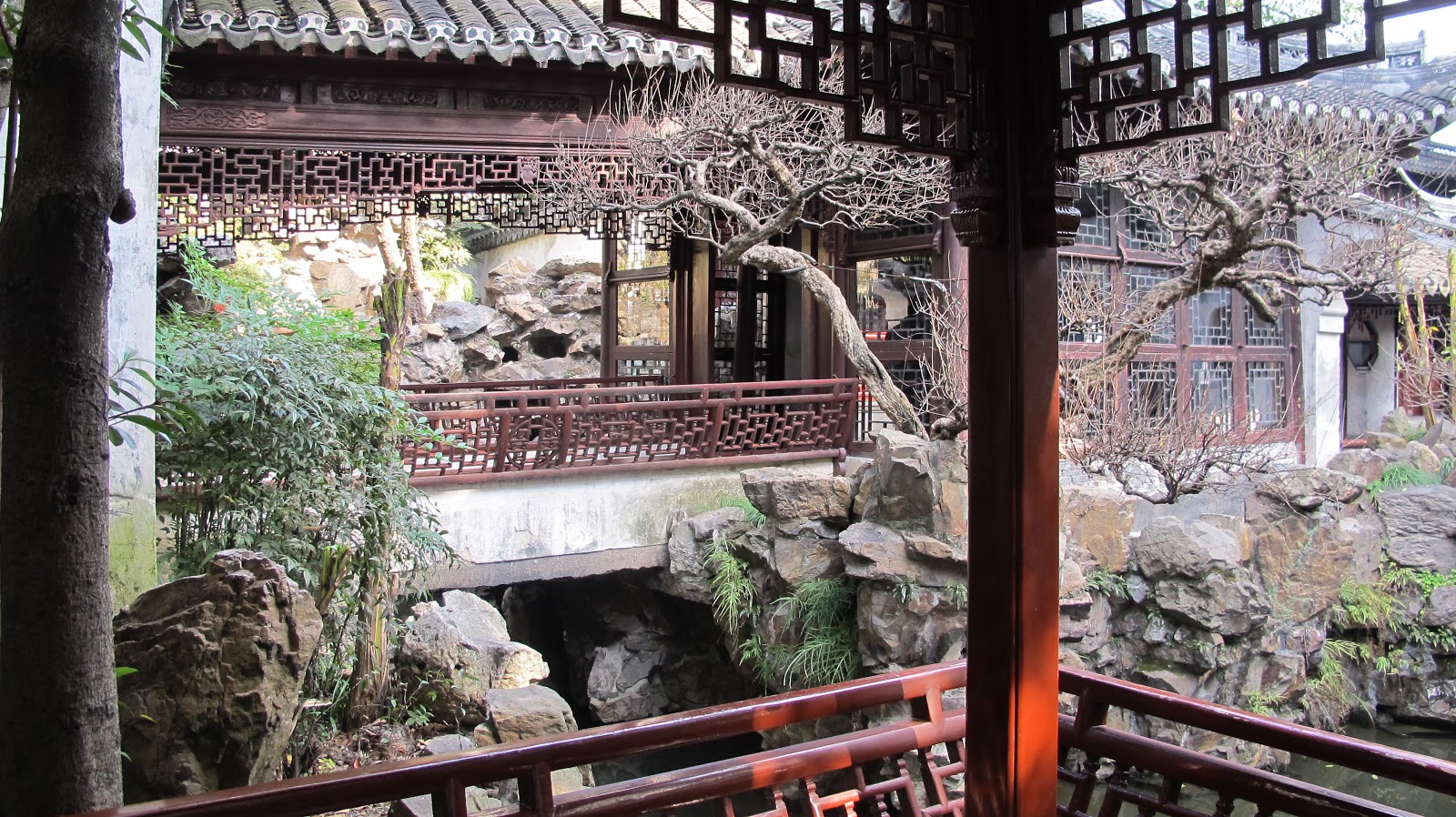
Having spent a morning this week wandering the Yu Gardens here and having all the various levels of symbolism explained to me by my young and very serious translator I feel I have just a glimmering of understanding.
Yu Gardens Shanghai, a rare non-touristed moment of tranquillity

At OV Gallery, an exhibition by painter Shi Jing, 'The Remains of the Day', also seems a little apocalyptic. Curator Rebecca Catching, whom I met today, says that his "asteroid series takes this concept of elapsing time to a new and cosmological level. Images of asteroids, which were taken from an Internet fan-site, are applied to the canvas using a combination of brushstrokes moving in different directions to depict the bulbous, pockmarked forms. What fascinates Shi Jing is the idea that for an asteroid, travelling an average of 90,000 km an hour, these photos are outdated even by the time they are taken. What we perceive is merely an image of an asteroid which is now light-years away from where it once was." The paintings become an installation with frames constructed with protruding LED lights which cast eerie shades of green, blue and magenta onto the dark surfaces. This continues the artist's interest in the vastness of the cosmos.

Shi Jing, Seen in Passing, courtesy of Chambers Fine Art Beijing
There seems to be a somewhat apocalyptic theme here, and in a week in which North Korea fired a long range missile and many memorial ceremonies of the 1937 Nanjing Massacre took place across China,  that may be most appropriate. Meanwhile, however, the men in People's Square play mahjong and in Fuxin Park they fly kites and play cards. Life continues in all its banality and its beauty.


Playing cards under the watchful eye of Marx and Engels
Gathering in People's Square

Kite Flyer at Fuxin Park

Tuesday, September 11, 2012

A 'double take' and some cognitive dissonance...

Old and new China, Shanghai, April 2011, photograph Luise Guest

So as usual I am attempting to immerse myself in all things Chinese and all things contemporary Chinese art. This sometimes leads to some strange cognitive dissonance. This week I am reading three books at once and jumping backwards and forwards from one to the other. The first is Jonathan Fenby's 'Tiger Head Snake Tail: China Today, How it Got There and Where It is Heading'. As you might guess from the title, this book delivers rather less than it promises. Despite being genuinely interesting, many chapters are essentially a series of lists and factoids in search of a narrative which could make sense of them. There are some great quotable bits and pieces though, like the story of the 6 year old child on a TV quiz show who was asked what she wanted to be when she grew up. 'An official', she said. 'What kind of official?' 'A corrupt official', she said. The book certainly paints a fascinating picture of a nation on fast forward with all the excitement and the inevitable problems that entails. The second is Tani E. Barlow's 'The Question of Women in Chinese Feminism' which I am earnestly and optimistically dipping into and then  putting down with a sense of exhaustion. The third is a book that surely must have been written just for me: A crime novel in an affectionate homage to the hard-boiled private eye genre, with a female protagonist (an American born Chinese) set in New York, with a plot centering around the Chinese contemporary art market. For me this already ticks all the boxes. And S J Rozan can really write. I totally love Lydia Chin!

And of course meanwhile I am neglecting to do my Chinese homework - I should be learning how to discuss the weather in Chinese for my class on Thursday but the 'tianqi yubao' (weather forecast) is so far failing to fascinate. And I make such tiny baby steps towards some kind of minimal level of competence that it is just depressing. Especially when I hear westerners speaking fluent Chinese and think 'But how did you GET there?!'

Meanwhile I have just got home from an absorbing and illuminating conversation held by the Power Institute at the University of Sydney, between Chinese curator Pi Li and Sydney art academic Thomas Berghuisen. Pi Li is here for 'Go Figure!', the big Contemporary Chinese Portraiture show opening at the  Sherman Foundation and the National Portrait Gallery later this week. He is in transition between Boers-Li Gallery and the Central Academy of Fine Arts in Beijing, and his new role at M+,  the new Museum of Visual Culture housing Uli Sigg's collection in the West Kowloon Cultural precinct in Hong Kong.

Pi Li gave a history from his own personal recollections of the development of contemporary art from the early 1980s in China, with all the many transformations and developments along the way. One of the fascinating things he commented on was the profound influence of the Sensation Exhibition and the yBa artists such as Hirst and Emin on a new generation of Chinese artists seeking another path following the commodification of the 90s wave of Cynical Realist and Political Pop painters. He identified Qiu Zhijie, Zhang Huan and Yang Zhenzhong among those who saw the use of ephemeral artforms, and rotting or impermanent materials as a way to reignite the avant garde. There was also some very interesting discussion of the impact of the returning diaspora of artists. When I met Yang Zhenzhong at his studio in Shanghai last year he was re-editing his iconic work 'I Will Die' into an 8 hour version for a European exhibition. He was the very model of the contemporary Chinese artist - essentially a global brand. But with an interesting and hugely significant body of work.

Yang Zhenzhong in his Shanghai Studio, April 2011, photograph Luise Guest
 (the artist  trying to give directions to my taxi driver on his way to pick me up from the studio - quite a challenge!)


Last Friday night saw the opening of the new White Rabbit exhibition 'Double Take'. It is clever and thought provoking and a wonderful chance to revisit some familiar works, such as paintings by Liang Yuanwei, painted 'neihua' bottles by Liu Zhuoquan, and even some of Ai Weiwei's sunflower seeds. I have written at greater length inhttp://theartlife.com.au/ and you can read more about my responses to the show here: Double Take at White Rabbit

A favourite work from the show? Gao Rong's fabulous simulacra of her Beijing basement apartment entrance, entirely fabricated from fabric and embroidery.

Gao Rong, Level 1/2, Unit 8, Building 5, Hua Jiadi, North Village (2010) fabric, thread, sponge, metal, image reproduced courtesy of the artist and White Rabbit Gallery.

Thursday, April 7, 2011

Days 24 and 25 – My final day in Shanghai, and one bizarre and surreal day in Guangzhou

 View of Duolun Street
Today I heard some very interesting perspectives on the Chinese and, specifically, Shanghai artworld from some gallerists, and also from 2 very different artists. It has taken longer for me to feel comfortable and confident in Shanghai, even though comparatively it has a more European and less Chinese feel, with the old European architectural heritage always evident. It has subtly insinuated itself now, though, and I feel sorry to leave when there still seems so much more to discover. This trip is just the tiniest exploration of the incredible richness of contemporary China, so I very much hope to be back again in the not too distant future – hopefully speaking more Chinese by then!
I met with George Michell, the Australian (who once upon a time in the distant past taught Chinese language and drama at Adelaide High School) who now runs Studio Rouge Gallery at its two locations in Shanghai. The gallery has been established for 8 years, and represents a range of very interesting artists including the abstract painter Qu Fengguo, whose work I much admire. George explains to me that the tradition of abstraction in Shanghai, in contrast to the figurative painting more dominant in Beijing, stems from the strong international influence in the 1920s and 1930s, thus an awareness and acceptance of modernist architecture and design, and so a sense of the modernist aesthetic, was already present in the city. In the 1980s during the ‘opening up’ period, young artists used abstraction as a means of seeking individual expression in defiant opposition to the proletarian realism in which they had been so rigorously trained. We also discussed the interesting manner in which foreign diplomats were the originators of the current Chinese art ‘boom’ – as virtually the only foreigners in China prior to the late 1990s they were the people interested in the work of Chinese artists, and were able to buy their works (at very low prices!) before any galleries, or an art market as such, came into existence.

According to George the huge and significant catalyst for the current art scene was China’s winning bid for the 2008 Olympics, as then the foreign media came to China and were amazed at what they found. "They expected people in Mao suits riding bicycles", he says, and instead found themselves in this ‘new China’ of booming industry, futurist architecture, boundless enthusiasm and determination to succeed in a global marketplace. 2004, he believes, was the start of the real art boom.

Now, however, the position is less certain, as with the sale of Baron Ullens’ collection, and also that of Charles Saatchi, buyers may be wary. Local Chinese art buyers prefer to buy in the secondary market of the auction houses, through Christies or Sotheby’s, essentially buying a ‘brand’, rather than take a risk on a new artist purchased through an independent gallery. However, George takes heart from the hordes of young people who flock to M50 galleries each weekend. The older generation are still dealing with a very complex set of circumstances stemming from the Cultural Revolution and its aftermath, whereas the younger generation are design-savvy and interested in the possibilities of art, design, information technologies and their interconnectedness.
Shi Zhi Ying in her studio

Later in the day I met Shi Zhi Ying in her large studio near the ShanghART Warehouse at Taopu, on the city’s edges. A quiet and thoughtful painter in her early thirties, she tells me her work is akin to meditation, and embodies Buddhist principles of simplicity and the connectedness of all things. Her ‘ocean’ paintings (one of which is in the Sydney ‘White Rabbit’ Gallery collection) were inspired by her travels back and forth across the Pacific Ocean since 2006 while her husband, an architect, was studying in America. On one trip they visited a lighthouse, and looking down at the ocean she had the sensation that she herself vanished, and what remained from this strange but not unpleasant sensation was a sense of her connectedness with the world. After this experience she read Buddhist scriptures in order to try to understand what had happened to her. She talks about the ‘me and we’ relationship within Buddhism, and emphasises that her work relates to this notion of connectedness between people, objects and the natural world. Her interest in Buddhist principles is also evident in the removal of colour from her palette – all her works are painted in subtle gradations between black and white, and in this are reminiscent of the subtlety of traditional ink paintings.
Shi Zhi Ying with her painting of the cloth shoes 
 I ask her whether as a young woman artist she has found it difficult to be taken seriously as a painter, thinking about some of the stories I had heard from other artists such as Liang Yuanwei and Monika Lin, but she just smiles and says she has had no problems. I wonder if the fact that her galleries in both Shanghai and Beijing are run by women has been helpful, but I am aware that she does not think the fact of gender has much relevance. She tells me she has not felt much pressure; after all, unlike a male artist she is not expected to support a wife! Chinese views about gender roles, and about social expectations, are often surprising, and it is easy to make the mistake of assuming a shared understanding in a conversation, only to discover at some point that you have been speaking at cross purposes.
I admire many works in progress in her studio – she is obviously both dedicated and prolific in her practice. In particular, I am drawn to a painting of a bowl of rice on a patterned tablecloth, where she intends to paint every individual grain, just as she paints every detailed wavelet on the ocean, and every facet on her current series of diamonds, in slow, measured layers of thin paint built up to create works of great detail and visual complexity. This work was inspired when she was stuck for a subject and finding painting difficult, and went out to dinner with her husband. There she saw the bowl of rice on the restaurant table and realised that it contained all the elements she was seeking to explore in her work. I ask her to tell me about a small painting of a pair of Chinese cloth shoes, and she explains it is a wedding present for a close friend, a painting of her favourite pair of shoes. Her works are both small and large scale, and focus on the small details of everyday life - a bowl of rice, a bra, a window, a pair of shoes – as well as on the enormity and vastness of the ocean. In her view, these things are not different, they make up the pieces of a whole existence in the world.

 High Seas (Series: Sea Sutra, 2009) Shi Zhi Ying
Shi Zhi Ying - Sea Painting - photographed by Luise Guest and used with the permission of the artist

Yang Zhenzhong in his studio 
Later, I meet another of the pioneers of new media and video in China, Yang Zhenzhong, who is re-editing his earlier work ‘I Will Die’, in which he asked random people found on the street and in shops and workplaces in 4 different countries to speak those words to the camera. The result is startling – both funny and disturbing. He wanted to explore the taboo subject of mortality and force people to confront it, but also to see how people altered their behaviour and ‘acted’ when faced with a camera. Like his peers Hu Jieming and Pu Jie he talks freely about the days of the student  movement of the 1980s, and also the way in which the ‘opening up’ of China introduced him to the work of artists such as Bill Viola. He will show ‘I Will Die’ in its new version (on a single screen rather than the original 10) in Beijing, together with the project completed with support of the giant Siemens Factory, ‘Spring Story’ in which 1500 workers at the factory were asked to recite a few words each from Deng Xiaoping’s ‘Southern Campaign Speech’. This was the famous speech which foreshadowed the complete transformation of China through the introduction of foreign capital and the creation of the Pearl River Delta in Guangdong Province as the world’s factory. As workers on the assembly line know only their single task and not the whole, so the people in the video knew only the words they were allocated to speak and not where they came from or their meaning. Thus the process of creating the work aligned itself to the nature of work in a factory – a metaphor for modern China.
I have been reading an interesting book, ‘Factory Girls: Voices from the Heart of Modern China’ by Leslie T. Chang, which connects directly to this theme. She puts a human face to the economic phenomenon of modern China, interviewing many young migrant workers in Guangdong Province in pieces originally written for the Wall Street Journal. “Today China has 130 million migrant workers. In factories, restaurants, construction sites, elevators, delivery services, house cleaning, child raising, garbage collecting, barber shops and brothels, almost every worker is a rural migrant. In large cities like Beijing and Shanghai, migrants account for a quarter of the population; in the factory towns of south China, they power the assembly lines of the nation’s export economy. Together they represent the largest migration in human history, three times the number of people who emigrated to America from Europe for over a century.” Her book explains how the history of modern China actually begins with the Taiping Handbag Factory in Dongguan, near Shenzhen.
On gallery rooftop in Weihai Lu 
On Thursday I left Shanghai on an obscenely early flight to Guangzhou, where I visited a teacher at the Guangzhou Nanhu International School, and also interviewed Professor Li Gongming at the Guangzhou Fine Arts Academy (more on those experiences later). Guangzhou didn’t feel like China to me – the difference between the north and south is so stark. It is subtropical, lush and humid, with gardens and parks filled with bougainvillea, palm trees and the beautiful bauhinia trees also seen in Hong Kong. The streets are lined with stalls selling snacks and tropical fruits. It is also extraordinarily multicultural, which I noticed on my visit to the school, and also at the airport later that night. This is really unusual in China – Shanghai has many westerners and expats but in Beijing, for example, I was often the only western person on the streets or in the markets in the area where I was staying. Even in tourist destinations such as the Forbidden City or the Summer Palace, most of the tourists are Chinese, not westerners.
At Guangzhou airport last night about half the travelling passengers were African, with many departing flights to Ethiopia and other African destinations listed on the electronic screens. My hired translator for the day, whose command of English was not entirely convincing, actually learned both French and English whilst working in Senegal. He spoke English with an African/French/Chinese accent, which is quite something, but makes for difficult communication in an interview with a third person!
Now back in Hong Kong, with the news about the detention of Ai Weiwei in the Hong Kong press, I will have some time to process some of the experiences and encounters of the last month. I want to think especially about the different schools and arts academies I have visited, and how those experiences may connect with what I have discovered in my meetings with the artists. I will be visiting the Hong Kong International School and the Canadian International School next week, and interviewing some more young Hong Kong artists here.
Shikumen(Stone House) doorway in Shanghai