The ongoing thoughts of an art teacher in China - and home in Sydney

A continuing diary about my travels in China, and thoughts about China and Chinese art from home and abroad
Showing posts with label Dong Yuan. Show all posts

Friday, April 26, 2019

中国日记 China Diary: 17 Artists and 13 Days

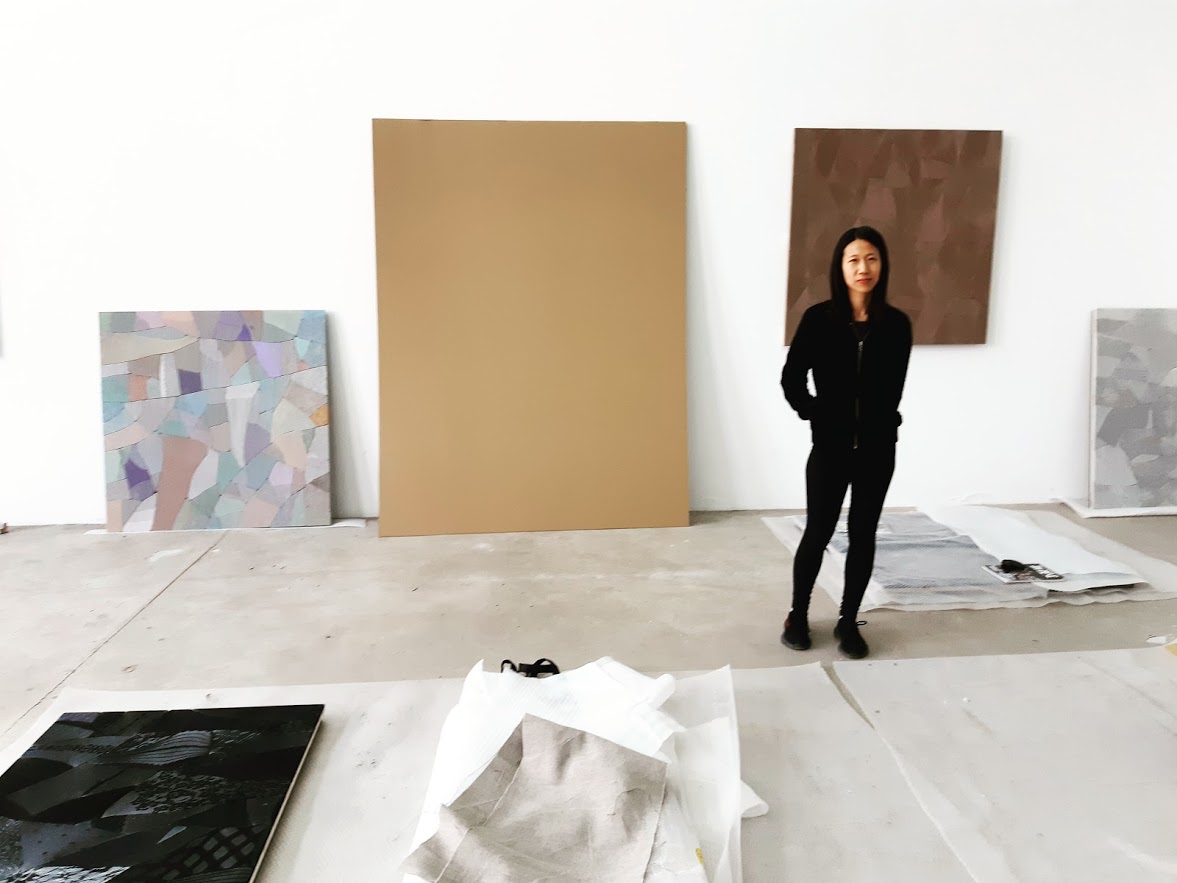
Artist Ma Qiusha in her Beijing Studio, photo: Luise Guest
You can find blog posts, news items and much more besides on the new website where the White Rabbit Collection and White Rabbit Gallery now live - including my description of a recent whirlwind trip to Shanghai and Beijing to interview some wonderful artists. I'll be writing more about these interviews in the coming weeks, so please take a look!

Note: it seems that the archive of blog posts and articles about artists is no longer available on the White Rabbit Collection website
The purpose of the trip to China undertaken in April 2019 by myself and gallery coordinator Hannah Toohey was to visit artists in their studios and record new interviews for the archive. Undertaking a marathon 17 interviews in 13 days, the conversations that ensued were intense – and intensely interesting. In between visiting artists they visited exhibitions in museums and galleries, and met arts writers, curators, gallery managers and museum directors to discuss the ever-changing Chinese art ecology.

Research Manager Luise Guest, artist He Sen, and Gallery Coordinator Hannah Toohey


The artists visited on this trip included acknowledged pioneer of Chinese video art, Zhang Peili; iconoclastic young creator of Electromagnetic BrainologyLu Yang; influential painter and conceptual artist Zhu Jinshi; magical realist Yang Shen; deeply philosophical Qiu Anxiong – creator of the sublime and terrifying New Classic of Mountains and Seastrilogy of animations – and painter Dong Yuan, who is creating a new version of ‘Grandma’s House’, documenting in paint every room, and every object, in her grandmother’s house in Dalian.

Research Manager Luise Guest with artist Yang Shen, Beijing April 2019, following an interview that covered topics ranging from Cultural Revolution propaganda to the novels of Marquez and Borges and the painters of the Leipzig School.
Dong Yuan with part of her new version of  ‘Lao Lao Jia’ (Grandma’s House) in Beijing. The discussion ranged from memories of her rural childhood to her inability to attend ancestor worship ceremonies at her grandmother’s home now that she is a married woman (and hence attached to another family).
Lu Yang in her natural habitat – behind multiple computer screens.


Thursday, December 14, 2017

Subterranean Feminism: Tao Aimin, Gao Rong and Dong Yuan

My article for WAGIC (Women and Gender in China) published last week:

Secret Language of Women: ‘Subterranean Feminism’ in the Work of Three Chinese Artists

December 11, 2017
Tao Aimin, The Secret Language of Women 女书, Book 3, Text 11, 2008, ink on paper, acrylic cover. Image courtesy the artist

The ‘F-word’ – feminism, that is – can be a minefield for non-Chinese writers in conversations with Chinese women, something I discovered whilst researching a book about women artists. An interpreter assisting me at first refused to translate the term, adamant that there was no such Chinese equivalent. The term ‘gender’, albeit much debated, is widely used, but the term for ‘feminism’ – variously, ‘nüxing zhuyi’ or 'nüquan zhuyi’ – frequently causes ‘lost in translation’ moments. Over time I learned not to make assumptions from a Euramerican feminist paradigm, and I discovered a Chinese feminist history. The problem for writers and curators, of course, is how to present the work of artists who do not identify with feminism, yet appear to be making feminist work, without speaking ‘for’ them, or orientalising their work. In ‘Toward Transnational Feminisms’, for the exhibition Global Feminisms: New Directions in Contemporary Art in 2007, Maura Reilly drew on the work of Ella Shohat to describe the work of such artists as a form of ‘subterranean feminism’. How do artists whose identification with feminism is complicated by their perception of an East/West divide navigate this somewhat treacherous territory?

The work of three women who examine hidden female histories reveals a gendered language of materiality and imagery. Tao Aimin (陶艾民) collected wooden washboards from hundreds of rural women to re-present as sculptural objects and surfaces from which to make prints and rubbings. Gao Rong (高蓉) applies embroidery to ambitious, padded fabric installations. Dong Yuan (董媛) paints tiny details of interior spaces, creating installations made up of separate canvases. In their work, the domestic and the humble are memorialised, the unsung labour of women is honoured, and the fast-vanishing world of an earlier generation of women is given physical form. They do not explicitly identify their work as feminist, but rather as exploring highly personal histories and individual responses to a rapidly changing world. From artists emerging into the aspirational present from the collectivist past, this emphasis is unsurprising.

The history of feminism in China explains the deep ambivalence many artists, writers and intellectuals feel about the term. Their unease with the feminist label reflects the suspicion of many towards the state-sponsored feminism of the recent past, epitomised by the All China Women’s Federation. After 1949 the explicit policy of the state was the erasure of traditional ‘feudal’ gender distinctions and the equal participation of women in the great Socialist project: female comrades would ‘hold up half the sky’ as workers, soldiers and farmers. Feminism became enmeshed in, but always secondary to, the utopian visions of the Chinese Communist Party. The impact of this history on the work of women artists who emerged in the post-Mao period into a globalising art economy should not be underestimated.

Identification as a feminist artist is as contentious in China as everywhere else, but here there is a particular art-world history. Exhibitions of women artists during the 1990s and early 2000s were focused on interiority and ‘womanliness’. Many women artists began to see them with a degree of suspicion, feeling (often quite rightly) that their work was trivialised by this curatorial separatism. In her catalogue essay for the 2013 exhibition Breakthrough: Work by Contemporary Chinese Women Artists, Peggy Wang argues that in this late twentieth century history: ‘… "women's art" served less as a rallying call for female artists, and more as the start of a set of thorny parameters against which to navigate and negotiate.’ In Gendered Bodies: Toward a Women's Visual Art in Contemporary China, Shuqin Cui characterises these exhibitions as “entangled in misconceptions” about feminism and femaleness. The disavowal of political activism continues: in 2017, curator Ai Lai’er insisted that her aim was not to reveal a ‘collective female identity’ but rather, ‘a “hint” towards a non-determinable factor’. In Beijing, where exhibitions of women’s art risk being closed by the authorities, this carefully vague and apolitical stance is understandable. (See, for example, The Guardian’s report on the closure of an exhibition focused on violence against women in 2015.) Ai, like others, perceives a shift from discussions of gender identity to an emphasis on the individual.

Tao Aimin, Gao Rong and Dong Yuan express considerable doubt about the word ‘feminist’ but they are deeply invested in female histories. Tao Aimin’s installations, paintings and books present the traces left by applying ink to wooden washboards collected from rural women. Choosing the ancient female script of Nüshu (女书) as her calligraphy, she inserts a language invented by anonymous rural women into the canon of the literati tradition, bringing an unacknowledged history into the light of day. Taught by mothers to daughters in remote villages of Hunan Province, the Nüshu script was used to embroider texts onto fans and belts, written in ‘Third Day Missives’ (San chao shu, books given to brides on the third day of marriage) or used to record the ‘bridal laments’ sung for young women leaving their family homes for their husband’s village.

Tao Aimin, Women's Book, Installation of Washboards, Image courtesy the artist

Click HERE to read more

Tuesday, July 4, 2017

All Under Heaven: the painted world of Dong Yuan

Dong Yuan, Painted objects, acrylic on multiple canvases, image courtesy the artist
I've interviewed Dong Yuan twice in Beijing (with one attempt abruptly aborted when I was robbed on the subway whilst on my way to her studio, left without even the 2 yuan needed to get through the turnstiles at the other end - a disaster story for another time.) Each time we met, in two different small apartments in enormous complexes of high rises on Beijing's furthest outskirts, I was charmed by her total lack of pretension. She is entirely, unselfconsciously herself. The second time we met, on a cold winter afternoon, I was befuddled by the incomprehensible numbering system of tower blocks, wandering helplessly, leaving her  ever more plaintive voice mail messages. Suddenly she appeared on the road beside me with her dog, wearing pyjamas. With red cheeks and with her hair roughly pulled back, she looked like a heroic girl farmer from a propaganda poster. And, in fact, she told me on both occasions that if she wasn't an artist, she'd like to be a farmer or a gardener.

Just this week my profile of Dong was published on The Art Life website. It starts this way:

A Short History of Everything: the painted world of Dong Yuan

ART LIFE , STUFF Jul 03, 201
As a student in the Experimental Arts Department at Beijing’s renowned Central Academy of Fine Arts, Dong Yuan began to document the mundane objects of daily life. She decided to paint, literally, everything she owned. Home of Paintings and Sketch of Family Belongings (2008) record, on fifty-nine and one hundred and eighty-six canvases respectively, the two apartments in which she lived as a student.

Dong Yuan, Sketch of Family Belongings, 2008, acrylic on 186 separate canvases, dimensions variable, image courtesy of White Rabbit Collection
With obsessive attention to detail, she rendered mundane objects on flat surfaces. Our gaze travels across a pair of shoes, a box of tissues, empty coat hangers, a striped towel hanging on the back of the door, an electric kettle and tea thermos, umbrellas leaning in a corner, books piled haphazardly on wonky shelves, stacks of papers, and a teapot. Some are painted with a Cézanne-inspired aerial perspective, others with meticulous trompe l’oeil illusionism. The canvases are then arranged in real space, in three dimensions: to enter the installation is to have sense of intruding on a private, domestic space. These works provide a glimpse into the world of a stranger, the same voyeuristic frisson as witnessing alternate lives in the blue light of a television screen through an un-curtained window.
Dong Yuan, 2014, with ‘Grandmother’s Cabinet’ painting, photograph Luise Guest
Dong Yuan’s installations of multiple paintings challenge the boundaries and limitations of the medium as it’s conventionally understood. Some are steeped in nostalgia, others are wryly observed representations of the everyday, and some are purely fantastical imaginings. As a student, inspired by her discovery of the paintings of Giorgio Morandi, she was fascinated by the historical genre of the still life. Later, she immersed herself in a study of Renaissance and Flemish painting: Hieronymous Bosch, Hendrick Avercamp and Pieter Bruegel the Elder, with their sharply focused gaze on every detail of a scene, near and far, especially delighted her.
Dong Yuan, Daily Scenes, 2009, oil on canvas, image courtesy White Rabbit Collection
Dong found living in Beijing alienating and stressful. Her practice of painting the minutiae of daily life grounded her, and helped her to adjust. Daily Scenes (2009) consists of forty-two separate canvases arranged in a grid, recording the view from every stairwell window in her apartment block. Windows were an important element in traditional Chinese architecture, garden design and painting, always placed to reveal a beautiful vista for contemplation and meditation. Dong Yuan’s utilitarian windows, in contrast, reveal a bleak view of endlessly repeated apartment blocks, cars, trucks and bicycles – the sprawling suburban periphery of Beijing. There is beauty, however, in her careful variation of partly-opened windows, a rhythm evoking the comforting familiarity of everyday routines and repetitions. The sky is an unlikely blue, the trees are in leaf and not yet covered by Beijing’s yellow dust, and the typically orange and salmon pink colour of the buildings seems cheerful rather than austere. The bottom row of canvases depicts open doorways, vignettes revealing glimpses of the life of the neighbourhood: a stout man unselfconsciously scratches himself, women look after small children and hang washing amongst haphazardly parked cars. A vista that at first seems sterile is filled with the parallel lives of others.

Dong Yuan, Painted Kitchen2010, (detail) acrylic on canvas, image courtesy White Rabbit Collection
Painted Kitchen (2010) takes us back into the domestic interior world: a cluttered kitchen lit by a bare bulb hanging from the ceiling. Rows of canvases depict bottles of cooking oil and soy sauce, stacks of noodle and rice bowls, teacups, hanging spoons and spatulas, plates of food, the porcelain sink and the stove. It is as if the inhabitants of this tiny domestic space have stepped out for a moment, and we are peering into their lit apartment, envious observers of a family meal being prepared and consumed.
TO READ MORE, CLICK HERE
Sunday, April 24, 2016

半 边 天 : Half the Beijing Sky Part 2

Ming City Wall Park, Beijing
 Blue sky continues, the air is fresh(ish), and trees are in green leaf everywhere you look. Three reasons to be cheerful in Beijing. Only the apocalyptic traffic today could put a dampener on my mood, the day after the big book launch and "Half the Sky" exhibition opening at Red Gate Gallery. The exhibition is causing a bit of a buzz around town, I hear, and I am hoping there will be at least a few people turn up for my talk tomorrow evening at the Beijing Bookworm. It seems that "Half the Sky" has hit some kind of zeitgeist - people are definitely interested, and warmly enthusiastic.

Half the Sky opens at Red Gate Gallery
How interesting that shows of women artists are in the news again, with Hauser and Wirth in LA re-writing the history of abstract sculpture in America in Revolution in the Making: Abstract Sculpture by Women, 1947 – 2016. Despite the apparent success of individual women - in that case Louise Bourgeois, or Lee Bontecou; in the Chinese context Cao Fei or Lin Tianmiao - they are still an absence in the larger narrative. The debate about the rightness or wrongness of all-women shows continues, and I must admit I had secret worries about whether it was a good strategy. But in the end, writing the book was a curatorial process, and an exhibition was a logical move.
Dong Yuan, Grandmother's Cabinet, installation view
When I began writing "Half the Sky" there were many anxious moments when I thought I must be mad. I continued to succumb to moments of doubt and despair throughout the process: was it a kind of hubris that made me think that I could - or should - write a book about artists in another culture, another language? But I really was determined to tell the story of this particular group of artists, representative in so many ways of the extraordinary phenomenon that is contemporary Chinese art.

Installing Gao Rong's "Sitting in a Chair and Thinking About My Future" - an armchair covered in embroidered mould, and lamp with knitted light rays
Installing Li Tingting works


Tao Aimin and Ma Yanling with Tao's "In an Instant" installation


In conversation with Lin Jingjing before the opening begins

  Visitors examining Dong Yuan's "Grandmother's Cabinet"


Tao Aimin, "In an Instant"


Brian Wallace, Red Gate director, with Xiao Lu and Guo Chen


With Dong Yuan


Gao Rong signs a copy of the book


Looking at Cui Xiuwen's "Existential Emptiness"


With Lin Jingjing


Brian Wallace introduces the Australian Ambassador at the opening


Australian Ambassador Jan Adams and a line-up of Chinese artists: 
L to R Zhou Hongbin, Cui Xiuwen, Li Tingting, Xie Qi, Jan Adams, Ma Yanling, myself, Bu Hua, Tony Scott, Bingyi, Xiao Lu, Lin Jingjing, Han Yajuan, Gao Ping. Not pictured: Gao Rong, Tao Aimin, Dong Yuan and Huang Yajuan