The ongoing thoughts of an art teacher in China - and home in Sydney

A continuing diary about my travels in China, and thoughts about China and Chinese art from home and abroad
Showing posts with label Wu Meng. Show all posts

Friday, December 19, 2014

上海日记 Shanghai Diary: two artists, a curator, and a revolutionary martyr

West Lake, Hangzhou, photograph Luise Guest

On the website of the Shanghai Biennale: "Free of charge for active army men, retired cadres, and dependents of martyrs, visitors with disabilities, and seniors over 70"

I have arrived in this exciting city of Jetsons-style futuristic overhead freeways, and flyovers, a veritable  concrete spaghetti, after the increasingly usual unexplained flight delays out of Beijing. Colonial and art deco buildings poke their heads above the freeway walls, and apartments with gold domes and cupolas gleam in the sun. At Hongqiao airport an exhibition of traditional ink painting sits side by side with a Chrysler show-room full of gleaming vehicles. This too is "socialism with Chinese characteristics." I have to get used to taxi drivers saying "Qu nali? " (where are you going?) Instead of the Beijing "Qu narrrrrr?" Immediate observation: Shanghai street style is very cool indeed compared with the more pragmatic and prosaic Beijing. The streets of the French Concession district are full of young guys in big overcoats with designer glasses and geometrically sharp haircuts. The notable exception to the high style aesthetic is that truly eccentric Shanghainese habit of wearing pyjamas - often bright pink flanellette, printed with Hello Kitty or Snoopy characters - in the street. They are sometimes paired with high heeled shoes and ankle socks. The addition of a puffy down jacket in a virulent shade of electric blue is often a notable feature as well. 


In Beijing it is rare in most places outside the diplomatic area or 798 to see another Westerner - Shanghai is much more ethnically diverse. On my very first visit to this city in 2011, after spending a month in Beijing, I was surprised to see mixed race couples. This is generally a Western man with a Chinese woman, almost never the other way around. My young postgrad student translators, however, (mostly girls) talk to me about the pressure from their parents to find a good Chinese husband. In Beijing last week "Shirley" told me that every time she returns home to Shanghai her mother sets up  a series of blind dates with eligible bachelors, worrying that she is leaving it too late. She is 22. She thinks her mother chooses a "better quality" man than the rock musicians with whom she has had disappointing romantic experiences, and says she would never, never marry a man that her parents disapproved of. "Family is the most important thing of all," she says, and as an only child she must not disappoint the parents who have lavished her with love and educational opportunities.

In the French Concession, Shanghai, Photos Luise Guest
Since I arrived in Shanghai I have had a fascinating conversation with independent curator Shasha Liu about the Chinese art market in the odd surroundings of the Marks and Spencer coffee shop - more of that in a later post. Two artist studio visits took up my first two days - the first an interview with young sculptor Yu Ji, whose work is currently showing in the Palais de Tokyo in Paris. She is pushing sculpture into the realms of performance art, and she won my heart when she confided her early love for the work of Wolfgang Laib. I later discovered she has worked with Grass Stage Theater Director and art historian Zhao Chuan whom I interviewed with his wife, the performance artist Wu Meng, back in 2012. There is a distinctly more theoretical approach - and perhaps a more polemical one too - to art practice in Shanghai as compared with Beijing. Yu Ji is interested in the body in quite an abstract way - her work is not about sentiment or feelings, but explores the body taking up space, moving in space, and the experience of physical sensation. 

An early work in her student days started with the used bars of soap with which a range of different people had washed their bodies. Yu Ji made plaster casts of these worn and humble objects. Arte Povera interests her - the use of simple inexpensive materials such as concrete and plaster. This has been partly out of necessity, as a student and then as a young impoverished artist just beginning to make her way, but it is also a distinct aesthetic and conceptual choice. It is something seen in the work of other Shanghai based artists, too, such as Shi Qing, and again represents a distinct contrast with the grand ambitions and enormous scale of many Beijing-based artists. Yu Ji loves the amputated limbs and battered torsos of Classical sculpture from the ancient world, and was also inspired by the Buddhist statuary of the Mogao caves along the silk route. She is interested too in the connection between art and daily life, and one of the works currently showing in Paris is based on the very particularly Chinese experience (outside the big "first-tier" cities) of the communal public toilet. For more about this interesting sculptor you can read my forthcoming article about ten interesting emerging Chinese artists in The Culture Trip!
Yu Ji December 2014 Photograph Luise Guest

Yu Ji, image courtesy the artist
My second interview was with painter Wang Zhibo, whose work was seen in Sydney this year in "Wondermountainat Sydney's Penrith Regional Gallery, an exhibition curated by Joanna Bayndrian. She selected contemporary artists both Chinese and Australian who draw in some way upon the traditions of scholar painting and "shan shui" ink and brush landscape painting. You can read my review of that exhibition if you click HERE. Zhibo lives and works in Hangzhou, so I had a grand Chinese travel adventure, leaving my hotel at 7.00am in order to get to Hangzhou's West Lake with at least a little time for a walk around its famed circumference before going to the studio she shares with her husband,  painter Yuan Yuan. The visit was worth it in every way - these highly landscaped vistas punctuated with red maple leaves and willows drooping into the water are so reminiscent of Chinese painting. I loved it despite the battered vans tearing around the lake with tourist touts screaming out the windows into hand-held loudspeakers, and hordes of people taking photographs of their wives and daughters leaning winsomely against trees or looking flirtatiously through pavilion windows.
Local officials on a West Lake junket? Photograph Luise Guest
West Lake Vista, Photograph Luise Guest
My conversation with Wang Zhibo took place amidst the constant noise of drills and jackhammers, as the old factory area is being "upgraded" to become fancy expensive design studios, shops and galleries - "like a little 798" said Zhibo. Her work is cool and metaphysical, dealing in imagined and remembered landscapes which blend east and west, past and present. She is currently working on a series of paintings of security guard houses (like those in the gated estates of the newly wealthy Chinese, always given grandiose names such as "Florida Heaven" or "European Mansions") sited in imaginary gardens inspired by Renaissance painters such as Botticelli. I like this idea, which combines whimsy with savage satire. Zhibo loves Masaccio and Piero della Francesca for how they make the difficult appear easy and inevitable, and there is a similar cool architectural eye on the world in her own work.
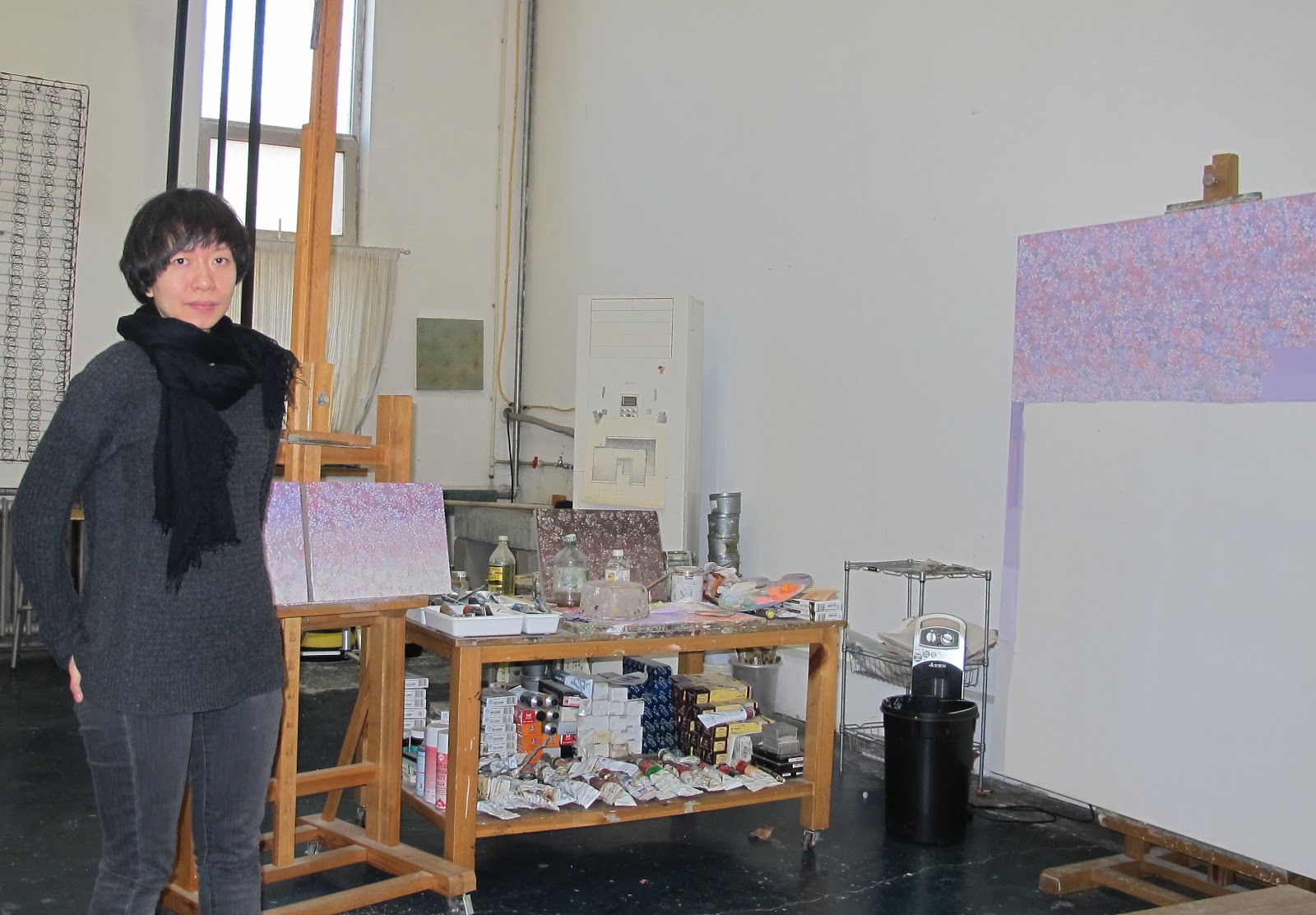
Wang Zhibo in her Hangzhou studio, December 2014, Photograph Luise Guest

Images courtesy the artist
After two hours talking with Zhibo and her young assistant, Bing Er (studying English languageat university but desperately wanting to be a photographer and work with Yang Fudong) came an exhausting trip back to Shanghai. Firstly a cab from studio to station with, as is usual, no suspension. The cheerful driver made up songs for me based on our stilted conversation. Sample words, translated from the Chinese: "Hangzhou traffic is terrible every day, every day, every dayl Traffic jams every day, traffic is shit!" Then he would turn to me and say, "Hao bu hao?" (Good or not good?) "Very good!" I assured him, hoping we would eventually arrive unscathed at our destination, which seemed more likely if he faced the road than swivelled around grinning at me. Then almost an hour in the grim, very cold waiting room of the railway station. Then an hour on the fast train, on which many people were standing, as they had sold more tickets than seats, with a man snoring more loudly than I would have believed possible next to me. Then one hour and ten minutes in a taxi line at Hongqiao Station, into which a Russian woman in a fur coat pushed ahead of hundreds of people and leaped into a cab with her child.Nobody protested. I wanted to punch her. Then 50 minutes in the taxi crawling through the stalled traffic, interspersed with burst of maniacal speed and heart-stopping near misses. Like so many of my China days, it was exhausting and wonderful at the same time. If only the mythical revolutionary martyr Lei Feng, who is like a socialist saint in China, much satirised by cynical youth,  HAD been there to help me get a taxi, as this sign in the railway station appeared to promise....

More on Shanghai art, and more of my random #OnlyinChina observations in a later post. Off to the Shanghai Biennale now, followed by more art, as much as I can cram into the day. I will give a few museums a miss, though, including the mysterious but terribly dull-sounding "Exhibition of Deeds of Good Eighth Company of PLA on the Nanjing Road."
From Chinese Posters site: The following example from early 2001 may serve as an illustration of the continuous redefinition of Lei's exemplary status. Falun Gong members undergoing "re-education through labor" were taken to the Lei Feng Memorial Hall in Liaoning Province, in order to learn from Lei's self-sacrifices. According to the report in the Liberation Army Daily [Jiefangjun ribao], the visitors "spontaneously repeated and copied down inscriptions" from his diary.

Friday, February 21, 2014

中国梦: My Chinese Dream / Dreaming in Chinese

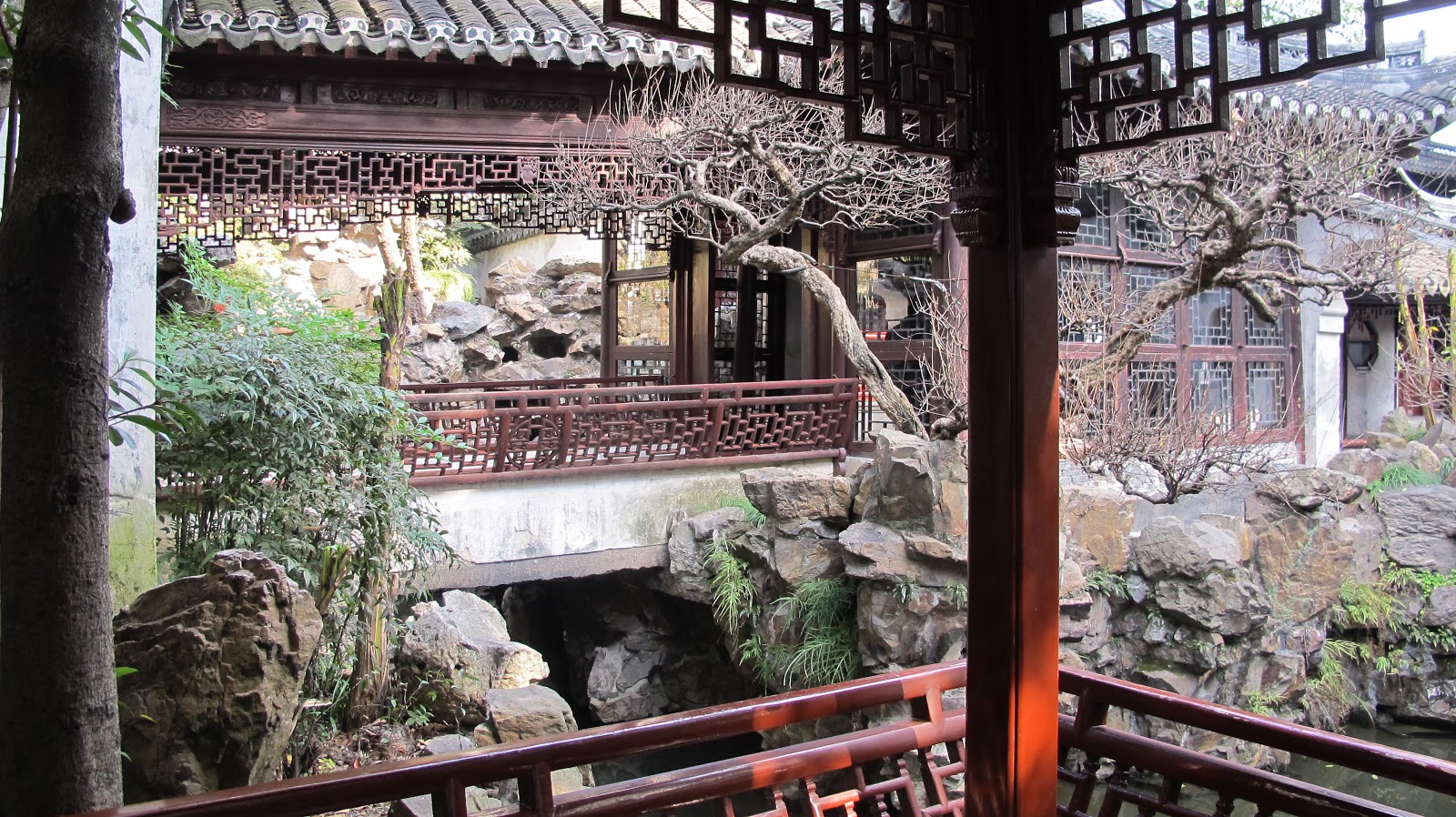
Changing China, from Yu Gardens Shanghai, photographed in 2012
Yesterday a friend asked if I sometimes dream in Chinese. I don't, of course, my Chinese is far too limited for that. But I do often wake up with Chinese words and phrases drifting through my head, and sometimes in those dark waking hours in the middle of the night I find myself going over and over Chinese sentences, or translating mundane conversations into Chinese. I find myself tempted to say "Wei, nihao" when I answer the phone. I want to ask people "Zenmeyang?" "OK?" or say "Wo mashang lai" instead of "Yes, I'm coming now". I'd like to tell my friends to "Man zou" instead of "Take care." The mental image of the horrified faces of my daughters stops me attempting Chinese in restaurants, or when ordering dim sum. Also the knowledge of how annoying and irritating that would be for people just trying to get through their shift without western wankers using them as language tutors.

 I am slowly, belatedly, coming to the unwelcome realisation that I am unlikely ever to be able to speak fluently - I left my run far too late. In my Eurocentric youth I learned French, then Italian, and naiively and optimistically believed that I was "good at languages." Oh boy, what a humbling experience awaited when I began to learn Chinese three years ago at the age of 54! And oh for a youthfully elastic brain to soak up this difficult syntax, these impossibly subtle tones, and to remember the damn vocabulary, much less to  help my quixotic attempt to learn to read characters. I sat in class in Beijing last year with 19 and 20-year old German and Dutch boys who began with no Chinese at all and soon outstripped me. I watched them soak up the language like sponges and learn to communicate pretty effectively. Perhaps in part because they went out drinking every night in attempts to meet Chinese girls. Also perhaps because they all had the hots for the very sexy young teacher, Yumi,  and wanted to talk to her about bars and nightclubs and try (in vain) to persuade her to go drinking with them. Each lesson began with a discussion in Chinese about who had drunk what and how much the night before - with the frequent absence of the American boy who was too hungover to come to class at all most mornings. Memorably, one day they discovered they had all coincidentally been at the same cocktail bar the night before and Yumi confided "Zuotian wanshang wo he le wu ge 'sex-on-the-beach.'" Five 'sex-on-the-beach' cocktails and the girl still rode her motorbike home to the outer suburbs!
My Chinese Dream: Tuanjiehu Park on an unpolluted weekend morning
After a period of being depressed and demoralised by the minuscule progress made after attending classes daily over 2 months in Beijing, I have decided to stop being so hard on myself and celebrate the small achievements. I should feel pleased that I can navigate the city, catch taxis and converse with shopkeepers. I should be amazed that I can remember any characters at all! So I shall persevere....and shall soon find myself back in Beijing, and back looking over the intersection of Gongti Bei Lu and Sanlitun Lu from the windows of the language school. Meanwhile, the new teacher of my Chinese class here (Level 8 - how ridiculous, what a sham!) is from Shanghai and continually corrects my Beijing accent.

Luckily, art is a universal language (at least to some extent) and with the help of my young translators from Beijing Foreign Languages University (who tell me that you can graduate from there either as a diplomat or a spy) I have managed to have fascinating and complex conversations with artists in my visits to studios. Here is my interview with Shanghai-based performance artist Wu Meng, published today in Daily Serving.
Wu Meng with her husband, Grass Stage Theatre director Zhao Chuan, photograph LG 2012
The Song of the Shirt
In her 2013 performance work And They Chat (also called Chat with Women), Wu Meng walked the streets of the old city of Haikou in a wedding dress made of newspaper, tying discarded domestic objects such as pots and pans, a broom, and a large mosquito net onto her body as she went. Her load became heavier and heavier as she dragged herself down the road, followed by small children and curious onlookers. The performance concluded with a reading from Engels on marriage and monogamy. A new collaborative work, Metamorphosis Garden, reveals her consistent interest in exploring aspects of women’s lived experience. “… sweet fairy tales, strange, even bloody little allegories, interwoven with real-life female stories. How should women view themselves and respond to this complex and lonely world?” In asking this question, Wu Meng creates a body of work that explores the contested territory of gender in today’s China.
Wu Meng, 'Gravity 1' 2010. Image courtesy of the Artist and OV Gallery Shanghai.
The contemporary Chinese art scene is exciting and dynamic, but at times seems fueled by a heady mixture of testosterone and “baijiu,” the Chinese white spirit that fells unsuspecting foreigners like rocket fuel. In my quest to meet women artists, I had been told by numerous people in Shanghai that I must interview Wu Meng: performance artist, freelance writer, and founding member of Grass Stage experimental theater collective. In addition to her work with Grass Stage, Wu has created solo works in Hong Kong, the German Pavilion at Shanghai EXPO (2010), Hamburg (2011), Leipzig (2012), and throughout China.
To read more, click HERE

Sunday, December 16, 2012

Zhong guo "Zai Jian" - for now

A large wall text at the entrance to the "Andy Warhol - 15 minutes eternal" exhibition currently showing at the Hong Kong Art Museum reads, " Making money is art and working is art and good business is the best art". This is curiously appropriate in Hong Kong, a city where, artist Celia Ko told me tonight, "money is the only language that everybody speaks."

Hmmm. Money and art. Who knew? Always a hugely problematic nexus, and ideas about the relationship of one to the other are contested bitterly. In Beijing there is no denying that a number of artists became seriously wealthy in the art boom of the late 90s and early 2000s. And cynical views are expressed by some in the artworld that everything and everyone have been corrupted by that.

However while everybody needs to earn a living and artists are not exempt from the normal kinds of greed and desire for comfort and ease that we are all heir to, I am prepared to go out on a limb and say that each of the seventeen artists I have interviewed on this trip are absolutely and seriously dedicated to making art that expresses deeply felt ideas and beliefs, and work incredibly hard to develop their practice and pursue a goal of excellence, whatever the art market might be doing.
Gao Ping, oil on canvas, image reproduced with permission of the artist and China Art Projects
Gao Ping told me, "Every year I want to find something new in my work" and added, "The drawing is my heart". Lin Tianmiao said, "Being an artist is a very personal thing. We are the people who raise the questions - the critical thinking is the most important thing". You can read a more detailed account of my interview with this iconic figure, currently showing at Lelong in New York, here: http://dailyserving.com/2012/12/holding-up-half-the-sky-an-interview-with-lin-tianmiao/

Lin Tianmiao, thread winding work viewed in the artist's studio,
 photograph Luise Guest, reproduced with the permission of the artist
Liang Yuanwei, who spent three months in Berlin after a less than happy experience representing China at the Venice Biennale, said. "My work is like a tunnel between myself and the world. It must be true."
Liang Yuanwei in her Beijing studio, December 2012
Photograph Luise Guest, reproduced with permission of the artist
Liang Yuanwei, Flower Study for the Golden Notes series, oil on canvas
Photograph Luise Guest reproduced with the permission of the artist
Liu Zhuoquan makes very beautiful works that contain within them some carefully coded meanings about issues in China today. Wu Meng makes works in the public space in Shanghai at considerable personal risk to herself and her family, raising issues of vital concern such as the suicides of workers in the factories of southern China, or the unfair treatment of migrant workers. And Lam Tung-pang in Hong Kong, whose work is currently showing at Saatchi in London, makes works which reflect his feelings of anxiety and distress about what is happening to his beloved city, and his search for quietness and repose in a re-examination of the traditions of ink painting.
Lam Tung-pang in his studio, Hong Kong December 2012,
photograph Luise Guest  reproduced with the permission of the artist
Lam Tung-pang, studio view
Lam Tung-pang, 2 sided work based on Tang Dynasty horse, photographed in the studio
Photograph Luise Guest reproduced with the permission of the artist
Lam Tung-pang, exhibition of work at Goethe Institut, Hong Kong, installation view
image reproduced with permission of the artist
I have interviewed painters and performance artists, photographers and sculptors, artists who work with found objects and found images, those who reinvent traditional Chinese forms such as ink painting or gong bi style painting and those who seek an entirely new visual language. I have met famous and revered artists, and artists newly graduated from art academies. I have met curators and gallery directors and critics.
Monika Lin, "On the Way to the Imperial Examination",
performance piece in which the artist wrote the character 'mi' (rice) 10,000 times
Image reproduced with permission of the artist
Shi Zhiying in her Shanghai studio,
Photograph Luise Guest, reproduced with permission of the artist
I have also met two wonderful and inspirational art teachers with whom I hope to collaborate on some projects with our respective art students - art that crosses national boundaries and limitations of culture and language, that sounds good!

I have learned enough to make my brain feel as if it is overflowing with new information, enough for a book! We'll see... I have loved the experience of travelling with this sense of purpose and in a spirit of enquiry, and have been warmly welcomed everywhere. I have sat in ice cold freezing studios in old 'Shikumen' houses in the French Concession in Shanghai, and in Caochangdi and Songzhuang artists' villages on the outskirts of Beijing. Today, after visiting Lam Tung-pang in his new studio in Fo Tan, I caught a local mini bus to Sha Tin Station, blaring Chinese opera all the way.

From the sublime to the truly ridiculous, Hong Kong has it. Yesterday I saw an eagle floating, suspended, high above the clustered apartment buildings as I rode down the hills from the Peak on the top deck of a bus. Today, in the shopping mall above the Sha Tin MTR station, I came across a brand of handbags and wallets called 'Shag Wear' - I swear this is true! Yesterday, in Canton Road, two young men in the jostling crowd carried sandwich boards advertising 'The Battery Operated Nasal Aspirator".

I have been observing - sometimes feeling like a voyeur - the people in each city as they go about their lives, Old men and women playing cards, mahjong, chess, doing Tai Chi, ballroom dancing, playing bowls. Such constant activity! And here in Hong Kong have been touched by the way tiny, wizened old ladies are led gently by daughters and grand-daughters down jostling Kowloon streets. And also by the general tenderness shown in every  city I have visited to babies and children. Not surprising in the land of the one child policy, changing though that may be. Often in Australia I observe parents respond to their small children with exasperation and impatience as their default position. Not so in China.

It is perhaps ironic that part of my purpose here has been to discover what the effect of international dialogues, residencies and exhibitions has been on the work of Chinese artists, and how they have been changed by these experiences. A lot more remains to discover on that topic, but in the meantime the person most changed by the dialogue is me.
Zhongguo - Zai Jian!

Thursday, December 13, 2012

Just what is it that makes Shanghai so different, so appealing?

My sentiments exactly, after a day experiencing all the contradictions of modern China. This is a work seen at Vanguard Gallery in M50

I go to sleep at night with all the Chinese phrases and sentences floating around in my head that I somehow haven't been able to remember during the day when I need them. In my dreams I am wonderfully fluent, but during my waking moments it is as if I have been rendered mute. I stumble through basic requests, usually forgetting the interrogative 'ma?' in my questions, so I must sound weirdly declarative. Sometimes I obviously sound better than I am, so am met with a flood, a torrent, an avalanche of Chinese and have to shamefully declare 'Wo bu mingbai' - I don't understand. I am absurdly pleased with myself when very simple conversations are conducted successfully in Chinese - albeit with a fair bit of mime and gesturing. People are wonderfully good-humoured and like to practice their English, so we get by with good grace on both sides - although I find they are generally very amused by the notion of any foreigner attempting to speak Chinese. Secretly I suspect they think we are absolute barbarians.

Sometimes this seems to be in fact the case. Last night as I was desperately flinging myself into the path of the terrifying Shanghai traffic, attempting to hail a cab, a middle aged Australian couple got out of a taxi next to me and the man said, "You might as well take this one, he can't seem to understand my instructions". Why on earth would you expect him to? is what I wanted to ask, but instead gratefully jumped in. Later I felt guilty, thinking I should have tried to help them communicate, but I must have been infected by some of the Chinese 'every woman for herself' attitude in public spaces. And I didn't like my compatriots appearing both ignorant AND arrogant. Also they had just come out of a very swanky hotel, so too bad!


Embarrassing Chinese moments: "Tai Chi Le!"
  1. Almost falling headfirst out of a Chinese toilet at the feet of an artist in his gallery. I had temporarily forgotten that Chinese-style toilets have a steep step at the door. A quick recovery and a (probably unconvincing) attempt to suggest that I had always intended to exit the 'ce suo' with astonishing speed was my strategy to save face here
  2. Involuntarily screaming loudly in the back of a Shanghai taxi as we swerved violently through an intersection, scattering riders of bicycles, pedi-cabs and pedestrians, almost colliding with a bus. I have become very used to the no-seatbelts, drive across multiple lanes and on the wrong side of the road and through red lights whenever you feel like it modus operandi, but this journey was horrific even by Shanghai standards. I sat gripping the door handle, thinking I may never see my children again. and  uttering moans and gasps, with the driver looking at me sideways in contempt
Three more things not to select from a Chinese menu:
  1. Bullfrog in sauce
  2. ' New York' pizza - I have tried this and it is neither New York style nor pizza
  3. 'Yuanyang' or Cantonese coffee/tea drink, a mixture of a small amount of instant coffee and Hong Kong style milk tea. My very sophisticated university lecturer Chinese friend drank this to accompany stir fried seafood and a Malaysian curry, much to my disbelief
Shi Qing, Shanghai Electricity Shopping Mall, Shanghai Biennale
Installation, Shanghai Biennale
Installation detail, Shanghai Biennale
Installation, Shanghai Biennale
The last few days have exposed once again the extraordinary contradictions of China, as seen through the  the microcosm lens of the artworld. From the quiet, contemplative and thoughtful practice of Shi Zhiying, steeped in Buddhism and the traditions of ink painting; to the internationalism of the Shanghai Biennale and some apocalyptic exhibitions at M50; to the Shanghai Museum's blockbuster show of Chinese ink painting and calligraphy from American museums; to sentimental socialist realism at the Shanghai Art Museum; to social activism through art in the work of a number of painters and the performance artist Wu Meng: everything goes into the stir fry that is China today.

I started the day at the very wonderful Shanghai Museum, which is housed in a rather ugly building designed to resemble an ancient bronze 'ding' vessel and containing a fabulous collection. The exhibition of paintings and calligraphy from museums such as the Metropolitan in New York, the Cleveland Art Museum and the Boston Museum of Fine Arts was packed with Chinese visitors of all ages, intently reading the calligraphy and peering at the scrolls and paintings in silence. I felt like such a frivolous dilettante flitting from one to the next and trying to remember the historical sequence of the different dynasties. It is very possible to see the strong influence that these traditions continue to have on contemporary artists - especially literati painting and Song Dynasty Bird and Flower painting. And humbling to see what the Chinese were doing during Europe's  Dark Ages.

I visited my favourite Tang Dynasty 'equestrienne' sculptures - love those feisty girls riding bareback - and also the court ladies looking terribly smug with their moon-like faces and fat rosy cheeks.


With a brief detour past the men playing cards and mahjong in People's Square, under the eyes of a statue of a revolutionary hero, I entered the Shanghai Art Museum, previously the European-only club of the Shanghai Racecourse, to discover myself deep in the sentimental land of socialist realism - the motherland in fact, as the exhibitions title declared. I have seen a number of these exhibitions in China, where artists employ their exemplary skills to depict scenes like those in a Victorian narrative painting with a moral - they always remind me of the Holman Hunt  work 'The Awakening Conscience' except that they depict beautiful idealised peasant girls and happy ethnic minority peoples herding their sheep. In fact, they are not unlike the photographs sold to tourists in Xintiandi and Tianzifang, which so often use dirty-faced ethnic minority children as their subjects. In these there is an unpleasant kind of Orientalism and 'exotification', as well as a romanticisation of a reality that is more often difficult, unpleasant and politically fraught. Ironically, the artist is based in LA and paints for an international market of nostalgic Chinese. The Shanghai Art Museum was, however, once again, full of Chinese visitors taking photos of the works on their mobile phones and buying postcards to take home.
Li Zijian poster at the Shanghai Art Museum - teeth clenching sentimentalism
Li Zijan, part of a series of paintings of young idealised rural women clutching letters
Artists have responded to the dramatic and growing wealth disparity in China in a number of ways. Suzhou Gallery in M50 showed paintings by a  group of artists participating in a project travelling to Hunan and Jiangsu Province and painting old people, young migrant workers, and children in the village school. Unfortunately there was no information available in English about the artists or the project. The paintings were good - strong, expressive and allowing the subjects full dignity, without romanticising their hardship. These young migrant workers lead hard lives with an optimistic determination to reinvent themselves, far from rural poverty, in the factories of the Pearl River Delta. 
Artist Unknown, Young Migrant Workers, Suzhou Gallery, M50
Artist Unknown, Village School, Suzhou Gallery, M50
At the Biennale a project of video interviews of old people from the villages of remote provinces and from older areas of the big cities is an attempt to record their stories and memories. Walking through the hanging installation of the still images of their faces is quite a haunting experience.


The painter Yi Wei is showing large and fabulously painterly canvases recording the impoverished living conditions of migrant workers and the urban poor. Reminiscent of the virtuousity of Liu Xioadong, I found these paintings gripping, absolutely unsentimental yet filled with humanity and compassion. There is a growing awareness and unease here about the social implications of the changes that have taken place in the last ten years, and a growing bitterness about the 'mega-rich' and their conspicuous consumption of all the status symbols of western fashion, from Philippe Patek watches to Louis Vuitton handbags and Porsches. In fact there is a web site that tracks the watches worn by members of the People's Congress and publicises them online. The other day, performance artist and activist Wu Meng told me about the film project she is working on, recording interviews with the 'educated youth' who were exiled from Shanghai to the countryside during the Cultural Revolution. Now elderly, and in many cases returned to the city of their birth, they feel angry and  unfairly treated. There are many such projects, some more politically sensitive and potentially dangerous to the artists than others, reflecting a growing interest in justice and a growing compassion for the 'underdog'.
Wu Meng in her Shanghai studio
Wu Meng's performance 'Security, Sad Clown' at Shanghai Expo, 2010
Another artist, Li Xiaofei, has presented a video work called 'Assembly Line' in which he interviewed factory workers, managers and owners about their lives, examining the relationships between man and machine, management and labour, and the individual and society. One of the women interviewed spoke about her work in the past enforcing family planning regulations and the one child policy, another issue currently being re-examined here.

Yi Wei, 'Slumdog'
Yi Wei, 'Slumdog'
Yi Wei, Old House
Yi Wei, Factory
At M50, the enclave of artist studios and galleries (the good, the bad and the ugly) next to Suzhou Creek I wandered the galleries for most of the afternoon. At Vanguard, a bizarre and interesting curated show 'Just What is it that Makes the End of the World so Appealing?' included works by the Made-In collective - a tent surely intended to reference Tracy Emin's notorious 'Everyone I Have Ever Slept With since 1963' and Yang Zhenzhong's video in which a series of people spit what appears to be blood over the camera in a repetitive sequence, recalling his famous 'I Know I Will Die' video from some years ago.
Hu Xiangcheng, ' Just What is it that Makes the End of the World so Different, So Appealing?', installation at Vanguard Gallery, M50, Shanghai
Made-In, Tent for Safety D
Yang Zhenzhong
Yang Zhenzhong
Yang Zhenzhong
At Island 6 (Liu Dao) 'The Cat That Eats Diodes' revealed their characteristic crossover hybrid works that blend painting, sculpture, light and sound, and computer generated animation. Sometimes too commercial for my taste (and, sometimes, quite frankly, sexist in their approach to the representation of women) nevertheless a really interesting collective art practice that integrates new technologies with artmaking. And a real indication of the interest in Shanghai of the way that boundaries between art, design, architecture, fashion and even events can be blurred.
Liu Dao (Island 6) Interactive Work - when you call the number, something will happen!
And you will get a text message from the character in the artwork. Witty, engaging and surprising. 
Art? I am still unsure.
At Studio Rouge, a number of different works including some of Huang Xu's beautiful plastic bags photographed to transmogrify them into 'scholar rocks', thus making a comment on the influence of the literati in Chinese tradition and the significant issues of environmental degradation and pollution. With his wife, Dai Dandan, he developed the recent installation show at Studio Rouge in Shanghai and later in Hong Kong. 'Mr and Mrs Huang in the Humble Administrator's Garden' combined his photographs and other sculptural works in which he uses buttons to create temples and pagodas, with Dai Dandan's 'luxe' scholar rocks encrusted with rhinestones.  A witty and beautiful play on the Chinese obsession with gardens as miniature perfected landscapes.
Huang Xu and Dai Dandan in their studio, Beijing, photograph Luise Guest reproduced with permission of the artists

Having spent a morning this week wandering the Yu Gardens here and having all the various levels of symbolism explained to me by my young and very serious translator I feel I have just a glimmering of understanding.
Yu Gardens Shanghai, a rare non-touristed moment of tranquillity

At OV Gallery, an exhibition by painter Shi Jing, 'The Remains of the Day', also seems a little apocalyptic. Curator Rebecca Catching, whom I met today, says that his "asteroid series takes this concept of elapsing time to a new and cosmological level. Images of asteroids, which were taken from an Internet fan-site, are applied to the canvas using a combination of brushstrokes moving in different directions to depict the bulbous, pockmarked forms. What fascinates Shi Jing is the idea that for an asteroid, travelling an average of 90,000 km an hour, these photos are outdated even by the time they are taken. What we perceive is merely an image of an asteroid which is now light-years away from where it once was." The paintings become an installation with frames constructed with protruding LED lights which cast eerie shades of green, blue and magenta onto the dark surfaces. This continues the artist's interest in the vastness of the cosmos.

Shi Jing, Seen in Passing, courtesy of Chambers Fine Art Beijing
There seems to be a somewhat apocalyptic theme here, and in a week in which North Korea fired a long range missile and many memorial ceremonies of the 1937 Nanjing Massacre took place across China,  that may be most appropriate. Meanwhile, however, the men in People's Square play mahjong and in Fuxin Park they fly kites and play cards. Life continues in all its banality and its beauty.


Playing cards under the watchful eye of Marx and Engels
Gathering in People's Square

Kite Flyer at Fuxin Park