The ongoing thoughts of an art teacher in China - and home in Sydney

A continuing diary about my travels in China, and thoughts about China and Chinese art from home and abroad
Showing posts with label Gao Rong. Show all posts

Thursday, December 14, 2017

Subterranean Feminism: Tao Aimin, Gao Rong and Dong Yuan

My article for WAGIC (Women and Gender in China) published last week:

Secret Language of Women: ‘Subterranean Feminism’ in the Work of Three Chinese Artists

December 11, 2017
Tao Aimin, The Secret Language of Women 女书, Book 3, Text 11, 2008, ink on paper, acrylic cover. Image courtesy the artist

The ‘F-word’ – feminism, that is – can be a minefield for non-Chinese writers in conversations with Chinese women, something I discovered whilst researching a book about women artists. An interpreter assisting me at first refused to translate the term, adamant that there was no such Chinese equivalent. The term ‘gender’, albeit much debated, is widely used, but the term for ‘feminism’ – variously, ‘nüxing zhuyi’ or 'nüquan zhuyi’ – frequently causes ‘lost in translation’ moments. Over time I learned not to make assumptions from a Euramerican feminist paradigm, and I discovered a Chinese feminist history. The problem for writers and curators, of course, is how to present the work of artists who do not identify with feminism, yet appear to be making feminist work, without speaking ‘for’ them, or orientalising their work. In ‘Toward Transnational Feminisms’, for the exhibition Global Feminisms: New Directions in Contemporary Art in 2007, Maura Reilly drew on the work of Ella Shohat to describe the work of such artists as a form of ‘subterranean feminism’. How do artists whose identification with feminism is complicated by their perception of an East/West divide navigate this somewhat treacherous territory?

The work of three women who examine hidden female histories reveals a gendered language of materiality and imagery. Tao Aimin (陶艾民) collected wooden washboards from hundreds of rural women to re-present as sculptural objects and surfaces from which to make prints and rubbings. Gao Rong (高蓉) applies embroidery to ambitious, padded fabric installations. Dong Yuan (董媛) paints tiny details of interior spaces, creating installations made up of separate canvases. In their work, the domestic and the humble are memorialised, the unsung labour of women is honoured, and the fast-vanishing world of an earlier generation of women is given physical form. They do not explicitly identify their work as feminist, but rather as exploring highly personal histories and individual responses to a rapidly changing world. From artists emerging into the aspirational present from the collectivist past, this emphasis is unsurprising.

The history of feminism in China explains the deep ambivalence many artists, writers and intellectuals feel about the term. Their unease with the feminist label reflects the suspicion of many towards the state-sponsored feminism of the recent past, epitomised by the All China Women’s Federation. After 1949 the explicit policy of the state was the erasure of traditional ‘feudal’ gender distinctions and the equal participation of women in the great Socialist project: female comrades would ‘hold up half the sky’ as workers, soldiers and farmers. Feminism became enmeshed in, but always secondary to, the utopian visions of the Chinese Communist Party. The impact of this history on the work of women artists who emerged in the post-Mao period into a globalising art economy should not be underestimated.

Identification as a feminist artist is as contentious in China as everywhere else, but here there is a particular art-world history. Exhibitions of women artists during the 1990s and early 2000s were focused on interiority and ‘womanliness’. Many women artists began to see them with a degree of suspicion, feeling (often quite rightly) that their work was trivialised by this curatorial separatism. In her catalogue essay for the 2013 exhibition Breakthrough: Work by Contemporary Chinese Women Artists, Peggy Wang argues that in this late twentieth century history: ‘… "women's art" served less as a rallying call for female artists, and more as the start of a set of thorny parameters against which to navigate and negotiate.’ In Gendered Bodies: Toward a Women's Visual Art in Contemporary China, Shuqin Cui characterises these exhibitions as “entangled in misconceptions” about feminism and femaleness. The disavowal of political activism continues: in 2017, curator Ai Lai’er insisted that her aim was not to reveal a ‘collective female identity’ but rather, ‘a “hint” towards a non-determinable factor’. In Beijing, where exhibitions of women’s art risk being closed by the authorities, this carefully vague and apolitical stance is understandable. (See, for example, The Guardian’s report on the closure of an exhibition focused on violence against women in 2015.) Ai, like others, perceives a shift from discussions of gender identity to an emphasis on the individual.

Tao Aimin, Gao Rong and Dong Yuan express considerable doubt about the word ‘feminist’ but they are deeply invested in female histories. Tao Aimin’s installations, paintings and books present the traces left by applying ink to wooden washboards collected from rural women. Choosing the ancient female script of Nüshu (女书) as her calligraphy, she inserts a language invented by anonymous rural women into the canon of the literati tradition, bringing an unacknowledged history into the light of day. Taught by mothers to daughters in remote villages of Hunan Province, the Nüshu script was used to embroider texts onto fans and belts, written in ‘Third Day Missives’ (San chao shu, books given to brides on the third day of marriage) or used to record the ‘bridal laments’ sung for young women leaving their family homes for their husband’s village.

Tao Aimin, Women's Book, Installation of Washboards, Image courtesy the artist

Click HERE to read more

Sunday, April 24, 2016

半 边 天 : Half the Beijing Sky Part 2

Ming City Wall Park, Beijing
 Blue sky continues, the air is fresh(ish), and trees are in green leaf everywhere you look. Three reasons to be cheerful in Beijing. Only the apocalyptic traffic today could put a dampener on my mood, the day after the big book launch and "Half the Sky" exhibition opening at Red Gate Gallery. The exhibition is causing a bit of a buzz around town, I hear, and I am hoping there will be at least a few people turn up for my talk tomorrow evening at the Beijing Bookworm. It seems that "Half the Sky" has hit some kind of zeitgeist - people are definitely interested, and warmly enthusiastic.

Half the Sky opens at Red Gate Gallery
How interesting that shows of women artists are in the news again, with Hauser and Wirth in LA re-writing the history of abstract sculpture in America in Revolution in the Making: Abstract Sculpture by Women, 1947 – 2016. Despite the apparent success of individual women - in that case Louise Bourgeois, or Lee Bontecou; in the Chinese context Cao Fei or Lin Tianmiao - they are still an absence in the larger narrative. The debate about the rightness or wrongness of all-women shows continues, and I must admit I had secret worries about whether it was a good strategy. But in the end, writing the book was a curatorial process, and an exhibition was a logical move.
Dong Yuan, Grandmother's Cabinet, installation view
When I began writing "Half the Sky" there were many anxious moments when I thought I must be mad. I continued to succumb to moments of doubt and despair throughout the process: was it a kind of hubris that made me think that I could - or should - write a book about artists in another culture, another language? But I really was determined to tell the story of this particular group of artists, representative in so many ways of the extraordinary phenomenon that is contemporary Chinese art.

Installing Gao Rong's "Sitting in a Chair and Thinking About My Future" - an armchair covered in embroidered mould, and lamp with knitted light rays
Installing Li Tingting works


Tao Aimin and Ma Yanling with Tao's "In an Instant" installation


In conversation with Lin Jingjing before the opening begins

  Visitors examining Dong Yuan's "Grandmother's Cabinet"


Tao Aimin, "In an Instant"


Brian Wallace, Red Gate director, with Xiao Lu and Guo Chen


With Dong Yuan


Gao Rong signs a copy of the book


Looking at Cui Xiuwen's "Existential Emptiness"


With Lin Jingjing


Brian Wallace introduces the Australian Ambassador at the opening


Australian Ambassador Jan Adams and a line-up of Chinese artists: 
L to R Zhou Hongbin, Cui Xiuwen, Li Tingting, Xie Qi, Jan Adams, Ma Yanling, myself, Bu Hua, Tony Scott, Bingyi, Xiao Lu, Lin Jingjing, Han Yajuan, Gao Ping. Not pictured: Gao Rong, Tao Aimin, Dong Yuan and Huang Yajuan


Sunday, May 3, 2015

Writing Makes You Fat! 写作会让你更胖!

Gao Rong, Guangzhou Station (detail) copy handbag, embroidery thread, fabric and foam, dimensions variable,
 image courtesy the artist
I have discovered a sinister and hitherto little known (at least to me) connection between writing and obesity. As I enter the final dark days of editing, wrestling my unwieldy and intractable beast of a book into submission in the attempt to create a leaner, meaner version ready for print and publication by October, any pretence of a commitment to fitness and exercise has flown right out the window. Writing in the early mornings before work, in the late afternoons as soon as I get home, and late into the night, carving out chunks of time on weekends, and lying awake thinking about it in the middle of the night, whilst also continuing to worry about my students and take home vast piles of marking has taken its toll. By this point it has resulted in a state of physical torpor so marked that my gym has now stopped sending me those annoying emails that begin cheerily, 'Luise, we haven't seen you for x weeks!' Am I feeling guilty? Of course. There's a direct correlation between the length of my book and the size of my arse. And now, as my book gets leaner, I seem to be getting larger.

There should surely be websites dedicated to this - maybe useful K-Tel products could be advertised on weird late night TV channels. Perhaps a treadmill which you could operate whilst typing might be the go. I tell myself - every week - that this week will be different. I will walk each morning at sunrise, I will go to the gym, I will go to all those yoga classes I've paid for already. I will not eat chocolate (ha ha) and I will not drink wine (ba ha ha!) And my final vain resolution, every single week, is that I will do an hour of Chinese study every day. Sad to admit, none of this has happened. But there is light at the end of the rainbow and a silver lining at the end of the tunnel. (Which, come to think of it, could well be a Chinese maxim.) Each day is a new beginning and the East is red.....

There is also the fact that the solitary occupation of writing has to be balanced with all the competing demands of daily life. When I read all those stories of male writers who shut themselves away in their studies and emerged only for meals that had been cooked and served by women, I used to think, 'Those bastards!' Now, I think, 'Those lucky bastards...' I am looking for inspiration in other stories of women like PD James who rose before the sun every morning and completed a few hours of writing before going to her job as a senior civil servant. Or Mary Wesley, whose first book was published after she was 70. It did, after all, take me until I was 58 before I had that all important "room of one's own."

The book will, I suppose, eventually, be finished. Afterwards I will return to China, study Chinese each day while I am in Beijing, and embark on a project for a whole new adventure that begins at the end of September. I am looking forward to my encounters with artists such as Li Hongbo, Xu Zhen, Lu Xinjian and Wang Qingsong, and to broadening my field of research. I will travel to Chengdu to visit some artists' studios, and return to Hangzhou, where I was able to spend only one day with Wang Zhibo last December. My experience of China is so limited, and I want to see cities other than Beijing and Shanghai, wonderful though they are.
Lu Xinjian, City DNA Beijing, 2010, acrylic on canvas, 200 x 400 cm, image reproduced courtesy of White Rabbit Gallery
Many of the artists included in my book have recently shown new work in China and internationally, or are about to do so: Cao Fei at Hong Kong Art Basel and the Venice Biennale, He Chengyao and Tao Aimin at the International Expo in Milan, Cui Xiuwen's second solo show at Klein Sun Gallery in New York, and Liu Shiyuan at Whitespace in Beijing, just for starters. Yin Xiuzhen's 'City Suitcases' and the feminist 'Badges' that Lin Tianmiao explained to me when we met in 2013 are in an important exhibition, opening later this month, of works from the Gene and Brian Sherman Contemporary Asian Art Collection at the Art Gallery of New South Wales, 'Go East'. This promises to be intriguing. As Ai Weiwei said, 'Everything is art, everything is politics,' and with works from Dinh Q. Le, Alfredo and Isabel Aquilizan, Song Dong, Zhang Huan and Yang Fudong, among others, this will be an exhibition not to be missed, of works by artists who engage with the most significant issues of our time. So while I am sad to miss the exhibition of Xu Zhen and his Madein Company at the Long Museum in Shanghai (a visitor to his studio recently described it as 'like Andy Warhol's Factory, but with less sex and drugs') and I can only sigh over the impossible dream of getting to the Venice Biennale, I can at least console myself with the knowledge that Chinese contemporary art is now everywhere, and Sydney is no exception.
Lin Tianmiao 'Badges' 2009 white silk satin, coloured silk threads, gold embroidery, frames made of stainless steel, sound component: 4 speakers with amplifier, Dimensions variable, Image courtesy the Gene and Brian Sherman Collection and Sherman Contemporary Art Foundation Sydney, Photo: Galerie Lelong New York
 In the meantime, I am enjoying working with my students on their own writing about contemporary artists ranging from Ai Weiwei and Xu Bing to He Xiangyu, Ah Xian and Shen Shaomin. They continue to surprise me with their thoughtful interpretations and their interest in the ways in which contemporary artists can embed meaning into their choices of materials. Most recently they have been writing interpretations of Ai Weiwei's latest installations on Alcatraz Island, particularly 'Blossom', the installation of white porcelain flowers with which he has filled the tubs, toilets and washbasins of the abandoned psychiatric hospital wing. Now they can talk knowledgeably about Mao's cruelly deceptive 'Let 100 Flowers Bloom and 100 Schools of Thought Contend' policy of the 1950s, no mean feat for Australian kids who could not tell you anything at all about China and its history only one short year ago.

Even the little ones in Year 7 have done some writing about Cai Guo-Qiang's beautiful circle of animals around a waterhole, 'Heritage', and Year 8 are writing imaginary wall texts for an exhibition of Gao Rong's fake designer handbags embroidered with stains and filled with unlikely embroidered objects, ranging from a sausage to a giant oozing tube of toothpaste; from a packet of laundry powder to builders' tools. I will be intrigued to see what they make of this work, entitled 'Guangzhou Station' and shown at the Moscow Biennale in 2013.


Gao Rong, Guangzhou Station, (details) copy bags, embroidery thread, fabric and foam, dimensions variable, image courtesy the artist

'Half the Sky: Conversations with Contemporary Women Artists in China' will be published by Piper Press in October 2015. 

Tuesday, January 13, 2015

Ten Artists, Ten Conversations, Ten Stories

My most recent article for The Culture Trip introduces ten of the fascinating artists that I have interviewed for my book, "Half the Sky: Conversations with Contemporary Women Artists in China". Here are the first three.

Ten Contemporary Chinese Women Artists You Should Know

Chinese contemporary art is ‘the flavour of the month’ in the West, but there are fascinating stories as yet insufficiently told: the stories of contemporary women artists. The ten artists introduced here are members of a generation who grew to adulthood in the 1980s and 1990s. Born into a post-Mao China that was entirely and disconcertingly different from the world of their parents, they have been forced to adjust to a tsunami of change.

Bu Hua Beijing Babe Loves Freedom No 6, 2008, Giclee Print, Image courtesy the artist and White Rabbit Gallery

Bu Hua

Bu Hua was born in 1973, graduating from the Institute of Fine Art, Tsinghua University, Beijing, (formerly the Central Academy of Fine Art and Design) in 1995. In her strong imagery and flat, decorative backgrounds we can see a trace of the traditional woodblock prints of the revolutionary period, and also her love of Japanese art and design. Often described as a pioneer of digital animation in China, Bu Hua was one of the first to use animation software in an art context, creating surreal narratives about contemporary life. Her animations and still images often feature a feisty, sassy pigtailed child dressed in the uniform of the Young Pioneers, a Communist Party youth group. A clever combination of innocence and knowing, cuteness and cunning, playfulness and cynical parody, she swaggers through Bu Hua’s invented world. ‘I felt that this character is an actual person living in real life but [she] is really also an idealised version of myself. She knows this universe and the rules of this society like the back of her hand,’ says the artist. ‘Savage Growth’ employs her characteristically crisp graphic style to create an allegory of industrialisation, pollution and militarisation. Her heroine, armed only with a slingshot, takes aim at flocks of white birds which prove, on closer examination, to be military aircraft. Twisted trees grow out of pools of oil, and a row of sexy foxes (‘fox spirits’, in Chinese lore, are dangerous seductresses) sway backwards and forwards to a mechanical sound track like the rhythmic metallic noise of a factory assembly line. Bu Hua says, ‘people in China pay a lot of attention to the past and the future, but it’s really kind of forbidden to pay a lot of attention to what is happening now, in real life…I am showing what is happening in China at this exact moment, what is happening now.’

Cui Xiuwen, Existential Emptiness No. 3, 2009 C-Print, (85 x 450 cm) Courtesy Klein Sun Gallery, NY. © Cui Xiuwen

Cui Xiuwen

Cui Xiuwen’s 2002 ‘Lady’s Room’ caused the first lawsuit in Chinese contemporary art, when a professor in Guangzhou took exception to its frank documentation of prostitution in the ‘new’ China. With a hidden video camera in the bathroom of a swanky Beijing nightclub she recorded young hostesses changing their clothes, counting their money and arranging their next liaisons with their clients, exposing the seedy underbelly of China’s economic miracle. Born in 1970 near Harbin, Cui Xiuwen trained as a painter, graduating from the Central Academy of Fine Arts in 1995. In the mid-2000s Cui produced a body of work featuring young girls dressed as Young Pioneers and posed in the Forbidden City, dwarfed by claustrophobic walls and gates representing Chinese tradition. ‘Angel no. 3’ features the same girl, nightmarishly replicated as a crowd of adolescent clones, sleepwalking towards us with arms outstretched. The work evokes the deliberate erasure of bitter memories – a collective amnesia. ‘This is about my own life experience,’ Cui says. ‘I would wake up and see the sky filled with this huge grey cloud which made me feel as if there was no hope.’ Cui Xiuwen returned to the countryside near Harbin to shoot ‘Existential Emptiness’. Like misty ink and wash ‘shan shui’ scrolls the series depicts a living girl and a life-sized doll, a shadow version of the living girl, a puppet figure. The figures are tiny in the vast landscape, like solitary scholars in the mists of a literati painting.
Dong Yuan, Grandma’s House and Bosch’s Garden, installation view, oil on separate canvases, image courtesy the artist

Dong Yuan

Dong Yuan paints objects which represent cultural and personal memory with meticulous realism, creating installations of multiple separate canvases. Born near Dalian in 1984, Dong studied at the Central Academy of Fine Arts in Beijing. As a student, inspired by Western still life painting and Giorgio Morandi, she painted literally everything she owned. Small canvases depict her shoes, rolled up quilts, books, a rice cooker, a bath towel hanging on the back of a door, a teapot, even a box of tissues. ‘Home of Paintings’ and ‘Sketch of Family Belongings’ record, on 59 and 186 canvases respectively, the tiny apartments in which she lived as a student. ‘Grandma’s House and Bosch’s Garden’ consists of 855 canvases, a surreal juxtaposition of the fantasy world imagined by Hieronymus Bosch and the rural Chinese world of her grandmother. The gods of happiness, prosperity and longevity are juxtaposed with images of Mao and the stars of TV game shows. Furniture, teacups, textiles, traditional New Year hanging scrolls and everyday possessions intermingle. The humble courtyard house where Dong Yuan had been happy as a child would, inevitably, be demolished. Dong Yuan believes it is her duty and obligation to paint these memories, slowly and intensively completing one room at a time. The project took the artist more than two years. She describes the process as ‘fixing it in memory,’ - an elegy to a lost world. ‘It’s hard to know how many things have to disappear before people find their hearts settled down,’ says the artist.
To find out about the other 7 - click HERE

Tuesday, September 9, 2014

Noun or Verb? "COMMUNE" at the White Rabbit Gallery

I must have really loved the new curated show of Judith Neilson's collection of contemporary Chinese art because I have managed to write two different reviews for two very different publications published within a week of each other.
Bai Yiluo. Spring and Autumn 1, 2007; wood, metal, farm tools. Courtesy of White Rabbit Gallery.
Here is an extract from the article now up on the Daily Serving website:

COMMUNE at White Rabbit Gallery of Contemporary Chinese Art

The word commune, whether used as a noun or a verb, has complex connotations. From earnest Utopianism to grim, state-enforced collectivism; from familial relationships and networks to our connection with the natural world—all of these possible associations are present in the new show at Sydney’s White Rabbit Gallery of Contemporary Chinese Art. From Judith Neilson’s impressive collection, curator Bonnie Hudson has selected works by twenty-three artists. They include representatives of the older generation that emerged in the 1980s and ’90s, characterized by transgressive experimentation and a merging of the local and global in their practice, through to young (in some cases, very young) artists whose work reflects their experiences growing up in the “new China.” Theirs is a world of chaotic energy, the newly globalised world into which Chinese people were catapulted by Deng Xiaoping’s socio-economic reforms, the transformative effects of which continue to convulse every aspect of Chinese life. As you might expect, an exhibition that explores this world has moments of both darkness and light. The artists examine the complex, shifting realities of contemporary China, including changing structures of family life, relationships between old and young, and the conflict between self-actualization and the collective past.
Xia Xing. 2010, 2010-2011; oil on canvas; 35 x 50 cm (x 60). Courtesy of White Rabbit Gallery.
A series of paintings by Xia Xing embodies these paradoxes. The artist collects press photographs from the Beijing News, a mass daily with a circulation of 450,000. In 2007 he was working as a reporter at the paper and became fascinated with how it shaped public opinion and represented only selected aspects of daily life in a time of flux and change. Trained as an oil painter, Xia had found his subject. He began to paint the images he saw on the front page of the newspaper. For 2010, he reproduced one photograph for every day of the year, emulating the commercial printing process in a painstaking application of layers of cyan, magenta, and yellow. There is no caption, no headline; from the sixty closely cropped paintings shown here, we must guess what the images represent. Each alludes to a private joy, tragedy, or conflict that has been made—all too fleetingly—public. By preserving these ephemeral images, Xia Xing documents a particular time in China’s history, structured as a series of apparently unconnected fragments. We encounter the man whose hands were amputated by a criminal against whom he had given evidence, the parents of missing children, the forced demolitions and removal of people from their homes, the polluted rivers and lakes. We sense the artist’s horror at a never-ending catalog of disaster and anguish. The artist as witness—a continuing theme in China’s contemporary art.
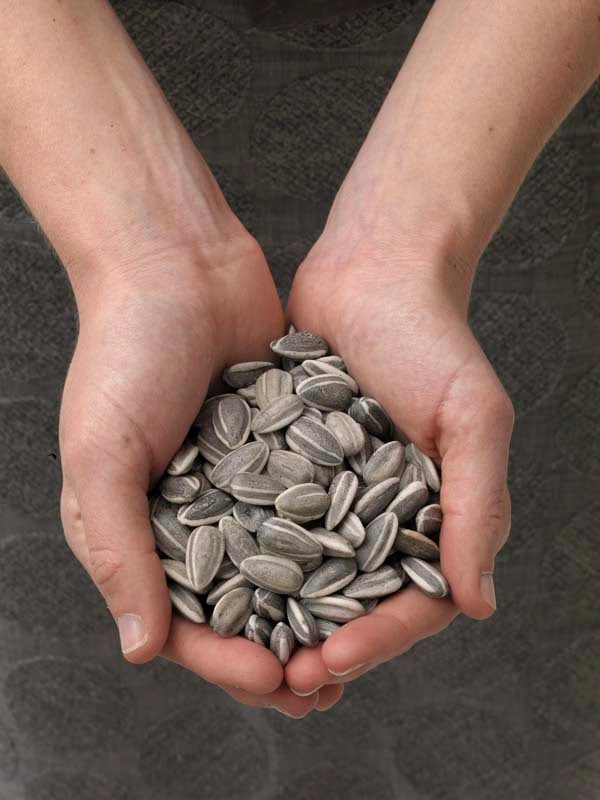
Ai Weiwei. Sunflower Seeds, 2010; porcelain, 500 kg. Courtesy of White Rabbit Gallery.
Bai Yiluo’s Spring and Autumn 1 (2007)  is juxtaposed with these paintings. A life-size tree with branches fashioned from old farming implements, with outstretched rakes, shovels, and pitchforks poignantly evoking the dependence on the seasons, the rhythms of nature, the times of planting and harvesting that dictate the lives of those who farm the land. One is also reminded of the obsession with rural agriculture of Mao’s revolutionaries: the ill-fated campaigns to eradicate the sparrows during the Great Leap Forward that caused enormous hunger and hardship; the rustication programs that sent urban “educated youth” to toil on communal farms and “learn from the peasants.” The work is very beautiful, and in its restrained use of weathered, rusted found objects, it is reminiscent of Ai Weiwei’s continued use of the “things” that evoke China, from ancient urns to three-legged stools and Qing Dynasty tables. Ai himself is represented by a pile of his porcelain sunflower seeds, that street snack shared among friends in hungry times in the past. These sunflower seeds have multiple meanings. They may be read as a comment on the ancient traditions of porcelain manufacture and its significance in trade with the West, or as a critique of mass production in China, “the world’s factory.” The realization that each seed, apparently identical, is actually different, reminds us of the weight of China’s population. The seeds also allude to Maoist iconography, which represented Mao as the sun, the Chinese people as sunflowers turning toward him. This is a subtle and clever acknowledgement of the tensions even today between individualism and collectivism.
Click HERE to read more