The ongoing thoughts of an art teacher in China - and home in Sydney

A continuing diary about my travels in China, and thoughts about China and Chinese art from home and abroad
Showing posts with label Cui Xiuwen. Show all posts

Sunday, May 17, 2015

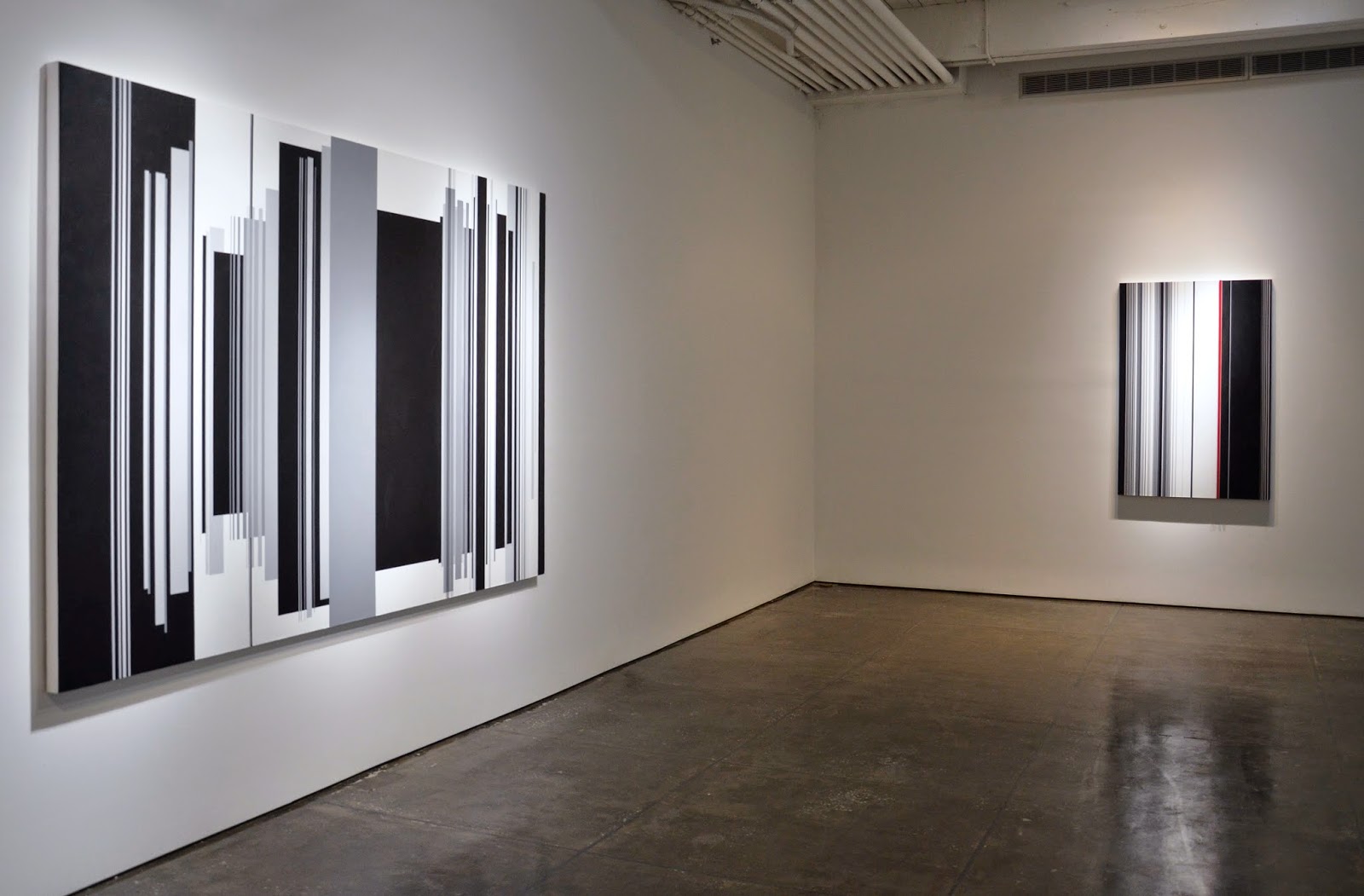
Physical to Metaphysical: Cui Xiuwen's Buddhist Formalism

Cui Xiuwen, Angel no. 3, 2006, photograph, image courtesy the artist
The artist whose video work prompted a notorious lawsuit, whose photomedia works explored the forbidden territory of sexuality and repressed memories of a different China, has reinvented herself as an abstract painter. Her show at Klein Sun Gallery in New York reveals the extent of this transformation.

Last December I met Cui Xiuwen in her Beijing studio for a long conversation about the dramatic shifts in her practice. At the risk of being accused of shameless self-promotion (OK, I plead guilty) she is one of the artists who features in my book about contemporary women artists in China. When I saw the images from her New York show this month, I replayed the tape of that interview, listening once more to the artist talk about her artistic metamorphosis, punctuated by the noise of barking dogs in the lane outside - an inevitable aural accompaniment in any visit to a Beijing studio.
The writer with Cui Xiuwen in Beijing, December 2014
I had particularly wanted to meet Cui, often described as one of very few feminist artists in China, because of her evocative photographic images of young girls in the forbidding surrounds of the Forbidden City - red walls, red scarves and a disturbing atmosphere of claustrophobic sexuality. I was even more intrigued when I realised that an early video work, 'Lady's Room', shot in the toilets of a swanky Beijing karaoke bar, where the 'hostesses' are not just selling their company and their singing, had caused the first lawsuit involving contemporary art in China. For details, you will have to read my book!
Cui Xiuwen, 'One Day in 2004', photograph, image courtesy the artist
From early notoriety as a painter of male nudes and fairly graphic depictions of sexuality (nudity is still, even now, somewhat taboo in China) to experimental video and photomedia works, Cui Xiuwen has charted the autobiographical territory familiar to many artists of her generation. Struggling to forge an identity in a country convulsed by change, trying to marry her experience of the collectivist past with the aspirational, individualist present, Cui like others turned to childhood memory for her image-making. Her crowds of sleepwalking girls in works such as 'Angel' represent a country that had been asleep, oblivious to repression and enforced conformity. Now, however, Cui has turned to a cool, minimalist abstraction - a visual language of line and shape that echoes the post-painterly formalism of the sixties and early seventies. She describes this transition as emerging from a renewed interest in Buddhism.
Cui Xiuwen, 'Awakening the Flesh', installation view, image courtesy Klein Sun Gallery
In recent years, she has become more interested in the spiritual, the ineffable; seeking ways to represent her experience of reading Buddhist texts. She has moved from the physical, to the psychological, to the spiritual and she uses the metaphor of climbing a staircase to describe this process. In doing so, she has found an abstract language that connects her with an interesting aspect of the Chinese artworld zeitgeist: a rediscovery of the possibilities of formal abstraction is an emerging trend there, just as it is internationally. Overwhelmingly, Chinese painting is figurative, with art schools training thousands of students every year to paint in the traditions of French and Soviet realism. Chinese-trained artists can paint like pretty much no-one else in the world today, and abstraction has not been a significant element in the contemporary art that emerged in the last 30 years. There are exceptions, of course, including Shanghai painters such as Ding Yi, or the young rising star, Li Shurui, who uses an airbrush to create almost psychedelic explosions of light and colour. There is a new interest in modernist and postmodernist abstraction, and many discussions of its possibilities in new media and sculpture, as well as in painting. Agnes Martin, Gerhard Richter, and even Barnett Newman are names that have emerged in my conversations with Chinese artists.

But there is another aspect to this new zeitgeist, or 'shidai jingshen'. In Beijing last December almost every conversation seemed to turn (unprompted by me) to Buddhism. Friends at dinner mused about the spiritual malaise they feel has infected Chinese society. Zhang Xiaotao told me his dearest hope for China was for a Buddhist renaissance. Feminist performance artist He Chengyao, returned from a year in a Tibetan monastery, spoke of her new practice creating abstract, meditative works on paper. Even the 'bad boys' of Beijing's East Village Artists' community have changed. The artists who shocked the artworld with their raw, masochistic performance works in the 1990s, featuring acts of self mutilation and abnegation, have turned to a newly reflective practice. Zhang Huan's 'Sydney Buddha' made of ash from the prayers burned in temples, and Yang Zhichao's beautiful 'Chinese Bible' installation at the Sherman Contemporary Art Foundation in Sydney both reflect elements of this transformation.
Cui Xiuwen, 'Reincarnation No.10, acrylic on canvas, 2014, image courtesy the artist
Works from Cui Xiuwen's 2014 abstract series are currently also showing at the 'Si Shang' Art Museum in Beijing, in  'Breaking the Image', an exhibition intended (somewhat didactically) to provoke discussion about how contemporary artists in China respond to international art discourses. Since the beginning of this century, access to global contemporary art is immediately available on the internet (albeit in virtual form) and many artists are also able to travel for residencies and study overseas. This has led to a revitalisation of previously marginalised forms such as abstract painting. Curator Libin Lu says, rather plaintively, "Many more artists have quietly explored this issue, looking for new possible forms of self-contained artistic language. Due to limiting factors as well as objective reasons from artists, this exhibition exhibits only a fraction of works by artists working within this vein." He hopes it is a continuing trend, and worries about the co-option of abstraction by the market since its emergence as a style in 2006: "But within less than ten years, we are grieved to discover that the majority of abstract art has become “decorative painting” or simply a “conceptual painting tool"

Cui Xiuwen arrived at her own spare visual language via a transitional series of photographs shot in bleak, snowy landscapes around her birthplace of Harbin, from which all the vivid colour of her early works has been removed, in a deliberate reference to the disciplined marks of  'Shan Shui' ink painting. The next phase was a move to pure abstraction. Cui Xiuwen speaks passionately of her desire to transcend the everyday, and to express profound truths in installations of painting that provide immersive experiences for the viewer. Despite the anxiety of the Si Shang curator she could not be accused of 'decorative painting'.
Cui Xiuwen, 'Reincarnation No.15, Varnished Aluminium and Acrylic on Canvas, 2014,
 image courtesy Klein Sun Gallery  

© Cui Xiuwen
So what do we see in Cui Xiuwen's new exhibition, 'Awakening of the Flesh' in New York? The title is provocatively paradoxical - any fleshly concerns here are so pared back as to be unrecognisable. All the elements of her typical iconography - the schoolgirls, iconic Chinese architecture, dolls and landscapes - have been stripped away. There is almost no colour. These new works, often created with aluminium and acrylic on canvas, are minimalist surfaces featuring repeated forms and lines. Cui is finding new ways to convey ideas about mysticism, meditation and a higher plane of consciousness. The works are severe, yet tranquil, and in paintings such as 'IU no. 4' there seem to be echoes of Malevich and the Russian Suprematists. Metallic, slightly brittle, they are the antithesis of her earlier lyrical, narrative photographic works.
Cui Xiuwen, 'IU No.3, Acrylic on Canvas, 2014, image courtesy Klein Sun Gallery  © Cui Xiuwen
Lit in the darkened space of the Chelsea gallery, they appear to glow. Is there more than surface beauty? 'Reincarnation No 9' suggests that the artist has one foot firmly on the ground, and although she may be operating in the rarefied plane of  'wu wei' she is still interested in responding to worldly concerns. Unlike the calm horizontal layers appearing in other works, this painting's variegated vertical bands remind us forcefully of a bar code. Intentional or not, it suggests the inevitable tensions and slippages between the desired state of elevated spiritual awakening, and the forceful imperatives of the flesh, especially those manifested in commerce and consumerist desire.

A full account of Cui Xiuwen's practice appears in 'Half the Sky: Conversations with Contemporary Women Artists in China', to be published by Piper Press in October.

Sunday, May 3, 2015

Writing Makes You Fat! 写作会让你更胖!

Gao Rong, Guangzhou Station (detail) copy handbag, embroidery thread, fabric and foam, dimensions variable,
 image courtesy the artist
I have discovered a sinister and hitherto little known (at least to me) connection between writing and obesity. As I enter the final dark days of editing, wrestling my unwieldy and intractable beast of a book into submission in the attempt to create a leaner, meaner version ready for print and publication by October, any pretence of a commitment to fitness and exercise has flown right out the window. Writing in the early mornings before work, in the late afternoons as soon as I get home, and late into the night, carving out chunks of time on weekends, and lying awake thinking about it in the middle of the night, whilst also continuing to worry about my students and take home vast piles of marking has taken its toll. By this point it has resulted in a state of physical torpor so marked that my gym has now stopped sending me those annoying emails that begin cheerily, 'Luise, we haven't seen you for x weeks!' Am I feeling guilty? Of course. There's a direct correlation between the length of my book and the size of my arse. And now, as my book gets leaner, I seem to be getting larger.

There should surely be websites dedicated to this - maybe useful K-Tel products could be advertised on weird late night TV channels. Perhaps a treadmill which you could operate whilst typing might be the go. I tell myself - every week - that this week will be different. I will walk each morning at sunrise, I will go to the gym, I will go to all those yoga classes I've paid for already. I will not eat chocolate (ha ha) and I will not drink wine (ba ha ha!) And my final vain resolution, every single week, is that I will do an hour of Chinese study every day. Sad to admit, none of this has happened. But there is light at the end of the rainbow and a silver lining at the end of the tunnel. (Which, come to think of it, could well be a Chinese maxim.) Each day is a new beginning and the East is red.....

There is also the fact that the solitary occupation of writing has to be balanced with all the competing demands of daily life. When I read all those stories of male writers who shut themselves away in their studies and emerged only for meals that had been cooked and served by women, I used to think, 'Those bastards!' Now, I think, 'Those lucky bastards...' I am looking for inspiration in other stories of women like PD James who rose before the sun every morning and completed a few hours of writing before going to her job as a senior civil servant. Or Mary Wesley, whose first book was published after she was 70. It did, after all, take me until I was 58 before I had that all important "room of one's own."

The book will, I suppose, eventually, be finished. Afterwards I will return to China, study Chinese each day while I am in Beijing, and embark on a project for a whole new adventure that begins at the end of September. I am looking forward to my encounters with artists such as Li Hongbo, Xu Zhen, Lu Xinjian and Wang Qingsong, and to broadening my field of research. I will travel to Chengdu to visit some artists' studios, and return to Hangzhou, where I was able to spend only one day with Wang Zhibo last December. My experience of China is so limited, and I want to see cities other than Beijing and Shanghai, wonderful though they are.
Lu Xinjian, City DNA Beijing, 2010, acrylic on canvas, 200 x 400 cm, image reproduced courtesy of White Rabbit Gallery
Many of the artists included in my book have recently shown new work in China and internationally, or are about to do so: Cao Fei at Hong Kong Art Basel and the Venice Biennale, He Chengyao and Tao Aimin at the International Expo in Milan, Cui Xiuwen's second solo show at Klein Sun Gallery in New York, and Liu Shiyuan at Whitespace in Beijing, just for starters. Yin Xiuzhen's 'City Suitcases' and the feminist 'Badges' that Lin Tianmiao explained to me when we met in 2013 are in an important exhibition, opening later this month, of works from the Gene and Brian Sherman Contemporary Asian Art Collection at the Art Gallery of New South Wales, 'Go East'. This promises to be intriguing. As Ai Weiwei said, 'Everything is art, everything is politics,' and with works from Dinh Q. Le, Alfredo and Isabel Aquilizan, Song Dong, Zhang Huan and Yang Fudong, among others, this will be an exhibition not to be missed, of works by artists who engage with the most significant issues of our time. So while I am sad to miss the exhibition of Xu Zhen and his Madein Company at the Long Museum in Shanghai (a visitor to his studio recently described it as 'like Andy Warhol's Factory, but with less sex and drugs') and I can only sigh over the impossible dream of getting to the Venice Biennale, I can at least console myself with the knowledge that Chinese contemporary art is now everywhere, and Sydney is no exception.
Lin Tianmiao 'Badges' 2009 white silk satin, coloured silk threads, gold embroidery, frames made of stainless steel, sound component: 4 speakers with amplifier, Dimensions variable, Image courtesy the Gene and Brian Sherman Collection and Sherman Contemporary Art Foundation Sydney, Photo: Galerie Lelong New York
 In the meantime, I am enjoying working with my students on their own writing about contemporary artists ranging from Ai Weiwei and Xu Bing to He Xiangyu, Ah Xian and Shen Shaomin. They continue to surprise me with their thoughtful interpretations and their interest in the ways in which contemporary artists can embed meaning into their choices of materials. Most recently they have been writing interpretations of Ai Weiwei's latest installations on Alcatraz Island, particularly 'Blossom', the installation of white porcelain flowers with which he has filled the tubs, toilets and washbasins of the abandoned psychiatric hospital wing. Now they can talk knowledgeably about Mao's cruelly deceptive 'Let 100 Flowers Bloom and 100 Schools of Thought Contend' policy of the 1950s, no mean feat for Australian kids who could not tell you anything at all about China and its history only one short year ago.

Even the little ones in Year 7 have done some writing about Cai Guo-Qiang's beautiful circle of animals around a waterhole, 'Heritage', and Year 8 are writing imaginary wall texts for an exhibition of Gao Rong's fake designer handbags embroidered with stains and filled with unlikely embroidered objects, ranging from a sausage to a giant oozing tube of toothpaste; from a packet of laundry powder to builders' tools. I will be intrigued to see what they make of this work, entitled 'Guangzhou Station' and shown at the Moscow Biennale in 2013.


Gao Rong, Guangzhou Station, (details) copy bags, embroidery thread, fabric and foam, dimensions variable, image courtesy the artist

'Half the Sky: Conversations with Contemporary Women Artists in China' will be published by Piper Press in October 2015. 

Tuesday, January 13, 2015

Ten Artists, Ten Conversations, Ten Stories

My most recent article for The Culture Trip introduces ten of the fascinating artists that I have interviewed for my book, "Half the Sky: Conversations with Contemporary Women Artists in China". Here are the first three.

Ten Contemporary Chinese Women Artists You Should Know

Chinese contemporary art is ‘the flavour of the month’ in the West, but there are fascinating stories as yet insufficiently told: the stories of contemporary women artists. The ten artists introduced here are members of a generation who grew to adulthood in the 1980s and 1990s. Born into a post-Mao China that was entirely and disconcertingly different from the world of their parents, they have been forced to adjust to a tsunami of change.

Bu Hua Beijing Babe Loves Freedom No 6, 2008, Giclee Print, Image courtesy the artist and White Rabbit Gallery

Bu Hua

Bu Hua was born in 1973, graduating from the Institute of Fine Art, Tsinghua University, Beijing, (formerly the Central Academy of Fine Art and Design) in 1995. In her strong imagery and flat, decorative backgrounds we can see a trace of the traditional woodblock prints of the revolutionary period, and also her love of Japanese art and design. Often described as a pioneer of digital animation in China, Bu Hua was one of the first to use animation software in an art context, creating surreal narratives about contemporary life. Her animations and still images often feature a feisty, sassy pigtailed child dressed in the uniform of the Young Pioneers, a Communist Party youth group. A clever combination of innocence and knowing, cuteness and cunning, playfulness and cynical parody, she swaggers through Bu Hua’s invented world. ‘I felt that this character is an actual person living in real life but [she] is really also an idealised version of myself. She knows this universe and the rules of this society like the back of her hand,’ says the artist. ‘Savage Growth’ employs her characteristically crisp graphic style to create an allegory of industrialisation, pollution and militarisation. Her heroine, armed only with a slingshot, takes aim at flocks of white birds which prove, on closer examination, to be military aircraft. Twisted trees grow out of pools of oil, and a row of sexy foxes (‘fox spirits’, in Chinese lore, are dangerous seductresses) sway backwards and forwards to a mechanical sound track like the rhythmic metallic noise of a factory assembly line. Bu Hua says, ‘people in China pay a lot of attention to the past and the future, but it’s really kind of forbidden to pay a lot of attention to what is happening now, in real life…I am showing what is happening in China at this exact moment, what is happening now.’

Cui Xiuwen, Existential Emptiness No. 3, 2009 C-Print, (85 x 450 cm) Courtesy Klein Sun Gallery, NY. © Cui Xiuwen

Cui Xiuwen

Cui Xiuwen’s 2002 ‘Lady’s Room’ caused the first lawsuit in Chinese contemporary art, when a professor in Guangzhou took exception to its frank documentation of prostitution in the ‘new’ China. With a hidden video camera in the bathroom of a swanky Beijing nightclub she recorded young hostesses changing their clothes, counting their money and arranging their next liaisons with their clients, exposing the seedy underbelly of China’s economic miracle. Born in 1970 near Harbin, Cui Xiuwen trained as a painter, graduating from the Central Academy of Fine Arts in 1995. In the mid-2000s Cui produced a body of work featuring young girls dressed as Young Pioneers and posed in the Forbidden City, dwarfed by claustrophobic walls and gates representing Chinese tradition. ‘Angel no. 3’ features the same girl, nightmarishly replicated as a crowd of adolescent clones, sleepwalking towards us with arms outstretched. The work evokes the deliberate erasure of bitter memories – a collective amnesia. ‘This is about my own life experience,’ Cui says. ‘I would wake up and see the sky filled with this huge grey cloud which made me feel as if there was no hope.’ Cui Xiuwen returned to the countryside near Harbin to shoot ‘Existential Emptiness’. Like misty ink and wash ‘shan shui’ scrolls the series depicts a living girl and a life-sized doll, a shadow version of the living girl, a puppet figure. The figures are tiny in the vast landscape, like solitary scholars in the mists of a literati painting.
Dong Yuan, Grandma’s House and Bosch’s Garden, installation view, oil on separate canvases, image courtesy the artist

Dong Yuan

Dong Yuan paints objects which represent cultural and personal memory with meticulous realism, creating installations of multiple separate canvases. Born near Dalian in 1984, Dong studied at the Central Academy of Fine Arts in Beijing. As a student, inspired by Western still life painting and Giorgio Morandi, she painted literally everything she owned. Small canvases depict her shoes, rolled up quilts, books, a rice cooker, a bath towel hanging on the back of a door, a teapot, even a box of tissues. ‘Home of Paintings’ and ‘Sketch of Family Belongings’ record, on 59 and 186 canvases respectively, the tiny apartments in which she lived as a student. ‘Grandma’s House and Bosch’s Garden’ consists of 855 canvases, a surreal juxtaposition of the fantasy world imagined by Hieronymus Bosch and the rural Chinese world of her grandmother. The gods of happiness, prosperity and longevity are juxtaposed with images of Mao and the stars of TV game shows. Furniture, teacups, textiles, traditional New Year hanging scrolls and everyday possessions intermingle. The humble courtyard house where Dong Yuan had been happy as a child would, inevitably, be demolished. Dong Yuan believes it is her duty and obligation to paint these memories, slowly and intensively completing one room at a time. The project took the artist more than two years. She describes the process as ‘fixing it in memory,’ - an elegy to a lost world. ‘It’s hard to know how many things have to disappear before people find their hearts settled down,’ says the artist.
To find out about the other 7 - click HERE

Wednesday, December 17, 2014

北京日记 Beijing Diary: Blue Skies and Buddhism in Beijing

Solitary Tai Ji Quan under a rare blue sky in Tuanjiehu Park\
I write this preparing to leave Beijing today, after a week so filled with studio visits, galleries, and interesting conversations with artists that it seems much longer. The skies have been miraculously blue every single day this week, which hardly seems possible in this city of "airpocalypse" - and without even an APEC conference of world leaders to explain it. The term "APEC Blue" entered the language last month, with phrases such as "He's not that into you, it's just an APEC blue" flying around the internet. In a city where the posh international schools have all erected air-filtered domes over their sports fields and playgrounds, I have loved walking around the city streets this week without a mask. For people like me who wear glasses, the addition of a mask often results in walking blindly into lamp posts with fogged up lenses obscuring the little vision that remains through the grey enshrouding fog.

Yesterday I spent almost two hours at Pekin Fine Arts talking with Zhang Xiaotao about his extraordinary, immersive and very beautiful video and 3-D animation works, which he showed at last year's Venice Biennale. A delightfully unpretentious interviewee, he spoke of his idealistic hopes that China could experience a Buddhist Renaissance, and return to its historical and spiritual roots, something he conveys to his students at the Sichuan Academy of Fine Arts where he is Director of the New Media Department. Unlike many other contemporary Chinese artists, who tend to dismiss out of hand the idea that they might be informed or influenced by the work of other artists, he spoke movingly of how much he admired his teacher and "master", Xu Bing, currently his PhD advisor. We talked about Xu Bing's work "Phoenix" (Huang Feng) which I recently saw in New York, and how the central element of Xu's work is the conceptual basis - in this case his admiration for the lowly, badly treated migrant workers on whose toil the modern cities and the wealth of China are built.
Zhang Xiaotao, Sakya, (still image) courtesy the artist and Pekin Fine Arts
Zhang told me that despite the massive technology and big teams of assistants working on his projects, it is the ideas behind the work that really matter. Joseph Beuys' notion of "social sculpture" lies somewhere behind his practice in new media and his earlier (and continuing) practice as a painter. He is something of a visionary, and a futurist. His work Sakya, (2010-2011) depicts most directly the struggle to retain spirituality and religious devotion within the context of China’s urbanised and consumerist present day. Based on an important Tibetan temple partially destroyed by the Red Guards during the Cultural Revolution, Sakya combines the imagery of video games, science and science fiction, Buddhist mandalas and thangka paintings and sutras. It is meditative and very beautiful.

With Zhang Xiaotao
 In China, despite all the hoopla of the art market, there is still a strong belief that art actually matters. In a world in which, increasingly, art is simply another branded luxury commodity, I so much enjoy the earnest sincerity with which Chinese artists speak about their practice. I also appreciate the sheer technical virtuosity of their work, whether it takes the form of painting, video, or sculpture. Look out for my full interview with Zhang in The Art Life in January. Liang Liang,in which he animated his little son's whimsical drawings to create a fabulous allegorical narrative in which China's past and present are interwoven, together with elements from video games, "Journey to the West" and cartoon monsters, is a wonderful thing. And the airport as a metaphor for hell - that I can relate to!
Tao Aimin, Photo Luise Guest
Another highlight of this visit was finally meeting an artist I have admired for a long time, Tao Aimin. Tao's "Book of Women" series uses the washboards traditional in rural China as sculptural found objects and also as "collagraph plates" to create prints and paintings, combined with characters from the ancient secret women's script 'Nushu'. This was one of the works that originally intrigued me and prompted me to begin this extended research project investigating the work of Chinese women artists. Originally from a farming family in rural Hunan Province, she spoke of living with her grandparents on their orchard, collecting eggs and feeding chickens. As was traditional, her grandparents made their own coffins, which stood in the house and became like big black pieces of furniture. Now, she says, they haunt her dreams. The first washboard was given to her by a 93-year-old woman with bound feet who became her landlady, and her friend. Now, she has more than one thousand, and has collected the stories, recorded on video, of the women to whom they belonged. Like many other Chinese women I speak to, she denies that she is a feminist, identifying feminism as a western thing of no relevance to Chinese culture. As for me, I think that if artists like Tao Aimin, Lin Tianmiao, Gao Rong and Yin Xiuzhen, to name a few, are not feminists then nobody is!

Tao Aimin, works from the Book of Women series, images courtesy the artist
Almost without exception, each artist I have spoken to this year has wanted to talk about Buddhism. From the painter Hu Qinwu whose abstract paintings are like Buddhist sutras,to Liu Zhuoquan and his worlds painted inside bottles and containers,  to Gao Ping who wanted to ask me what I thought about the comparison between Buddhism and Christianity, to Cui Xiuwen who has returned to a study of Buddhist belief to inform her new abstract video and digital works, to He Chengyao who came back to Beijing completely changed after a year in Tibet, each is preoccupied with seeking the spiritual dimension in their life and work.  It seems that like so many people in China today these artists (and so many others) are sensing a hollowness at the heart of the new Chinese society wrought by Deng Xiaoping's economic reforms after the death of Mao, and the embrace of a market economy. Whether there will be a "Buddhist renaissance" as Zhang Xiaotao wishes is another matter - the genie is perhaps too far out of the bottle.
Cui Xiuwen, Reincarnation, 2014, image courtesy the artist
An unexpected delight was the opportunity to see Huang Yong Ping's extraordinary "Thousand Armed Guanyin" at the Red Brick Art Museum. I had seen it before at the last Shanghai Biennale, but it was somehow more impressive in three sections in the almost deserted new museum on Beijing's outskirts, rather than the Shanghai Powerhouse of Art.


Now, on my way to Shanghai, here are some more of my random #onlyinChina observations:
  1. Best Chinglish shop name seen on this visit: A hairdresser in Tuanjiehu called "Moist Beauty" ("eeeew, gross!" as my students would say)
  2. Food mysteries: "Wang Pangzi Donkey Burger" chain restaurant - really? I have avoided the donkey pastrami sandwiches on past visits but there is something too sad about a donkey burger, illogical though that may be.
  3. I love watching the young girls riding their motorscooters in the Beijing winter - they often have hot pink furry ear-muffs, hot pink sheepskin or fur-lined gloves attached to their handlebars, and ingenious padded blankets that attach over the head and tie like an apron to cover the entire front of their bodies whilst riding. They look like pink armchairs with heads.
  4. Despite the fact that in my youth in Australia and England, everybody smoked everywhere, including on buses and in cinemas (and even as a young teacher I remember everyone having an ashtray on their desks) it is hard to get used to entering a cafe filled with cigarette, cigar and even (in the art district) pipe smoke. And I am always amused by the fact that ashtrays are conveniently positioned at squatting height in Chinese public toilets. But there is much to be said for a city where there IS a public toilet on practically every corner, a reminder of the recent past when people did not have their own bathrooms. Having navigated New York, where there are almost none, and developed the ability to walk confidently into restaurants and 5 star hotels purely in search of the conveniences, I think the Chinese pragmatism about all bodily functions is great. The spitting is still an issue, though!
  5.  I am always mystified when expats talk about the "rudeness" of the Chinese. In contrast, I am always struck anew by the helpfulness, friendliness and general cheerfulness of most people I encounter. I am always dropping gloves, leaving books on bus seats, forgetting to take my change and invariably someone comes running after me.I must admit I have seen arguments which have turned into half-hearted punch-ups over car accidents, but even these often seem more for the sake of it than seriously aggressive. (except the collision between a new Porsche and a three-wheeled cycle laden with recycling, witnessed outside the Central Academy of Fine Arts yesterday - now that was nasty!) You almost never see a child being shouted at or smacked. Children are doted on, most especially by their grandparents. The ballroom dancers in the park pose good-naturedly for my photographs, and the dancing grannies invite me to join them.

  6. And it's a rare huge metropolis where women can safely walk around in any streets, day or night, without fear or harrassment. As I navigated the pitch dark corridors of my Beijing apartment building (lights never work - in fact I ran into my own front door with my head, the darkness is so complete) I thought that in Sydney, or New York, or London I would have been incredibly fearful. The stairwells of Beijing apartments are "gritty" to say the least, but I have never had a single qualm. The streets are busy till late into the night, and girls walk freely, arm-in-arm, laughing. That is not to be diminished.
In Shanghai this week I will meet the sculptor Yu Ji, go the the opening of Fang Lu's new work at OCAT, and the Shanghai Biennale, and travel to Hangzhou to meet the painter Wang Zhibo. Watch this space!

Saturday, November 29, 2014

北京日记激活 Beijing Diary Reactivated

Zhou Hongbin, Utopia, image courtesy the artist and China Art Projects
I am getting myself organised to go to China in just over a week, my second trip this year. My last visit was in April, and Beijing was leafy and warm, mitigating the overall greyness of the city, which I must admit I have come to love. This time, in December, I am preparing for the cold. The last time I spent part of December in Beijing, back in 2012, I had never been quite so cold before in my soft Australian life.

I have a ridiculously big line-up of artists to meet, including Tao Aimin, Cui Xiuwen and Ma Qiusha, as well as photographer Zhou Hongbin, all of whom I have admired for a long time. Tao Aimin's work, 'Book of Women' resonates with the research I have been doing about the ancient secret women's script of 'Nushu'.
Tao Aimin, Book of Women

Cui Xiuwen's video work 'Lady's Room' was the cause of the first lawsuit in contemporary Chinese art. It shattered many taboos - about prostitution in the "new" China, about the boundaries between public and private space, and about notions of femininity and the expectations of "good" women. Her later works in video and digital media layer past and present, memory and dreams, in the way we have come to expect in Chinese contemporary art. 
Cui Xiuwen, One Day in 2004, image courtesy the artist and Klein Sun Gallery
Cui Xiuwen, San Jie, image courtesy the artist
Ma Qiusha is one of a number of performance artists I will be interviewing on this trip. The theme of bodily inscription, physical challenge, and various enactments upon and by the body is a powerful continuing thread in Chinese contemporary art, ever since the experimental days of the Beijing East Village artists in the late '80s and early '90s, and the iconoclastic performances of Zhang Huan and Ma Liuming. It's a kind of endurance which, although owing something of a debt to Beuys, and something more to Marina Abramovic, is peculiarly Chinese. Stoicism in the face of suffering - akin to "eating bitterness" perhaps. Ma Yanling told me about her interest in Ma Qiusha last year, when we were talking about her own "Nushu" performance pieces, in which she and her daughter wrote on each other's bodies in the ancient script. You can read my interview with her, 'A Secret Script: The Painting and Performance Work of Ma Yanling' on the Creative Asia website. (Click HERE for that article.)

She described seeing a performance in which a young artist spoke with razor blades in her mouth, interpreted by Yanling as a metaphor for the powerlessness of young women in the face of parental and societal pressures. This turned out to be a very significant work, From Pingyuanli No.4 to Tianqiaobeili No.4 (2007) "Ma Qiusha’s career was born through pain... the camera records her as she removes a bloody razor blade from her mouth after she finishes narrating her experiences." (Randian.) Art critic Iona Whittaker described her early work as possessing "a spiky intimacy paired with a girlish aspect (like a kitten with needle-like claws)" - a bizarrely intriguing description which makes me eager to find out how the artist herself thinks of her practice.

So, for accounts of my meetings with these artists, and many others, watch this space! 

I am returning to the part of Beijing where I feel most at home. In Tuanjiehu Park I look forward to new encounters with the dancing grannies, the water calligraphers, the choirs singing revolutionary songs, the ballroom dancers, erhu players, kite flyers, Tai Ji Quan practitioners and vigorous octogenarian exercisers. No time for more Chinese classes this time, so I shall have to bumble through as best I can with my broken and ungrammatical Mandarin, hoping that I don't make too many shocking faux pas and relying as always on the good nature of the Chinese. Beijing taxi drivers have been amongst my best language instructors to date, although they occasionally teach me swear words and then appear shocked and horrified if I repeat them.

From Beijing I go to Shanghai, again for meetings with artists including the wonderful painter Wang Zhibo in Hangzhou, where I wish I could stay longer. And for the Shanghai Biennale in the Power Station of Art, always a mixture of awe, astonishment and bemusement for a whole range of reasons.

So, amidst all the usual end of year stress, Christmas shopping and ticking of lists, I am checking the VPN to bypass that Great Firewall,emailing artists, figuring out how to use "wechat" instead of Facebook (it's great!), lining up translators and drivers, purchasing the obligatory antibiotics (because I seem to get sick every single time - that Beijing "airpocalypse" no doubt to blame) and - finally - packing the bags. 

北京我来了! Beijing here I come!