The ongoing thoughts of an art teacher in China - and home in Sydney

A continuing diary about my travels in China, and thoughts about China and Chinese art from home and abroad
Showing posts with label Guan Wei. Show all posts

Tuesday, February 21, 2023

Beyond the Ordinary: Guan Wei at Vermilion Art

Guan Wei, Apparition, 2023, acrylic on canvas, 10 panels, 180x254 cm. Image courtesy Vermilion Art

Out of the Ordinary is the title of Guan Wei’s solo exhibition at Sydney’s Vermilion Art, a description that also fits the man himself. From his early years in Beijing’s post-Cultural Revolution contemporary art scene, to his arrival in Hobart in 1989 and emergence as the most prominent of the so-called ‘post-Tiananmen’ generation of Chinese artists in Australia, Guan Wei developed an art practice that merges two worlds. His visual language as painter, ceramicist and sculptor juxtaposes Chinese traditional motifs with Australian colonial imagery, and with continuing references to the indigenous history that intrigued him from his earliest days in Tasmania. The result is a surreal parallel universe, a place of imagined, alternative histories.

Covering twelve years of the artist’s work, Out of the Ordinary is a collaboration between Guan Wei’s long-time gallery, Martin Browne Fine Art, and Vermilion Art, Sydney’s only commercial gallery specialising in contemporary Chinese art. It reveals distinct phases in his practice over that time, and a variety of influences ranging from his fascination with Australian beach culture to appropriations of the Chinoiserie that was so fashionable in Britain and Europe in the eighteenth and nineteenth centuries. Prevented from returning to his Beijing studio for three years due to Covid-19 border closures, Guan Wei’s recent work examines the global pandemic as a kind of spiritual malaise. We humans may need an extra-terrestrial intervention, he suggests, whether that be from angels or aliens.

Guan Wei once said that he likes to work in ‘the space between imagination and reality’: he is a storyteller, a myth-maker – an artist with a strong sense of social justice and moral conviction. His blend of real and imaginary histories creates a world in which his characteristically faceless, pale figures interact with silhouettes of animals and people that resemble paper-cuts. His paintings are populated by Indigenous Australian, European and Chinese characters who wander in exotic landscapes or sail across painted oceans. Described poetically by Alex Burchmore as ‘adrift in dense spaces of iconographic collision’[i], Guan Wei’s eclectic imagery suggests stories of empire, invasion, exploration, and migration  – and often evokes a contemporary political paranoia over ‘sovereign borders’. Together with his distinctive iconography of Chinese clouds, swirling waves, map coordinates, navigational charts, and astrological diagrams they create a floating world of ambiguous transnational narratives.

Guan Wei, Play on the Beach No.2, 2010, acrylic on canvas, diptych, 130x106 cm.
Image courtesy Vermilion Art

The earliest work in the exhibition, Play on the Beach 2, dates from 2010. Part of a series created on Guan Wei’s return from China in 2008, the diptych suggests the simple, hedonistic Australian pleasures of sun and surf, with curly Chinese clouds floating above a blue ocean. Yet there is a hint of something darker. In the foreground, an emu buries its head in the sand while a fleshy pink figure runs towards the ocean, arms outstretched and mouth agape. In the background, tiny figures appear at first glance to be frolicking happily in the ocean. On closer inspection, however, we wonder whether perhaps they are not waving, but drowning.

Notions of navigation – the crossing of oceans, the art of the cartographer, the study of constellations – are significant in Guan Wei’s work. The exhibition features paintings from two important series, Reflections and Time Tunnel, that were inspired by a residency in England. Guan visited stately homes and historical museums and became fascinated by the exploits of the British navy in the eighteenth century. He studied maps and historical engravings and was inspired by collections of textiles and porcelain with the Chinoiserie motifs so beloved of the period. Contrasting a Rousseau-esque ideal of a Utopia in the Pacific with the horrors of a brutal penal colony and the violence of the Frontier Wars, Guan Wei developed new imagery to re-imagine these histories. He reflects on the universal theme of the journey, on specific historical voyages, and on his own journeys of migration and return.

Guan Wei, Reflection 12, 2016, acrylic on canvas, triptych, 130x162 cm. Image courtesy Vermilion Art

When the series was first exhibited Guan Wei described them as ‘floating between true and false, dark and light’. Reflection 12 (2016), for example, depicts what at first seems a bucolic idyll. In the blue tones typical of export porcelain or toile textiles, enclosed in an ornate frame, the foreground shows the silhouette of a woman and child feeding chickens. Cows and sheep stand in a small stream that runs beneath a curved stone bridge. A silhouetted figure playing a pipe recalls Arcadian landscapes by Watteau. In the background, indigenous figures are strongly reminiscent of the paintings of early nineteenth-century Tasmanian artist John Glover, no doubt encountered during Guan Wei’s time in Hobart. Glover’s paintings of Aboriginal ceremonies ignored inconvenient truths, presenting instead  of dispossession and disease an imagined pastoral ideal of coexistence. In Reflection 12 the faint image of a sailing ship in the background, and the black silhouettes of an angel fighting a demon outside the framed landscape, allude to darker truths of our history. A four-panelled folding screen, Remarkable World 3 (2019) continues this interest in the intersections between colonial European, Chinese and indigenous histories, filtered through the artist’s imagination.

The most recent painting in Out of the Ordinary is The Apparition (2023), an ambitious ten-panelled contemporary version of a medieval altarpiece that distils Guan Wei’s response to the ruptures of the global pandemic. The lower five panels depict an ocean dotted with islands. The island peaks and swirling waves recall the mountain and water imagery of shan shui ink painting. Yet here, rather than lonely scholars or Immortals wandering in the mountains we see the biblical story of Noah’s Ark (with an abandoned panda looking on plaintively from the waves). Dinosaurs coexist with Chinese dragons and dolphins, and the sea is filled with capsizing boatloads of anguished human figures. Above, angels appropriated from Renaissance paintings appear to offer hope and salvation. Guan Wei says, ‘A terrifying flood submerged the world. People were struggling in the water. Noah's Ark appeared from afar and magical forces descended from the sky. Human beings who had been troubled by the pandemic for three years were, at long last, rescued. There is always hope.’ Yet, the tiny silhouettes of a submarine and hovering UFOs suggest that humanity is not out of the woods just yet. Guan Wei’s work always balances despair with hope, tragedy with humour, and the ordinary with the mystical.

Out of the Ordinary continues at Vermilion Art until 23 March 2023


[i] Alex Burchmore, ‘Guan Wei’s “Australerie” ceramics and the binary bind of identity politics’. Index Journal issue no. 4 https://index-journal.org/issues/identity/guan-wei-australerie-ceramics-and-the-binary-bind-of-identity-politics-by-alex-burchmore


Sunday, January 26, 2014

马年吉祥! The Year of the Horse

I know it's Australia Day, but I am pretending that I never saw those teenage girls dressed in flag-adorned costumes, or the many people sporting temporary Australian flag tattoos - it has all become way too creepy. And, frankly,dare I say it, "un-Australian". What happened to our famously laconic and cynical national character? So this post is ignoring January 26 in favour of the lunar calendar.The Year of the Horse approaches. In fact 2014 is the Year of the Wooden Horse, which is regarded, I discovered in a rapid scroll through a few Googled web pages, as a year of quick victories, unexpected adventures, and surprising romances. Those born in a horse year are supposed to be strong, courageous, independent, creative free spirits. Possibly, as a monkey year person, I am a little envious. Sydney is currently filled with red lanterns, many opportunities to eat noodles and dumplings, and a plethora of events in the lead-up to the enormous street parade in celebration of Chinese New Year. In addition to Mahjong, food, music and lion dances, art is also getting a look-in, thank goodness. 'Crossing Boundaries' is an exhibition of Asian Australian artists - some young emerging artists and some, such as Guan Wei and Lindy Lee, who are extremely well-known and celebrated. Curated by Catherine Croll of Cultural Partnerships Australia, and currently showing at Sydney Town Hall, the exhibition is an important part of Sydney's Lunar New Year celebrations. And, appropriately, many of the works are equine and celebratory in flavour.
Hu Ming, Wishes for Every Success in the Year of the Horse, 2013, oil on canvas
This is the third consecutive year that the exhibition has been held to coincide with New Year celebrations, and this time around it includes a number of the same artists as last year, as well as a host of new, previously unknown artists. Not every work in this highly eclectic show is great, but most are at the very least interesting, and the exhibition as a whole suggests evocative connections and parallels between works by very different artists. Croll says, "Artists participating in Crossing Boundaries have created new work that reflects upon individual journeys undertaken, boundaries crossed and new territories explored to provide a dynamic exhibition with strong celebratory flavour for the Year of the Horse."

Hu Ming, represented by two works quite unlike her usual repertoire of voluptuous revolutionary soldiers, is an interesting case study of a diasporic Chinese artist. In fact the artist herself spent 20 years of her life in the People's Liberation Army, from 1970 to 1990, eventually becoming a major. During this time she saw the last bitter years of the Cultural Revolution, the death of Mao, the 'opening up' under Deng Xiaoping and the tragedy of Tiananmen. She was given leave to study art and learned the painstaking hyper-realism of the traditional Chinese 'gongbi' style in Tianjin. She arrived in Australia in 1999 and now lives and works in Sydney, producing works that, albeit in a Pop idiom, are thoroughly immersed in traditional imagery and techniques.

Two panels of black paper, pitted with burned holes and marks, form "1000 Blacks & Myriad White', created  by Lindy Lee in collaboration with Elizabeth Chang. For both artists black has deeply ancestral connections to Taoist traditions and the principle of Yin/Yang. Yin, the black, represents earth, darkness and the interior. Yang, the white, represents heaven, lightness and the exterior. One cannot exist without the other. Lee has long been interested in ways of making the immaterial,the evanescent, take on a  material form. In these works she and Chang have created a powerful and mysterious diptych.
Somchai Charoen, Landmind, 2013, ceramic installation (detail)
At the entrance of the space is a floor installation by Thai ceramic artist Somchai Charoen. Deceptively pretty, his field of ceramic flowers, sitting lotus-like on the polished floor, conceal in their midst weapons of terror and destruction. 'Landmind' was created following his visit to the Landmine Museum in Siem Reap, Cambodia. "Landmines are one of the most horrific inventions," he says in his catalogue statement. "The consequences of war on the landscape inflict a trauma for people who travel through the land where an unknown terror lies beneath the surface. This remains decades after the conflict subsides. I am fascinated by how the regeneration of land works to conceal the mines as part of the natural landscape." Certainly his invitation to audiences to walk through the installation was not being eagerly embraced yesterday - the installation is a sobering reminder of the appalling consequences of war and conflict.

Tianli Zu has contributed one of her characteristic paper-cut works celebrating Nuwa, a powerful creation figure in Chinese mythology. Around 179-122 BCE in remote antiquity, so the story goes, the four pillars that supported the universe collapsed. The world became dark and chaotic. Nüwa tempered five-coloured stones to repair the heavens and held up the sky with four legs that she cut off a tortoise. According to the Chinese myth Shanhaijing (山海经), she created the horse before she created humans. Sometimes this artist works with video, however in this installation she has chosen to add evocative forest sounds which echo around the space, so realistic that they apparently caused maintenance men from the Town Hall to investigate whether an owl was trapped in the ceiling.
Tianli Zu,  Nuwa Created Horses on the Sixth Day, 2013, Chinese ink and tea, Hand cut cotton rag paper,
and sound composition
My 2013 interview with Tianli Zu, in which she revealed the ways in which her Cultural Revolution childhood continue to impact her work today, can be found  HERE: Tianli Zu: The Power of the Shadow

Tianli Zu,  Nuwa Created Horses on the Sixth Day (detail), 2013, Chinese ink and tea, Hand cut cotton rag paper,
and sound composition
Other interesting works included Ahn Wells and Linda Wilson's 'Ten Thousand Horses' which consists of 60  rosewood tiles with wax painted symbols referencing the power of the horse moving en masse in Chinese military history, as well as shamanism and Ahn's Korean heritage.
Ahn Wells and Linda Wilson, Ten Thousand Horses, 2013, Rosewood and Wax installation
 Guan Wei's panels from his recent dark series of constellations, 'Twinkling Galaxies' are beautiful, of course. In my conversation with him at his Beijing studio in November he reflected on the contrast he sees between Australia and China, now that he divides his time more or less equally between Sydney and Beijing. http://theartlife.com.au/2013/floating-worlds-a-conversation-with-guan-wei/  

And I did enjoy a work made entirely of used teabags. Born in Indonesia, Jayanto Damanik now lives and works in Sydney and has recently returned from a residency at Redgate Gallery in Beijing. He has been collecting teabags since 1997, seeing them as a memory of family, a reminder of ceremonies and as an offering for the dead. Tea has both mundane and spiritual connotations, and is both deeply personal and cultural. He said, "My current project is focused on the psychology of family and home... I collected my tea bags from family and friends and each tea bag contains a memory... every teabag tells a story of daily life’s grievances and joys."
Jayanto Damanik, Conversations, 2013, used teabags, Chinese paper, glue

In amongst the dragon boat races, night noodle markets and (I hope) a revival of the wonderfully funny Pandas on bicycles (panda costumes, OK, no animal cruelty!) in the Lunar New Year Parade, you should definitely make the time to walk round the side of the Town Hall and see what a very diverse range of Asian artists who now "call Australia home" - and Australian artists with links to Asian cultures - are doing. And on Australia Day, when increasingly there is way too much flag waving and scarily mindless jingoism, it's a salutary reminder that this nation is all the richer and more interesting due to the contributions of people who have arrived here from all corners of the globe.

Tuesday, November 26, 2013

北京日记 Beijing Diary: the floating world of Guan Wei

I have long been fascinated by that group of Chinese contemporary artists who dispersed after 1989 and found themselves working (and sometimes also driving taxis, washing dishes in restaurants, or drawing tourist portraits around Sydney Harbour or Manhattan) in places far, far from home. Xu Bing in New York, Huang Yong Ping in Paris, and of course, Guan Wei, Jin Sha, Ah Xian, Shen Jiawei and many others in Sydney. A new diaspora. Many have since returned to China, either full or part time, and some, like Xu Bing, now occupy elevated positions in academia or the museum world here in Beijing. 

Thus it was that on a cold, windy day recently I found myself waiting for Guan Wei in the surreal environment of the big outlet malls on Beijing's outskirts, which look more Rodeo Drive than Chang'An Avenue. When he pulled up beside me he assured me he has never been inside them - and the idea of him shopping among the fake designer brands and factory seconds of Burberry and Louis Vuitton (or perhaps Burberrk - yes I have really seen this one - or Louis Vuillon) is a little hard to imagine. He is a larger than life figure with an infectious laugh and an engaging turn of phrase. I was intrigued to find out more about his life now, as he moves between his Sydney and Beijing studios. He told me he prefers Beijing in the winter as Sydney summer heat is too much for him.
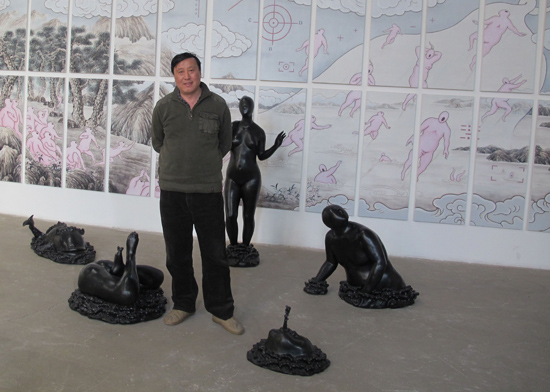
With Guan Wei in his Beijing studio, November 2013

What follows is an account of my interview with him, published in 'The Art Life' today.

Guan Wei is a story-teller, a myth-maker and a social commentator. He is also a fabulist who blends real and imaginary histories, both Chinese and Western, in order to create a parallel universe, a floating world which invites us to question our cultural certainties. He has said that he likes to work in the space between imagination and reality, and his work is deeply personal, reflecting his unique experience of the world, and of a hybrid identity, moving between cultures. He is perhaps the most significant artist currently working between Australia and China, showing regularly in Sydney, Melbourne, and Adelaide as well as Beijing, Suzhou and Shenzhen. His characteristic imagery of pink fleshy faceless people, Chinese clouds and swirling seas, mythological beasts and disembodied Buddha hands is well known and distinctive. However, he is not an artist who stands still, nor is he content to merely repeat what has brought him success, as I found when I visited him this month in his Beijing studio.
Image 6 Guan Wei in his studio
Guan Wei in his studio, photograph Luise Guest.
Guan Wei has had the same small studio in Sydney’s Newtown since 1994, but in China artists know there is no certainty in any rented space. Studios are summarily demolished with little notice and no opportunity for negotiation, to make way for new developments. His current large, airy Beijing space, ironically located close to the vast outlet malls filled with the real and fake big-name brands beloved of Chinese shoppers (where he assures me he has never been) is his third studio since his return to China in 2008. Filled with paintings and sculptures from different phases of his life, it is also now the space where he is experimenting with ink painting, screen printing, lithography, and painting on ceramics created with artisans in the famous porcelain centre of Jingdezhen. It is also home to his collection of sketchbooks, filled with intricate drawings and plans for works – paintings, sculptures and the designs he intends to paint onto the new ceramic works. The tiny drawings in these books, delicate and deft in execution, are like storyboards for a film. In some ways his work is cinematic – narrative, often epic in scale, and featuring multiple overlapping plotlines. Guan Wei’s sense of humour, as well as his keen awareness of both Chinese traditional practices and the contemporary artworld underpins his practice. His work is deeply moral, frequently dealing with injustice and repression; yet also calmly reflective, and highly attuned to a sense of the ridiculous. There is a disarming lightness of touch which actually lends greater weight to the seriousness of his purpose.
Image 1
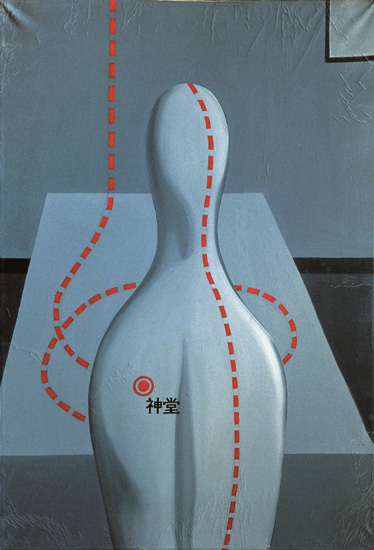
Guan Wei, Acupuncture point - Temple, 1985, oil on canvas, 60 x 75cm. Image courtesy the artist.
His story as a member of that group of artists who made Sydney their refuge after the events of 1989 is well known in Australia. This diasporic personal history plays out in all his work, with its focus on issues of migration, and imagery relating to the journeys of both the colonisers and the dispossessed. It is often assumed that he came to Australia as a direct result of the student uprisings and their culmination at Tiananmen Square in June of 1989. In fact, he arrived in January of that year with artist friends Ah Xian and Lin Chunyan as a result of a chance meeting with Professor Geoff Parr to take up a 2-month residency at the University of Hobart’s Tasmanian School of Art. During that time, he tells me, he completed thirty three paintings in his ‘Acupuncture’ series, working in his early style of grey, black and red with overtly political themes. He realised that Australian audiences, despite their unfamiliarity with contemporary Chinese art at this time, were able to understand his intended meanings and the political concerns about the lack of human rights and democratic freedoms in China that he expressed in these works.
Returning to China in April of that year, despite the concern of his Australian friends, he discovered what was happening with the student pro-democracy demonstrations in Beijing. These events and the resulting repression of artists, writers and intellectuals, made him reconsider his position. He says it made him feel “very badly and sadly about the situation in China, (with) so many intellectuals and students leaving.” In August 1990 Guan Wei returned to Hobart, having been given strong support by numerous individuals including Professor Geoff Parr and Bernice Murphy, at that time Deputy Director of the Museum of Contemporary Art, and by the Australian Government. Later, after a year in Hobart, came residences at the Museum of Contemporary Art in Sydney, the Canberra School of Art at the Australian National University, and then his productive relationship with Sherman Galleries in Sydney. I wonder aloud what it must have been like for an artist from Beijing to find himself in Hobart, of all places, at the start of the 90s. He laughs and says, “I got two culture shocks. When I arrived in Hobart I got a culture shock; it was so beautiful but so very quiet. After five pm nobody on the streets! When I go back to China after four years (to visit) I got another culture shock because of the pollution. So dirty, even in daytime you could not look clearly. (So) when I went back to Australia I changed my subject. For a couple of years I did a lot (of paintings) about the environment.”
At this time he began to use maps in his work, initially with the idea of creating maps of the apocalypse, and later as a way of exploring ideas about colonisation and nationalism. It was at this time, also, that he began to introduce scientific and biomedical elements into his work, with the ‘Test Tube Babies’ series. Later, he says, “I did a lot of Australian political stories, like refugee and migration stories – mixing indigenous stories and colonisation.” “Are you also thinking of your own journey, and more generally the diasporic experiences of so many Chinese artists in these works?” I ask. “Yes, of course!” he says. Guan Wei points out, though, that he feels a responsibility, living in Australia, to tell Australian stories in his work. “I am different to other Chinese artists living in Australia. My many Chinese artist friends, like Shen Jiawei, are doing Chinese histories, but I am doing Australian histories. If you live in Australia you must serve Australian audiences; that is my opinion. That is why I am interested in Australian history, Australian politics and culture. I did a big show at the Powerhouse Museum called ‘Other Histories’ [2006 ‘Guan Wei’s Fable for a Contemporary World’ was his first foray into large scale mural painting] about the Chinese discovering Australia. It’s maybe not true!” “A parallel ‘Guan Wei’ universe?” I suggest. “Yes!” he says.
His ambitious wall mural, ‘The Journey to Australia’, commissioned for the new entrance to Sydney’s Museum of Contemporary Art reveals his continuing interest in themes of diaspora and migration. The painting, which shows a fleet of boats heading towards Australian shores, is a pointed reference to the continuing debates about immigration and, in particular, about boat arrivals. He has in the past described his work as a kind of “bearing witness” to these themes. As with other, earlier, paintings, he is interested in layering indigenous history, colonisation, Chinese history and recent political discourses about refugees and border protection. With his distinctive iconography of lyrical floating clouds, map coordinates, and meteorological patterns; and references as diverse as Chinese astrology, necromancy, traditional medicine and 21st century science, he is able to create works which cleverly comment on contemporary paranoia, yet also reflect the universal themes of journeying, so prevalent in ancient Chinese texts, and literati paintings of wandering scholars in misty landscapes of clouds and mountains.
Image 2 A
Image 2 B
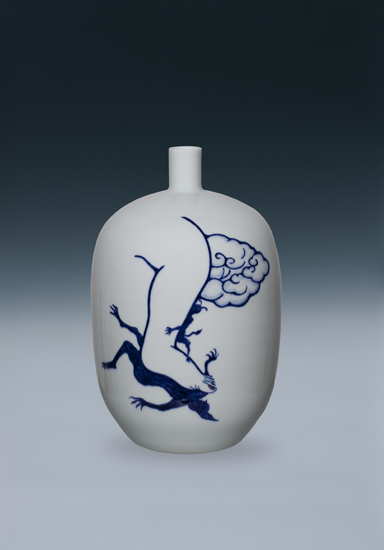
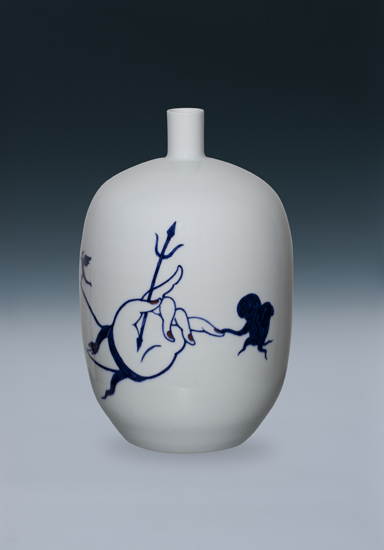
Guan Wei, Subdued Demons vase, 2012. Ceramic, H37cm x Dia20cm. Image courtesy the artist
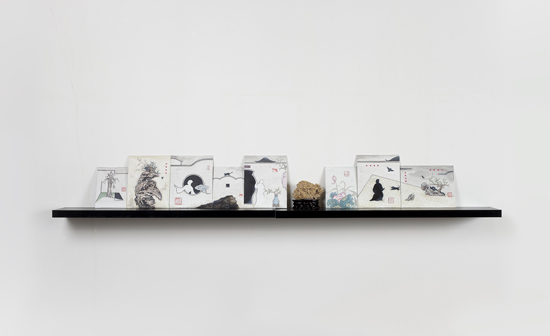
A recent exhibition in Suzhou, Enigma Space, at No. 8 Gallery in Suzhou Industrial Park, represents a new direction in his practice. Small installations of acrylic paintings on boards include found objects such as rocks, bonsai trees and tea, arranged horizontally on narrow shelves. Referencing the Chinese classical design of the garden as a refuge, a spiritual space for contemplating nature in its most perfect form, these works extend his particular visual language in a more overtly narrative manner. Guan Wei has always worked in series, and the paintings move beyond that convention to create tiny landscape vistas which evoke the experience of reading a Chinese scroll. In the catalogue for this exhibition he says, “In our daily lives gardens provide us refuge and spiritual comfort. They are a wonderland within the physical world.” Like many other contemporary Chinese artists, it seems, Guan Wei is reconsidering the traditions of literati painting and the mastery of representing idealised version of nature with ink and brush. In the chaos and confusion of the contemporary world, the artist is continuing to work with deeply felt ideas about the environment, and about the relationship between man and nature.
Image 3
Guan Wei, Enigma Place No.1, 2013. Acrylic on board & rock?30 x 200 cm, 8 panels. Image courtesy the artist
Since 1994 Guan Wei has visited China regularly, making the significant decision to set up a studio in Beijing in 2008. “Why return?” I ask. He gives his characteristic laugh and says, “So many reasons.” Firstly, he tells me, the decision was prompted by the transition of Sherman Galleries to its new incarnation as the Sherman Contemporary Art Foundation and the fact that he was thus no longer represented (at that time) by a Sydney gallery. Secondly, he was invited to produce works for the cultural component of the Beijing Olympics. Thirdly, he says, “Since 2002, each year when I come back to visit family and friends I see big changes; big art communities; many of my artist friends have big studios. I feel very excited! And many of my Chinese artist friends were already back in China.” And, finally, and perhaps most importantly, he wanted to bring his young daughter back to China, to learn about her Chinese culture and background. And of course, he adds, in Beijing it is easy for him to communicate with colleagues, technicians, fabricators and galleries; he has access to spaces, assistants and materials that would be impossible, or impossibly expensive, in Sydney. This has allowed him to explore new possibilities – the bronzes, the ceramics, the current installation of shelf works in Suzhou, that city of beautiful gardens.
Image 5 Ocean
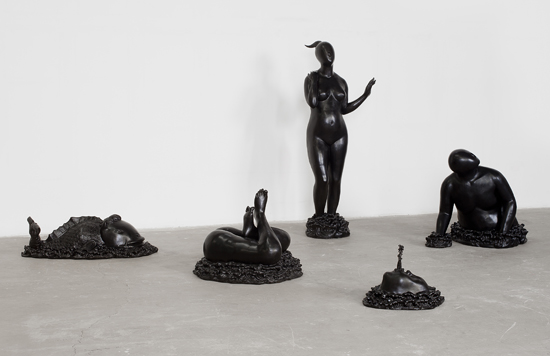
Guan Wei, Ocean, bronze sculpture, 2013. Image courtesy the artist
For his 2013 show at Martin Browne Fine Art, he completed the paintings in Sydney but the bronze sculptures, large and small, were made in China. The complexities and logistics of this kind of global practice are not to be underestimated. In these works too, the complex layering of Chinese and Western references are clear. The solid weighty forms remind me of the female figures of the 19th century sculptor Aristide Maillol, yet their heaviness is belied by the fact that they are frolicking in water, like the pink figures in his paintings which reference the joyful hedonism of Australian beach culture. The stylised water in these bronze works is a reference to the lotus seat of the Tathagata Buddha. The body in water, unencumbered by its own weight, is able to enter a state of complete liberty. His paintings in this show reinforced the palpable awareness of Australia as an island continent, of a place with edges, and permeable borders. Figures cluster on shorelines, or traverse oceans and seas in tiny boats. The series ‘Twinkling Galaxies’ with its emphasis on constellations and heavenly bodies in the endless darkness of the night sky, reveals the sense of place and the careful observation of particular locations that is so evident in his work, as well as his interest in mythology and science. And, as he said to me with a laugh, he always gets a shock when he returns from Sydney to Beijing and realises that he cannot see any stars through the haze of pollution.
At the end of our conversation he is most animated when he shows me the samples of his ceramics from Jingdezhen. It will be too cold during the Chinese winter to go there to continue the project, he says, so he is impatiently waiting for the moment when he can return to work with the porcelain craftsmen and apply his lyrical human figures, demons and mythological creatures to the seductive curved surfaces of the vessels and bowls. Guan Wei is an artist who never stands still. Just as he continues his regular journeying between Beijing and Sydney, so too his work continues to evolve

Monday, November 18, 2013

北京日记 Beijing Diary: Food, Learning Chinese, People - and Art


As I come to the final weeks of my residency I have been savouring some of my favourite Beijing moments. And they're not all food-related, but I have to say that food has figured largely in the fascination of my time here in China. That includes those foods which are immediately appealing and wonderful, and those which I am adding to my list of things to avoid. Joining the donkey pastrami and the boiled goats' feet of Xi'an I can now add the grilled duck tongues of Chengdu. The visual richness of street vendors of all kinds is a feature of any walk in Beijing, and the foods on offer have changed as the weather has grown colder - grilled corn, chestnuts and walnuts, congee and pancakes and baozi, sweet potato and cakes. Beijingers love their 'Xiao Chi' (literally, little food, i.e snacks)


So here's a list of other things I have enjoyed seeing and experiencing of late

  • I am amused and impressed by the fur-lined sleeves that have appeared on bikes and motorbikes - very necessary and so ingenious!

  • The tiny mandarins in the markets with their leaves attached - so cheap and so sweet - as well as pineapples and other strangely tropical fruits in this cold climate

  • Pomegranate juice from the street stalls

  • The woman who takes her microphone and amplifier into the park each afternoon and sings opera and Chinese folk songs in a pavilion beside the lake

  • The people both young and old who practise their saxophones, flutes and clarinets seated on benches in the park
  • Tiny children bundled into so many layers that they are completely spherical
  • The massive army greatcoats and hats with fur earflaps worn by men collecting recycling
  • The way that people love to gather in groups and add their opinion to whatever is happening, whether that's a car accident, a mahjong game, a dispute over the price of vegetables, or the technique of the water calligraphers and dancers in the park


Among many possible candidates for a favourite English shop name, my current favourite is definitely "Bing Bing Decently", a small emporium selling 'scholar rocks' and ornately carved pieces of timber and "jade" (I suspect definitely of the inverted commas variety) in the Chaoyang Cultural Market. But there is also this one, which definitely falls into the WTF category:


  • The frustration but also the joy of starting to be able to read Chinese characters continues - I forget as many as I learn, but it is a revelation to me in gaining a greater understanding of the people, culture and history. And Chinese characters are just so beautiful, even in subway signs or scrawled graffiti. I often trip over steps and walk into posts as I am so occupied in staring at billboards and street signs and trying to work out what they say.

I have been meeting so many interesting artists, including Guan Wei and Lin Jingjing, and continuing my series of interviews. As this research continues I've had many conversations with these artists, with my interpreters, with curators and with friends both western and Chinese about ideas relating to gender in China right now. It is often at the forefront of public discourse, and certainly forms a subtext to much policy debate and media angst. 


With artist Bu Hua in her studio, October 21
Lin Jingjing in her studio, November 14
With Guan Wei in his studio, November 11

Here are my first thoughts about this, in relation to three of the eighteen artists I have spoken with to this point. The article, 'Material Girls, Super Starlets, and Girls with Swagger'  was published in The Artlife last week, and this is an extract:


Late Autumn in Beijing alternates glorious blue sky days with others on which the pollution levels soar into the ‘alarming’ zone and people with masks covering their faces are glimpsed through mist and fog on grey streets under grey clouds. The schizophrenic weather conditions mirror something of the paradoxical nature of contemporary China. On one street you see old men in Mao suits playing mah-jongg on the corner, while in the next you are as likely to find a Lamborghini showroom as a snack cart selling dumplings. These paradoxes extend into the art world too. The pace of change in China has been so swift and dislocating that each new generation of artists essentially inhabits a different country, with different experiences, ideas and beliefs. On every construction site billboards loudly proclaim: “This is my Chinese Dream.” This dream, and what it might entail for different generations in China – and what that might imply for the rest of the world - is definitely contested territory.
I have been fascinated to discover these generational dissonances as I have met with artists during a two-month stay in Beijing. My particular project has been to interview female artists. Just as the social forces in China have swept away old certainties, so too have ideas about gender and the roles of women been changing, albeit in ways quite different from what one might expect.
Recently this has come to the forefront of public discourse, as the term “sheng nu” (“left-over women” - defined as single women over the age of 27) has gained increasing traction in the media. The following delightful piece was published on the website of China’s state feminist agency, the All-China Women’s Federation:
“Pretty girls don’t need a lot of education to marry into a rich and powerful family, but girls with an average or ugly appearance will find it difficult. These kinds of girls hope to further their education in order to increase their competitiveness. The tragedy is, they don’t realize that as women age, they are worth less and less, so by the time they get their M.A. or Ph.D., they are already old, like yellowed pearls.”
Despite the gender imbalance created by the One Child Policy and a preference for boys resulting in an over-abundance of men seeking wives, it seems that contemporary Chinese culture punishes women for being over-educated, over-ambitious and financially independent.
In street fashion, advertising, and, yes, even in the hallowed space of art galleries, I have been observing a kind of hyper-femininity. Representations of the feminine in some of the less illustrious galleries in the 798 Art Zone range from imperial maidens and concubines, reflecting nostalgia for a patriarchal past and its certainties, to fibreglass stilettos covered in spikes, an indication of current anxieties. Young men are nervous. They feel enormous pressure to be rich enough, and successful enough, to attract girls and find a wife. The famous quote from a TV dating show, from a young woman who said she would rather weep in the back of a BMW than laugh on a bicycle, is cited often as evidence of women’s materialism.
1. Travel Alone 60+50cm oil on canvas 2007
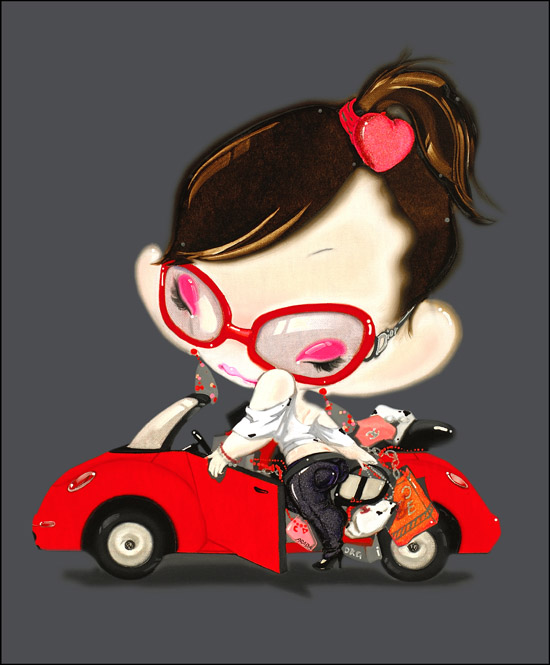
Han Yajuan, Travel Alone, 2007. Oil on canvas image courtesy the artist.
To find out more, I spoke with three artists who explore some of these ideas in their work.
I met Han Yajuan in her bright apartment and studio in the new area of Wangjing, where she looks down over block after block of high-rise apartments and sweeping expressways, a view she describes as “depressing”. Her work has been seen recently in Australia in the ‘Go Figure’ exhibition, curated by Claire Roberts from Uli Sigg’s collection at the National Portrait Gallery, and in ‘Far East Duet’ at the ACAF Project Space in Melbourne. She is represented in New York by Eli Klein Fine Art.
Born in 1980 in Qingdao, Shandong Province, and earning her MFA from the Central Academy of Fine Arts in Beijing, she is sometimes described as an artist whose works embody the collective unconscious of her generation, which seems rather a heavy burden. Her paintings reveal her interest in Japanese design and animation, as well as fashion, and reflect the culture of ‘cuteness’ (in Chinese, “Ke’ai”) prevalent in contemporary pop culture. In China, young (and even not so young) women are expected to behave in ways which are winsome, even child-like. ‘Travel Alone’ depicts a cute, big-headed, bling-adorned cartoon girl climbing into her red sports car wearing Dior glasses. She carries bags labelled Prada and Chanel. Fake or real, they reflect the current obsession with designer brands as symbols of wealth and success. Han Yajuan reveals the current anxiety about the lives of young women, the ‘material girls’ who want it all, and want it now. ‘Fashion Week’ represents the frantic busy-ness, but also the emptiness, of this world. In response to my suggestion that her paintings are a critique of contemporary life and materialism, she says, “I was just trying to present what I see…what exists. Twenty years ago a bicycle was a luxury, but things change. There is so much pressure; the speed (of life) is so fast. I am trying to present my point of view and also to give people an opportunity to see their own lives.” Her generation have not experienced the hardships of the past, and are experiencing the loneliness, as well as the material comforts, of an entirely different kind of society.
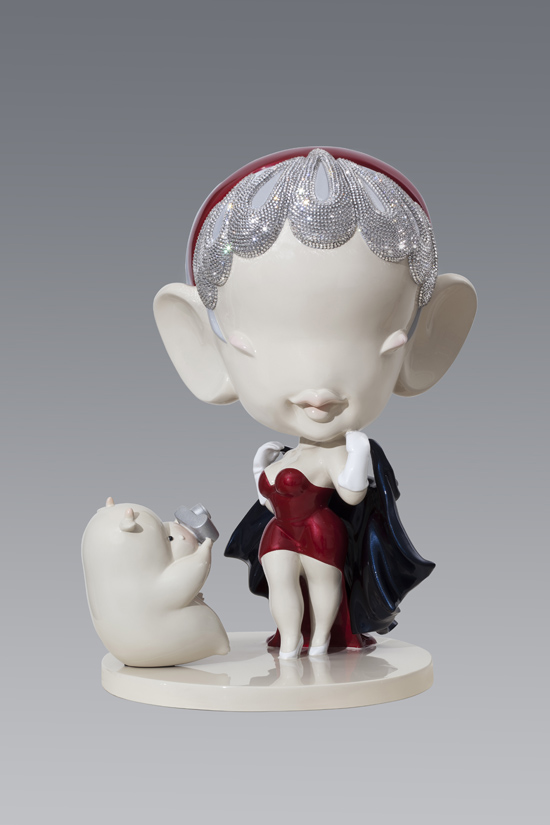
In sculptural works such as ‘Super Starlet 6’ the cloying cuteness is undercut by a disturbing sense of identity crisis – these are essentially faceless beings, literally from the assembly line. Looking at these works before I met the artist, I wondered what she intends to communicate about the lives of Chinese women today. Are the creatures she represents victims of new social pressures, or are they empowered and materially successful beings? Is it celebration, or criticism? The answer, as is so often the case in China, is equivocal. Han Yajuan’s female figures are, and also are not, self-portraits. She is a participant in, as well as an intelligent observer of, the culture in which she finds herself. Self-possessed and confident, with her deep voice and disarmingly infectious laugh, she is fully aware of the dark side of the glamorous world she depicts: a world of corruption and karaoke bars; mistresses and designer handbags. But she is pragmatic. “From a very primitive perspective,” she says, “it relates to the uncertainties of life – we should pursue the things that make us happy. It’s personal. It’s about what makes me happy. There is a part of me in all those figures.”
2. Super Sterlet 6 out of 6
Han Yajuan, Super Starlet 6, 2011. Color paint on tin bronze, crystals, 45 x 36 x 40 cms. Image courtesy the artist
“I am from the eighties generation”, she says, identifying the strictures of the Chinese education system as well as the Japanese cartoons she loved as a child as key influences on her thinking. “My early works are about individualism and uncertainty. Later I changed my perspective to stand on a higher point and look down upon a whole complex and contradictory world.” When she began to create these elaborate multi-dimensional compositions, she was initially filled with self-doubt and uncertainty. Working towards a solo show in New York next April, she says, “I am trying to connect doubt and uncertainty with very concrete things. You can see the materialism, you can see the fashion, but this is just recognition. I know why I am doing this. I know what I try to achieve. It is for people who maybe don’t have the time to see this, to look at these things.”
Rather surprisingly, given their apparent celebration of consumerism, Han sees her practice as relating to Zen philosophy and to Qing Dynasty paintings in which multiple perspectives depict a whole universe, both microcosm and macrocosm. We discuss the famous scroll representing an entire town in which every person depicted is doing something different. In ‘Perfect Ending’, a parallel universe of tiny cubicles is filled with girls and consumer products - espresso machines, laptops, mobile phones, shoes and handbags. They strike me as extremely sad. A tiny world appears about to implode under its own pressure. “This is still a male-dominated society,” she says, in response to my query about whether it is more difficult for female artists in China. “But I’m a human being first, then a woman, then an artist.” And, she adds, if you just keep on doing good work, people will have to take notice.
3. Perfect Ending 360+180cm 2010
Han Yajuan, Perfect Ending, Oil on canvas. Image courtesy the artist
Bu Hua was born in 1973, graduating from the Institute of Fine Art, Tsinghua University, Beijing, (formerly the Central Academy of Fine Art and Design) in 1995. Coming from a family of artists, with a father who was a distinguished printmaker, she “learned the language of lines” at an early age. Her work is represented in the collection of the White Rabbit Gallery in Sydney.
Bu Hua is best known as one of the pioneers of digital animation in China, discovering the expressive possibilities of Flash software and its potential to convey emotional truths about contemporary life in an immediately engaging and dynamic way. During our conversation she tells me about an artist whose name she cannot remember, discovered in the late 90s at Kassel Documenta, who created wonderful, complex, highly political animations with charcoal drawing. “William Kentridge?” I ask. “Yes, yes, yes!” she exclaims. Seeing his work in Germany was the impetus that made her want to combine drawing, painting and animation. In recent years she has developed a character, a key protagonist in both video and still images, who is based on herself as a child - a defiantly feisty but definitely cute Young Pioneer. She bravely navigates the surreal landscape of the 'new' China, encountering strange beasts, mystical forests, hideous pollution and rapacious developers, somehow emerging victorious. She is a girl with 'swagger', according to Bu Hua, and a more confident version of the artist herself - a fearless alter ego. In ‘Savage Growth’ she wanted to express this anxiety and fuse western and eastern traditions of art and design. “In modern China, how could you not be influenced by this fusion of West and East, this cultural invasion and ‘soft power’? I am just reflecting this reality,” she says.
attachment
Bu Hua, The Water is deep here in Beijing I (2010). Image courtesy the artist.
The girl who skips and jumps through her animations, woodblock prints, paintings and digital images is based on the artist's memory of herself as a schoolgirl in Beijing in a simpler era. She thinks about herself cycling to school at a time before the recent explosion of wealth and development with a certain degree of nostalgia. Past, present and future collide in the imagined adventures of this 'Beijing babe' who functions as a voyeur, a means by which we can see the craziness of the contemporary world.
5. Bu Hua AD 302 - 8
Bu Hua, AD3012-8,2012, giclee print on paper. Image courtesy the artist.
To read the rest of the article, click here: HERE

Monday, November 14, 2011

Zhong Jian and Babelogic: the Middle Kingdom Translated

Breughel's Tower of Babel 1563 (source: Wikimedia Commons)
The exhibition 'Zhong Jian' (translated in Australia as 'Midway') at the Mosman Regional Gallery was a huge surprise to me when I visited on Saturday. I am not sure what I expected of this show, previously seen at the Wollongong Regional Gallery,  of works by 5 Chinese artists living and working in China, 5 Chinese-born artists who work between the two countries, and 5 Australian artists whose work is informed by China in some way. Most of the publicity material I had seen used images by Kate Beynon or Guo Jian. Not uninteresting, but not inspiring either. I am never sure how I feel about Beynon's work - it certainly has an immediate graphic appeal, and an interesting take on cultural hybridity but it 'empties out' pretty fast, and one is then left with seductive patterned surfaces. 


Jin Sha's appropriated 'Conversations' with Durer and Piero della Francesca have an appealing impertinence, but then again Yasumasa Morimura did this 'insert an Asian into the western canon' thing with his 1980s 'Daughter of Art History' series. Jin Sha's 'Conversation with Durer', however, repays a longer look, with its melding of Durer's iconic ringleted self portrait and the image of the Chinese Emperor in his imperial robes and peacock feather hat. Artist as emperor? I recall artist Wu Junyong telling me that he sees the role of the artist as a cross between a magician and an emperor. In Jin Sha's more recent works he plays with the notion of absence, taking canonical western images such as Bellini's Doge or Piero della Francesca's Duke of Urbino and representing them as empty suits of clothes. A comment on power and the emptiness of political pomp and circumstance, perhaps. His works are clever, and beautifully realised, revealing the rigorous academic training that underpins the work of contemporary Chinese artists.

Other works are less immediately appealing. Guo Jian's sexy girls in lingerie juxtaposed with dancing Red Guards or Peoples Liberation Army soldiers are a form of Political Pop that is considered very passe in China today, despite the fact that the galleries in 798 and M50 are full of such images. However these works represent the 'assault' of Western culture on China after the Cultural Revolution and the art movements which flourished during the 1990s, and are therefore far more self consciously 'Chinese' than work currently being made in China. They speak of a particular historical moment now vanished, and of the process of questioning culture - of both high and low varieties. Despite my hesitation, the exhibition itself was quite a revelation. Interesting juxtapositions ensure that the stated aim of occupying a 'new space' in the artworld, one of dynamic transformation that acknowledges the Chinese diaspora (and, more recently, the return of so many artists to China) and celebrates fluid identities and cultural hybridity, is fulfilled. The viewer is left with a jumble of impressions and ideas, much like the contemporary world of immediate cultural exchange and visual pastiche.


Lionel Bawden's sculptural pieces carved from white Staedtler pencils, with the ironic title 'Clouds and Rain', stand on their two plinths at the entrance like the guardian lions at a Chinese doorway, but they also remind me of 'scholar rocks' in their undulating forms, as well as hinting at the sexual meaning of the phrase and its metaphor of joining together two disparate sensibilities - whether two lovers or two cultures. I enjoyed Liu Xiao Xian's witty 'Game', the porcelain chess board with a game that no-one can play, made up of Western chess and Chinese Checkers; and Guan Wei's meditations on Australians and their relationship to land and history. As Shen Shaomin's show at Gallery 4A opens this week it was also very interesting to see his earlier work, 'Experimental Field No. 2: Cabbages', made of bone and bone meal, with tiny shards of bone and skull revealing themselves among the leaf like forms. As my daughter said, 'Creepy!'


The highlight for me, though, was the wonderful work by Laurens Tan, 'Babelogic II', with a white model of Breughel's 'Tower of Babel' (or is it?) on a white tricycle of the kind that abounds in Chinese cities carrying everything from firewood to recycling to eggs and other farm produce, to huge loads of industrial piping. The video screens which form an integral part of the work are intoning words in Mandarin which echo through the gallery space, underlining the difficult, tentative frustrations of attempting to communicate across cultures. Especially for me, all too conscious of my slow and tortuous study of Chinese. This work, in which Tan communicates his sense of the ambiguity of being both foreign (waiguoren) and Chinese, in China, is wonderful. I am astonished as I walk into this space, as one of my own senior students is working on a piece about the difficulty of communicating across language and culture. She has been inspired by artists such as Yang Zhenzhong, Susan Hiller and Jenny Holzer, and only last week we had a conversation about how the Tower of Babel might be a useful metaphor to make a complex work hang together visually. And here is such a work! It seems  that some ideas are just out there, in the 'zeitgeist' ready to fall out of the air.


Laurens Tan, 'Babelogic II', 2008, Tower and Tricycle with Dual Channel Projections, image from 
http://weijingxuforparsons.com/?page_id=269


I leave the exhibition with a last look at the very beautiful works by Zhang Qing, 'Clothes Patches from the Qing Dynasty' with their sense of an ordered Middle Kingdom in harmony with nature (oh dear!) and with the audio from Tan's Babelogic sternly uttering phrases such as 'fiscal markets' in perfectly enunciated Mandarin. Guiltily I go home vowing to do my Chinese homework.