The ongoing thoughts of an art teacher in China - and home in Sydney

A continuing diary about my travels in China, and thoughts about China and Chinese art from home and abroad
Showing posts with label Gao Ping. Show all posts

Saturday, October 26, 2013

Knowing Shadows: three conversations with Gao Ping

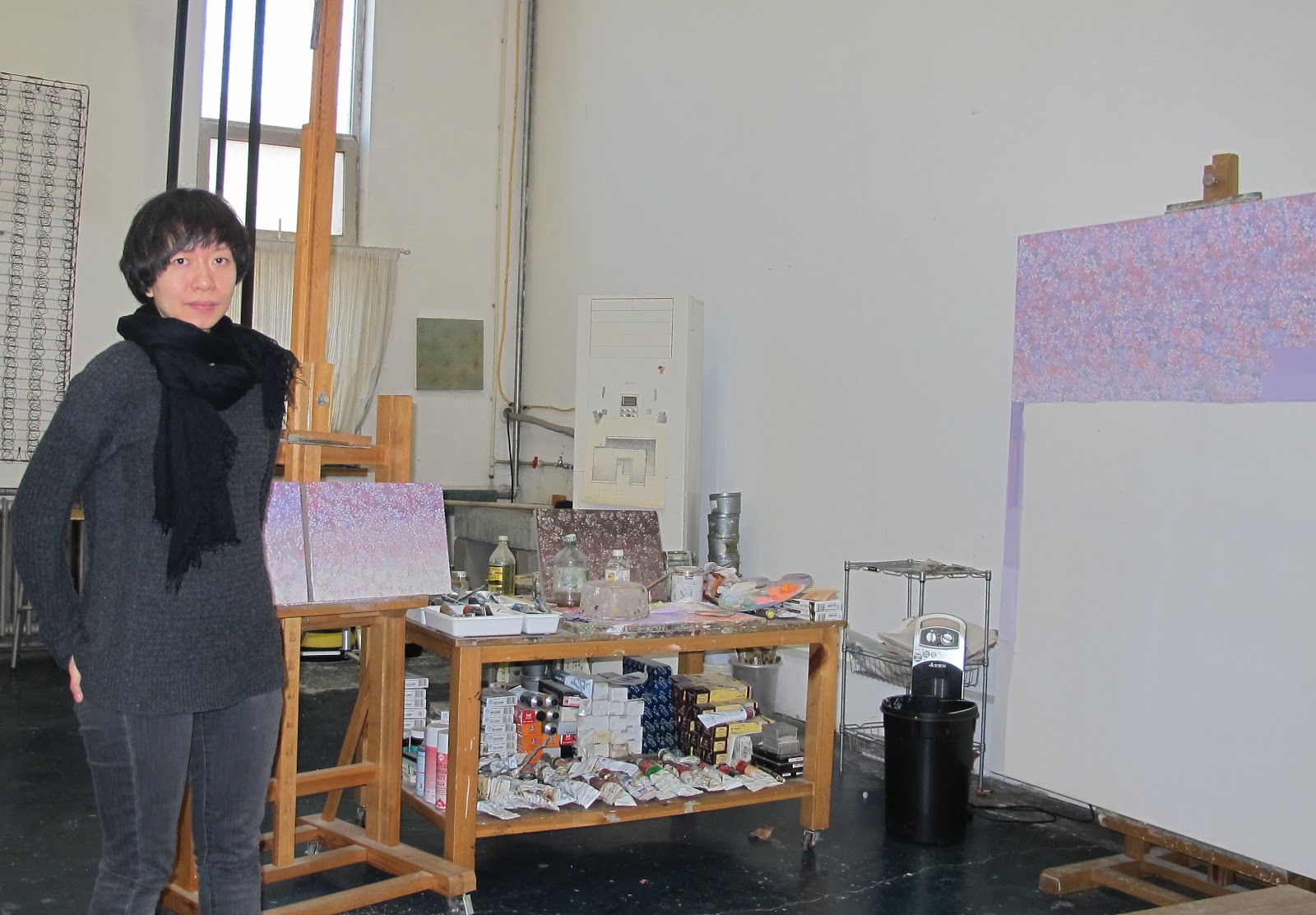
Gao Ping in her studio, photograph Luise Guest, reproduced with permission of the artist
This post is an edited and expanded version of a piece I wrote about Gao Ping last year, published as part of a longer article on The Culture Trip.

“I knew nothing but shadows and I thought them to be real.” 

(Oscar Wilde, The Picture of Dorian Grey)


 I first spoke with artist Gao Ping in 2012, when she arrived in Sydney for shows of her work at Stella Downer Fine Art and at the Maitland Regional Gallery. She told me that for Chinese artists the traditions of ink painting are “like the ground under your feet”. In December last year when we spoke at greater length in her Beijing studio, she expanded on this idea, telling me of her admiration for the painter Ba Da of the early Qing Dynasty, adept at creating visual metaphors, who famously observed that there were “more tears than ink” in his paintings. His expressive landscapes achieve a balance between stillness, space and closely observed detail, which Gao Ping returns to again and again. She finds his work both sad and “calm in heart”, a description which could equally be applied to her own work, and especially to her drawings. In these works, created with traditional inks on silk or rice paper, tiny lonely figures or objects float in a vast empty space, creating a dynamic relationship between the forms themselves and the space they inhabit. Her deep knowledge and understanding of traditional painting is evident in the ‘rightness’ of her placement and the confidence of her mark-making. She says that tiny things are sometimes more important than the large and obvious, and her work creates an ongoing narrative grounded in her idiosyncratic observations of people, places and events. The life of an artist in Beijing is a lonely one, she says, and she believes that painting is like a secret language, creating mysterious layers that reveal themselves slowly to those willing to take the time to look carefully. Reticent and not keen to talk much about herself or about the meanings of her work, she says, “What I want to say is in the paintings.”
Ink paintings of tiny female figures, some nude, some clothed, perhaps represent a kind of self-portrait, an exploration of loneliness. Still Life – Girls contains 4 minute figures: an overtly sexy one in black stockings, an exhausted one slumped flat on her back, and two who turn away from the viewer. Their outlines are softly blurred. They are touching and whimsical, as are her representations of lonely toys, battered teddy bears and stuffed animals, pot plants, electric fans, figures seated on park benches, slightly shabby gardens and simple houses like those around the courtyard where she and her husband work intently in separate studio spaces, heated by a wood burning stove. These works express fragility and vulnerability. They evoke memories of childhood, as well as her astute observations of the world around her and her responses to it. “The drawing is in my heart,” she says.
In contrast, her oil and acrylic paintings, some large and powerful and others on smaller square canvases, are at once strong and lyrical, often employing a subtle grisaille in which translucent washes are layered to create great depth. She began to experiment with introducing washes of colour underneath her palette of greys after looking closely at the work of Marlene Dumas, an artist she much admires. These painterly works evoke ambiguous landscapes which to the artist represent an ideal world, a place of harmony and retreat from the chaos of the city. Gao Ping is a quiet observer of contemporary urban life, and much of her work speaks of her distress at the pace of change in Beijing, and the constant and unsettling transformation of familiar places in a never-ending process of demolition and urban renewal. She is creating a different, calmer world in her paintings.
When we met once again last week at her Beijing studio, she showed me the acrylic-on-paper works for her new show at Yun Gallery, in the 798 Art District here, as well as more of the beautiful ink works mounted on silk in the traditional manner, which she has just recently shown in Perth at Seva Frangos Art

Gao Ping, Still Life - Chairs, Chinese ink on paper, image courtesy the artist and China Art Projects

In a long conversation punctuated by many tiny cups of tea Gao Ping told me that she often walks after nightfall in Ditan Park (Temple of Earth Park), observing the natural and architectural forms which loom out of the darkness and the shadowy forms of people. Like every park in Beijing it is still busily populated by dancers, walkers and water calligraphers long after sunset, and the artist enjoys the experience of encountering others in the vast spaces.These quiet experiences in the midst of a chaotically busy city inform her work, the images staying in her memory in an almost photographic manner, as she experiments with ink, sometimes mixed with gesso and water, drawing freely and quickly onto large sheets of heavy paper. The first mark is the hardest, she says, but after that it flows almost effortlessly. This is a process quite unlike the meticulousness of traditional ink painting, which may look spontaneous but in fact is utterly controlled and deliberate. In these new works some of the most interesting surface qualities and marks have been arrived at through experimentation and unorthodox combinations of materials.
Gao Ping, untitled, acrylic, ink and gesso on paper,photographed in the studio, image courtesy the artist

She has developed a technique of layering her materials, brushing and scraping thinned washes of acrylic over the ink underneath, in a process akin to a wax resist.The final works are built up of many layers, creating images which are moody, atmospheric and subtle. She uses stencils to create forms reminiscent of traditional Chinese carved window screens, seen in the pavilions bordering the lakes in public parks and gardens.

Gao Ping, Untitled, acrylic on paper, 2013, 100 x 100 cm, image courtesy the artist

She has said that during this process, the works become images – but not an image of ‘reality’ – "it’s a kind of vague trace on the surface of the paper without clear definition." I suggested to her that she would be interested to look at some of Bill Henson's works - especially the Port Phillip Bay series where the cargo vessels appear almost invisible against the inky blackness of sky and ocean. To me there is something of the same sensibility at work here. A quiet and acute observer of her surroundings, Gao Ping possesses a unique ability to transform the mundane - a teapot, a window, a branch of blossom seen in the park - into something mysterious and other-worldly.

Gao Ping, Untitled, 2013, acrylic on paper, 350 x 100 cm, image courtesy the artist


Saturday, April 6, 2013

Chinese - Tai Nan Le! - 太难了!

Laurens Tan, 'Kuai Le Wan Ju', image courtesy the artist
I have been giving myself a number of self-imposed deadlines, writing in a fast and furious fashion about my interviews with Chinese artists; reviewing exhibitions; reading numerous books (often several at a time) in an attempt to make sense of my kaleidoscopic impressions of the fast-changing Chinese artworld on my last visits to Beijing and Shanghai. At times it seems like a form of insanity. But the topic continues to fascinate. I have been reading a new book of essays, 'My First Trip to China' in which scholars, diplomats and journalists reflect on their first encounters with China - it contains some wonderful insights and fabulous anecdotes from the 1950s to today. Jerome A. Cohen, who went on a US diplomatic and scientific delegation in 1972 and met Zhou Enlai, finished his account by observing that he agreed with the humourist Art Buchwald that, after a stomach-full of China watching, an hour later you're hungry for more. I can only concur!

I am  beginning to plan a trip for later this year, when I will be staying in Beijing for a couple of months to write, research and explore artists' studios, galleries and China in general. I am hoping to go beyond Beijing and Shanghai this time, and see more of China than the view visible from the windows of the high-speed train. Although this too was completely fascinating to me.

As I write this I should be at my Chinese class. But am not. Oh dear."Tai Nan Le! Too hard! - 太难了!" I am feeling overwhelmed by the enormity of trying to learn this difficult language and feel that I will never improve beyond the stumbling baby Chinese that I can manage right now. And as for character reading, forget it! My strategy today turns out to be one of avoidance. Probably not recommended. Next week, I WILL do the homework and go to class, I tell myself sternly. We'll see.... 
Laurens Tan, Beng Beng Prototype,Made in China.
 Fiberglass, Steel, Acrylic, Plastic, Wood, Baked Enamel, 62 x 30 x 11 cm, edition of 8, image courtesy of the artist.
Meanwhile, my interview with the wonderful Beijing/Las Vegas/Sydney based artist Laurens Tan has been published on The Artlife web site. I love the way that his work also deals with the traps and slippages of communication across language barriers. His is a practice that is absolutely unique. Tan went to China in 2006 speaking little Mandarin, and discovered a way to use Chinese characters as both the form and symbolic coding in his sculptural, digital and screen-based work. "There are different ways of operating as an artist but essentially I think art is always about embracing risk and letting go. And that’s the hardest part," he told me in a wide-ranging conversation in the (very noisy) cafe of the Art Gallery of New South Wales.  For my account of the interview, 'Laurens Tan, Art as a Vehicle for Thinking" - click HERE 
Laurens Tan, Babalogic II, Installation View. Computer-cut ABS, Light, Custom Sanlunche, Dual-Channel Projection, Variable Dimensions, image courtesy of the artist
Another article (previously published in a longer, slightly different form on Artspace China) about the continuing influence of traditions of calligraphy and ink painting on Chinese contemporary painters has been republished on The Culture Trip as 'Constancy and Change in Contemporary Chinese Ink Painting' - featuring the work of three very interesting young women artists - Li Tingting and Gao Ping from Beijing, and Shi Zhiying from Shanghai. Click HERE to see the article.
Li Tingting, Chandelier, Ink on Chinese paper, image courtesy the artist
Recently, too, my interview with Hong Kong based artist Lam Tung-pang appeared on 'Daily Serving'. Lam is currently in new York on an Asia Council fellowship and residency, continuing a discourse about ink painting traditions and making new work in a number of US cities. For the interview, click this link: Things Happened on the Island: Lam Tung-pang's Floating World
Lam Tung-pang in his Hong Kong studio, photograph Luise Guest reproduced with permission of the artist
And my conversations with two emerging women artists in Beijing, Dong Yuan and Gao Rong, were published by Randian Online - click 'In Grandmother's House' to see the article.


Dong Yuan, Daily Scenes, oil on 42 separate canvases, image courtesy of the artist and White Rabbit Gallery
Dong Yuan, Hui Hua Chi Fan, oil on separate canvases, installation view, image courtesy the artist
My problem is not being able to type fast enough, nor go without sleep for long enough, to read, write and research as much as I want to. I should at least thank my mother for making me learn touch-typing when I was 16. She said, "Anyone who wants to work in the arts had better have something to fall back on", imagining, no doubt, a life of secretarial drudgery in an office, rather than adventures hiking around Beijing with a laptop.

Upcoming - an article about performance artist and painter Monika Lin and Beijing-based Huang Xu and Dai Dan Dan - 'Landmines in the Garden of the Literati' - watch this space!
Huang Xu, Plastic Bag No. 28, C-print, reproduced courtesy the artist and China Art Projects

Tuesday, March 19, 2013

God of Small Things - the art of Gao Ping

One of my favourite artists is Beijing-based Gao Ping. She has shown her ink drawings of 'tiny things,' like the solitary fragile figure in the work below,  at Stella Downer Fine Art in Sydney where I first met her. She has also been included in a curated show at the Maitland Regional Gallery in 2012. Her works both ink on paper and oil on canvas have the same paradoxical combination of fragility and strength that the artist herself exhibits in person.

These works have a sadness about them - minute figures, objects, buildings and gardens seem to float on the surface of the Chinese paper. They appear spontaneous, but are in fact carefully planned and controlled by an artist in full command of her medium. Her subjects range from tiny figures, usually girls, to banal household objects such fans or furniture, to depictions of her Beijing courtyard studio or the slightly wonky potplants it contains. There is a series of toys - battered teddy bears and toy trucks, tin wind-up toys and well loved animals.


 Space is used so cleverly - the forms float slightly uneasily, and the white void around them is equally as important as the subjects she has chosen. When I reviewed the show at Stella Downer for The Art Life in 2012,following a long conversation with the artist in a Waterloo cafe,  I said this: She stores up memories of the people and things she observes in her daily life, until she is safely in the solitude of the studio when they spring back to life under her brush – a weary figure leaning sideways on a park bench, a feisty girl in jeans talking on a mobile, a gathering of men in suits. Together with her characteristic subjects of sad, abandoned toys, and collections of chairs, lamps or electric fans, they suggest a whole population in a state of flux. The delicate restraint of her ink marks gives them a sense of impermanence, as if they could dissolve, shape-shift, or transform themselves into something else altogether. It is perhaps not surprising that the artist describes her experience of living in the constantly changing chaos of Beijing as one of loss and sadness. There is humour too, however, to be found in her wry observations of the unexpected details of city life."

We met once again in Beijing in December, and when Gao Ping brought a folder of drawings to show me over coffee in a 798 cafe, she told me that she is happiest when she is drawing: "The drawing is my heart." 


Gao Ping, ink on Chinese paper, all works above courtesy of the artist and China Art Projects
Her oil on canvas works are strong and subtle, working with a nuanced palette of greys and muted colours. My visit to her studio in Beijing was the first of several conversations where we talked about her life and her art practice. "The life of the artist in Beijing is a lonely one," she says. Her ambitions as an artist are  very pure - almost austere: "Work is the most important thing," she told me, wary of saying too much or of over-analysing. "All the ideas, all the talk is in the paintings."

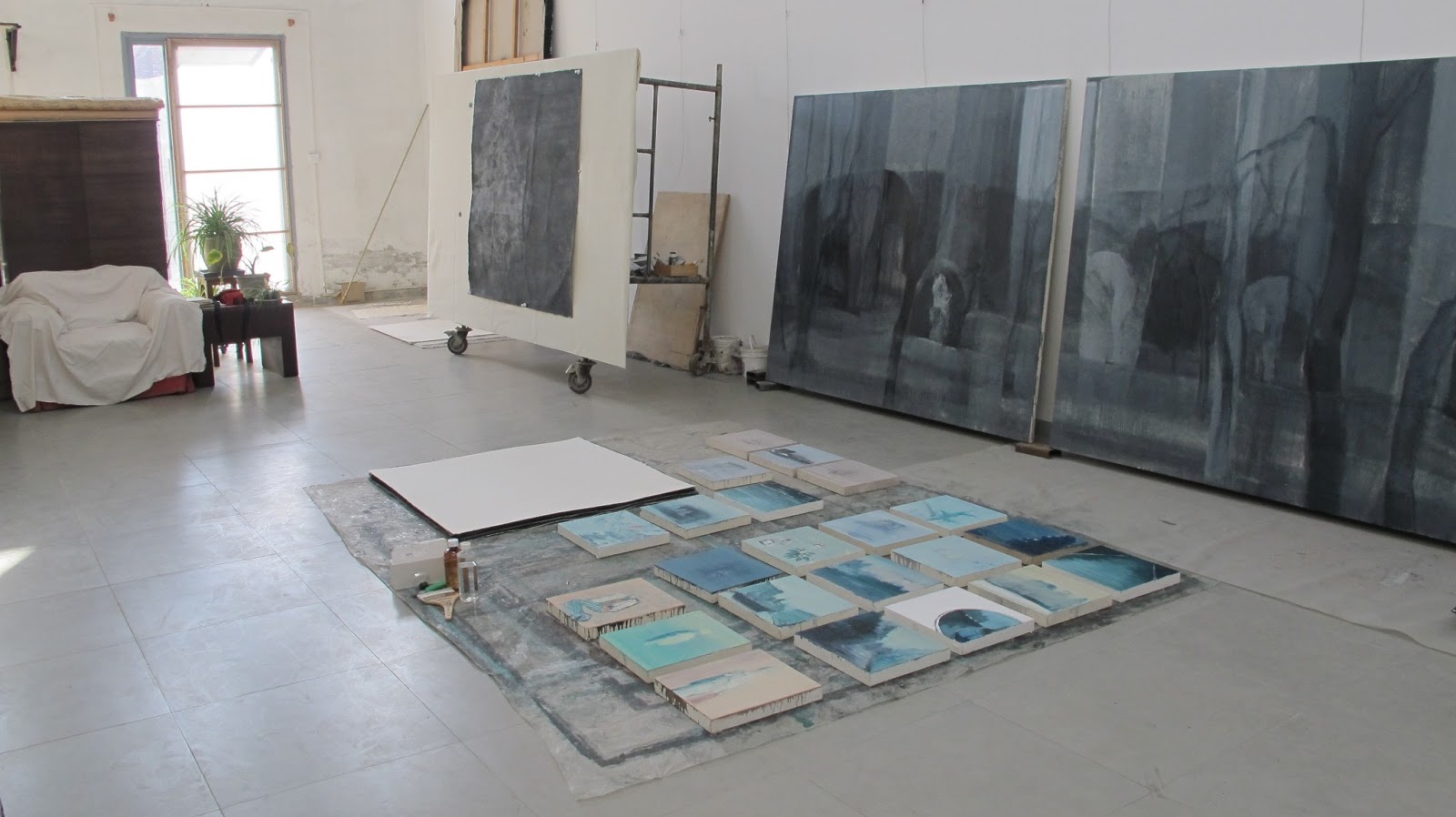
The images of her studio and her work below communicate that sense of a rigorous practice, one which eliminates all that is unnecesary, even discarding colour altogether at times, and concentrates on what really matters.
Gao Ping studio view, photograph Luise Guest reproduced with permission of the artist
Gao Ping, studio view,  photograph Luise Guest reproduced with permission of the artist
Gao Ping with her unfinished work, photograph Luise Guest
reproduced with permission of the artist and China Art Projects
Gao Ping, work in progress photographed in her studio, photograph Luise Guest
reproduced with permission of the artist and China Art Projects
Gao Ping Studio, Photograph Luise Guest reproduced with permission of the artist


Wednesday, January 23, 2013

With ink and brush - a tradition reinvented

Shi Zhiying, 'Mr Palomar', Chinese ink on paper, image reproduced courtesy of the artist

I have been thinking, reading, writing, eating, drinking, breathing Chinese art since my return from Beijing and Shanghai. Even more than usual, that is. I returned with my head bursting with ideas and quite overwhelmed with information about the artists I had met and interviewed. What to do with all this material has been the dilemma. I am developing a new blog for art teachers and art students, with separate pages and posts representing possible case studies about specific contemporary Chinese artists. And planning a book. And impatiently planning my next trip to Beijing. And ordering a ridiculous number of new Chinese art books online. And making a New Year's Resolution to study Chinese for one hour every day - a resolution I had abandoned by January 3. And reluctantly facing the realities of life, such as earning a living!

In the meantime I have been reviewing exhibitions, and writing some pieces based on my Chinese artist interviews - here is the start of one of them, posted by Sydney University's 'Artspace China' this week. Of course I am secretly hoping that if you read the beginning you'll want to read all of it, so here goes...


Extract of Article posted on Artspace China  in which I look at how three young artists are re-interpreting the traditions of the ink-painting masters of the past

I sat in the Gallery of Modern Art in Brisbane last week, resting my weary art gallery feet after many hours traversing the Asia Pacific Triennial, and watched a charming Chinese animation for children, called Where is Mama?. Created in 1960 at Shanghai Film Studios under the guidance of the legendary animator Te Wei, it tells the story of a group of tadpoles searching for their mother. They plaintively question goldfish, shrimp, turtles and other creatures on their journey through a watery landscape. Each frame is rendered in deft, minimal brushstrokes with ink and wash, influenced by the watercolour paintings of Qi Baishi.

[ If you want to see the film, click on the title Where is Mama?]
In these digital days its artistry and simplicity were a revelation. Art historian Lin Ci speaks of the ways in which scholar painting techniques which vividly evoke, not an exact likeness, but a “spiritual resemblance” to aspects of nature such as plum blossom, birds, bamboo, stone, withered trees and orchids allowed the artists to “play the game of inks” better. For scholar officials trying to distance themselves from the realpolitik of the imperial court, these freehand ink paintings of birds and flowers could “bring comforts to their hearts” he says, evoking an endearing image of the lonely scholar contemplating his garden and disregarding the painting conventions of his imperial masters. (Lin Ci, ‘Chinese Painting: Capturing the Spirit of Nature with Brushes’) Watching this little film certainly brought “comforts to my hearts” after a somewhat disappointing APT experience.
It may seem a long distance between a sweet animated film and the great masters of the Yuan and Ming Dynasties, however, the adherence to the beauty and discipline of calligraphy and ink painting so evident in every frame of Where is Mama? is the very thing that so often joins past and present in Chinese art. In a catalogue essay for Ink – the Art of China at the Saatchi Gallery in London in June 2012, Dominique Narhas had this to say: “Ink painting brings us into contact with an immersive intimacy in which humanistic themes of man’s relation to himself, to nature and to the other are played out against the great backdrop of constancy and change.” It is precisely this notion of constancy and change, the intertwining of past and present, which distinguishes contemporary Chinese art in the global marketplace and results in works which are able to reference tradition and convention yet speak to the contemporary world and an international audience.
Current discourses about the significance of ink-painting in contemporary art practices acknowledge its central importance. Keith Wallace, writing in Yishu, said, “A growing number of exhibitions [feature] artists who… explore and even push the parameters of what ink-painting should represent…a concerted effort by historians, curators, and critics not to let ink-painting slip into the abyss of historical dinosaurs, but to encourage ways in which its practice can continue to contribute to contemporary art.” (Yishu: Journal of Contemporary Chinese Art, July-August 2011 volume 10 no. 4) The mass circulation print media have noted this phenomenon too. A recent New York Times article quoted Britta Erickson, a curator and scholar who teaches courses on the history of ink painting at Stanford University. “Today, there’s ink on paper; there’s ink by itself; there’s the gesture without the ink; there’s just the paper, or there’s the performance of the gesture, and there’s video and installation art too.” (Nina Siegel, ‘Ancient Art Tells China’s Modern Tale’, New York Times October 31, 2012)
Gao Ping, Untitled, Oil on Canvas, image reproduced courtesy of the artist and China Art Projects
So, how are contemporary artists re-imagining and transforming an archaic tradition? From Xu Bing’s iconic Book from the Sky and Gu Wenda’s human hair frozen with adhesive into translucent curtains of unreadable language, from Song Dong’s calligraphy written with water on a stone slab in ‘Writing Diary with Water’ to the digital multimedia works of Yang Yongliang, to conceptual works by Zhang Huan and Qiu Zhijie, a generation of Chinese artists have been reinventing traditional forms to represent ideas and observations about their contemporary world. Last summer we saw He Xiangyu’s extraordinary Cola Project at 4A Centre for Contemporary Asian Art here in Sydney, in which he appropriated Song Dynasty masterworks using ink mixed with litres of Coca Cola. Indeed, one of the key elements underpinning the inventiveness and innovation of contemporary art in China is, perhaps paradoxically, a deep knowledge of and respect for traditional forms. Chinese artists revere their cultural heritage and art traditions yet at the same time freely experiment with them. Almost every artist will tell you that they learned calligraphy and ink painting as a child, and they speak knowledgeably about historical ink painting masters. This results in works of great depth and layered meaning. In the hands of some artists this reinvention leads to transgressive works of social critique, even savage satire, whilst others reflect on elements of their world in a quieter, more personal or meditative manner. I recently spoke with a number of artists in Beijing and Shanghai about the way in which their practice is informed by their study of traditional Chinese painting – these are just three of those stories.
Shi Zhiying, Mr Palomar, Chinese ink on rice paper, image reproduced courtesy of the artist
If you want to know more about the ways in which Gao Ping, Li Tingting and Shi Zhiying are reinventing this ancient visual language you can read the whole article from Artspace China here !

Sunday, December 16, 2012

Zhong guo "Zai Jian" - for now

A large wall text at the entrance to the "Andy Warhol - 15 minutes eternal" exhibition currently showing at the Hong Kong Art Museum reads, " Making money is art and working is art and good business is the best art". This is curiously appropriate in Hong Kong, a city where, artist Celia Ko told me tonight, "money is the only language that everybody speaks."

Hmmm. Money and art. Who knew? Always a hugely problematic nexus, and ideas about the relationship of one to the other are contested bitterly. In Beijing there is no denying that a number of artists became seriously wealthy in the art boom of the late 90s and early 2000s. And cynical views are expressed by some in the artworld that everything and everyone have been corrupted by that.

However while everybody needs to earn a living and artists are not exempt from the normal kinds of greed and desire for comfort and ease that we are all heir to, I am prepared to go out on a limb and say that each of the seventeen artists I have interviewed on this trip are absolutely and seriously dedicated to making art that expresses deeply felt ideas and beliefs, and work incredibly hard to develop their practice and pursue a goal of excellence, whatever the art market might be doing.
Gao Ping, oil on canvas, image reproduced with permission of the artist and China Art Projects
Gao Ping told me, "Every year I want to find something new in my work" and added, "The drawing is my heart". Lin Tianmiao said, "Being an artist is a very personal thing. We are the people who raise the questions - the critical thinking is the most important thing". You can read a more detailed account of my interview with this iconic figure, currently showing at Lelong in New York, here: http://dailyserving.com/2012/12/holding-up-half-the-sky-an-interview-with-lin-tianmiao/

Lin Tianmiao, thread winding work viewed in the artist's studio,
 photograph Luise Guest, reproduced with the permission of the artist
Liang Yuanwei, who spent three months in Berlin after a less than happy experience representing China at the Venice Biennale, said. "My work is like a tunnel between myself and the world. It must be true."
Liang Yuanwei in her Beijing studio, December 2012
Photograph Luise Guest, reproduced with permission of the artist
Liang Yuanwei, Flower Study for the Golden Notes series, oil on canvas
Photograph Luise Guest reproduced with the permission of the artist
Liu Zhuoquan makes very beautiful works that contain within them some carefully coded meanings about issues in China today. Wu Meng makes works in the public space in Shanghai at considerable personal risk to herself and her family, raising issues of vital concern such as the suicides of workers in the factories of southern China, or the unfair treatment of migrant workers. And Lam Tung-pang in Hong Kong, whose work is currently showing at Saatchi in London, makes works which reflect his feelings of anxiety and distress about what is happening to his beloved city, and his search for quietness and repose in a re-examination of the traditions of ink painting.
Lam Tung-pang in his studio, Hong Kong December 2012,
photograph Luise Guest  reproduced with the permission of the artist
Lam Tung-pang, studio view
Lam Tung-pang, 2 sided work based on Tang Dynasty horse, photographed in the studio
Photograph Luise Guest reproduced with the permission of the artist
Lam Tung-pang, exhibition of work at Goethe Institut, Hong Kong, installation view
image reproduced with permission of the artist
I have interviewed painters and performance artists, photographers and sculptors, artists who work with found objects and found images, those who reinvent traditional Chinese forms such as ink painting or gong bi style painting and those who seek an entirely new visual language. I have met famous and revered artists, and artists newly graduated from art academies. I have met curators and gallery directors and critics.
Monika Lin, "On the Way to the Imperial Examination",
performance piece in which the artist wrote the character 'mi' (rice) 10,000 times
Image reproduced with permission of the artist
Shi Zhiying in her Shanghai studio,
Photograph Luise Guest, reproduced with permission of the artist
I have also met two wonderful and inspirational art teachers with whom I hope to collaborate on some projects with our respective art students - art that crosses national boundaries and limitations of culture and language, that sounds good!

I have learned enough to make my brain feel as if it is overflowing with new information, enough for a book! We'll see... I have loved the experience of travelling with this sense of purpose and in a spirit of enquiry, and have been warmly welcomed everywhere. I have sat in ice cold freezing studios in old 'Shikumen' houses in the French Concession in Shanghai, and in Caochangdi and Songzhuang artists' villages on the outskirts of Beijing. Today, after visiting Lam Tung-pang in his new studio in Fo Tan, I caught a local mini bus to Sha Tin Station, blaring Chinese opera all the way.

From the sublime to the truly ridiculous, Hong Kong has it. Yesterday I saw an eagle floating, suspended, high above the clustered apartment buildings as I rode down the hills from the Peak on the top deck of a bus. Today, in the shopping mall above the Sha Tin MTR station, I came across a brand of handbags and wallets called 'Shag Wear' - I swear this is true! Yesterday, in Canton Road, two young men in the jostling crowd carried sandwich boards advertising 'The Battery Operated Nasal Aspirator".

I have been observing - sometimes feeling like a voyeur - the people in each city as they go about their lives, Old men and women playing cards, mahjong, chess, doing Tai Chi, ballroom dancing, playing bowls. Such constant activity! And here in Hong Kong have been touched by the way tiny, wizened old ladies are led gently by daughters and grand-daughters down jostling Kowloon streets. And also by the general tenderness shown in every  city I have visited to babies and children. Not surprising in the land of the one child policy, changing though that may be. Often in Australia I observe parents respond to their small children with exasperation and impatience as their default position. Not so in China.

It is perhaps ironic that part of my purpose here has been to discover what the effect of international dialogues, residencies and exhibitions has been on the work of Chinese artists, and how they have been changed by these experiences. A lot more remains to discover on that topic, but in the meantime the person most changed by the dialogue is me.
Zhongguo - Zai Jian!

Friday, December 14, 2012

Shanghai to Xiang Gang

Ah Hong Kong! Toilets flush, traffic lights are obeyed, nobody is spitting in the street right next to me, and whilst it can seem chaotic and frenetic there is still a sense of order and stability. As Fuschsia Dunlop so memorably said, Hong Kong is like a decompression chamber after being in mainland China. It is strange to hear Cantonese, with its long "maaaaaa" and "laaaaa" sounds at the ends of sentences, after the more clipped  tones of Mandarin. And just when I was getting a little bit better at communicating!


When I arrived today I was struck anew by the contrasts. Glitzy storefronts with mildewed apartments stacked above. Beautiful mountains rising out of the sea like a literati painting juxtaposed with enormous slender tower blocks and  outlet malls. In Kowloon two men with a sign reading "Keep away from Falun Gong Evil Cult" lounged against the wall of the Gucci shop next to a poster advertising cosmetic surgery and a woman handing out foot massage leaflets. Mainland Chinese queued in long noisy lines to get into Prada, Chanel and Burberry on one side of Canton Road whilst on the other side Hong Kong citizens queued patiently at bus stops, waiting for buses to far suburbs.

Louise Hawson of '52 suburbs' fame has some great photographs of Hong Kong housing estates - check them out here: http://52suburbs.com/suburb/hong-kong/

On Sunday I will go out to Fo Tan to see the artist Lam Tung-pang in his studio in that previously industrial neighbourhood. Now all the industry is pretty much over the border. And so are many of the workers who can commute to Shenzhen or Donguan and be paid in RMB.

Reflecting on my past two weeks in Beijing and Shanghai - I have learned so much and been so privileged to be welcomed into studios and galleries with great warmth and kindness. Ordinary people from taxi drivers to hotel staff to shop assistants have generally been helpful and friendly - maybe it's my grey hair!

Three things I love about China:
  1. The sense that anything is possible, no matter how ambitious, and can be achieved very fast. Quite possibly by tomorrow if you like (although it may very well fall apart soon after that)
  2. The way that elderly people are treated with devotion, respect and care
  3. The openness and generosity of ordinary people. I cannot imagine that I would be welcomed into artists' homes and studios in the same way anywhere else - certainly not in Australia
Three things I don't love about China:
  1. Spitting loudly and revoltingly in the street 
  2. Food safety fears - every day the newspapers contain stories about adulterated milk, or prosecutions of farmers for adding chemicals to the feed of pigs or chickens
  3. Air quality - it is appalling
Three silly moments from a week in Shanghai:
  1. Channel flicking from one CCTV station to another, I came across 'China You've Got Talent', featuring a competitor who said he was a 28 year old worker from Shandong Province. He was dressed inexplicably as a Teenage Mutant Ninja Turtle, and he performed by juggling eggs with his mouth, shooting them up to the ceiling and catching them again to the wild applause of the audience and the apparent approval of the judges. Chinese TV has a zillion variations on music and MTV style shows, mostly featuring very pretty boys with improbable hair-dos and girls whose role appears to be to giggle on cue. And incredibly soppy romantic love songs with videos starring girls who swoon and are rescued by young men who look extremely gay.
  2. Yesterday in M50 I walked into an upmarket art gallery and found three very glamorous young gallery assistants all dancing 'gangnam style' to THAT track. They collapsed into helpless and embarrassed giggles when they realised I was there.
  3. Walking in Fuxin Park I came across senior citizens playing a game that resembled bowls, or maybe bocce. It was all very serious - they had uniform team aprons in different colours and a referee with a microphone headset, but they seemed to be having great fun. Much confusion ensued when I asked them what the game was called and about 6 people all tried to explain the rules to me -all in Chinese and all talking at once. Little did they know that I don't understand the rules of ANY sport, much less something that is played only in China!
Three friends watching the ball game at Fuxin park
And three favourite artworks - although there are so many it is almost impossible to narrow it down

1. Cui Guotai, a painter I had not come across before - I loved his raw expressionist works of military hardware and industrial installations fallen into decay. Like a eulogy for the Socialist Utopia.

Cui Guotai
2. Liu Zhuoquan's new work is very exciting - a development from his 'neihua' inside painted bottles as seen in White Rabbit and the Biennale of Sydney, he is now working with lights and developing larger installations. These birds are painted on the inside of the lamps which are intended to evoke those on Chang'An Avenue in Beijing, leading to Tiananmen Square. The black birds are birds of ill omen, a dangerous portent. And a coded political meaning as in so much of this artist's work. The references are very subtle, but they are very deliberate and intentional.

Liu Zhuoquan with his new installation, bound for an exhibition in Australia.
Photograph Luise Guest, reproduced with permission of the artist and China Art Projects
3. The new works by Gao Ping - she continues her subtle and delicate ink on paper works of 'tiny things' - rows of tin mechanical toys, sad stuffed animals, tiny people or cars, miniature gardens or pot plants, floating on expanses of Chinese paper. However she has developed strong works in oil on paper and canvas, exploring a palette of subtle greys, fleshy pinks and celadon green, from which murky forms emerge from a misty wash of pigment. They are evocative and very beautiful works.
Gao Ping, untitled, oil on canvas, image reproduced courtesy of the artist and China Art Projects

Gao Ping is an artist who impressed me enormously with her quiet dedication to advancing her practice - unflashy, unpretentious, absolutely sincere and genuine in her determination to keep learning.

Gao Ping Studio View, Photograph Luise Guest
Gao Ping in her studio, photograph Luise Guest reproduced with permission of the artist
Actually I lied - I can't leave it at three. I have to include Dong Yuan and her paintings of her grandmother's house - multiple small canvases making up the entire 4-roomed house as it was in Dalian in the artist's childhood, reconstructed from photographs, memories and interviews with her relatives:

Dong Yuan, Grandmother's House, oil on multiple canvases to make up installation,
 image reproduced courtesy of the artist
And. finally, the truly astonishing work by Huang Yong Ping in the Shanghai Biennale, 'Thousand Hands Kuanyin' - this artist continues to amaze, delight and impress.


Huang Yong Ping, Thousand Hands Kuanyin, Shanghai Biennale