The ongoing thoughts of an art teacher in China - and home in Sydney

A continuing diary about my travels in China, and thoughts about China and Chinese art from home and abroad
Showing posts with label Tianli Zu. Show all posts

Sunday, January 26, 2014

马年吉祥! The Year of the Horse

I know it's Australia Day, but I am pretending that I never saw those teenage girls dressed in flag-adorned costumes, or the many people sporting temporary Australian flag tattoos - it has all become way too creepy. And, frankly,dare I say it, "un-Australian". What happened to our famously laconic and cynical national character? So this post is ignoring January 26 in favour of the lunar calendar.The Year of the Horse approaches. In fact 2014 is the Year of the Wooden Horse, which is regarded, I discovered in a rapid scroll through a few Googled web pages, as a year of quick victories, unexpected adventures, and surprising romances. Those born in a horse year are supposed to be strong, courageous, independent, creative free spirits. Possibly, as a monkey year person, I am a little envious. Sydney is currently filled with red lanterns, many opportunities to eat noodles and dumplings, and a plethora of events in the lead-up to the enormous street parade in celebration of Chinese New Year. In addition to Mahjong, food, music and lion dances, art is also getting a look-in, thank goodness. 'Crossing Boundaries' is an exhibition of Asian Australian artists - some young emerging artists and some, such as Guan Wei and Lindy Lee, who are extremely well-known and celebrated. Curated by Catherine Croll of Cultural Partnerships Australia, and currently showing at Sydney Town Hall, the exhibition is an important part of Sydney's Lunar New Year celebrations. And, appropriately, many of the works are equine and celebratory in flavour.
Hu Ming, Wishes for Every Success in the Year of the Horse, 2013, oil on canvas
This is the third consecutive year that the exhibition has been held to coincide with New Year celebrations, and this time around it includes a number of the same artists as last year, as well as a host of new, previously unknown artists. Not every work in this highly eclectic show is great, but most are at the very least interesting, and the exhibition as a whole suggests evocative connections and parallels between works by very different artists. Croll says, "Artists participating in Crossing Boundaries have created new work that reflects upon individual journeys undertaken, boundaries crossed and new territories explored to provide a dynamic exhibition with strong celebratory flavour for the Year of the Horse."

Hu Ming, represented by two works quite unlike her usual repertoire of voluptuous revolutionary soldiers, is an interesting case study of a diasporic Chinese artist. In fact the artist herself spent 20 years of her life in the People's Liberation Army, from 1970 to 1990, eventually becoming a major. During this time she saw the last bitter years of the Cultural Revolution, the death of Mao, the 'opening up' under Deng Xiaoping and the tragedy of Tiananmen. She was given leave to study art and learned the painstaking hyper-realism of the traditional Chinese 'gongbi' style in Tianjin. She arrived in Australia in 1999 and now lives and works in Sydney, producing works that, albeit in a Pop idiom, are thoroughly immersed in traditional imagery and techniques.

Two panels of black paper, pitted with burned holes and marks, form "1000 Blacks & Myriad White', created  by Lindy Lee in collaboration with Elizabeth Chang. For both artists black has deeply ancestral connections to Taoist traditions and the principle of Yin/Yang. Yin, the black, represents earth, darkness and the interior. Yang, the white, represents heaven, lightness and the exterior. One cannot exist without the other. Lee has long been interested in ways of making the immaterial,the evanescent, take on a  material form. In these works she and Chang have created a powerful and mysterious diptych.
Somchai Charoen, Landmind, 2013, ceramic installation (detail)
At the entrance of the space is a floor installation by Thai ceramic artist Somchai Charoen. Deceptively pretty, his field of ceramic flowers, sitting lotus-like on the polished floor, conceal in their midst weapons of terror and destruction. 'Landmind' was created following his visit to the Landmine Museum in Siem Reap, Cambodia. "Landmines are one of the most horrific inventions," he says in his catalogue statement. "The consequences of war on the landscape inflict a trauma for people who travel through the land where an unknown terror lies beneath the surface. This remains decades after the conflict subsides. I am fascinated by how the regeneration of land works to conceal the mines as part of the natural landscape." Certainly his invitation to audiences to walk through the installation was not being eagerly embraced yesterday - the installation is a sobering reminder of the appalling consequences of war and conflict.

Tianli Zu has contributed one of her characteristic paper-cut works celebrating Nuwa, a powerful creation figure in Chinese mythology. Around 179-122 BCE in remote antiquity, so the story goes, the four pillars that supported the universe collapsed. The world became dark and chaotic. Nüwa tempered five-coloured stones to repair the heavens and held up the sky with four legs that she cut off a tortoise. According to the Chinese myth Shanhaijing (山海经), she created the horse before she created humans. Sometimes this artist works with video, however in this installation she has chosen to add evocative forest sounds which echo around the space, so realistic that they apparently caused maintenance men from the Town Hall to investigate whether an owl was trapped in the ceiling.
Tianli Zu,  Nuwa Created Horses on the Sixth Day, 2013, Chinese ink and tea, Hand cut cotton rag paper,
and sound composition
My 2013 interview with Tianli Zu, in which she revealed the ways in which her Cultural Revolution childhood continue to impact her work today, can be found  HERE: Tianli Zu: The Power of the Shadow

Tianli Zu,  Nuwa Created Horses on the Sixth Day (detail), 2013, Chinese ink and tea, Hand cut cotton rag paper,
and sound composition
Other interesting works included Ahn Wells and Linda Wilson's 'Ten Thousand Horses' which consists of 60  rosewood tiles with wax painted symbols referencing the power of the horse moving en masse in Chinese military history, as well as shamanism and Ahn's Korean heritage.
Ahn Wells and Linda Wilson, Ten Thousand Horses, 2013, Rosewood and Wax installation
 Guan Wei's panels from his recent dark series of constellations, 'Twinkling Galaxies' are beautiful, of course. In my conversation with him at his Beijing studio in November he reflected on the contrast he sees between Australia and China, now that he divides his time more or less equally between Sydney and Beijing. http://theartlife.com.au/2013/floating-worlds-a-conversation-with-guan-wei/  

And I did enjoy a work made entirely of used teabags. Born in Indonesia, Jayanto Damanik now lives and works in Sydney and has recently returned from a residency at Redgate Gallery in Beijing. He has been collecting teabags since 1997, seeing them as a memory of family, a reminder of ceremonies and as an offering for the dead. Tea has both mundane and spiritual connotations, and is both deeply personal and cultural. He said, "My current project is focused on the psychology of family and home... I collected my tea bags from family and friends and each tea bag contains a memory... every teabag tells a story of daily life’s grievances and joys."
Jayanto Damanik, Conversations, 2013, used teabags, Chinese paper, glue

In amongst the dragon boat races, night noodle markets and (I hope) a revival of the wonderfully funny Pandas on bicycles (panda costumes, OK, no animal cruelty!) in the Lunar New Year Parade, you should definitely make the time to walk round the side of the Town Hall and see what a very diverse range of Asian artists who now "call Australia home" - and Australian artists with links to Asian cultures - are doing. And on Australia Day, when increasingly there is way too much flag waving and scarily mindless jingoism, it's a salutary reminder that this nation is all the richer and more interesting due to the contributions of people who have arrived here from all corners of the globe.

Monday, December 30, 2013

Art in Review, 2013: The Good, the Bad and the.....

 It's the end of 2013, another year over and a time to look back. Every writer of every description is doing their end of year roundups (aka "quick, make a list, rather than actually write something of substance") and "who am I to disagree?" to quote Annie Lennox and the Eurythmics. And that's always appropriate. Returned from a Chinese winter, exposing my startlingly white skin to the Australian sun and walking along the beach, instead of more practical and useful tasks I have been deciding on my top ten gallery experiences of the past year. I could have been thinking about New Year's resolutions such as, oh, I don't know, losing 10 kilos, going to the gym more often (or, in actual fact, ever), doing intensive Chinese homework every single week, being kinder and less impatient, being less of a workaholic. But instead, I decided to write a list of the aforesaid gallery moments of wonder and awe. And here they are:

1. Song Dong, Waste Not, at Carriageworks, Sydney, January 2013. This was magical and moving, a testament to family, to memory, a profoundly human elegy to the artist's mother and to times past.


Song Dong, Waste Not, photographs Luise Guest
When I wrote about this installation, which I had always wanted to see, I found it hard to express my own feelings of sadness that linked me directly with my own very complex relationship with my mother. Here is the start of my review for 'The Art Life'.

The Ancestral Temple: memory and mourning in the work of Song Dong

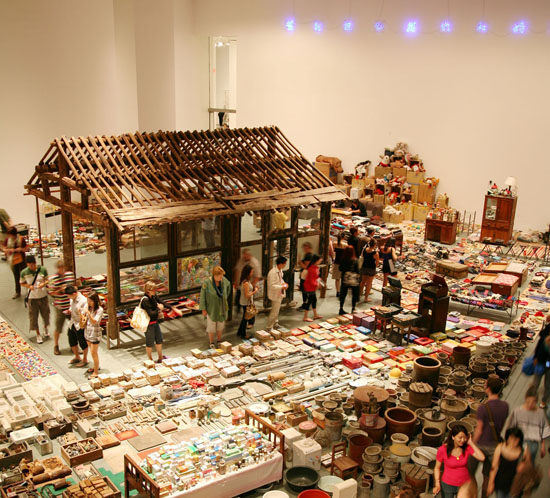
Ten thousand objects collected by the artist Song Dong’s mother Zhao Xiangyuan, over the course of her adult life, are arranged in neat rows and grids on the ground at Carriageworks. During the Cultural Revolution, a period of extreme uncertainty and privation, she began hoarding – drying out and keeping even her allocated bars of soap for fear of future soap shortages. Continuing right through to her last years, Zhao saved everything, in a process called “wu jin qi yong”, translated as “waste not”. This is the latest incarnation of Chinese artist Song Dong’s extraordinary installation, itself entitled ‘Waste Not’.
Song Dong Waste Not - main image 1_web
Song Dong: Waste Not (detail, installation view) Photograph by: Jane Hobson Courtesy Barbican Art Gallery.
Entering the vast space one first sees a row of old chairs, and beyond them the reconstructed frame of Zhao’s traditional timber home. Radiating from the skeleton of the house, the possessions it once contained are laid out on the floor: among them 4 TVs, 3 record player turntables, numerous clocks and watches, broken toys, lamps, old umbrellas, plastic buckets and tin washing tubs, rows of shoes, coat hangers, threadbare face washers, stacked quilts and blankets, polystyrene food containers, empty plastic bottles and their lids, and hundreds of plastic bags folded into neat triangles. They are unbearably poignant in their sheer ordinariness. To read the rest of my review in The Art Life, click on this link: theartlife.com.au/2013/the-ancestral-temple-memory-and-mourning-in-the-work-of-song-dong/

2. Liu Zhuoquan, Chang'An Avenue, at Sydney Contemporary, August 2013

Liu Zhuoquan. Chang'An Avenue (detail) image courtesy the artist and China Art Projects
I have loved the 'neihua', or 'inside bottle painting' installations of this artist from my first encounter with him at his Beijing studio early in 2011. A major installation at the MCA for the 18th Biennale of Sydney in 2012 gave Sydney audiences a sense of his ambition and range. His recent work, shown here for the first time at the Niagara Galleries booth at the inaugural Sydney Contemporary Art Fair, is an indication of the way his practice is continuing to develop.
Here is the catalogue essay that I wrote for this work, which I just wish an Australian museum had the foresight to acquire: http://www.chinaartprojects.com/liu-zhuoquan-essay/

3. 'Serve the People', curated by Edmund Capon at White Rabbit Gallery, Sydney, August 2013

Each show at the White Rabbit Gallery of Contemporary Chinese art presents us with intriguing new works as well as old favourites in new juxtapositions. Edmund Capon, retired (liberated?)  from his role as Director of the Art Gallery of New South Wales, curated this show and it was excellent. Even the gallery spaces themselves looked different and the works were selected and arranged to elucidate his narrative, which related very strongly to his own memories of China during the Cultural Revolution. And why read John McDonald's review if you can read mine?
Jin Feng, History of China's Modernisation, Volumes I and II, 2011, rubber, marble, ricepaper installation, image courtesy White Rabbit Gallery

Shen Shaomin, Laboratory - Three-Headed, Six-Armed Superhuman, 2005, bone, bone meal, glass, glue, dimensions variable, image courtesy White Rabbit Gallery
Chen Wenling, Happy Life - Family, bronze with vehicle duco, 2005, (with Gonkar Gyatso Buddha at rear), image courtesy White Rabbit Gallery
Here is the start of my review for The Art Life:

Serve The People

Wang Zhiyuan - Object of Desire, 2008, fibreglass, lights, sound, 363 x 355 x 70 cm (1)
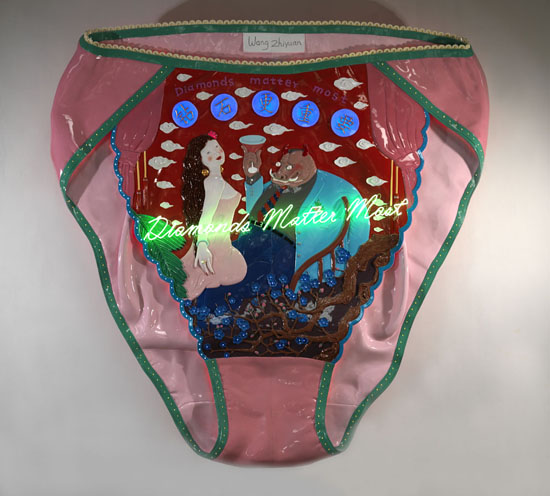
Wang Zhiyuan ‘Object of Desire’, 2008, fibreglass, lights, sound, 363 x 355 x 70 cm image courtesy the artist and White Rabbit Gallery
In Mao Zedong’s famous exhortation to the Red Army at the 1942 Yenan Forum on Art and Literature, he emphasised the close relationship between art and revolution, stressing that art must ‘serve the masses’. He probably wasn’t envisaging a gigantic pair of gaudy pink knickers made of fibreglass and car duco; a three-headed conjoined baby skeleton in a scientific bell jar; vegetables growing in an illicit Shanghai garden engaged in a sexually explicit conversation courtesy of Chen Hangfeng’s video installation; or a baby stroller customised with spikes on the wheels, symbolising the fierce struggle for success that characterises parenthood in today’s China. Imagine the bewilderment of Mao and his revolutionary comrades in an encounter with these works and others in the new exhibition at White Rabbit Gallery. ‘Serve the People’ has been curated by former director of the Art Gallery of New South Wales, Edmund Capon, from Judith Neilson’s impressive collection of contemporary Chinese art.
The notion of how art might “serve the people” has an entirely different resonance in today’s China. Artists born before Mao’s death in 1976 cannot help but look back and attempt to reconcile their life experience with the strangeness of the present day. The dislocations of social transformation, globalisation, demolition and urbanisation which have swept away the revolutionary past, ushering in a world filled with uncertainty, have rendered many of the tropes of the first 1990s wave of contemporary Chinese art passé. A new visual language is emerging, with which artists can respond to the strangeness of their contemporary world, in which enormous disparities of wealth, education and personal freedom are creating new schisms in the social fabric. It is in reflecting this 21st century world back to audiences, both within China and in the West, that artists ‘serve the people’ today. If you want to read on, click on this link: http://theartlife.com.au/2013/serve-the-people/
4. Shoufay Derz, Owen Leong and Cyrus Tang, Phantom Limb, UTS Gallery, September 2013
Shoufay Derz, On the other hand (detail), concept image for sculpture, 2013. Natural Indigo, blown borosilicate glass fountain pens, gold plated nibs, sandblasted black granite, black Chinese ink. Image source http://www.cofa.unsw.edu.au/events/archive/935
Three really interesting artists in an exhibition which explored "disembodiment and the attempt to bridge a physical or metaphysical divide."
In the interests of what politicians like to call 'full disclosure' I have to declare that Shoufay Derz is a friend and colleague, however that does not alter the fact that I consider her unequivocally one of the most interesting artists working in Sydney right now. Her commitment to a deeply philosophical practice based on her research and investigation of religion, philosophy, art and cultural history and the embodiment of materiality is impressive. She followed this exhibition with a show at Artereal Gallery (link here: http://arterealgalleryblog.blogspot.com/2013/11/luise-guest-on-shoufay-derz.html) and is currently completing a residency in Taipei. I look forward to seeing what she will do next.

Shoufay Derz, I Am Death, Destroyer of Worlds, image courtesy the artist


5. Yin Xiuzhen, 'Nowhere to Land' at Pace Beijing, October 2013
Song Dong and Yin Xiuzhen at their Beijing studio, November 2013, photograph Luise Guest
Yin Xiuzhen, Portable Cities, Biennale of Sydney 2003, image courtesy the artist
I have loved her work since I saw the whimsical 'suitcase cities' at the Biennale of Sydney many years ago (seen again this year at the Moscow Biennale.) This exhibition was a revelation - her use of old discarded clothing is powerfully evocative and I particularly loved the moody, atmospheric paintings of Beijing streetscenes on cement road barriers. She combines whimsy and wit with a passionate and intelligent focus on issues and ideas. After I saw the exhibition, on my first visit to 798, I was determined to find a way to meet the artist. It took until the end of my residency, in the very last week, before we managed to arrange a time, and it was a highlight of my time in China. I just hope to have the opportunity at some point to see the wonderfully witty 'Collective Subconscious', shown at MOMA in 2010.
Installation view: Yin Xiuzhen. Collective Subconscious. 2007. Minibus, stainless steel, used clothes, stools, music. Collection of the artist. © 2009 Yin Xiuzhen. Photo: Jason Mandella.
When I met Yin, with her husband Song Dong, at their studio out near the Great Wall, she told me that her intention with these painted works was to reflect on China's appalling and worsening air pollution. She fears for her daughter, and sometimes feels hopeless and despairing. She said, "They (these paintings) may look beautiful and misty, but in fact they are poisonous." The visit was not without drama. Mr Zhang, my driver, nearly had a heart attack when he saw the complicated directions in their text message, which took up 3 or 4 screens and went along the lines of: "After you leave the expressway, drive past a group of dead trees, then when you see a factory with a red gate, take the next road on the left over a small bridge. Drive for a while. You will see a blue sign on a fence. Turn right at the next village....etc." We got lost many times, asking directions from farmers, factory workers, and women riding bicycles along the dusty road. The drive from central Beijing took nearly two hours and the drive back, in traffic that caused the usually placid and unflappable Mr Zhang to swear continuously and viciously, took three. As we left,and Song Dong and Yin Xiuzhen were waving us goodbye from their gate, he asked dubiously, "Tamen youming ma?" (Are they famous?) I said, "Dui ah, tamen shi zhende hen, hen, feichang youming yishujia!" Which is bad grammar but gets the emphatic point across.


Yin Xiuzhen, Traffic Barrier, Chang'An, from solo show 'Nowhere to Land' at Pace Beijing, image source: ocula.com
6. Qiu Zhijie 'Satire' at Galleria Continua, 798, Beijing, November 2013
Weird and slightly incomprehensible, but oddly fascinating as this artist always is. When I went to his talk at the MCA last year and he presented his concepts for the Shanghai Biennale, I left the lecture theatre thinking that either I am very, very stupid ( always a possibility) or else that Qiu Zhijie is a very charming but alien being from a far far galaxy. His exhibition confirmed for me that while he may not actually be an extraterrestrial, he certainly doesn't think like other people.


Qiu Zhijie, 'Satire' at Galleria Continua, Beijing, installation views, photographs Luise Guest
7. Yinka Shonibare at Pearl Lam Hong Kong in December 2013
To tell the truth, the major Yinka Shonibare show at the MCA in Sydney some years ago left me a little cold - I thought the messages about postcolonialism were obvious and a bit trite. The new show at Pearl Lam was different - multiple meanings and some witty and satirical views about Hong Kong's obsession with wealth and status as well as the fabulous characteristic use of textile patterns.


8. Do Ho Suh at Lehmann Maupin Hong Kong, December 2013
What can I say? His work is profound, beautiful and spellbinding, even in the context of this extremely swanky gallery where I had trouble attracting attention to ask for a catalogue because they were very busy doing a high pressure sales pitch to a glamorous, designer-clad, Chinese buyer.


9. No Country: Contemporary Art for South and South East Asia, Asia Society Hong Kong, December 2013
This was unexpectedly fantastic. One of the best curated exhibitions I saw in 2013, in fact. Curated by June Yap under the auspices of the Guggenheim UBS MAP Global Art Initiative , the exhibition included some artists whose work I know (Shilpa Gupta) and others who were new to me. My favourite was Bangladeshi Tayeba Begum's 'Love Bed' - a little bit Mona Hatoum, a little bit Lin Tianmiao, a little bit Ed Kienholz but without being merely derivative. And absolutely chilling.

Love Bed, 2012. Stainless steel, 31 1/4 × 72 3/4 × 87 inches (79.4 × 184.8 × 221 cm). Solomon R. Guggenheim Museum, New York, Guggenheim UBS MAP Purchase Fund, 2012, 2012.153. © Tayeba Begum Lipi. Installation view: No Country: Contemporary Art for South and Southeast Asia, Solomon R. Guggenheim Museum, New York, February 22–May 22, 2013. Photo: Kristopher McKay

The catalogue provided insight without empty 'artspeak'. 
"For the artist, the nation’s political state forms the backdrop to another critical political concern: the gendered violence that was rife during both partitions. Her works reflect on both the double bind of the personal and the political, expressing and accentuating a sense of unease through a public form of gendered expression that also speaks to challenges faced by the artist and her contemporaries. In Bizarre and Beautiful (2011), exhibited at the inaugural Bangladesh Pavilion at the 54th Venice Biennale, she transformed mock stainless-steel razor blades into the fabric of a feminine undergarment. Attractive yet threatening, the article is converted into a hard, gritty form, possessing the qualities of armor or a shield.
Razor blades return in Love Bed (2012), in which the shared space of domesticity, affection, and bliss glints with both threat and invitation. The blade here represents not merely the violence implied by its sharp edge, but also the object’s function as a basic tool to aid in childbirth in the absence of other medical support, a circumstance that the artist recalls from childhood. Printed on the blades is the Bengali name Balaka, a well-known Bangladeshi brand. Coming from a large family, the artist associates the strength of steel with the tenacity of the women who surrounded her as she grew up, individuals who defied the odds to keep their families and communities together. Yet these works resist interpretation according to simple binary opposition along historical, religious, social, or gendered lines. As much as the skeins of razors draped across the bed frame warn against our approach, they also, paradoxically, join together into a productive space for connection and dialogue."
Zhou Hongbin, image courtesy the artist and China Art Projects

10. Two exhibitions at the CAP Project Space in Sheung Wan, Hong Kong which neatly bookended my 3 months in China - the first, 'Aquarium' by Chinese photomedia artist Zhou Hongbin (definitely someone to watch) and the second, a show of new artists from Sri Lanka, 'Serendipity Revealed'. This last contained the extraordinary images of Anoli Perera.
Anoli Perera, 'Protest', black and white photograph
I also enjoyed 'I Am Your Agency', Jing Yuan Huang's November solo show at Force Gallery in 798, and 'I Love Shanghai', a group show at Art Labor Gallery which included works by Lu Xinjian, the ubiquitous Island6 (Liu Dao) collective - are they actually literally everywhere? - Emma Fordham (she's an art teacher - yay!) and a stunning photograph of the transformation and loss of old Shanghai, by Greg Girard.

Image source for Emma Fordham and Greg Girard: http://www.artlaborgallery.com/pages/artists/gourp_i%20love%20shanghai.html#

I also loved the concept behind Redgate Gallery's November show, which paired printmakers with significant Chinese poets. 'River on Paper' included some of the printmakers that I had met earlier in the month at the Xi'an Academy of Fine Arts, and it was a delight to discover some of the poems as well.
River on Paper - Dialogue between Poetry and Prints
Lies, Poet: Zhai Yongming, Artist: Kou Jianghui, 2013, Lithograph, 56 x 38 cm, part of the River on PaperPortfolio, 2013, Boxed, 61 x 42 cm, image Redgate Gallery http://www.redgategallery.com/Exhibitions%201991%20-%202013/River_on_Paper/index.html

Earlier in the year I really loved Tianli Zu's work at 4A Centre for Contemporary Art in the group show 'In Possible Worlds'. And who could forget John Kaldor's '13 Rooms' - not all fabulous but the re-creation of the Marina Abramovic piece was extraordinary as was Xu Zhen's 'Blink of an Eye'.

Xu Zhen, 'In the Blink of an Eye', image source: www.smh.com
I won't be negative and focus on the disappointments. But they included, most especially, the Hugo Boss Asian Art Awards at the Rockbund Museum Shanghai - this left me completely cold and utterly disengaged. So disappointing, as the show there last December which included Huang Yong Ping was one of my 2012 highlights. I was left unexcited by much of the Asia Pacific Triennial early in the year as well - unexpected as every previous show has been fantastic. I suspect that sourcing so many artists from Micronesia and Central Asia and pretty much ignoring China may have been one of the factors that left me less than impressed there. Not that I am biased or anything. And to even the balance, the new Fang Lijun show in 798 was very, very dull. I don't think he should bother returning to Jingdezhen to do any more slumped, fallen, collapsed ceramic pieces, frankly.

What am I looking forward to? Cai Guo-qiang at the Queensland Gallery of Modern Art next week - watch this space!  Christian Boltanski at Carriageworks in January. And Beijing Silvermine at 4A Centre for Contemporary Art - intriguing!

What were your highlight exhibitions this year?

Happy New Year! 新年快乐!Xinnian Kuai Le! 
May 2014 (the year of the horse) be filled with interesting art, and fascinating conversation.

Thursday, April 25, 2013

Chinese Women Speaking


Last week I had a long conversation with Sydney-based, Chinese-born and trained artist Tianli Zu, just prior to the opening of the exhibition 'In Possible Worlds' at 4A Centre for Contemporary Asian Art. Our discussion ranged far and wide, from the intricacies of her practice of paper-cutting and how she learned it from the peasants in Shanxi Province as a student, to her sadness at knowing that she was always the unwanted second daughter, and not the longed-for son. We spoke about the ways in which women must constantly juggle different roles - being mother, wife and artist is not an easy path.

Throughout our conversation about her interesting art practice this theme of the status of women in Chinese history, both in the distant Imperial past and the closer Revolutionary past, kept on re-emerging. Dark folk-tales, unhappy family memories and reactions to all the girl children aborted or abandoned due to the One Child Policy are a recurring theme in her work. 
Tianli Zu photographed at 4A Centre for Contemporary Asian Art,
photograph Luise Guest reproduced with the permission of the artist
Here is an excerpt from our conversation:
Her childhood and teenage years were spent in Beijing, during the tumultuous 1960s and 1970s. Tianli Zu grew up with her grandparents. Her parents were ‘sent down’ to the countryside during the Cultural Revolution, but even before that time her childhood memories are filled with dark shadows. “The day I was born, my mother cried. I was born on the national day, which should have been a happy time. But she said to my father, ‘Another girl’, and then from the first day I came back from the hospital I lived with my grandparents.” She had a sense, always, of being unwanted. “They always said they intend to exchange me with my boy cousins,” she says sadly. “But I always wanted to be loved. This love thing is to me so important, and I wanted to be loved, and I always wanted to make them happy and satisfied. But each time … I am always in the wrong.” When her parents made their infrequent visits, she would lay out all her schoolwork and the calligraphy that her grandfather taught her, desperate for their approval and praise, receiving instead only criticism. “This kind of traumatic memory becomes a shadow – it’s always there.” She points out elements in her work that symbolise this deep sense of abandonment. Slowly falling drops of water become flames, or in another sequence, merge together to become piles of excrement. “You think it’s a beautiful drop of water, something that will get to somewhere… (that will) bring you something good. But then – it’s a pile of poo!” Zu laughs then, as she does many times throughout our conversation, even when the subject matter seems especially dark.
Despite the horrors of the Cultural Revolution, not all her memories of this time are sad. Her grandparents were the foundation of much of her work today. “My grandmother taught me sewing and paper cuts. My granddad taught me calligraphy and every afternoon he read me the traditional stories – the ‘San Guo Yan Yi’, which is all about revenge, royalty, war and strategy.” This story, ‘The Romance of the Three Kingdoms’ is about the three power blocs that emerged from the collapse of the Han Dynasty. It is filled with battles, intrigues and struggles for dominance. The famous opening lines explain why the story has continued to haunt Zu’s memory and influence the imagery in her work: “It is a general truism of this world that anything long divided will surely unite, and anything long united will surely divide.” She is haunted by feelings that as a child she could not understand, and by the divisions and separations which prevented a sense of belonging and acceptance. In her work, she is facing her deepest fears, and confronting the past. Zu is the product of a culture in which what is hidden is sometimes more important than what is revealed. “I came with a shadow,” she says, “and with my parents’ shadows. I was my parents’ shadow. I was living to their wish … That’s one thing I cannot run away from, I have to embrace this shadow.” Her work is deeply, intensely personal in a manner similar to some of the artists that she most admires: Louise Bourgeois, Eva Hesse, Kara Walker and Yayoi Kusama also ‘embrace the shadow’ in their work.
To read the whole article on 'The Art Life', click HERE
Tianli Zu 'White Shadows' (2013) (detail), acrylic on acetate film, hand cut, and light projection and animation, dimensions variable, courtesy the artist.
Something that has interested me for a long time is 'Nu Shu' ( 女书) or 'women's writing, a secret form of character writing that was used exclusively among women in Jianyong County, Hunan Province. According to that most authoritative of sources, Wikipedia, "A large number of the Nüshu works were "third day missives" (三朝書, pinyin: sānzhāoshū). They were cloth bound booklets created by "sworn sisters" (結拜姊妹, pinyin: jiébàizǐmèi) and mothers and given to their counterpart "sworn sisters" or daughters upon their marriage. They wrote down songs in Nüshu, which were delivered on the third day after the young woman's marriage. This way, they expressed their hopes for the happiness of the young woman who had left the village to be married and their sorrow for being parted from her. Other works, including poems and lyrics, were handwoven into belts and straps, or embroidered onto everyday items and clothing."

So women who had no access to education or literacy were able to communicate with each other in the form of embroidered gifts.

Australian artist Marion Borgelt made a series of works, 'The Cryptologist's Memoir' based on this secret language - see more information HERE
Marion Borgelt, 'Cryptologist's Memoir', 2006, book, beeswax, pins,
source: http://www.ccpr.murdoch.edu.au/art/acquisitions/marion_borgelt.html 
And this reminds me of Tao Amin, whose work I discovered by chance in 2010.
Using installation combined with oil painting and video, Tao Aimin bears witness to the lives of the rural poor. Focusing on women in particular, she creates art with an anthropological side to compliment and enlarge the aesthetic. In River of Women and Book of Women, she uses wooden washboards to create moving and thought-provoking installations—monuments to the daily lives and grinding labor of rural women. 
    "I went to villages all around the countryside outside Beijing collecting washboards. I explained to the women there that I wanted to incorporate their labor into my work as a way of acknowledging and respecting it. I listened to them tell me about their lives." The artist’s playful expression disappears as she narrates the intense process of creating her latest works.    Both pieces employ over 60 such washboards as a tribute to the way in which repetitive manual labor marks the passage of life for the rural poor. In River of Women, Tao Aimin hangs boards under lights, fashioning a metaphorical river.         Onto each washboard, she has painted the faces of each board’s owner, whose lined, sun-weathered expressions iconically resemble the age-worn ruts of the washboards themselves. In the background, the sound of a washing machine cycles repeatedly, as if to ask what the status of such women will be in the age of modernization. Book of Women uses such labor-worn washboards to form an ironic book constructed in the ancient style of calligraphy scrolls made from bamboo tiles in order to underscore the ways in which ordinary women’s cultural contributions have historically been circumvented by a lifetime of labor. " (Source: http://www.nyartsmagazine.com/?p=3892)
Tao Aimin, Book of Women
Tao Aimin with 'River of Women'
Tao Aimin, 'Book of Women'
How interesting to see that she has recently exhibited in a show at Paterson University New Jersey with 3 other female artists, including Lin Tianmiao, who told me in December that she did not agree with 'women only' shows in Beijing, finding them 'regressive'. Perhaps it's different in America? The show is A Women's View: New Chinese Art, curated by Kristen Evangelista and Zhang-He.
Tao Aimin, 'Women's Writing: Rhetoric',ink on paper 16 x 20 in, source: Artslant
And from this a segue to .... past western representations of Chinese women:

This is a book that a friend found for me in a second-hand bookshop. 'Chinese Women Speak' by Australian writer Dymphna Cusack, was published in Sydney in 1958. The author of 'Come in Spinner' spent 18 months in China and travelled over 7000 miles through the countryside, visiting both cities and villages. 1958 was the start of the 'three bitter years' of Mao's ill-judged 'Great Leap Forward' and the beginning of the famine that historian Frank Dikötter, having been granted special access to Chinese archival materials, estimates caused at least 45 million premature deaths between 1958 to 1962. During the time that she was there, for those with less starry eyes there must have been signs that all was not well. But In Cusack's account there is no sense of any privation or hardship observed anywhere. One wonders how she and other 'foreign friends' at this time could possibly have been so naiive, as they were ushered around 'Potemkin Villages' and showpiece factories and apartment buildings in Beijing, Harbin and other cities. Cusack's partner, journalist Norman Freehill, was a member of the Australian Communist Party so they were honoured guests of the Chinese government, feted and banqueted everywhere they went throughout China. 
Designer: Xin Liliang (忻礼良)
1953
New view in the rural village
Nongcun fengguang (农村风光)
Publisher: Sanyi Printers (三一印刷厂)
Size: 53.5x77.5 cm. Source: www.chineseposters.net
The artist of this poster designed glamorous movie posters in the 1930s, and the style is still evident in the works he produced after 1949. No woman in a rice field ever looked like this. But this is also the picture painted by Dymphna Cusack in her descriptions of rural life

She and her companions went to the opening of the People's Congress in the Forbidden City, and she describes the scene in great detail, including encounters with female delegates from ethnic minorities who tell her how happy they are that under Communism there will be no more discrimination or 'Sinization' by Han Chinese (!). She describes an encounter thus: "Then two women come towards me. We smile at each other. They stop and hold out their hands. Will I walk with them? I go, their arms linked in mine, the interpreter following....I  want to know something of Li Yu-hsin's life and she sums it up for me in a sentence. "Four years ago I was illiterate. Last year I was selected to go to a women's conference in Switzerland...now we all eat rice every day out of good china bowls." Their conversation is interrupted: "Premier Chou Enlai has come up to us. We are presented to him." When the women take their leave of her they say, "You must come and visit us, Come and see for yourself how Chinese women have stood up!"

Designer: Xin Liliang (忻礼良)
1954, March
Chairman Mao gives us a happy life
Mao zhuxi gei womende xingfu shenghuo (毛主席给我们的幸福生活)source: www.chineseposters.net

A new spacious home, a radio set, abundant and good food and three healthy children: the happy workers' family of the early 1950s - the view of the 'new China' presented in Cusack's book.
Dymphna Cusack before her trip to China
Her focus is on women - she meets Zhou Enlai's wife, and everywhere she goes, she writes about happy women with fat healthy babies, in picture perfect, clean, prosperous villages and city dwellings, liberated from centuries of feudal oppression. The mental picture as one reads her account is of the propaganda posters of the time, with happy smiling peasants and victorious heroines of industry. It is an interesting case of seeing what you want to see. It is so very much of its time, in a writing style filled with exclamation marks and a kind of jolly hockey sticks 'all girls together' style. It is incredibly poignant to read this now, with all the benefits of hindsight. How interesting it would be to read an alternative account of this highly organised and stage-managed travel, of the behind-the-scenes manipulation of show apartments and show villages, of scripted encounters with people and the removal of anything that might suggest an alternative reality.
Designers: Ha Qiongwen (哈琼文)
1965, March
Become a red seedling - Strike root, sprout flower and bear seed in the places the motherland needs it most!
Zuo yike hongsede zhongzi - Dao zuguo zui xuyaode difang shenggen faya, kaihua, jieguo!
Publisher: Shanghai renmin meishu chubanshe (上海人民美术出版社)