The ongoing thoughts of an art teacher in China - and home in Sydney

A continuing diary about my travels in China, and thoughts about China and Chinese art from home and abroad
Showing posts with label wang qingsong. Show all posts

Sunday, May 3, 2015

Writing Makes You Fat! 写作会让你更胖!

Gao Rong, Guangzhou Station (detail) copy handbag, embroidery thread, fabric and foam, dimensions variable,
 image courtesy the artist
I have discovered a sinister and hitherto little known (at least to me) connection between writing and obesity. As I enter the final dark days of editing, wrestling my unwieldy and intractable beast of a book into submission in the attempt to create a leaner, meaner version ready for print and publication by October, any pretence of a commitment to fitness and exercise has flown right out the window. Writing in the early mornings before work, in the late afternoons as soon as I get home, and late into the night, carving out chunks of time on weekends, and lying awake thinking about it in the middle of the night, whilst also continuing to worry about my students and take home vast piles of marking has taken its toll. By this point it has resulted in a state of physical torpor so marked that my gym has now stopped sending me those annoying emails that begin cheerily, 'Luise, we haven't seen you for x weeks!' Am I feeling guilty? Of course. There's a direct correlation between the length of my book and the size of my arse. And now, as my book gets leaner, I seem to be getting larger.

There should surely be websites dedicated to this - maybe useful K-Tel products could be advertised on weird late night TV channels. Perhaps a treadmill which you could operate whilst typing might be the go. I tell myself - every week - that this week will be different. I will walk each morning at sunrise, I will go to the gym, I will go to all those yoga classes I've paid for already. I will not eat chocolate (ha ha) and I will not drink wine (ba ha ha!) And my final vain resolution, every single week, is that I will do an hour of Chinese study every day. Sad to admit, none of this has happened. But there is light at the end of the rainbow and a silver lining at the end of the tunnel. (Which, come to think of it, could well be a Chinese maxim.) Each day is a new beginning and the East is red.....

There is also the fact that the solitary occupation of writing has to be balanced with all the competing demands of daily life. When I read all those stories of male writers who shut themselves away in their studies and emerged only for meals that had been cooked and served by women, I used to think, 'Those bastards!' Now, I think, 'Those lucky bastards...' I am looking for inspiration in other stories of women like PD James who rose before the sun every morning and completed a few hours of writing before going to her job as a senior civil servant. Or Mary Wesley, whose first book was published after she was 70. It did, after all, take me until I was 58 before I had that all important "room of one's own."

The book will, I suppose, eventually, be finished. Afterwards I will return to China, study Chinese each day while I am in Beijing, and embark on a project for a whole new adventure that begins at the end of September. I am looking forward to my encounters with artists such as Li Hongbo, Xu Zhen, Lu Xinjian and Wang Qingsong, and to broadening my field of research. I will travel to Chengdu to visit some artists' studios, and return to Hangzhou, where I was able to spend only one day with Wang Zhibo last December. My experience of China is so limited, and I want to see cities other than Beijing and Shanghai, wonderful though they are.
Lu Xinjian, City DNA Beijing, 2010, acrylic on canvas, 200 x 400 cm, image reproduced courtesy of White Rabbit Gallery
Many of the artists included in my book have recently shown new work in China and internationally, or are about to do so: Cao Fei at Hong Kong Art Basel and the Venice Biennale, He Chengyao and Tao Aimin at the International Expo in Milan, Cui Xiuwen's second solo show at Klein Sun Gallery in New York, and Liu Shiyuan at Whitespace in Beijing, just for starters. Yin Xiuzhen's 'City Suitcases' and the feminist 'Badges' that Lin Tianmiao explained to me when we met in 2013 are in an important exhibition, opening later this month, of works from the Gene and Brian Sherman Contemporary Asian Art Collection at the Art Gallery of New South Wales, 'Go East'. This promises to be intriguing. As Ai Weiwei said, 'Everything is art, everything is politics,' and with works from Dinh Q. Le, Alfredo and Isabel Aquilizan, Song Dong, Zhang Huan and Yang Fudong, among others, this will be an exhibition not to be missed, of works by artists who engage with the most significant issues of our time. So while I am sad to miss the exhibition of Xu Zhen and his Madein Company at the Long Museum in Shanghai (a visitor to his studio recently described it as 'like Andy Warhol's Factory, but with less sex and drugs') and I can only sigh over the impossible dream of getting to the Venice Biennale, I can at least console myself with the knowledge that Chinese contemporary art is now everywhere, and Sydney is no exception.
Lin Tianmiao 'Badges' 2009 white silk satin, coloured silk threads, gold embroidery, frames made of stainless steel, sound component: 4 speakers with amplifier, Dimensions variable, Image courtesy the Gene and Brian Sherman Collection and Sherman Contemporary Art Foundation Sydney, Photo: Galerie Lelong New York
 In the meantime, I am enjoying working with my students on their own writing about contemporary artists ranging from Ai Weiwei and Xu Bing to He Xiangyu, Ah Xian and Shen Shaomin. They continue to surprise me with their thoughtful interpretations and their interest in the ways in which contemporary artists can embed meaning into their choices of materials. Most recently they have been writing interpretations of Ai Weiwei's latest installations on Alcatraz Island, particularly 'Blossom', the installation of white porcelain flowers with which he has filled the tubs, toilets and washbasins of the abandoned psychiatric hospital wing. Now they can talk knowledgeably about Mao's cruelly deceptive 'Let 100 Flowers Bloom and 100 Schools of Thought Contend' policy of the 1950s, no mean feat for Australian kids who could not tell you anything at all about China and its history only one short year ago.

Even the little ones in Year 7 have done some writing about Cai Guo-Qiang's beautiful circle of animals around a waterhole, 'Heritage', and Year 8 are writing imaginary wall texts for an exhibition of Gao Rong's fake designer handbags embroidered with stains and filled with unlikely embroidered objects, ranging from a sausage to a giant oozing tube of toothpaste; from a packet of laundry powder to builders' tools. I will be intrigued to see what they make of this work, entitled 'Guangzhou Station' and shown at the Moscow Biennale in 2013.


Gao Rong, Guangzhou Station, (details) copy bags, embroidery thread, fabric and foam, dimensions variable, image courtesy the artist

'Half the Sky: Conversations with Contemporary Women Artists in China' will be published by Piper Press in October 2015. 

Saturday, December 27, 2014

Shock and Awe: my ten best exhibitions of 2014

Huang Yong Ping, Thousand Armed Guanyin (detail), at Red Brick Art Museum, Beijing
photograph Luise Guest
It is that time of year once again, when every form of media is filled with lists. What to buy, what to see, what to do, what to read, how to lose all the weight gained from what you ate, how to restore your finances from the impact of what you spent, and now, of course, what was good and bad in 2014. Why should this blog be any different? 

So, here is my entirely personal list of the ten best art experiences of 2014. It was a year of art as spectacle, in many memorable instances, and of art dominated -  sometimes entirely suffocated - by theory, in other far less memorable and disappointing instances. It's MY list, so naturally there is a major focus on China - what else would you expect? I had originally intended it to be the typical "Best and Worst of..." list, but then decided I would much prefer to write about what I loved. Yes, I was disappointed in Christian Boltanski at Carriageworks in January - despite my admiration for this artist I found the installation underwhelming. The current exhibition curated by Sun Yuan and Peng Yu at three major Beijing galleries, Pace, Galleria Continua, and Tang, disappointed and annoyed me. "Unlived by What is Seen" (um, what?) reveals a triumph of rather obvious and frankly half-baked theory over any visual, visceral or rigorously intellectual engagement. I loved Qiu Zhijie's 2012 Shanghai Biennale but this year's iteration curated by Anselm Franke was a dry theoretical exegisis that made me not want to see it. And the exhibition of figurative painting at Shanghai's Long Museum curated by Xu Zhen (of whom more later in this post) was just plain incoherent. I loved Pop to Popism at the Art Gallery of New South Wales but I did wonder, in this massive survey of the influence of Pop on artists through the 1980s and beyond, where were the Chinese Political Pop and Cynical Realist artists? But enough of the complaints - on with the Shock and Awe! And there was plenty of that, and spectacle, too, to delight and surprise me in exhibitions from Beijing to Shanghai, from Brisbane to New York. Not so much in Sydney, sadly, with the notable exception of the White Rabbit Gallery.

The title of my blog also gives the game away. For me so much of the excitement of contemporary art comes from introducing my students to particular artists and works. This was the year of Xu Bing for my senior high school students. To see them enthralled by "Phoenix"; to listen to their impassioned discussions of the way in which his choices of materials embody complex meanings; and to read their critical writing, with interesting links to works by other artists ranging from Damien Hirst and Tracey Emin, to Claire Healey and Sean Cordeiro, to Liu Zhuoquan, and to Fiona Hall was wonderfully exciting for me. With my resourceful assistant I spent a long time tracking down permission to show them a fantastic documentary made by Daniel Traub which deserves a general release. Traub very generously allowed me to show it to my students as long as I promised faithfully never to disclose the password - to anybody, ever. The kids, of course, loved that bit of cloak and dagger secrecy. I have since discovered that it is now available for purchase by educational institutions and I highly recommend it - here is the link to Magic Lantern Films.
One of Xu Bing's Phoenixes soars over Beijing, outside the Today Art Museum
#1: Xu Bing, "Phoenix" in the Cathedral of St John the Divine, NYC, September 2014
In September I saw the work for myself. Xu's two giant Chinese phoenixes, Huang and Feng, are entirely constructed from the junk and rubbish he collected from building sites in Beijing's rapidly transforming CBD, the detritus left behind by the migrant workers who are the unsung (and often openly despised) heroes of China's transformation and growing wealth. When Xu Bing was commissioned by the developers of new financial towers, connected by a glass atrium, he visited the site and was shocked by the conditions in which these rural migrants lived and worked. He saw them as heroic, and decided at that point that his work would be constructed to honour their labour, The glass atrium reminded him of a birdcage, and the Phoenix of course is redolent with symbolism in Chinese history and culture. The developers were not too impressed with giant sculptures made, essentially, with rubbish, and asked the artist to cover them with crystals. Xu Bing refused, and then the project languished for years, in part due to the global financial crisis. Later purchased by a millionaire after its rejection by the Hong Kong developer who had just wanted an auspicious symbol for his building (oh, the irony!) it is currently still installed in the magnificent echoing nave of St John the Divine Cathedral on New York's Upper West Side, a sacramental space which provides new layers of meaning for the work. Describing his process, Xu Bing said, “The method is unsophisticated, like Chinese lanterns. At the same time it is also in keeping with the Western concept of ready-made assemblage. The entire process of creation forms an interactive relationship with the environment and Chinese society.”The two monumental birds "bear witness to the complex interconnection between labor, history, commercial development, and the rapid accumulation of wealth in today's China." In the cathedral, they evoke the back-breaking labour of poor workers globally, who provide the comforts and material goods that we in the developed world take entirely for granted.
Xu Bing, 'Phoenix' 2008 - 2011, in Cathedral of St John the Divine, New York, image source www.xubing.com
#2: Zhang Xiaotao "In the Realm of Microcosmic" at Pékin Fine Arts , December 2014


My second most awe-inspiring art experience this year took place just two weeks ago, in Beijing. Zhang Xiaotao credits Xu Bing as his most significant influence, his "master" in the old Chinese scholarly tradition. Zhang Xiaotao was trained as an oil painter but now heads the New Media Department of the Sichuan Academy of Fine Arts, and Xu Bing is his PhD advisor. His extraordinary animations shown at the 2013 Venice Biennale in the China Pavilion's "Transfiguration", curated by Wang Chunchen, were on exhibition at Pékin Fine Arts in Beijing's Caochangdi. It was there that I spent a couple of hours with Zhang, discussing his works and his ideas about contemporary art and culture in China. "Sakya" (2010-2011) represents the struggle to retain spirituality in today's China, and is focused on a major Tibetan temple which was partially destroyed by Red Guards during the Cultural Revolution. 
Zhang Xiaotao, still from Sakya, image courtesy the artist and Pekin Fine Arts
 "The Adventures of Liang Liang" (2012-2013) is particularly charming, as he and his team animated the fantastic drawings of his eight-year-old son to create a sweeping allegorical adventure which blends Chinese traditional folk tales and mythology with video games and cartoons, and a child's-eye view of the world, from horrendous traffic jams to  transiting through airports (represented as a zone of hell) as he accompanies his father on his travels.His command of the new language of 3D animation creates an experience which is entirely immersive. Spectacular, yes, but never for its own sake, as his works are profound and thought-provoking. Like Xu Bing, the artist whom he most admires, he says that the conceptual intentions are the most important thing, and the technologies, whether of oil painting, photography, video or 3D animation, are just the tools with which an artist can convey his or her ideas.


With Zhang Xiaotao in front of his work "Liang Liang" at Pekin Fine Arts, December 2014
#3: "Xu Zhen, a MadeIn Company Production" at the Ullens Center for Contemporary Art, Beijing, April 2014
Xu Zhen is a key figure in Shanghai's art scene and his individual identity is now subsumed by his “contemporary art creation company” MadeIn Company which he founded in 2009, as well as his newly launched brand “Xu Zhen.” A witty comment on the inevitability of branding in the contemporary (especially the Chinese contemporary) artworld and the triumph of marketing and globalisation everywhere. The exhibition was curated by UCCA Director Philip Tinari and UCCA Chief Curator Paula Tsai and it was nothing if not spectacular. I reviewed the show for The Culture Trip: Beijing’s Best Spring Exhibitions: City of Artistic Spectacle


Xu Zhen 4 installation view photo Eric Powell image courtesy UCCA
Installation view of Xu Zhen, Photo by Eric Powell | Image courtesy of UCCA
An extraordinary diversity of installations, performances and objects across multiple platforms and media makes for a very powerful experience, sadly not always the case in the contemporary art museum. The exhibition as a whole, and individual works within it, pack quite a punch. Surprise, delight, awe at the artist’s sheer inventiveness is the initial audience response, followed by a growing awareness of Xu’s thoughtful representation of some of the big issues of our times. The Duchampian wit and irreverent Pop sensibility is underpinned by the artist’s critical gaze on both Chinese society and the international art world. The UCCA show included more than 50 installation pieces, 10 videos, 40 painting and collage works and several performances (including slipper clad grandmothers who followed audiences around the gallery.)


Xu Zhen 2 Installation View
Xu Zhen, Installation View, Photo by Eric Powell | Image Courtesy of UCCA
One enters the museum to encounter a monumental sculpture in which the heads of Ancient Greek gods and goddesses have been replaced by inverted Buddhist statuary. In Xu’s hands this literal overlapping of East and West, the continuing concern of so many Chinese artists, becomes parodic. A multi-coloured Goddess Guanyin presides over the ‘ShanghArt Supermarket’, a replica of a convenience store, staffed by cashiers at the cash registers, in which the contents of every package have been removed – and are for sale. This is the literal embodiment of consumerist emptiness. In an interview with Ocula the artist said ‘We consider that exhibitions nowadays are a product, and that art is being sold…’ You wander through rooms containing museum vitrines showing the cross-cultural connections of bodily gestures, or witty replica oil paintings complete with carefully rendered camera flash. Courbet’s notorious La Source with camera flash obscuring – of course – the very source of the painting’s controversy cleverly skewers the phenomenon of art tourism whereby people experience artworks only through the lens of their camera. Images like these may be found in many vernacular Chinese photographs of the 1990s as citizens took up the opportunity for travel outside China.
Smaller versions of Play, the architectural construction of black leather, ropes and bondage items now in the collection of Sydney’s White Rabbit Gallery reveals another aspect of the work of Xu and his art corporation. These works, and the upside down be-feathered tribal people hanging, bound, in contorted poses from the ceiling above us, are deeply sinister and to some extent defy interpretation. Their sheer physical presence is enormously powerful. They suggest the ways in which religion and tribal identities are merely another brand in today’s world.


Xu Zhen, installation view, UCCA Beijing, Photo Eric Powell courtesy UCCA
#4: Huang Yong Ping at the Red Brick Art Museum, Beijing, December 2014
Huang Yong Ping is a member of the Chinese diaspora who has lived in Paris since 1989. This exhibition, in the vast almost deserted spaces of the Red Brick Art Museum is called 'The Conclusion of Tales from the Taiping Era - the Arrival of the Circus', a title which alludes to the notion of spectacle and also includes suggestions of cruelty and control. I have been interested in Huang's practice since  encountering "Leviathanation" at Beijing's Tang Gallery in 2011 and being completely overwhelmed by the scale of his ambition, and then again awe-struck by his Thousand Armed Guanyin at the 2012 Shanghai Biennale. At the same time Shanghai's  Rockbund Museum showed 'Two Baits', an installation of giant fiberglass fish lures with enormous stainless steel hooks protruding from their mouths. Hidden in the cavity cut into the belly of one fish are books, in the other, a large knife. Writing about the exhibition for The Art Life, I said: 
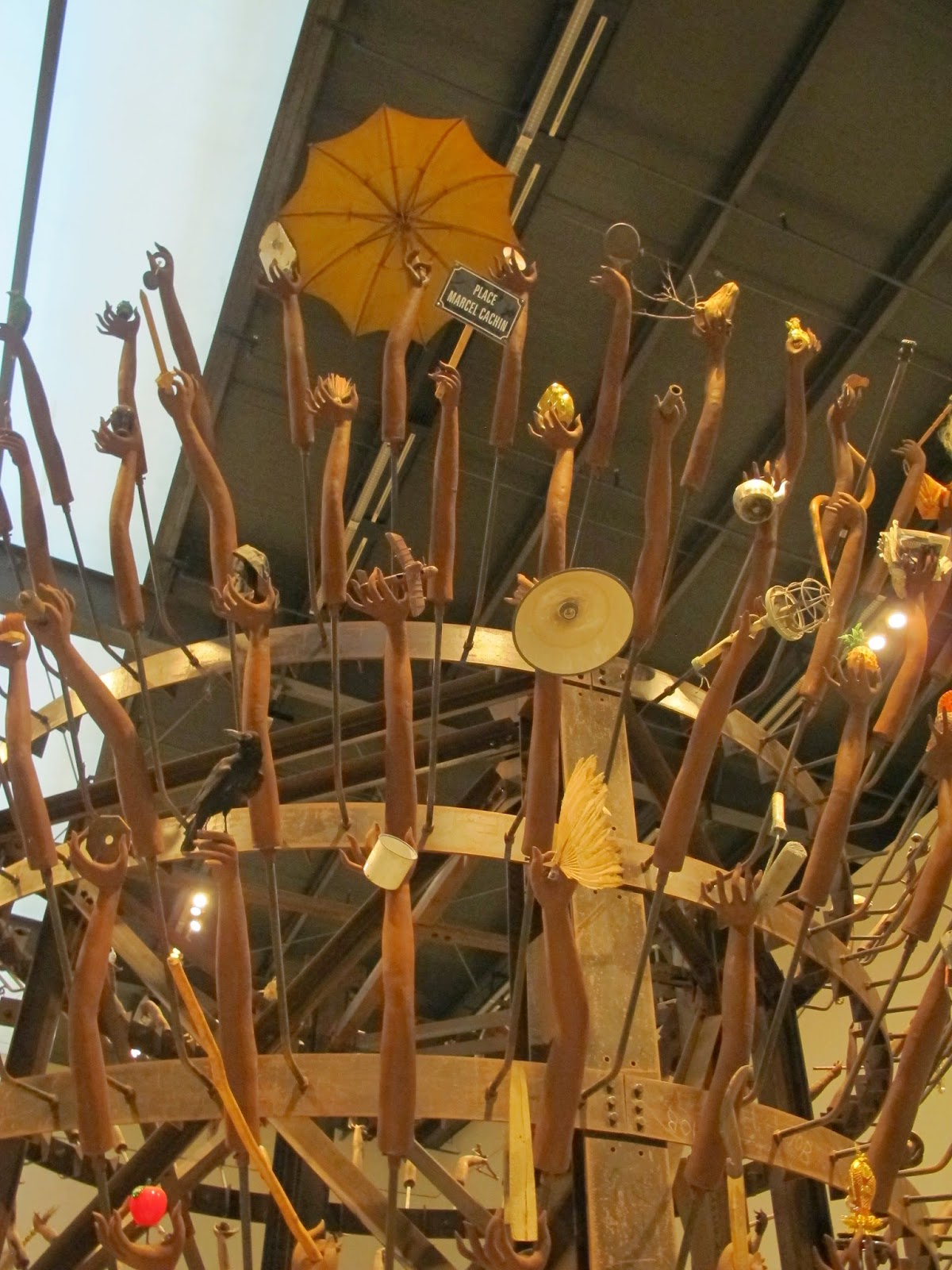
"The work does not give up its meaning easily, but it evokes a sense of unease and of impending disaster, a sensation which lingers. Huang questions prevailing norms and social systems, including art ‘systems’ such as the organisation of the museum and curatorial practices. In the 1980s, as a member of the radically nihilist "Xiamen Dada"group, he carried out a series of actions in which works of art were damaged, burnt and reconfigured, posing some big questions about the necessity for works of art to exist in a physical form. Once in Paris, his work became concerned with the deconstruction of history, religion, myth and philosophy. Click on the link to read the complete article, "Time Travelling in Shanghai" Before I went to the Red Brick Art Museum I read a review in a Beijing magazine which described his "Thousand Armed Guanyin" as a disturbing work consisting of severed, amputated arms, evoking mutilation and violence. This is clearly nonsense. The work is beautiful, meditative, deeply spiritual, and also witty and irreverant - quite a feat. An intentional homage to Marcel Duchamp’s ‘Bottle Rack’ blown up to Brobdingnagian dimensions, the work is also a nod to Tatlin’s unfinished ‘Monument to the Third International’, and a lament for the notion of a failed socialist Utopia.


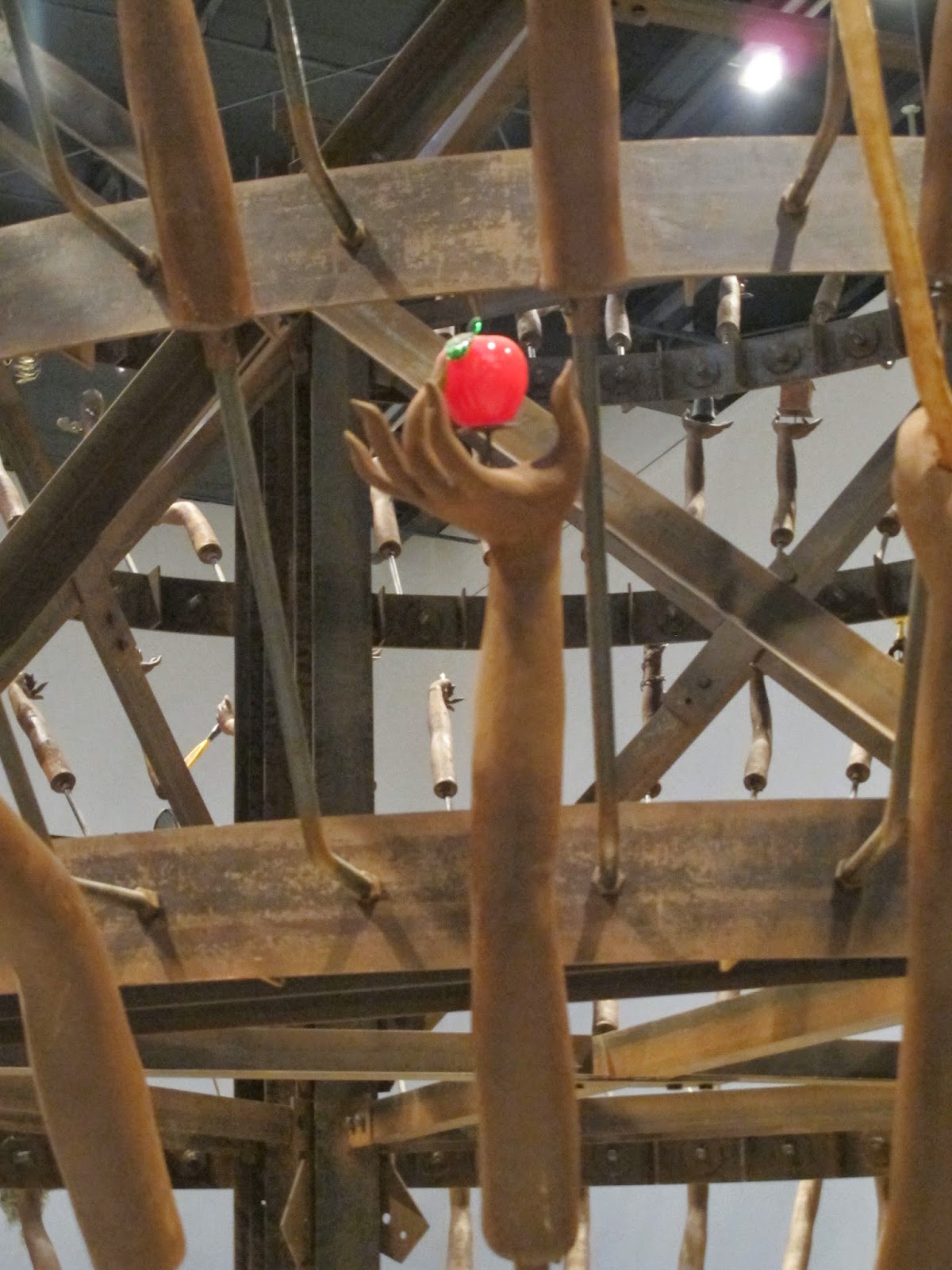
The thousand arms of the Goddess of Mercy protrude like mannequins in a shop window bearing unlikely objects – a tortoise, a broom, an apple, a skull, a mop, a book, a lantern. Despite being dismissed by Arts Asia Pacific as an ‘old monster’ the result is mesmerising. The artist himself has said that when invited to participate in a Sculpture Project in Germany he cane across an astonishing statue of Christ in Munster Cathedral, which had lost both its arms during WWII. A line scribbled next to the statue read "Your hands are my hands." Responding to the armless Christ, Huang decided to make his "Guanyin of a Thousand Hands", a Buddhist deity, 18 meters high (although here shown in three separate segments due to the height of the ceilings.) The artist said, "I have 'reproduced' the famous work in Western art history [the bottle rack] into an Oriental Buddhist Guanyin. The sense of detachment and indifference associated with the ready-made Bottle Rack is complicated and shrouded by various figures and symbols."
I was much less enamoured of "Circus" which appeared less refined and resolved than other works. Two giant wooden hands - one hanging from the ceiling and the other broken in pieces on the floor - reference marionettes and social control. A circus of headless animals encircle the space. The artist, always elusive and given to gnomically ambiguous utterances, has suggested that the work is about faith. It is also about control, and free will, or the lack of it.


#5: Cai Guo Qiang at Queensland Gallery of Modern Art "Falling Back to Earth", January 2014
I did wonder, "What is it about Chinese artists and Taxidermy?" as I encountered Cai Guo-Qiang's installations "Head On" and "Heritage" in Brisbane last summer. I wrote about this experience for The Art Life and Daily Serving.
Cai Guo-Qiang, Heritage, 2013. 99 life-sized replicas of animals, water, sand, drip mechanism; installed dimensions variable;
commissioned for the exhibition Falling Back to Earth, 2013; proposed for the Queensland Art Gallery collection with funds from the Josephine Ulrick and Win Schubert Diversity Foundation through and with the assistance of the Queensland Art Gallery | Gallery of Modern Art Foundation.
Falling Back to Earth’ consists of three monumental installations. Two new projects were inspired by his immersion in the Australian landscape and in his themes of humanity’s connection to the natural world. The third has a different resonance in an Australian context. ‘Head On’ was originally created for an exhibition in Germany, inspired by the dramatic, divided history of Berlin. ‘Heritage’, with its 99 replica creatures (polystyrene casts covered in hyper-real fur made from goatskin) gathered around a waterhole was inspired by Cai’s visit to the pristine environment of Stradbroke Island, and the fact that he considers Australia to be a kind of paradise. The title of the exhibition – his first solo show in Australia – evokes the traditional Chinese literati scholars’ yearning for nature and was inspired by a fourth century poem by Tao Yuanming. Why 99 animals? In Chinese numerology and in Taoist philosophy the number 9 is highly significant, representing completion, perfection and regeneration. 99 to Cai represents something that is yet to be completed.
This is the first time that the entire 3000 square metres of GOMA ground floor space has been given over to the work of a single living artist, and due to Cai Guo-Qiang’s global reputation international media – in particular Chinese language media – were targeted by the gallery, so expectations were high. ‘Heritage’ is the big drawcard and it is as spectacular as the gallery’s publicists would have us believe. There is a stillness that somehow transcends the crowds with their strollers and fidgety small children, and a feeling that you have entered a fairy-tale world where natural enemies can peaceably coexist. The enormous waterhole is surrounded by every conceivable kind of animal – zebras, giraffes, a horse, pandas, kangaroos, tigers, a lion, antelope - all creatures great and small. Their relative sizes and forms are exaggerated, enhancing the sense of unreality. They are rendered equal in their vulnerability as they drink, heads bent, from a huge pool of water. As you circumnavigate the pond, watching the animals and their reflections on the surface of the water, you slowly begin to think about the implications of this impossible scene. Cai has moved from the extra-terrestrial to the terrestrial, and invites us to think about our relationship with nature.
In ‘Head On’ 99 replica wolves appear as if in a freeze frame, arcing through the space in a graceful curve, only to hit the glass wall and slide to the floor, slinking back to begin the process all over again. In its original German setting this work had very particular connotations. Shown here, in conjunction with ‘Heritage’ it could be seen as an allegory of heroism, or as terrible misguided foolishness – a warning that those who do not learn from history are condemned to repeat it, perhaps. I thought about climate change deniers and the disastrous consequences of human decisions made in the interests of political expediency or short term greed. ‘Eucalyptus’ relocates a vast native gum, earmarked for clearing, to the gallery. Placed on its side it fills the architectural space and forces us to contemplate at close quarters its ancient, gnarled surface. Roots and branches stretch out like capillaries, touching the walls and inviting the visitor to walk underneath and look more closely at what we often take for granted. Cai visited Lamington National Park and was inspired by the giant Antarctic beeches and the primeval power of the landscape. Like the Chinese literati painters who found solace and a sense of the sublime in nature, Cai suggests there is both a moral and a spiritual dimension in our relationship to the land. We need to consider our place in the universe, our interconnectedness, and “fall back to earth.”

Cai Guo-Qiang China b.1957 Head On 2006, 99 life-sized replicas of wolves and glass wall. Wolves: gauze, resin, and hide  
                    Photo by Yuyu Chen, courtesy Cai Studio.
#6 and #7: "Reformation" and "Commune" at White Rabbit Gallery
My 6th and 7th selections are two shows at White Rabbit Gallery in Sydney. Perhaps this is cheating, but too bad, I am making up my own rules. "Reformation" early in the year, followed by "Commune" in the latter part of 2014 presented us with entirely different, and entirely fascinating, views of contemporary China. In writing about Reformation for The Art Life I noted the clever - and unexpected - "salon hang" of paintings from the collection. 
"The first thing you see is a dramatic “salon hang” of 37 paintings from the collection, a visual feast hanging ceiling to (almost) floor in the atrium. Wang Luyan’s Global Watch is a giant’s timepiece bearing the flags of China, the United States, Iran, Korea and other nations in a wry comment on the inevitability of global conflict. Above this hangs a 2006 work by his wife, Qin Fengling, Red, with her characteristic technique of tiny sculpted figures covering the entire surface, referencing submerging of individual desires to the collective, the overwhelming mass of the Chinese population. Lu Xinjian’s City DNA Beijing, part of a larger series representing numerous world cities, emerges from an examination of aerial views from Google Earth, revealing the sameness of the contemporary urban hub. A seemingly flat pictorial space, and a surface that appears to be an impenetrable code, or a diagrammatic representation of a flickering electrical charge, on closer examination reveals some of the distinguishing features of each singular place. In this work, the grid of Beijing, with the Forbidden City at its central meridian, merges into an incoherent jumble like every other place in the developed and developing world. Mondrian’s Modernist grid has become the language with which to expose the homogenising impact of globalisation." 
Lu Xinjian, City DNA Beijing, 2010, acrylic on canvas, 200 x 400 cm,
image courtesy White Rabbit Gallery
As an antidote to works exploring the stresses and strains of the contemporary world, Shi Zhiying’s glorious monochrome ocean vastness, her sea sutra, evokes the sublime, a meditation upon Buddhist notions of emptiness. Ma Yanling’s delicate portraits of Shanghai actresses of the 1930s, including Jiang Qing (Madam Mao) reveal her interest in the hidden history of women in China. Other works are more personal. Bingyi’I Watch Myself Dying, painted after the artist suffered an appalling accident resulting in serious burns and multiple surgeries, is a compelling, raw work which reveals her interest in European painters such as the Symbolist Odilon Redon as well as Chinese ink painting masters. Bingyi described her painting practice to me as “Intensely primal. It raises questions about our fundamental being – what is pain, what is suffering, what is loneliness?” Other highlights in this show were Wang Qingsong's cinematic allegorical staged photograph, "Follow You" and the evocative and clever paintings of young Beijing artist Huang Jingyuan.
Wang Qingsong, "Follow You" 2008 C-Print, image courtesy White Rabbit Gallery
Huang Jing Yuan "I Am Your Agency" 2013, image courtesy the artist
For me, the major highlight of "Commune" was the opportunity to see once again Gao Rong's extraordinary embroidered installation, a hyper-realist simulation of the simple house of her beloved grandparents, with whom she grew up in Inner Mongolia. This lifesize simulacrum, "The Static Eternity" is a way of freezing memory and stopping time.

#8: Liu Bolin, Jenny Holzer and Do Ho Suh
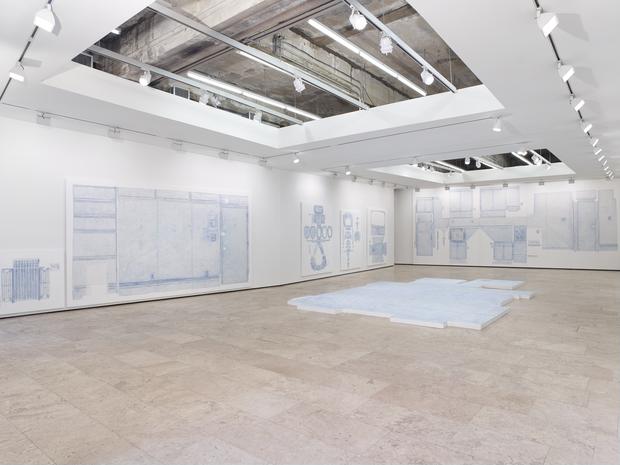
Cheating here (again) I am listing as number 8 three shows that I saw in one magical afternoon in Chelsea. Liu Bolin at Klein Sun Gallery, Jenny Holzer at Cheim & Reid and Do Ho Suh at Lehman Maupin gave me hope that globally, contemporary art is not moribund, despite what we might sometimes think after a visit to commercial galleries. And after some previously very dispiriting visits to the Chelsea galleries, this was a joyful experience despite the somewhat dark subject matter of some of the works. In the same afternoon I saw works by Mona Hatoum and Ai Weiwei. Do Ho Suh's fragile and evanescent recreations of his New York and Korean homes are just so damn beautiful. For this show, "Drawings" the artist used an intensive process of rubbing to record the physical space of every inch and every detail of his West 22nd Street apartment.  Art in America said, "By rubbing the skinlike surfaces with blue pencil, he creates a ghostly imprint of the most minute architectural details. The results fill both the gallery's venues, accompanied by a recent series of works featuring quasi-surrealist figurative images made of colorful threads embedded into paper."  
Do Ho Suh at Lehmann Maupin, Chelsea, installation view
Jenny Holzer's "Dust Paintings" were a whole other story. As is usual for Holzer, the works are textual, but the source of these sensually luscious paintings is declassified, highly redacted government documents recording acts of brutality and barbarism carried out by US forces in Afghanistan. Most of the text comes from  witness statements, transcribed with misspellings and other grammatical mistakes, concerning Jamal Naseer, an Afghan soldier who died in American custody. It is possible to lose oneself in the beauty of the painterly surfaces, to be brought up short by a sudden realisation of the import of the lushly painted brushmarks. Painting as document and as abstraction. Liu Bolin, too, is motivated to document aspects of his contemporary world, navigating the tricky terrain of avoiding polemic whilst taking a moral stance. 
Liu Bolin Head Portrait’ 2012. Courtesy Klein Sun Gallery, NY. © Liu Bolin
Best known for his ‘Hiding in the City’ series, in which he literally paints himself into various backgrounds, in cityscapes as diverse as Beijing, New York, London and Paris, Liu Bolin is sometimes called “The Invisible Man”. He is a master of a complex trompe l’oeil technique which allows him to examine the paradoxes and slippages of the contemporary world. Wearing a specially designed suit, the artist is painted by a team of assistants, in a painstaking and sometimes physically challenging ordeal, to merge almost seamlessly with his background. A disappearing trick; the artist as conjurer. No mere pop culture gimmickry, Liu Bolin’s process of erasure examines issues of contemporary culture and social justice, never more so than in his most recent exhibition in New York, at Klein Sun Gallery, ‘A Colorful World?’ In the lyrics of pop diva Cece Winans, “It’s a colorful world, it’s a beautiful world that we live in/ It’s a colorful world…” Well, perhaps, but Liu Bolin is interested in what happens when saccharine sentiments are juxtaposed with contemporary realities. Here we see works from the ongoing ‘Hiding in the City’ series, and new works created for the show. Liu also involved New Yorkers - 100 volunteers - who spent many excruciating hours being painted by the artist and his assistants for a new ‘Target’ series. Camouflaged into backgrounds of new $100 bills and a traditional Chinese ink painting, they were required to hold poses inspired by Renaissance paintings. The artist questions the ways in which people are made the passive recipients of consumerism, and the victims of political forces beyond their control. Underlying ‘Hiding in the City’, too, is the omnipresent smog and haze of pollution in Chinese cities, which Liu sees as rendering their inhabitants partially invisible, both literally and metaphorically.
Liu Bolin, Security Check No.2, 2014, 205x95x55cm. Courtesy Klein Sun Gallery, NY. © Liu Bolin
More recently, Liu’s concerns have become global in their scope. A key image from this show is a life-size standing sculpture, cast from the artist’s own body and covered with brightly coloured food packaging logos. The figure assumes the submissive pose required by airport security in the full body scanner. The posture is one of surrender, capitulation. What is more symbolic of the contemporary world (and the international world of the contemporary artist, in particular) than the airport, that liminal zone of ever more authoritarian surveillance juxtaposed with ever more shiny shopping opportunities? What pose could be more appropriate for the current moment? Klein Sun assistant director, Willem Molesworth, pointed out to me that the pose is also the bitterly ironic “Don’t shoot” stance of black youth protesting in Ferguson, a viral internet phenomenon and a new cultural trope which instantly traversed the globe. In subsequent weeks it was to be echoed by the Occupy Central demonstrators facing police teargas in Hong Kong. Click HERE for the full review of this exhibition.
Liu Bolin ‘In Junk Food No.5, 2014. Acrylic on copper 36x36x26cm. Courtesy Klein Sun Gallery, NY. © Liu Bolin
#9: Nam June Paik 'Becoming Robot' at Asia Society NYC
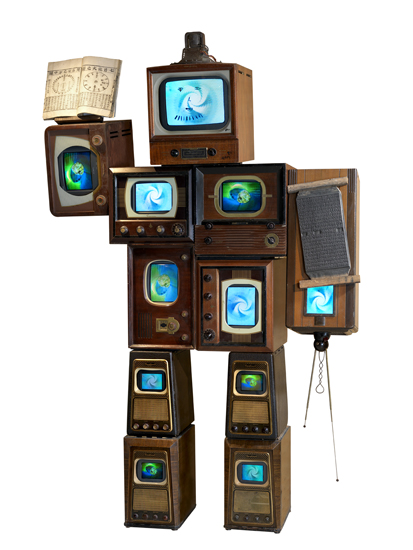
In the same week in New York I saw the Nam June Paik retrospective Becoming Robot at the Asia Society. The exhibition charmed and delighted me, suggesting that Paik was a kind of cultural boundary rider, an inter-galactic hitch-hiker.  New York Times critic Holland Cotter describes him as an “existential floater”, a visionary more comfortable with sound waves and satellites than with any terrestrial matters. The man who fell to earth, perhaps. He is often described as “the father of video art” and certainly he was one of the first artists to see the possibilities of working with very new technologies in a post-Dada re-framing of the readymade.
AS 048
Li Tai Po, 1987.10 antique wooden TV cabinets, 1 antique radio cabinet, antique Korean printing block, antique Korean book, 11 color TVs. 96 x 62 x 24 in. (243.8 x 157.5 x 61 cm). Asia Society, New York: Gift of Mr. and Mrs. Harold and Ruth Newman, 2008.2. Photo credit: © 2007 John Bigelow Taylor Photography, courtesy of Asia Society, New York
I must confess a particular affection and partisanship here. Nam June Paik’s collaboration with cellist Charlotte Moorman was my introduction to the playful possibilities of contemporary art, and its debt to Duchamp, when I was a young art student. Who can forget a nude Moorman playing a cello made of Perspex TVs in the Art Gallery of New South Wales? Or wearing them, in ‘TV Bra for Living Sculpture’? And this at a far more prudish time, in 1976, when vice cops had only relatively recently removed copies of Michelangelo’s David from David Jones Department Store on a charge of public indecency!
TV Buddha’, also seen in Sydney in the 1970s (thanks to John Kaldor) and in other versions since, has always seemed to beautifully encapsulate his mix of seriousness and play; absurdity and moral purpose. There is a version here at the Asia Society and amidst more theatrical works, later readymades, and video footage from the 1980s (which does, it must be said, look seriously dated) it retains a compelling power and stillness. A closed circuit television camera and a seated Buddha figure face each other on a white plinth. The Buddha is engaged in silent contemplation of himself. Walk into the frame and you too become a part of the work’s circular navel gazing. Past and present, East and West, sacred and secular, stillness and busy-ness. A Zen wake-up call to mindfulness? It echoes Paik’s interest in Zen philosophy, shared with his friend and collaborator John Cage. Unlike some of the other works in the exhibition such as the roughly hand-painted TV sets of the artist’s late practice, charming though they are, ‘TV Buddha’ lingers in the mind.
The New York show provides a new context for these works, and adds a contemporary spin to all the well-known details of his life and work: the collaborations with John Cage and Joseph Beuys; the philosophies of the Fluxus Movement and the blurring of boundaries between art, performance, music and what was called “electromedia” back in the ‘70s, in those heady days of experimentation. ‘Becoming Robot’ suggests that Paik predicted the kind of world we now inhabit; our constant interaction with screens of various kinds, the relentless connectivity, the overload of information, and the tension between controlling technology and being controlled by it. Paik himself said, “Our life is half natural and half technological. Half-and-half is good. You cannot deny that high-tech is progress. We need it for jobs. Yet if you make only high-tech, you make war. So we must have a strong human element to keep modesty and natural life.” Click HERE for the full review of the exhibition.
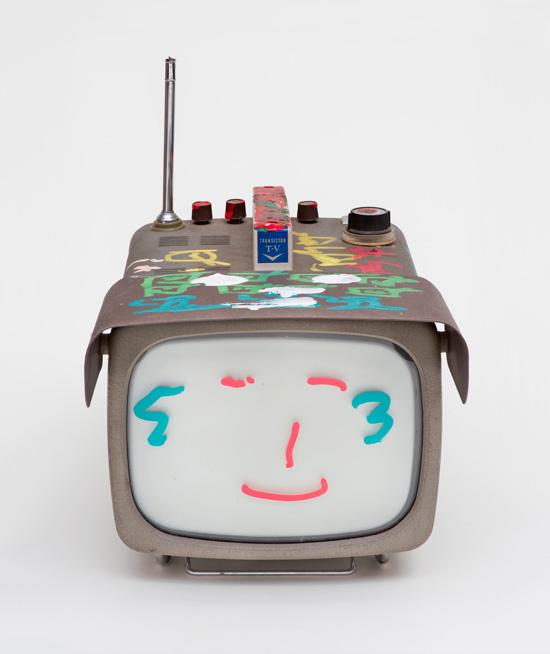
2. NJP Transistor TV
Transistor Television, 2005.Permanent oil marker and acrylic paint on vintage transistor television. 12½ x 9½ x 16 in. (31.8 x 24.1 x 40.6 cm). Nam June Paik Estate Photo credit: Ben Blackwell
#10: Xiao Yu, "Ground" at Pace Beijing, April 2014
Xiao Yu "Ground" 2014 image courtesy Pace Beijing
My final choice is very different. Xiao Yu's "Ground" (which might also be translated as "Earth") was literally as described. The vast space of Pace Beijing's 798 gallery was filled with earth, the smell of rich loam and the earthiness of the farmyard. During the installation it had been ploughed by farmers with teams of cattle. but only the earth remained, with photographic documentation of the time-based performative elements. There are inescapable echoes of Walter de Maria’s ‘Earth Room’, yet in a Chinese context, at this time in history, there are other interpretations. The enormous divide in wealth and opportunity between rural and urban China is a growing source of tension and social unrest, and the contempt with which city-dwellers regard the countryside always surprises foreign visitors. Alienated from cycles of growth and renewal, fearful of food safety scandals and toxic contamination, Chinese consumers have come to regard their food, and the soil and water which produces it, with fear and suspicion. Is this a metaphor for the ‘nothingness’ within the artworld as pointed as Xu Zhen’s supermarket filled with empty packaging? It takes us full circle to Xu Bing and his admiration for the skilful labour of rural migrants, transplanted into big Chinese cities in search of a better life for their families. And to an idea, unfashionable in some circles, that art actually can and should matter.
In the interests of full disclosure, as they say, some of the artists in the exhibitions referred to above will be included in my forthcoming book "Half the Sky: Women Artists in China", published by Piper Press in 2015. Shi Zhiying, Bingyi, Huang Jingyuan, Ma Yanling, Qin Fengling and Gao Rong were all interviewed for that project, along with 25 other contemporary female artists.

Wednesday, December 26, 2012

A Window Suddenly Opened: New Photography in China

Chu Haina, 隐秘的风景1号 (Hidden Landscape No.1) 2006
 43cm x 30cm*3. Photograph| Digital printing
Image reproduced with permission of the artist

To coin a phrase: "What is it about contemporary photography in China that makes it so different, so revealing?"

 I have been reading a fascinating article in 'Glass' (the Autumn 2012 Asian edition about all things stylish, arty and Chinese) about the genesis of contemporary photographic practice in China. And musing over my meeting at Three Shadows Photography Art Centre in Beijing this month where I asked some hard questions of  International Programs Director, Jillian Schultz, about how female photographers are positioned in the Chinese artworld, and about how collectors and serious art buyers see photography in an art market still very much dominated by painting (more on this meeting later.) 

Photographic practice now in China is a vital, continually evolving and often a sensational and provocative art form. Since the emergence of contemporary Chinese art as we know it in the 1990s, in the experimental art communities such as Beijing's 'East Village', painting, sculpture, performance, installation and photography have merged and blurred, often in the practice of individual artists such as Hu Jieming or Wang Jianwei. Younger artists such as Huang Xu and Chen Hangfeng also exhibit this willingness to blend photographic practice with a range of other expressive forms in order to communicate particular ideas. 


Huang Xu, 'Fragment: Plastic Bag No 31',
 image reproduced with the permission of the artist and China Art Projects
Chen Hangfeng, 'Where the Wind Comes From
image reproduced with permission of the artist
See the link to the video by clicking on the title above
In 1996 photographer Rong Rong (who established Three Shadows with his Japanese artist/photographer wife, Inri) wrote an introduction to the third issue of avant-garde journal 'New Photo': "When CONCEPT enters Chinese photography, it is as if a window suddenly opens in a room which has been sealed for years. We can now breathe comfortably, and we now reach a new meaning of 'new photography.' " The metaphor of the window suddenly opening could be applied to all avant-garde art, blossoming after years of repression, but most particularly applies to photography.

Some historical background

Contemporary photography in China emerged from the tight control of its use as a propaganda tool between 1949 and Mao's death in 1976, and achieved a dramatic Renaissance in the 90s which culminated in the important 2004 exhibition at the International Center for Photography in New York, "Between Past and Future"

An interesting historical perspective is revealed in Peter Yeoh's 'Glass' article. William Henry Fox Talbot and Louis Daguerre developed the photographic process in the same year that the First Opium War erupted, which led to the British control of Hong Kong. The first British Governor of Hong Kong presented a photographic portrait of himself and his family to the Guangdong Governor General, Qi Ying, who then requested a reciprocal photographic portrait from the Emperor. This is the earliest evidence of official Chinese contact with photography. By 1846 foreigners had set up photographic studios in Hong Kong and in the 1870s Chinese owned and operated studios opened in treaty ports such as Shanghai, but were suppressed by the Qing government who saw them as spreading Western culture. Later, in Shanghai, there were photographic studios owned by European Jewish refugees. In fact one was recently rediscovered in the lead-up to the Shanghai Biennale, with a stock of old photographs and negatives intact. The story of one such studio (the most successful in Shanghai in the 1920s, with 4 branches, run by a Jewish immigrant who gave himself the new name and identity 'Sam Sanzetti') can be read on 'American Photomag'. When 'Sanzetti'  left China in the 1950s he took with him 20,000 photographs. I recently met a woman in Sydney whose father, a White Russian, owned a photographic studio in Harbin in the 30s and 40s, photographing local identities both Chinese and European. 


1920s Studio Portrait from the Shanghai studio of Sam Sanzetti

And now?

Yeoh says that "contemporary Chinese photography can be confounding to viewers in the West." Certainly it is necessary to know the points of reference, whether that be a reinterpretation of the tropes of literati painting, historical events from the Imperial or revolutionary past, references to the Cultural Revolution or to more recent events in Chinese history. Staged photographs such as Wang Qingsong's iconic tableaux are popular with artists intending to comment on the extraordinarily rapid pace of change in Chinese society.


Wang Qingsong Can I cooperate with you, 120x200cm, 2000
(
http://www.wangqingsong.com/)
 Sometimes the reference points are elusive. I recently saw works by Birdhead, the Shanghai duo who document their city and its inhabitants in black and white images, in the 2012 MOMA New Photography show as well as the Shanghai Biennale, and found the works difficult to engage with. Works by Liu Xiaofang, on the other hand, with her dreamy and evocative 'I Remember' series featuring a small girl in a white dress with a red Pioneer scarf are much easier to like. Yao Lu makes works that initially look like traditional misty ink paintings featuring mountains, lakes and waterfalls, which on closer inspection reveal themselves to be constructions entirely made up of garbage such as discarded plastic bags. He is working in a well-mined idiom very popular in Chinese art. 
Yao Lu, New landscape part I – Ancient Spring Time Fey, 2006
Courtesy of 798 Photo Gallery, Beijing
The artist photographs mounds of garbage covered in green protective nets which he reworks and digitally manipulates to create images of mountain landscapes shrouded in the mist inspired by traditional Chinese paintings. "Lying somewhere between painting and photography, between the past and the present, Yao Lu’s work speaks of the radical mutations affecting nature in China as is it subjected to rampant urbanization and the ecological threats that endanger the environment." (eflux)

Another photographic artist who has used the 'moon window' as a device to suggest links to the classical past and to the iconography of the garden in all its complex layering of meanings, as well as to traditions of ink painting, is Han Lei. Other aspects of this artist's practice, such as the photographs of large fleshy naked women wearing bunny ears and furry bunny rabbit slippers, are another matter entirely!
Han Lei, Yellow Mountain 15, Lambda Colour Photograph

Huang Xu, Fragment, Plastic Bag No. 30
Image reproduced courtesy of the artist and China Art Projects
Likewise Huang Xu's photographs of plastic bags, arranged and lit so they become objects of great beauty, taking on the appearance of the 'scholar rocks' found in Chinese classical gardens.He has exhibited his photographic work (he also works as a sculptor and a painter) in Beijing, London and in Australia, presenting ethereal large scale C-prints exploring "the fragile nature of the contemporary global economy." (http://www.octobergallery.co.uk)  Tattered plastic bags, seen everywhere floating in the air and lying on the ground in Chinese cities, towns and villages, were collected and digitally remodelled, sometimes by using 3D scanners. They evoke the sublime, but they are also suggestive of the decay and destruction inherent in the transformation of today's China. Luminous and beautiful, dramatically lit to recall the chiaroscuro and billowing drapery of Baroque paintings, it has been said that they also resemble the fine silks of imperial China, recalling trade links between East and West. 
Huang Xu, Fragment No 26, C-Print, shown October Gallery London 2009,
reproduced courtesy of the artist and China Art Projects
"Using artifice to reconfigure traditional paintings of landscapes into hyper-modern expressions is also a central approach in contemporary Chinese photography" says Yeoh. And not only in photography - Chen Hangfeng has done something similar in video, with his 'Where the wind comes from', as has Taiwanese artist Chen Chun- Hao with his “Imitating Fan Kuan’s ‘Travelled Among Mountain and Streams from the Song Dynasty” which appears at first to be a lyrical, misty landscape painted in ink. On closer inspection, however, one sees it is made entirely with headless steel pins punched through the work with a nail gun - 750,000 of them. In reviewing this and other works shown in 'Down the Rabbit Hole' at the White Rabbit Gallery for 'The Art Life' I wrote, "Beauty and tranquillity on the surface, but with an underlying reminder of mechanical ‘fakery’. In Chinese tradition, the copying of historical paintings is an act required of the scholar. This artist, however, reinvents and subverts the act in a similar manner to Xu Bing’s ‘Background Story series, where apparent ink paintings, re-creating old masters from the Song Dynasty, are constructed with rubbish and debris, back lit behind a screen."
Xu Bing, 'Background Story', shown in 'Dead and Alive' at the Museum of Arts and Design, New York, 2010
One of my favourite Chinese photographers is Chen Jiagang, whose work I first encountered at 'Contemporary by Angela Li' Gallery in Hong Kong in 2009. It was a revelation to me. Melancholy, beautiful, elegiac, romantic yet cynical - the works have so many of the features that I associate with contemporary China and its art and literature. Chen uses specially created negatives and a large format film camera to create these staged images.

The Great Third Front-66, Chen Jiagang, 2008
Power Station, Galeries Paris-Beijing
Chen Jiagang, Wharf in Old Chongqing, from the 'Smog City' series
Artist's web site: http://www.chenjiagang.com/EnWorks.aspx
Emerging Beijing photographer Chu Haina lives and works in Caochangdi and uses her camera to record images which have the fleeting and melancholic beauty that she seeks, as well as a puzzling and intriguing ambiguity. She principally  uses black and white film, and works with minimal digital manipulation. We met in early December at a gallery and at her tiny one-room apartment in Caochangdi, and spoke at length about her practice. At Egg Gallery her work was showing in a group exhibition called 'Light Sensation', which had the somewhat bizarre tag line,"The classical aesthetics give the feeling of being more familiar and friendly" which gives you some idea of the generally mystifying and appalling quality of the art writing found in many Chinese gallery publications, catalogue essays and wall texts. In conversation she revealed that her favourite photographers are Diane Arbus, (no suprises there - how many young photographers have been inspired to take up a camera after seeing her work for the first time?) Bernard Faucon and the Taiwanese Juan I-Jong, whose photographic theory books had a profound impact on her and "touched the road I started as a photographer".

 Influential Chinese practitioners of the pioneering generation include Han Lei and Wang Ningde well as Wang Qingsong. More and more young artists are choosing photography as their medium, she believes, because it is both more "mobile and more direct". There are many 'salon photographers' and mutually supportive photographers' groups in Beijing. and the support and recognition from institutions such as Three Shadows Gallery (and, in particular, 'Caochangdi Photospring' each year) encourages more Chinese artists to work in this medium.
Wang Ningde, image from the 'Some Days' series

Wang Ningde, image from the 'Some Days' series

The lyrical black and white melancholy found in Wang Ningde's works finds its echo in Chu Haina's approach to her work - she believes it is what she can see through her viewfinder, rather than how she can manipulate it later, that is the important thing. Chu tells me that she found Hiroshi Sugimoto's, exhibition at Pace Beijing in July of 2012 hugely influential. The work of this artist, which she had admired since first seeing it in 2002, made her realise to what extent photographic works can contain within them layers of meaning and a deep philosophical intent. She is careful to avoid explaining too much about her works - and even adroitly evades my direct questions about the subjects of some of the more ambiguous images. "I want my photographs to trigger a feeling, or maybe a memory", she says.

Chu Haina隐秘的风景3号, Hidden Landscape No.3, 80cm x 50cm
Photograph| Digital printing,  2004
Chu Haina with her work at Egg Gallery, photograph Luise Guest, reproduced with the permission of the artist
Chu Haina, Extension, Digital C Print, 80 x 120, 2003, image reproduced courtesy of the artist and Redgate Gallery
In my conversation with Jillian Schultz at Three Shadows Gallery, she is rueful about the fact that there is as yet no national photography collection, and still as yet little strong scholarship or connoisseurship in China regarding photomedia. But local interest and awareness is growing, in large part due to the work of Rong Rong and Inri at Three Shadows, with its clearly stated mission to promote and discuss contemporary Chinese photography. "What makes Chinese photography different?" I ask her. She tells me that there is now a strong interest in alternative processing, 'low-fi' techniques such as i-phone photography, and the production of independent artists' photo-books,as well as a shift away from digital manipulation of images. When I say that it seems to me that those are aspects of photographic practice which are engaging artists internationally, she thinks for a  moment and then tells me that the newest and most interesting aspect of current practice in China is that it is becoming far more nuanced and subtle "capable of saying lots without saying much at all", by which she means that meanings are layered and artists are representing and critiquing aspects of their changing society in much less obvious ways than in the past. 

As an example, she introduces me to the work of Wang Lin, who won the Shiseido Prize in Caochangdi Photospring this year. Formerly a flight attendant on a regional airline, she documented the life of her peers in documentary black and white images which together form a compelling narrative. She was dismissed from the airline after someone anonymously posted her photographs on the internet. In 'Dreams of a Stewardess' she shows us not the supposedly glamorous life of these independent women, but the tedium and loneliness, the hectic schedules, as well as the intimacy of a life shared with other women crammed into dormitories not unlike those of the much despised migrant workers in southern China. "Her subjects can surrender totally in her presence, oblivious to the presence of her camera. This fusion of the photographer with her subjects gives us a unique window into an un-suspected micro-universe." (Jean Loh, Trans Asia Photography Review)
Wang Lin, “From the window of the dormitory at Tianjin airport”,
 from 
Heaven & Earth series, 2009, 50x40cm.
Wang Lin, “Resting and reading papers on board flight Changsha-Kunming”,
from 
Heaven & Earth series, 2007, 50x40cm.
Wang Lin, “Waiting for passengers to board the flight from Tianjin-Changsha”,
from 
Heaven & Earthseries, 2008, 40x50cm.
Wang has been compared to Nan Goldin in her use of unsentimental, everyday imagery. Like many young photographers (and artists) in China today she is unencumbered by memories of the Cultural Revolution or the 'June 4th' Tiananmen movement and its aftermath of cynicism and wariness. Both materially and conceptually there are significant changes occurring in the practice, and the identity, of a younger generation of emerging artists. Schultz told me that the change she would most like to see (apart from a willingness on the part of collectors to buy photographic works) is a shift in thinking to embrace scholarly research and criticality. This, she believes, would give the work of many young photographers a greater conceptual depth. It is beginning to happen now.

And finally?

Photographic practice in China, as with artists working in every other medium you can think of, is vital, energetic and dynamic. There may be opportunities for young artists (and for women artists) in photography that are harder to come by in other forms. It is not so long ago that a gallery director infamously told Liang Yuanwei that she should try photography as "there are already too many female painters"! As Peter Yeoh concludes in his 'Glass' article, the reinvention of photography in China continues, but now many artists are taking the time to reflect more deeply on their practice and consider how it can develop in new and unexpected directions. He is a bit gloomy about what he sees as the loss of a willingness to experiment and combine genres and influences in 'mash-ups' creating bizarrely wonderful hybrid forms. However I am sure that Chinese photography will continue to possess the inventiveness, the playfulness and the imaginative freedom that has distinguished it to this point.


Chu Haina自然世界4号 Hidden Landscape No. 4, 80cm x 50cm
Photograph| digital printing, 2006
Image reproduced with permission of the artist