The ongoing thoughts of an art teacher in China - and home in Sydney

A continuing diary about my travels in China, and thoughts about China and Chinese art from home and abroad
Showing posts with label Xu Zhen. Show all posts

Sunday, December 20, 2020

Watching the Moon: The end of a terrible year

Pixy Liao, 'Things We Talk About', 2013, image courtesy the artist


In normal times at this tail end of the year I would write a kind of  'best of'' list of the art, the exhibitions and the most memorable artworld moments of 2020. I know, I know, it's kind of lame and a cliched media trope, but I have always enjoyed looking back over my calendar and sorting through all the many and varied experiences. Well, as we all know, these are not normal times, and this year there are vanishingly few things to talk about. The lasting experience of 2020 is of solitude mixed with uncertainty, boredom, and occasional lapses into existential despair. Life became very small as I encountered my students and colleagues mostly on Zoom, and seized precious socially distanced opportunities to see family and friends. I have tried to be more aware of the natural world, the turning of the leaves, the singing of birds in the garden, the sunsets and the moon - but frankly I'm often reading or watching Netflix and shamefully I see the moon and the sunsets in other people's Instagram photos more often than in reality. And as for art.....

The final exhibition I saw before the onset of Sydney's lockdown in March, somewhat nervously due to the increasingly serious pandemic, was 'Xu Zhen: Eternity Vs. Evolution' at the National Gallery. I felt that the visceral spectacle of the works, which had been so evident in the major survey exhibition at Beijing's UCCA and in various shows at White Rabbit Gallery, was somehow diminished inside the rather dark concrete spaces of that Brutalist Canberra building. 

XU ZHEN® "Hello", installation view, Photograph: Luise Guest

The best critical account of that exhibition is by Alex Burchmore, in Randian. Of the snake-like, moving Corinthian column activated by visitor movement he writes: ''the voluptuous coils of ‘“Hello”’ (2019) take pride of place in ‘Eternity Vs Evolution’, towering over the viewer and following their every move with a baleful gaze that threatens consumption by the emptiness of the void (and note the inclusion of quotation marks in the title). The caption for this work draws attention to the historic prestige of the Corinthian column that Xu has chosen for the body of his serpent, ‘first created in ancient Greece [as] a symbol of power, prestige and western civilization.’ Yet the flaccid immobility of this automated guardian, save for the hesitant and creaking sway of its pediment-head when activated by the approach of the viewer, inspires more pity than dread. Carved in soft and yielding Styrofoam, this is a column devoid of all function, a structural support incapable of supporting its own weight, spectacular in scale but hollow within. As such, ‘“Hello”’ offers a clue to the underlying message of the exhibition: that which seems invulnerable and eternal is often little more than an artfully contrived illusion, while the evidence of our own eyes is rarely as straightforward as it seems and inevitably colored by the assumptions that structure our view of the world.'' Read the full article here. 

Lindy Lee, 'Moonlight Deities', installation view, photo: Luise Guest

Lindy Lee, No Up, No Down, I Am the Ten Thousand Things, 1995/2020, installation view, Lindy Lee: Moon in a Dew Drop, Museum of Contemporary Art Australia, Sydney, 2020, photocopy, synthetic polymer paint, ink on Stonehenge paper, dimensions variable, image courtesy the artist, Sutton Gallery, Melbourne and Museum of Contemporary Art Australia, Sydney and © the artist, photograph: Anna Kucera

I managed to briefly see a small part of Brook Andrew's Biennale of Sydney before it closed and then, once museums re-opened, enjoyed a visit to an almost empty Museum of Contemporary Art to see 'Lindy Lee: Moon in a Dewdrop' (about which, more later). Apart from those experiences, months apart, the wonderful 'Indonesia Calling' at 16 Albermarle Project Space turned out to be one of those increasingly rare experiences - an exhibition that was curatorially coherent and visually and conceptually exciting. John McDonald's curation of an exhibition of work by extraordinary (and eccentric) ink painter Li Jin for Vermilion Art, 'To Live [It Up]', was also interesting, providing a different view of the artist's work than the big survey show of his career that I had seen at Ink Studio in Beijing in 2019. It's great to know that a number of works were acquired from this exhibition for the collection of the Art Gallery of New South Wales. 


Works by Li Jin shown at Vermilion Art in November

So, in this globally calamitous and personally very challenging year, how to make some sense out of the chaos and confusion? Is it even possible in this year when the president of the United States is advocating a literal military coup to contest an election he lost, and when so many of us have lost faith in our governments' responses to the pandemic that has devastated the globe. We are increasingly divided, angry, sad and cynical.

Among the many losses of the year, a bright spot for me was the realisation that it was still possible to continue my conversations with Chinese artists, albeit (sadly, and who knows for how long) not face to face in their studios. I've spoken with Pixy Liao, Cao Yu, Liu Xi and Shoufay Derz via email, Facebook and Wechat and have had articles published in a range of print and online journals that I've referenced in previous blog posts, including most recently an article in Art Monthly Australasia.

Pixy Liao, 'Ít's Never Been Easy to Carry You', 2013, image courtesy the artist


These conversations were interesting and thought-provoking, challenging some of my assumptions about art, feminism and China, which is always a good thing. I take these ideas now into the chapter for a book that I am working on, so watch this space! Here is the opening section of the Art Monthly piece.  In the extract below I've left out the footnotes and references, just to make it more readable in this blog format:

 'Public Bodies, Private Lives: the work of Cao Yu and Pixy Liao'

In the cold Beijing winter of 2012, I interviewed Lin Tianmiao – often described as one of very few feminist artists in China. She told me bluntly, ‘There is no feminism in China. It’s a Western thing.’She meant, I think, that Euro-American feminism/s were not especially relevant to the experiences of Chinese women – and also that she resisted being silo-ed in a still-patriarchal Chinese artworld as a ‘woman artist’. It is generally acknowledged, as Shuqin Cui recently argued, that ‘few Chinese women artists would welcome the label of feminist art or categorize their work as feminist art even if the feminist dimensions of their work were clearly evident.’ Nonetheless, many artists grapple with issues of gender and challenge heteronormative stereotypes. A feminist self-identification is not especially significant, as art historian Joan Kee noted: The question is not whether women artists from Asian countries identify themselves as feminists, or whether their work imparts feminist messages. Instead, the issue concerns the logic of interpretation’. Feminism is embodied in nuanced and culturally specific ways in the practice of many contemporary Chinese artists – even if they disavow the label.  When I spoke with multi-disciplinary artists Cao Yu and Pixy Liao, they expressed reservations about being pigeonholed, yet their work powerfully challenges essentialist notions of the ‘feminine’.

Cao Yu, 'Mother' series, installation view, image courtesy Cao Yu and Urs Meile Beijing/Lucerne


Cao Yu, 'Everything Will Be Left Behind', installation view (above) and detail (below), image courtesy the artist and Urs Meile Beijing/Lucerne

You will find the whole article in the Summer 2020/2021 issue of Art Monthly Australasia.

Perhaps, at the end of a year that has been so terrible for so many across the globe, at the mercy of a virus (and I don't mean the one in the White House) we come back to the knowledge of our tiny insignificance in the vastness of the universe. Lately I am finding that comforting rather than frightening. The title of Lindy Lee's exhibition 'Moon in a Dewdrop' is a reference to the writings of 
Dōgen, the 13th century Zen monk who brought Buddhism from China to Japan. Lee is a practising Buddhist and the philosophy informs her life and art. I think of the artists I know in China whose study of Daoism similarly inflects their work, and their reactions to the world and its suffering. We too are the 'ten thousand things' - everything under heaven - in a constantly fluxing relationship with the world and everything in it - light and dark, health and illness, solitude and companionship. Well, I'm working on that level of acceptance. Mostly failing. It's a process.

Lindy Lee, Buddhas and Matriarchs, 2020, installation view, Lindy Lee: Moon in a Dew Drop, Museum of Contemporary Art Australia, Sydney, 2020, flung bronze, image courtesy the artist, Sullivan+Strumpf, Sydney and Singapore and the Museum of Contemporary Art Australia, Sydney with the assistance of UAP and © the artist, photograph: Anna Kucera

As Dōgen said of himself watching the moon:

‘Sky above, sky beneath, cloud self, water origin’


Saturday, January 2, 2016

The List: Ten Moments that Mattered

Cruising lazily out of the choppy seas of 2015 and into the uncharted waters of 2016 I have been reviewing experiences of Chinese art, and China, and doing that very cliched thing: making a list. I've read so many of these in the last few days. Lists of the best and worst of the year are metastastizing everywhere, from movies and music to food fads (kale is gone, you'll be glad to know) to the most over-used words of 2015 (''bae'', apparently, and I am sadly so out of touch with popular culture that I could not tell you what it even means) The list mania appears to be contagious. I decided to launch into my own "best of" compilation of art highlights - and a few lowlights. It's entirely personal; my retrospective musings over a year filled with art, mostly Chinese.

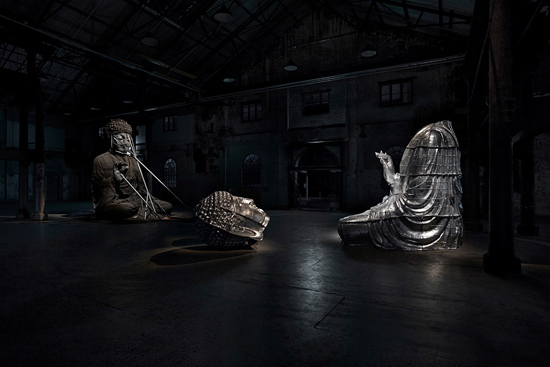
1 January saw Sydney audiences enthralled by the ever-so-slowly crumbling face of a giant Buddha made of ash from the burned prayers of temple worshippers in China and Taiwan. Zhang Huan, having reinvented himself entirely from his earlier persona as the bad boy of '90s violently masochistic performance art, presented this latest iteration at Carriageworks. And it was rather wonderful. I wrote about meeting the artist and encountering the silent presence of 'Sydney Buddha' for The Art Life. Click HERE for the story.
sydney buddha 3
Zhang Huan, 'Sydney Buddha'' installed at Carriageworks, image courtesy the artist and Carriageworks

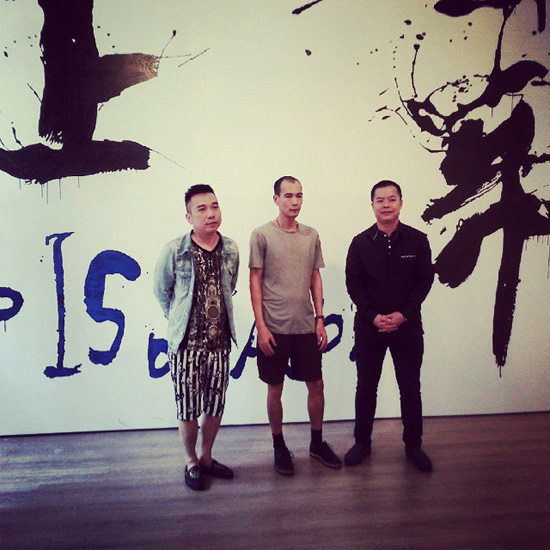
2 January also saw some younger Chinese bad boys hit town - the Yangjiang Group arrived with their unique brand of artistic anarchy for a crowd-funded project, 'Áctions for Tomorrow',  at 4A Centre for Contemporary Asian Art. Along with a bunch of other bemused scribes I had tea with the artists. So. Much. Tea. It was an artwork, and we were part of the art. Previously their performances of 'Fan Hou Shu Fa' (After Dinner Calligraphy) had involved prodigious feats of alcohol consumption, but they now stick mainly to tea, which they had brought with them from their home in Guangdong Province. What did we see in the gallery? Wax dripped over a shop full of mass produced clothing to create a frozen monument to retail therapy? Check. An installation of the remains of 7,000 sheets of paper covered with text from Marx’s Das Kapital in Chinese calligraphy, over which simultaneous games of soccer had been played? Check. A 24-metre mural juxtaposing expressive Chinese characters with scrawled English text reading “God is Dead! Long Live the RMB!”? Check. When I presumptuously asked if this last had a connection with their views about a materialistic new China, Zheng Guogu shook his head sadly at my outdated desire to find meaning. That's entirely beside the point, he said. Anti-art? To misquote the Chinese Communist Party’s description of socialism in the global marketplace, perhaps this was “dada with Chinese characteristics.” I wrote about my interview in Daily Serving. Click HERE for the story.
The Yangjiang Group at 4 A Centre for Contemporary Asian Art (Zheng Guogu in centre) photo: Luise Guest

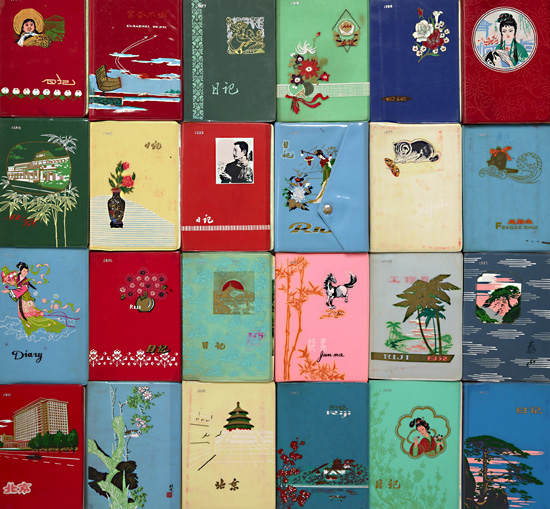
3 In February I was a little bit preoccupied with arranging a wedding, and I have zero recollection of March to April. May brought the Sherman Foundation exhibition of Yang Zhichao's 'Chinese Bible'. Yang is another Chinese performance artist becoming a little less inclined in middle age to punish his own body with the surgical insertion of various objects - reputedly at the insistence of his daughter. Chinese Bible is a beautiful and important installation - part art, part anthropology, part social action. Not unlike his good friend Ai Weiwei, Yang Zhichao made a formalist, minimalist arrangement of found objects, some dating from the Cultural Revolution. 

Historical experience is written in iron and blood,” said Mao Zedong. In Chinese Bible, historical experience is written in thousands of humble, mass-produced notebooks once owned by ordinary Chinese people, their worn covers testament to the weathering of time and the vicissitudes of social change. Ai Weiwei says, “Everything is art. Everything is politics,” and Chinese Bible reveals a similar approach to art as a form of social engagement. I interviewed Yang Zhichao at SCAF with the translation assistance of Claire Roberts, who curated the show and had written a most wonderful catalogue essay. They told me that after the installation, on their way to a celebratory lunch in Chinatown, they asked their Chinese taxi driver if he would like to see the exhibition. He said he could not possibly, his memories are so painful it would make him weep. Later, in October, I met sculptor Shi Jindian at his home and studio in the mountains outside Chengdu. Disarmingly humble, polite and hospitable, as the day wore on he was becoming monosyllabic and I was worrying about why my interview with this artist was proving to be such hard going. He suddenly said, "I have lived through every period of recent Chinese history, and it was all terrible. I don't want to talk about the past." Like the Sydney taxi driver, and for so many others of his generation, there are just too many bitter memories. You can read the article and my interview with Yang Zhichao  HERE.
Yang Zhichao Chinese Bible, 2009 (detail) 3,000 found books Dimensions variable Image courtesy: the Gene and Brian Sherman Collection, and Sherman Contemporary Art Foundation, Sydney Photo: Jenni Carter AGNSW
Yang Zhichao, Chinese Bible, 2009 (detail, 3,000 found books, Dimensions variable
Image courtesy: the Gene and Brian Sherman Collection, and Sherman Contemporary Art Foundation, Sydney
Photo: Jenni Carter AGNSW
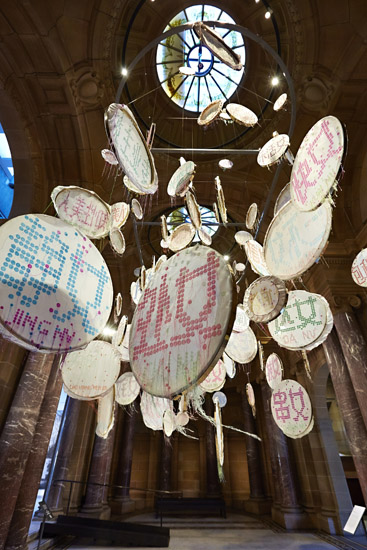
Lin Tianmiao, Badges 2009 White silk satin, coloured silk threads, gold embroidery frames made of stainless steel; sound component: 4 speakers with amplifier. Dimensions variable, diameters range from 25 cm - 120 cm, 266 badges total. Image courtesy: The Gene & Brian Sherman Collection, and Sherman Contemporary Art Foundation, Photo: Jenny Carter
4 In the second part of this exhibition, 'Go East' at the Art Gallery of New South Wales, curated from the Sherman collection by Suhanya Raffel, it was wonderful to finally see Lin Tianmiao's 'Badges' hanging in the imposing domed vestibule. Visiting her studio in 2013, I had watched her assistants stitching the texts, words describing women in Chinese and English, onto embroidery hoops. I had wondered what they were thinking as their nimble fingers stitched words like "Slut", "Whore" and "Fox Spirit" (a terrible name for a woman in Chinese.) I was amused in Sydney, where all the badges were Chinese,  to encounter shocked groups of Mandarin speaking tourists making their children look the other way. In this show, in addition to works by Zhang Huan and Song Dong, Yin Xiuzhen's 'Suitcase Cities' were a highlight. A newly commissioned work by Ai Weiwei intrigued my students. An Archive’ is a collection of the artist’s blog posts, banned since his efforts to name the children killed in the 2008 Sichuan earthquake attracted the attention of the authorities, presented in the form of traditional Chinese books in a beautiful timber box. A clever and more than usually subtle representation of Ai's resistance to the censorship and constraint that saw him confined to Beijing without possession of his passport, constantly under surveillance, until 22 July this year.


Kawayan De Guia. Bomba, 2011; installation comprising 18 mirror bombs, sputnik sound sculpture; dimensions variable. Collection of Singapore Art Museum. Courtesy of Singapore Art Museum
5 In July, in Singapore, I saw 'After Utopia: Revisiting the Ideal in Asian Contemporary Art ' at the Singapore Art Museum, confirming my suspicion that after 'the sublime', 'Utopia' was THE buzzword of the 2015 artworld. It was an excellent and intriguing riff on the theme, featuring familiar works by Shen Shaomin and The Propellor Group with others that were new and wonderful discoveries. I loved 'Bomba': Eighteen sparkling 'bombs' hung in a darkened space. Terrifying disco balls promising destruction, they cast shards of light onto the Stations of the Cross that still adorn the walls of what was once the chapel of a Catholic school. Beautiful and menacing, Kawayan De Guia’s installation specifically references the bombing of Manila in World War II, but it also evokes the horrors of more recent conflicts, contrasting the glittery lure of hedonism with a dance of death. After that, Shen Shaomin's embalmed dictators lying in their glass coffins were an added bonus.
Shen Shaomin. Summit (detail) silica gel simulation, acrylic and fabric, dimensions variable, Singapore Art Museum collection, image courtesy Singapore Art Museum
Shen Shaomin. Summit (detail – Ho Chi Minh), 2009; silica gel simulation, acrylic, and fabric; dimensions variable. Singapore Art Museum collection. Courtesy of Singapore Art Museum.
6 August was about planning and organising my own reinvention, from one kind of life to another, and in September I went to China for 5 weeks, to interview artists for a new project, which (of course) provided more highlights. Of these, perhaps the most remarkable was my visit to the studio/manufacturing hub of Xu Zhen and the MadeIn Company, in Shanghai. You would have to have been wearing a blindfold or lived in a cave to remain unaware of Xu Zhen, who appears to have taken on the mantle of Andy Warhol (although he told me that his favourite artists are Jeff Koons and Matthew Barney.) His enormous installations merge art and commerce, art and design, east and west, past and present, and any other form of post-internet hybridity you care to mention. He will feature in the 2016 Biennale of Sydney, and the work of the artist and his company of assistants and employees has been seen simultaneously in almost as many locations as the ubiquitous Ai Weiwei. (Although Xu Zhen himself does not fly, so everything is arranged and organised, and all research outside of China completed, by teams of MadeIn employees.) A focus artist at the 2014 New York Armory Show, and one of my top picks of last year for the spectacle of his retrospective exhibition at Beijing's Ullens Center for Contemporary Art, Xu Zhen is given to gnomic Warhol-like utterances. "Chinese contemporary art nowadays is a farce filled with surprises," he told Ocula. 'Eternity' has been wowing audiences at the White Rabbit Gallery since early September. And watch out Sydney, there is a promise of more to come! 
Xu Zhen by MadeIn Company, Eternity, 2013-2014, glass-fibre-reinforced concrete, artificial stone, steel, mineral pigments, 15 m x 1 m x 3.4 m image courtesy White Rabbit Collection
7 And so to Shanghai in late September, and a major highlight of my year: the exhibition of an artist who should be a household name. Chen Zhen died (much too young) in Paris in 2000. Although after 1986 he essentially lived and worked in Paris, his personal history and deep cultural roots lay in China, and specifically in Shanghai. From the mid-1990s he returned over and over to a city on fast-forward. Shanghai was undergoing a massive, controversial transformation, in the process of becoming the global megalopolis it is today. The exhibition at Shanghai’s Rockbund Art Museum presented works from this period. Sometimes witty, sometimes profoundly beautiful and melancholy, Chen Zhen’s works are steeped in his identity as a Chinese artist at a historical “tipping point.” As the artist said in his online project Shanghai Investigations, “without going to New York and Paris, life could be internationalized.” To finally see 'Crystal Landscape of the Inner Body' was a revelation - both sad and beautiful. HERE is the whole story.
Chen Zhen, Crystal Landscape of Inner Body, 2000, crystal, iron, glass, 95 x 70 x 190cm, image courtesy Rockbund Museum and Galleria Continua San Gimignano/Beijing/Les Moulins
Chen Zhen. Crystal Landscape of Inner Body, 2000; crystal, iron, glass; 95 x 70 x 190 cm. 
Courtesy of Rockbund Art Museum and Galleria Continua San Gimignano/Beijing/Les Moulins.
With Wang Qingsong in his Studio, October 2015, Caochangdi, Beijing

8 is for Beijing, in October, and meetings over three action-packed weeks with a ridiculous number of interesting artists, all represented in the White Rabbit Collection. Old friends and new faces: Bu Hua, Bingyi, Li Hongbo, Zhu Jia, Wang Qingsong, Wang Guofeng, Liu Zhuoquan, Qiu Xiaofei, Lin Zhi, Huang Jingyuan, and Zhou Jinhua. Dinners with friends, long walks through the hutongs and the never-ending struggles of language learning. I journeyed through the smog to studios on Beijing's far outskirts, collecting stories and looking at extraordinary work, as I had done the previous week in Shanghai and Hangzhou. I left China with a kaleidoscope of impressions that are just starting to crystallise into the possibility of words. I saw Liu Xiaodong at the Faurschou Foundation and Ai Weiwei at Continua, but disappointingly missed Liu Shiyuan in Shanghai at the Yuz Museum. One of the youngest artists I interviewed in 2013 and 2014, her work will next show at the Fondation Louis Vuitton in Paris, in an exhibition curated by Philip Tinari, among others, called 'Bentu: Chinese Artists in a Time of Turbulence and Transformation.'


9 is another repeat of one of my 2014 picks. The rather bizarre Red Brick Museum (practically empty on each occasion I have visited) on Beijing's northern outskirts was showing work by the artist who first inspired me to make Chinese art my focus of research, teaching and writing. Huang Yong Ping's fabulous thousand armed goddess of mercy was an unexpected delight when I visited in December of 2014. Again, in 2015, a new exhibition, curated by Hou Hanru (also the curator of the Chen Zhen show in Shanghai) presented a version of Baton - Serpent, seen in a previous Asia Pacific Triennial in Brisbane. Not quite the 'words fail me' experience of seeing Leviathanation at Tang Gallery in 2011, or the 'Thousand Armed Guanyin' at the Shanghai Biennale in 2012, but nonetheless extraordinary. And all the more wonderful for being encountered in the deserted echoing spaces of one of China's newest museums.


10 And here we are, washed up on shore, arrived at the final, dog days of 2015. 

November to December, hmmm. What to pick? NOT 'Ai Weiwei and Andy Warhol' at the NGV. If you have read my review (Click HERE if you want to) you know I had some issues with that exhibition - although I wish I had seen the London show at the Royal Academy. I admire Ai enormously for his genuine commitment - particularly his establishment of a studio on Lesbos to make art relating to the current refugee crisis. But boy oh boy did I hate those Lego portraits. And absolutely NOT the 'Rain Room' at the Yuz Museum in Shanghai - an empty spectacle. Nor anything at the major Sydney galleries - I cannot get excited about a few Renaissance works from Scotland, and Grayson Perry, whilst interesting, does not float my boat. 

Image 1 [Digital Photography_Colour Photograph] Dwelling - Moment III small file


YUAN GOANG-MING Dwelling - Moment III 2014. Digital Photography / Colour Photograph. 
120 x 180 cm Edition of 8. Image Courtesy of the Artist and Hanart TZ Gallery.

 I'm giving my Number 10 highlight spot to Yuan Goang-ming at Hanart TZ in Hong Kong. In this show, entitled Dwelling, we were presented with the uncomfortable intersection of the real and the apparently impossible. In the gallery space, an elegant table was laid as if for a dinner party, with crystal glasses and an ornate dinner service. Every now and then a loud clanking noise disrupted the silence, and the table shook as if the building had been hit by an earthquake. In the title work, Dwelling, (2014) the focus is a blandly modern living room, the only oddity the rather slow riffling pages of a magazine on the chair, a book on the coffee table. A breeze wafts the curtains. Suddenly, and without warning, the entire room explodes. Slowly, languidly, the wreckage of the room drifts back until the room once again regains its ordinary appearance. Filmed 
underwater, although it takes a while to realise this, the movement of every object seems dreamlike. Yuan suggests that what we accept as stable and fixed is in fact entirely unpredictable. In a split second, the apparently impossible can disrupt everything we take for granted. 

In my own 2015 version of the impossible becoming possible, I have changed careers, started new research and writing projects, and - in a total triumph of optimism over bitter experience, I enrolled in a new term of Chinese language classes.

Oh. And I have written a book. Out in February. 


Tuesday, September 29, 2015

上海日记: Shanghai Diary Revisited

French Concession Shanghai, photo LG
After 7 action-packed days in Shanghai I have arrived in Beijing - as always struck anew by the stark differences between these southern and northern cities. Reflecting on my week interviewing artists in Shanghai, my impression that the Shanghai artworld is growing ever stronger, and more interesting, is reinforced. The influence of the new private museums, the Yuz and Long Museums, now a major force to be reckoned with, is a significant factor.

Bicycle Repairs, Shanghai, Photo LG
My hotel in Shanghai's former French Concession was in a fabulous location for exploring the city on foot, and for navigating the Metro - wonderfully efficient, although not for the faint of heart during the rush hour. It was, however, of a uniquely Chinese type - on the surface very luxe, with glittery lamps, lots of fairly appalling art (for sale), enormous marble bathroom and pseudo-antique Chinoiserie. The room, however, was pitch dark even with all the lights on and the curtains open, the carpets in the corridors were badly stained and often covered with drop-sheets (Why? Who knows!) and the breakfast was beyond appalling - once tried never repeated, which perhaps is their intention. However, as Chinese hotels go, it all ran pretty smoothly.

My most memorable Chinese hotel experience was in Beijing, in the winter of 2012, at a supposedly swanky "art hotel" (now closed, and no wonder!) I had begun to think I was the only guest, when on my second night at about 11.00pm there was an almighty noise of thundering feet and shouting in the corridor, and then a loud banging on my door. Imagine my astonishment when I looked through the peephole to find a young Chinese man, stark naked, beating the door with both fists. Later, safely home again, I told a gay friend this story and he said, "Give me the name of this hotel immediately!" I, however, was a little alarmed. I called the reception fuwuyuan, who said with apparent resignation, "Oh Miss, what we can do? He drink too much!" I suggested that perhaps in fact they they did need to do something, anything, anything at all! whereupon the manager rang back and told me they would move me to another floor. There was nothing to be done about Mr Naked Guy. Reluctantly I agreed, and waited for the manager to accompany me. He knocked on the door, I opened it, and together we stepped over the naked body of the man who was now completely comatose, lying stretched out across my doorway. The incident was never mentioned again for the rest of my stay. (Except when I told my translator, who refused point blank to believe that it could possibly have been a Chinese man - he told me I must be mistaken, as only a "waiguoren", a foreigner, would behave so badly.)

A more ludicrous (and less amusing) Chinese hotel experience happened in Xi'an, where I sent some clothes to the laundry and then waited for their return. And waited. When I rang reception they were most apologetic and concerned. A farce ensued, where I received knock after knock on my door, with staff from the laundry bearing ever more preposterous items of clothing and attempting to persuade me they were mine: mens' leather jackets, assorted tiny dresses for tiny Chinese ladies, and enormous jeans for enormous men. It culminated around midnight, with a staff member who simply could not accept that a sequin-covered blue suit (think Xi Jinping's wife on a state occasion) was not in fact mine. He became argumentative and kept trying to shove it at me through the door, which I eventually closed in his face. I never did get my best David Jones blue sweater back.

And of course, there are the two most bizarre experiences of all: the "Art Hotel'' in Chengdu where I discovered to my surprise - and horror - that I was expected to make a speech at the opening of an exhibition of an Australian and Sichuan artist. With about two hours to write it and have it translated, and with no fancy clothes in my overnight bag (perhaps I should have taken that sparkly suit after all!) I fronted up and discovered that my speech was to follow the local Party chiefs, the Chengdu Art Academy bigwigs, and the Australian Ambassador. I was introduced as a "famous Australian art critic" (ha!) and began in Chinese with an apology for my poor language skills. The artist's son then translated my speech line by line. I began to see my entire life flashing before my eyes as time seemed to stop and then go backwards. Dripping with sweat, I ploughed gamely on, filmed by three local television stations - thank God nobody is ever likely to see that footage.

But the honours for first place must go to the "Vineyard"- and I use those inverted commas advisedly -  about two hours out of Xi'an, where I was taken to see an artist's work. My lunch with the artist, a property developer, and a returned Chinese movie producer from Hollywood is a story for another time. I will just say that the wine, the wisteria and even the fields of grapes stretching into the distance are all fake. The local farmers have been persuaded to stop growing corn and vegetables and instead grow table grapes so that wealthy city people can come on weekends and go grape picking and stay in the "chateaux". Truly a Marie-Antoinette at Le Petit Trianon experience.
Yang Fudong, still from video at Yuz Museum
But back to Shanghai, and to art! On my first visit to Shanghai, back at the start of 2011, a number of artists told me they felt almost like the poor relatives of their peers in the art centres of Beijing. Now, they talk about their independence from Beijing, their capacity to innovate and the ways that each individual artist can pursue a unique vision. One said that in his opinion Beijing artists indulge in way too much "liao tianr" - too much chat and communal thinking. I am quite sure, of course, that artists in Beijing will tell me an entirely different story! However, the fact remains that with a unique history of European Modernist influence, and a sense that Shanghai is a truly global city, artists here work in distinct ways. I was fascinated to be shown the extraordinary studio of Xu Zhen - the 'MadeIn Corporation' - where with the assistance of 40 artists/collaborators/assistants some incredibly ambitious and monumental projects take shape. Some say, with a bit of a sneer, it's merely "art as spectacle". I say, "Bring it on!"

Xu Zhen, Guanyin and 'Shanghart Art Supermarket' at Ullens Center for Contemporary Art, Beijing, 2014, Photo LG
The massive Xu Zhen retrospective at the Ullens Center for Contemporary Art in Beijing last year was one of the most exciting exhibitions I had seen in years, from his enormous fluoro-coloured Guanyin to the Shanghart Art "Supermarket" where all the packaging is empty, and "grannies" shuffled around in slippers, following you through the aisles. "Eternity",  a sculpture for which 3D printing technology created absolutely accurate moulds for casting the replicas of figures from Greek classical sculpture and ancient Chinese Buddha figures, is currently showing at White Rabbit Gallery in Sydney. The artist agrees, without apparent irony, that he is the successor to Andy Warhol and his "factory". He says, "Andy Warhol made a connection between art and commerce, but we recognise that art IS commerce and we aim to make the commercial, artistic." There is a similarly cool Warholian demeanour evident in conversation with this artist, who turned himself, literally, into a brand, recognising the global reach of the art market. At the same time, Xu Zhen supports young emerging artists with the MadeIn Gallery in Shanghai's M50 art district.

Xu Zhen Éternity' at Ullens Center for Contemporary Art Beijing 2014
Artists such as Yang Yongliang, Chen Hangfeng, Lu Xinjian and Hu Jieming reinvent and recontextualise  Chinese tradition and history in different ways, both subtle and overt. From papercutting to "Shui Mo" ink painting, from Gongbi realism to the revolutionary photography of the 20th century, each is taking elements of the past and making work that is absolutely contemporary and reflecting the realities of our world today. Chen Hangfeng is working on a significant project about the notorious village in southern China where most of the world's Christmas ornaments are made, an industry which has filled its waterways with glitter, tinsel and assorted festive crap. It's a village of great historical importance in China, in a most beautiful landscape where significant poems were written. Chen Hangfeng's work is a metaphor for globalisation, a theme which concerns many of these artists. Yang Yongliang continues to make beautiful digital works, and now also narrative films, relating to the destruction of the environment as Chinese megacities eat the countryside, devouring tradition in their wake. He takes thousands of photographs for each digital animation, often choosing to shoot in Chongqing. And no wonder - the greater municipality of Chongqing is now, by all accounts, the largest city in the world. Lu Xinjian continues his ''City DNA" and "City Streaming" series of paintings, inspired by aerial views, Google Maps and Mondrian. And Hu Jieming has begun several new projects, including one for which he has written computer coding that can take a photograph and reproduce it, making subtle and not-so-subtle alterations. From this he makes a painting, then scans it and repeats the process, over and over again. Each painting is further from the original image, more abstract. He is asking questions about the relationship between human observation and artificial intelligence.

With Lu XInjian in front of one of his "City DNA" series
After seven intense conversations with seven artists, a Saturday morning walk around the former French Concession provided breathing space, and time to re-acquaint myself with the idiosyncracies of Shanghai life, from the wearing of pyjamas as streetwear to the washing hanging on every street corner, and from powerlines and railings: "Shanghai flags." The sun shone, the oppressive humidity vanished, good coffee was readily available, the trees were green and beautiful, and life seemed very good. Visits to exhibitions at as many galleries as I could cram into one day, including Chen Zhen at Rockbund Museum, Yang Fudong at Yuz Museum, and an exhibition of work by women artists at Pearl Lam, provided a visual feast.

Chen Zhen Purification Room, 2000 - 2015, found objects, clay, photo LG
Chen Zhen, Crystal Landscape of Inner Body, 2000, crystal, iron, glass, photo LG
Yang Fudong, still from video work, Yuz Museum
Lin Ran "Lesbos Island" - traditional Chinese medicine cabinet with drawers "filled with gifts and mementoes given to the artist by lesbians" at Pearl Lam Gallery Shanghai photo LG
My Shanghai experience concluded with the Zhou Fan exhibition at Art Labor Gallery - beautiful works that appear marbled, or as if pigment has been gently dripped onto the surface with an eye dropper. The artist told me that every nuanced gradation of colour and finest line has been carefully applied with tiny brushes. Zhou Fan's practice exemplifies the subtlety and thoughtful refinement that co-exists with the chaotic frenzy of life in modern China.

Zhou Fan, Mountain #0003, 2014, Acrylic ink and mineral color on paper, 38.3 x 56.7 cm image courtesy the artist and Art Labor Gallery


Sunday, May 3, 2015

Writing Makes You Fat! 写作会让你更胖!

Gao Rong, Guangzhou Station (detail) copy handbag, embroidery thread, fabric and foam, dimensions variable,
 image courtesy the artist
I have discovered a sinister and hitherto little known (at least to me) connection between writing and obesity. As I enter the final dark days of editing, wrestling my unwieldy and intractable beast of a book into submission in the attempt to create a leaner, meaner version ready for print and publication by October, any pretence of a commitment to fitness and exercise has flown right out the window. Writing in the early mornings before work, in the late afternoons as soon as I get home, and late into the night, carving out chunks of time on weekends, and lying awake thinking about it in the middle of the night, whilst also continuing to worry about my students and take home vast piles of marking has taken its toll. By this point it has resulted in a state of physical torpor so marked that my gym has now stopped sending me those annoying emails that begin cheerily, 'Luise, we haven't seen you for x weeks!' Am I feeling guilty? Of course. There's a direct correlation between the length of my book and the size of my arse. And now, as my book gets leaner, I seem to be getting larger.

There should surely be websites dedicated to this - maybe useful K-Tel products could be advertised on weird late night TV channels. Perhaps a treadmill which you could operate whilst typing might be the go. I tell myself - every week - that this week will be different. I will walk each morning at sunrise, I will go to the gym, I will go to all those yoga classes I've paid for already. I will not eat chocolate (ha ha) and I will not drink wine (ba ha ha!) And my final vain resolution, every single week, is that I will do an hour of Chinese study every day. Sad to admit, none of this has happened. But there is light at the end of the rainbow and a silver lining at the end of the tunnel. (Which, come to think of it, could well be a Chinese maxim.) Each day is a new beginning and the East is red.....

There is also the fact that the solitary occupation of writing has to be balanced with all the competing demands of daily life. When I read all those stories of male writers who shut themselves away in their studies and emerged only for meals that had been cooked and served by women, I used to think, 'Those bastards!' Now, I think, 'Those lucky bastards...' I am looking for inspiration in other stories of women like PD James who rose before the sun every morning and completed a few hours of writing before going to her job as a senior civil servant. Or Mary Wesley, whose first book was published after she was 70. It did, after all, take me until I was 58 before I had that all important "room of one's own."

The book will, I suppose, eventually, be finished. Afterwards I will return to China, study Chinese each day while I am in Beijing, and embark on a project for a whole new adventure that begins at the end of September. I am looking forward to my encounters with artists such as Li Hongbo, Xu Zhen, Lu Xinjian and Wang Qingsong, and to broadening my field of research. I will travel to Chengdu to visit some artists' studios, and return to Hangzhou, where I was able to spend only one day with Wang Zhibo last December. My experience of China is so limited, and I want to see cities other than Beijing and Shanghai, wonderful though they are.
Lu Xinjian, City DNA Beijing, 2010, acrylic on canvas, 200 x 400 cm, image reproduced courtesy of White Rabbit Gallery
Many of the artists included in my book have recently shown new work in China and internationally, or are about to do so: Cao Fei at Hong Kong Art Basel and the Venice Biennale, He Chengyao and Tao Aimin at the International Expo in Milan, Cui Xiuwen's second solo show at Klein Sun Gallery in New York, and Liu Shiyuan at Whitespace in Beijing, just for starters. Yin Xiuzhen's 'City Suitcases' and the feminist 'Badges' that Lin Tianmiao explained to me when we met in 2013 are in an important exhibition, opening later this month, of works from the Gene and Brian Sherman Contemporary Asian Art Collection at the Art Gallery of New South Wales, 'Go East'. This promises to be intriguing. As Ai Weiwei said, 'Everything is art, everything is politics,' and with works from Dinh Q. Le, Alfredo and Isabel Aquilizan, Song Dong, Zhang Huan and Yang Fudong, among others, this will be an exhibition not to be missed, of works by artists who engage with the most significant issues of our time. So while I am sad to miss the exhibition of Xu Zhen and his Madein Company at the Long Museum in Shanghai (a visitor to his studio recently described it as 'like Andy Warhol's Factory, but with less sex and drugs') and I can only sigh over the impossible dream of getting to the Venice Biennale, I can at least console myself with the knowledge that Chinese contemporary art is now everywhere, and Sydney is no exception.
Lin Tianmiao 'Badges' 2009 white silk satin, coloured silk threads, gold embroidery, frames made of stainless steel, sound component: 4 speakers with amplifier, Dimensions variable, Image courtesy the Gene and Brian Sherman Collection and Sherman Contemporary Art Foundation Sydney, Photo: Galerie Lelong New York
 In the meantime, I am enjoying working with my students on their own writing about contemporary artists ranging from Ai Weiwei and Xu Bing to He Xiangyu, Ah Xian and Shen Shaomin. They continue to surprise me with their thoughtful interpretations and their interest in the ways in which contemporary artists can embed meaning into their choices of materials. Most recently they have been writing interpretations of Ai Weiwei's latest installations on Alcatraz Island, particularly 'Blossom', the installation of white porcelain flowers with which he has filled the tubs, toilets and washbasins of the abandoned psychiatric hospital wing. Now they can talk knowledgeably about Mao's cruelly deceptive 'Let 100 Flowers Bloom and 100 Schools of Thought Contend' policy of the 1950s, no mean feat for Australian kids who could not tell you anything at all about China and its history only one short year ago.

Even the little ones in Year 7 have done some writing about Cai Guo-Qiang's beautiful circle of animals around a waterhole, 'Heritage', and Year 8 are writing imaginary wall texts for an exhibition of Gao Rong's fake designer handbags embroidered with stains and filled with unlikely embroidered objects, ranging from a sausage to a giant oozing tube of toothpaste; from a packet of laundry powder to builders' tools. I will be intrigued to see what they make of this work, entitled 'Guangzhou Station' and shown at the Moscow Biennale in 2013.


Gao Rong, Guangzhou Station, (details) copy bags, embroidery thread, fabric and foam, dimensions variable, image courtesy the artist

'Half the Sky: Conversations with Contemporary Women Artists in China' will be published by Piper Press in October 2015.