The ongoing thoughts of an art teacher in China - and home in Sydney

A continuing diary about my travels in China, and thoughts about China and Chinese art from home and abroad
Showing posts with label BingYi. Show all posts

Wednesday, November 15, 2017

不好意思 Bu Hao Yisi: Apologies from a Bad Blogger, and Bingyi's Floating Life

So how many excuses are there for not updating this blog? I have been slack, it's true. My excuse is that I'm juggling a (very) full time job with a research degree and yet another attempt to study Chinese (hopeless task!) and as a tired juggler I'm beginning to drop the balls. And given that the research and the job both immerse me in reading and writing about contemporary Chinese art every day, this blog has had to take a back seat. I am also engaged in interviewing each Chinese artist from the White Rabbit Collection who comes through Sydney. For a link to the White Rabbit Vimeo Collection - 12 videos so far - click HERE.

Here is the trailer to my interview with the rather provocative artist, Xiao Lu:

Xiao Lu Trailer from White Rabbit Collection on Vimeo.

I've recently returned from the UK where I presented a paper about my current research - no surprise to those in the know, it's focused on women artists and gender in contemporary practice. I'm writing an article for a new website (watch this space), a paper for a journal, and also writing up my interview with the very interesting performance artist, Xie Rong (Echo Morgan) whom I interviewed in London. And I'm in the final throes of a major book project.
Xie Rong / Echo Morgan, 'Be The Inside of the Vase', 2012, 4-hour performance, clay, body paint, water, Chinese paper, willow, metal, photographed by Jamie Baker, image courtesy the artist
More on my fascinating conversation with Xie Rong, over coffee in the British Library, coming very soon.

In the meantime, here's my recent article about Bingyi, who also features in my current research project and was a focus of the paper I presented at the Annual Conference of the Centre for Chinese Visual Art in Birmingham last month.
Bingyi at work in the mountains, image courtesy the artist

A Floating Life: Navigating Bingyi’s Literary Maze

Chinese contemporary artist, Bingyi (her full name is Bingyi Huang but she goes by one name, like a rock star), has ‘bombed’ the airfield at Shenzhen’s Bao’an Airport with 500 kg ink and oil missiles in order to create a dramatic painting for the terminal. She has created vast ink paintings 200 metres in length by laying specially made paper on basketball courts and mountain roads, pouring and hosing ink and water by the light of car headlights. She has sometimes burned her own paintings, letting the ash and paper fragments fall and mix into the ink of new works. A precociously gifted child, born in Beijing in 1975, Bingyi grew up to become a true polymath: an art historian with a doctorate from Yale, she has composed operas and ballets, made films, incorporated her knowledge of science and engineering into her artworks, and recently started a school for young artists and activists in Beijing. All in addition to creating exquisitely beautiful small ink paintings and large, expressive figurative canvases. An essentially self-taught artist, she began to paint in her mother’s living room in 2007, after eye surgery to correct her extreme short-sightedness.
Bingyi in her Beijing studio, 2013, photograph Luise Guest
Bingyi did not start painting with ink ­ — that came later — but with oil and acrylic on canvas. She developed an expressive and intuitive painting idiom that she describes as a search for the sublime. Her vision is not the European Romantic sublime, but a specifically Chinese notion informed by Buddhist and Daoist philosophy. From metaphysics to classical Chinese literature; from the poetry of Emily Dickinson to contemporary music; from Song and Yuan Dynasty ink painting to postmodernism, from geology and meteorology to physics and arcane mathematics, Bingyi brings a wealth of esoteric knowledge and a passionate interest in the possibilities of intellectual inquiry to her work. She is also a dancer and a musician, and a performative theatricality has certainly found its way into her work, but her approach, even when working with oil or acrylic, is the disciplined, controlled method of the traditional ink painter: each mark of the brush is deliberately placed. Her works appear painterly, but their apparent spontaneity is carefully considered.
Six Accounts of a Floating Life (2008) is characteristically literary in its density of poetic allusion and ambiguous narrative structure. Inspired by the memoirs of the eighteenth-century writer Shen Fu, it evokes the literati tradition of the handscroll, designed to be slowly unrolled and closely examined in scholarly gatherings called ‘yaji’. The handscroll represents the passage of time in an episodic manner: viewing a scroll is a sequential unfolding, intimate and revelatory. The size and format of a scroll makes the experience uniquely suited to a conversation between connoisseurs, poring over each new visual delight as it is rolled and unrolled. It is a method of painting that takes the viewer on a journey through time and space, both metaphorically and literally.
The artist describes Six Accounts of a Floating Life as a metaphysical love diary that describes life’s flow, its ‘shengming de huadong’. Its expressionist style and scribbly calligraphic line recall the innovations of early twentieth century painters, but the small figures scattered across the composition suggest, rather, the Chinese tradition of the wandering scholar. Each of the five (not six) panels depicts separate incidents, small moments in the passage of time, from the innocence of childhood to romantic love, its inevitable unravelling, and, finally, to death.


Bingyi, Six Accounts of a Floating Life, Parts 1, 3, 4 and 5, 008, oil on canvas, whole work 160 x 900 cm,
 courtesy of White Rabbit Collection
The original literary work is a multi-layered chronicle that tells and re-tells significant events in consecutive chapters, revealing new details and different points of view, shifting from private and domestic moments to public events and, rather surprisingly, to long descriptions of gardening and flower-arranging. Chapter titles such as The Joys of the Wedding ChamberThe Pleasures of LeisureThe Sorrows of Misfortune, and The Delights of Roaming Afar, are replicated in Bingyi’s appropriation of the text. The original memoir concludes mysteriously after only four sections, rather than the six alluded to in the title. (Two final chapters published in the 1930s were subsequently revealed to be fraudulent.) Bingyi similarly suggests an element of mystery with her five panels. It can be conjectured that the missing sixth panel represents an absence, a space in which one can insert whatever narrative you please, connecting artist to her audience.
Bingyi, I Watch Myself Dying, 2009, oil on canvas, 300 x 500 cm, courtesy of White Rabbit Collection
Monkeys and butterflies cavort through the paintings, referencing folk tales and classical literature. Bingyi’s multi-layered iconography links western and eastern philosophy, and personal events with universal human experiences. Another reference in her complex lexicon of imagery is to sacred Buddhist frescoes in the caves of Dunhuang, along the Silk Road, as well as to western art history and Christian theology. In the second panel of the series, two nude figures are depicted surrounded by green foliage, birds and butterflies, an allusion to Adam and Eve in the Garden of Eden. Semi-transparent, their pink skin reveals the organs beneath. The male figure has a brain and nervous system, the female is in possession of a heart and lungs: Bingyi sees the wonder as well as the danger in the intertwining of separate identities in passionate romantic relationships. If you lose yourself entirely, what then?
Bingyi’s immersion in Chinese art history – her Yale PhD thesis was a study of the Han Dynasty – provides a depth of understanding that she applies in a contemporary idiom, whether working on a small and intimate scale or in the monumental ‘land art’ ink paintings for which she has become well-known. With Six Accounts of a Floating Life, the large scale of Bingyi’s paintings render the experience immersive, almost cinematic. It is like reading a book, but a book where the ending has deliberately been left open for the viewer to imagine a conclusion. Perhaps the absent sixth panel is the ‘colophon’, where in traditional handscrolls the owner and other viewers would attach their comments, or engage with the comments left by previous viewers, like a pre-digital version of a social media ‘thread’.
A serious accident in 2009 in which Bingyi’s clothing was set alight by a candle flame left her very badly burned, subject to a series of traumatic and excruciatingly painful medical interventions and operations. I Watch Myself Dying (2009) expresses the horror of this experience, with the artist’s fragile body lying on the operating table under brilliant lights, watched by an alternate self who hovers above her like the soul leaving the body. This creature is Cyclops-eyed, with engorged breasts, pregnant with suffering. Malevolent faces crowd into the top of the composition, recalling Ensor’s masked figures in The Entry of Christ into Brussels. Part of a series of works entitled ‘Skin’, it’s an unsentimental representation of physical anguish, making deliberate references to Thomas Eakins’ nineteenth century medical portraits, and his paintings depicting surgical procedures.

Cathartic and gestural, Bingyi once again references the work of Philip Guston, a painter who understood suffering, whilst her floating figures reveal a distinctly Chinese sensibility. The pink body of the artist lying on the table, organs and sutures visible on the surface, is like a pupa in the process of becoming. The most autobiographical of Bingyi’s works, it nonetheless reveals her scholarly and poetic approach, layered with dense literary and artistic allusion. She likens her practice to composing music, or writing computer code, using a language that juxtaposes the intuitive with the controlled and systematic. Like the imperial scholar painter in his study, Bingyi applies a highly refined visual language to express her deepest feelings and responses to the events of her world. In a long conversation in her studio, a converted Yuan Dynasty temple in the oldest part of Beijing, she said, ‘It’s like I am composing a riddle. I am convinced that in a thousand years, people will dive into my paintings and they will want to know what kind of a literary maze I was constructing.’
About the artist:
Born in 1975 in Beijing, Bingyi’s training as an art historian informs her painting practice. Her doctoral dissertation at Yale was based on her study of the Han Dynasty, and her deep knowledge of Chinese art and literature underpins every aspect of her practice. Bingyi’s paintings and installations have been shown in the United States, Korea, Spain, Belgium, Canada and Hong Kong, as well as in group and solo exhibitions in China.

Photographs of Bingyi in her Beijing studio by Luise Guest

Saturday, May 6, 2017

北京日记 Beijing Diary: Art and Life in a Grey City


Guozijian Street Beijing, photo LG
My three April weeks in China were lucky ones - even despite the food poisoning (thanks, Guilin) and the viral pneumonia (thanks, Hangzhou). Why lucky? Because you can go to China expecting to see extraordinary contemporary art and find little that excites you, or you can go another time and be blown away by the quality of work shown in galleries and artists' studios, by the sheer energy, vitality and innovation of what Chinese artists are doing. This was one of those fortunate times. And to be back in Beijing in Spring after a twelve month absence was a delight: the sky was (mostly) blue, the parks full of blossoms and ballroom dancers; and the galleries (mostly) open and showing interesting work.
Reflected blossoms, near Nanluoguxiang, Beijing, photo: LG
China's dizzying pace of change continues: on every visit, even if only a few months apart, I see new developments. This time what I noticed most was the explosion of the bicycle-sharing app; the streets are filled with colourful bikes rented easily, anywhere, by scanning a QR-code with your smartphone, and then left wherever you finish up. Every ride costs about 20 cents and they are HUGELY popular. Beijing has once again become a city of bicycles. And tiny new electric cars as well. The old tin can 'beng beng' taxis are still there, and the traditional pedi-cabs (not used only by tourists, by the way) but my usual Dongzhimen neighbourhood is filled with little vans silently scooting along delivering water, take-out meals, dry-cleaning, and anything else you can imagine could be delivered in a city of entrepreneurs.
Motor-cycle taxi, Dashilar, Photo: LG
Old shool beng beng taxi, Photo L
Combined with the three-wheeled carts collecting recycling, generally presaged by a ringing bell and a harsh cry,  it is a collision of old and new. The scourge of the silent scooter on the sidewalk is still there, though, particularly unnerving at dusk, or when the rider suddenly shouts at you to get out of the way. And there's still plenty of sidewalk spitting, which is perhaps a comforting sign that some things don't change. Old bars and expat hangouts have closed (sorry, not sorry) and the gentrification of the hutongs proceeds apace, but the essential character of the city remains, much like its inhabitants - tough, gritty, no bullshit, and a sardonic sense of humour. I was glad to see the battered velour armchairs still on the street in Chunxiu Lu, and the outdoor hairdressers at work in the hutong nearby. And the unique and unmistakeable smell of the Beijing drains is always present.
Hutong, Dashilar, photo: LG
Washing drying in the lanes, Beijing, April 2017, Photo: LG
Beijing rooftops through a hutong window, Photo: LG
I was in Beijing for my own research project, meeting with artists who are subverting ink traditions in very particular ways, and most of my time was taken up with long drives to and from studios in Songzhuang, Caochangdi and Shunyi. But in intervening windows of time I visited galleries in 798 and Caochangdi and saw wonderful things.
My top  5 Beijing highlights:
1. Qiu Anxiong, 'New Book of Mountains and Seas Part III' at Boers-Li Gallery - immersive, completely extraordinary. Qiu has created a dystopic universe with just enough connections to the present-day to make it thoroughly terrifying. So immersive that I sat through the entire video twice. Part II was a central element of White Rabbit's 2016 exhibition, 'Vile Bodies'. Here Qiu talks about his work for the exhibition at New York's Metropolitan Museum in 2013: http://www.metmuseum.org/metmedia/video/collections/asian/qiu-anxiong-ink-art


2. Wang Yuping at Tang Contemporary - a remarkable painter whose work I had not seen before. His series of paintings of the intersection near Jingshan Park is so characteristically Beijing that it would make you weep with nostalgia. And how lovely to discover that he taught my good friend Gao Ping at CAFA, and is a beloved professor. The exhibition 'Jingshan Hill' is divorced from current fashion and theoretical discourse and is all the better for it.
https://www.tangcontemporary.com/wangyupingen


3. Tai Xiangzhou at Ink Studio -  a stunning exhibition called 'Speculative Cosmologies' - the curator says: Working in the literati mode, Tai spent years copying and mastering classical compositions and brushwork. He focuses on the landscapes of the Song Dynasty (960-1279), considered a Chinese golden age for both pictorial and astral arts. Speculative Cosmologies features select examples of Tai’s classicizing style, including Mountain of Heaven, a virtuosic rendition of a Song monumental landscape as a screen—a format charged with cosmological significance; Cosmic Symphonies, an elaboration of a celebrated 13th-century album depicting different aspects of water; and Microcosm-Macrocosm, a primordial landscape without organic life generated from a miniature scholar’s rock. Lovingly and intimately antiquarian, these paintings also ask, speculatively and counterfactually, what a Song landscape would be if it encompassed the vastly expanded scope of contemporary knowledge and experience. http://www.inkstudio.com.cn/exhibitions/24/overview/


4. Liu Di at Pekin Fine Arts - new directions in the work of this interesting artist, whose digital works of large-bottomed animals plonked in the courtyards of Beijing apartments have been shown at White Rabbit Gallery in Sydney. http://pekinfinearts.com/en/exhibition/liu-di-break-with-convention/


5. An exhibition of new directions in the work of young artists, both Chinese and international, at Ullens Center for Contemporary Art (UCCA) - still with a cloud hanging over its future and no buyer in sight - presented tiny enclosed spaces with lots of video.Highlights here were the futuristic imaginings of Cui Jie - and in China they're not much of a stretch - and a stunning, ambiguous installation by Ma Jianfeng. Here's an interesting article featuring Cui Jie - and Lu Yang who I will write about in a later post: Where Next? Imagining the Dawn of the Chinese Century


Apart from that, the skies were blue and clear, my wanderings in the remaining hutongs were a delight (even though I still cannot persuade my husband to love Beijing), you can now get excellent coffee all over the city, and it was great to be back in a place that I have come to love like a second home. I visited the studios of Xiao Lu, Ma Yanling, Yu Hong and Bingyi, and spoke with Tao Aimin at Egg Gallery and Ink Studio in Caochangdi.
With Xiao Lu and her exciting recent ink works in her studio, Beijing, April 2017
The following week, in Shanghai, a city I have grown to love over the years, the exhibitions on offer were just as compelling. Next week: Shanghai Diary Revisited.

Wednesday, October 21, 2015

北京日记 Beijing Diary: 一 日 千 秋 One Day a Thousand Autumns


I've left Beijing and I'm already missing it. Like many, both Chinese and non-Chinese, I have a love/hate relationship with that big bad city - I am already breathing a little more easily after 24 hours, but the "Beijing cough" is still with me. Each time, I leave with a sense of regret for all the exhibitions that I didn't have time to see, the places I didn't have time to explore, and the fluency in speaking Chinese that I failed to achieve. The month-long immersion certainly helped, although my language skills are still woeful. I am in Hong Kong now, and still stopping myself in taxis, shops and restaurants from speaking Putonghua, which does not generally go down well here, where tensions between Hong Kong citizens and mainlanders are high. I feel as if my brain is divided in two - one section is thinking in Chinese (slow, clumsy, yet definitely improving) and the other half is English. And there are just so many words and phrases where the Chinese seems more on-the-money, so a creole mixture is often spoken by expats. To feel a bit unwell is to be "bu shufu" - much more descriptive! Something annoying or troublesome is "mafan", and to do anything immediately (unlikely in China) is "mashang", literally meaning, "on horseback". Something so-so is "ma ma hu hu" (horse, horse, tiger, tiger) although I suspect this is a phrase more said by foreigners than by Chinese. And then there are all the fabulous 4 character idioms, or Chengyu, that in translation can be poetic (三人成虎, Three Men Make A Tiger, or if something nonsensical is repeated enough it is accepted as truth) or rather earthy. Something completely pointless or a waste of time is "like taking your trousers off to fart." New slang, too, usually spread via the internet, is often very revealing: a desirable woman is a "bai fu mei" (white rich pretty.) The insistence on whiteness is evident in the number of skin whitening creams sold in pharmacies, the use of umbrellas to shade your face from the sun, and in the universal contempt shown to the "nongmin" or country-side people (the peasants in the old socialist etymology). At an artist's studio in the mountains outside Chengdu his female assistants from the local village crowded around me exclaiming over the whiteness of my skin (and no doubt my white hair too!) And riches - to reverse the famous Jane Austen line, it is a truth universally acknowledged that a man in search of a wife must be possessed of a good fortune. And all the better if her family is rich too.

Beijing Walls - a palimpsest of erased phone numbers, October 2015, Photo LG
Beijing Hutong Doorway, October 2015, Photo LG
On the plane from Beijing to Hong Kong, I began reading The Porcelain Thief, the tale of an American Chinese journalist's search for the treasure trove of porcelain buried by his great grandfather before the family fled the advancing Japanese army, eventually ending up in Taiwan, then the United States. A bemused first-time traveller to Shanghai, he encounters the anarchy of the roads with a description that made me laugh in recognition. Each time I come to China (and in the last 2 years I have spent 5 months in the neighbourhoods of Tuanjiehu and Dongzhimen) by the second week I have forgotten all about the existence of seatbelts and have stopped flinching when taxis change lanes suddenly, forcing their way into non-existent gaps in fast moving streams of traffic. When I return to Sydney I have to remind myself to wait for the lights to change, to indicate when I change lanes, and not to just walk out into the traffic and expect that it will flow around me if I hold up one hand.

Here is Huan Hsu's description, so accurate that it's worth quoting the full paragraph: "Though the taxi fleets boasted high-tech touch screens built into their headrests with a recorded message reminding passengers (in English) to wear their seat belts, none of the taxis had seat belts in their back seats...City buses swerved into oncoming traffic and cut across two lanes to make their stops. Drivers used their horns so liberally that expats joked about it being the Chinese brake pedal. Drivers could, and did, disobey every explicit and implicit traffic rule on the books. Police, fire and medical vehicles enjoyed no special dispensation on the roads; nor did police seem interested in pursuing reckless drivers. It was common to see cars stopped in the middle of a freeway, crossing elevated medians, or driving long distances in reverse after they'd missed an exit, and in each case the rest of the cars simply purled around the offender like a stream around a boulder. The streets follow a design that can only have been created by someone who didn't drive. (The use of headlights was actually prohibited in China until the mid 1980s, when officials began going overseas and realised it was the norm.)" And now in Beijing, where the Lamborghini showroom on Xindong Lu also has a private plane in the window, the "Fu Er Dai" (second generation rich) drive expensive cars with utterly reckless abandon, often whilst talking on their cell phones, with an attitude of contempt for every other vehicle and pedestrian on the road.
Near Gulou Daijie, Beijing, October 2015, Photo LG
Old Hong Kong is still there! Causeway Bay, October 2015, Photo LG
I already miss Beijing but love Hong Kong too. English writer Fuchsia Dunlop memorably described is as like a "decompression chamber" for those returning to the west from China. Despite the increasing glitziness of the island - how many Gucci and Prada shops can one city possibly accommodate, and does anyone actually buy all this expensive crap? - I am always charmed. I love the rattly trams and the Star Ferry, the chaotic tumbledown streets around Yau Ma Tei and Jordan, and the flocks of schoolgirls in white dresses with coloured belts who fill the streets and MTR stations in the late afternoons. I like the "sitting out places" - tiny oases of calm in a frenetic city - where men sleep on benches with their shoes neatly arranged on newspaper beside them. I like the unexpected Buddhist shrines next to shops, under stairways and under the overpass on Canal Road. Today in the Nam June Paik exhibition in the hushed and tony surrounds of Gagosian Galleries, a cleaning lady bowed with folded hands in front of one his TV Buddha installations.


Each time I arrive from the mainland and see people actually waiting for traffic lights to turn green before they cross the road, I experience a slight shock. Entering a subway car is no longer a life-threatening push-and-shove survival of the fittest, people stand to one side on escalators and actually line up in shops and banks, and nobody is coughing up phlegm and spitting it onto the footpath directly beside you. It's a relief, and yet....

It's the sense of unpredictability in China, the sense that everyone is making it all up as they go along (and in the case of many drivers, that is exactly what they are doing) that is also the source of dynamic entrepreneurialism, creative energy and optimism. People reinvent themselves continually - from the rural teenagers travelling to the factory towns for work to the artists trained in one medium who decide to do something completely different and unexpected working in another. It's that sense that anything is possible, that anything can happen - and probably will - that makes me love China despite all the very real difficulties and the increasingly worrying crackdown on human rights lawyers, activists, journalists and NGOs. The artists' villages - Caochangdi, Heiqiao, Hege, Songzhuang, Feijiacun and Beigao, not to mention others so new that I haven't yet discovered them - are seething whirlpools of creation. Not everything is fabulous, of course, how could it be? But in a converted barn-like space in Songzhuang I found Li Hongbo working on his miraculous expanding paper sculptures for his New York show; in Heiqiao Liu Zhuoquan spoke of his plans to create an installation of more than 6,000 of his "inside bottle" paintings; and I met Wang Lei in a 798 cafe on my way to the airport for my flight to Chengdu. We spoke of his use of Chinese and English dictionaries sliced, shredded and spun to become a textile-like material that can be "knitted" into imperial robes. I told him he reminded me of the dark fairytale where a girl is kidnapped and forced to spin straw into gold - a metaphor for the alchemy performed by each of these artists.
Liu Zhuoquan in his studio, Beijing October 2015 Photo LG
In Hangzhou Jin Shi talked about his wonderfully witty yet poignant sculptures, creating the tiny spaces and makeshift worlds of the rural migrant workers who are building this "new China". In Shanghai Yang Yongliang explained his technique of working with thousands of photographs of the cityscapes of Chongqing and Shanghai in order to create his magically animated versions of  "shan shui" ink paintings. In Chengdu I spoke with Shi Jindian in his house up in the mountains about his intricate, painstaking reproductions in wire of mechanical and natural forms. In her converted Yuan Dynasty temple studio and living space in Beijing, Bingyi had just returned from an early morning photoshoot - she is working on a project that will combine film, drama, poetry, music, still photography and ink painting as a record of the lives and experiences of those living in the last, endangered traditional "hutongs" or courtyard houses of old Beijing. These are just 7 of the more than 20 artists I interviewed in the last month. Each represents an aspect of the vitality of contemporary Chinese art, and the ways in which many Chinese artists are adapting traditional forms to create a contemporary language. These are global artists - their work, and in many cases the artists themselves, regularly criss-cross the globe, participating in group and solo shows and Biennales in Venice, Paris, New York, London and Moscow. Yet their work remains distinctly Chinese.

The first time I went to China I realised I was witnessing something extraordinary and historically significant, and that feeling has only grown stronger in subsequent years. In the last five years I have seen dramatic change, and understood just a glimpse of the disorientation felt by Chinese people, especially those of an older generation. One artist, explaining his refusal to answer any questions about his youth, said, "I have experienced all of recent Chinese history, and it is all terrible." The pace of change is relentless, a source of both distress and excitement: the Chinese paradox. There is of course a chengyu for every occasion. "One Day A Thousand Autumns" (Yi Ri Qian Qiu) meaning that change comes so swiftly that it seems a thousand years passes in one day, fits the bill here: 
一   秋.

Bingyi with ink painting in her Beijing studio, a Yuan Dynasty temple near the Drum and Bell Towers,
October 2015 Photo LG

Tuesday, April 22, 2014

北京日记: Beijing nights, Beijing days


Beijing, such a grey, grey city by day becomes a fairyland at night. Red lanterns swing in the breeze at every tiny restaurant - a cab ride across the city is a blur of neon and red. Last night I walked home by a circuitous route down unfamiliar back lanes and through hutongs and found a different world behind the big roads with their clogged traffic. Hundreds of people sat at makeshift tables on small chairs and stools, eating in happy, noisy "renao" family groups - pavement hot pot, pavement barbeque, food of every description being cooked and consumed outdoors in the warm evening air. Inside the steamy windows of small local restaurants were more big groups. Children chased each other up and down the street between the tables, one of them calling, "Watch out for the 'waiguoren' (foreigner)" - me! From the moment I left my apartment and encountered the busy mobile bicycle repair man and felt the breeze, walking behind laughing, chattering girls arm-in-arm as they left the subway, I was in a good mood.

And tonight again, waiting for my cappuccino in a Costa Coffee before meeting an artist friend for a walk in Ditan Park, I stood next to a Buddhist Monk from the Lama Temple who was perusing French mineral water at 50 kuai per bottle, and watching an old man with a waist-length grey ponytail carry his birds in their bamboo cages for a stroll along the busy road. A cyclist cut across his path, another elderly man with a small poodle in the basket of his bike, the ends of its ears dyed bright green. Beijing, where cognitive dissonance is everywhere. You've got to love this city! After dinner in a vegetarian restaurant near the Confucius Temple we walk to visit another artist, and music emanates from every quarter - the shops selling Buddhist paraphernalia, a group of women dancing in unison to a disco track on the footpath outside KFC and then a much bigger group of women dancing in the pitch dark of Ditan Park. In my taxi back to Tuanjiehu, stopped at lights next to a small park in the centre of the city, I hear a clashing of cymbals and drums, and massed voices singing revolutionary songs from the past - in complete darkness, with barely even a streetlight.

In fact, I could have been singing James Brown to myself - "I feel GOOD!" Or perhaps more appropriately, Pharrell Williams' "Happy". If I stay here any longer I might actually catch the habit of many Beijingers of singing in public, Imagine the horror of my daughters - and my students! I have emerged from a few days of feeling sick with flu and constant coughing, not helped at all by the legendary Beijing air pollution, feeling anxious about why on earth I am here at the other side of the earth, away from my family and engaged on this quixotic enterprise of writing a book about people whose language I don't speak, indulging in self-doubt.

But I have had a (small) breakthrough - a tipping point if you like - with the language. After the usual first few days of feeling as if my tongue had been cut out, I have been navigating the city in Chinese, and felt very smug yesterday after two days of negotiating with a non-English speaking driver, arranging times and places for pick up and drop off, prices, and general conversation about weather, traffic, artists being famous or not, and what he sees as the hopeless inadequacy of Australian medecine to cure my cold and cough. It has of course helped that he is an immensely patient young man, who simply keeps repeating everything over and over again until he thinks I have probably understood most of it. We have had a few comic set pieces where I constantly misunderstood "houtian" (the day after tomorrow) as "the day before yesterday" which did not help the fine-tuning of my complex arrangements. He was no doubt relieved that today I had a young translator with me so he could impress upon her the necessity for me to get myself to a Chinese doctor to get the right herbs for my cough. I imagine that to him I am a venerable grandma and he wonders what on earth I am doing gallivanting around Beijing on my own.

The other factor causing my more optimistic view of the world and my place within it is the three interviews I have completed in the last three days. Bingyi, with her complete radicalisation of ink painting conventions, and her refreshing and somewhat weird take on the world, is always a delight. She thinks the notion of gender is utterly insignificant, as we are all nothing but specks in the universe. However, she did tell me that feminism makes her a little bored, as she likes to have men around "for my amusement."
Bingyi, "The Shape of the Wind: Fuchun Mountains" image courtesy the artist

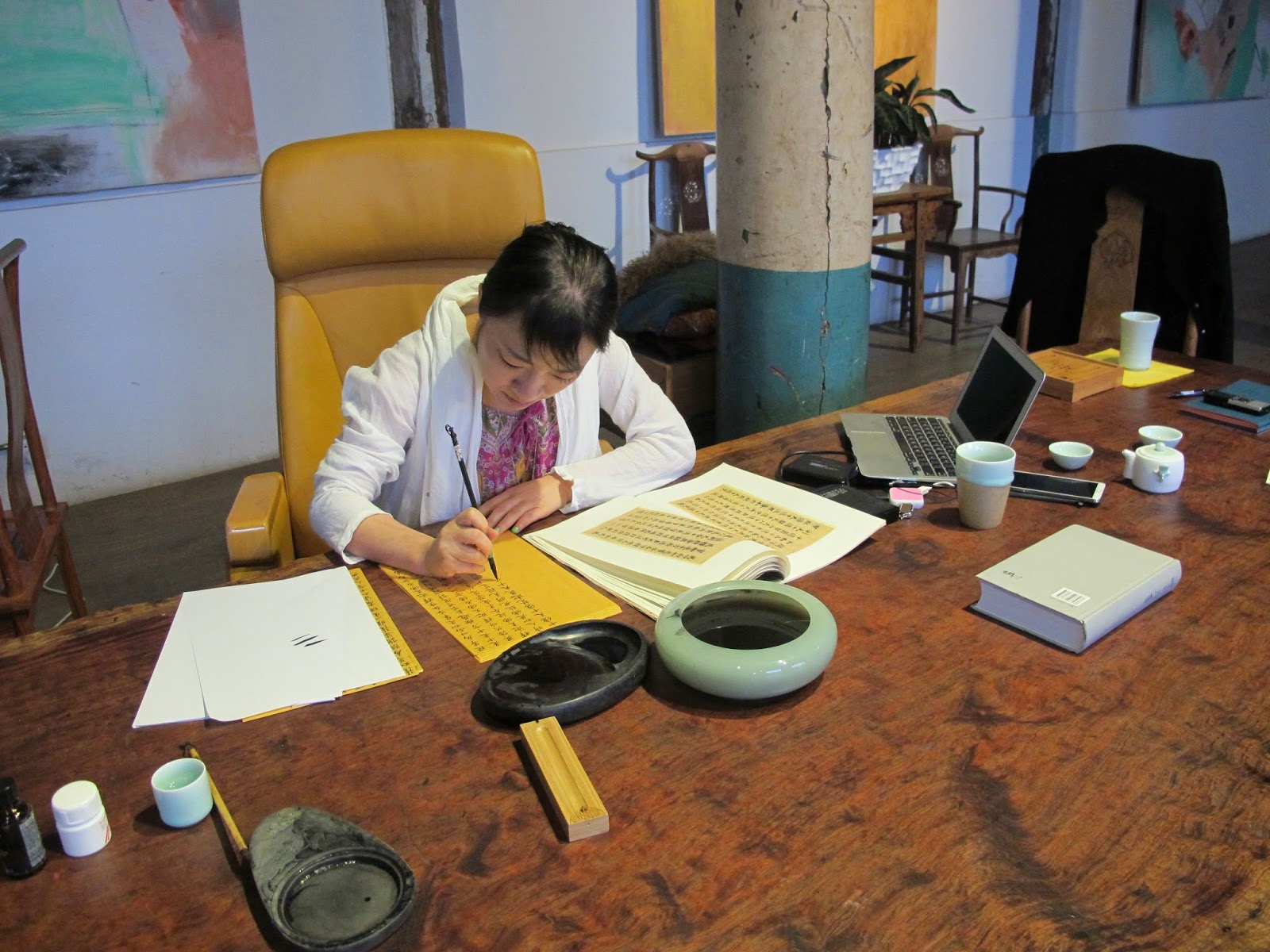
Bingyi writing calligraphy, photo Luise Guest, reproduced with permission of the artist
Yesterday I had a second conversation with the young and very successful painter, Han Yajuan, who told me that after our first meeting last October she has been reconsidering the notion of gender in her work, especially as it has played out for her generation, born in the 80s and coming to adulthood in the 90s, heirs to a completely transformed China. She thinks they had no education about gender, raised at the end of the Maoist period, and hence have struggled to form an identity and to find values. A searching, confused generation. Her new work returns to memories of childhood, creating allegories on circular and oval canvases which are both nostalgic and disturbing.
Han Yajuan in her studio, Photo Luise Guest reproduced with permission of the artist
Han Yajuan, Cashmere Mafia, Image courtesy the artist
From Han Yajuan's studio on the 21st floor of an apartment building in Wangjing, looking over freeways, overpasses and more concrete towers, we drove to 798 and a studio at the back of this complex of galleries, shops and studios - once an East-German designed factory "work unit" where people lived, worked, went to school, gave birth, and spent their entire productive lives - now more often given over to fashion shows, wedding shoots, TV commercials and wandering tourists than to the business of serious art. Here the wonderful painter Yu Hong has her studio.

She found time for me amidst the apparent chaos of a fashion shoot for Tiffany, who have asked her to paint the tennis star Li Na and the most famous movie stars in China. I asked her if she saw any tension or conflict with her serious practice as one of China's best known figurative painters, and she seemed a little bemused. This willingness to challenge the conventional boundaries between fine art and design (or, the more cynical might say, between art and branding)  links her with other, younger artists such as Han Yajuan and Bu Hua, both of whom are interested in "derivatives" - product designs based on their works.  No different to Tracey Emin or Yayoi Kusama working with Louis Vuitton I guess. Interesting times, where boundaries are blurred. In fact Han Yajuan tells me that she thinks this is actually a Buddhist concept as it challenges the authority of the art masterpiece.
Yu Hong with her work in the studio, photo Luise Guest reproduced with permission of the artist
I have long admired Yu Hong's work - and that of her husband, the great Liu Xiaodong - and the way in which she is able to meld Western and Eastern influences so seamlessly. The gold backgrounds in her paintings refer explicitly to Song Dynasty masterpieces but also to the canon of western Renaissance imagery and to notions of the sacred and sublime. Yu Hong tells me that, growing up during a period of great privation and austerity, she was lucky to have access to books with art images and to the Soviet tradition of painting, as her mother was a successful painter and professor. She felt she was on a pre-destined path to become an artist.

Today I went to see work in the Today Art Museum - some good, some not so very. And then to Vitamin Creative Space to watch Cao Fei's latest work, completed last year and collected by the Pompidou Centre, a 45 minute epic narrative video work called "Haze and Fog". It should be no surprise that this artist, with her love of popular culture, has been drawn to horror, and this, of all things, a zombie movie set in north east Beijing, with a large cast of characters including housewives, real estate agents, cleaners, security guards, a prostitute, a peacock and a tiger - and zombies! Ava Gardner once said that Melbourne was a great place to make a movie about the end of the world. Much as I love Beijing, there are days in the apocalyptic dust and smog haze when I think the same applies, But not tonight. Tonight I am "Happy in Beijing"


Sunday, April 20, 2014

北京日记: Nothing and Everything - Three Days in Beijing


Here is a list of all the things that I could have bought from carts, trucks, three-wheeled bicycles or directly from the pavement as I walked home today:

  • underpants with slogans in gold lame embroidered on the bum
  • pineapples carved into beautiful sculptured shapes - in one instance by a very small boy wielding a very sharp knife
  • socks
  • balloons
  • strange white cakes from a woman who only seems to have a small boxful each day - is it her hobby? How on earth can she make a living?
  • American tights and "spanx" shapewear laid out straight onto the dust, spit (and worse) of the road
  • Sausages and pancakes cooked on a griddle on a three-wheeled cart
  • jewellery and textiles - supposedly Tibetan, but quite possibly from a factory in the Pearl River Delta
  • interesting notebooks from a man who sells them from the back of a cart
  • mysteriously, a small selection of frilly pink and white hats, again laid on the filthy ground

Needless to say, many of these people vanish quickly into the shadows when the police appear. You can walk down a road filled with these vendors, go and buy a coffee and when you emerge they are all gone. Later at night, you see carts with all their pineapples covered with a blanket, under the overpass of the Third Ring Road, just waiting.

And here are some of my questions about daily life in this city:
  • Why is it that everything sort of works but nothing quite works? Every tap in China is apparently not quite connected to its sink so they are always wobbly and appear about to break entirely. Beijing plumbing is not designed to take toilet paper so you cannot actually flush it down the toilet without risking something truly appalling in the way of a sewer catastrophe. Electric lights are flaky. The heating in Beijing goes on on a certain date each year and off on another, never mind the weather. I am walking around my apartment wearing multiple sweaters and several pairs of socks. 
  • The light in my pitch dark apartment block hallway goes on automatically only after I have finally - by a Braille method of feeling my way along the wall, then feeling all around the door, and eventually finding the lock - somehow blindly managed to insert the key. At that moment, hey presto, the light goes on. WHY?
Whether one is charmed or annoyed by these things depends on what kind of day you are having. And today I was noticing the beauty of the willow trees and the blossoms, and less aware of the dust, noise, polluted air, spitting and smoking that surrounds me every time I venture out.

Beijing continues to delight, intrigue, amuse and infuriate in equal measures. Today, in the end, delight won out as I came home from interviewing the absolutely extroardinary artist Bingyi, in her studio in a converted Yuan Dynasty temple, in the hutongs right near the Drum and Bell Towers. Two hours hearing about Bingyi's ambitious projects - for example the 160 metre long ink painting to be exhibited in Essen, Germany and then (maybe) buried in a mineshaft - quite restored my equilibrium after a few days of being a bit defeated by big bad Beijing. Bingyi's work is part 'shui mo' scholarly ink painting, part performance art, part land art and part installation. She has been described as a postmodern literati painter, a description she quite likes. She paints, writes calligraphy, writes poems and libretti for opera, composes music, designs and makes incredible costumes and plans ambitious projects and exhibitions which take place across the world. Do you ever sleep? I ask her. "Not much," she says, "I am always working!" An artist with a global practice, yet absolutely grounded in Chinese history and tradition - her Yale PhD thesis, after all, immersed her in a study of the Han Dynasty for seven years - she has reinvented ink painting for a new age.
Bingyi writes calligraphy in her studio, photograph Luise Guest

Bingyi, ink on Chinese paper, photograph Luise Guest reproduced with permission of the artist
Bingyi, Cascade, installation and performance, image courtesy the artist
Yesterday I was thrilled to meet a true legend of the Beijing artworld, Meg Maggio of Pekin Fine Arts, who deftly skewered many of the preconceptions that I and other westerners may have about Chinese art, the artworld and the market. I enjoyed her direct and down-to-earth attitude and the opportunity to hear at first hand some of her stories - and I like to question my own assumptions, testing for traces of chinoiserie and romanticism that we are all a little prone to. The exhibition currently showing, of work by Xie Qi in her first solo show with the gallery, is wonderful, and I will be looking forward to meeting and interviewing this artist. From Pekin Fine Arts at Caochangdi, in its beautiful Ai Weiwei designed courtyard, I spent an hour travelling across the city in apocalyptic traffic jams to Redgate Gallery in the Ming Dynasty watchtower and an exhibition by painter Zhang Yajie. I particularly loved his tough, expressive paintings of electric sockets, sinks and taps, perhaps partly due to my own Beijing plumbing adventures.


Zhang Yajie at Redgate Gallery, images courtesy the artist and Redgate Gallery
The previous day I had been absolutely bowled over by two exhibitions in 798. The first, Xu Zhen (Madein Company) at the Ullens Centre for Contemporary Art - well, at the moment I have no words. I shall have to think of some, given that I plan to write about the show, but I am still absorbing it as spectacle. 
The Goddess of Mercy at the entry to Xu Zhen's Art Supermarket, filled with bags and packs of - nothing
The entrance to the Xu Zhen exhbition at Ullens Centre for Contemporary Art Beijing
Inside the "ShanghArt Art Supermarket at Ullens

The second, entirely different, Xiao Yu's "Earth" at Pace Beijing. Literally that. A vast space filled with earth, the smell of rich loam and the earthiness of the farmyard. During the installation it had been ploughed by farmers with cattle, but only the earth remains. Nothing and everything. And all I can think, at the end of three days such as these is, "How incredibly lucky am I, to be here, in this place, at this particular moment in history."

Xiao Yu, "Earth" at Pace Beijing