The ongoing thoughts of an art teacher in China - and home in Sydney

A continuing diary about my travels in China, and thoughts about China and Chinese art from home and abroad
Showing posts with label Han Yajuan. Show all posts

Tuesday, January 13, 2015

Ten Artists, Ten Conversations, Ten Stories

My most recent article for The Culture Trip introduces ten of the fascinating artists that I have interviewed for my book, "Half the Sky: Conversations with Contemporary Women Artists in China". Here are the first three.

Ten Contemporary Chinese Women Artists You Should Know

Chinese contemporary art is ‘the flavour of the month’ in the West, but there are fascinating stories as yet insufficiently told: the stories of contemporary women artists. The ten artists introduced here are members of a generation who grew to adulthood in the 1980s and 1990s. Born into a post-Mao China that was entirely and disconcertingly different from the world of their parents, they have been forced to adjust to a tsunami of change.

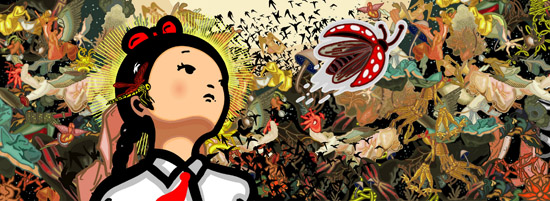
Bu Hua Beijing Babe Loves Freedom No 6, 2008, Giclee Print, Image courtesy the artist and White Rabbit Gallery

Bu Hua

Bu Hua was born in 1973, graduating from the Institute of Fine Art, Tsinghua University, Beijing, (formerly the Central Academy of Fine Art and Design) in 1995. In her strong imagery and flat, decorative backgrounds we can see a trace of the traditional woodblock prints of the revolutionary period, and also her love of Japanese art and design. Often described as a pioneer of digital animation in China, Bu Hua was one of the first to use animation software in an art context, creating surreal narratives about contemporary life. Her animations and still images often feature a feisty, sassy pigtailed child dressed in the uniform of the Young Pioneers, a Communist Party youth group. A clever combination of innocence and knowing, cuteness and cunning, playfulness and cynical parody, she swaggers through Bu Hua’s invented world. ‘I felt that this character is an actual person living in real life but [she] is really also an idealised version of myself. She knows this universe and the rules of this society like the back of her hand,’ says the artist. ‘Savage Growth’ employs her characteristically crisp graphic style to create an allegory of industrialisation, pollution and militarisation. Her heroine, armed only with a slingshot, takes aim at flocks of white birds which prove, on closer examination, to be military aircraft. Twisted trees grow out of pools of oil, and a row of sexy foxes (‘fox spirits’, in Chinese lore, are dangerous seductresses) sway backwards and forwards to a mechanical sound track like the rhythmic metallic noise of a factory assembly line. Bu Hua says, ‘people in China pay a lot of attention to the past and the future, but it’s really kind of forbidden to pay a lot of attention to what is happening now, in real life…I am showing what is happening in China at this exact moment, what is happening now.’

Cui Xiuwen, Existential Emptiness No. 3, 2009 C-Print, (85 x 450 cm) Courtesy Klein Sun Gallery, NY. © Cui Xiuwen

Cui Xiuwen

Cui Xiuwen’s 2002 ‘Lady’s Room’ caused the first lawsuit in Chinese contemporary art, when a professor in Guangzhou took exception to its frank documentation of prostitution in the ‘new’ China. With a hidden video camera in the bathroom of a swanky Beijing nightclub she recorded young hostesses changing their clothes, counting their money and arranging their next liaisons with their clients, exposing the seedy underbelly of China’s economic miracle. Born in 1970 near Harbin, Cui Xiuwen trained as a painter, graduating from the Central Academy of Fine Arts in 1995. In the mid-2000s Cui produced a body of work featuring young girls dressed as Young Pioneers and posed in the Forbidden City, dwarfed by claustrophobic walls and gates representing Chinese tradition. ‘Angel no. 3’ features the same girl, nightmarishly replicated as a crowd of adolescent clones, sleepwalking towards us with arms outstretched. The work evokes the deliberate erasure of bitter memories – a collective amnesia. ‘This is about my own life experience,’ Cui says. ‘I would wake up and see the sky filled with this huge grey cloud which made me feel as if there was no hope.’ Cui Xiuwen returned to the countryside near Harbin to shoot ‘Existential Emptiness’. Like misty ink and wash ‘shan shui’ scrolls the series depicts a living girl and a life-sized doll, a shadow version of the living girl, a puppet figure. The figures are tiny in the vast landscape, like solitary scholars in the mists of a literati painting.
Dong Yuan, Grandma’s House and Bosch’s Garden, installation view, oil on separate canvases, image courtesy the artist

Dong Yuan

Dong Yuan paints objects which represent cultural and personal memory with meticulous realism, creating installations of multiple separate canvases. Born near Dalian in 1984, Dong studied at the Central Academy of Fine Arts in Beijing. As a student, inspired by Western still life painting and Giorgio Morandi, she painted literally everything she owned. Small canvases depict her shoes, rolled up quilts, books, a rice cooker, a bath towel hanging on the back of a door, a teapot, even a box of tissues. ‘Home of Paintings’ and ‘Sketch of Family Belongings’ record, on 59 and 186 canvases respectively, the tiny apartments in which she lived as a student. ‘Grandma’s House and Bosch’s Garden’ consists of 855 canvases, a surreal juxtaposition of the fantasy world imagined by Hieronymus Bosch and the rural Chinese world of her grandmother. The gods of happiness, prosperity and longevity are juxtaposed with images of Mao and the stars of TV game shows. Furniture, teacups, textiles, traditional New Year hanging scrolls and everyday possessions intermingle. The humble courtyard house where Dong Yuan had been happy as a child would, inevitably, be demolished. Dong Yuan believes it is her duty and obligation to paint these memories, slowly and intensively completing one room at a time. The project took the artist more than two years. She describes the process as ‘fixing it in memory,’ - an elegy to a lost world. ‘It’s hard to know how many things have to disappear before people find their hearts settled down,’ says the artist.
To find out about the other 7 - click HERE

Tuesday, April 22, 2014

北京日记: Beijing nights, Beijing days


Beijing, such a grey, grey city by day becomes a fairyland at night. Red lanterns swing in the breeze at every tiny restaurant - a cab ride across the city is a blur of neon and red. Last night I walked home by a circuitous route down unfamiliar back lanes and through hutongs and found a different world behind the big roads with their clogged traffic. Hundreds of people sat at makeshift tables on small chairs and stools, eating in happy, noisy "renao" family groups - pavement hot pot, pavement barbeque, food of every description being cooked and consumed outdoors in the warm evening air. Inside the steamy windows of small local restaurants were more big groups. Children chased each other up and down the street between the tables, one of them calling, "Watch out for the 'waiguoren' (foreigner)" - me! From the moment I left my apartment and encountered the busy mobile bicycle repair man and felt the breeze, walking behind laughing, chattering girls arm-in-arm as they left the subway, I was in a good mood.

And tonight again, waiting for my cappuccino in a Costa Coffee before meeting an artist friend for a walk in Ditan Park, I stood next to a Buddhist Monk from the Lama Temple who was perusing French mineral water at 50 kuai per bottle, and watching an old man with a waist-length grey ponytail carry his birds in their bamboo cages for a stroll along the busy road. A cyclist cut across his path, another elderly man with a small poodle in the basket of his bike, the ends of its ears dyed bright green. Beijing, where cognitive dissonance is everywhere. You've got to love this city! After dinner in a vegetarian restaurant near the Confucius Temple we walk to visit another artist, and music emanates from every quarter - the shops selling Buddhist paraphernalia, a group of women dancing in unison to a disco track on the footpath outside KFC and then a much bigger group of women dancing in the pitch dark of Ditan Park. In my taxi back to Tuanjiehu, stopped at lights next to a small park in the centre of the city, I hear a clashing of cymbals and drums, and massed voices singing revolutionary songs from the past - in complete darkness, with barely even a streetlight.

In fact, I could have been singing James Brown to myself - "I feel GOOD!" Or perhaps more appropriately, Pharrell Williams' "Happy". If I stay here any longer I might actually catch the habit of many Beijingers of singing in public, Imagine the horror of my daughters - and my students! I have emerged from a few days of feeling sick with flu and constant coughing, not helped at all by the legendary Beijing air pollution, feeling anxious about why on earth I am here at the other side of the earth, away from my family and engaged on this quixotic enterprise of writing a book about people whose language I don't speak, indulging in self-doubt.

But I have had a (small) breakthrough - a tipping point if you like - with the language. After the usual first few days of feeling as if my tongue had been cut out, I have been navigating the city in Chinese, and felt very smug yesterday after two days of negotiating with a non-English speaking driver, arranging times and places for pick up and drop off, prices, and general conversation about weather, traffic, artists being famous or not, and what he sees as the hopeless inadequacy of Australian medecine to cure my cold and cough. It has of course helped that he is an immensely patient young man, who simply keeps repeating everything over and over again until he thinks I have probably understood most of it. We have had a few comic set pieces where I constantly misunderstood "houtian" (the day after tomorrow) as "the day before yesterday" which did not help the fine-tuning of my complex arrangements. He was no doubt relieved that today I had a young translator with me so he could impress upon her the necessity for me to get myself to a Chinese doctor to get the right herbs for my cough. I imagine that to him I am a venerable grandma and he wonders what on earth I am doing gallivanting around Beijing on my own.

The other factor causing my more optimistic view of the world and my place within it is the three interviews I have completed in the last three days. Bingyi, with her complete radicalisation of ink painting conventions, and her refreshing and somewhat weird take on the world, is always a delight. She thinks the notion of gender is utterly insignificant, as we are all nothing but specks in the universe. However, she did tell me that feminism makes her a little bored, as she likes to have men around "for my amusement."
Bingyi, "The Shape of the Wind: Fuchun Mountains" image courtesy the artist

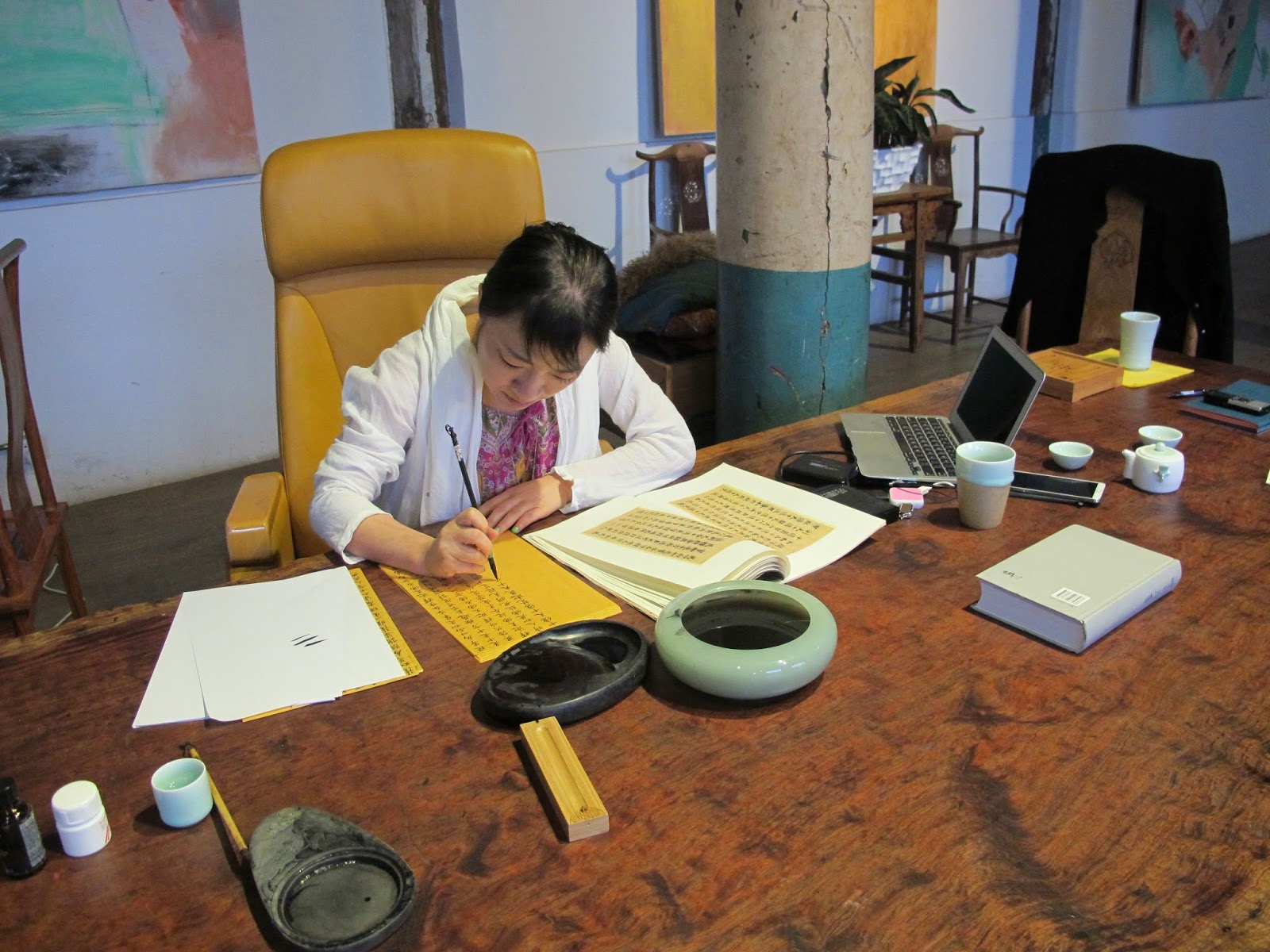
Bingyi writing calligraphy, photo Luise Guest, reproduced with permission of the artist
Yesterday I had a second conversation with the young and very successful painter, Han Yajuan, who told me that after our first meeting last October she has been reconsidering the notion of gender in her work, especially as it has played out for her generation, born in the 80s and coming to adulthood in the 90s, heirs to a completely transformed China. She thinks they had no education about gender, raised at the end of the Maoist period, and hence have struggled to form an identity and to find values. A searching, confused generation. Her new work returns to memories of childhood, creating allegories on circular and oval canvases which are both nostalgic and disturbing.
Han Yajuan in her studio, Photo Luise Guest reproduced with permission of the artist
Han Yajuan, Cashmere Mafia, Image courtesy the artist
From Han Yajuan's studio on the 21st floor of an apartment building in Wangjing, looking over freeways, overpasses and more concrete towers, we drove to 798 and a studio at the back of this complex of galleries, shops and studios - once an East-German designed factory "work unit" where people lived, worked, went to school, gave birth, and spent their entire productive lives - now more often given over to fashion shows, wedding shoots, TV commercials and wandering tourists than to the business of serious art. Here the wonderful painter Yu Hong has her studio.

She found time for me amidst the apparent chaos of a fashion shoot for Tiffany, who have asked her to paint the tennis star Li Na and the most famous movie stars in China. I asked her if she saw any tension or conflict with her serious practice as one of China's best known figurative painters, and she seemed a little bemused. This willingness to challenge the conventional boundaries between fine art and design (or, the more cynical might say, between art and branding)  links her with other, younger artists such as Han Yajuan and Bu Hua, both of whom are interested in "derivatives" - product designs based on their works.  No different to Tracey Emin or Yayoi Kusama working with Louis Vuitton I guess. Interesting times, where boundaries are blurred. In fact Han Yajuan tells me that she thinks this is actually a Buddhist concept as it challenges the authority of the art masterpiece.
Yu Hong with her work in the studio, photo Luise Guest reproduced with permission of the artist
I have long admired Yu Hong's work - and that of her husband, the great Liu Xiaodong - and the way in which she is able to meld Western and Eastern influences so seamlessly. The gold backgrounds in her paintings refer explicitly to Song Dynasty masterpieces but also to the canon of western Renaissance imagery and to notions of the sacred and sublime. Yu Hong tells me that, growing up during a period of great privation and austerity, she was lucky to have access to books with art images and to the Soviet tradition of painting, as her mother was a successful painter and professor. She felt she was on a pre-destined path to become an artist.

Today I went to see work in the Today Art Museum - some good, some not so very. And then to Vitamin Creative Space to watch Cao Fei's latest work, completed last year and collected by the Pompidou Centre, a 45 minute epic narrative video work called "Haze and Fog". It should be no surprise that this artist, with her love of popular culture, has been drawn to horror, and this, of all things, a zombie movie set in north east Beijing, with a large cast of characters including housewives, real estate agents, cleaners, security guards, a prostitute, a peacock and a tiger - and zombies! Ava Gardner once said that Melbourne was a great place to make a movie about the end of the world. Much as I love Beijing, there are days in the apocalyptic dust and smog haze when I think the same applies, But not tonight. Tonight I am "Happy in Beijing"


Monday, November 18, 2013

北京日记 Beijing Diary: Food, Learning Chinese, People - and Art


As I come to the final weeks of my residency I have been savouring some of my favourite Beijing moments. And they're not all food-related, but I have to say that food has figured largely in the fascination of my time here in China. That includes those foods which are immediately appealing and wonderful, and those which I am adding to my list of things to avoid. Joining the donkey pastrami and the boiled goats' feet of Xi'an I can now add the grilled duck tongues of Chengdu. The visual richness of street vendors of all kinds is a feature of any walk in Beijing, and the foods on offer have changed as the weather has grown colder - grilled corn, chestnuts and walnuts, congee and pancakes and baozi, sweet potato and cakes. Beijingers love their 'Xiao Chi' (literally, little food, i.e snacks)


So here's a list of other things I have enjoyed seeing and experiencing of late

  • I am amused and impressed by the fur-lined sleeves that have appeared on bikes and motorbikes - very necessary and so ingenious!

  • The tiny mandarins in the markets with their leaves attached - so cheap and so sweet - as well as pineapples and other strangely tropical fruits in this cold climate

  • Pomegranate juice from the street stalls

  • The woman who takes her microphone and amplifier into the park each afternoon and sings opera and Chinese folk songs in a pavilion beside the lake

  • The people both young and old who practise their saxophones, flutes and clarinets seated on benches in the park
  • Tiny children bundled into so many layers that they are completely spherical
  • The massive army greatcoats and hats with fur earflaps worn by men collecting recycling
  • The way that people love to gather in groups and add their opinion to whatever is happening, whether that's a car accident, a mahjong game, a dispute over the price of vegetables, or the technique of the water calligraphers and dancers in the park


Among many possible candidates for a favourite English shop name, my current favourite is definitely "Bing Bing Decently", a small emporium selling 'scholar rocks' and ornately carved pieces of timber and "jade" (I suspect definitely of the inverted commas variety) in the Chaoyang Cultural Market. But there is also this one, which definitely falls into the WTF category:


  • The frustration but also the joy of starting to be able to read Chinese characters continues - I forget as many as I learn, but it is a revelation to me in gaining a greater understanding of the people, culture and history. And Chinese characters are just so beautiful, even in subway signs or scrawled graffiti. I often trip over steps and walk into posts as I am so occupied in staring at billboards and street signs and trying to work out what they say.

I have been meeting so many interesting artists, including Guan Wei and Lin Jingjing, and continuing my series of interviews. As this research continues I've had many conversations with these artists, with my interpreters, with curators and with friends both western and Chinese about ideas relating to gender in China right now. It is often at the forefront of public discourse, and certainly forms a subtext to much policy debate and media angst. 


With artist Bu Hua in her studio, October 21
Lin Jingjing in her studio, November 14
With Guan Wei in his studio, November 11

Here are my first thoughts about this, in relation to three of the eighteen artists I have spoken with to this point. The article, 'Material Girls, Super Starlets, and Girls with Swagger'  was published in The Artlife last week, and this is an extract:


Late Autumn in Beijing alternates glorious blue sky days with others on which the pollution levels soar into the ‘alarming’ zone and people with masks covering their faces are glimpsed through mist and fog on grey streets under grey clouds. The schizophrenic weather conditions mirror something of the paradoxical nature of contemporary China. On one street you see old men in Mao suits playing mah-jongg on the corner, while in the next you are as likely to find a Lamborghini showroom as a snack cart selling dumplings. These paradoxes extend into the art world too. The pace of change in China has been so swift and dislocating that each new generation of artists essentially inhabits a different country, with different experiences, ideas and beliefs. On every construction site billboards loudly proclaim: “This is my Chinese Dream.” This dream, and what it might entail for different generations in China – and what that might imply for the rest of the world - is definitely contested territory.
I have been fascinated to discover these generational dissonances as I have met with artists during a two-month stay in Beijing. My particular project has been to interview female artists. Just as the social forces in China have swept away old certainties, so too have ideas about gender and the roles of women been changing, albeit in ways quite different from what one might expect.
Recently this has come to the forefront of public discourse, as the term “sheng nu” (“left-over women” - defined as single women over the age of 27) has gained increasing traction in the media. The following delightful piece was published on the website of China’s state feminist agency, the All-China Women’s Federation:
“Pretty girls don’t need a lot of education to marry into a rich and powerful family, but girls with an average or ugly appearance will find it difficult. These kinds of girls hope to further their education in order to increase their competitiveness. The tragedy is, they don’t realize that as women age, they are worth less and less, so by the time they get their M.A. or Ph.D., they are already old, like yellowed pearls.”
Despite the gender imbalance created by the One Child Policy and a preference for boys resulting in an over-abundance of men seeking wives, it seems that contemporary Chinese culture punishes women for being over-educated, over-ambitious and financially independent.
In street fashion, advertising, and, yes, even in the hallowed space of art galleries, I have been observing a kind of hyper-femininity. Representations of the feminine in some of the less illustrious galleries in the 798 Art Zone range from imperial maidens and concubines, reflecting nostalgia for a patriarchal past and its certainties, to fibreglass stilettos covered in spikes, an indication of current anxieties. Young men are nervous. They feel enormous pressure to be rich enough, and successful enough, to attract girls and find a wife. The famous quote from a TV dating show, from a young woman who said she would rather weep in the back of a BMW than laugh on a bicycle, is cited often as evidence of women’s materialism.
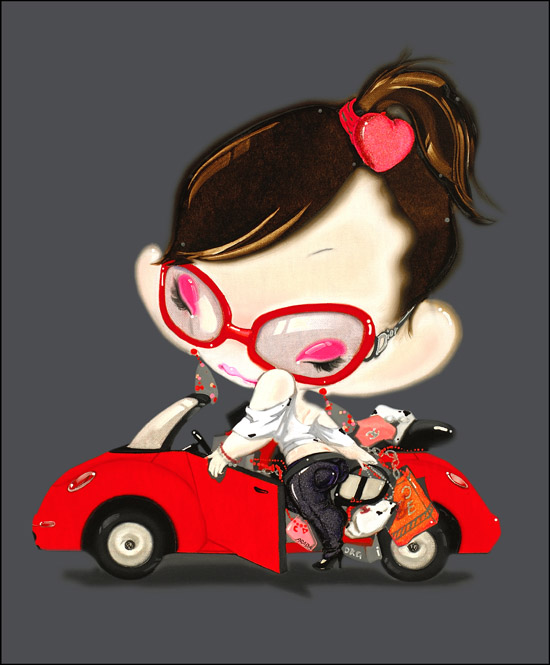
1. Travel Alone 60+50cm oil on canvas 2007
Han Yajuan, Travel Alone, 2007. Oil on canvas image courtesy the artist.
To find out more, I spoke with three artists who explore some of these ideas in their work.
I met Han Yajuan in her bright apartment and studio in the new area of Wangjing, where she looks down over block after block of high-rise apartments and sweeping expressways, a view she describes as “depressing”. Her work has been seen recently in Australia in the ‘Go Figure’ exhibition, curated by Claire Roberts from Uli Sigg’s collection at the National Portrait Gallery, and in ‘Far East Duet’ at the ACAF Project Space in Melbourne. She is represented in New York by Eli Klein Fine Art.
Born in 1980 in Qingdao, Shandong Province, and earning her MFA from the Central Academy of Fine Arts in Beijing, she is sometimes described as an artist whose works embody the collective unconscious of her generation, which seems rather a heavy burden. Her paintings reveal her interest in Japanese design and animation, as well as fashion, and reflect the culture of ‘cuteness’ (in Chinese, “Ke’ai”) prevalent in contemporary pop culture. In China, young (and even not so young) women are expected to behave in ways which are winsome, even child-like. ‘Travel Alone’ depicts a cute, big-headed, bling-adorned cartoon girl climbing into her red sports car wearing Dior glasses. She carries bags labelled Prada and Chanel. Fake or real, they reflect the current obsession with designer brands as symbols of wealth and success. Han Yajuan reveals the current anxiety about the lives of young women, the ‘material girls’ who want it all, and want it now. ‘Fashion Week’ represents the frantic busy-ness, but also the emptiness, of this world. In response to my suggestion that her paintings are a critique of contemporary life and materialism, she says, “I was just trying to present what I see…what exists. Twenty years ago a bicycle was a luxury, but things change. There is so much pressure; the speed (of life) is so fast. I am trying to present my point of view and also to give people an opportunity to see their own lives.” Her generation have not experienced the hardships of the past, and are experiencing the loneliness, as well as the material comforts, of an entirely different kind of society.
In sculptural works such as ‘Super Starlet 6’ the cloying cuteness is undercut by a disturbing sense of identity crisis – these are essentially faceless beings, literally from the assembly line. Looking at these works before I met the artist, I wondered what she intends to communicate about the lives of Chinese women today. Are the creatures she represents victims of new social pressures, or are they empowered and materially successful beings? Is it celebration, or criticism? The answer, as is so often the case in China, is equivocal. Han Yajuan’s female figures are, and also are not, self-portraits. She is a participant in, as well as an intelligent observer of, the culture in which she finds herself. Self-possessed and confident, with her deep voice and disarmingly infectious laugh, she is fully aware of the dark side of the glamorous world she depicts: a world of corruption and karaoke bars; mistresses and designer handbags. But she is pragmatic. “From a very primitive perspective,” she says, “it relates to the uncertainties of life – we should pursue the things that make us happy. It’s personal. It’s about what makes me happy. There is a part of me in all those figures.”
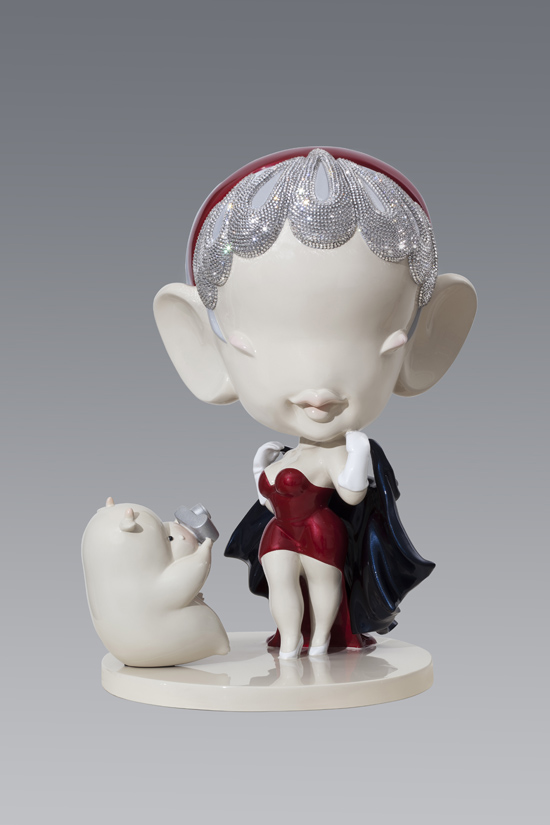
2. Super Sterlet 6 out of 6
Han Yajuan, Super Starlet 6, 2011. Color paint on tin bronze, crystals, 45 x 36 x 40 cms. Image courtesy the artist
“I am from the eighties generation”, she says, identifying the strictures of the Chinese education system as well as the Japanese cartoons she loved as a child as key influences on her thinking. “My early works are about individualism and uncertainty. Later I changed my perspective to stand on a higher point and look down upon a whole complex and contradictory world.” When she began to create these elaborate multi-dimensional compositions, she was initially filled with self-doubt and uncertainty. Working towards a solo show in New York next April, she says, “I am trying to connect doubt and uncertainty with very concrete things. You can see the materialism, you can see the fashion, but this is just recognition. I know why I am doing this. I know what I try to achieve. It is for people who maybe don’t have the time to see this, to look at these things.”
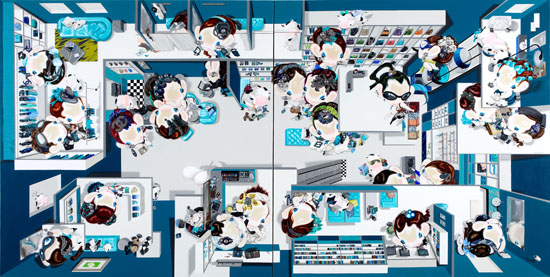
Rather surprisingly, given their apparent celebration of consumerism, Han sees her practice as relating to Zen philosophy and to Qing Dynasty paintings in which multiple perspectives depict a whole universe, both microcosm and macrocosm. We discuss the famous scroll representing an entire town in which every person depicted is doing something different. In ‘Perfect Ending’, a parallel universe of tiny cubicles is filled with girls and consumer products - espresso machines, laptops, mobile phones, shoes and handbags. They strike me as extremely sad. A tiny world appears about to implode under its own pressure. “This is still a male-dominated society,” she says, in response to my query about whether it is more difficult for female artists in China. “But I’m a human being first, then a woman, then an artist.” And, she adds, if you just keep on doing good work, people will have to take notice.
3. Perfect Ending 360+180cm 2010
Han Yajuan, Perfect Ending, Oil on canvas. Image courtesy the artist
Bu Hua was born in 1973, graduating from the Institute of Fine Art, Tsinghua University, Beijing, (formerly the Central Academy of Fine Art and Design) in 1995. Coming from a family of artists, with a father who was a distinguished printmaker, she “learned the language of lines” at an early age. Her work is represented in the collection of the White Rabbit Gallery in Sydney.
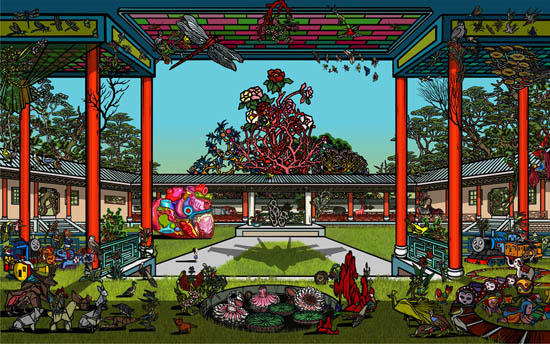
Bu Hua is best known as one of the pioneers of digital animation in China, discovering the expressive possibilities of Flash software and its potential to convey emotional truths about contemporary life in an immediately engaging and dynamic way. During our conversation she tells me about an artist whose name she cannot remember, discovered in the late 90s at Kassel Documenta, who created wonderful, complex, highly political animations with charcoal drawing. “William Kentridge?” I ask. “Yes, yes, yes!” she exclaims. Seeing his work in Germany was the impetus that made her want to combine drawing, painting and animation. In recent years she has developed a character, a key protagonist in both video and still images, who is based on herself as a child - a defiantly feisty but definitely cute Young Pioneer. She bravely navigates the surreal landscape of the 'new' China, encountering strange beasts, mystical forests, hideous pollution and rapacious developers, somehow emerging victorious. She is a girl with 'swagger', according to Bu Hua, and a more confident version of the artist herself - a fearless alter ego. In ‘Savage Growth’ she wanted to express this anxiety and fuse western and eastern traditions of art and design. “In modern China, how could you not be influenced by this fusion of West and East, this cultural invasion and ‘soft power’? I am just reflecting this reality,” she says.
attachment
Bu Hua, The Water is deep here in Beijing I (2010). Image courtesy the artist.
The girl who skips and jumps through her animations, woodblock prints, paintings and digital images is based on the artist's memory of herself as a schoolgirl in Beijing in a simpler era. She thinks about herself cycling to school at a time before the recent explosion of wealth and development with a certain degree of nostalgia. Past, present and future collide in the imagined adventures of this 'Beijing babe' who functions as a voyeur, a means by which we can see the craziness of the contemporary world.
5. Bu Hua AD 302 - 8
Bu Hua, AD3012-8,2012, giclee print on paper. Image courtesy the artist.
To read the rest of the article, click here: HERE

Wednesday, October 9, 2013

北京日记:ruminations inspired by Yiyun Li, daily life in Tuanjiehu, and some artists in their studios

A view from the studio of Bing Yi Huang, reproduced with permission of the artist

I sat this morning at my tiny table at the window, with the noise from the street and the market floating up to me, immersed in a book of short stories by Yiyun Li. Her first collection, “A Thousand Years of Good Prayers” was the first contemporary Chinese fiction that I read before my very first trip to China, and it has haunted me ever since. Her stories are achingly sad but filled with the ordinary details of daily life so they never seem forced or artificially constructed. The first story in “Gold Boy, Emerald Girl” is simply told in the voice of a woman who has never married, works as an English teacher, and lives alone following the death of her parents. Her army service in a far province was the only time she has left Beijing. A meditation on kindness and cruelty, it has made me look at the middle-aged women walking down Tuanjiehu Zhong Lu with their bags of shopping and speculate about their past lives.

The second, told in the voice of Teacher Fei, is so sad that I had to put the book down and leave the house. “At eighteen he had been an ambitious art student about to enter the nation’s top art institute, but within a year, his father, an exemplary member of the reactionary intellectuals, was demoted from professor to toilet cleaner, and Teacher Fei’s education was terminated. For the next twenty years, Teacher Fei’s mother accompanied his father from building to building, one hand carrying a bucket of cleaning tools and the other holding her husband’s arm, as if they were on their way to a banquet. Yet, in the end, even she could not save her husband from despair. Teacher Fei’s father had killed himself two years after he was restored to his position at the university.”

Artist Jin Fei has described China’s history as “brutal and tragic” and I have been watching some of the very old men I see in the local park, with their walking sticks, Mao jackets and cloth shoes, and wondering about all they have seen and experienced. The past and present often seem to merge in China; or rather it sometimes appears as if the present is a very thin veneer laid upon the past, which can bubble up through it unexpectedly.


Listening to the group singing in Tuanjiehu Park, Sunday morning

Tuanjiehu Street Market

I have settled into something of a routine after my first week in Beijing: a morning walk around the neighbourhood which always ends with a circumnavigation of the lake in Tuanjiehu Park, somewhat voyeuristically observing the extraordinarily rich and diverse activities taking place from early morning till nightfall. Today I entered the gates to discover perhaps 100 people energetically exercising in unison, very seriously (although with a smile for me and my camera.)  As usual there are groups engaged in beautifully fluid qi gong, and elderly people everywhere exercising vigorously. Men and women who are clearly well into their seventies use the park benches and railings to stretch their legs, revealing a flexibility and suppleness that I can only envy. One area of the park has open air fitness equipment and there they all are, pedalling furiously, doing push-ups and handstands and even more frenetic stretches. Hundreds of people walk and jog around the lake, many of them vigorously slapping themselves as they go, which I have realised is something to do with stimulating the circulation rather than a form of self-flagellation. And, magically, strolling home after dinner with some other Redgate residents, we followed the music coming from the park and discovered a large group of people dancing in the dark. Quite extraordinary and enchanting.

Qi Gong, Tuanjiehu Park
The thing which forcibly struck me this morning, though, is the visible presence of old people. Apart from the exercisers, elderly couples are sitting on benches watching the lake, old ladies walk in pairs carrying their vegetables from the market, and the really old and frail are being pushed in wheelchairs by sons or daughters. Their presence made me realise how much more hidden away from view old people are in the west. As I left the park at 9.00am today the exercisers had been replaced by the water calligraphers and old ladies lined up in their wheelchairs; and three old men were arguing about how to place a very rickety ladder to remove the red lanterns from the trees, marking the end of the Golden Week national holiday.
Removing the red lanterns from Tuanjiehu Park after Golden Week
Water Calligraphy in Tuanjiehu Park
I spend a little time each day studying one of my various maps of Beijing – all inexplicably different, and most appearing to bear little resemblance to the actual physical streets – to plot a route for grocery shopping, to the English language bookshop, or to a gallery or artist’s studio. The maps bear inscribed upon them the extraordinary changes this city has undergone in the last century. “Five Dragon Pavilion” and “Former Residence of Princess Hejing” are juxtaposed with the Beijing Workers’ Stadium, the Working People’s Cultural Palace, and the Monument to the People’s Heroes. And then the map shows the location of every McDonalds and Pizza Hut in Beijing – and for good measure, Hooters. Cognitive dissonance!

It seems that everything is tumbled one upon the other – the imperial past, the revolutionary years and the capitalism ( or rather the “Socialism with Chinese characteristics”) of the present . Late this afternoon as I walked towards Ritan Park I passed a long queue of people waiting outside a dental clinic, and more waited  outside the attractively named ‘Beijing Hospital for Proctological and Intestinal Disease’. Old men cycled past with huge loads of recycling piled up on the trays of their tricycles. Suddenly an enormous shopping mall appeared in view – glitzy in the extreme, and filled with fashionable sculpture and high-end shops. The mall could be anywhere – Singapore, LA, London. The same shops too – GAP, American Apparel, Kate Spade. Although clearly so new that it was not quite finished, in typical fashion when I visited the toilets of this establishment the taps had come loose from the wall and none of the doors closed properly – near enough is usually good enough in new buildings here. But one block further down the street and I was back in China – little carts whizzing by selling snacks, and groups lounging on street corners playing cards.

This layering of past and present has been a feature of my conversations with the artists I have met this last week. By pure chance in my first week in Beijing I interviewed an artist in her twenties, one in her thirties and one in her late forties. Each woman has experienced a different China. Of course to some extent this is true everywhere – the world my daughters inhabit is not the one in which I grew up. But in China those differences are far more marked, and the artists themselves are very aware of it.

With Ma Yanling in her Songzhuang studio Saturday October 5
Ma Yanling believes that the young artists today cannot understand the experiences of her generation, who saw the brief flowering of the avant-garde in the late 1980s, only to have their ideals crushed after 1989. The young Liu Shiyuan spoke of her generation, children of the 1990s who came too late for the art boom, and must find their place in an incredibly competitive art world. There are just so many artists in China, all struggling to make work, to be seen and heard, to find ways to keep going. I have been in beautiful studios in Songzhuang, with courtyards and goldfish ponds, a high-rise apartment studio on the 21st floor looking down at Beijing spread out below, and spacious studios in Caochangdi. Today I spent some hours with the extraordinary Bing Yi in her studio on the central axis of Beijing – a Yuan Dynasty temple near the Drum and Bell Tower. 
Bingyi Huang in her studio, explaining her series of ink on paper works
I am hearing stories of struggle and survival and steely determination. I am talking to artists who regularly cross the globe, to New York and Helsinki and Moscow and Montreal and back to Beijing, which pulls them back again for so many reasons. I am discovering that in some ways the differences between each of these artists is more dramatic than the things that unite them.
Han Yajuan explaining her work in her Wangjing studio Thursday October 3 

In my next post I will start to pull some threads together from the interviews I have conducted so far - with Han Yajuan, Liu Shiyuan, Ma Yanling, Huang Jing Yuan and Bing Yi - and start to think about the connections as well as the discontinuities between the work and experiences of these very different women.
Bing Yi, ink on Chinese Paper, photograph Luise Guest reproduced with permission of the artist