The ongoing thoughts of an art teacher in China - and home in Sydney

A continuing diary about my travels in China, and thoughts about China and Chinese art from home and abroad
Showing posts with label Lindy Lee. Show all posts

Friday, February 19, 2021

Seeing the Moon in a Dewdrop: Lindy Lee at the Museum of Contemporary Art


Appropriately enough at this tail end of the lunar new year celebrations, the review I wrote of Lindy Lee's survey exhibition 'Moon in a Dewdrop' at the Museum of Contemporary art back in December has been published in Randian this week. It's timely too, because her new solo exhibition at Sullivan and Strumpf has just opened - more on that show soon. And given that Facebook has exercised its unscrupulous might over the Australian government and blocked ALL news from its platform in Australia, it means that freelance writers and academics can no longer post links to their articles: posting references and links on this blog is now one of the few ways for me to share my writing with others who are interested in Chinese contemporary art, including the art of the diaspora and of  Australian/Chinese artists. 

So my piece for Randian began with a personal reflection: Lindy Lee and I are of the same generation, and although our experiences and cultural heritages are quite distinct, we both entered an artworld in Australia that was isolated and insular in the 1970s, growing less so in the 1980s, and is now far more connected with the rest of the world. Here's the beginning of the article: 

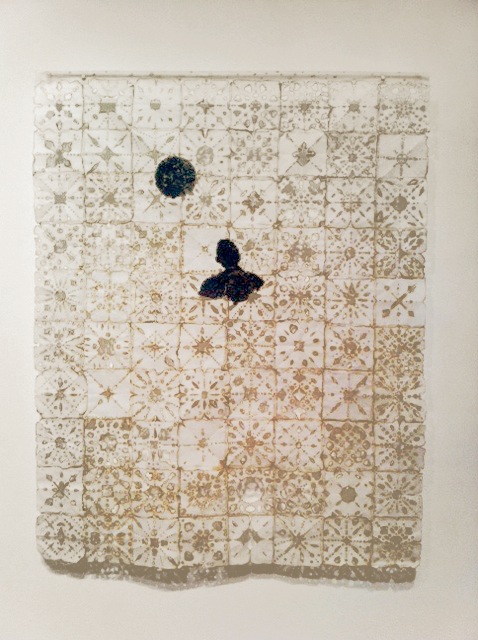
Lindy Lee, Doctrine of the Golden Flower, 2003, inkjet print, synthetic polymer paint on paper mounted on board, 25 parts: 40.6 x 28.6 cm each, 204.2 x 142.8 x 28.6 cm overall, Collection of The University of Queensland, gift of Lindy Lee through the Australian Government's Cultural Gifts Program, 2013


Replicas, postmodernism and ‘bad copies’ 

I vividly remember seeing Lindy Lee’s early works when they were first exhibited in Sydney in 1985 in Australian Perspecta and 1986 in the 6th Biennale of Sydney. Grainy, velvety black photocopies of famous faces – portraits by Jan Van Eyck, Rembrandt, Ingres, Artemisia Gentileschi and other images from the western art historical canon – were arranged in rows or grids. They gazed out from behind layers of acrylic paint, or wax that had been partially scraped back. Hints of darkened visages emerged through cobalt blue or deepest crimson pigment, making them appear unfamiliar and mysterious. Their characters seemed to be both concealed and revealed by the artist’s manipulations. 

These shadowy works powerfully conveyed a sense common to artists and writers of my generation (and Lee’s): we were far from the action, on the other side of the world. The cultural centres, the ‘real’ art hubs, or so we thought then, were London, Paris, Florence, New York. We Australians were exiled to the periphery, inhabiting a postcolonial shadow world, a simulacrum – a pale photocopy, faded by the tyranny of distance. The art history we studied was almost entirely European and American; we feasted on images in reproduction, leafing through books with colour plates of Renaissance masters, and lined up for the (very occasional) blockbuster exhibition of works loaned from overseas collections at the state galleries. In that 1980s heyday of postmodern theory Lee’s works were discussed by critics and academics invoking Walter Benjamin and Baudrillard, but for me their interest lay in the connection forged between the artist and the mechanical reproduction. They suggested the angst of someone searching for a relationship across differences of time and culture. But there was more to Lee’s search than the general Australian awareness of the colonial ‘fatal shore’. 

Lindy Lee was born in Brisbane in 1954 to parents who had immigrated from China. She grew up in the (then) stultifyingly parochial suburbs of Brisbane during the era of the racist White Australia Policy; just a few years earlier, in 1947, Labor politician Arthur Calwell had notoriously ‘joked’ in parliament that ‘Two Wongs don’t make a white’. This upbringing, and the experience of being the only Chinese child in her school, left Lee uncertain of her identity. Like other children of Australia’s post-war migrants, she felt she was somehow inauthentic – not quite Australian, nor quite Chinese. Her early, experimental work with photocopies examined her own sense of being a ‘bad copy’, an altered, faded reproduction of the ‘real thing’.

Read the whole article HERE on the Randian Online site - and subscribe to their newsletter for interesting articles, interviews, reviews on global contemporary art

Sunday, December 20, 2020

Watching the Moon: The end of a terrible year

Pixy Liao, 'Things We Talk About', 2013, image courtesy the artist


In normal times at this tail end of the year I would write a kind of  'best of'' list of the art, the exhibitions and the most memorable artworld moments of 2020. I know, I know, it's kind of lame and a cliched media trope, but I have always enjoyed looking back over my calendar and sorting through all the many and varied experiences. Well, as we all know, these are not normal times, and this year there are vanishingly few things to talk about. The lasting experience of 2020 is of solitude mixed with uncertainty, boredom, and occasional lapses into existential despair. Life became very small as I encountered my students and colleagues mostly on Zoom, and seized precious socially distanced opportunities to see family and friends. I have tried to be more aware of the natural world, the turning of the leaves, the singing of birds in the garden, the sunsets and the moon - but frankly I'm often reading or watching Netflix and shamefully I see the moon and the sunsets in other people's Instagram photos more often than in reality. And as for art.....

The final exhibition I saw before the onset of Sydney's lockdown in March, somewhat nervously due to the increasingly serious pandemic, was 'Xu Zhen: Eternity Vs. Evolution' at the National Gallery. I felt that the visceral spectacle of the works, which had been so evident in the major survey exhibition at Beijing's UCCA and in various shows at White Rabbit Gallery, was somehow diminished inside the rather dark concrete spaces of that Brutalist Canberra building. 

XU ZHEN® "Hello", installation view, Photograph: Luise Guest

The best critical account of that exhibition is by Alex Burchmore, in Randian. Of the snake-like, moving Corinthian column activated by visitor movement he writes: ''the voluptuous coils of ‘“Hello”’ (2019) take pride of place in ‘Eternity Vs Evolution’, towering over the viewer and following their every move with a baleful gaze that threatens consumption by the emptiness of the void (and note the inclusion of quotation marks in the title). The caption for this work draws attention to the historic prestige of the Corinthian column that Xu has chosen for the body of his serpent, ‘first created in ancient Greece [as] a symbol of power, prestige and western civilization.’ Yet the flaccid immobility of this automated guardian, save for the hesitant and creaking sway of its pediment-head when activated by the approach of the viewer, inspires more pity than dread. Carved in soft and yielding Styrofoam, this is a column devoid of all function, a structural support incapable of supporting its own weight, spectacular in scale but hollow within. As such, ‘“Hello”’ offers a clue to the underlying message of the exhibition: that which seems invulnerable and eternal is often little more than an artfully contrived illusion, while the evidence of our own eyes is rarely as straightforward as it seems and inevitably colored by the assumptions that structure our view of the world.'' Read the full article here. 

Lindy Lee, 'Moonlight Deities', installation view, photo: Luise Guest

Lindy Lee, No Up, No Down, I Am the Ten Thousand Things, 1995/2020, installation view, Lindy Lee: Moon in a Dew Drop, Museum of Contemporary Art Australia, Sydney, 2020, photocopy, synthetic polymer paint, ink on Stonehenge paper, dimensions variable, image courtesy the artist, Sutton Gallery, Melbourne and Museum of Contemporary Art Australia, Sydney and © the artist, photograph: Anna Kucera

I managed to briefly see a small part of Brook Andrew's Biennale of Sydney before it closed and then, once museums re-opened, enjoyed a visit to an almost empty Museum of Contemporary Art to see 'Lindy Lee: Moon in a Dewdrop' (about which, more later). Apart from those experiences, months apart, the wonderful 'Indonesia Calling' at 16 Albermarle Project Space turned out to be one of those increasingly rare experiences - an exhibition that was curatorially coherent and visually and conceptually exciting. John McDonald's curation of an exhibition of work by extraordinary (and eccentric) ink painter Li Jin for Vermilion Art, 'To Live [It Up]', was also interesting, providing a different view of the artist's work than the big survey show of his career that I had seen at Ink Studio in Beijing in 2019. It's great to know that a number of works were acquired from this exhibition for the collection of the Art Gallery of New South Wales. 


Works by Li Jin shown at Vermilion Art in November

So, in this globally calamitous and personally very challenging year, how to make some sense out of the chaos and confusion? Is it even possible in this year when the president of the United States is advocating a literal military coup to contest an election he lost, and when so many of us have lost faith in our governments' responses to the pandemic that has devastated the globe. We are increasingly divided, angry, sad and cynical.

Among the many losses of the year, a bright spot for me was the realisation that it was still possible to continue my conversations with Chinese artists, albeit (sadly, and who knows for how long) not face to face in their studios. I've spoken with Pixy Liao, Cao Yu, Liu Xi and Shoufay Derz via email, Facebook and Wechat and have had articles published in a range of print and online journals that I've referenced in previous blog posts, including most recently an article in Art Monthly Australasia.

Pixy Liao, 'Ít's Never Been Easy to Carry You', 2013, image courtesy the artist


These conversations were interesting and thought-provoking, challenging some of my assumptions about art, feminism and China, which is always a good thing. I take these ideas now into the chapter for a book that I am working on, so watch this space! Here is the opening section of the Art Monthly piece.  In the extract below I've left out the footnotes and references, just to make it more readable in this blog format:

 'Public Bodies, Private Lives: the work of Cao Yu and Pixy Liao'

In the cold Beijing winter of 2012, I interviewed Lin Tianmiao – often described as one of very few feminist artists in China. She told me bluntly, ‘There is no feminism in China. It’s a Western thing.’She meant, I think, that Euro-American feminism/s were not especially relevant to the experiences of Chinese women – and also that she resisted being silo-ed in a still-patriarchal Chinese artworld as a ‘woman artist’. It is generally acknowledged, as Shuqin Cui recently argued, that ‘few Chinese women artists would welcome the label of feminist art or categorize their work as feminist art even if the feminist dimensions of their work were clearly evident.’ Nonetheless, many artists grapple with issues of gender and challenge heteronormative stereotypes. A feminist self-identification is not especially significant, as art historian Joan Kee noted: The question is not whether women artists from Asian countries identify themselves as feminists, or whether their work imparts feminist messages. Instead, the issue concerns the logic of interpretation’. Feminism is embodied in nuanced and culturally specific ways in the practice of many contemporary Chinese artists – even if they disavow the label.  When I spoke with multi-disciplinary artists Cao Yu and Pixy Liao, they expressed reservations about being pigeonholed, yet their work powerfully challenges essentialist notions of the ‘feminine’.

Cao Yu, 'Mother' series, installation view, image courtesy Cao Yu and Urs Meile Beijing/Lucerne


Cao Yu, 'Everything Will Be Left Behind', installation view (above) and detail (below), image courtesy the artist and Urs Meile Beijing/Lucerne

You will find the whole article in the Summer 2020/2021 issue of Art Monthly Australasia.

Perhaps, at the end of a year that has been so terrible for so many across the globe, at the mercy of a virus (and I don't mean the one in the White House) we come back to the knowledge of our tiny insignificance in the vastness of the universe. Lately I am finding that comforting rather than frightening. The title of Lindy Lee's exhibition 'Moon in a Dewdrop' is a reference to the writings of 
Dōgen, the 13th century Zen monk who brought Buddhism from China to Japan. Lee is a practising Buddhist and the philosophy informs her life and art. I think of the artists I know in China whose study of Daoism similarly inflects their work, and their reactions to the world and its suffering. We too are the 'ten thousand things' - everything under heaven - in a constantly fluxing relationship with the world and everything in it - light and dark, health and illness, solitude and companionship. Well, I'm working on that level of acceptance. Mostly failing. It's a process.

Lindy Lee, Buddhas and Matriarchs, 2020, installation view, Lindy Lee: Moon in a Dew Drop, Museum of Contemporary Art Australia, Sydney, 2020, flung bronze, image courtesy the artist, Sullivan+Strumpf, Sydney and Singapore and the Museum of Contemporary Art Australia, Sydney with the assistance of UAP and © the artist, photograph: Anna Kucera

As Dōgen said of himself watching the moon:

‘Sky above, sky beneath, cloud self, water origin’


Sunday, January 26, 2014

马年吉祥! The Year of the Horse

I know it's Australia Day, but I am pretending that I never saw those teenage girls dressed in flag-adorned costumes, or the many people sporting temporary Australian flag tattoos - it has all become way too creepy. And, frankly,dare I say it, "un-Australian". What happened to our famously laconic and cynical national character? So this post is ignoring January 26 in favour of the lunar calendar.The Year of the Horse approaches. In fact 2014 is the Year of the Wooden Horse, which is regarded, I discovered in a rapid scroll through a few Googled web pages, as a year of quick victories, unexpected adventures, and surprising romances. Those born in a horse year are supposed to be strong, courageous, independent, creative free spirits. Possibly, as a monkey year person, I am a little envious. Sydney is currently filled with red lanterns, many opportunities to eat noodles and dumplings, and a plethora of events in the lead-up to the enormous street parade in celebration of Chinese New Year. In addition to Mahjong, food, music and lion dances, art is also getting a look-in, thank goodness. 'Crossing Boundaries' is an exhibition of Asian Australian artists - some young emerging artists and some, such as Guan Wei and Lindy Lee, who are extremely well-known and celebrated. Curated by Catherine Croll of Cultural Partnerships Australia, and currently showing at Sydney Town Hall, the exhibition is an important part of Sydney's Lunar New Year celebrations. And, appropriately, many of the works are equine and celebratory in flavour.
Hu Ming, Wishes for Every Success in the Year of the Horse, 2013, oil on canvas
This is the third consecutive year that the exhibition has been held to coincide with New Year celebrations, and this time around it includes a number of the same artists as last year, as well as a host of new, previously unknown artists. Not every work in this highly eclectic show is great, but most are at the very least interesting, and the exhibition as a whole suggests evocative connections and parallels between works by very different artists. Croll says, "Artists participating in Crossing Boundaries have created new work that reflects upon individual journeys undertaken, boundaries crossed and new territories explored to provide a dynamic exhibition with strong celebratory flavour for the Year of the Horse."

Hu Ming, represented by two works quite unlike her usual repertoire of voluptuous revolutionary soldiers, is an interesting case study of a diasporic Chinese artist. In fact the artist herself spent 20 years of her life in the People's Liberation Army, from 1970 to 1990, eventually becoming a major. During this time she saw the last bitter years of the Cultural Revolution, the death of Mao, the 'opening up' under Deng Xiaoping and the tragedy of Tiananmen. She was given leave to study art and learned the painstaking hyper-realism of the traditional Chinese 'gongbi' style in Tianjin. She arrived in Australia in 1999 and now lives and works in Sydney, producing works that, albeit in a Pop idiom, are thoroughly immersed in traditional imagery and techniques.

Two panels of black paper, pitted with burned holes and marks, form "1000 Blacks & Myriad White', created  by Lindy Lee in collaboration with Elizabeth Chang. For both artists black has deeply ancestral connections to Taoist traditions and the principle of Yin/Yang. Yin, the black, represents earth, darkness and the interior. Yang, the white, represents heaven, lightness and the exterior. One cannot exist without the other. Lee has long been interested in ways of making the immaterial,the evanescent, take on a  material form. In these works she and Chang have created a powerful and mysterious diptych.
Somchai Charoen, Landmind, 2013, ceramic installation (detail)
At the entrance of the space is a floor installation by Thai ceramic artist Somchai Charoen. Deceptively pretty, his field of ceramic flowers, sitting lotus-like on the polished floor, conceal in their midst weapons of terror and destruction. 'Landmind' was created following his visit to the Landmine Museum in Siem Reap, Cambodia. "Landmines are one of the most horrific inventions," he says in his catalogue statement. "The consequences of war on the landscape inflict a trauma for people who travel through the land where an unknown terror lies beneath the surface. This remains decades after the conflict subsides. I am fascinated by how the regeneration of land works to conceal the mines as part of the natural landscape." Certainly his invitation to audiences to walk through the installation was not being eagerly embraced yesterday - the installation is a sobering reminder of the appalling consequences of war and conflict.

Tianli Zu has contributed one of her characteristic paper-cut works celebrating Nuwa, a powerful creation figure in Chinese mythology. Around 179-122 BCE in remote antiquity, so the story goes, the four pillars that supported the universe collapsed. The world became dark and chaotic. Nüwa tempered five-coloured stones to repair the heavens and held up the sky with four legs that she cut off a tortoise. According to the Chinese myth Shanhaijing (山海经), she created the horse before she created humans. Sometimes this artist works with video, however in this installation she has chosen to add evocative forest sounds which echo around the space, so realistic that they apparently caused maintenance men from the Town Hall to investigate whether an owl was trapped in the ceiling.
Tianli Zu,  Nuwa Created Horses on the Sixth Day, 2013, Chinese ink and tea, Hand cut cotton rag paper,
and sound composition
My 2013 interview with Tianli Zu, in which she revealed the ways in which her Cultural Revolution childhood continue to impact her work today, can be found  HERE: Tianli Zu: The Power of the Shadow

Tianli Zu,  Nuwa Created Horses on the Sixth Day (detail), 2013, Chinese ink and tea, Hand cut cotton rag paper,
and sound composition
Other interesting works included Ahn Wells and Linda Wilson's 'Ten Thousand Horses' which consists of 60  rosewood tiles with wax painted symbols referencing the power of the horse moving en masse in Chinese military history, as well as shamanism and Ahn's Korean heritage.
Ahn Wells and Linda Wilson, Ten Thousand Horses, 2013, Rosewood and Wax installation
 Guan Wei's panels from his recent dark series of constellations, 'Twinkling Galaxies' are beautiful, of course. In my conversation with him at his Beijing studio in November he reflected on the contrast he sees between Australia and China, now that he divides his time more or less equally between Sydney and Beijing. http://theartlife.com.au/2013/floating-worlds-a-conversation-with-guan-wei/  

And I did enjoy a work made entirely of used teabags. Born in Indonesia, Jayanto Damanik now lives and works in Sydney and has recently returned from a residency at Redgate Gallery in Beijing. He has been collecting teabags since 1997, seeing them as a memory of family, a reminder of ceremonies and as an offering for the dead. Tea has both mundane and spiritual connotations, and is both deeply personal and cultural. He said, "My current project is focused on the psychology of family and home... I collected my tea bags from family and friends and each tea bag contains a memory... every teabag tells a story of daily life’s grievances and joys."
Jayanto Damanik, Conversations, 2013, used teabags, Chinese paper, glue

In amongst the dragon boat races, night noodle markets and (I hope) a revival of the wonderfully funny Pandas on bicycles (panda costumes, OK, no animal cruelty!) in the Lunar New Year Parade, you should definitely make the time to walk round the side of the Town Hall and see what a very diverse range of Asian artists who now "call Australia home" - and Australian artists with links to Asian cultures - are doing. And on Australia Day, when increasingly there is way too much flag waving and scarily mindless jingoism, it's a salutary reminder that this nation is all the richer and more interesting due to the contributions of people who have arrived here from all corners of the globe.

Friday, May 18, 2012

Lindy Lee: making the immaterial visible

Lindy Lee, 'Conflagrations from the End of Time', 2011, paper, fire, Chinese ink, image reproduced courtesy of the artist and the Museum of Contemporary Art Australia
I loved hearing Lindy Lee talk about her practice to assembled art educators at the MCA today - her long pigtail flying behind her and her disarmingly self deprecating manner somewhat belie her absolute seriousness of purpose and the clarity and sharp intelligence with which she approaches her work. She talked engagingly about her own discovery, some years after she had begun her professional practice as an artist, that it was matter rather than image that was important to her. Even her early choice to photocopy masterworks from the western canon related to her sense that the carbon in the copy contained her intended meaning.  These blurry images suggested a connection with the shadow identity of the hybrid being that she felt herself to be - seeing western art reproductions from the position of an outsider in a culture that was already 'outside' and marginal. Australians have always suffered from the awareness of being on the periphery, never in that elusive 'centre'.
Lee spent years reproducing canonical western works through techniques of photocopying, printmaking and painting, in an investigation of what it means to be an outsider in the '2nd degree culture' of Australia.  She described a dawning realisation that she herself felt like a 'bad copy', alienated from her parents' friends playing mahjong at the Chinese Club, and equally alien as the only Chinese girl in school. After ten years of this practice of appropriation - in fact very successful years as the postergirl of postmodernity -  she began to turn her eyes towards China. This was an aspect of her identity about which she had long been in denial, and in telling us about this personal story today she quoted Jung: "Everything repressed returns as fate". Later, through exploring her family's history and their complex and traumatic migration story, and through her immersion in Buddhist thought and practice, she began to see that in her art practice "the materiality had to hold the essence of what I was trying to do".

Lindy Lee, 'Conflagrations from the End of Time' (detail) 2011, paper, fire, image reproduced courtesy of the artist and the Museum of Contemporary Art Australia
We looked at her recent works,showing in Marking Time at the MCA in which long scrolls of paper are burned and marked by rain and weather, as she spoke of the ways that art brings into visibility "all these wondrous things that make us who we are". This has confirmed for me all my own recent musings about materiality in art practice, and the way that meanings are embedded so deeply into the artist's often unconscious decisions about the physical nature of their work, whether that be Xu Bing's dust from Manhattan streets after 9/11, or He Xiangyu's coca cola transformed to a crystalline substance in his recent show at Gallery 4A.

I wish I had seen these recent works, marked by fire and water, in the 'Forces' exhibition late last year at 10 Chancery Lane in Hong Kong, in which she showed with Carol Lee Mei Kuen, whose practice also includes the mark-making possibilities of fire, water and sun on paper. The show explored the 5 elements of Chinese tradition, a curatorial conceit with so many interesting possibilities. The curator described the way that the 5 elements of Wood, Fire, Earth, Metal and Water constantly act upon and react with each other, and her selection of 5 artists, including Lindy Lee and Carol Lee, as well as Ken Matsubara, William Furniss and Xiao Lu, whose work all incorporates the forces of nature in a tangible way. 10 Chancery Lane Gallery web site This also suggests an interesting connection with the works shown in the Chinese Pavilion at the Venice Biennale last year, which included references to tea and 'baijiu', or white liquor, as two of the essential elements.

Carol Lee Mei Kuen, To Set Fire and Stir Wind 8, image reproduced with permission of the artist
Carol Lee Mei Kuen, paper, fire, Chinese ink, image reproduced with the permission of the artist