The ongoing thoughts of an art teacher in China - and home in Sydney

A continuing diary about my travels in China, and thoughts about China and Chinese art from home and abroad
Showing posts with label Shi Qing. Show all posts

Sunday, April 19, 2020

Doing the Cha-Cha with Marx and Engels: an Ode to Shanghai

Fuxing Park, Shanghai, April 2019. Photo: Luise Guest
In a pre-pandemic world I would have been in Shanghai with my daughters right now, introducing them to the city I have grown to love over the last ten years. Such plans we had, for wandering the streets of the former French Concession, watching the dancers in the park, exploring the tiny shops and all the art galleries, and - of course - eating amazing food. In this grim and fractured time it may seem frivolous or self-indulgent to be remembering an era when travel to China was a (relatively) simple matter of getting a visa and booking a flight: in our new parallel universe that will likely be unthinkable for a long time to come. But in a period of growing xenophobia everywhere across the globe, it's more than ever necessary that we hold on to our dreams of trans-cultural encounters and our hopes that in the future our borders will open and our horizons will expand once more. And my nostalgia helps me with that, in a bittersweet way.
Shanghai laneway, April 2019. Photo: Luise Guest
Instead of being a Shanghai flâneur exploring ever-widening arcs around Maoming Nan Lu, I'm 'sheltering in place' like most people across the planet and wondering whether our world will ever be the same. One year ago I was in Shanghai after a week in Beijing, interviewing artists, visiting exhibitions, and enjoying the frenetic pace of this city with its complicated history. I've been thinking about what it is that I most enjoy about Shanghai, and how it is so different to Beijing. My affection was far from instant - it took quite a few years of learning the rhythms of this mega-city with its population of more than 24 million people before I suddenly realised one day that I had fallen in love with it.
Shanghai street scene, 2017. Photograph Luise Guest. 
On my first visit, arriving by high-speed train after a month spent in Beijing, I became instantly lost in the multiple exits from the station, and found it utterly alienating. I had unwittingly booked a hotel in exactly the wrong part of the city, all 8-lane highways and concrete and glass, impossible to walk around and in a construction zone difficult for taxis to navigate. It was the end of winter, and still bitterly cold and damp. On my second visit the following year, and just slightly more savvy, the taxi driver from the airport decided that a foreigner was just too much mafan and tried to make me get out on the side of the elevated expressway off ramp. Fortunately, by this time my Chinese was just barely good enough to argue, and by midnight I'd arrived at the right (very odd) hotel. Although only after he had tried to drop me at three others, apparently randomly selected.

I hired a young translator for my interviews with artists who introduced himself to me with his chosen English name as 'Troy Sailor'. He was certainly handsome and charming, but on our first trip to an artist's studio he unsmilingly told me that in China, old women like me stayed home to save their money to pass on to their children and didn't gallivant around the world on their own. A great start! But going back through my notebooks I am astonished to remember that on my very first trip, as the recipient of a travelling scholarship for art educators, in a single week I interviewed luminaries Hu Jieming, Yang Zhenzhong, Shi Qing and Pu Jie, as well as Shi Zhiying, Chen Hangfeng, performance artist Wu Meng and Monika Lin. And a very young Lu Yang, who had just recently graduated from the China Academy of Art in Hangzhou. This is evidence of my own chutzpah, for sure, but also reveals the kindness and generosity of the artists and their galleries - I'm grateful to Shasha Liu and Martin Kemble from Art Labor, Lorenz Helbling from ShanghART, and to Art + Shanghai curator Diana Freundl, who had shown Shi Zhiying's beautiful paintings in a group show of women artists.
Lu Yang with 'Biological Strike Back', 2011. Photograph Luise Guest
Leaving the hotel to find somewhere to eat on my first night in Shanghai I remember being too terrified to cross the road, as hundreds of motor scooters revved their engines impatiently at every traffic light. Shanghai taxi drivers were not the chatty, chain smoking 'lao Beijingren'  with their leather jackets and buzzcuts listening to crosstalk on their radios that I had become used to, but surly characters who reversed terrifyingly, at speed, on the elevated freeway and zigzagged in and out of lanes, horns blaring and cigarettes dangling from their mouths as they swore at every other road user. Shanghai driving, it seemed, was a Darwinian exercise where only the most fearless survived. When I showed a Chinese address to one driver, he told me he didn't have his glasses so would have to borrow mine - then proceeded to hurtle down the highway, turned around to face me in the back of the cab, wearing my multifocals. At that point I truly thought I would never see my children again.

In 2012 I was still describing Shanghai as a savage beast of a city - a jabberwock with 'jaws that bite and claws that catch'. When did this change? Perhaps it was in 2013 when I had enough Chinese to feel more confidently independent, or arriving in the Spring of 2014 and realising just how beautiful the old streets are.

Former French Concession street scene, April  2019. Photograph Luise Guest

So what do I love?
The parks with their dancers and singers - of course.  I love the impromptu concerts by students in the tiny park across the road from the Shanghai Conservatorium. On each visit I try to make a very early morning visit to Fuxing Park with its staggering array of activity including the very loud, and often completely tone-deaf, amplified singers belting out anything from Chinese opera, to cheesy karaoke ballads, to Puccini.  I love watching the ballroom dancers doing rather stiff, upright, Latin moves under the watchful gaze of Marx and Engels.
Doing the cha-cha with Marx and Engels. April 2019. Photo Luise Guest
I love the tree-lined streets with their tiny shop windows where gaudy qipao and satin stilettos jostle against windows displaying rows of lacquered roast ducks or dusty mops and buckets in hardware stores. I love the lines of people waiting to buy baozi, pancakes and cakes at the famous places on Huaihai Road. I love the strange fashions in the windows of the 'Shanghai Lady' department  store. I love peering into beautiful but run-down gardens behind walls and fences. I love the sheets, towels, quilts and undies hanging from lines strung from windows, between trees, and on power lines, and the padded jackets waving in the wind on coat-hangers hooked onto street lights.
'Shanghai flags' in the French Concession. April 2019. Photo Luise Guest
Cyclists on Changle Lu, Shanghai, 2017. Photograph Luise Guest
I used to love the uniquely Shanghainese habit of wearing pyjamas in the street - often paired with high heeled shoes, and a tiny dog on a leash, or sometimes worn with fluffy slippers. Younger people found this fashion choice excruciatingly unsophisticated and over the years these sightings have become very rare. I always found it eminently practical and comfortable, if not exactly elegant.  Now that we are all wearing old track pants all day, or switching from our night pyjamas to day pyjamas to start working on laptops in our locked-down interior worlds, it also seems rather foresighted.
Shanghai street scene, 2012. Photograph Luise Guest
I love Shanghai's architecture too, from the art deco around Maoming Nan Lu and Huaihai Lu and the colonial buildings (a reminder of a dark past, but very beautiful) on the Bund. The towers topped with neon-lit, Gotham City-like spires you glimpse as you speed along the elevated freeway coming into the city are visions of a modernity of the past. The stone doorways of shikumen houses and multi-dwelling longtang laneways, whether crumbling and chaotic or restored and gentrified are beautiful. They are endangered, of course, as Shanghai undergoes a constant process of being torn down and rebuilt, like every other Chinese city.
Shanghai Longtang, Neighbours chatting, 2015. Photograph Luise Guest
Shanghai rooftops, 2011. Photograph Luise Guest.
Most of all I love the palpable energy of my conversations with artists in their studios - oftentimes now far outside the city centre - and their sense that anything is possible. Last April I engaged in intense conversations, recording interviews with artists ranging from painter Zhao Xuebing to video artists Li Xiaofei and Qiu Anxiong, and global new media star Lu Yang, almost ten years after we first met.
Zhao Xuebing in his studio, 2019. Photograph Luise Guest
Qiu Anxiong in his studio, 2019. Photograph Luise Guest
With Lu Yang, Shanghai, 2019
Now, of course, galleries and museums are closed, exhibitions are virtual, and art fairs are cancelled or indefinitely postponed. The future of the artworld, and of artists as nomadic beings participating in a global ecology of fairs, biennales and curated museum shows is anyone's guess. We can probably assume that after this (if there is an after this) then nothing will ever again be quite as it was.
Chen Hangfeng in his Shanghai studio, 2011. Photograph Luise Guest
Last April I travelled to the outskirts of the city to meet once again with Chen Hangfeng in a suburban villa.  I had first interviewed Chen ten years earlier in his tiny, former French Concession studio: changes in the places where artists live and work echo the changes in Chinese society over the intervening time. Chen discussed his new work 'Excited with No Reason'. This video animation was inspired in part by his new life, shuttling back and forth between Shanghai and Amsterdam, and his interest in global trade and its effects - an interest that seems even more compelling in a world brought to its knees by a pandemic that has infected the globe, vectored on planes and cruise ships.

The outcome of that conversation with a wonderful artist who jokingly describes himself as a 'half-assed literati' was published last year as Invasive Species and Global Trade Routes: A Conversation with Chen Hangfeng. Click on the link to read the article in Sydney-based online journal, The Art Life.

Artists, in Shanghai and everywhere, are continuing to work in their studios. Perhaps artists and writers, often somewhat introverted and solitary by nature, are among those whose lives are least altered by our current circumstances. I hope I shall return to see their new work and to wander those streets and laneways once again.
Shanghai street in the rain, 2011. Photograph Luise Guest


Thursday, December 13, 2012

Just what is it that makes Shanghai so different, so appealing?

My sentiments exactly, after a day experiencing all the contradictions of modern China. This is a work seen at Vanguard Gallery in M50

I go to sleep at night with all the Chinese phrases and sentences floating around in my head that I somehow haven't been able to remember during the day when I need them. In my dreams I am wonderfully fluent, but during my waking moments it is as if I have been rendered mute. I stumble through basic requests, usually forgetting the interrogative 'ma?' in my questions, so I must sound weirdly declarative. Sometimes I obviously sound better than I am, so am met with a flood, a torrent, an avalanche of Chinese and have to shamefully declare 'Wo bu mingbai' - I don't understand. I am absurdly pleased with myself when very simple conversations are conducted successfully in Chinese - albeit with a fair bit of mime and gesturing. People are wonderfully good-humoured and like to practice their English, so we get by with good grace on both sides - although I find they are generally very amused by the notion of any foreigner attempting to speak Chinese. Secretly I suspect they think we are absolute barbarians.

Sometimes this seems to be in fact the case. Last night as I was desperately flinging myself into the path of the terrifying Shanghai traffic, attempting to hail a cab, a middle aged Australian couple got out of a taxi next to me and the man said, "You might as well take this one, he can't seem to understand my instructions". Why on earth would you expect him to? is what I wanted to ask, but instead gratefully jumped in. Later I felt guilty, thinking I should have tried to help them communicate, but I must have been infected by some of the Chinese 'every woman for herself' attitude in public spaces. And I didn't like my compatriots appearing both ignorant AND arrogant. Also they had just come out of a very swanky hotel, so too bad!


Embarrassing Chinese moments: "Tai Chi Le!"
  1. Almost falling headfirst out of a Chinese toilet at the feet of an artist in his gallery. I had temporarily forgotten that Chinese-style toilets have a steep step at the door. A quick recovery and a (probably unconvincing) attempt to suggest that I had always intended to exit the 'ce suo' with astonishing speed was my strategy to save face here
  2. Involuntarily screaming loudly in the back of a Shanghai taxi as we swerved violently through an intersection, scattering riders of bicycles, pedi-cabs and pedestrians, almost colliding with a bus. I have become very used to the no-seatbelts, drive across multiple lanes and on the wrong side of the road and through red lights whenever you feel like it modus operandi, but this journey was horrific even by Shanghai standards. I sat gripping the door handle, thinking I may never see my children again. and  uttering moans and gasps, with the driver looking at me sideways in contempt
Three more things not to select from a Chinese menu:
  1. Bullfrog in sauce
  2. ' New York' pizza - I have tried this and it is neither New York style nor pizza
  3. 'Yuanyang' or Cantonese coffee/tea drink, a mixture of a small amount of instant coffee and Hong Kong style milk tea. My very sophisticated university lecturer Chinese friend drank this to accompany stir fried seafood and a Malaysian curry, much to my disbelief
Shi Qing, Shanghai Electricity Shopping Mall, Shanghai Biennale
Installation, Shanghai Biennale
Installation detail, Shanghai Biennale
Installation, Shanghai Biennale
The last few days have exposed once again the extraordinary contradictions of China, as seen through the  the microcosm lens of the artworld. From the quiet, contemplative and thoughtful practice of Shi Zhiying, steeped in Buddhism and the traditions of ink painting; to the internationalism of the Shanghai Biennale and some apocalyptic exhibitions at M50; to the Shanghai Museum's blockbuster show of Chinese ink painting and calligraphy from American museums; to sentimental socialist realism at the Shanghai Art Museum; to social activism through art in the work of a number of painters and the performance artist Wu Meng: everything goes into the stir fry that is China today.

I started the day at the very wonderful Shanghai Museum, which is housed in a rather ugly building designed to resemble an ancient bronze 'ding' vessel and containing a fabulous collection. The exhibition of paintings and calligraphy from museums such as the Metropolitan in New York, the Cleveland Art Museum and the Boston Museum of Fine Arts was packed with Chinese visitors of all ages, intently reading the calligraphy and peering at the scrolls and paintings in silence. I felt like such a frivolous dilettante flitting from one to the next and trying to remember the historical sequence of the different dynasties. It is very possible to see the strong influence that these traditions continue to have on contemporary artists - especially literati painting and Song Dynasty Bird and Flower painting. And humbling to see what the Chinese were doing during Europe's  Dark Ages.

I visited my favourite Tang Dynasty 'equestrienne' sculptures - love those feisty girls riding bareback - and also the court ladies looking terribly smug with their moon-like faces and fat rosy cheeks.


With a brief detour past the men playing cards and mahjong in People's Square, under the eyes of a statue of a revolutionary hero, I entered the Shanghai Art Museum, previously the European-only club of the Shanghai Racecourse, to discover myself deep in the sentimental land of socialist realism - the motherland in fact, as the exhibitions title declared. I have seen a number of these exhibitions in China, where artists employ their exemplary skills to depict scenes like those in a Victorian narrative painting with a moral - they always remind me of the Holman Hunt  work 'The Awakening Conscience' except that they depict beautiful idealised peasant girls and happy ethnic minority peoples herding their sheep. In fact, they are not unlike the photographs sold to tourists in Xintiandi and Tianzifang, which so often use dirty-faced ethnic minority children as their subjects. In these there is an unpleasant kind of Orientalism and 'exotification', as well as a romanticisation of a reality that is more often difficult, unpleasant and politically fraught. Ironically, the artist is based in LA and paints for an international market of nostalgic Chinese. The Shanghai Art Museum was, however, once again, full of Chinese visitors taking photos of the works on their mobile phones and buying postcards to take home.
Li Zijian poster at the Shanghai Art Museum - teeth clenching sentimentalism
Li Zijan, part of a series of paintings of young idealised rural women clutching letters
Artists have responded to the dramatic and growing wealth disparity in China in a number of ways. Suzhou Gallery in M50 showed paintings by a  group of artists participating in a project travelling to Hunan and Jiangsu Province and painting old people, young migrant workers, and children in the village school. Unfortunately there was no information available in English about the artists or the project. The paintings were good - strong, expressive and allowing the subjects full dignity, without romanticising their hardship. These young migrant workers lead hard lives with an optimistic determination to reinvent themselves, far from rural poverty, in the factories of the Pearl River Delta. 
Artist Unknown, Young Migrant Workers, Suzhou Gallery, M50
Artist Unknown, Village School, Suzhou Gallery, M50
At the Biennale a project of video interviews of old people from the villages of remote provinces and from older areas of the big cities is an attempt to record their stories and memories. Walking through the hanging installation of the still images of their faces is quite a haunting experience.


The painter Yi Wei is showing large and fabulously painterly canvases recording the impoverished living conditions of migrant workers and the urban poor. Reminiscent of the virtuousity of Liu Xioadong, I found these paintings gripping, absolutely unsentimental yet filled with humanity and compassion. There is a growing awareness and unease here about the social implications of the changes that have taken place in the last ten years, and a growing bitterness about the 'mega-rich' and their conspicuous consumption of all the status symbols of western fashion, from Philippe Patek watches to Louis Vuitton handbags and Porsches. In fact there is a web site that tracks the watches worn by members of the People's Congress and publicises them online. The other day, performance artist and activist Wu Meng told me about the film project she is working on, recording interviews with the 'educated youth' who were exiled from Shanghai to the countryside during the Cultural Revolution. Now elderly, and in many cases returned to the city of their birth, they feel angry and  unfairly treated. There are many such projects, some more politically sensitive and potentially dangerous to the artists than others, reflecting a growing interest in justice and a growing compassion for the 'underdog'.
Wu Meng in her Shanghai studio
Wu Meng's performance 'Security, Sad Clown' at Shanghai Expo, 2010
Another artist, Li Xiaofei, has presented a video work called 'Assembly Line' in which he interviewed factory workers, managers and owners about their lives, examining the relationships between man and machine, management and labour, and the individual and society. One of the women interviewed spoke about her work in the past enforcing family planning regulations and the one child policy, another issue currently being re-examined here.

Yi Wei, 'Slumdog'
Yi Wei, 'Slumdog'
Yi Wei, Old House
Yi Wei, Factory
At M50, the enclave of artist studios and galleries (the good, the bad and the ugly) next to Suzhou Creek I wandered the galleries for most of the afternoon. At Vanguard, a bizarre and interesting curated show 'Just What is it that Makes the End of the World so Appealing?' included works by the Made-In collective - a tent surely intended to reference Tracy Emin's notorious 'Everyone I Have Ever Slept With since 1963' and Yang Zhenzhong's video in which a series of people spit what appears to be blood over the camera in a repetitive sequence, recalling his famous 'I Know I Will Die' video from some years ago.
Hu Xiangcheng, ' Just What is it that Makes the End of the World so Different, So Appealing?', installation at Vanguard Gallery, M50, Shanghai
Made-In, Tent for Safety D
Yang Zhenzhong
Yang Zhenzhong
Yang Zhenzhong
At Island 6 (Liu Dao) 'The Cat That Eats Diodes' revealed their characteristic crossover hybrid works that blend painting, sculpture, light and sound, and computer generated animation. Sometimes too commercial for my taste (and, sometimes, quite frankly, sexist in their approach to the representation of women) nevertheless a really interesting collective art practice that integrates new technologies with artmaking. And a real indication of the interest in Shanghai of the way that boundaries between art, design, architecture, fashion and even events can be blurred.
Liu Dao (Island 6) Interactive Work - when you call the number, something will happen!
And you will get a text message from the character in the artwork. Witty, engaging and surprising. 
Art? I am still unsure.
At Studio Rouge, a number of different works including some of Huang Xu's beautiful plastic bags photographed to transmogrify them into 'scholar rocks', thus making a comment on the influence of the literati in Chinese tradition and the significant issues of environmental degradation and pollution. With his wife, Dai Dandan, he developed the recent installation show at Studio Rouge in Shanghai and later in Hong Kong. 'Mr and Mrs Huang in the Humble Administrator's Garden' combined his photographs and other sculptural works in which he uses buttons to create temples and pagodas, with Dai Dandan's 'luxe' scholar rocks encrusted with rhinestones.  A witty and beautiful play on the Chinese obsession with gardens as miniature perfected landscapes.
Huang Xu and Dai Dandan in their studio, Beijing, photograph Luise Guest reproduced with permission of the artists

Having spent a morning this week wandering the Yu Gardens here and having all the various levels of symbolism explained to me by my young and very serious translator I feel I have just a glimmering of understanding.
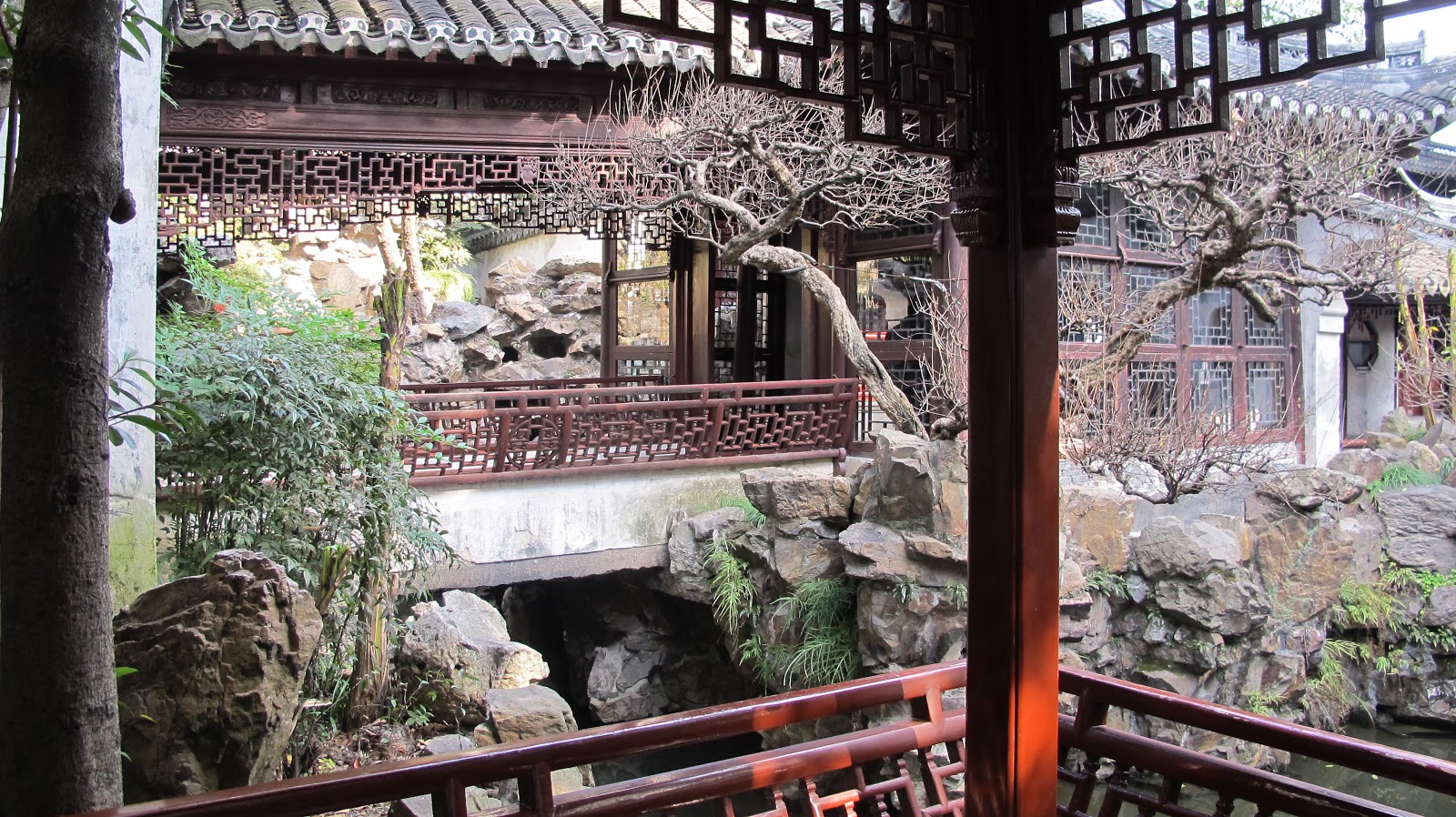
Yu Gardens Shanghai, a rare non-touristed moment of tranquillity

At OV Gallery, an exhibition by painter Shi Jing, 'The Remains of the Day', also seems a little apocalyptic. Curator Rebecca Catching, whom I met today, says that his "asteroid series takes this concept of elapsing time to a new and cosmological level. Images of asteroids, which were taken from an Internet fan-site, are applied to the canvas using a combination of brushstrokes moving in different directions to depict the bulbous, pockmarked forms. What fascinates Shi Jing is the idea that for an asteroid, travelling an average of 90,000 km an hour, these photos are outdated even by the time they are taken. What we perceive is merely an image of an asteroid which is now light-years away from where it once was." The paintings become an installation with frames constructed with protruding LED lights which cast eerie shades of green, blue and magenta onto the dark surfaces. This continues the artist's interest in the vastness of the cosmos.

Shi Jing, Seen in Passing, courtesy of Chambers Fine Art Beijing
There seems to be a somewhat apocalyptic theme here, and in a week in which North Korea fired a long range missile and many memorial ceremonies of the 1937 Nanjing Massacre took place across China,  that may be most appropriate. Meanwhile, however, the men in People's Square play mahjong and in Fuxin Park they fly kites and play cards. Life continues in all its banality and its beauty.


Playing cards under the watchful eye of Marx and Engels
Gathering in People's Square

Kite Flyer at Fuxin Park

Sunday, October 16, 2011

Yibian xuexi Hanyu, yibian ku

The Emperor's Garden in the Forbidden City - attempting to learn Chinese is like scaling  rocks!
Wondering how to avoid becoming completely demoralised about my efforts to learn Chinese, I have been dutifully going over vocabulary lists and repeating words and phrases out loud, much to the annoyance of my family. My feelings of frustration are partly my own fault due to juggling work, life and everything else and therefore neglecting to do the necessary amounts of homework, but partly it's the sheer difficulty of learning a language so different to any European one. Last week was the first lesson of a new term. I entered the room with great optimism and enthusiasm, and left it again two hours later feeling thoroughly dejected. In part this was due to the arrival of a new student with far more fluent Chinese than I feel mine will ever be, who can confidently engage the teacher in conversation, while my attempts are still stumbling simple sentences that make me feel (and no doubt look) like a halfwit. And partly due to a growing feeling that I have engaged on an almost impossible endeavour. I am ashamed of any moment in my 30 years of teaching when I have been less than patient with a student who has struggled with learning something new!


Here is a sentence from this week's chapter of 'Integrated Chinese' (but without tones indicated): " Xie Hanzi, kaishi juede nan, changchang lianxi, jiu juede rongyi" meaning "When you first learn to write Chinese characters, you would find it difficult. If you practise often, you would find it easy." 


I am sorry, but this is clearly a lie. My more truthful, indeed hearfelt, sentence is this: "Wo yibian xuexi Zhongwen, yibian ku" (At the same time as I study Chinese, I weep")


Speaking of lies, I have been reading Jan Wong's earlier book, 'Red China Blues: My Long March from Mao to Now' which recounts her experiences as one of the very few foreign students at Beijing University during the 1970s in the crucial period of the power struggle between the Gang of Four and Deng Xiaoping. Unlike her more recent 'Chinese Whispers' (see previous post) this gives a more complete picture of the time, and of the experience of young Chinese of her own generation, the generation which missed so much of their education through being sent to the countryside to work alongside the peasants and study 'Mao Zedong Thought'. In 'Chinese Whispers' she discovers the consequences of her naive denunciation of a fellow student who had asked for assistance to leave China and go to the United States. Reading 'Red China Blues', however, I discovered that there was another, even more unforgivable act of betrayal: she is invited to dinner by a friend of one of her North American professors and his wife, two Beijing intellectuals whose careers had been destroyed by the Anti-Rightist campaigns. They asked for her help to get their daughter out of China. Without hesitation she reported them to university authorities. Embarrassed by being the daughter of the wealthy owner of a string of Chinese restaurants, she believed she was going back to Canada to be 'Beijing Jan', something  like 'Hanoi Jane', in order to bring revolution to the decadent West. Despite my unease about aspects of her writing, it is certainly brave to admit this youthful foolishness, particularly when it had such terrible consequences. She says, "I do not know what happened to Professor Zhao and his family...May God forgive me; I don't think they ever will."


 the image of revolutionary China as a socialist utopia  in which Jan Wong so fervently believed
The chapter that especially fascinated me, though, was about the popular uprising that took place in Tiananmen Square in 1976 after the death of Zhou Enlai. Thousands of people left wreaths and poems, many of them attacking the seventh century Tang Empress Wu Zetian, who reigned after her husband's death: a thinly veiled attack on Madame Mao. There were outpourings of grief in other cities too, in Hangzhou, Zhengzhou and Nanjing. This threat could not be tolerated - the wreaths and poems were removed and the square was cordoned off. The Ministry of Public Security reported that hundreds of demonstrators were beaten and four thousand were arrested. If there was a death toll, it was a state secret. There are some eerie parallels here to later events.


This afternoon at a picnic I met a teacher who studied at Beijing University in the early 1990s, on exchange from Sydney University. She described a very similar experience of constant monitoring and control of the foreign students, but not being a fervent convert to 'Mao Zedong Thought' such as Jan Wong twenty years earlier, she decided to come home and abandon her studies after a PLA soldier pointed a gun at her as she tried to re-enter her locked dormitory after curfew. So fascinating that the stories people recount to me about their experiences of China are all so different, yet there are threads which connect them, both positive and negative.


Jan Wong's book, and also Lijia Jiang's memoir of the 1980s, 'Socialism is Great' are evocative reminders of the daily life of so many people for so long - and the far-reaching effects of that time on current generations. But I thought about my meeting with artist Shi Qing in Shanghai, and his response when I told him how sad  I found his 'Factory Farm' installation, inspired by the Danwei (work unit) in Mongolia where he grew up. He said, "The past is neither sweet nor bitter, it just is." This says something about Chinese resilience, and also about determination, but like the workers leaving poems about Tang Dynasty Empresses as dangerous political comment, it also speaks of the interconnectedness of past and present in China.


Shi Qing, 'Factory', installation photographed at ShanghArt Taopu by Luise Guest and reproduced with the permission of the artist and ShanghArt Gallery