The ongoing thoughts of an art teacher in China - and home in Sydney

A continuing diary about my travels in China, and thoughts about China and Chinese art from home and abroad
Showing posts with label Contemporary Ink Painting. Show all posts

Friday, March 9, 2018

Body Calligraphy: Ink and Breastmilk


I'm currently immersed in thinking about materiality and Chinese contemporary art -  most especially in relation to ink, and how it is being used in performance works by women artists. So when I saw photographs of work by an artist called Xie Rong in a Hong Kong exhibition '家' at Galerie Huit last year, I wanted to find out more, thinking that I could perhaps interview her in China. I discovered that she lives in London, and goes by the name Echo Morgan. Serendipitously, I was visiting the UK for the first time in many years to present a paper at a conference - yes, about ink, and women artists - so we were able to meet. This account, published in The Art Life last week, was based on a very long conversation over many cups of coffee in the British Library tea room.

Body Calligraphy: the performance work of Echo Morgan


Echo Morgan (Xie Rong), Hair Painting, 2011, documentation of performance, image courtesy the artist
Echo Morgan is the English name of Xie Rong, a Chengdu-born, London-based, multi-disciplinary artist whose work is underpinned by a dark family story. She works with stereotypes of ‘Chineseness’ and femininity in order to subvert them. Morgan has written texts on her skin using red lipstick, black Chinese ink, white ‘ink’ made from jasmine tea, and her own breast milk after giving birth to her second child. She has played with tropes of Chinoiserie, painting her naked body to resemble blue and white porcelain, and then inviting the audience to violently wash the patterns away by hurling water-filled balloons at her. Her work mines her own experiences of childhood, family, marriage and motherhood – and those of her female ancestors. She is a story-teller.

Echo Morgan (Xie Rong), Hair Painting, 2011, ink on paper, image courtesy the artist
When I saw images from Morgan’s 2017 Hong Kong show,  Home, I was intrigued. The exhibition featured a re-enactment of her 2011 work, I Am A Brush, in which she ‘wrote’ calligraphy with Chinese ink using her own long hair. The result of the original performance was an 11-metre long scroll covered in abstract marks, later cut into five pieces for the exhibition. It’s a wry comment on the red-hot market for ink painting and the fashion for Chinese traditions, but it’s also the result of a very personal ritual of loss and sadness. I found Morgan through the Hong Kong gallery, and we met in London late last year. Over coffee in the hushed surrounds of the British Library tea room, she told me about her life and work.
Morgan’s performances incorporate gesture, voice, text and image. I Am A Brush began when she was completing a master’s degree at the Royal College of Art in London. She had become interested in theories of female language, prompted in part by the breakdown of her first marriage to a husband who could not comprehend why his wife, then working as a designer for a major department store, would give up a good salary to become an impoverished art student. Morgan remembered how her mother had carefully brushed her long hair before her wedding, reciting a traditional bridal blessing. She wanted to make something using hair and text to express her sorrow. Hair, ink, and tears: in I Am A Brush the traditionally masculine scholarly language of calligraphy becomes a female language of the body.
A woman’s hair is imbued with contradictory meanings – a ‘crowning glory’ that is also abject, a sexual fetish that is also terrifying, a source of power that also signifies vulnerability and subservience. Dipping her hair into dense black Chinese ink, Morgan ‘wrote’ out her heartbreak and her strength, her sadness about the end of her own marriage and those of her divorced mother and aunts. She thought of The Good Women of China: Hidden Voices by Xinran (another Chinese woman who had made her home in England). Morgan told me of a line that resonated with her own experience: ‘Every family has a book but in China the book is glued with women’s tears.’ Her mother’s bitterness, and her own, seeped into the paper with the sweeping arcs of her hair. She said, ‘All the ink marks and dots were words, they were the stories of the women in my family.’
Be Inside the Vase was a multi-layered work performed in London in 2012 and documented by Morgan’s partner and collaborator, photographer Jamie Baker. It includes photographs, a film with a haunting monologue reflecting on her fraught relationship with her father, and the performance itself. The photographs of Morgan’s body, painted with floral motifs, are a challenge to orientalism, a self-reflexive examination of Chinoiserie, and a deliberate positioning of a Chinese body for a western gaze. The naked artist, painted white, has covered herself with a blue and white porcelain pattern of bamboo and cherry blossom. A branch of blossom trails across her face, covering her mouth, silencing her. The beauty of these photographs belies the much darker content of the performance from which they came.

Echo Morgan (Xie Rong), Be the Inside of the Vase, 2012, documentation of performance, photograph by Jamie Baker, image courtesy the artist
The title references a Chinese saying that likens a beautiful woman to a vase – fragile, smooth, and hollow. Morgan’s abusive and emotionally volatile father was a gangster who operated in the grey areas of the rapidly opening Chinese economy in the 1980s; he ran nightclubs, brothels and casinos, and collected black market porcelain. He demanded that his daughter appear decorative and expensive, like a Song Dynasty vase. Morgan’s mother, in contrast, told her not to be like the surface of a pretty, empty vessel, but instead to be like the inside: ‘Be the quality!’ Divided into ‘chapters’, the first part of Be Inside the Vase deals with the conflict and violence of her childhood. Morgan said, ‘The first story [Million Dollar Baby] began with my father’s attempt to commit suicide. He owed everyone money.’

Echo Morgan (Xie Rong) You Have My Blood In You , documentation of performance, image courtesy the artist
In the second part, Break the Vase, the artist stood inside an enormous vessel made of paper and bamboo. She invited the audience to throw water-filled balloons at her in order to ‘break the vase’. At first people were hesitant, but soon the paper vase broke apart and the missiles smashed into the artist’s face. Morgan’s nude body was gradually revealed as the paint washed away and the bamboo structure was broken: a simmering undertone of violence became explicit and dangerous, the audience was made complicit. Juxtaposing English narration with Chinese traditional songs, Morgan plays with her complex hybrid identity and her difficult childhood. She explores the territory of translation: between two languages, between gesture and stillness, between her Chinese past and English present, between performance and image.

Echo Morgan (Xie Rong), You Have My Blood In You, documentation of performance, image courtesy the artist
You Have My Blood in You is a further interrogation of her past – sent away at the age of four after her parents’ divorce to board at a much-hated ‘strict Communist kindergarten’, Morgan was shaped into a ‘xiao hong hua’ (Little Red Flower), obedient and pliant. Later, she yearned to escape the cage of expectation and the weight of memory. When Morgan became a mother to sons, memories of her father threatened to overwhelm her. All his shady schemes came to nothing, and all his supposedly valuable Song Dynasty vases turned out to be worthless fakes – he died destitute. Underneath her white clothes, her body is painted with black ink that gradually seeps through, signifying a stain that cannot be washed away, and the blue pigment represents the blue and white glaze of porcelain.
Since the 1980s contemporary artists in China have deconstructed and reconstructed calligraphy in subversive ways, often – as with Xu Bing, Wu Shanzhuan or Gu Wenda, for example – to comment on meta-narratives of culture such as the power of the state or the sweeping forces of history. In Echo Morgan’s works her own body, her hair, even her breast milk, become a language; she is writing a woman’s story of suffering with a subtext of strength and courage. She says, ‘I do really respect the power and strength of women, but I think in my work you see a lot of fragility. And that is how I feel, as a daughter, as a wife, as a mother.’

Wednesday, November 15, 2017

不好意思 Bu Hao Yisi: Apologies from a Bad Blogger, and Bingyi's Floating Life

So how many excuses are there for not updating this blog? I have been slack, it's true. My excuse is that I'm juggling a (very) full time job with a research degree and yet another attempt to study Chinese (hopeless task!) and as a tired juggler I'm beginning to drop the balls. And given that the research and the job both immerse me in reading and writing about contemporary Chinese art every day, this blog has had to take a back seat. I am also engaged in interviewing each Chinese artist from the White Rabbit Collection who comes through Sydney. For a link to the White Rabbit Vimeo Collection - 12 videos so far - click HERE.

Here is the trailer to my interview with the rather provocative artist, Xiao Lu:

Xiao Lu Trailer from White Rabbit Collection on Vimeo.

I've recently returned from the UK where I presented a paper about my current research - no surprise to those in the know, it's focused on women artists and gender in contemporary practice. I'm writing an article for a new website (watch this space), a paper for a journal, and also writing up my interview with the very interesting performance artist, Xie Rong (Echo Morgan) whom I interviewed in London. And I'm in the final throes of a major book project.
Xie Rong / Echo Morgan, 'Be The Inside of the Vase', 2012, 4-hour performance, clay, body paint, water, Chinese paper, willow, metal, photographed by Jamie Baker, image courtesy the artist
More on my fascinating conversation with Xie Rong, over coffee in the British Library, coming very soon.

In the meantime, here's my recent article about Bingyi, who also features in my current research project and was a focus of the paper I presented at the Annual Conference of the Centre for Chinese Visual Art in Birmingham last month.
Bingyi at work in the mountains, image courtesy the artist

A Floating Life: Navigating Bingyi’s Literary Maze

Chinese contemporary artist, Bingyi (her full name is Bingyi Huang but she goes by one name, like a rock star), has ‘bombed’ the airfield at Shenzhen’s Bao’an Airport with 500 kg ink and oil missiles in order to create a dramatic painting for the terminal. She has created vast ink paintings 200 metres in length by laying specially made paper on basketball courts and mountain roads, pouring and hosing ink and water by the light of car headlights. She has sometimes burned her own paintings, letting the ash and paper fragments fall and mix into the ink of new works. A precociously gifted child, born in Beijing in 1975, Bingyi grew up to become a true polymath: an art historian with a doctorate from Yale, she has composed operas and ballets, made films, incorporated her knowledge of science and engineering into her artworks, and recently started a school for young artists and activists in Beijing. All in addition to creating exquisitely beautiful small ink paintings and large, expressive figurative canvases. An essentially self-taught artist, she began to paint in her mother’s living room in 2007, after eye surgery to correct her extreme short-sightedness.
Bingyi in her Beijing studio, 2013, photograph Luise Guest
Bingyi did not start painting with ink ­ — that came later — but with oil and acrylic on canvas. She developed an expressive and intuitive painting idiom that she describes as a search for the sublime. Her vision is not the European Romantic sublime, but a specifically Chinese notion informed by Buddhist and Daoist philosophy. From metaphysics to classical Chinese literature; from the poetry of Emily Dickinson to contemporary music; from Song and Yuan Dynasty ink painting to postmodernism, from geology and meteorology to physics and arcane mathematics, Bingyi brings a wealth of esoteric knowledge and a passionate interest in the possibilities of intellectual inquiry to her work. She is also a dancer and a musician, and a performative theatricality has certainly found its way into her work, but her approach, even when working with oil or acrylic, is the disciplined, controlled method of the traditional ink painter: each mark of the brush is deliberately placed. Her works appear painterly, but their apparent spontaneity is carefully considered.
Six Accounts of a Floating Life (2008) is characteristically literary in its density of poetic allusion and ambiguous narrative structure. Inspired by the memoirs of the eighteenth-century writer Shen Fu, it evokes the literati tradition of the handscroll, designed to be slowly unrolled and closely examined in scholarly gatherings called ‘yaji’. The handscroll represents the passage of time in an episodic manner: viewing a scroll is a sequential unfolding, intimate and revelatory. The size and format of a scroll makes the experience uniquely suited to a conversation between connoisseurs, poring over each new visual delight as it is rolled and unrolled. It is a method of painting that takes the viewer on a journey through time and space, both metaphorically and literally.
The artist describes Six Accounts of a Floating Life as a metaphysical love diary that describes life’s flow, its ‘shengming de huadong’. Its expressionist style and scribbly calligraphic line recall the innovations of early twentieth century painters, but the small figures scattered across the composition suggest, rather, the Chinese tradition of the wandering scholar. Each of the five (not six) panels depicts separate incidents, small moments in the passage of time, from the innocence of childhood to romantic love, its inevitable unravelling, and, finally, to death.


Bingyi, Six Accounts of a Floating Life, Parts 1, 3, 4 and 5, 008, oil on canvas, whole work 160 x 900 cm,
 courtesy of White Rabbit Collection
The original literary work is a multi-layered chronicle that tells and re-tells significant events in consecutive chapters, revealing new details and different points of view, shifting from private and domestic moments to public events and, rather surprisingly, to long descriptions of gardening and flower-arranging. Chapter titles such as The Joys of the Wedding ChamberThe Pleasures of LeisureThe Sorrows of Misfortune, and The Delights of Roaming Afar, are replicated in Bingyi’s appropriation of the text. The original memoir concludes mysteriously after only four sections, rather than the six alluded to in the title. (Two final chapters published in the 1930s were subsequently revealed to be fraudulent.) Bingyi similarly suggests an element of mystery with her five panels. It can be conjectured that the missing sixth panel represents an absence, a space in which one can insert whatever narrative you please, connecting artist to her audience.
Bingyi, I Watch Myself Dying, 2009, oil on canvas, 300 x 500 cm, courtesy of White Rabbit Collection
Monkeys and butterflies cavort through the paintings, referencing folk tales and classical literature. Bingyi’s multi-layered iconography links western and eastern philosophy, and personal events with universal human experiences. Another reference in her complex lexicon of imagery is to sacred Buddhist frescoes in the caves of Dunhuang, along the Silk Road, as well as to western art history and Christian theology. In the second panel of the series, two nude figures are depicted surrounded by green foliage, birds and butterflies, an allusion to Adam and Eve in the Garden of Eden. Semi-transparent, their pink skin reveals the organs beneath. The male figure has a brain and nervous system, the female is in possession of a heart and lungs: Bingyi sees the wonder as well as the danger in the intertwining of separate identities in passionate romantic relationships. If you lose yourself entirely, what then?
Bingyi’s immersion in Chinese art history – her Yale PhD thesis was a study of the Han Dynasty – provides a depth of understanding that she applies in a contemporary idiom, whether working on a small and intimate scale or in the monumental ‘land art’ ink paintings for which she has become well-known. With Six Accounts of a Floating Life, the large scale of Bingyi’s paintings render the experience immersive, almost cinematic. It is like reading a book, but a book where the ending has deliberately been left open for the viewer to imagine a conclusion. Perhaps the absent sixth panel is the ‘colophon’, where in traditional handscrolls the owner and other viewers would attach their comments, or engage with the comments left by previous viewers, like a pre-digital version of a social media ‘thread’.
A serious accident in 2009 in which Bingyi’s clothing was set alight by a candle flame left her very badly burned, subject to a series of traumatic and excruciatingly painful medical interventions and operations. I Watch Myself Dying (2009) expresses the horror of this experience, with the artist’s fragile body lying on the operating table under brilliant lights, watched by an alternate self who hovers above her like the soul leaving the body. This creature is Cyclops-eyed, with engorged breasts, pregnant with suffering. Malevolent faces crowd into the top of the composition, recalling Ensor’s masked figures in The Entry of Christ into Brussels. Part of a series of works entitled ‘Skin’, it’s an unsentimental representation of physical anguish, making deliberate references to Thomas Eakins’ nineteenth century medical portraits, and his paintings depicting surgical procedures.

Cathartic and gestural, Bingyi once again references the work of Philip Guston, a painter who understood suffering, whilst her floating figures reveal a distinctly Chinese sensibility. The pink body of the artist lying on the table, organs and sutures visible on the surface, is like a pupa in the process of becoming. The most autobiographical of Bingyi’s works, it nonetheless reveals her scholarly and poetic approach, layered with dense literary and artistic allusion. She likens her practice to composing music, or writing computer code, using a language that juxtaposes the intuitive with the controlled and systematic. Like the imperial scholar painter in his study, Bingyi applies a highly refined visual language to express her deepest feelings and responses to the events of her world. In a long conversation in her studio, a converted Yuan Dynasty temple in the oldest part of Beijing, she said, ‘It’s like I am composing a riddle. I am convinced that in a thousand years, people will dive into my paintings and they will want to know what kind of a literary maze I was constructing.’
About the artist:
Born in 1975 in Beijing, Bingyi’s training as an art historian informs her painting practice. Her doctoral dissertation at Yale was based on her study of the Han Dynasty, and her deep knowledge of Chinese art and literature underpins every aspect of her practice. Bingyi’s paintings and installations have been shown in the United States, Korea, Spain, Belgium, Canada and Hong Kong, as well as in group and solo exhibitions in China.

Photographs of Bingyi in her Beijing studio by Luise Guest

Thursday, March 9, 2017

Lin Yan: Ink and Paper


Lin Yan,'Sky 2', 2016, installation view in Taipei, image courtesy the artist and White Rabbit Collection

Last week I interviewed artist Lin Yan about her life and work. She is the daughter and grand-daughter (and wife) of artists, born into one of those extraordinary dynasties of artists that you find more often in China than elsewhere. She reflected on her life of journeying, from Beijing, to Paris to New York where she now lives and works. Her beautiful ink and paper installation Sky 2 is currently installed for 'The Dark Matters' exhibition at Sydney's White Rabbit Gallery. Soon I will post the video of our interview. In the meantime, here is part of the abridged version published today, very appopriately in time for International Women's Day in the Northern Hemisphere:

Three cities, three histories, and three artistic languages co-exist in the work of Chinese artist Lin Yan, who was raised in Beijing and studied in Paris before moving to the USA, where she now lives and works in New York.
Lin was born in 1961 to a family with a distinguished artistic lineage —both her parents and two grandparents were famous artists. Like other intellectuals, writers, artists and teachers, they suffered through the changing political winds of twentieth century China. Lin studied at Beijing’s Central Academy of Fine Arts, entering in 1980, only two years after it had re-opened at the end of the Cultural Revolution. After graduation, she followed in the footsteps of her mother and grandfather, studying in Paris before moving to the United States in 1986. Today, she works in her Long Island City studio, travelling back and forth between New York and Beijing several times each year.
Lin Yan's parents, Lin Gang and Pang Tao, in 1958, image courtesy the artist

Best known for working with paper, Lin Yan bridges the divide between two and three dimensions (she calls it working in ‘two and a half dimensions’), and between Chinese and Western philosophies and aesthetics. She blurs boundaries, embraces paradox, and juxtaposes past and present. I wanted to learn more about her journey from one culture and visual language to another, and to discover how her beautiful, fragile works encompass past and present. While the artist was in Sydney to install her work at the White Rabbit Gallery we spoke about her early life in Beijing, and how she thinks about her practice: what follows is an abridged and edited account of a much longer conversation.
Luise Guest: I’d like to ask about your early life, growing up in a family of artists in Beijing. Your parents were modernist artists and influential teachers; I know that your mother, a printmaker who had also studied in Paris, at the École Nationale Supérieure des Beaux Arts, was Xu Bing’s teacher, for example, and your father, Lin Gang, had studied in the Soviet Union. Your grandfather, Pang Xunqin, was a very famous modernist artist. How do you think these early experiences influenced you? And what are some of your most vivid memories of your early childhood growing up in this artistic milieu?
Lin Yan with her mother, artist Pang Tao, in Beijing in 1963, image courtesy the artist

Lin Yan: I saw my parents doing paintings a lot when I was young, but not my grandfather, because he was accused of being a Rightist in 1957 before I was born. [Mao’s Anti-Rightist campaigns began in 1957: more than half a million intellectuals, students, artists and ‘dissidents’ were persecuted. Many were executed, imprisoned or sent to labour camps. Lin Yan’s grandfather was made to clean toilets and forbidden to make art, blacklisted for more than twenty years.] Actually, I didn’t really meet him until I was ten or eleven years old. Of course, I had met him when I was a baby, but I couldn’t remember that, I just saw the pictures. My earliest memory of him is from the time during the Cultural Revolution when my parents had been sent to a labour camp along with all the other professors from the Central Academy of Fine Arts, and I was staying behind in Beijing, living with neighbours. On my way home from school one day I saw an old man with white hair standing in front of the gate … he was staring at me. I asked if he was looking for someone, or if he wanted to come into the yard, and he said, ‘Are you Pang Tao’s daughter? I am your grandfather.’
Lin Yan as a student at the Central Academy of Fine Arts, Beijing, in 1982, image courtesy the artist

...Lin Yan pleats, drapes, folds, sheaves, crumples, cuts and layers soft handmade Xuan paper. Sometimes stained, even saturated, with black ink, her works remind us that ink and paper are the essential Chinese materials for both art and writing. Floating in the gallery space, suspended by fragile threads, the crumpled, twisted, grey and black forms of Sky 2 evoke brooding grey skies over polluted Chinese cities. They contrast with sheaves of pleated white paper that hang behind them, a curtain that shifts gently in every current of air, as if breathing. Overhead, the soft, hollow forms of paper stained with black ink loom like storm clouds.
Lin Yan, Inhale, 2014, ink, plastic bag, light and Xuan paper installation, 765x508x190cm, image courtesy the artist, photo: Jiaxi Yang

Lin Yan with her work Sky 2 at White Rabbit Gallery, image courtesy White Rabbit Collection, photograph: David Roche

T
O read the rest of the article on The Art Life website, click HERE

Wednesday, March 9, 2016

Invisible Ink: The Ink Tradition Remixed and Reclaimed

Charwei TSAI, Incense Mantra, 2013, single channel video. In collaboration with Tsering Tashi Gyalthang.


The ink tradition in Chinese art continues to fascinate the art market and international curators, as well as being a political hot potato inside the Chinese artworld. To some, it's a regressive artform manipulated in the interests of bolstering nationalism. To others, it's part of the reinvention and reclamation of Chinese tradition after thirty years of Maoist suppression. Whatever your stance, contemporary variations on ink painting are not vanishing any time soon. The current exhibition at UNSW Galleries illustrates all the possible variations employed by contemporary artists who are deeply invested in the philosophy of the tradition, but not necessarily in the physical medium itself. 

Here is my review, published today in The Art Life after two visits to the exhibition and an illuminating chat with its curator, Sophie McIntyre, in which she explained the long gestation of her research, her interest in the ink phenomenon, and why she chose these particular artists, all of a younger generation than some of those who first began the ink revival in the 1980s and 1990s. We are lucky to see this exhibition in Sydney after its successful launch in Canberra and a second showing in Bendigo. Don't miss it while it's here!

Ink Remix at UNSW Galleries
The term ‘ink painting’ evokes mental images of delicately rendered misty mountains, waterfalls, peonies and bamboo. In China today this category of art production does include artists whose work falls within the boundaries of historical conventions, but it has also come to include a younger generation of artists who challenge and subvert the tradition in surprising ways. The highly politicised ‘Contemporary Ink’ movement includes artists with extraordinarily diverse practices. And some of them don’t use ink at all.
YAO Jui-chung 2015 -complete work small file
Yao Jui-chung, Yao's Journey to Australia, 2015, biro, oil pen with gold leaf on Indian handmade paper, 200 x 546 x 6cm. Courtesy of the artist and Tina Keng Gallery.
The use of ink is deeply embedded in the Chinese sense of nationhood. Fundamental to Chinese calligraphy and painting for more than two millennia, the unique properties of Chinese ink allow artists to produce works of great expressive power with limited means. Whether diluted or ‘black as lacquer’, it is capable of infinitely nuanced and subtle mark-making. Reinventing and transforming traditional modes of expression, artists in China, Hong Kong and Taiwan brought the philosophy and aesthetics of Shui Mo (‘water and ink’ painting) to their sculpture, drawing, video and performance practices, a fresh approach revealed in ‘Ink Remix’ at UNSW Galleries. From a Buddhist prayer written with ink on tofu by Charwei Tsai to Ni Youyu’s reimagined Chinese cosmology made of flattened coins, the exhibition reveals how contemporary artists ensure the ink tradition remains vital and alive.
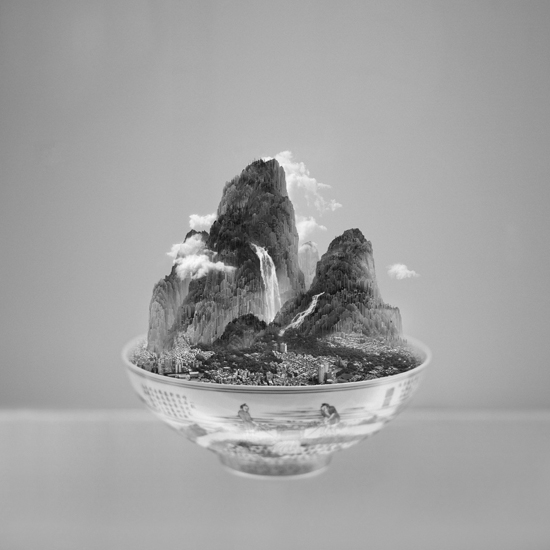
YangYongliang_ABowlofTaipeiNo 4
YANG Yongliang, A Bowl of Taipei no. 4, 2012, photographs (Epson Ultragiclee print on Hahnemuhle paper), 100 x 100 cm. Courtesy of the artist.
Sophie McIntyre brings her deep knowledge of contemporary art from China, Taiwan and Hong Kong to the curation of the exhibition. Two years in the making, ‘Ink Remix’ was intended to examine the work of a younger generation of artists, born after 1960. McIntyre says, ‘I was curious about why a lot of young contemporary artists were turning to this phenomenon of ink. But I was most interested in those artists who were critically interrogating an ink tradition and what that means in contemporary society.’ McIntyre was curious to see how artists in the three locations respond differently to this revitalisation of an ancient art practice. What she discovered, in many conversations with many artists, was their desire to reconnect with the tradition in a philosophical sense, rather than as technique, style or medium. And not just to reconnect, but to reinterpret.
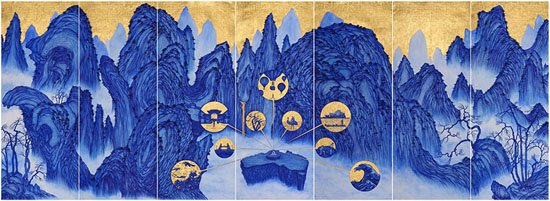
Just as a musical remix could include sampling of tracks by multiple artists, many of the artists in ‘Ink Remix’appropriate the tropes of traditional ink works. Misty mountains do appear, albeit in a much altered form. In Yang Yongliang’s ‘Bowl of Taipei’ series (2012) they are crammed into noodle bowls, suggesting the ‘bonsai-ing’ of nature, squeezed into a new urban world of consumerism and mass production. Yang’s clever animations respond to China’s environmental crisis and the pace of urbanisation. ‘Rising Mist’ (2014) at first appears to emulate a traditional scholar painting of mountains and water. On closer inspection you realise that the mountains are formed by the towering steel and concrete high-rises of an enormous city; construction cranes and electric stanchions rather than pine trees punctuate the horizon line. The entire urban landscape is adrift in a miasma of pollution.
He Xiangyu learned how to paint like masters of the Song Dynasty in order to produce works that appear similar to classical paintings. His vistas of mist-shrouded mountains, tiny temples and tumbling waterfalls, however, are painted with ink mixed with Coca-Cola, a satirical jab at the unstoppable march of globalisation and consumer culture. Part of a much larger project shown at 4A Centre for Contemporary Asian Art in 2012, ‘Cola Project’ also involved the boiling down of 135,000 litres of the soft drink into a smelly tar-like sludge, and the carving of two jade skeletons (made to the exact dimensions of the artist’s, with the assistance of MRI imaging and X-rays) that were then partially simmered in Coca-Cola. The paintings make more sense in the context of that larger body of work, but in pondering their materiality we are forced to consider whether Chinese culture is being overwritten in a destructive process of what used to be called ‘Coca-Colonisation’, or whether, in contrast, they show the enduring nature of those traditions, outlasting the sweet product of consumer desire.
TSAI Charwei, Tofu Mantra, 2005, video still. Courtesy the artist and TKG+
The act of writing is central to the practice of Charwei Tsai, born in Taipei and currently living and working between Taiwan and Vietnam. For many years her work has explored relationships between spirituality and the natural world, using performance, photography and video. She conveys the transience of the physical world in the ‘Mantra’ series, writing a Buddhist prayer onto lotus leaves, mushrooms, flowers and other organic materials. Tsai memorised the important Heart Sutra when she was growing up in Taiwan, and its meditation upon the impermanence of all things continues to inform her practice. For ‘Tofu Mantra’ (2005) she wrote its 260 Chinese characters onto a large piece of tofu. The video documents the process of decay, the tofu liquefying, surrounded by falling insects, an arresting memento mori.
Her choice of tofu, a material so symbolic of Chinese culture globally, has particular significance for an artist straddling cultures and languages. (As, incidentally, was also seen recently in Chen Qiulin’s ‘One Hundred Names’ project at 4A, in which the artist carved the most common Chinese surnames into large blocks of firm tofu.) ‘Incense Mantra’ (2013) is a site-specific work produced in Hong Kong in collaboration with Tibetan Tsering Tashi Gyalthang, inspired by the enormous conical joss sticks burned in the Man Mo Temple. The incense, densely covered with characters written in black ink, slowly burns, turns to ash and crumbles. A soundtrack of chanting monks and the noise of waves (Hong Kong, so closely associated with the maritime world, translates from the Chinese as ‘Fragrant Harbour’) produces a genuinely stilling and meditative experience.
To read more, click HERE
To see exhibition details, Click HERE

Saturday, November 30, 2013

北京日记 Beijing Diary: Zai Jian!

Monk in the Lama Temple, Beijing, photo Luise Guest
I am finding it difficult to believe that nine weeks in Beijing have come to an end. Despite the various vicissitudes and dramas, despite the air pollution, despite the occasional overwhelming awareness of the challenges of navigating "big bad Beijing" I have really come to love this city, and my neighbourhood of Tuanjiehu in particular. This afternoon the toothy street cleaner in his orange overalls sweeping up after the morning market told me my Chinese was "bu cuo" (not bad) after shamelessly eavesdropping on my purchases of mandarins and bananas at the fruit market. And the sky has been a brilliant blue for several days, wiping away memories of waking to a toxic metallic smell and grey clouds of pollution. When Beijing is good, it is very, very good. So I shall return!

Hutong Doorway

I have spent the last few days seeing the "big sights" under clear blue skies, hoping to persuade my husband (initially dubious) of the delights of Beijing. I am not sure whether I have succeeded on that score, but walking on the Great Wall at Mutianyu is always a memorable experience, as is the Forbidden City, the Lama and Confucius Temples, the Drum and Bell Tower, and the remaining hutongs.

The artists I have met, the people I have encountered, the extraordinary juxtapositions, contrasts and contradictions of a society in great flux - all so memorable and so unlike anywhere else in the world - will continue to astonish me every time I think about my time here.

In the meantime, here is an extract from my article about my encounter with the very extraordinary Bingyi Huang in her converted Yuan Dynasty temple in Beijing, published on The Culture Trip 

Between Heaven and Earth: 

Bingyi's Meditative Ink Paintings

With a new international interest in contemporary interpretations of Chinese ink painting, reflected in the number of exhibitions in major museums and galleries around the world, the practice of brush and ink has caught the attention of the international art market. But for Chinese artist Bingyi Huang it remains deeply personal and meditative, a means of reaching the sublime

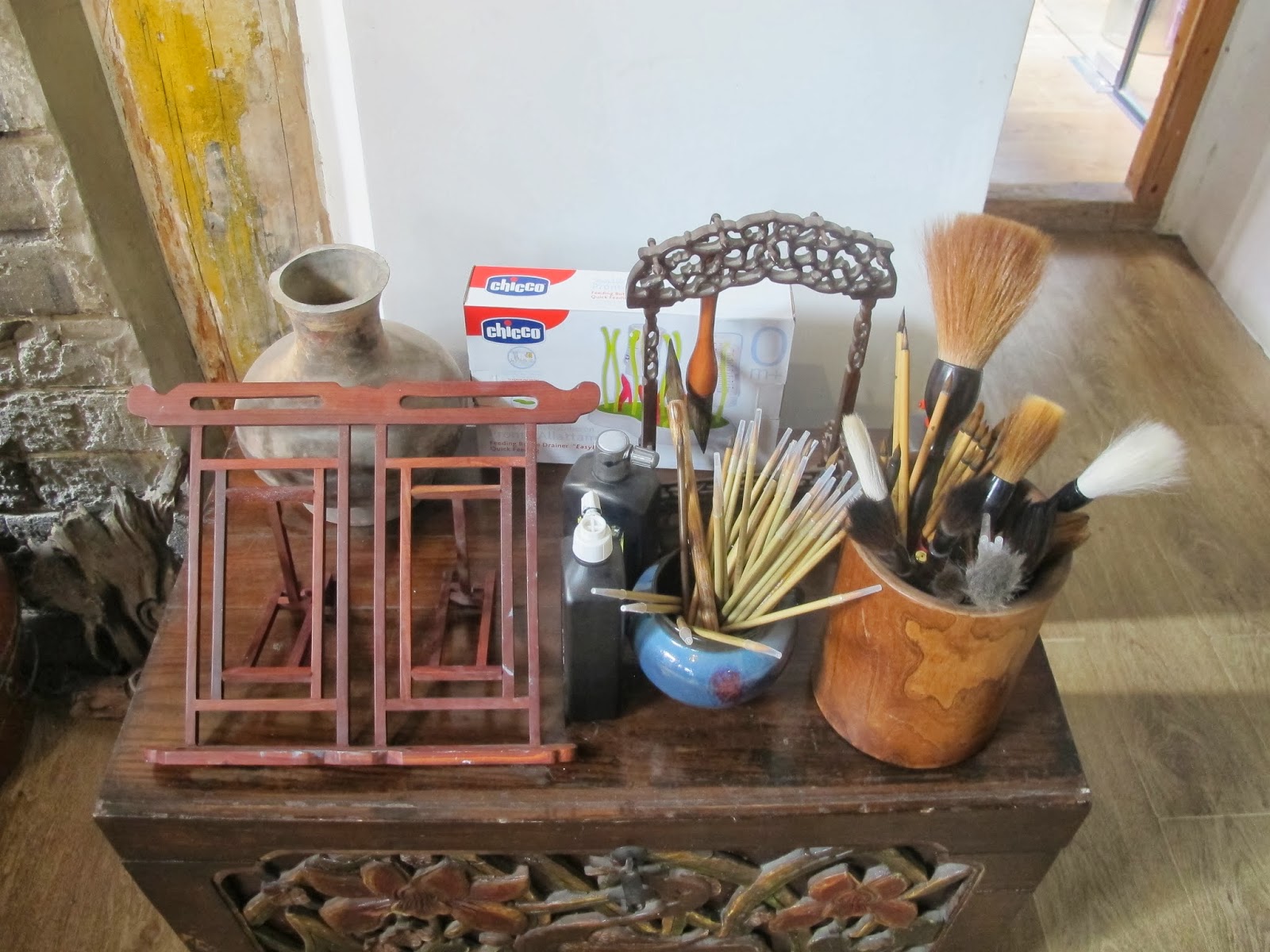
Bingyi's brushes, photo Luise Guest

In the tradition of Chinese ink painting, which most art historians agree began during the Tang Dynasty, the artist’s aim was to capture the spirit of the subject, rather than to create a realistic representation, or likeness. Today, discussions about ink painting are at the centre of global discourses about contemporary art in China, and the practice itself is in flux.
James Elkins, in his essay ‘A New Definition of Contemporary Ink Painting’, describes this highly contested and increasingly controversial form as ‘a Chinese art practice with an unparalleled density, complexity, and historical depth of reference…ink painting connects to a tradition that has been traced back to Han dynasty (206 B.C. – A.D. 220) tomb reliefs, and even to cave paintings and the decorations on Shang( ca. 1600 – 1050 B.C.) bronzes...No other genre of Chinese image making draws on such significant history or requires so much knowledge and experience on the part of the viewer.’ He goes on to make the point that his is not a visual description, nor an account of a method of making. The art could have ink, brushwork and paper, or use video, performance, sculpture, or other media; it may not even look like a traditional ink painting at all.’ It is this layering of past and present, of tradition and its constant transformation, that distinguishes contemporary Chinese art and provides much of its fascination for both Western and (increasingly) Chinese audiences.
Bingyi Huang in her studio
Bingyi Huang in her Beijing studio/Photo by Luise Guest; reproduced with permission of the artist
In fact, it seems that ink itself is no longer necessary for a work to be defined as ‘contemporary ink painting’. The gesture or the mark is sufficient, even in the form of sculpture, video or photography. From Xu Bing’s re-interpretations of literati masterpieces using debris and rubbish behind backlit screens, to the digital multimedia works of Yang Yongliang, the ‘Family Series’ of Zhuang Huan, the gunpowder works of Cai Guo-Qiang, and the recent cartographic works of Qiu Zhijie, the label of ‘Contemporary Ink’ is being applied to the works of many artists who may themselves not always agree with the interpretation. The Wall Street Journal has identified contemporary ink painting as the ‘next big thing’. A major exhibition at the Metropolitan Museum in New York, Ink Art: Past as Present in Contemporary China opens in December 2013, and will include Xu Bing’s installation ‘A Book from the Sky’ (1989), and Ai Weiwei’s ‘Map of China’ (2006), which is constructed entirely of wood salvaged from demolished Qing dynasty temples. Sotheby’s and Christies have recently gone head to head with sales of contemporary ink works in Hong Kong.
Even the most casual observer of Chinese contemporary art cannot fail to notice the myriad ways in which Chinese artists are working within and reinterpreting these traditional forms. New interpretations of a ‘Shui Mo’ (ink and water) tradition pose a challenge the hegemony of oil painting, which has dominated the art world in China since the rise of the avant-garde painters in the early 1990s. One might take a cynical view and suggest that there is a great deal of marketing going on.

In the work of one Beijing artist, however, the tradition of brush and ink has become a way to express deeply personal, spiritual, cultural and even political concerns. Bingyi Huang(usually known simply as ‘Bingyi’) lives and works in a Yuan Dynasty temple building on the ancient central axis of Beijing, near the Drum and Bell Towers. The vast space of her studio, with its enormous pillars and antique furniture, orchids and birds fluttering in large cages, is a tranquil oasis. Once across the stone threshold and inside the heavy wooden doors the shouts of street vendors, and the honking horns of motorcycles and cars navigating the narrow laneways of the hutongs, seem very far away.
When I met Bingyi in October she had just returned from a period of some months painting in the mountains a few hours outside Beijing. Her assistants carefully unrolled a 30-meter long painting to show me how she has developed a unique approach, fusing ink painting with land art, installation art and even performance art. I ask her what she thinks about the current international interest in renewed traditions of ink painting, and she laughs, saying, ‘I could not care less.’ I am doubtful, asking again why she thinks western audiences are so intrigued by the contemporary interpretations of this ancient art form, but she says again, emphatically, 'I couldn’t care less about the art market, about auction prices, it’s boring. In my case it’s not about reinterpreting Chinese traditional ink painting. If you are truly ‘Shan Shui’ you don’t need to think about it. If you are the being, you don’t need to think about the being. You just are.’ She describes her work in an intensely spiritual manner, ‘It’s the universe working through me,’ she says, ‘and sometimes it’s that space between human hand and God’s hand.’
Bingyi Huang, Journey to the Centre of the Earth
Bingyi Huang’s assistants unroll part of 'Journey to the Centre of the Earth'/Photograph by Luise Guest.
Becoming a practising artist only six years ago, after an extraordinarily diverse career, in which she switched from biomedical engineering to art history, along the way also studying computer programming, music and finance, she has created a painting idiom which she describes as a search for the sublime. This is not the European Romantic sublime of the human being as a passive observer of the power of nature, however, but rather a specifically Chinese notion informed by Buddhist beliefs and by her years of art historical research into the Han Dynasty. Bingyi completed her PhD at Yale in 2005. ‘I lived with the Han Dynasty for seven years,’ she says, ‘I was them!’ And what she learned from the years researching her dissertation was that through art, ‘one can embody the notion of eternity. If you can feel and express eternity and transience, then you are approaching a much higher level of metaphysics.’ She tells me that she began painting in her mother’s living room in 2006. ‘What drove you to become a practising artist after a successful academic career?’ I ask. ‘I always wanted to,’ she says. ‘What lies in the heart of humans is a desire to express. We all wish to express, but the question becomes “What is your embodiment? What is your medium?” It was completely inside of me, completely contained… One could say that it’s fate, but we Chinese have a different way of perceiving that.’
Her recent work, Journey to the Centre of the Earth, created for a site in Essen, Germany, a mining region of dramatic mountainous landscapes, is an ink painting of 150 metres in length – a length which equals the depth of the shaft of the first mine. It is developed from meticulous research. Weather, geology, geography, history and sociology are all elements that Bingyi investigates in the planning process for a project such as this. She began the research in Germany and then moved into the mountains outside Beijing for two months, camping in 45 degree heat, in order to physically create the work. Working with four assistants, she worked on the painting section by section, applying the ink to the paper with a variety of techniques and tools that would astonish the traditional literati painters. In an exhaustive and painstaking process her assistants even created a man-made pond large enough to make the sheets of paper that are joined end to end to create the vast scroll.
Bingyi Huang quote
‘I was standing between the heaven and the earth,’ says Bingyi. Dealing with the extreme physical discomfort of the conditions, she says, and even finding herself covered with mosquito bites, was all an important element of her practice. ‘I could feel I was no different than a mosquito, I was no different than a toad. That’s eternity – you are so minimal, you are nothing. And that is the sublime.’ She explains that this process is entirely different than traditional notions of landscape art or Chinese ‘Shan Shui’ (water and mountain painting) in which the artist observing and recording nature. ‘Nature is just a projection of the universe.’ This is not landscape painting in either its western ‘sublime vista’ guise or the Chinese ‘Shui Mo’ (water ink) tradition. ‘It’s conceptual, it’s land art, it’s performance art,’ says the artist. ‘It’s a ritual I perform between Heaven and Earth. I am not a shaman, I am just a human, but this ritual is relational between the universe and the individual, it’s a kind of sublime. It’s intensely primal. It raises questions about our fundamental being – what is pain, what is suffering, what is loneliness.’
Bingyi, ‘The Shape of the Wind: in Fuchun Mountains” (2012) ink on Chinese paper, 2.65 x 160 m, image courtesy the artist
Bingyi, ‘The Shape of the Wind: in Fuchun Mountains' (2012) ink on Chinese paper, 2.65 x 160 m/Image courtesy the artist.
To read the rest of this article, click HERE