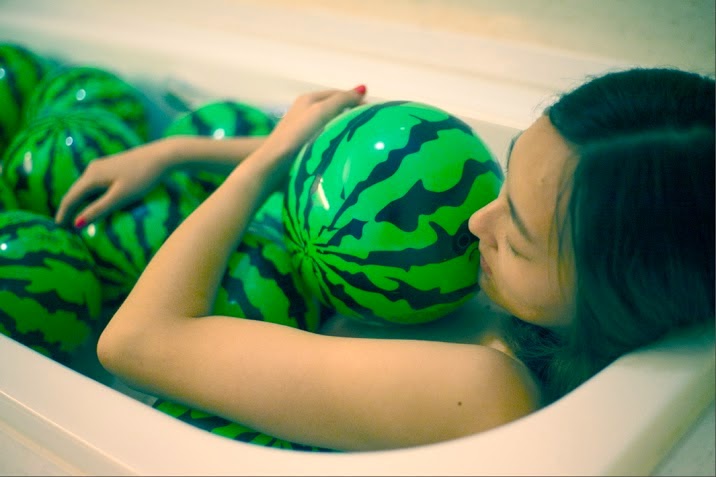
Cao Fei, My Future is Not a Dream, 2006, from the series Whose Utopia,
digital video 20 min 6 sec, image courtesy the artist and Vitamin Creative Space
The urbanisation of China and its entry into world markets in recent decades has resulted in the largest migration in human history. Young - and not so young - workers from the impoverished countryside flocked to the big cities, especially to the manufacturing centres of southern China. The Pearl River Delta became the world's factory. Cities like Dongguan, in Guangdong Province, were populated almost entirely by rural teenagers and young parents who had been forced to leave their children back in their villages to be raised by grandparents, creating a generation of 'left behind children'. Despite the complex social issues that resulted, millions of resourceful and resilient migrants sought a secure financial future, and until recently it seemed most unlikely that many would return to the much-despised countryside and hard-scrabble rural poverty they had left behind. Except, of course, at Spring Festival time, when they returned home en masse for the holiday, bringing gifts and money to their families. This social revolution has been documented in Leslie T. Chang's wonderful book 'Factory Girls'; in the documentary film, 'Last Train Home', that recounts the arduous journeys of some of the 130 million workers travelling home for Spring Festival, and in contemporary art. Cao Fei's award-winning SIEMENS Art Project of 2006, What Are You Doing Here? traced
the daily lives of workers at the Osram Light Bulb Factory in Foshan. One element of her ambitious work is a video entitled Whose Utopia, for
which she invited the workers to perform a dance to the music of their choice,
against the background clatter of the assembly line. The video closes with portraits of individual workers gazing straight
at the camera, defying us to see them as mere cogs in the machinery of China’s
economic miracle. Now, however, the 'miracle' is souring. The London Financial Times has produced a powerful series, 'The End of the Chinese Miracle', examining the impacts of a slowing economy, an aging population, and a dwindling labour force. After three decades of economic growth, and carefully targeted social and economic policy, China has completed its transformation from an essentially agrarian nation to an almost entirely urban society. But now, with factories closing (or relocating to Vietnam) due to changing markets and the pressures of higher wages, some of these migrant workers are returning to their hometowns. The implications of this metamorphosis, for China and for the world, are enormous. Check out the series HERE. And watch this fascinating and timely doco.
As soon as I heard that Cao Fei had made a zombie movie I was intrigued and amused - what else could we expect, after all, from the artist who created her own Utopian city on Second Life, complete with her avatar 'China Tracy'? I had wanted to meet and interview Cao Fei for a long time, although the journey to her studio almost defeated me - and brought my driver to new extremes of exasperated swearing. With a text message of instructions in Chinese and an address (essentially entirely meaningless in most of Beijing, especially in hutong neighbourhoods and outlying villages) we circled around for over an hour, pulling over to ask taxi drivers, women with prams, security guards and anyone else who looked local. Eventually we pulled off the main road (steel and glass structures under construction, factories, new apartments, shopping malls) and instantly were back in winding narrow lanes with chickens wandering in front of the car and skinny dogs slinking along in the shadows or lying scratching themselves in the middle of the road. After emails and phone calls we eventually found the elusive courtyard with the red door. The article resulting from that interview was published last week in Creative Asia - here it is.
Cao Fei, Haze and Fog (still), 2013, High Definition Digital Video, 16:9, colour, with sound, 46 min 3 sec (end credit starting from 44 min 24 sec) image courtesy the artist and Vitamin Creative Space
In 1959 when Hollywood diva Ava Gardner was shooting the
post-apocalyptic drama “On the Beach”,
she famously declared that Melbourne was the perfect place to make a movie
about the end of the world. Anyone who has spent time in Beijing might be
forgiven for thinking the same, as they navigate through a blanketing fog of
pollution, glimpsing masked people through the ever-present haze. Artist Cao Fei (曹斐), best known for her love of popular culture, performance, cos-play and the
exploration of virtual realities, has given the Chinese capital the “Apocalypse”
treatment, with an ambitious new 47-minute drama set in Beijing’s north-eastern
suburbs - a zombie movie, with a twist.
With a cast of characters including real estate agents,
cleaners and maids, security guards, delivery boys, bored housewives and
nouveau riche apartment buyers, as well as a sex-worker who changes costumes
quickly in apartment block fire-stairs in between clients, Haze and Fog examines the alienation of a society in which
traditional Confucian values and revolutionary collectivism are being
transformed by growing wealth and materialism. Class divisions are ever more
glaringly obvious, underlined in the film through the relationships between
those who are served (by an army of maids, cleaners, delivery boys,
manicurists, guards and sex-workers) and those who serve them. The presence of
a peacock and a tiger, repeated motifs suggesting the dissonance between nature
and culture, are strange and unsettling. Together with a magical realist
mise-en-scene and languid cinematography they place the work firmly in the
realm of allegory, linking her narrative with Chinese tradition and mythology.
Cao Fei, Haze and Fog (still), 2013, High Definition Digital Video, 16:9, colour, with sound, 46 min 3 sec (end credit starting from 44 min 24 sec) image courtesy the artist and Vitamin Creative Space
While Cao Fei was
breastfeeding her second child she became obsessed with watching the American
TV series The Walking Dead. In
conversation with me last month she wryly observed that during this period of
her life she had a lot of time on her hands to think and dream as she pushed a
pram around her neighbourhood. “Why zombies?” I ask. “I think it’s quite
interesting, the idea of a dead city,” she says.“I like the idea of making a video about an
anti- Utopia.” In fact, she says, this is really an “anti-anti-Utopia” as it
reverses many of the commonly held assumptions and conventions of the genre. Unlike
most zombie movies, “It’s about how the people
are the living dead while the zombies are alive - more alive than the living
people. This is my feeling, living in this city in the past few years.”
She has been observing Beijing with the clear gaze of the
newcomer since she moved there in 2006 from her home in Guangzhou. Moving from
the south of China was hard, and she has struggled to feel at home, in an
unforgiving environment. “At the beginning I worked on the virtual project so I
didn’t need to touch the ground. I was always floating in the virtual world.
Then I had two kids. That brought me back to reality!” She slowed down and
spent a lot of time at home, feeling a little lost in Beijing. Her feelings are distilled into the film.
“Some of it is my sad feelings about life. I watch different characters in in
my district. I take my kids to the supermarket and watch the security guards, I
watch people in the gardens. It wasn’t like research for a project, this was my
life, and I slowed down and took lots of time. You can feel the heartbeat,” she
tells me.
“Is this really how you see Beijing?” I ask. “Not just
Beijing, but maybe the whole country,” she replies. “People are stuck. They are
living statues. The people are all the same whatever (their) social class. In
the film you can see the city like a ghost city - empty real estate, (full of) excess.”
She doesn’t want to be too critical, she says, but despite moments of humour the
film is a damning portrayal of a lost place full of lost people, none of whom
seem able to connect with each other. There is no dialogue, but an evocative cello
and tango soundtrack enhances the strange atmosphere. Surreal and disturbing, Haze
and Fog is immediately compelling from its opening sequence.Apartment buyers arrive at an empty, de
Chirico-like plaza where real estate agents are spruiking newly built apartments.
They run over a cyclist, who turns into a zombie and staggers away. The
middle-class buyers are oblivious to his plight, and to the humanity of the
bored real estate agents. In Cao Fei’s bleak vision old notions of a
common humanity have given way to an individualism that leaves each of her characters
utterly alone, alienated from each other.
The ‘haze’ of the work’s title refers to more than the
perpetual haze of pollution in Beijing,
In fact, it mirrors the collective psychological ‘haze’ of its
inhabitants – an inability to see clearly which impedes human connection,
empathy or any vision for the future. Haze and fog are not just weather
conditions, but rather an inevitable emotional state in the liminal spaces of
the contemporary city. Her characters are trapped in a situation from which
they can see no escape.
I met Cao Fei at her studio last month and we spoke about her practice
as one of China’s foremost new media artists, and a pioneer of virtual reality.
Born in Guangzhou to artist parents in 1978, she creates work which explores a
fluid, rapidly changing world and the dissonance between fantasy and reality.
Growing up through the period in which southern China transformed itself into
the world’s factory provided rich material for her work. Previously she has
explored the imaginary identities of factory workers and the seriously weird subculture
of Cos Play. This early body of work found its ultimate expression in the
digital universe of Second Life, and the design of her virtual Utopia, RMB City, in which her avatar, ‘China
Tracy’ acts as guide.She
identifies key influences on her early work: “Pop culture, Hong Kong TV, music,
Japanese Anime – but less than for my kids! The impact of western culture at the
end of the 1980s and the beginning of the 1990s was just starting.”
Cao Fei, Live in RMB City, 2009, 3D Machinima, 24 min 49 sec (end credit starting from 21 min 15 sec) image courtesy the artist and Vitamin Creative Space
In this new work Cao Fei has created memorable characters: the
isolated old man on his walking frame; the bored housewife who chops off her
own finger in a moment of savagery and is then shown having a manicure, lying
listlessly on her sofa; the maid trying on the stiletto heels of her employer –
they each reveal aspects of the new China. She pays homage to cinematic
conventions, from the bleak urban landscape of Jean Luc-Godard’s Alphaville to a parody of the Hollywood
musical, in which her zombies dance through the deserted aisles of the
supermarket. The work explores how people can live in what she describes as
“magical metropolises”. She is interested
in fantasy lives, the “magic reality” in which we all really live, most
especially perhaps those people inhabiting a city in such continual flux as
Beijing. People in China reinvent themselves all the time, but in the process,
says the artist, they risk losing important parts of their culture, their moral
compass and their identity.
Cao Fei, RMB City, image courtesy the artist and Vitamin Creative Space
‘Haze and Fog’ is a joint commissionproduced by Eastside Projects and
Vitamin Creative Space, commissioned byUniversity
of Salford and Chinese Art Centre, Eastside Projects, and Bath School of Art
andDesign, Bath Spa University,
with Vitamin Creative Space.
Beijing, such a grey, grey city by day becomes a fairyland at night. Red lanterns swing in the breeze at every tiny restaurant - a cab ride across the city is a blur of neon and red. Last night I walked home by a circuitous route down unfamiliar back lanes and through hutongs and found a different world behind the big roads with their clogged traffic. Hundreds of people sat at makeshift tables on small chairs and stools, eating in happy, noisy "renao" family groups - pavement hot pot, pavement barbeque, food of every description being cooked and consumed outdoors in the warm evening air. Inside the steamy windows of small local restaurants were more big groups. Children chased each other up and down the street between the tables, one of them calling, "Watch out for the 'waiguoren' (foreigner)" - me! From the moment I left my apartment and encountered the busy mobile bicycle repair man and felt the breeze, walking behind laughing, chattering girls arm-in-arm as they left the subway, I was in a good mood.
And tonight again, waiting for my cappuccino in a Costa Coffee before meeting an artist friend for a walk in Ditan Park, I stood next to a Buddhist Monk from the Lama Temple who was perusing French mineral water at 50 kuai per bottle, and watching an old man with a waist-length grey ponytail carry his birds in their bamboo cages for a stroll along the busy road. A cyclist cut across his path, another elderly man with a small poodle in the basket of his bike, the ends of its ears dyed bright green. Beijing, where cognitive dissonance is everywhere. You've got to love this city! After dinner in a vegetarian restaurant near the Confucius Temple we walk to visit another artist, and music emanates from every quarter - the shops selling Buddhist paraphernalia, a group of women dancing in unison to a disco track on the footpath outside KFC and then a much bigger group of women dancing in the pitch dark of Ditan Park. In my taxi back to Tuanjiehu, stopped at lights next to a small park in the centre of the city, I hear a clashing of cymbals and drums, and massed voices singing revolutionary songs from the past - in complete darkness, with barely even a streetlight.
In fact, I could have been singing James Brown to myself - "I feel GOOD!" Or perhaps more appropriately, Pharrell Williams' "Happy". If I stay here any longer I might actually catch the habit of many Beijingers of singing in public, Imagine the horror of my daughters - and my students! I have emerged from a few days of feeling sick with flu and constant coughing, not helped at all by the legendary Beijing air pollution, feeling anxious about why on earth I am here at the other side of the earth, away from my family and engaged on this quixotic enterprise of writing a book about people whose language I don't speak, indulging in self-doubt.
But I have had a (small) breakthrough - a tipping point if you like - with the language. After the usual first few days of feeling as if my tongue had been cut out, I have been navigating the city in Chinese, and felt very smug yesterday after two days of negotiating with a non-English speaking driver, arranging times and places for pick up and drop off, prices, and general conversation about weather, traffic, artists being famous or not, and what he sees as the hopeless inadequacy of Australian medecine to cure my cold and cough. It has of course helped that he is an immensely patient young man, who simply keeps repeating everything over and over again until he thinks I have probably understood most of it. We have had a few comic set pieces where I constantly misunderstood "houtian" (the day after tomorrow) as "the day before yesterday" which did not help the fine-tuning of my complex arrangements. He was no doubt relieved that today I had a young translator with me so he could impress upon her the necessity for me to get myself to a Chinese doctor to get the right herbs for my cough. I imagine that to him I am a venerable grandma and he wonders what on earth I am doing gallivanting around Beijing on my own.
The other factor causing my more optimistic view of the world and my place within it is the three interviews I have completed in the last three days. Bingyi, with her complete radicalisation of ink painting conventions, and her refreshing and somewhat weird take on the world, is always a delight. She thinks the notion of gender is utterly insignificant, as we are all nothing but specks in the universe. However, she did tell me that feminism makes her a little bored, as she likes to have men around "for my amusement."
Bingyi, "The Shape of the Wind: Fuchun Mountains" image courtesy the artist
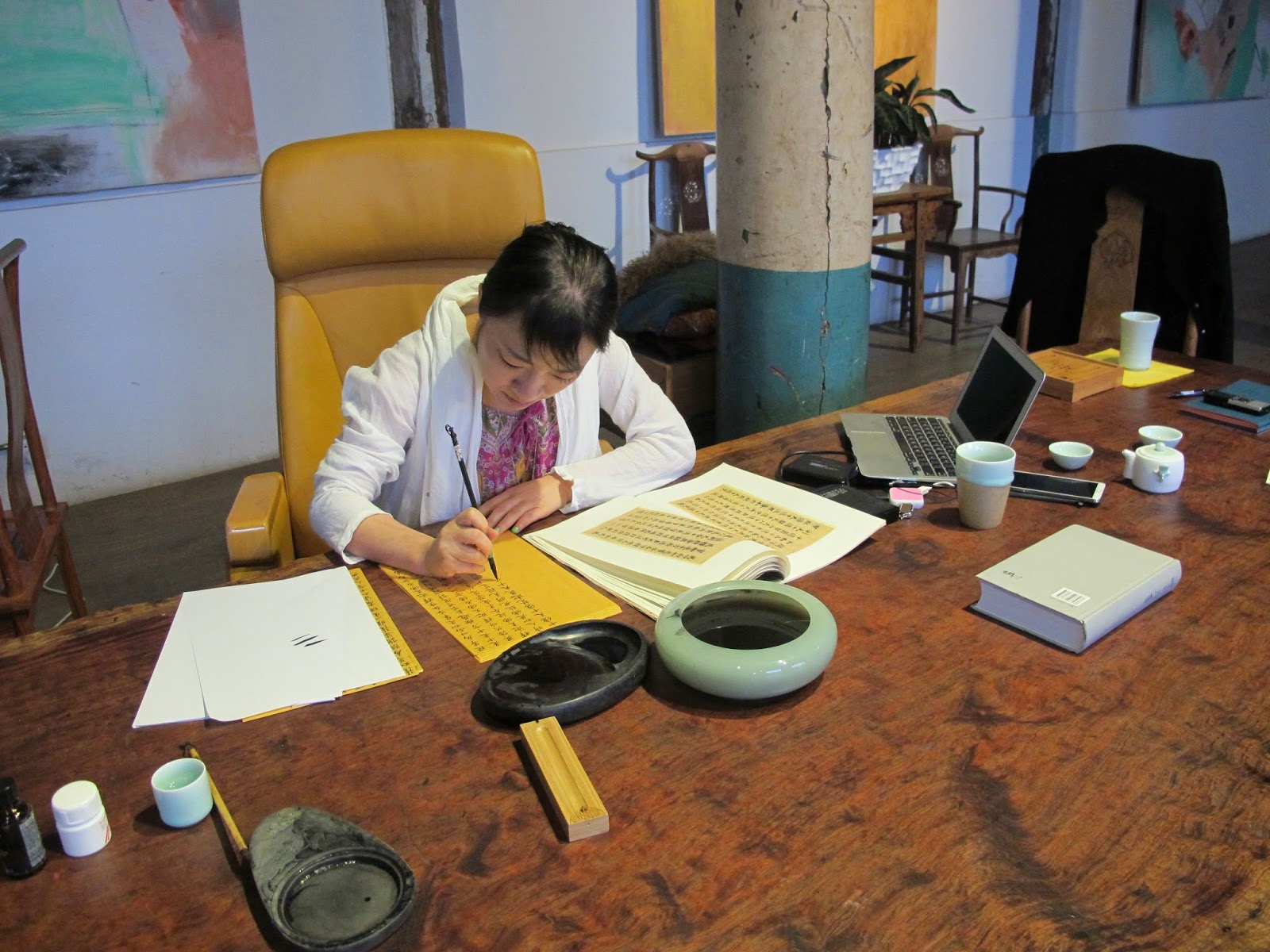
Bingyi writing calligraphy, photo Luise Guest, reproduced with permission of the artist
Yesterday I had a second conversation with the young and very successful painter, Han Yajuan, who told me that after our first meeting last October she has been reconsidering the notion of gender in her work, especially as it has played out for her generation, born in the 80s and coming to adulthood in the 90s, heirs to a completely transformed China. She thinks they had no education about gender, raised at the end of the Maoist period, and hence have struggled to form an identity and to find values. A searching, confused generation. Her new work returns to memories of childhood, creating allegories on circular and oval canvases which are both nostalgic and disturbing.
Han Yajuan in her studio, Photo Luise Guest reproduced with permission of the artist
Han Yajuan, Cashmere Mafia, Image courtesy the artist
From Han Yajuan's studio on the 21st floor of an apartment building in Wangjing, looking over freeways, overpasses and more concrete towers, we drove to 798 and a studio at the back of this complex of galleries, shops and studios - once an East-German designed factory "work unit" where people lived, worked, went to school, gave birth, and spent their entire productive lives - now more often given over to fashion shows, wedding shoots, TV commercials and wandering tourists than to the business of serious art. Here the wonderful painter Yu Hong has her studio.
She found time for me amidst the apparent chaos of a fashion shoot for Tiffany, who have asked her to paint the tennis star Li Na and the most famous movie stars in China. I asked her if she saw any tension or conflict with her serious practice as one of China's best known figurative painters, and she seemed a little bemused. This willingness to challenge the conventional boundaries between fine art and design (or, the more cynical might say, between art and branding) links her with other, younger artists such as Han Yajuan and Bu Hua, both of whom are interested in "derivatives" - product designs based on their works. No different to Tracey Emin or Yayoi Kusama working with Louis Vuitton I guess. Interesting times, where boundaries are blurred. In fact Han Yajuan tells me that she thinks this is actually a Buddhist concept as it challenges the authority of the art masterpiece.
Yu Hong with her work in the studio, photo Luise Guest reproduced with permission of the artist
I have long admired Yu Hong's work - and that of her husband, the great Liu Xiaodong - and the way in which she is able to meld Western and Eastern influences so seamlessly. The gold backgrounds in her paintings refer explicitly to Song Dynasty masterpieces but also to the canon of western Renaissance imagery and to notions of the sacred and sublime. Yu Hong tells me that, growing up during a period of great privation and austerity, she was lucky to have access to books with art images and to the Soviet tradition of painting, as her mother was a successful painter and professor. She felt she was on a pre-destined path to become an artist.
Today I went to see work in the Today Art Museum - some good, some not so very. And then to Vitamin Creative Space to watch Cao Fei's latest work, completed last year and collected by the Pompidou Centre, a 45 minute epic narrative video work called "Haze and Fog". It should be no surprise that this artist, with her love of popular culture, has been drawn to horror, and this, of all things, a zombie movie set in north east Beijing, with a large cast of characters including housewives, real estate agents, cleaners, security guards, a prostitute, a peacock and a tiger - and zombies! Ava Gardner once said that Melbourne was a great place to make a movie about the end of the world. Much as I love Beijing, there are days in the apocalyptic dust and smog haze when I think the same applies, But not tonight. Tonight I am "Happy in Beijing"