The ongoing thoughts of an art teacher in China - and home in Sydney

A continuing diary about my travels in China, and thoughts about China and Chinese art from home and abroad
Showing posts with label Ma Yanling. Show all posts

Saturday, May 6, 2017

北京日记 Beijing Diary: Art and Life in a Grey City


Guozijian Street Beijing, photo LG
My three April weeks in China were lucky ones - even despite the food poisoning (thanks, Guilin) and the viral pneumonia (thanks, Hangzhou). Why lucky? Because you can go to China expecting to see extraordinary contemporary art and find little that excites you, or you can go another time and be blown away by the quality of work shown in galleries and artists' studios, by the sheer energy, vitality and innovation of what Chinese artists are doing. This was one of those fortunate times. And to be back in Beijing in Spring after a twelve month absence was a delight: the sky was (mostly) blue, the parks full of blossoms and ballroom dancers; and the galleries (mostly) open and showing interesting work.
Reflected blossoms, near Nanluoguxiang, Beijing, photo: LG
China's dizzying pace of change continues: on every visit, even if only a few months apart, I see new developments. This time what I noticed most was the explosion of the bicycle-sharing app; the streets are filled with colourful bikes rented easily, anywhere, by scanning a QR-code with your smartphone, and then left wherever you finish up. Every ride costs about 20 cents and they are HUGELY popular. Beijing has once again become a city of bicycles. And tiny new electric cars as well. The old tin can 'beng beng' taxis are still there, and the traditional pedi-cabs (not used only by tourists, by the way) but my usual Dongzhimen neighbourhood is filled with little vans silently scooting along delivering water, take-out meals, dry-cleaning, and anything else you can imagine could be delivered in a city of entrepreneurs.
Motor-cycle taxi, Dashilar, Photo: LG
Old shool beng beng taxi, Photo L
Combined with the three-wheeled carts collecting recycling, generally presaged by a ringing bell and a harsh cry,  it is a collision of old and new. The scourge of the silent scooter on the sidewalk is still there, though, particularly unnerving at dusk, or when the rider suddenly shouts at you to get out of the way. And there's still plenty of sidewalk spitting, which is perhaps a comforting sign that some things don't change. Old bars and expat hangouts have closed (sorry, not sorry) and the gentrification of the hutongs proceeds apace, but the essential character of the city remains, much like its inhabitants - tough, gritty, no bullshit, and a sardonic sense of humour. I was glad to see the battered velour armchairs still on the street in Chunxiu Lu, and the outdoor hairdressers at work in the hutong nearby. And the unique and unmistakeable smell of the Beijing drains is always present.
Hutong, Dashilar, photo: LG
Washing drying in the lanes, Beijing, April 2017, Photo: LG
Beijing rooftops through a hutong window, Photo: LG
I was in Beijing for my own research project, meeting with artists who are subverting ink traditions in very particular ways, and most of my time was taken up with long drives to and from studios in Songzhuang, Caochangdi and Shunyi. But in intervening windows of time I visited galleries in 798 and Caochangdi and saw wonderful things.
My top  5 Beijing highlights:
1. Qiu Anxiong, 'New Book of Mountains and Seas Part III' at Boers-Li Gallery - immersive, completely extraordinary. Qiu has created a dystopic universe with just enough connections to the present-day to make it thoroughly terrifying. So immersive that I sat through the entire video twice. Part II was a central element of White Rabbit's 2016 exhibition, 'Vile Bodies'. Here Qiu talks about his work for the exhibition at New York's Metropolitan Museum in 2013: http://www.metmuseum.org/metmedia/video/collections/asian/qiu-anxiong-ink-art


2. Wang Yuping at Tang Contemporary - a remarkable painter whose work I had not seen before. His series of paintings of the intersection near Jingshan Park is so characteristically Beijing that it would make you weep with nostalgia. And how lovely to discover that he taught my good friend Gao Ping at CAFA, and is a beloved professor. The exhibition 'Jingshan Hill' is divorced from current fashion and theoretical discourse and is all the better for it.
https://www.tangcontemporary.com/wangyupingen


3. Tai Xiangzhou at Ink Studio -  a stunning exhibition called 'Speculative Cosmologies' - the curator says: Working in the literati mode, Tai spent years copying and mastering classical compositions and brushwork. He focuses on the landscapes of the Song Dynasty (960-1279), considered a Chinese golden age for both pictorial and astral arts. Speculative Cosmologies features select examples of Tai’s classicizing style, including Mountain of Heaven, a virtuosic rendition of a Song monumental landscape as a screen—a format charged with cosmological significance; Cosmic Symphonies, an elaboration of a celebrated 13th-century album depicting different aspects of water; and Microcosm-Macrocosm, a primordial landscape without organic life generated from a miniature scholar’s rock. Lovingly and intimately antiquarian, these paintings also ask, speculatively and counterfactually, what a Song landscape would be if it encompassed the vastly expanded scope of contemporary knowledge and experience. http://www.inkstudio.com.cn/exhibitions/24/overview/


4. Liu Di at Pekin Fine Arts - new directions in the work of this interesting artist, whose digital works of large-bottomed animals plonked in the courtyards of Beijing apartments have been shown at White Rabbit Gallery in Sydney. http://pekinfinearts.com/en/exhibition/liu-di-break-with-convention/


5. An exhibition of new directions in the work of young artists, both Chinese and international, at Ullens Center for Contemporary Art (UCCA) - still with a cloud hanging over its future and no buyer in sight - presented tiny enclosed spaces with lots of video.Highlights here were the futuristic imaginings of Cui Jie - and in China they're not much of a stretch - and a stunning, ambiguous installation by Ma Jianfeng. Here's an interesting article featuring Cui Jie - and Lu Yang who I will write about in a later post: Where Next? Imagining the Dawn of the Chinese Century


Apart from that, the skies were blue and clear, my wanderings in the remaining hutongs were a delight (even though I still cannot persuade my husband to love Beijing), you can now get excellent coffee all over the city, and it was great to be back in a place that I have come to love like a second home. I visited the studios of Xiao Lu, Ma Yanling, Yu Hong and Bingyi, and spoke with Tao Aimin at Egg Gallery and Ink Studio in Caochangdi.
With Xiao Lu and her exciting recent ink works in her studio, Beijing, April 2017
The following week, in Shanghai, a city I have grown to love over the years, the exhibitions on offer were just as compelling. Next week: Shanghai Diary Revisited.

Saturday, November 29, 2014

北京日记激活 Beijing Diary Reactivated

Zhou Hongbin, Utopia, image courtesy the artist and China Art Projects
I am getting myself organised to go to China in just over a week, my second trip this year. My last visit was in April, and Beijing was leafy and warm, mitigating the overall greyness of the city, which I must admit I have come to love. This time, in December, I am preparing for the cold. The last time I spent part of December in Beijing, back in 2012, I had never been quite so cold before in my soft Australian life.

I have a ridiculously big line-up of artists to meet, including Tao Aimin, Cui Xiuwen and Ma Qiusha, as well as photographer Zhou Hongbin, all of whom I have admired for a long time. Tao Aimin's work, 'Book of Women' resonates with the research I have been doing about the ancient secret women's script of 'Nushu'.
Tao Aimin, Book of Women

Cui Xiuwen's video work 'Lady's Room' was the cause of the first lawsuit in contemporary Chinese art. It shattered many taboos - about prostitution in the "new" China, about the boundaries between public and private space, and about notions of femininity and the expectations of "good" women. Her later works in video and digital media layer past and present, memory and dreams, in the way we have come to expect in Chinese contemporary art. 
Cui Xiuwen, One Day in 2004, image courtesy the artist and Klein Sun Gallery
Cui Xiuwen, San Jie, image courtesy the artist
Ma Qiusha is one of a number of performance artists I will be interviewing on this trip. The theme of bodily inscription, physical challenge, and various enactments upon and by the body is a powerful continuing thread in Chinese contemporary art, ever since the experimental days of the Beijing East Village artists in the late '80s and early '90s, and the iconoclastic performances of Zhang Huan and Ma Liuming. It's a kind of endurance which, although owing something of a debt to Beuys, and something more to Marina Abramovic, is peculiarly Chinese. Stoicism in the face of suffering - akin to "eating bitterness" perhaps. Ma Yanling told me about her interest in Ma Qiusha last year, when we were talking about her own "Nushu" performance pieces, in which she and her daughter wrote on each other's bodies in the ancient script. You can read my interview with her, 'A Secret Script: The Painting and Performance Work of Ma Yanling' on the Creative Asia website. (Click HERE for that article.)

She described seeing a performance in which a young artist spoke with razor blades in her mouth, interpreted by Yanling as a metaphor for the powerlessness of young women in the face of parental and societal pressures. This turned out to be a very significant work, From Pingyuanli No.4 to Tianqiaobeili No.4 (2007) "Ma Qiusha’s career was born through pain... the camera records her as she removes a bloody razor blade from her mouth after she finishes narrating her experiences." (Randian.) Art critic Iona Whittaker described her early work as possessing "a spiky intimacy paired with a girlish aspect (like a kitten with needle-like claws)" - a bizarrely intriguing description which makes me eager to find out how the artist herself thinks of her practice.

So, for accounts of my meetings with these artists, and many others, watch this space! 

I am returning to the part of Beijing where I feel most at home. In Tuanjiehu Park I look forward to new encounters with the dancing grannies, the water calligraphers, the choirs singing revolutionary songs, the ballroom dancers, erhu players, kite flyers, Tai Ji Quan practitioners and vigorous octogenarian exercisers. No time for more Chinese classes this time, so I shall have to bumble through as best I can with my broken and ungrammatical Mandarin, hoping that I don't make too many shocking faux pas and relying as always on the good nature of the Chinese. Beijing taxi drivers have been amongst my best language instructors to date, although they occasionally teach me swear words and then appear shocked and horrified if I repeat them.

From Beijing I go to Shanghai, again for meetings with artists including the wonderful painter Wang Zhibo in Hangzhou, where I wish I could stay longer. And for the Shanghai Biennale in the Power Station of Art, always a mixture of awe, astonishment and bemusement for a whole range of reasons.

So, amidst all the usual end of year stress, Christmas shopping and ticking of lists, I am checking the VPN to bypass that Great Firewall,emailing artists, figuring out how to use "wechat" instead of Facebook (it's great!), lining up translators and drivers, purchasing the obligatory antibiotics (because I seem to get sick every single time - that Beijing "airpocalypse" no doubt to blame) and - finally - packing the bags. 

北京我来了! Beijing here I come!

Sunday, March 16, 2014

A Secret Script

Here is my article based on 2 interviews with a most interesting artist, A Secret Script: the painting and performance work of Ma Yanling, published last week on a new website, 'Creative Asia', which promises to be a really interesting source of articles, information about events and galleries, and a generally Beijing / Shanghai arts focus: http://www.creative-asia.net/ 

(I have added a couple of additional photographs.)

Ma Yanling in her studio, Songzhuang, Beijing, photograph Luise Guest
When I visited Beijing-based painter and performance artist Ma Yanling I didn’t expect to find a connection with a mysterious aspect of Chinese history – an ancient secret female language. Ma is known for her paintings, in which she covers her portraits of glamorous women with a fine mesh of calligraphic lines. She is less well-known for her performance art, more explicitly focused on female experience. As we talked, however, she revealed that “Nüshu (literally, “women’s writing”) is the conceptual basis for much of her work, connecting these apparently disparate elements of her practice. The history of Nüshu is obscure and contested, but we know that women in Hunan Province used this script to communicate secretly, when women were denied education and confined to the home. It was taught to female children by mothers and grandmothers, after their feet were bound and before they married. Messages from mother to daughter were often embroidered into gifts and dowry items. “Nüshu is like a Morse Code used only by women,” says Ma. In a performance work presented in Japan she wrote Nüshu characters on sanitary towels and handed them to the audience, who were, she says, very reluctant to take them. In another performance Ma and her daughter wrote in this secret script on each other’s skin. “We read it and then wiped it away – so it is like you wipe away the language and then you wipe away the possibility to inherit this language.” In yet another work the clothes worn by the artist and her daughter were stitched together. “I sew people together, then cut them apart,” she says. Ma explores the profound relationships between women, most particularly between mothers and daughters.

Before we met I had failed to see the connection between her delicate paintings of women (1930s Shanghai beauties, Western movie stars, and significant female figures including the notorious Jiang Qing) and her more obviously confronting performances. In our conversation it became clear that the theme of “secrets” threads through her work: the secret ways in which women were forced to operate in a world which confined them to the domestic sphere and denied them a voice in public discourse; the secrecy which pervades politics and public life in China even today; and the coded communications – and miscommunications - between generations of Chinese women. Inspired by her love for the works of ink-painting masters, Ma applies extraordinarily fine brush strokes derived from the 18 styles of traditional calligraphy over the entire surface of her acrylic or oil on canvas works, a veil partially shrouding their features. This may be read as a net, capturing and imprisoning the woman thus contained, or as a screen, behind which the painful realities of their lives remain obscured. Ma explains that she sees her subjects as captive commodities - they are not in control of their own destiny, but subjected by the power of others. “Even Madam Mao?” I ask. “Yes, actually I think she was brainwashed by Mao. Before she knew him she was just an actress – she was politically brainwashed,” says Ma. The result is a meditation on the darkness underlying glamour and desire.

Ma Yanling, Jiang Qing, 2008, acrylic and Chinese ink on canvas. Image courtesy the artist and the White Rabbit Collection, Sydney 

A series of large photographs reveals the other element of this artist’s practice, in which she focuses more explicitly on uncomfortable ideas about femininity and social control. Theatrically staged interventions in the public sphere, these performance works reflect Ma’s interest in the work of Joseph Beuys and, most particularly, Marina Abramovic’s ‘endurance’ performances. After the horrors of 9/11 and, later, the anger of many in China at the destruction wrought upon Beijing by demolition and development leading up to the 2008 Olympics, Ma saw how sudden violence could transform ordinary urban space into a locus of tragedy. She covertly brought a convincing replica gun into crowded public spaces including buses, the subway and, with the inevitable result of her arrest, subsequent detention and release, Tiananmen Square. The resulting photographs of the artist holding the gun to her own head, surrounded by crowds, reveal the anxiety evident in public spaces everywhere post 9/11. A claustrophobic awareness of surveillance, and the symbolically loaded significance of Tiananmen, with the events of 1989 so shrouded in secrecy and denial, are particularly Chinese elements of the imagery. One cannot avoid the connection with the 1989 ‘China Avant-garde’ exhibition, closed by authorities after Xiao Lu shot her own sculpture with a gun she brought into the gallery.
Ma sees this body of work, in which she performs the role of “the terrorist”, and another series in which she photographed women on an abandoned movie set representing Tiananmen in the pre-1949 past, as part of her ongoing investigation of a secret female Chinese history. Like her paintings these images reveal a paradox: despair underlying beauty and grace. In another work the artist’s own naked body is tightly bound with plastic tape, creating grotesque patterns in her flesh, and crammed into small spaces – cupboards and suitcases – in a meditation upon the violence meted out to uncooperative women everywhere.  Ma Yanling is, above all, concerned with the female body and the ways in which femininity is “performed”. Her female forms inhabit a ghostly, insubstantial painted space; or else are actors in a drama of constraint and sadness.


Ma Yanling, untitled, 2004, documentation of performance. Image courtesy the artist


Friday, November 22, 2013

北京日记 Beijing Diary: "Tuhao" or not "Tuhao"

Scary children's ride in Tuanjiehu Park
Three items from today's China Daily which evoke the general strangeness of China:

  1. Five junior high students in Jishou were forced to eat paper trash off the floor as a punishment for dropping paper after an exam. Their teacher has now been forced to apologise
  2. Tuesday was 'world toilet day' and there have been numerous news items about the state of public toilets and how people should (and should not) use them. Given that this afternoon I saw a police officer casually urinate in bushes outside a public toilet I can only say that despite improvements there is still some way to go.
  3. Officials are now forbidden from exchanging gifts such as fireworks, cigarettes and alcohol (a rather unsafe combination, one feels) bought with public money, during the New Year and Spring Festival holidays, says the Central Commission for Discipline Inspection of the Communist Party of China
And there appears to be much excitement that the Oxford English dictionary might include a Chinese neologism, an example if ever there was one of how language must change to reflect changing realities. The word "tuhao" has gone viral to describe the vulgarity of the newly rich. I first heard it from a young translator who asked me to define the Australian term "bogan". I confess. I struggled. When I asked him to tell me what the Chinese equivalent might be, he came up with "tuhao", telling me it applied to people with money but no class. 

How do you say "nouveau riche" in China? Tuhao.
As in, "The Real Housewives of Beverly Hills" are tuhao. Covering the inside of your Rolls-Royce with jade is tuhao. Or, the most popular use, the new gold iPhone 5s is now known in China as the "tuhao gold iPhone."


Meanwhile, in Tuanjiehu Park, which is emphatically NOT 'tuhao' the dancers, singers, musicians, card players, Qi Gong disciples, and water calligraphers go about their self-appointed tasks. People out to run, listen to radios (loudly) read out loud to themselves as they walk, do various vigorous forms of exercise or just sit in the sun are there in force each day. It is a tiny microcosm of Chinese life. As one Tuanjiehu resident said to me, "If you want to know about China and the Chinese, don't read a book, come to the park."
Enthusiastic singers, Tuanjiehu Park
Great spot for a morning chat


In the last week I have returned from a weekend trip to the wonderful city of Chengdu where I attended the opening of an exhibition of collaborative works by Australian artist (and longtime China resident and director of China Art Projects) Tony Scott, and Chengdu artist Dong Xiaozhuang. We stayed at the Art Hotel Chengdu and were treated as honoured guests by the artist's son, visiting the impressive space of the new Chengdu Modern Art Museum, and eating hotpot with local artists. I hadn't expected to find myself making a speech at an art opening to more than 100 people, following a line-up which included the Australian Consul General, Nancy Gordon (a lovely woman with enviably fluent Chinese) and a bunch of Chengdu politicians (who looked like every Chinese official you ever see in a news photograph - I think there is an assembly line somewhere) and artists and academics from the Chengdu Academy of Fine Arts. It was a surreal moment to add to all my other surreal China moments. I had to give the speech in English, with a translation sentence by sentence, so I thought the only thing I could do was to start in Chinese with an apology and an explanation for why I couldn't give the whole speech in Chinese - at least that got a laugh.
Tony Scott with work created collaboratively with Dong Xiaozhuang in the exhibition 'Two Voices'
Sichuan Opera performance in a Chengdu restaurant includes fire breathing - or is that the result of the hotpot?
The doors of the Chengdu Museum of Modern Art

I have finished six weeks of Chinese classes, with very little appreciable advance in my fluency of speech or my ability to read. This might be a lost cause. I have days where I feel at least vaguely competent to communicate and others where it all just goes pear-shaped. When I went to the post office today various officious post office employees were shouting a whole lot of instructions and I couldn't understand a single word in the torrent of verbiage flying at me. I maintained my usual tactic, which is to nod and smile in the hope that eventually people will do things for you, even if only in an exasperated desire to get rid of the stupid laowai. This usually works. Whether my letters will ever reach Australia is another matter though. 

I have had a second interview with the wonderful Ma Yanling at her studio in Songzhuang, sitting in front of an open fire as they have no heating. And a highlight of this week: meeting Yin Xiuzhen after her successful solo show at Pace Beijing, returned from installing shows in Korea, Philadelphia and the Moscow Biennale, and seeing the studio out near the Great Wall where she works collaboratively with husband Song Dong. I enjoyed hearing about her transition from ten years as a high school art teacher, where by all accounts she was in constant trouble from the school authorities for such infractions as allowing her students to listen to music while they were painting. 
Ma Yanling with friend
Ma Yanling in her studio
Ma Yanling, Jiang Qing, image courtesy the artist and White Rabbit Gallery
In addition to writing an article about my interview with Bingyi Huang, and one about Guan Wei (watch this space!) and thinking about how to structure my account of the fascinating women I have met in Beijing,  I have done a little bit of wandering around, looking and listening and enjoying the rare blue sky days and sunny afternoons. One more week in Beijing then on to Shanghai - it will be difficult to leave!
21st century offering - a can of coca cola


Monday, November 18, 2013

北京日记 Beijing Diary: Food, Learning Chinese, People - and Art


As I come to the final weeks of my residency I have been savouring some of my favourite Beijing moments. And they're not all food-related, but I have to say that food has figured largely in the fascination of my time here in China. That includes those foods which are immediately appealing and wonderful, and those which I am adding to my list of things to avoid. Joining the donkey pastrami and the boiled goats' feet of Xi'an I can now add the grilled duck tongues of Chengdu. The visual richness of street vendors of all kinds is a feature of any walk in Beijing, and the foods on offer have changed as the weather has grown colder - grilled corn, chestnuts and walnuts, congee and pancakes and baozi, sweet potato and cakes. Beijingers love their 'Xiao Chi' (literally, little food, i.e snacks)


So here's a list of other things I have enjoyed seeing and experiencing of late

  • I am amused and impressed by the fur-lined sleeves that have appeared on bikes and motorbikes - very necessary and so ingenious!

  • The tiny mandarins in the markets with their leaves attached - so cheap and so sweet - as well as pineapples and other strangely tropical fruits in this cold climate

  • Pomegranate juice from the street stalls

  • The woman who takes her microphone and amplifier into the park each afternoon and sings opera and Chinese folk songs in a pavilion beside the lake

  • The people both young and old who practise their saxophones, flutes and clarinets seated on benches in the park
  • Tiny children bundled into so many layers that they are completely spherical
  • The massive army greatcoats and hats with fur earflaps worn by men collecting recycling
  • The way that people love to gather in groups and add their opinion to whatever is happening, whether that's a car accident, a mahjong game, a dispute over the price of vegetables, or the technique of the water calligraphers and dancers in the park


Among many possible candidates for a favourite English shop name, my current favourite is definitely "Bing Bing Decently", a small emporium selling 'scholar rocks' and ornately carved pieces of timber and "jade" (I suspect definitely of the inverted commas variety) in the Chaoyang Cultural Market. But there is also this one, which definitely falls into the WTF category:


  • The frustration but also the joy of starting to be able to read Chinese characters continues - I forget as many as I learn, but it is a revelation to me in gaining a greater understanding of the people, culture and history. And Chinese characters are just so beautiful, even in subway signs or scrawled graffiti. I often trip over steps and walk into posts as I am so occupied in staring at billboards and street signs and trying to work out what they say.

I have been meeting so many interesting artists, including Guan Wei and Lin Jingjing, and continuing my series of interviews. As this research continues I've had many conversations with these artists, with my interpreters, with curators and with friends both western and Chinese about ideas relating to gender in China right now. It is often at the forefront of public discourse, and certainly forms a subtext to much policy debate and media angst. 


With artist Bu Hua in her studio, October 21
Lin Jingjing in her studio, November 14
With Guan Wei in his studio, November 11

Here are my first thoughts about this, in relation to three of the eighteen artists I have spoken with to this point. The article, 'Material Girls, Super Starlets, and Girls with Swagger'  was published in The Artlife last week, and this is an extract:


Late Autumn in Beijing alternates glorious blue sky days with others on which the pollution levels soar into the ‘alarming’ zone and people with masks covering their faces are glimpsed through mist and fog on grey streets under grey clouds. The schizophrenic weather conditions mirror something of the paradoxical nature of contemporary China. On one street you see old men in Mao suits playing mah-jongg on the corner, while in the next you are as likely to find a Lamborghini showroom as a snack cart selling dumplings. These paradoxes extend into the art world too. The pace of change in China has been so swift and dislocating that each new generation of artists essentially inhabits a different country, with different experiences, ideas and beliefs. On every construction site billboards loudly proclaim: “This is my Chinese Dream.” This dream, and what it might entail for different generations in China – and what that might imply for the rest of the world - is definitely contested territory.
I have been fascinated to discover these generational dissonances as I have met with artists during a two-month stay in Beijing. My particular project has been to interview female artists. Just as the social forces in China have swept away old certainties, so too have ideas about gender and the roles of women been changing, albeit in ways quite different from what one might expect.
Recently this has come to the forefront of public discourse, as the term “sheng nu” (“left-over women” - defined as single women over the age of 27) has gained increasing traction in the media. The following delightful piece was published on the website of China’s state feminist agency, the All-China Women’s Federation:
“Pretty girls don’t need a lot of education to marry into a rich and powerful family, but girls with an average or ugly appearance will find it difficult. These kinds of girls hope to further their education in order to increase their competitiveness. The tragedy is, they don’t realize that as women age, they are worth less and less, so by the time they get their M.A. or Ph.D., they are already old, like yellowed pearls.”
Despite the gender imbalance created by the One Child Policy and a preference for boys resulting in an over-abundance of men seeking wives, it seems that contemporary Chinese culture punishes women for being over-educated, over-ambitious and financially independent.
In street fashion, advertising, and, yes, even in the hallowed space of art galleries, I have been observing a kind of hyper-femininity. Representations of the feminine in some of the less illustrious galleries in the 798 Art Zone range from imperial maidens and concubines, reflecting nostalgia for a patriarchal past and its certainties, to fibreglass stilettos covered in spikes, an indication of current anxieties. Young men are nervous. They feel enormous pressure to be rich enough, and successful enough, to attract girls and find a wife. The famous quote from a TV dating show, from a young woman who said she would rather weep in the back of a BMW than laugh on a bicycle, is cited often as evidence of women’s materialism.
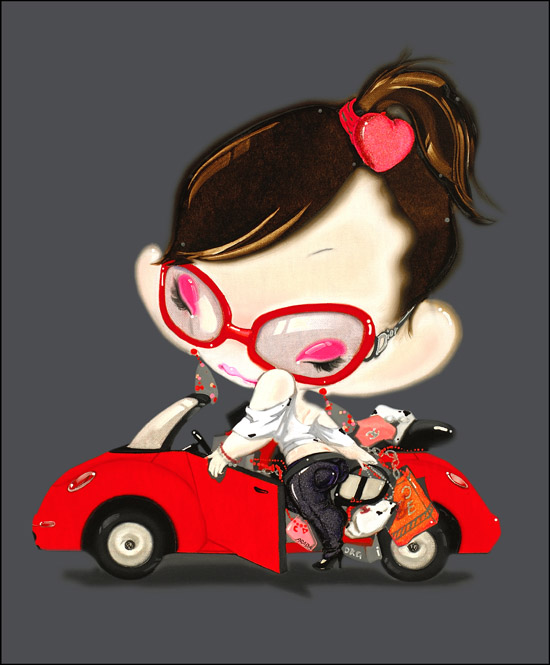
1. Travel Alone 60+50cm oil on canvas 2007
Han Yajuan, Travel Alone, 2007. Oil on canvas image courtesy the artist.
To find out more, I spoke with three artists who explore some of these ideas in their work.
I met Han Yajuan in her bright apartment and studio in the new area of Wangjing, where she looks down over block after block of high-rise apartments and sweeping expressways, a view she describes as “depressing”. Her work has been seen recently in Australia in the ‘Go Figure’ exhibition, curated by Claire Roberts from Uli Sigg’s collection at the National Portrait Gallery, and in ‘Far East Duet’ at the ACAF Project Space in Melbourne. She is represented in New York by Eli Klein Fine Art.
Born in 1980 in Qingdao, Shandong Province, and earning her MFA from the Central Academy of Fine Arts in Beijing, she is sometimes described as an artist whose works embody the collective unconscious of her generation, which seems rather a heavy burden. Her paintings reveal her interest in Japanese design and animation, as well as fashion, and reflect the culture of ‘cuteness’ (in Chinese, “Ke’ai”) prevalent in contemporary pop culture. In China, young (and even not so young) women are expected to behave in ways which are winsome, even child-like. ‘Travel Alone’ depicts a cute, big-headed, bling-adorned cartoon girl climbing into her red sports car wearing Dior glasses. She carries bags labelled Prada and Chanel. Fake or real, they reflect the current obsession with designer brands as symbols of wealth and success. Han Yajuan reveals the current anxiety about the lives of young women, the ‘material girls’ who want it all, and want it now. ‘Fashion Week’ represents the frantic busy-ness, but also the emptiness, of this world. In response to my suggestion that her paintings are a critique of contemporary life and materialism, she says, “I was just trying to present what I see…what exists. Twenty years ago a bicycle was a luxury, but things change. There is so much pressure; the speed (of life) is so fast. I am trying to present my point of view and also to give people an opportunity to see their own lives.” Her generation have not experienced the hardships of the past, and are experiencing the loneliness, as well as the material comforts, of an entirely different kind of society.
In sculptural works such as ‘Super Starlet 6’ the cloying cuteness is undercut by a disturbing sense of identity crisis – these are essentially faceless beings, literally from the assembly line. Looking at these works before I met the artist, I wondered what she intends to communicate about the lives of Chinese women today. Are the creatures she represents victims of new social pressures, or are they empowered and materially successful beings? Is it celebration, or criticism? The answer, as is so often the case in China, is equivocal. Han Yajuan’s female figures are, and also are not, self-portraits. She is a participant in, as well as an intelligent observer of, the culture in which she finds herself. Self-possessed and confident, with her deep voice and disarmingly infectious laugh, she is fully aware of the dark side of the glamorous world she depicts: a world of corruption and karaoke bars; mistresses and designer handbags. But she is pragmatic. “From a very primitive perspective,” she says, “it relates to the uncertainties of life – we should pursue the things that make us happy. It’s personal. It’s about what makes me happy. There is a part of me in all those figures.”
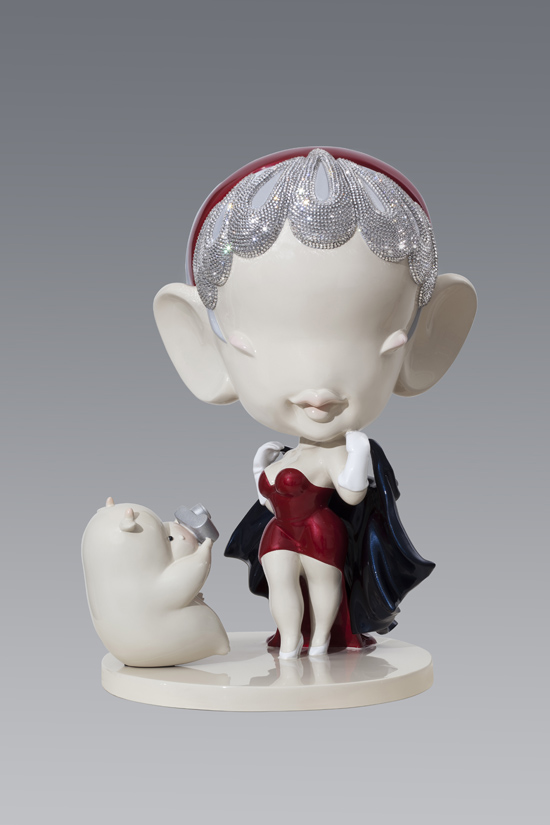
2. Super Sterlet 6 out of 6
Han Yajuan, Super Starlet 6, 2011. Color paint on tin bronze, crystals, 45 x 36 x 40 cms. Image courtesy the artist
“I am from the eighties generation”, she says, identifying the strictures of the Chinese education system as well as the Japanese cartoons she loved as a child as key influences on her thinking. “My early works are about individualism and uncertainty. Later I changed my perspective to stand on a higher point and look down upon a whole complex and contradictory world.” When she began to create these elaborate multi-dimensional compositions, she was initially filled with self-doubt and uncertainty. Working towards a solo show in New York next April, she says, “I am trying to connect doubt and uncertainty with very concrete things. You can see the materialism, you can see the fashion, but this is just recognition. I know why I am doing this. I know what I try to achieve. It is for people who maybe don’t have the time to see this, to look at these things.”
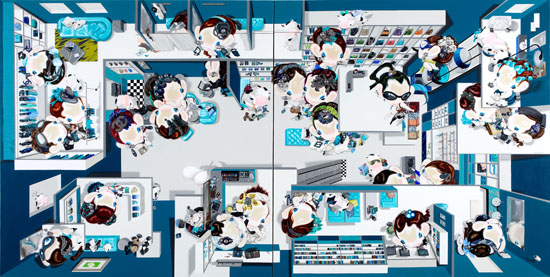
Rather surprisingly, given their apparent celebration of consumerism, Han sees her practice as relating to Zen philosophy and to Qing Dynasty paintings in which multiple perspectives depict a whole universe, both microcosm and macrocosm. We discuss the famous scroll representing an entire town in which every person depicted is doing something different. In ‘Perfect Ending’, a parallel universe of tiny cubicles is filled with girls and consumer products - espresso machines, laptops, mobile phones, shoes and handbags. They strike me as extremely sad. A tiny world appears about to implode under its own pressure. “This is still a male-dominated society,” she says, in response to my query about whether it is more difficult for female artists in China. “But I’m a human being first, then a woman, then an artist.” And, she adds, if you just keep on doing good work, people will have to take notice.
3. Perfect Ending 360+180cm 2010
Han Yajuan, Perfect Ending, Oil on canvas. Image courtesy the artist
Bu Hua was born in 1973, graduating from the Institute of Fine Art, Tsinghua University, Beijing, (formerly the Central Academy of Fine Art and Design) in 1995. Coming from a family of artists, with a father who was a distinguished printmaker, she “learned the language of lines” at an early age. Her work is represented in the collection of the White Rabbit Gallery in Sydney.
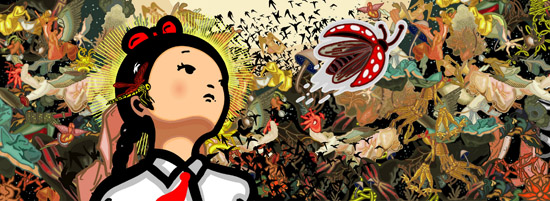
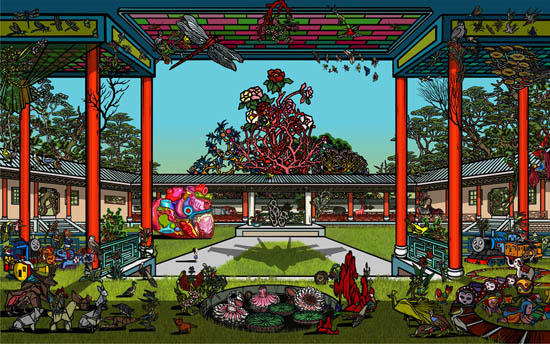
Bu Hua is best known as one of the pioneers of digital animation in China, discovering the expressive possibilities of Flash software and its potential to convey emotional truths about contemporary life in an immediately engaging and dynamic way. During our conversation she tells me about an artist whose name she cannot remember, discovered in the late 90s at Kassel Documenta, who created wonderful, complex, highly political animations with charcoal drawing. “William Kentridge?” I ask. “Yes, yes, yes!” she exclaims. Seeing his work in Germany was the impetus that made her want to combine drawing, painting and animation. In recent years she has developed a character, a key protagonist in both video and still images, who is based on herself as a child - a defiantly feisty but definitely cute Young Pioneer. She bravely navigates the surreal landscape of the 'new' China, encountering strange beasts, mystical forests, hideous pollution and rapacious developers, somehow emerging victorious. She is a girl with 'swagger', according to Bu Hua, and a more confident version of the artist herself - a fearless alter ego. In ‘Savage Growth’ she wanted to express this anxiety and fuse western and eastern traditions of art and design. “In modern China, how could you not be influenced by this fusion of West and East, this cultural invasion and ‘soft power’? I am just reflecting this reality,” she says.
attachment
Bu Hua, The Water is deep here in Beijing I (2010). Image courtesy the artist.
The girl who skips and jumps through her animations, woodblock prints, paintings and digital images is based on the artist's memory of herself as a schoolgirl in Beijing in a simpler era. She thinks about herself cycling to school at a time before the recent explosion of wealth and development with a certain degree of nostalgia. Past, present and future collide in the imagined adventures of this 'Beijing babe' who functions as a voyeur, a means by which we can see the craziness of the contemporary world.
5. Bu Hua AD 302 - 8
Bu Hua, AD3012-8,2012, giclee print on paper. Image courtesy the artist.
To read the rest of the article, click here: HERE