 |
| Charwei TSAI, Incense Mantra, 2013, single channel video. In collaboration with Tsering Tashi Gyalthang. |
The ink tradition in Chinese art continues to fascinate the art market and international curators, as well as being a political hot potato inside the Chinese artworld. To some, it's a regressive artform manipulated in the interests of bolstering nationalism. To others, it's part of the reinvention and reclamation of Chinese tradition after thirty years of Maoist suppression. Whatever your stance, contemporary variations on ink painting are not vanishing any time soon. The current exhibition at UNSW Galleries illustrates all the possible variations employed by contemporary artists who are deeply invested in the philosophy of the tradition, but not necessarily in the physical medium itself.
Here is my review, published today in The Art Life after two visits to the exhibition and an illuminating chat with its curator, Sophie McIntyre, in which she explained the long gestation of her research, her interest in the ink phenomenon, and why she chose these particular artists, all of a younger generation than some of those who first began the ink revival in the 1980s and 1990s. We are lucky to see this exhibition in Sydney after its successful launch in Canberra and a second showing in Bendigo. Don't miss it while it's here!
Ink Remix at UNSW Galleries
The term ‘ink painting’ evokes mental images of delicately rendered misty mountains, waterfalls, peonies and bamboo. In China today this category of art production does include artists whose work falls within the boundaries of historical conventions, but it has also come to include a younger generation of artists who challenge and subvert the tradition in surprising ways. The highly politicised ‘Contemporary Ink’ movement includes artists with extraordinarily diverse practices. And some of them don’t use ink at all.
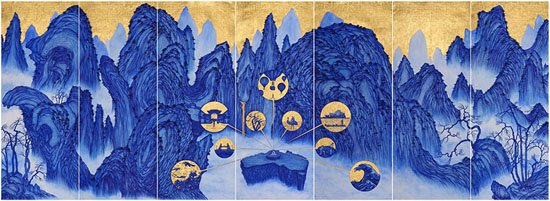 |
| Yao Jui-chung, Yao's Journey to Australia, 2015, biro, oil pen with gold leaf on Indian handmade paper, 200 x 546 x 6cm. Courtesy of the artist and Tina Keng Gallery. |
The use of ink is deeply embedded in the Chinese sense of nationhood. Fundamental to Chinese calligraphy and painting for more than two millennia, the unique properties of Chinese ink allow artists to produce works of great expressive power with limited means. Whether diluted or ‘black as lacquer’, it is capable of infinitely nuanced and subtle mark-making. Reinventing and transforming traditional modes of expression, artists in China, Hong Kong and Taiwan brought the philosophy and aesthetics of Shui Mo (‘water and ink’ painting) to their sculpture, drawing, video and performance practices, a fresh approach revealed in ‘Ink Remix’ at UNSW Galleries. From a Buddhist prayer written with ink on tofu by Charwei Tsai to Ni Youyu’s reimagined Chinese cosmology made of flattened coins, the exhibition reveals how contemporary artists ensure the ink tradition remains vital and alive.
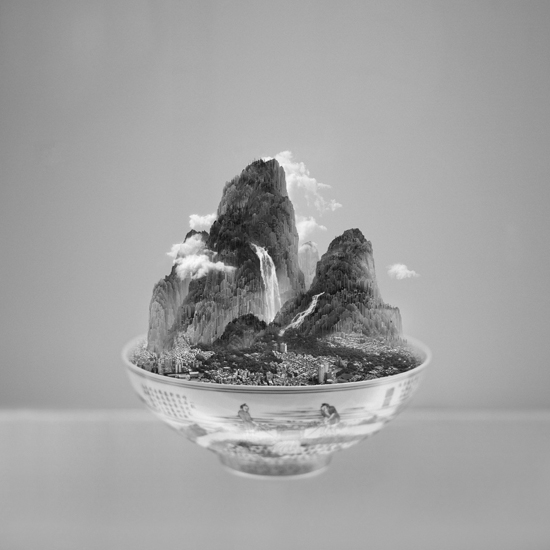
YANG Yongliang, A Bowl of Taipei no. 4, 2012, photographs (Epson Ultragiclee print on Hahnemuhle paper), 100 x 100 cm. Courtesy of the artist.
Sophie McIntyre brings her deep knowledge of contemporary art from China, Taiwan and Hong Kong to the curation of the exhibition. Two years in the making, ‘Ink Remix’ was intended to examine the work of a younger generation of artists, born after 1960. McIntyre says, ‘I was curious about why a lot of young contemporary artists were turning to this phenomenon of ink. But I was most interested in those artists who were critically interrogating an ink tradition and what that means in contemporary society.’ McIntyre was curious to see how artists in the three locations respond differently to this revitalisation of an ancient art practice. What she discovered, in many conversations with many artists, was their desire to reconnect with the tradition in a philosophical sense, rather than as technique, style or medium. And not just to reconnect, but to reinterpret.
Just as a musical remix could include sampling of tracks by multiple artists, many of the artists in ‘Ink Remix’appropriate the tropes of traditional ink works. Misty mountains do appear, albeit in a much altered form. In Yang Yongliang’s ‘Bowl of Taipei’ series (2012) they are crammed into noodle bowls, suggesting the ‘bonsai-ing’ of nature, squeezed into a new urban world of consumerism and mass production. Yang’s clever animations respond to China’s environmental crisis and the pace of urbanisation. ‘Rising Mist’ (2014) at first appears to emulate a traditional scholar painting of mountains and water. On closer inspection you realise that the mountains are formed by the towering steel and concrete high-rises of an enormous city; construction cranes and electric stanchions rather than pine trees punctuate the horizon line. The entire urban landscape is adrift in a miasma of pollution.
He Xiangyu learned how to paint like masters of the Song Dynasty in order to produce works that appear similar to classical paintings. His vistas of mist-shrouded mountains, tiny temples and tumbling waterfalls, however, are painted with ink mixed with Coca-Cola, a satirical jab at the unstoppable march of globalisation and consumer culture. Part of a much larger project shown at 4A Centre for Contemporary Asian Art in 2012, ‘Cola Project’ also involved the boiling down of 135,000 litres of the soft drink into a smelly tar-like sludge, and the carving of two jade skeletons (made to the exact dimensions of the artist’s, with the assistance of MRI imaging and X-rays) that were then partially simmered in Coca-Cola. The paintings make more sense in the context of that larger body of work, but in pondering their materiality we are forced to consider whether Chinese culture is being overwritten in a destructive process of what used to be called ‘Coca-Colonisation’, or whether, in contrast, they show the enduring nature of those traditions, outlasting the sweet product of consumer desire.
 |
| TSAI Charwei, Tofu Mantra, 2005, video still. Courtesy the artist and TKG+ |
The act of writing is central to the practice of Charwei Tsai, born in Taipei and currently living and working between Taiwan and Vietnam. For many years her work has explored relationships between spirituality and the natural world, using performance, photography and video. She conveys the transience of the physical world in the ‘Mantra’ series, writing a Buddhist prayer onto lotus leaves, mushrooms, flowers and other organic materials. Tsai memorised the important Heart Sutra when she was growing up in Taiwan, and its meditation upon the impermanence of all things continues to inform her practice. For ‘Tofu Mantra’ (2005) she wrote its 260 Chinese characters onto a large piece of tofu. The video documents the process of decay, the tofu liquefying, surrounded by falling insects, an arresting memento mori.
Her choice of tofu, a material so symbolic of Chinese culture globally, has particular significance for an artist straddling cultures and languages. (As, incidentally, was also seen recently in Chen Qiulin’s ‘One Hundred Names’ project at 4A, in which the artist carved the most common Chinese surnames into large blocks of firm tofu.) ‘Incense Mantra’ (2013) is a site-specific work produced in Hong Kong in collaboration with Tibetan Tsering Tashi Gyalthang, inspired by the enormous conical joss sticks burned in the Man Mo Temple. The incense, densely covered with characters written in black ink, slowly burns, turns to ash and crumbles. A soundtrack of chanting monks and the noise of waves (Hong Kong, so closely associated with the maritime world, translates from the Chinese as ‘Fragrant Harbour’) produces a genuinely stilling and meditative experience.
To read more, click HERE
To see exhibition details, Click HERE


