The ongoing thoughts of an art teacher in China - and home in Sydney

A continuing diary about my travels in China, and thoughts about China and Chinese art from home and abroad
Showing posts with label song dong. Show all posts

Friday, December 29, 2017

六六大顺 or, 2017: Six of One and Half a Dozen of the Other

Thinking about the usual end of year list (lazy writer's shortcut, I know), my plan was to write about six outstanding exhibitions. Six of the best, I thought, but when the phrase came to mind I shuddered: I remembered to my horror that it's what cane-wielding teachers said to boys they were about to beat when I was a child. Absolutely barbaric, and not what I meant at all!  Although, come to think of it, I've seen some exhibitions, and some artworks, that could be described as painful this year. Hence the English title of this piece, 'Six of One and Half a Dozen of the Other'. The Chinese title is uncharacteristically optimistic too, unlike most Chinese aphorisms: 'Liu Liu Da Shun' means that everything is running smoothly, an outcome devoutly to be wished as we approach the Year of the Dog.  I'd much rather write about art that I loved than the much greater proportion of exhibitions and individual works that left me cold, so here are my top six art experiences for 2017 as this difficult and, yes, painful year comes to a close. Four exhibitions, and two encounters, in no particular order, and a quick gloss over the half dozen 'other'.
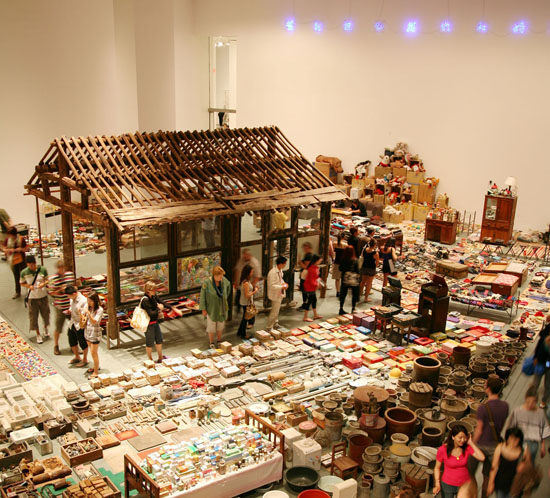
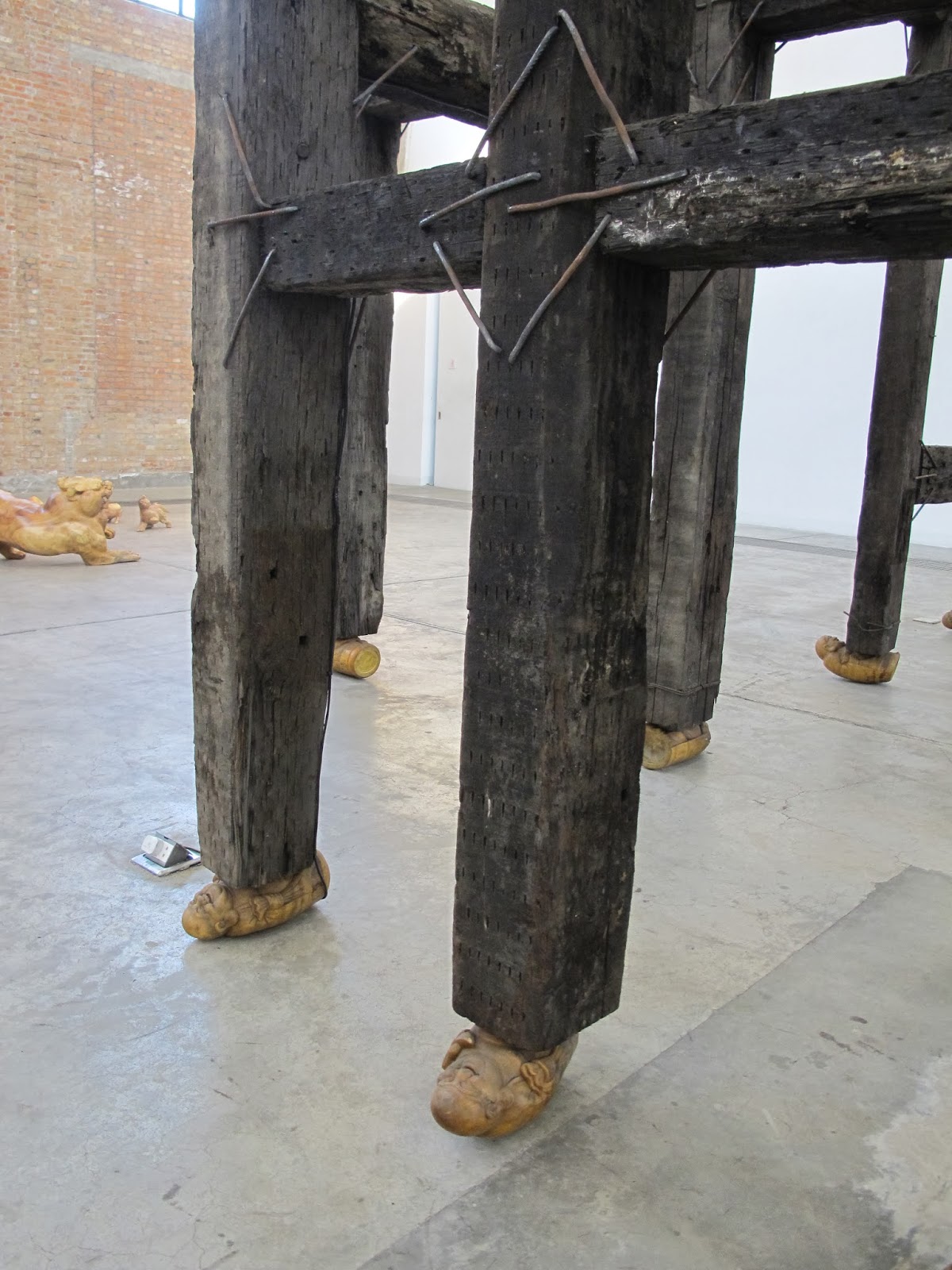
Song Dong, Wisdom of the Poor: Song Dong’s Para-Pavilion, Old house, old furniture, steel, Dimensions variable. 2011. Image courtesy Rockbund Art Museum
1. Song Dong, "I Don't Know the Mandate of Heaven" Rockbund Museum, Shanghai, April
In Shanghai at the end of April I was lucky -- so lucky -- to catch the last weeks of this show, a survey of 30 years of Song Dong's work. From his earliest performance works, lying flat on the frozen ground in Tiananmen Square and breathing, or stamping the surface of the Lhasa River in Tibet with a seal carved with the character for 'water', to works based on his extended series of 'para-pavilions', architectural structures made from re-purposed furniture and building remnants, the show was a marvel across the six levels of the museum. For a review published in 'The Art Life', I described it like this:
I Don’t Know the Mandate of Heaven’ is a mature artist’s reflection on life’s joys, dreams, fears and disappointments. Beijing-based conceptual artist, Song Dong, responds to one of the Analects of Confucius, in which the sage suggests that by the age of 50, one ought to be sure of one’s place in the universe, should know ‘the mandate of heaven’. The getting of wisdom, if you like, should be done and dusted. Across six floors of Shanghai’s Rockbund Museum, and across its façade, rooftop balcony, stairwells and elevators, Song Dong responds to Confucius with all the uncertainty and anxiety of a more complicated age: ‘At 10, I was not worried. At 20, I was not restrained. At 30, I wasn’t established. At 40, I was perplexed and at 50, I don’t know the mandate of heaven.’
The exhibition is divided into seven ‘chapters’, one for each floor of the museum and the seventh for the exterior. Each chapter is represented by a Chinese character; together they form a line of a verse:
Jing (mirror), Ying (shadow), Yan (word), Jue (revelation),
Li (experience), Wo (self), and Ming (illumination).
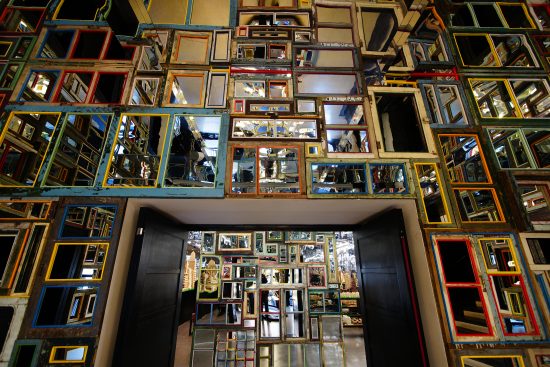
Entering, you are immersed in a structure of re-purposed window frames and mirrors, a (literal) Daoist reflection on the fleeting nature of the physical world, beautiful and unsettling. Within the structure you find Song’s homage to Duchamp’s first readymade. The Use of Uselessness: Bottle Rack Big Brother (2016) is an enlarged version of Duchamp’s inverted bottle rack; on its prongs are discarded bottles that once held whiskey or powerful Chinese baijiu. Lit to resemble a fallen chandelier, they have been cleverly arranged to look a lot like the ubiquitous surveillance cameras that watch our every waking moment. This modern day panopticon has particularly chilling connotations in China, and the work reminds us that surveillance has been a recurring theme in Song’s work. To read more, click HERE
2. "Jasper Johns, Something Resembling Truth", Royal Academy, London, October
While I loved visiting old favourites on my blink-and-you'll-miss-it work trip to the UK in October (obligatory visit to Holbein's Ambassadors, the odd Titian and Raphael, and my favourite bizarre Annunciation by Carlo Crivelli) only one London exhibition really excited me, another survey. An artist of almost Chinese longevity, Jasper Johns has produced consistently interesting work since the late 1950s and this exhibition, the first comprehensive survey to be shown in the UK in 40 years, revealed the shifts and developments in his six decades of practice. Many works I had only seen before in reproduction, such as the Four Seasons paintings; other, more recent, work was completely new to me. Johns continues to experiment with form and content, defying stereotypes of the aging artist repeating the tropes of their youth. In the grand, hushed surrounds of the Royal Academy, visitors murmured discreetly, a very different experience from being amongst the young Chinese audience at Song Dong, taking selfies and giggling.


3. Qiu Anxiong, "New Book of Mountains and Seas Part III" at Boers-Li Gallery, Beijing, April
Immersive and extraordinary, Qiu Anxiong's final work in this trilogy is a frighteningly dystopic twist on the present day. Adding a newly high-tech gloss to Qiu's technique of animating his ink drawings, the work conveys themes of twenty-first century anxiety and alienation expressed through the metaphor of the metropolis. It's probably no wonder that speculative fiction is big in China, although I often feel that nothing could be stranger than reality.


4. Zhou Li, Yuz Museum, Shanghai, April
In her first solo exhibition for many years, Zhou Li's works completely seduced me. In a darkened space on the upper level of the huge Yuz Museum on the West Bund, her abstract canvases glowed. Floating shapes hover on soft grounds of grey, or occasionally, of vivid red or pink. Linear forms overlap, abut and coalesce, suggesting the constant rhythms of the universe. Zhou, like many contemporary Chinese artists, is interested in Daoist philosophy: the push and pull of yin and yang are discernible in her juxtapositions of line, colour and form.

Here's a description of the show from ARTFORUM

In 2017 I have been fortunate to have conversations with many artists, both in Sydney and in China. As part of an archive project for the White Rabbit Collection, I have recorded interviews with Guo Jian, Song Yongping, Lu Xinjian, Xiao Lu, Lin Yan, Song Jianshu, Xia Hang, Cang Xin, Wang Zhiyuan, Huang Hua-Chen and Shen Jiawei. You can find these videos HERE. For my own ongoing research project I have re-interviewed Xiao Lu, Ma Yanling and Tao Aimin in Beijing, and for yet another project I've met with Shi Yong in Shanghai. Courtesy of the Vermilion Art stand at Sydney  Contemporary, I engaged Cang Xin in conversation about his life and work as a post-89 conceptual artist. All of these conversations have been fascinating, but two that have been especially memorable were my second visit to the studios shared by Yu Hong and Liu Xiaodong, in Beijing, and a long conversation over cups of coffee in the British Library Cafe with performance artist Echo Morgan (aka Xie Rong).

Yu Hong, One Hundred Years of Repose, 2011, Acrylic and gold leaf on canvas, Image courtesy the artist
Yu Hong in her Beijing studio in 2014, Photo: Luise Guest
5. Yu Hong spoke about her work 'One Hundred Years of Repose', currently on view at the White Rabbit Gallery, and about her particular painting techniques, when we met in April in Beijing. I find Chinese artists of her generation especially interesting: they began their studies in an era of strict formalism and an approved style influenced by French Realism and Soviet Socialist Realism, and then graduated into a changing world in which avant-garde artists and critics were doing their best to shake everything up. My last conversation with the artist had taken place in the spring of 2014, while I was writing my book about Chinese women artists, 'Half the Sky', and we sat in her studio drinking cups of tea in front of that painting. I had been amused when I arrived that time to find a kerfuffle of TV camera crews and cars outside the studio: she had been painting a portrait of tennis star Li Na, commissioned for a Tiffany ad campaign. Inside the studio was a different, and much quieter, more reflective world. And so it was again in 2017, as we drank tea and spoke about her love for the physicality of paint, behind us on large easels a multi-panelled work appropriating Michelangelo's "Creation of Adam" from the Sistine ceiling, the figure of God now a Chinese Immortal.
Echo Morgan, Be the Inside of the Vase, 2012, Performance Still, image courtesy the artist
6. With Echo Morgan in London, our conversation ranged across her dramatic and difficult childhood, shaped by her resilient mother as much as by her gambling, gangster father, and an eventful journey towards a life in the UK. I'm thinking about her work in relation to my interest in how women artists are using ink and their bodies. More soon.

And the 'Half a Dozen of the Other'?
Best not to dwell. Disappointments in 2017, apart from the sense of impending doom shared by all sentient beings in a time of Trump, included the David Hockney exhibition at the NGV, some lacklustre shows at the Art Gallery of New South Wales, and a truly awful exhibition by ''KAWS" at the Yuz Museum in Shanghai, to which the only possible response was "WTF". I'm sad not to have been able to see THAT Chinese show at the Guggenheim, nor the earlier "Tales of Our Time", but, hey, you can't see everything. Onward to 2018, to a new Biennale of Sydney, curated by Mami Kataoka, to a visit to Melbourne to the first NGV Triennial, the 9th Asia Pacific Triennial in November, some exciting shows coming up at White Rabbit Gallery, building on the beautifully curated 'The Dark Matters' and 'Ritual Spirit', and to further adventures in China and elsewhere. And a heartfelt New Year's resolution to work harder on my Chinese. We'll see. Meanwhile, a happy and prosperous 2018 to all readers of this blog!
With Cang Xin, courtesy of Vermilion Art, at Sydney Contemporary (we did not exchange clothing!)


Saturday, July 15, 2017

Heaven's Mandate: Song Dong at Rockbund

Song Dong, Wisdom of the Poor: Song Dong’s Para-Pavilion, Old house, old furniture, steel, Dimensions variable. 2011. Photograph, LG
This week The Art Life published my review of Song Dong's survey show at Shanghai's Rockbund Art Museum, which was absolutely a highlight of my April immersion in Chinese contemporary art.
As you will see, I loved this show.

The Getting of Wisdom: Song Dong’s ‘I Don’t Know the Mandate of Heaven’

ART LIFE , REVIEWS Jul 14, 2017 
Song Dong, Mirror Hall, Mirrors, old wooden window frames, mirror boards, Dimensions variable. 2016–2017. Image courtesy Rockbund Art Museum
‘I Don’t Know the Mandate of Heaven’ is a mature artist’s reflection on life’s joys, dreams, fears and disappointments. Beijing-based conceptual artist, Song Dong, responds to one of the Analects of Confucius, in which the sage suggests that by the age of 50, one ought to be sure of one’s place in the universe, should know ‘the mandate of heaven’. The getting of wisdom, if you like, should be done and dusted. Across six floors of Shanghai’s Rockbund Museum, and across its façade, rooftop balcony, stairwells and elevators, Song Dong responds to Confucius with all the uncertainty and anxiety of a more complicated age: ‘At 10, I was not worried. At 20, I was not restrained. At 30, I wasn’t established. At 40, I was perplexed and at 50, I don’t know the mandate of heaven.’
The exhibition is divided into seven ‘chapters’, one for each floor of the museum and the seventh for the exterior. Each chapter is represented by a Chinese character; together they form a line of a verse:
Jing (mirror), Ying (shadow), Yan (word), Jue (revelation),
Li (experience), Wo (self), and Ming (illumination).
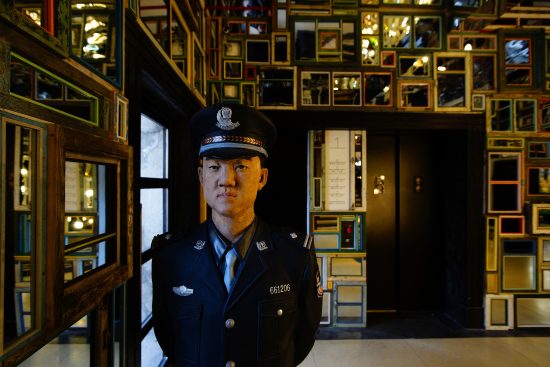
Entering, you are immersed in a structure of re-purposed window frames and mirrors, a (literal) Daoist reflection on the fleeting nature of the physical world, beautiful and unsettling. Within the structure you find Song’s homage to Duchamp’s first readymade. The Use of Uselessness: Bottle Rack Big Brother (2016) is an enlarged version of Duchamp’s inverted bottle rack; on its prongs are discarded bottles that once held whiskey or powerful Chinese baijiu. Lit to resemble a fallen chandelier, they have been cleverly arranged to look a lot like the ubiquitous surveillance cameras that watch our every waking moment. This modern day panopticon has particularly chilling connotations in China, and the work reminds us that surveillance has been a recurring theme in Song’s work. Another work that hints at the heavy hand of the state is found on the third floor. ‘Slogans’ is a maze of fencing and the red banners with white text that you see everywhere in Chinese cities, hanging on fences, outside schools and across the entrance to apartment buildings. Visitors were forced to follow a narrow, circumscribed path through the fences, with the most popular political slogans of the last century and today looming over them – there was no possible alternative route. Sixteen watchful fibreglass policeman with Song Dong’s face are positioned throughout the exhibition.

Song Dong, Mirror Hall, installation view, Mirrors, old wooden window frames, mirror boards, Dimensions variable. 2016–2017. With policeman figure from the series Policemen. Fiberglass, acrylic painting, 170 cm in height, 16 pieces. 2000–2004. Image courtesy Rockbund Art Museum
To read more, click HERE

Thursday, June 1, 2017

九牛一毛: The Nine and the One: Art in Shanghai

A group of young photographers shoot the work of Liang Shaoji at ShanghART, photo:LG
It's taken a while for the art I saw in Shanghai last month to percolate and for the sediment to settle: images and moments continue to drift in my mind. Meeting artists Lu Xinjian and Shi Yong, and talking with Monika Lin over coffee at the Old China Hand Reading Room about her new body of work, 'From the Bones of the Fish' (watch this space!) Walking to galleries through the tree-lined streets of the former French Concession. The shock of the new on the West Bund. A (somewhat) revitalized M50. Some spaces have closed, some were mysteriously dark, with rumours buzzing like flies, but Shanghai shows every sign of being at the centre of contemporary art in China - at least, at the centre of where the money is right now.
Lu Yang, Uterus Man installation, K11 Art Mall, Shanghai 2017

A classic China moment: I wanted to see a curated group show at a certain very high-profile commercial gallery. It was a Saturday afternoon, and it should have been open. Arriving at the address, I found the door mysteriously locked. A bored guard, dozing over his jar of tea, got up and opened the door, and realised I was in the middle of a fashion shoot, with the paintings as backdrops. The guard assumed that any strange foreigner arriving at the door (no matter my less than fashionista appearance) must somehow be connected. The models, photographers, lighting technicians, make-up artists, hairdressers and runners completely ignored me, so I stayed tolook at the paintings by the light from my mobile phone.
My inadvertent participation in a fashion shoot - as a witness
Now, though, to the sublime, the wonderful, the surprising -- and, frankly, the absolutely awful:

The sublime category absolutely belongs to Song Dong and his survey show, 'I Don't Know the Mandate of Heaven', at Rockbund Museum. Five floors of work from the last four decades was quite stunning - and often very moving. Song's re-purposing of architectural fragments and obsolete objects was much in evidence - an insistence, as Rauschenberg said, on working in ''the gap between art and life.'' More about this important exhibition later.


Tiny wooden stools like those that Song Dong and his friends sat on as children to watch movies shown in the Beijing hutongs - but here they are arranged behind the screen not in front of it.
Another iteration of ''Eating the City" - I overheard a boy strongly (and wisely) advise his girlfriend not to eat the stale cake

The top floor of Rockbund is filled with an installation featuring these tiny mannequins, representing Song Dong's childhood self, engaged in every activity imaginable, including peeing, sleeping, and lying face down in a reference to his famous performance lying in a wintry Tiananmen Square and breathing on the frozen ground
While not quite at the Song Dong level of jaw-dropping wonderment, six other shows/artists/galleries provided intrigue, curiosity, astonishment, and moments of reflection.
He Xiangyu, 'Turtle, Lion and Bear' at Qiao Space was a disconcerting and very moving installation of 25 screens in a darkened space, featuring people in the act of yawning. It's infectious - you cannot not respond with your own yawns - the link between artist, artwork and viewer is complete. There was something quite magical about this sense of shared humanity.
Two exhibitions at ShanghART's new West Bund space fof work by Liang Shaoji and Hu Liu were filled with young student photographers on a Saturday afternoon. These two artists, on the surface so different, are linked by their focus on a very limited and highly specific choice of materials: Liang Shaoji works with silkworms and their silken cocoons, creating immersive sculptural installations,while Hu Liu works with pencil and graphite. Every work takes months, and she uses thousands of pencils on a single large drawing. When you look from different angles they catch the light and what at first appeared as entirely black and featureless reveals itself to be immensely detailed.
Student photographers engage with Liang Shaoji's work at ShanghART
At Bank/Mabsociety Chen Yujun's exhibition was intriguingly titled 'The River Never Remembers, the House Cannot Forget'. Working across multiple forms and navigating different conventions, Chen's work is focused on diasporic experience and personal memory. Like Song Dong, he is interested in the connections between people and the architecture they inhabit, often vernacular and makeshift, even chaotic, yet imbued with the experiences of generations.

Chen Yujun, installation view at Bank/Mabscociety
Chen Yujun, collage, detail, at Bank/Mabsociety

Lu Yang, breaker of taboos and too cool for school, is always fabulous, and 'Delusional Mandala' in an exhibition of young new media artists 'Three Rooms' at Chronus Art Centre did not disappoint. I am rarely willing to stand in uncomfortable, cold gallery spaces on hard floors and watch long artist videos, but I watched this one twice, all the way through. Here's a snippet to tantalise, with commentary, from M Woods Museum in Beijing:


Yin Xiuzhen, Xu Bing, Hong Hao, Chen Yujun and a group of interesting artists in 'Collage: The Cards Players' (sic) at the Shanghai Gallery of Art, provided some strange and unexpected juxtapositions. I was delighted to see another iteration of Xu Bing's 'Background Story' series, where apparent traditional Chinese landscapes are created,not with ink and brush, but from rubbish and debris attached to a backlit screen.


Xu Bing, Background Story, the front and the back

Yin Xiuzhen's rockets - or missiles - parodying the kitsch Pearl Orient TV Tower, all made of old clothing and textiles
All the above artists are represented in the White Rabbit Collection of Contemporary Chinese art in Sydney - so here's a disclaimer: This blog is unconnected, it's a collection of my entirely personal views and general ramblings and ravings: my discovery of exhibitions featuring these artists was purely serendipitous. And how wonderful that Sydney audiences have the opportunity to see their work in the curated shows at White Rabbit Gallery.
Song Dong, "I Don't Know the Mandate of Heaven"
Another discovery provided much needed balm for a great disappointment. On a previous visit the Yuz Museum had been closed, so I was hoping this time to see some of Budi Tek's reputedly very interesting collection. Instead, as perhaps I should have been able to guess from the surprising lines of teenagers and 20-somethings snaking around the block to buy tickets ("How wonderful that they love contemporary art!" I foolishly thought), I was confronted with a museum filled with the vapid 'sculptures' of American graffiti artist, product designer, graphic designer, sculptor and toymaker, KAWS described thus: "His art stands somewhere between fine art and global commerce. KAWS moved beyond the sphere of the exclusive art market to occupy a more complex global market." Really, enough said. This guy makes Damien Hirst look very, very deep. 


After this disappointment, I entered a dimly lit upstairs space to be immersed in the meditative abstract paintings of Zhao Li, in her first solo exhibition for many years. Floating shapes hover on soft grounds of grey, or vivid red and pink. Linear forms overlapping and coalescing suggesting the constant rhythms of the universe and the human body. Zhao is interested in Daoist thought, and the push and pull of yin/yang binaries are evident in the juxtaposition of line and form in these compelling paintings. I was seduced - and calmed - post KAWS. 

The exhibition text is, not unusually in China, full of emotive phrases like this: ''Reasonable romance and bold elegance can both be seen in her works.'' I may be obtuse, but I have no idea what reasonable romance is. But these paintings are absolutely, stunningly, beautiful. Painting in China is alive and well, and if April's crop of exhibitions in Beijing and Shanghai are any indication, it is holding its own amongst the new media, photography, augmented/virtual reality, sculpture and installation.
A ratio of nine strong exhibitions to one that was just silly and shallow  - actually, that's not bad. And there's even a Chengyu, a four character idiom, that fits the situation: ''nine cows, one strand of hair'' 
(九牛一毛 - jiu niu yi mao) refers to something so small and insignificant that it's like one strand of hair in amongst nine cows. Or something. 


Tuesday, July 21, 2015

Why art education matters: and what it's got to do with Ai Weiwei

Last week I took a group of 30 senior high school students to the exhibition of works from the Sherman Collection of Contemporary Asian Art, 'Go East' at the Art Gallery of New South Wales. (I reviewed the show for 'The Art Life' - click here for my thoughts.)
Jitish Killat, Public Notice 2 (detail)  in Go East, image The Gene & Brian Sherman Contemporary Asian Art Collection and the Art Gallery of New South Wales
I was curious to see their responses to a show which is in many ways quiet and cerebral, opening with Jitish Kallat's (admittedly visually overwhelming) tribute to Mahatma Gandhi's famous Salt March speech, in which every word is represented with letters made out of replica bones, arranged on narrow ledges on a wall painted the colour of turmeric. The students were fascinated, responding thoughtfully - even tired, at the end of a long day, very close to final exams, and close to the looming deadline for the submission of their own bodies of work. Their willingness to look for the conceptual intentions and possible meanings behind each new artwork they encountered was heartening.

They have spent the last two years with me, immersed in contemporary art from around the globe. At first they had been frankly sceptical - we'd had a few of those "But how can that be art?" conversations that every teacher knows. So it delighted me to hear their earnest discussions of Song Dong's endurance performance, in which he lay prostrate on the winter-cold surface of Tiananmen Square, and then upon a frozen lake, discovering (rather to his surprise) that in that location his warm breath had no discernible effect on the ice. They talked about the subtle symbolism - and clever satirical intent - of any Chinese work produced after 1989 that uses the potent location of Tiananmen. Some saw a comment on the continuing elemental power of the natural world in comparison to the puny efforts of humanity. Others discerned a comment on the failure of artists and pro-democracy demonstrators to change the tragic course of events 26 years ago.
Zhang Huan
Family Tree, 200
C-type prints. Suite of 9 images
Edition 2/3
227 x 183 cm (Framed)
Image courtesy: The Gene and Brian Sherman Collection, and Sherman Contemporary Art Foundation, Sydney
Photo: the artist
They looked with interest at Zhang Huan's 'Family Tree', reading it variously as the overwhelming power of written language and traditional culture over individual desires and freedoms, or alternatively as the sadness and loss of diaspora. Charwei Tsai's quietly meditative Buddhist sutra written on a mirror reflecting the ocean enthralled them, as did Tibetan artist Nortse's installation of the robes of Buddhist monks, arranged as if the seated monks have vanished into the blowing sand that covers the hem of each robe, overturned yak butter lamps indicating the overturning of tradition, religious practices and - again - the loss of language. Some knew about the practice of self-immolation, and others were completely horrified to learn of these acts of desperation.
Nortse, Zen Meditation, 6 monks' robes, butter lamps, Chinese money, scriptures, sand, metal frames,
image courtesy the Gene and Brian Sherman collection
The work that caused the most intense discussions, however, was by Ai Weiwei. Familiar with many of his works, from the iconoclastic smashed Han Dynasty urns to porcelain sunflower seeds, from 9,000 school backpacks representing young lives lost in the Sichuan earthquake to the recent (and I must confess, a little disappointing) installations on Alcatraz Island, my class were excited to see 'An Archive' - a work newly commissioned by Gene and Brian Sherman, and generously gifted to the Art Gallery of New South Wales.
Ai Weiwei, 'An Archive', huali wood, xuan paper, edition of 2 + 1 AP, image courtesy the Gene and Brian Sherman collection and Art Gallery of New South Wales
We had discussed its possible references and the artist's intentions before we went to the gallery, reading a little about the work, watching an informal video of Ai talking about it (and endearingly dropping the video camera, so the end footage is upside down). Nothing prepared them for the size of the beautifully constructed huali wood box, and its contents of 6000 large sheets of rice paper with every (banned) blog post and tweet made by the artist since around 2005. I had deliberately made no reference to it, wanting that first immediacy of seeing the actual, physical object to be a memorable and palpable experience: a salutary reminder of the power of an encounter with the original work of art rather than its reproduced 'shadow image'.

 I listened to their impassioned discussions in response to my question - why a wooden box? Why stacks of paper that cannot be read? Why transcribe something so essentially ephemeral as tweets? I cautioned them against identifying Ai Weiwei as a secular saint - the patron saint of free speech according to some western observers, or alternatively as a giant ego who "hoovers up all the oxygen" in the Beijing artworld, according to others. And with four (yes - four!) concurrent shows at four major Beijing galleries, nobody could say he's invisible, or unheard, even despite the continuing and constant surveillance to which he is subjected. Nevertheless, polarising though he might be, his practice provides rich and fascinating opportunities for my seventeen and eighteen-year-old students to hone their artwriting chops. I confess I would be a little happier if I didn't occasionally read responses that told me that Han Dynasty urns were important artefacts of the Cultural Revolution, but hey, you can't have everything!

At the end of the day, the bizarre rite of passage that is the Higher School Certificate examination aside, what I take with me from this afternoon is the genuine interest my students showed in looking carefully, slowly and with keen intelligence at contemporary art that is not easy or quick to decipher. Even more importantly, that critical ability to make connections, to "join the dots", to make informed inferences and logical deductions, as well as those all too rare intuitive, imaginative leaps that make the heart sing. “So if you set a model of what it means to look hard at something, think a while about it before you open your mouth, and then articulate it carefully—you will have done your job as a critic," said  Robert Storr, Dean of the School of Art at Yale. He was talking about art criticism, but what a principle for an intelligent, interesting and thoughtful life!  I believe that my students (maybe not all, but certainly most) will take this with them into their adult lives, and be the richer for it. And THAT is why an academically rigorous and challenging art education matters.

Ai Weiwei, 'Overcoat', military coat and 2 digital prints, image courtesy the Gene and Brian Sherman collection

Monday, December 30, 2013

Art in Review, 2013: The Good, the Bad and the.....

 It's the end of 2013, another year over and a time to look back. Every writer of every description is doing their end of year roundups (aka "quick, make a list, rather than actually write something of substance") and "who am I to disagree?" to quote Annie Lennox and the Eurythmics. And that's always appropriate. Returned from a Chinese winter, exposing my startlingly white skin to the Australian sun and walking along the beach, instead of more practical and useful tasks I have been deciding on my top ten gallery experiences of the past year. I could have been thinking about New Year's resolutions such as, oh, I don't know, losing 10 kilos, going to the gym more often (or, in actual fact, ever), doing intensive Chinese homework every single week, being kinder and less impatient, being less of a workaholic. But instead, I decided to write a list of the aforesaid gallery moments of wonder and awe. And here they are:

1. Song Dong, Waste Not, at Carriageworks, Sydney, January 2013. This was magical and moving, a testament to family, to memory, a profoundly human elegy to the artist's mother and to times past.


Song Dong, Waste Not, photographs Luise Guest
When I wrote about this installation, which I had always wanted to see, I found it hard to express my own feelings of sadness that linked me directly with my own very complex relationship with my mother. Here is the start of my review for 'The Art Life'.

The Ancestral Temple: memory and mourning in the work of Song Dong

Ten thousand objects collected by the artist Song Dong’s mother Zhao Xiangyuan, over the course of her adult life, are arranged in neat rows and grids on the ground at Carriageworks. During the Cultural Revolution, a period of extreme uncertainty and privation, she began hoarding – drying out and keeping even her allocated bars of soap for fear of future soap shortages. Continuing right through to her last years, Zhao saved everything, in a process called “wu jin qi yong”, translated as “waste not”. This is the latest incarnation of Chinese artist Song Dong’s extraordinary installation, itself entitled ‘Waste Not’.
Song Dong Waste Not - main image 1_web
Song Dong: Waste Not (detail, installation view) Photograph by: Jane Hobson Courtesy Barbican Art Gallery.
Entering the vast space one first sees a row of old chairs, and beyond them the reconstructed frame of Zhao’s traditional timber home. Radiating from the skeleton of the house, the possessions it once contained are laid out on the floor: among them 4 TVs, 3 record player turntables, numerous clocks and watches, broken toys, lamps, old umbrellas, plastic buckets and tin washing tubs, rows of shoes, coat hangers, threadbare face washers, stacked quilts and blankets, polystyrene food containers, empty plastic bottles and their lids, and hundreds of plastic bags folded into neat triangles. They are unbearably poignant in their sheer ordinariness. To read the rest of my review in The Art Life, click on this link: theartlife.com.au/2013/the-ancestral-temple-memory-and-mourning-in-the-work-of-song-dong/

2. Liu Zhuoquan, Chang'An Avenue, at Sydney Contemporary, August 2013

Liu Zhuoquan. Chang'An Avenue (detail) image courtesy the artist and China Art Projects
I have loved the 'neihua', or 'inside bottle painting' installations of this artist from my first encounter with him at his Beijing studio early in 2011. A major installation at the MCA for the 18th Biennale of Sydney in 2012 gave Sydney audiences a sense of his ambition and range. His recent work, shown here for the first time at the Niagara Galleries booth at the inaugural Sydney Contemporary Art Fair, is an indication of the way his practice is continuing to develop.
Here is the catalogue essay that I wrote for this work, which I just wish an Australian museum had the foresight to acquire: http://www.chinaartprojects.com/liu-zhuoquan-essay/

3. 'Serve the People', curated by Edmund Capon at White Rabbit Gallery, Sydney, August 2013

Each show at the White Rabbit Gallery of Contemporary Chinese art presents us with intriguing new works as well as old favourites in new juxtapositions. Edmund Capon, retired (liberated?)  from his role as Director of the Art Gallery of New South Wales, curated this show and it was excellent. Even the gallery spaces themselves looked different and the works were selected and arranged to elucidate his narrative, which related very strongly to his own memories of China during the Cultural Revolution. And why read John McDonald's review if you can read mine?
Jin Feng, History of China's Modernisation, Volumes I and II, 2011, rubber, marble, ricepaper installation, image courtesy White Rabbit Gallery

Shen Shaomin, Laboratory - Three-Headed, Six-Armed Superhuman, 2005, bone, bone meal, glass, glue, dimensions variable, image courtesy White Rabbit Gallery
Chen Wenling, Happy Life - Family, bronze with vehicle duco, 2005, (with Gonkar Gyatso Buddha at rear), image courtesy White Rabbit Gallery
Here is the start of my review for The Art Life:

Serve The People

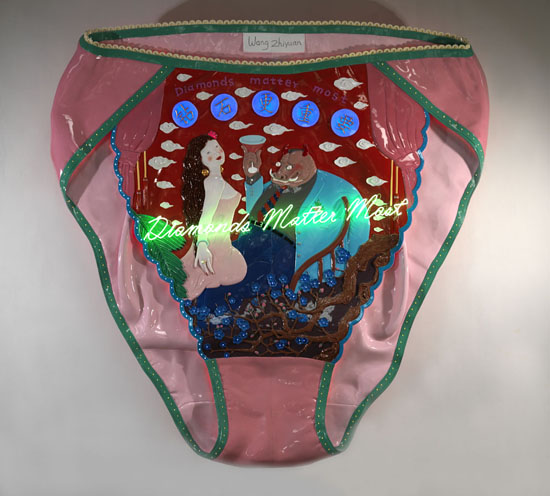
Wang Zhiyuan - Object of Desire, 2008, fibreglass, lights, sound, 363 x 355 x 70 cm (1)
Wang Zhiyuan ‘Object of Desire’, 2008, fibreglass, lights, sound, 363 x 355 x 70 cm image courtesy the artist and White Rabbit Gallery
In Mao Zedong’s famous exhortation to the Red Army at the 1942 Yenan Forum on Art and Literature, he emphasised the close relationship between art and revolution, stressing that art must ‘serve the masses’. He probably wasn’t envisaging a gigantic pair of gaudy pink knickers made of fibreglass and car duco; a three-headed conjoined baby skeleton in a scientific bell jar; vegetables growing in an illicit Shanghai garden engaged in a sexually explicit conversation courtesy of Chen Hangfeng’s video installation; or a baby stroller customised with spikes on the wheels, symbolising the fierce struggle for success that characterises parenthood in today’s China. Imagine the bewilderment of Mao and his revolutionary comrades in an encounter with these works and others in the new exhibition at White Rabbit Gallery. ‘Serve the People’ has been curated by former director of the Art Gallery of New South Wales, Edmund Capon, from Judith Neilson’s impressive collection of contemporary Chinese art.
The notion of how art might “serve the people” has an entirely different resonance in today’s China. Artists born before Mao’s death in 1976 cannot help but look back and attempt to reconcile their life experience with the strangeness of the present day. The dislocations of social transformation, globalisation, demolition and urbanisation which have swept away the revolutionary past, ushering in a world filled with uncertainty, have rendered many of the tropes of the first 1990s wave of contemporary Chinese art passé. A new visual language is emerging, with which artists can respond to the strangeness of their contemporary world, in which enormous disparities of wealth, education and personal freedom are creating new schisms in the social fabric. It is in reflecting this 21st century world back to audiences, both within China and in the West, that artists ‘serve the people’ today. If you want to read on, click on this link: http://theartlife.com.au/2013/serve-the-people/
4. Shoufay Derz, Owen Leong and Cyrus Tang, Phantom Limb, UTS Gallery, September 2013
Shoufay Derz, On the other hand (detail), concept image for sculpture, 2013. Natural Indigo, blown borosilicate glass fountain pens, gold plated nibs, sandblasted black granite, black Chinese ink. Image source http://www.cofa.unsw.edu.au/events/archive/935
Three really interesting artists in an exhibition which explored "disembodiment and the attempt to bridge a physical or metaphysical divide."
In the interests of what politicians like to call 'full disclosure' I have to declare that Shoufay Derz is a friend and colleague, however that does not alter the fact that I consider her unequivocally one of the most interesting artists working in Sydney right now. Her commitment to a deeply philosophical practice based on her research and investigation of religion, philosophy, art and cultural history and the embodiment of materiality is impressive. She followed this exhibition with a show at Artereal Gallery (link here: http://arterealgalleryblog.blogspot.com/2013/11/luise-guest-on-shoufay-derz.html) and is currently completing a residency in Taipei. I look forward to seeing what she will do next.

Shoufay Derz, I Am Death, Destroyer of Worlds, image courtesy the artist


5. Yin Xiuzhen, 'Nowhere to Land' at Pace Beijing, October 2013
Song Dong and Yin Xiuzhen at their Beijing studio, November 2013, photograph Luise Guest
Yin Xiuzhen, Portable Cities, Biennale of Sydney 2003, image courtesy the artist
I have loved her work since I saw the whimsical 'suitcase cities' at the Biennale of Sydney many years ago (seen again this year at the Moscow Biennale.) This exhibition was a revelation - her use of old discarded clothing is powerfully evocative and I particularly loved the moody, atmospheric paintings of Beijing streetscenes on cement road barriers. She combines whimsy and wit with a passionate and intelligent focus on issues and ideas. After I saw the exhibition, on my first visit to 798, I was determined to find a way to meet the artist. It took until the end of my residency, in the very last week, before we managed to arrange a time, and it was a highlight of my time in China. I just hope to have the opportunity at some point to see the wonderfully witty 'Collective Subconscious', shown at MOMA in 2010.
Installation view: Yin Xiuzhen. Collective Subconscious. 2007. Minibus, stainless steel, used clothes, stools, music. Collection of the artist. © 2009 Yin Xiuzhen. Photo: Jason Mandella.
When I met Yin, with her husband Song Dong, at their studio out near the Great Wall, she told me that her intention with these painted works was to reflect on China's appalling and worsening air pollution. She fears for her daughter, and sometimes feels hopeless and despairing. She said, "They (these paintings) may look beautiful and misty, but in fact they are poisonous." The visit was not without drama. Mr Zhang, my driver, nearly had a heart attack when he saw the complicated directions in their text message, which took up 3 or 4 screens and went along the lines of: "After you leave the expressway, drive past a group of dead trees, then when you see a factory with a red gate, take the next road on the left over a small bridge. Drive for a while. You will see a blue sign on a fence. Turn right at the next village....etc." We got lost many times, asking directions from farmers, factory workers, and women riding bicycles along the dusty road. The drive from central Beijing took nearly two hours and the drive back, in traffic that caused the usually placid and unflappable Mr Zhang to swear continuously and viciously, took three. As we left,and Song Dong and Yin Xiuzhen were waving us goodbye from their gate, he asked dubiously, "Tamen youming ma?" (Are they famous?) I said, "Dui ah, tamen shi zhende hen, hen, feichang youming yishujia!" Which is bad grammar but gets the emphatic point across.


Yin Xiuzhen, Traffic Barrier, Chang'An, from solo show 'Nowhere to Land' at Pace Beijing, image source: ocula.com
6. Qiu Zhijie 'Satire' at Galleria Continua, 798, Beijing, November 2013
Weird and slightly incomprehensible, but oddly fascinating as this artist always is. When I went to his talk at the MCA last year and he presented his concepts for the Shanghai Biennale, I left the lecture theatre thinking that either I am very, very stupid ( always a possibility) or else that Qiu Zhijie is a very charming but alien being from a far far galaxy. His exhibition confirmed for me that while he may not actually be an extraterrestrial, he certainly doesn't think like other people.


Qiu Zhijie, 'Satire' at Galleria Continua, Beijing, installation views, photographs Luise Guest
7. Yinka Shonibare at Pearl Lam Hong Kong in December 2013
To tell the truth, the major Yinka Shonibare show at the MCA in Sydney some years ago left me a little cold - I thought the messages about postcolonialism were obvious and a bit trite. The new show at Pearl Lam was different - multiple meanings and some witty and satirical views about Hong Kong's obsession with wealth and status as well as the fabulous characteristic use of textile patterns.


8. Do Ho Suh at Lehmann Maupin Hong Kong, December 2013
What can I say? His work is profound, beautiful and spellbinding, even in the context of this extremely swanky gallery where I had trouble attracting attention to ask for a catalogue because they were very busy doing a high pressure sales pitch to a glamorous, designer-clad, Chinese buyer.


9. No Country: Contemporary Art for South and South East Asia, Asia Society Hong Kong, December 2013
This was unexpectedly fantastic. One of the best curated exhibitions I saw in 2013, in fact. Curated by June Yap under the auspices of the Guggenheim UBS MAP Global Art Initiative , the exhibition included some artists whose work I know (Shilpa Gupta) and others who were new to me. My favourite was Bangladeshi Tayeba Begum's 'Love Bed' - a little bit Mona Hatoum, a little bit Lin Tianmiao, a little bit Ed Kienholz but without being merely derivative. And absolutely chilling.

Love Bed, 2012. Stainless steel, 31 1/4 × 72 3/4 × 87 inches (79.4 × 184.8 × 221 cm). Solomon R. Guggenheim Museum, New York, Guggenheim UBS MAP Purchase Fund, 2012, 2012.153. © Tayeba Begum Lipi. Installation view: No Country: Contemporary Art for South and Southeast Asia, Solomon R. Guggenheim Museum, New York, February 22–May 22, 2013. Photo: Kristopher McKay

The catalogue provided insight without empty 'artspeak'. 
"For the artist, the nation’s political state forms the backdrop to another critical political concern: the gendered violence that was rife during both partitions. Her works reflect on both the double bind of the personal and the political, expressing and accentuating a sense of unease through a public form of gendered expression that also speaks to challenges faced by the artist and her contemporaries. In Bizarre and Beautiful (2011), exhibited at the inaugural Bangladesh Pavilion at the 54th Venice Biennale, she transformed mock stainless-steel razor blades into the fabric of a feminine undergarment. Attractive yet threatening, the article is converted into a hard, gritty form, possessing the qualities of armor or a shield.
Razor blades return in Love Bed (2012), in which the shared space of domesticity, affection, and bliss glints with both threat and invitation. The blade here represents not merely the violence implied by its sharp edge, but also the object’s function as a basic tool to aid in childbirth in the absence of other medical support, a circumstance that the artist recalls from childhood. Printed on the blades is the Bengali name Balaka, a well-known Bangladeshi brand. Coming from a large family, the artist associates the strength of steel with the tenacity of the women who surrounded her as she grew up, individuals who defied the odds to keep their families and communities together. Yet these works resist interpretation according to simple binary opposition along historical, religious, social, or gendered lines. As much as the skeins of razors draped across the bed frame warn against our approach, they also, paradoxically, join together into a productive space for connection and dialogue."
Zhou Hongbin, image courtesy the artist and China Art Projects

10. Two exhibitions at the CAP Project Space in Sheung Wan, Hong Kong which neatly bookended my 3 months in China - the first, 'Aquarium' by Chinese photomedia artist Zhou Hongbin (definitely someone to watch) and the second, a show of new artists from Sri Lanka, 'Serendipity Revealed'. This last contained the extraordinary images of Anoli Perera.
Anoli Perera, 'Protest', black and white photograph
I also enjoyed 'I Am Your Agency', Jing Yuan Huang's November solo show at Force Gallery in 798, and 'I Love Shanghai', a group show at Art Labor Gallery which included works by Lu Xinjian, the ubiquitous Island6 (Liu Dao) collective - are they actually literally everywhere? - Emma Fordham (she's an art teacher - yay!) and a stunning photograph of the transformation and loss of old Shanghai, by Greg Girard.

Image source for Emma Fordham and Greg Girard: http://www.artlaborgallery.com/pages/artists/gourp_i%20love%20shanghai.html#

I also loved the concept behind Redgate Gallery's November show, which paired printmakers with significant Chinese poets. 'River on Paper' included some of the printmakers that I had met earlier in the month at the Xi'an Academy of Fine Arts, and it was a delight to discover some of the poems as well.
River on Paper - Dialogue between Poetry and Prints
Lies, Poet: Zhai Yongming, Artist: Kou Jianghui, 2013, Lithograph, 56 x 38 cm, part of the River on PaperPortfolio, 2013, Boxed, 61 x 42 cm, image Redgate Gallery http://www.redgategallery.com/Exhibitions%201991%20-%202013/River_on_Paper/index.html

Earlier in the year I really loved Tianli Zu's work at 4A Centre for Contemporary Art in the group show 'In Possible Worlds'. And who could forget John Kaldor's '13 Rooms' - not all fabulous but the re-creation of the Marina Abramovic piece was extraordinary as was Xu Zhen's 'Blink of an Eye'.

Xu Zhen, 'In the Blink of an Eye', image source: www.smh.com
I won't be negative and focus on the disappointments. But they included, most especially, the Hugo Boss Asian Art Awards at the Rockbund Museum Shanghai - this left me completely cold and utterly disengaged. So disappointing, as the show there last December which included Huang Yong Ping was one of my 2012 highlights. I was left unexcited by much of the Asia Pacific Triennial early in the year as well - unexpected as every previous show has been fantastic. I suspect that sourcing so many artists from Micronesia and Central Asia and pretty much ignoring China may have been one of the factors that left me less than impressed there. Not that I am biased or anything. And to even the balance, the new Fang Lijun show in 798 was very, very dull. I don't think he should bother returning to Jingdezhen to do any more slumped, fallen, collapsed ceramic pieces, frankly.

What am I looking forward to? Cai Guo-qiang at the Queensland Gallery of Modern Art next week - watch this space!  Christian Boltanski at Carriageworks in January. And Beijing Silvermine at 4A Centre for Contemporary Art - intriguing!

What were your highlight exhibitions this year?

Happy New Year! 新年快乐!Xinnian Kuai Le! 
May 2014 (the year of the horse) be filled with interesting art, and fascinating conversation.