The ongoing thoughts of an art teacher in China - and home in Sydney

A continuing diary about my travels in China, and thoughts about China and Chinese art from home and abroad
Showing posts with label Monika Lin. Show all posts

Tuesday, July 25, 2017

From the Bones of the Fish: Narrating Desire and Beauty in the Work of Monika Lin


Walnut shells, miniature monsters, nail polish, mirrors, plastic debris and the beauty myth - how does all that coalesce in a socially engaged, multi-disciplinary body of work?


I've written about Monika Lin's work before -- she was one of the female artists I encountered on my first, 2011, research trip to China, when it was beginning to dawn on me that the research question I'd set myself, and on the basis of which I had been lucky enough to win a coveted travelling scholarship, was not really the one that I wanted to find answers to. Instead of producing general teaching and learning materials about how contemporary Chinese artists envisaged their practice, I had become far more interested in the work of women artists, and how they positioned themselves in a still, sadly, testosterone-fuelled Chinese artworld. I met Monika in a Shanghai cafe -- she rode up on her bicycle and we talked about the difficulties faced by women artists, about her practice-led research, about art and motherhood, and how her own position as an American/Chinese artist gave her a unique perspective on the art scene in Shanghai. Her performance in which she wrote the character for 'rice' 10,000 times featured in my article for The Culture Trip, 'The Power of the Word: Calligraphy in Contemporary Chinese Art''

Here's my catalogue essay for her intriguing new body of work, 'From the Bones of the Fish', shown in New York this month:


‘She was very lonely in this sealed-off place. Actually, she was cursed by a witch because of her beauty.’ (Wu Siying, aged 11)

Around the year 700 CE, during the Tang Dynasty in China, a folk tale pre-dated European versions of the story of Cinderella by at least one thousand years. In this earlier version, the protagonist Ye Xian (叶限) was similarly mistreated by an evil stepmother. Her only friend was a pet fish, which her wicked stepmother served for dinner, in an act of vengeful spite. The bones of this fish were magical, recalling the oracle bones used for divination in ancient China. They replace the role of the fairy godmother in the western version of this morality tale, but other elements are depressingly constant: tiny feet, golden slippers, feminine duty, self-sacrifice, and a prince seeking a woman both beautiful and compliant.

The form of this story, like so many others in which women are punishedRapunzel locked in her tower, Sleeping Beauty cast into a coma, or Snow White slumbering in her glass coffinare, artist Monika Lin believes, deeply entrenched in the collective psyche. They cut across cultures and historical periods, representing notions of class, gender and sexuality in highly problematic ways. The consistent thread underlying all these stories, and other fairy-tales from many cultures, is the punishment of women for imagined transgressions. Too beautiful? Not beautiful enough? Too proud? Too independent? The narrative arc will ensure that women will learn their place, only to be saved by the grace and favour of a powerful man.
The essential role of women in such punishing mythologies is one of waiting: to be rescued, to be awoken, to be chosen, to be judged as beautiful and therefore worthy. ‘Those who are not judged beautiful are not beautiful’ pointed out John Berger in his 1972 analysis of the female nude in western art history. Women in fairy tales, and indeed in European oil paintings (think of Giorgione’s ‘Sleeping Venus’, for example), are reduced to a passivity that borders on narcolepsy. British writer Angela Carter likened this to a death sentence in her 1978 text, The Sadeian Woman. Add a more explicitly pornographic element to these tales of women waiting to be activated by being chosen, and we end up with The Story of O.

Where is female agency in these stories, so ingrained in us from earliest childhood? If women tell their own real and imagined stories, might they be different? In her latest body of work Lin has engineered an opportunity for us to hear stories told by 147 women and girls – their voices echo through the gallery space, their stories are written in Chinese and English, and the images they created to illustrate them are exhibited as relief prints. The participants in these oral story-telling workshops were inhabitants of Shanghai: migrant workers, retirees, school children and middle class women alike assuming authorship and agency. In the Hans Christian Andersen tale, the Little Mermaid must sacrifice her voice in order to be seen and desired by the Prince; Lin’s project invited women to speak and be heard.


‘The Bones of the Fish’ interrogates the cultural constructs found in fairy tales as historically powerful, enduring myths that constrain women. Even now. Today. And everywhere. As I walked to meet the artist in Shanghai, I passed a cosmetic surgery hospital. The large banner across its façade said, ‘You too can be a beautiful woman.’ In China, to be ‘bai fu mei’ (white, rich, pretty) is a contemporary aspiration, and Chinese beauty standards are even more stringent than in the west. Women trying to raise daughters free to be their authentic selves must negotiate a Disneyfied global minefield of candy pink. Adult women are marketed versions of the consolatory princess myth as ‘empowerment’. All women judge themselves and each other by impossible standards of beauty and behaviour. Lin’s work investigates this conscious and unconscious consumerism and dares to consider alternatives.

Monika Lin’s work has consistently focused on the marginalised, on those absent from the grand narratives of history. In ‘Double Happiness’ (2011) she explored the impact of pharmaceutical companies and the ‘medicalisation’ of ordinary life. ‘Exemplars’ (2013) used the medium of the woodcut — making a reappearance here in her new work — to deconstruct patriarchal Confucian allegories of filial duty. She works at the intersections of gender, class and race, examining the lives of Shanghai courtesans in ‘flower house’ brothels, and the exclusion of women from the Imperial Examinations system that produced Chinese literati painters and poets. In innovative multi-disciplinary bodies of work, underpinned by deep research, she presents us with alternative, hidden histories, and with the voices of those who were expected to be silent.

‘The Bones of the Fish’ is shaped through connected elements, like the chapters of a book. ‘Lacquered’ is the most explicitly polemical. Nail polish contains highly toxic chemicals that leach into the body and have been found in international samples of breast milk. Lin interviewed manicurists in Shanghai nail salons—young women from the countryside seeking a better life and the promised intoxicating glamour of the big city—engaging them in conversation about their working lives far from their hometowns. Twelve portraits resulted from these lengthy conversations, painted with glossy nail polish on mirrored surfaces. It’s a dangerous glamour: the seductively luscious surfaces of lacquered nails can be likened to the shiny poisoned apple given to Snow White by the wicked queen. 
‘Philosopher’s Walnuts’ consists of 1,000 gilded walnut shells, each containing a tiny, part-human figure. Arranged on square tiles of gold leaf, they recall religious iconography. These miniature hybrid creatures reference a Japanese erotic print, Hokusai’s 1814 ‘The Dream of the Fisherman’s Wife’ (also known as ‘Girl Diver and Two Octopuses’) that shows an ecstatic sexual encounter between a woman and two octopi. These works possess an element of the uncanny, a suggestion of the cyborg, of an impending post-human dystopia.  The walnut shell itself is imbued with magical possibilities of transformation. Alternately representing fecundity or masculinity, walnut shell bracelets are prized male accessories in China, with links to Buddhist practice and to the imperial past. Signifiers of status. In the early twenty-first century, for a while walnuts were artefacts of trade worth more than gold. Lin cleverly interweaves a gendered narrative with theories of labour and capital.
With great prescience, Roland Barthes suggested in his 1957 text ‘Mythologies’ that ‘the whole world can be plasticised, and even life itself.’ ‘Plastic River’ is an installation made of rubbish salvaged from the streets – recycled advertising signs, acrylic, Tyvek bags and LED signs. Here Lin connects the toxicity of the beauty myth to the vast waste dumps of plastic and garbage surrounding Chinese cities and polluting the oceans, a result of our reliance on the endless cycle of production and consumption, and the repetitive labour of millions. Culture subsumes nature.
In ‘The Bones of the Fish’, Monika Lin suggests that the shiny, seductive allure of advertising is a siren song of desire, as toxic and false in the end as the beauty myth and the fairy tale.
Luise Guest, May 2017
All images courtesy of the artist

 The artist's book may be seen HERE, and click HERE for Monika Lin's website

Tuesday, September 3, 2013

"Dragons Leaping at the Gate of Heaven": calligraphy in contemporary art

Here is the start of my new article, published today on The Culture Trip. I have been interested for a while in the growing international fascination with ink painting and calligraphy, which is slowly coming to replace the rather tired western characterisation of Chinese contemporary art as all about Political Pop and Cynical Realist Mao-dominated imagery.


Xu Bing, 'A book from the sky', Woodblock print, wood, leather, ivory, The Kenneth and Yasuko Myer Collection of Contemporary Asian Art. Purchased 1994 with funds from the International Exhibitions Program and with the assistance of The Myer Foundation and Michael Sidney Myer through the Queensland Art Gallery Foundation, Queensland Art Gallery, 1987-91.
"Each day in the park around the Temple of Heaven in Beijing one can encounter old men drawing beautiful calligraphy on the pavement with nothing more than a bucket of water and a long, broom-like brush. Fluid, elegant characters appear all too briefly, vanishing as the water dries.
Water Calligraphy at the Temple of Heaven, Beijing, December 2012
Calligraphy is an essential element in any discussion of Chinese culture, language or identity. ‘This was a culture devoted to the power of the word.’ (Dawn Delbanco, Columbia University) The scholar class who dominated government and culture in pre-modern China, the product of the Imperial Examination system, elevated written language to the status of the highest human endeavour. The visual form of written Chinese lends itself to metaphor, coming to symbolise both the beauty and vitality of nature and the energy (or ‘qi’) of the human body. Its essence is the gesture, restrained and contained. Ancient poems often refer to the beauty of specific calligraphy in dramatic terms:
‘A dragon leaping at the Gate of Heaven,
A tiger crouching at the Phoenix Tower.’
(Description of the calligraphy of Wang Xizhi by Emperor Wu)
From the Song Dynasty to the early 20th century, the practices of calligraphy, poetry and ink painting were intertwined. ‘Scholar painters’ represented subject matter such as bamboo, old twisted trees, and dramatic rock formations with deft, skilful use of ink and brush developed through disciplined years of practice in calligraphy, creating animated and expressive works. By this time the combination of painting, poetry and calligraphy was known as the ‘Three Perfections’, a trinity of expression called san jue’ The significance of these traditional forms is not lost on contemporary artists, who are increasingly marrying past practices with a drive to subvert our expectations and communicate multiple meanings in works which appropriate, reinvent, recontextualise and reconsider the past."
Jiang Weitao,'Work 112', 2011, oil on canvas, image courtesy Redgate Gallery, Beijing
Read on by clicking HERE to see what I have to say about Song Dong, Xu Bing, Monika Lin, Hu Qinwu and others in this context.


Friday, May 10, 2013

Landmines in the Gardens of the Literati

I have been thinking about the ways in which contemporary artists in China continue to use and be informed by the traditional forms of ink painting such as the continuing references to Shan Shui (mountain / water) painting which seem to be everywhere right now, and by the scholarly traditions of calligraphy. Sometimes in obvious ways, sometimes subtle. Sometimes overt, sometimes nuanced. Sometimes in order to pay homage to the long history of the Chinese prior to the humiliations visited upon them by western powers in the 19th century and the chaos of the revolutionary period. Sometimes to combine that respect for tradition with a wry or downright satirical view of the contemporary world. But always there is this looking back - at times almost wistfully - to a time before the landscape was covered in advertising hoardings for mobile phones and fast food. This may be perverse - after all ordinary Chinese citizens enjoy a measure of moderate prosperity now that was unimaginable thirty years ago, let alone in the distant past when those who passed the imperial examinations became scholar officials, and developed their passion for painting and calligraphy. But nevertheless it is a consistent feature of so much contemporary art being made in China today that it clearly reveals something of significance about the 'zeitgeist' (whatever the Chinese term for that may be! Google Translate provides this: 時代精神 - someone might tell me if this is even remotely accurate.) And not just in the PRC, but in Taiwan and Hong Kong too. Past and present - always layered in rich and sometimes surprising ways.

Yang Yongliang, 'A Bowl of Taipei', source http://www.yangyongliang.com/index.htm
Lam Tung-pang in his studio with works in progress, photograph Luise Guest
Lam Tung-pang, Horse and Rider, charcoal, acrylic and ink on plywood, double-sided work on wheeled panel, photograph Luise Guest, image courtesy the artist
In Hong Kong artists such as Lam Tung-pang revere the traditions of the Chinese ink painting masters, and refer to them constantly. Lam spends long hours in the Hong Kong Heritage Museum working from their collection, however the historical images are transformed to become works in a new idiom in his own unique medium of charcoal and acrylic on plywood. Lam uses the themes of landscape to reflect on what is happening to his beloved homeland. Wong Chung-yu, likewise, admires the tradition of ink painting and some years ago he decided to reinvent it using his skills as a computer programmer. His works often involve the audience and use real-time video.
Lam Tung-pang installation view, image courtesy the artist
Lam Tung-pang, Travel and Leisure series, detail, image courtesy the artist

Lam Tung-pang, small detail of commissioned work, image courtesy the artist
Wong Chung-yu, When Time Flows Away 2011, water, digital projections and web cam operating in real time
image courtesy the artist
In Wong Chung-yu's ‘When Time Flows Away’, two screens are hung one above the other. On the top screen a traditional ink grinding stick is activated when an audience member takes a ladle of water and pours it into the vessel below the screen. A computer program designed to calculate the effect of ink infiltration then interacts with the water in real time. Virtual ink begins to flow downward into the second screen, ‘washing away’ images from the last 100 years of Chinese history, including the Japanese occupation, Mao Zedong, Cultural Revolution propaganda, Deng Xiaoping and images of the 1997 handover. The ink grinding represents China and the ebb and flow of its history, and the work involves the audience in its alteration. Wong believes that ink painting expresses the deepest beliefs and philosophies of the Chinese people: “What I am interested in is how to reinterpret Chinese traditional art in a new way,” he says.

In Shanghai, Yang Yongliang also works with video and digital media, creating works which initially appear to be tranquil Shan Shui paintings, until you realise that everything in the misty landscape is in motion - the mountains are made up of towering skyscrapers, cranes reach their arms into the air, cars travel on Jetsons-style freeways and planes criss-cross the sky. These works are very disconcerting - beauty juxtaposed with the uncertainty of modern life. In China the only certainty is change and these works certainly reflect that.
Yang Yongliang, Phantom Landscape, Blu-Ray HD, source http://www.yangyongliang.com/video.html

Yang Yongliang, Viridescence, Ultra Giclee Print on Epson Paper
source http://www.yangyongliang.com/Photography/35.html?a=5
It is in Shanghai, too, that Shi Zhiying experiments with the removal of colour from her vast canvases depicting oceans, expanses of grass, the raked spirals of Zen Gardens, as well as the humble objects of everyday life. In Shi's case, there is a specific reference to Buddhist belief.
Shi Zhiying's brushes, photograph Luise Guest reproduced with permission of the artist
Shi Zhiying in her Shanghai studio, photograph Luise Guest reproduced with permission of the artist
Work in progress photographed in Shi Zhiying's studio, photograph Luise Guest reproduced with permission of the artist
Some might attribute the continued focus on ink painting and Confucian or scholarly tradition as an aspect of Chinese nationalism, with all the implications and complications that suggests. Others see it as a welcome reversal after 30 years of Maoist policies of 'Smashing the Four Olds' and breaking with tradition (literally, in so many instances of the destruction of artworks, artifacts and buildings.)  Some, like artist Jin Sha, a painter of 'contemporary gongbi' works, see ink painting as a later version of Chinese culture which is not truly Chinese at all! Like everything else in China, it is complicated, contested and open to multiple interpretation.

So thinking all these thoughts about the enduring nature of - and in fact the increasing interest in - Chinese traditions, I wrote an article for a new web site peek365.com/ about how this plays out in the work of Monika Lin, a painter and performance artist based in Shanghai, whom I met first in April 2011 and again in December 2012; and the photographer/painter/sculptor Huang Xu and his very interesting and somewhat enigmatic wife, Dai Dandan, whom I interviewed in their Beijing studio.

Here is an extract:

Monika Lin is an American-born artist of Swiss and Chinese heritage, living and working in Shanghai, who focuses on socio-political and historical issues in her paintings and performance works. Lin is simultaneously part of the Chinese world and also, by virtue of her ‘foreign-ness’, separated from it. She views contemporary China with a clear and critical eye and in the performance ‘Ten Thousand’, presented last year at the Performance Art Institute in San Francisco, she reflected on Chinese history. In Imperial China, scholars who passed the Imperial Examinations were appointed to administrative positions overseeing populations ranging from small villages to entire provinces. Many of these scholarly civil servants – the literati – devoted themselves thereafter to the practices of the fine arts. An uncomfortable truth often overlooked, Lin says, is that their privileged life of contemplation depended on the work of innumerable peasants.
Monika Lin performance, 'Ten Thousand', image courtesy the artist

For the performance, Lin decided she would write the character for ‘rice’ – 米 – 10,000 times. Ten thousand as a numerical denomination (‘yi wan’) is unique to the Chinese language and signifies ideas about eternity and infinity. Lin chose the character for rice in part for its beauty and simplicity but also for its ironic resonance: rice was produced by peasant farmers who were taxed on it, but could not afford to eat it. Lin wanted to work in a physical way to connect herself to the labours of the peasantry rather than the literati. Influenced by endurance-based performances by artists such as Marina Abramovic and Kiki Smith, the result was 833 sheets of paper. The act of placing each sheet down on the gallery floor was so physically challenging that it appeared to some observers akin to the act of planting rice.
Monika Lin, Ten Thousand, image courtesy the artist
The American audience perceived Lin’s silent enactment of the act of calligraphy, an act that she describes as unspeakably arduous and emotionally powerful, as ‘beautiful and tranquil’. Lin told me that she saw this as an orientalist interpretation of her work, a misreading of her intentions. It was the backbreaking physical labour of the peasants, which made possible the countless hours (represented by the symbolic number 10,000, or万) that the literati were able to spend contemplating nature in their gardens, perfecting their calligraphy and painting. Is there a resonance here with the position of artists as privileged elite? Lin suggests, perhaps, that the contemporary artist, like the scholar in his garden, is seeing a convenient constructed version of the ‘natural’ world. She is wary of romanticising Chinese history, of falling into the kind of Chinoiserie that westerners living in China can fall prey to. Lin’s other works have dealt with the oppression of women in Imperial China, the ‘lotus feet’ resulting from foot-binding, and the ‘flower houses’ or brothels in Shanghai.
Monika Lin 'On the Way to the Imperial Examinations' - sculptures created from the 'mi' covered paper after the performance. These were shown in a curated exhibition at OV Gallery in Shanghai, 'Learning from the Literati'
In Beijing, photographer Huang Xu often represents ‘scholar rocks’, traditional subjects for Chinese painting for their natural perfect forms that echo Taoist philosophy. However Huang’s rocks are photographs of decaying plastic bags. They evoke the sublime, but also suggest the destruction inherent in China’s social and political transformation – the demolition of entire neighbourhoods, the emptying out of rural villages in the largest mass migration in history of workers to the factory towns of southern China, and the growing fears about air quality, pollution, food safety and environmental degradation. Floating plastic bags are ubiquitous in Chinese towns and cities. Luminous and beautiful, Huang’s works are dramatically lit like the billowing drapery of Baroque paintings, while they also recall the silk cloth of imperial China. Huang studied traditional painting from the age of twelve and he continues to emulate its ethereal qualities and its mastery of space and form in his photographic practice.
Huang Xu, Plastic Bag #1, C-print, image courtesy China Art Projects
Huang Xu, Plastic Bag #20, image courtesy China Art Projects

Huang’s most recent work is an installation in collaboration with his artist wife, Dai Dandan, who has recently turned to art practice following a career in television. In her own Duchampian act of transgression, she purchases rocks, probably intended for fish tanks, from the markets, decorating them with rhinestones and fake jewels in order, she says, ‘to perfect them’. A reference to the beauty of imperial gardens, and a nod to the rich traditions of Chinese art, but also, perhaps, a satire of the imposition of global branding onto Chinese culture, and the nouveau preference for ‘luxe’ consumer goods over the values and beliefs of the past. It is appropriate then, that her work with its ironic edgy glamour also featured in a curated show at Shanghai gallery Studio Rouge’s new branch in Hong Kong, on Hollywood Road, where art meets commerce and many of the Chinese antiquities in the shops are of dubious provenance.
Dai Dan Dan, Crystal Rock, image courtesy China Art Projects
The recent collaborative work between Dai Dandan and Huang Xu (the artist couple is an intriguing feature of the contemporary Chinese art scene) is titled ‘Mr and Mrs Huang in the Humble Administrator’s Garden’. It features Huang’s plastic bag scholar rock images together with his subtly erotic flower photographs and new button pavilion sculptures, juxtaposed with Dai’s ‘assisted ready-mades’. ‘Mr and Mrs Huang’ take traditional Chinese philosophy and aesthetics as their starting point and lay subversive landmines of the kitsch and the banal in the garden of the literati.

To read the whole article, click this link: artists-subverting-scholarly-traditions-in-contemporary-china-2#
'Mr and Mrs Huang' (Huang Xu and Dai Dandan) in thei Beijing studio,
photograph Luise Guest reproduced with permission of the artists


Saturday, April 6, 2013

Chinese - Tai Nan Le! - 太难了!

Laurens Tan, 'Kuai Le Wan Ju', image courtesy the artist
I have been giving myself a number of self-imposed deadlines, writing in a fast and furious fashion about my interviews with Chinese artists; reviewing exhibitions; reading numerous books (often several at a time) in an attempt to make sense of my kaleidoscopic impressions of the fast-changing Chinese artworld on my last visits to Beijing and Shanghai. At times it seems like a form of insanity. But the topic continues to fascinate. I have been reading a new book of essays, 'My First Trip to China' in which scholars, diplomats and journalists reflect on their first encounters with China - it contains some wonderful insights and fabulous anecdotes from the 1950s to today. Jerome A. Cohen, who went on a US diplomatic and scientific delegation in 1972 and met Zhou Enlai, finished his account by observing that he agreed with the humourist Art Buchwald that, after a stomach-full of China watching, an hour later you're hungry for more. I can only concur!

I am  beginning to plan a trip for later this year, when I will be staying in Beijing for a couple of months to write, research and explore artists' studios, galleries and China in general. I am hoping to go beyond Beijing and Shanghai this time, and see more of China than the view visible from the windows of the high-speed train. Although this too was completely fascinating to me.

As I write this I should be at my Chinese class. But am not. Oh dear."Tai Nan Le! Too hard! - 太难了!" I am feeling overwhelmed by the enormity of trying to learn this difficult language and feel that I will never improve beyond the stumbling baby Chinese that I can manage right now. And as for character reading, forget it! My strategy today turns out to be one of avoidance. Probably not recommended. Next week, I WILL do the homework and go to class, I tell myself sternly. We'll see.... 
Laurens Tan, Beng Beng Prototype,Made in China.
 Fiberglass, Steel, Acrylic, Plastic, Wood, Baked Enamel, 62 x 30 x 11 cm, edition of 8, image courtesy of the artist.
Meanwhile, my interview with the wonderful Beijing/Las Vegas/Sydney based artist Laurens Tan has been published on The Artlife web site. I love the way that his work also deals with the traps and slippages of communication across language barriers. His is a practice that is absolutely unique. Tan went to China in 2006 speaking little Mandarin, and discovered a way to use Chinese characters as both the form and symbolic coding in his sculptural, digital and screen-based work. "There are different ways of operating as an artist but essentially I think art is always about embracing risk and letting go. And that’s the hardest part," he told me in a wide-ranging conversation in the (very noisy) cafe of the Art Gallery of New South Wales.  For my account of the interview, 'Laurens Tan, Art as a Vehicle for Thinking" - click HERE 
Laurens Tan, Babalogic II, Installation View. Computer-cut ABS, Light, Custom Sanlunche, Dual-Channel Projection, Variable Dimensions, image courtesy of the artist
Another article (previously published in a longer, slightly different form on Artspace China) about the continuing influence of traditions of calligraphy and ink painting on Chinese contemporary painters has been republished on The Culture Trip as 'Constancy and Change in Contemporary Chinese Ink Painting' - featuring the work of three very interesting young women artists - Li Tingting and Gao Ping from Beijing, and Shi Zhiying from Shanghai. Click HERE to see the article.
Li Tingting, Chandelier, Ink on Chinese paper, image courtesy the artist
Recently, too, my interview with Hong Kong based artist Lam Tung-pang appeared on 'Daily Serving'. Lam is currently in new York on an Asia Council fellowship and residency, continuing a discourse about ink painting traditions and making new work in a number of US cities. For the interview, click this link: Things Happened on the Island: Lam Tung-pang's Floating World
Lam Tung-pang in his Hong Kong studio, photograph Luise Guest reproduced with permission of the artist
And my conversations with two emerging women artists in Beijing, Dong Yuan and Gao Rong, were published by Randian Online - click 'In Grandmother's House' to see the article.


Dong Yuan, Daily Scenes, oil on 42 separate canvases, image courtesy of the artist and White Rabbit Gallery
Dong Yuan, Hui Hua Chi Fan, oil on separate canvases, installation view, image courtesy the artist
My problem is not being able to type fast enough, nor go without sleep for long enough, to read, write and research as much as I want to. I should at least thank my mother for making me learn touch-typing when I was 16. She said, "Anyone who wants to work in the arts had better have something to fall back on", imagining, no doubt, a life of secretarial drudgery in an office, rather than adventures hiking around Beijing with a laptop.

Upcoming - an article about performance artist and painter Monika Lin and Beijing-based Huang Xu and Dai Dan Dan - 'Landmines in the Garden of the Literati' - watch this space!
Huang Xu, Plastic Bag No. 28, C-print, reproduced courtesy the artist and China Art Projects

Sunday, December 16, 2012

Zhong guo "Zai Jian" - for now

A large wall text at the entrance to the "Andy Warhol - 15 minutes eternal" exhibition currently showing at the Hong Kong Art Museum reads, " Making money is art and working is art and good business is the best art". This is curiously appropriate in Hong Kong, a city where, artist Celia Ko told me tonight, "money is the only language that everybody speaks."

Hmmm. Money and art. Who knew? Always a hugely problematic nexus, and ideas about the relationship of one to the other are contested bitterly. In Beijing there is no denying that a number of artists became seriously wealthy in the art boom of the late 90s and early 2000s. And cynical views are expressed by some in the artworld that everything and everyone have been corrupted by that.

However while everybody needs to earn a living and artists are not exempt from the normal kinds of greed and desire for comfort and ease that we are all heir to, I am prepared to go out on a limb and say that each of the seventeen artists I have interviewed on this trip are absolutely and seriously dedicated to making art that expresses deeply felt ideas and beliefs, and work incredibly hard to develop their practice and pursue a goal of excellence, whatever the art market might be doing.
Gao Ping, oil on canvas, image reproduced with permission of the artist and China Art Projects
Gao Ping told me, "Every year I want to find something new in my work" and added, "The drawing is my heart". Lin Tianmiao said, "Being an artist is a very personal thing. We are the people who raise the questions - the critical thinking is the most important thing". You can read a more detailed account of my interview with this iconic figure, currently showing at Lelong in New York, here: http://dailyserving.com/2012/12/holding-up-half-the-sky-an-interview-with-lin-tianmiao/

Lin Tianmiao, thread winding work viewed in the artist's studio,
 photograph Luise Guest, reproduced with the permission of the artist
Liang Yuanwei, who spent three months in Berlin after a less than happy experience representing China at the Venice Biennale, said. "My work is like a tunnel between myself and the world. It must be true."
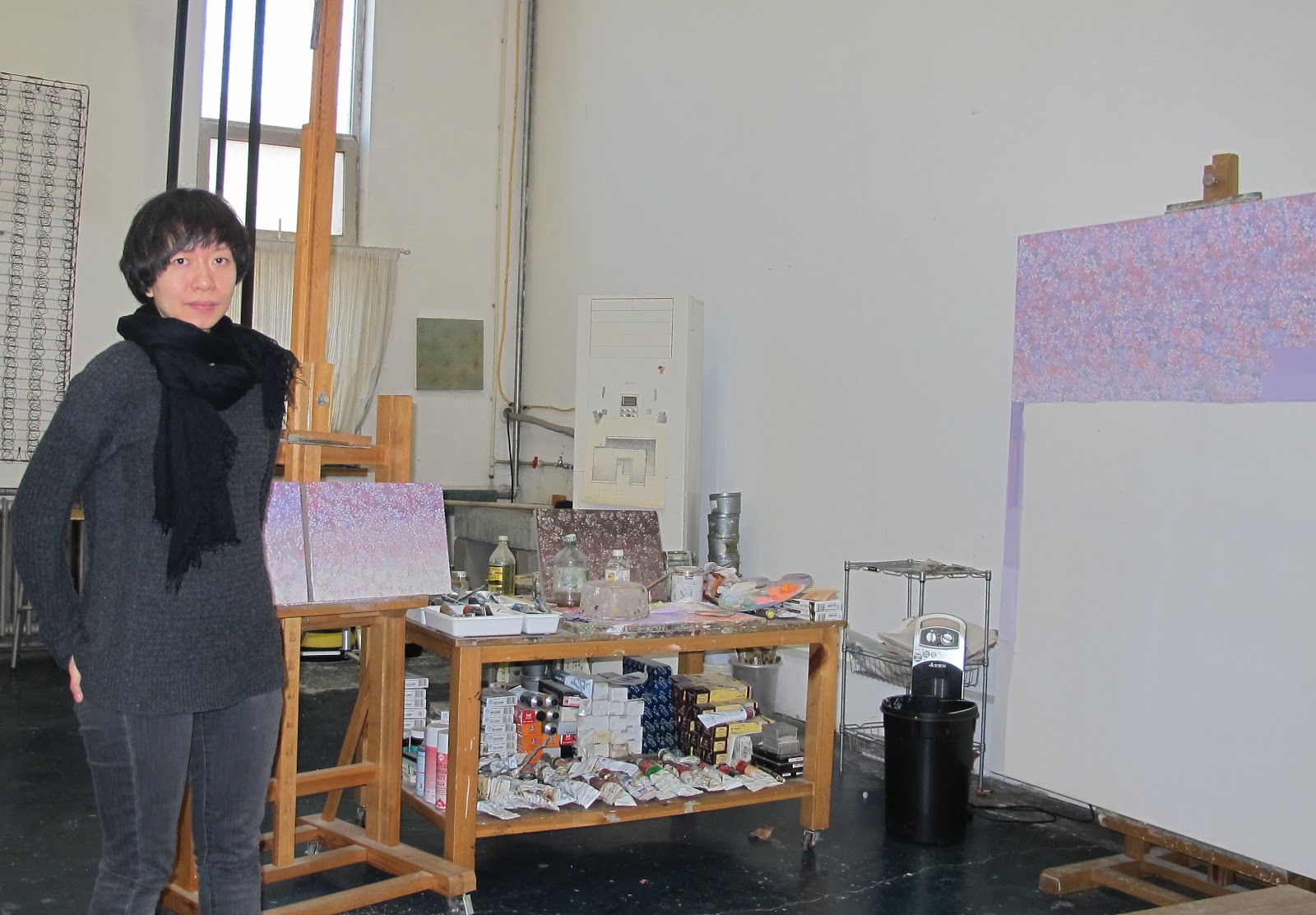
Liang Yuanwei in her Beijing studio, December 2012
Photograph Luise Guest, reproduced with permission of the artist
Liang Yuanwei, Flower Study for the Golden Notes series, oil on canvas
Photograph Luise Guest reproduced with the permission of the artist
Liu Zhuoquan makes very beautiful works that contain within them some carefully coded meanings about issues in China today. Wu Meng makes works in the public space in Shanghai at considerable personal risk to herself and her family, raising issues of vital concern such as the suicides of workers in the factories of southern China, or the unfair treatment of migrant workers. And Lam Tung-pang in Hong Kong, whose work is currently showing at Saatchi in London, makes works which reflect his feelings of anxiety and distress about what is happening to his beloved city, and his search for quietness and repose in a re-examination of the traditions of ink painting.
Lam Tung-pang in his studio, Hong Kong December 2012,
photograph Luise Guest  reproduced with the permission of the artist
Lam Tung-pang, studio view
Lam Tung-pang, 2 sided work based on Tang Dynasty horse, photographed in the studio
Photograph Luise Guest reproduced with the permission of the artist
Lam Tung-pang, exhibition of work at Goethe Institut, Hong Kong, installation view
image reproduced with permission of the artist
I have interviewed painters and performance artists, photographers and sculptors, artists who work with found objects and found images, those who reinvent traditional Chinese forms such as ink painting or gong bi style painting and those who seek an entirely new visual language. I have met famous and revered artists, and artists newly graduated from art academies. I have met curators and gallery directors and critics.
Monika Lin, "On the Way to the Imperial Examination",
performance piece in which the artist wrote the character 'mi' (rice) 10,000 times
Image reproduced with permission of the artist
Shi Zhiying in her Shanghai studio,
Photograph Luise Guest, reproduced with permission of the artist
I have also met two wonderful and inspirational art teachers with whom I hope to collaborate on some projects with our respective art students - art that crosses national boundaries and limitations of culture and language, that sounds good!

I have learned enough to make my brain feel as if it is overflowing with new information, enough for a book! We'll see... I have loved the experience of travelling with this sense of purpose and in a spirit of enquiry, and have been warmly welcomed everywhere. I have sat in ice cold freezing studios in old 'Shikumen' houses in the French Concession in Shanghai, and in Caochangdi and Songzhuang artists' villages on the outskirts of Beijing. Today, after visiting Lam Tung-pang in his new studio in Fo Tan, I caught a local mini bus to Sha Tin Station, blaring Chinese opera all the way.

From the sublime to the truly ridiculous, Hong Kong has it. Yesterday I saw an eagle floating, suspended, high above the clustered apartment buildings as I rode down the hills from the Peak on the top deck of a bus. Today, in the shopping mall above the Sha Tin MTR station, I came across a brand of handbags and wallets called 'Shag Wear' - I swear this is true! Yesterday, in Canton Road, two young men in the jostling crowd carried sandwich boards advertising 'The Battery Operated Nasal Aspirator".

I have been observing - sometimes feeling like a voyeur - the people in each city as they go about their lives, Old men and women playing cards, mahjong, chess, doing Tai Chi, ballroom dancing, playing bowls. Such constant activity! And here in Hong Kong have been touched by the way tiny, wizened old ladies are led gently by daughters and grand-daughters down jostling Kowloon streets. And also by the general tenderness shown in every  city I have visited to babies and children. Not surprising in the land of the one child policy, changing though that may be. Often in Australia I observe parents respond to their small children with exasperation and impatience as their default position. Not so in China.

It is perhaps ironic that part of my purpose here has been to discover what the effect of international dialogues, residencies and exhibitions has been on the work of Chinese artists, and how they have been changed by these experiences. A lot more remains to discover on that topic, but in the meantime the person most changed by the dialogue is me.
Zhongguo - Zai Jian!