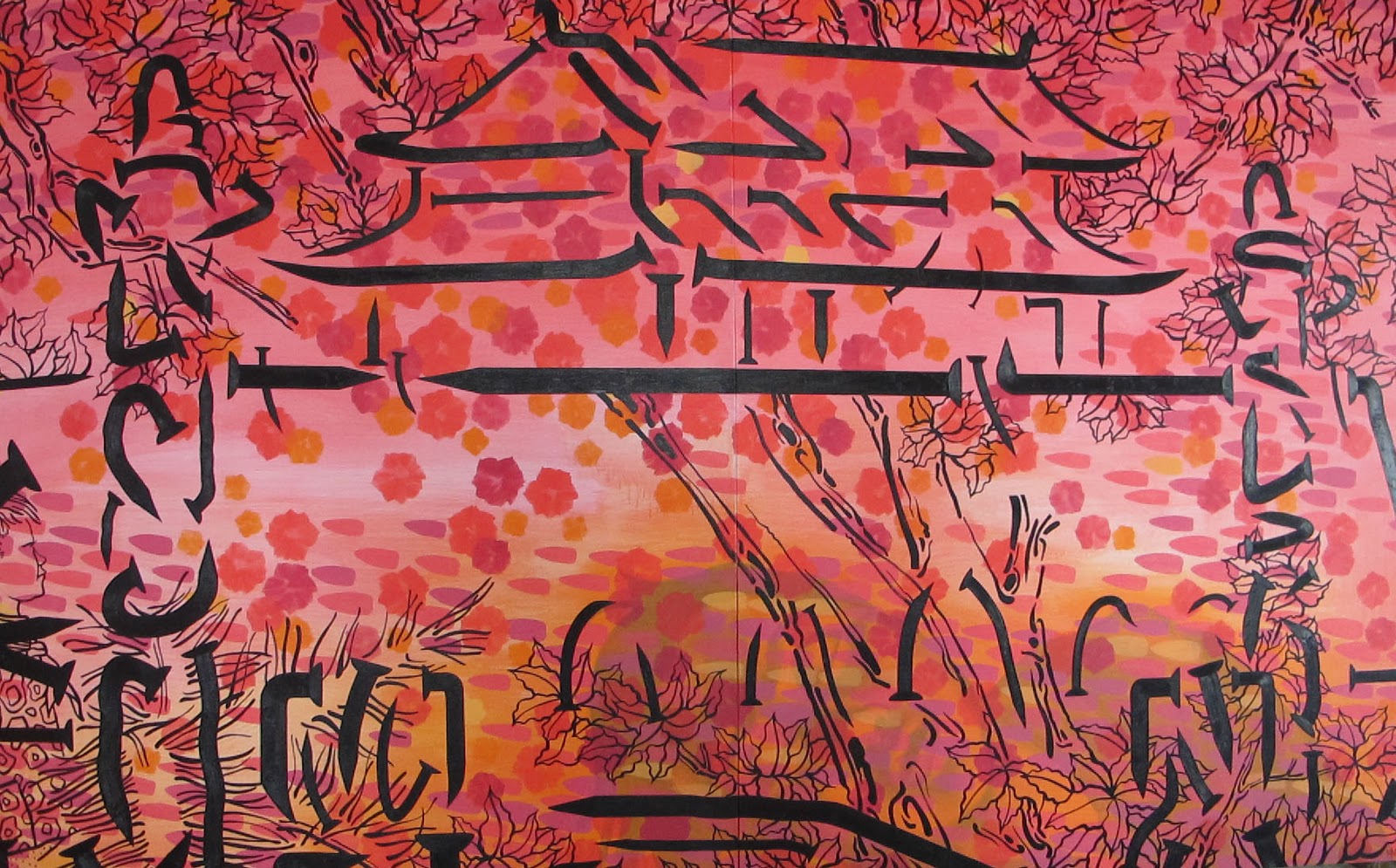
I have no idea how this compares with being in a Chinese city for Spring Festival - not at all, I imagine. But it was good to be in George Street and to feel that yes, Sydney is an Asian city to a very large degree, with an extremely good-humoured crowd lining the barricades and cheering as different groups went past. The Australian Chinese veterans got an especially loud cheer, as did the Police Band. Different provinces were obviously well represented in the crowd, so cheers broke out from different quarters when the Guangdong Province Association, or the Fujian Association marched past. Bizarrely it all reminded me very much of the St Patrick's Day Parade in New York, which I was surprised to find included groups representing pretty much every ethnic group and/or professional group in the city, rather than being overwhelmingly Irish. Very inclusive!
The ongoing thoughts of an art teacher in China - and home in Sydney
A continuing diary about my travels in China, and thoughts about China and Chinese art from home and abroad
Monday, January 30, 2012
Lunar reflections and Pandas on Parade
Wednesday, January 11, 2012
postcard art project
When I met artist Carol Lee Mei-kuen in Hong Kong last year, she told me about her ongoing postcard 'mail art' project. She makes small postcard-sized works using her idiosyncratic time paper technique, in which she lays objects and cut paper stencils down onto cheap newsprint paper (usually bought in rolls from Ikea!) and exposes the paper to the sun for various controlled amounts of time. She has done this so often that she can predict and control the degree of discoloration on the surface of the paper, so the method produces results which are essentially photograms made without chemicals. In this way, her works become a record of the effects of light, and the passage of time. They are often melancholy reflections on the fleeting nature of human existence in this world, the transience of relationships and the ephemera of our lives. Carol has been sending hundreds of postcards to people all over the world, requiring that, in turn, her recipients take a photograph of the tiny artwork they have received through the mail, in their own environment, and send it back to her.
I was delighted to open the mailbox some months ago to find a delicate piece called 'Laundry basket and button Bisney home HK', but then I began to agonise over how to respond, and where to photograph the postcard. The longer I delayed, the more guilty I felt about holding up this process of artist/audience collaboration.
As Carol's work is so intimate and domestic in its focus, I decided that my response had to be a close up image in an interior setting. Finally I chose to photograph it on an old cross-stitch embroidered tablecloth found in a second-hand shop, with thread, tape measure and pins from my jumbled sewing box, and the tiny porcelain children climbing a peach tree that I bought in the Panjaiyuen 'Dirt Market' in Beijing last year, as a nod to the significant influence of the Chinese traditions of ink painting and paper-cutting on Carol's work.
Saturday, January 7, 2012
'Dreaming in Chinese'
I have been earnestly attempting to spend an hour every day over the summer revising Chinese, aiming to arrive at a lesson one of these days without feeling woefully inadequate, unprepared and unable to speak. I am told that at some point in language learning there will be a breakthrough - I am rather hoping for that day to come before I return to China in April. Meanwhile, I find myself dreaming about Chinese, and sometimes waking with whole Chinese sentences in my head. This must be my unconscious mind attempting to create some linguistic neural pathways. I have occasionally found myself breaking into partial Chinese in the middle of a sentence, much to the amusement and/or consternation of my daughters. "Want to go and get a coffee, zenmayang?",I hear myself say, or replying to a question with 'Mei wenti!" (no problems!). Looking for a particular volume on the bookshelf I discover that I am talking out loud. "Zhe ben shu!" (This book!) I say triumphantly. I even confess to texting my daughter, away on holidays, "wo ai ni!" (I love you). I have post-it notes stuck to chairs, tables, windows, doors, cupboards and kitchen utensils, in a vain attempt to remember their names. Embarrassing, and makes me feel like a sad loser, but what the hell, at this point I am prepared to do just about anything that might help in this mad endeavour.
'Dreaming in Chinese' is the title of a book that I loved, by Deborah Fallows, subtitled 'Mandarin lessons in life, love and language'. The author, a professor of linguistics who lived in China for three years, muses on particular words and phrases, and what they reveal of cultural identity and cultural differences. Notions of politeness, for example, prove to be very culturally specific, as anyone who has run the brusque gauntlet of "Mei you!" (Don't have!) and "Bu Keyi!" (Cannot!) in a Chinese shopping centre can attest. Interestingly, many Chinese people told her that English requires way too many pleases and thankyous, making conversation between friends seem stilted and formal. In other words, language shapes us, and shapes our interactions and connections with each other. English speakers use too many of these elaborate politenesses when speaking Chinese as well; it feels so rude to just say "Give me coffee!" In contrast to western stereotypes of Chinese rudeness, however, there are so many delightful linguistic courtesies in Chinese. I was absurdly pleased every morning when the teenage bellhop, attired in a ridiculously large and ancient army greatcoat, called out "Man zou!" (Literally 'walk slowly', but used colloquially to mean 'take care') as I left my hotel in Beijing each morning, dodging cars driven by maniacs and bicycles carrying entire families.
Despite my constant struggle to learn and remember Chinese vocabulary, I tend to fall in love with particular words and phrases: current favourites include "deng deng" ('wait a minute', and also 'etcetera') and "gongong qiche" ('public bus'), purely because they sound so great. I also love the fact that the word for the colour pink, "fenhong se" is literally 'half red'. These are words I have no trouble memorising! Unfortunately I can't string my favourite words together to make conversation - unless I wanted to write dada poetry.
I enjoy the many poetic compound words such as "haohuai" (meaning 'quality', but literally "good/bad"), "zuoyou" ('nearly', literally "left/right") and "gaoai" ('height', literally "tall/short"). My favourite, though is the word for 'stuff', or 'things', "dongxi" (literally "east/west" as in: "I am going to the shops to buy some east/west!")
The ultimate Beijing "dongxi" shopping destination is the Panjaiyuan 'Dirt Market', a huge, fascinating and, I confess, rather intimidating chaos of dubious Mao memorabilia, Buddhist statuary, and fake 'antiques' of every possible supposed dynasty. I spent time wandering, and chatting, and especially in watching the Uighur traders from Xinjiang Province and the furthest reaches of northern China with their arrays of beautifully displayed stones and gems, their faces also like polished walnuts. Intimidated by trying to bargain, hindered not just by my bad Chinese but also by my mathematical hopelessness, in the end I came away with just a snuffbottle (fake, no doubt) in the shape of a peach tree with two small children climbing its branches. "Good fortune," said my Chinese friend, and associated with the need to ensure the birth of sons. "Give it to your daughters", she said, before launching into a pop song of the "wo ai ni" romantic variety.
Tuesday, December 20, 2011
eros and thanatos at mona
![]() |
| image reproduced from themonthly.com.au |
The building is incredible and the collection it houses even more so. A visit to MONA is a Grand Guignol theatrical experience, from the moment you arrive by ferry and climb the 99 steep steps, before descending into the bowels of the earth in a glass lift, to the moment you encounter works such as Jake and Dinos Chapman's (somewhat cheesy, it must be said) Goyaesque nightmare vision 'Great Deeds Against the Dead', Chris Ofili's notorious 'The Holy Virgin Mary' (yes, that one, the one with the elephant poo, the one that sent poor Rudy Giuliani into a fit of hysterics in New York in 1999) or Wim Delvoye's 'Cloaca'. Visitors are shocked, as well as entertained, and this is all highly deliberate and quite self-consciously intentional.
For a museum so absorbed in art about sex and death, and every permutation in between, the experience has an oddly religious flavour. It came as no surprise to me at all to read in David Walsh's rambling catalogue notes that he was raised as a Catholic and still expected at the age of 14 to go to Mass every Sunday, but instead he snuck off to TMAG, the Tasmanian Museum and Art Gallery. "This may explain two things" he says, "why I love stupid acronyms and why I see Mona as a substitute for worship, a secular temple." Adding to this sense of religious portentousness is the way the ancient artifacts such as Egyptian sarcophagi, Greek and Roman coins, and tomb figures, are displayed as if floating, beautifully lit, in a black void. The darkness is disconcerting, objects appear to float in and out of one's vision, and there are no wall texts to distract from the power of the object itself. This is probably a good thing, and another point of difference with other 'normal' museums, however I confess that I found the "O", the ipod issued at the entrance, quite as distracting if not more so. The available text is categorised as either 'Gonzo' (usually rambling discursive self referential riffs by David Walsh) or 'Art Wank' (usually quite good extracts from different art historical sources). The implied put down of art scholarship is deeply irritating, and adds to the sense that one is wandering through a private cabinet of curiosities on a very large scale indeed - a rich man's self-indulgence, maybe, but already a very significant art pilgrimage site.
Almost without exception, the works in the lower levels of the museum are focused on flesh, sex, violence, butchery, cruelty, decay. I felt claustrophobic and overwhelmed. Only once do I remember feeling anything like this before, when I was young in Rome, and thought it would be fun to see the Capuchin monastery where the bones of dead monks had been turned into chandeliers, furniture and decorations. I well remember feeling that I was suffocating, imagining that I could smell the stench of decay, and I fled in panic into the street and was nearly run over by a motor scooter. No chance of fleeing into Roman sunshine here, three stories down below ground level.
The upper level, juxtaposing figurative works ranging from Boyd and Nolan to Basquiat is less confronting, and the curatorial decisions are clever, creating some astonishing and wonderful juxtapositions. I am curious, though, that Wang Qingsong's haunting 'Dream of Migrants' is the only work by a contemporary Chinese artist. No shortage of confronting and challenging contemporary works in China! Chinese artists generally are making works which deal with complex subject matter in coded and multi-layered ways, expressing experiences which certainly include both sex and death but which also acknowledge that there are other subjects and ideas to legitimately make art about. In fact I was mentally contrasting my experiences in Chinese artists' studios and in galleries in Beijing and Shanghai, and thinking that many of the works here are awfully self-indulgent, Juan Davila, Damien Hirst and the Chapman 'boys' in particular.
On leaving the museum after five hours on the first day I feel depressed, and also perplexed. There is so much to enjoy (that may sound paradoxical, but there are light hearted moments amongst the darkness) however there is a sense of misogyny and cruelty too. Often it is the text on the 'O' device which gives it away: a beautiful and poignant work by Chiharu Shiota, which speaks of the experience of women's lives in women's bodies is described in gratuitously crude terms, as are other works relating to female bodies and genitalia. Jenny Holzer's 'Lustmord' is displayed in a way which emphasises its sense of claustrophobic voyuerism and horror, but de-emphasises its sense of outrage about the real stories of Bosnian women raped as an act of war. An overwhelming sense of 'boy' gonzo aesthetics and a particular sexuality permeates everything.
And yet....
What a wonderful thing that thanks to a truly eccentric individual (and his successful formula to beat gambling odds) this small city at the southern end of the world now has such an astonishing art destination. Personal highlights for me were Fiona Hall's 'Further Shore' and an extraordinarily powerful Anselm Kiefer installation, 'Sternenfall'. Perhaps the most memorable experience, though, was entering a pitch dark room, alone and in silence walking carefully across stepping stones arranged across black water, to encounter Andres Serrano's 'The Morgue (Blood Transfusion Resulting in Aids)' photograph of 1992, juxtaposed with the 'Mummy and Coffin of Ta Sheret Min', dating from 664 - 332 BCE. Two stone sarcophagi contain the mummy itself, and, next to it, an X-ray image that slowly penetrates the bindings to reveal the skeleton of this girl who died so long ago. There is no way to avoid thinking, really thinking, about mortality and all its implications in this dark space.
Later, a friend tells me that the rumour in Hobart is that there is a secret doorway into David Walsh's private apartment from this room.
Wednesday, November 30, 2011
A tangled web of Chinese grammar...
| trees and powerlines, photographed near Duolun Street, Shanghai, April 2011 |
Pu Jie, 'Heavenly Gate', to be shown here in Sydney at Gallery Barry Keldoulis, photographed by the author in the artist's studio, April 2011 and reproduced with the permission of the artist
I enjoyed this artist's articulate and thoughtful explanation of his technique - of the images that are hidden below the beautifully painted red, yellow and vivid green surfaces of the work, usually images relating to unspoken and terrible events of the Cultural Revolution, events which profoundly affected his own family. Layered one over the other, in semi transparent glazes, the present is literally hiding and overshadowing the past, and yet the past is always there, just under the surface. In the painting above, a sad male figure from the revolutionary period lies under the Tiananmen Square image: still a potent and politically charged sign of dissent. In other works, the pop-infused images of modern Shanghai and consumerist desire are underpinned by Young Pioneers in their red scarves. The works are simple on one level, and visually slick and appealing, yet they possess an undeniable and powerful charge, that sense of the extraordinary pace of change and transformation that is everywhere in China, and most particularly in contemporary artworks of every type.
Monday, November 14, 2011
Zhong Jian and Babelogic: the Middle Kingdom Translated
![]() |
| Breughel's Tower of Babel 1563 (source: Wikimedia Commons) |
Jin Sha's appropriated 'Conversations' with Durer and Piero della Francesca have an appealing impertinence, but then again Yasumasa Morimura did this 'insert an Asian into the western canon' thing with his 1980s 'Daughter of Art History' series. Jin Sha's 'Conversation with Durer', however, repays a longer look, with its melding of Durer's iconic ringleted self portrait and the image of the Chinese Emperor in his imperial robes and peacock feather hat. Artist as emperor? I recall artist Wu Junyong telling me that he sees the role of the artist as a cross between a magician and an emperor. In Jin Sha's more recent works he plays with the notion of absence, taking canonical western images such as Bellini's Doge or Piero della Francesca's Duke of Urbino and representing them as empty suits of clothes. A comment on power and the emptiness of political pomp and circumstance, perhaps. His works are clever, and beautifully realised, revealing the rigorous academic training that underpins the work of contemporary Chinese artists.
Other works are less immediately appealing. Guo Jian's sexy girls in lingerie juxtaposed with dancing Red Guards or Peoples Liberation Army soldiers are a form of Political Pop that is considered very passe in China today, despite the fact that the galleries in 798 and M50 are full of such images. However these works represent the 'assault' of Western culture on China after the Cultural Revolution and the art movements which flourished during the 1990s, and are therefore far more self consciously 'Chinese' than work currently being made in China. They speak of a particular historical moment now vanished, and of the process of questioning culture - of both high and low varieties. Despite my hesitation, the exhibition itself was quite a revelation. Interesting juxtapositions ensure that the stated aim of occupying a 'new space' in the artworld, one of dynamic transformation that acknowledges the Chinese diaspora (and, more recently, the return of so many artists to China) and celebrates fluid identities and cultural hybridity, is fulfilled. The viewer is left with a jumble of impressions and ideas, much like the contemporary world of immediate cultural exchange and visual pastiche.
Lionel Bawden's sculptural pieces carved from white Staedtler pencils, with the ironic title 'Clouds and Rain', stand on their two plinths at the entrance like the guardian lions at a Chinese doorway, but they also remind me of 'scholar rocks' in their undulating forms, as well as hinting at the sexual meaning of the phrase and its metaphor of joining together two disparate sensibilities - whether two lovers or two cultures. I enjoyed Liu Xiao Xian's witty 'Game', the porcelain chess board with a game that no-one can play, made up of Western chess and Chinese Checkers; and Guan Wei's meditations on Australians and their relationship to land and history. As Shen Shaomin's show at Gallery 4A opens this week it was also very interesting to see his earlier work, 'Experimental Field No. 2: Cabbages', made of bone and bone meal, with tiny shards of bone and skull revealing themselves among the leaf like forms. As my daughter said, 'Creepy!'
The highlight for me, though, was the wonderful work by Laurens Tan, 'Babelogic II', with a white model of Breughel's 'Tower of Babel' (or is it?) on a white tricycle of the kind that abounds in Chinese cities carrying everything from firewood to recycling to eggs and other farm produce, to huge loads of industrial piping. The video screens which form an integral part of the work are intoning words in Mandarin which echo through the gallery space, underlining the difficult, tentative frustrations of attempting to communicate across cultures. Especially for me, all too conscious of my slow and tortuous study of Chinese. This work, in which Tan communicates his sense of the ambiguity of being both foreign (waiguoren) and Chinese, in China, is wonderful. I am astonished as I walk into this space, as one of my own senior students is working on a piece about the difficulty of communicating across language and culture. She has been inspired by artists such as Yang Zhenzhong, Susan Hiller and Jenny Holzer, and only last week we had a conversation about how the Tower of Babel might be a useful metaphor to make a complex work hang together visually. And here is such a work! It seems that some ideas are just out there, in the 'zeitgeist' ready to fall out of the air.
![]() |
| Laurens Tan, 'Babelogic II', 2008, Tower and Tricycle with Dual Channel Projections, image from |
I leave the exhibition with a last look at the very beautiful works by Zhang Qing, 'Clothes Patches from the Qing Dynasty' with their sense of an ordered Middle Kingdom in harmony with nature (oh dear!) and with the audio from Tan's Babelogic sternly uttering phrases such as 'fiscal markets' in perfectly enunciated Mandarin. Guiltily I go home vowing to do my Chinese homework.
Tuesday, November 1, 2011
We Have Crossed the Lake
![]() |
| Ian Woo, 'We Have Crossed the Lake', image used with permission of the artist |
![]() |
| Ian Woo, 'The Great Interior', image used with permission of the artist I loved the work by Abstract painter Ian Woo in his review show at the Institute of Contemporary Art, Lasalle College of Fine Arts, SIngapore. I included a review of the show in a piece about contemporary art in Singapore I recently had posted on 'The Art Life' http://theartlife.com.au/?p=5698. Here are my thoughts about the exhibition: Lyrical and beautiful, without ever descending into empty gesture, or becoming formulaic, Woo’s body of work reveals a practice of unremitting commitment and a single-minded examination of the possibilities of colour, mark and surface. Owing a debt to Philip Guston and Susan Rothenberg, as well as to canonical abstract painters of the mid-20th century such as Kline or Motherwell, the works represent nevertheless a powerful and idiosyncratic visual language all his own. In works such as ‘We Have Crossed the Lake’, 2009, the figure-ground relationships demonstrate a confident knowledge that what is left out is just as important as what is shown. An energetic calligraphy of white and black lines scrawls with apparent abandon across the surface of the work, yet underlying the gestural mark-making is a sure, spare restraint which derives from his evident knowledge of Chinese ink-painting traditions. Playing with hard edge shapes versus lyrical, smoky drifts of grey and ochre, an earlier work such as Before I give an answer I see a flower indicates more obviously the artist’s influence from New York painters such as Guston. The ethereal drawn lines of The Clearest Symbol, dating from 1997, tantalise with hints of mysterious half-seen objects or landscapes. The subtlety of the grey washes and stains and the spare restraint of the floating forms evoke a dream-like state. Large ink drawings in this show reinforced this sense of meditation – a surprising calm as many of the individual works are so filled with energy and crammed with disparate shapes, colours and forms. Woo has said he is interested in complication, confusion and connection, and this sense that the artist is working out difficult problems on the surface of each painting is a thread running through this show. Ian Woo, Before I Give an Answer I See a Flower, image used with permission of the artist |
'We have crossed the lake', indeed.
| Lasalle College of Fine Arts Buildings, Singapore |
Wednesday, October 26, 2011
Beautiful ephemera and extraordinary transformations
![]() |
| Chen Hangfeng, 'Where the Wind Comes From' 2011 |
Here are two links to the new work by Chen Hangfeng, whom I interviewed in his studio in Shanghai in April this year. I love the way he incorporates a deep knowledge of Chinese traditions of the scholar painters and the literati, and yet uses materials which contain their own comment about the nature of contemporary society and our cavalier use of non-recyclable materials. In particular, his use of plastic, and plastic bags, strikes a chord with anyone who has ever walked through a Chinese city (and especially the outskirts of big cities such as Shanghai or Beijing) as plastic bags and pieces of discarded plastic litter the ground everywhere you look, and dusty pieces of plastic float in the wind. Chen makes works which make wry comments about contemporary life in Shanghai, but contain within them many references to Chinese tradition, culture and folk art. His work is serious yet whimsical, and combines a tongue-in- cheek wry humour in his observations of his world, with an awareness of the power of art to make one think anew about things we might have taken for granted (such as vegetable gardens - see previous post).
http://vimeo.com/29653143
http://www.wkshanghai.com/blog/?p=3094
This new work, "Where the wind comes from" is a development of an earlier piece, "Wind from West' which consists of depictions of plants such as plum blossom, orchid, chrysanthemum and bamboo - “the Four Gentlemen” of literati lore, rendered in pieces cut from black plastic rubbish bags. The leaves of the plants are affixed with pins ("somewhat like a dead scarab beetle pinned to a piece of Styrofoam" says the artist), which suggests the memento mori, or the museum. A row of fans mounted on the side of the work causes a periodic rustling of the leaves, "yet despite these wayward modern disturbances, when the wind stops, the leaves always return to their original position".See this earlier work here: http://vimeo.com/15700276
Both pieces also remind me of a work by Xu Bing I saw in an exhibition in New York last year. This fascinating show, 'Dead or Alive' at the Museum of Arts and Design, explored the many ways that artists work with nature, the natural world, and unexpected materials ranging from bones, to feathers, to leaves, to beetles and skeletal parts. Xu Bing's 'Background Story' at first sight appeared to be a traditional, lyrical, Chinese scholar painting depicting mountains and water on a scroll or screen. On closer examination this proved to be all a fake, a 'shadow world': when you looked behind the screen you saw that the apparently beautiful landscape was made up of rubbish and detritus, casting shadows onto a frosted glass screen. A whole new definition of 'the floating world'.
Yet another artist working in a similar vein is Yao Lu, with photographic works such as 'Early Spring on Lake Dong Ting', 2008. I saw these works in Hong Kong at the Galerie du Monde in an exhibition of contemporary photography, 'Capturing Cathay'. Once again, apparently traditional and beautiful Chinese landscapes, on closer viewing, prove to be made of refuse, plastic garbage bags and all the detritus of the growing cities and their fast-paced throw away materialist culture.
![]() |
| Yao Lu, Lake Dong Ting, Photograph, 2008 |
Sunday, October 16, 2011
Yibian xuexi Hanyu, yibian ku
![]() |
| The Emperor's Garden in the Forbidden City - attempting to learn Chinese is like scaling rocks! |
Here is a sentence from this week's chapter of 'Integrated Chinese' (but without tones indicated): " Xie Hanzi, kaishi juede nan, changchang lianxi, jiu juede rongyi" meaning "When you first learn to write Chinese characters, you would find it difficult. If you practise often, you would find it easy."
I am sorry, but this is clearly a lie. My more truthful, indeed hearfelt, sentence is this: "Wo yibian xuexi Zhongwen, yibian ku" (At the same time as I study Chinese, I weep")
Speaking of lies, I have been reading Jan Wong's earlier book, 'Red China Blues: My Long March from Mao to Now' which recounts her experiences as one of the very few foreign students at Beijing University during the 1970s in the crucial period of the power struggle between the Gang of Four and Deng Xiaoping. Unlike her more recent 'Chinese Whispers' (see previous post) this gives a more complete picture of the time, and of the experience of young Chinese of her own generation, the generation which missed so much of their education through being sent to the countryside to work alongside the peasants and study 'Mao Zedong Thought'. In 'Chinese Whispers' she discovers the consequences of her naive denunciation of a fellow student who had asked for assistance to leave China and go to the United States. Reading 'Red China Blues', however, I discovered that there was another, even more unforgivable act of betrayal: she is invited to dinner by a friend of one of her North American professors and his wife, two Beijing intellectuals whose careers had been destroyed by the Anti-Rightist campaigns. They asked for her help to get their daughter out of China. Without hesitation she reported them to university authorities. Embarrassed by being the daughter of the wealthy owner of a string of Chinese restaurants, she believed she was going back to Canada to be 'Beijing Jan', something like 'Hanoi Jane', in order to bring revolution to the decadent West. Despite my unease about aspects of her writing, it is certainly brave to admit this youthful foolishness, particularly when it had such terrible consequences. She says, "I do not know what happened to Professor Zhao and his family...May God forgive me; I don't think they ever will."
![]() |
| the image of revolutionary China as a socialist utopia in which Jan Wong so fervently believed |
This afternoon at a picnic I met a teacher who studied at Beijing University in the early 1990s, on exchange from Sydney University. She described a very similar experience of constant monitoring and control of the foreign students, but not being a fervent convert to 'Mao Zedong Thought' such as Jan Wong twenty years earlier, she decided to come home and abandon her studies after a PLA soldier pointed a gun at her as she tried to re-enter her locked dormitory after curfew. So fascinating that the stories people recount to me about their experiences of China are all so different, yet there are threads which connect them, both positive and negative.
Jan Wong's book, and also Lijia Jiang's memoir of the 1980s, 'Socialism is Great' are evocative reminders of the daily life of so many people for so long - and the far-reaching effects of that time on current generations. But I thought about my meeting with artist Shi Qing in Shanghai, and his response when I told him how sad I found his 'Factory Farm' installation, inspired by the Danwei (work unit) in Mongolia where he grew up. He said, "The past is neither sweet nor bitter, it just is." This says something about Chinese resilience, and also about determination, but like the workers leaving poems about Tang Dynasty Empresses as dangerous political comment, it also speaks of the interconnectedness of past and present in China.
![]() |
| Shi Qing, 'Factory', installation photographed at ShanghArt Taopu by Luise Guest and reproduced with the permission of the artist and ShanghArt Gallery |
Thursday, October 6, 2011
Chinese Whispers / Singapore Stories
![]() |
| Life After Death, Justin Lee, at the Asian Civilisations Museum, Singapore |
On the plane coming home from Singapore I began to read Jan Wong's 'Chinese Whispers', her excruciating, harrowing, sometimes funny and sometimes very moving account of her quest to track down a fellow student from Beijing University where she had studied in the years immediately following the dramatic upheavals of the Cultural Revolution. At the time Wong was the first foreign (Canadian of Chinese descent) student to be admitted to the university, and an ardent Maoist. A fellow student approached her and asked for her help to get to America. Wong made the momentous decision to denounce her to the university authorities. By her own account, in the intervening 30 years, working as a Beijing-based foreign correspondent and then back in North America, she forgot all about this incident. It was only when she re-read her old diaries that she began to realise the enormity of what she had done, and begin (somewhat belatedly, some might think) to feel a great weight of guilt and remorse. The book recounts her quest in 2006 to find out what happened to this student.
Without revealing too much, it goes without saying that the consequences of her action were catastrophic. Despite some reservations about books of this quest-like and somewhat confessional nature (it is too easy to imagine the conversations with her agent and publisher, negotiating a book deal and a trip back to China) I found that I couldn't put it down. I especially enjoyed her astonishment, amusement and dismay at the enormous changes in China and in Beijing since she had last lived there in the 1990s - the condos for the wealthy, the emphasis on flashy designer labels, the BMWs and Mercedes, the shiny new pre-Olympics architecture and shopping malls. And the wholesale destruction of ancient neighbourhoods and significant buildings. All this in contrast with the wages and conditions of the migrant construction workers and maids (once a Maoist.....)
I recognised much in her descriptions from my own bemused wanderings in Beijing, although I agree to some extent with those who suggest that the foreigners (and it is mostly foreigners) who are eager to save the old courtyard houses in the hutongs are engaging in a kind of orientalism, a nostalgic chinoiserie of blue jackets, cloth shoes and bicycles.
So, despite being in Singapore and immersing myself in the colonial architecture, the food (fabulous as always) and the chaos and colour of Little India, I found myself thinking about the Chinese diaspora and the ways that it has played out in the artworld internationally, most particularly of course since 1989. Similarly to Hong Kong, many of the commercial galleries were showing works by Chinese painters from the mainland. However I enjoyed quirky works by Lu Yifei painted on the covers of old books - these have a somewhat Japanese 'kawaii' or cute aesthetic which is also found in much contemporary graphic design. Lu was born in Shandong Province but studied and now lives and works in Singapore. In contrast, I also enjoyed the strong review show at the Lasalle College of the Arts (where Lu Yifei also studied) of abstract painter Ian Woo.
| Ian Woo |
Lyrical and beautiful without descending into empty gesture or ever becoming formulaic, this body of work represents a practice of unremitting commitment and a single-minded examination of the possibilities of colour, mark and surface. Owing a debt to Philip Guston or Susan Rothenberg, as well as to canonical abstract painters such as Kline and Motherwell, the resulting series reveals nevertheless a powerful and idiosyncratic visual language.
And the other huge surprise was the campus building - an extraordinary sculptural edifice of glass and tilting planes. Designed by RSP Architects and completed in 2007 the project represented Singapore in the architectural section of the Venice Biennale in 2004.
| Lasalle College of the Arts, Singapore |
That a city of this size has three significant art and design schools is interesting, although the quality of what was on show in the various gallery spaces was variable. A show running concurrently in the smaller gallery space at Lasalle, Ava Tan's "Woman, Body, Fetish" exploring the representation of the female body in a series of paintings offered little that is new, despite some energetic and expressive painterly surfaces.
At the Nanyang Academy of Fine Arts Gallery (NAFA) "Sooner or Later this Happens to Everyone, Everyone" included conceptual works by Erica Lai, Joey Soh and Miguel Chew. These were perhaps more interesting in their conceptualisation by the artists than in the experience of the audience. The always interesting experimental Substation on Armenian Street showed an installation by Bruce Quek, "The Hall of Mirrors". So it would seem that the vital signs of the visual arts in Singapore are in good shape, despite all the usual problems faced by artists everywhere, and others which are unique to this small city of so many diverse cultural traditions and languages. One very strong thread seems to be the interest in design in all its forms, and the breaking down of barriers between artists, architects and graphic designers in particular. The Red Dot Design Museum had a steady stream of Singaporean visitors while I was there, and the works of Zxerokool (see previous post) and Justin Lee demonstrate the successful hybridisation of art and design.
![]() |
| Tupperware Display at the Red Dot Design Museum |
![]() |
| Justin Lee installation at the Asian Civilisations Museum |
Subscribe to:
Posts (Atom)