The ongoing thoughts of an art teacher in China - and home in Sydney

A continuing diary about my travels in China, and thoughts about China and Chinese art from home and abroad

Tuesday, August 30, 2011

leviathanation excites Year 8

Huang Yong Ping, Leviathanation, Tang Galleries, Beijing

My Year 8 students today were fascinated by Huang Yong Ping's gigantic installation 'Leviathanation', which I photographed at Tang Galleries in Beijing in March. I showed them half the image without any other information (the train carriage) and asked them to guess what was on the other side. Variously they thought "Godzilla', a 'giant caterpillar', 'a tiger' (quite prescient!), a human head, a spider (they have seen works by Louise Bourgeois!) and a whole range of other animals. When they saw the entire work they were amazed, and engaged in very animated conversations about how it was scary, funny, surprising, and overwhelming, and were able to suggest a surprisingly diverse list of possible meanings for the work. I am so interested to observe the reactions of young teenage students to contemporary art, as they come to it with such fresh eyes. Next lesson with this class we will write about the work using a range of critical thinking techniques. I am looking forward to this as they were so enthusiastic this morning that it just made my day. Among the many more tedious aspects of the working day I kept thinking about their open faces and their genuine spontaneous responses to the work. More on  this work and how students respond to it later!
Huang Yong Ping, Leviathanation, in Tang Galleries Beijing - note the tiger between fish and carriage!

Saturday, August 27, 2011

song dong

Song Dong, 'Waste Not'

I was envious of friends who saw Song Dong's work at the recent Venice Biennale, as it looked both beautiful and profound, and then found this slideshow relating to his earlier work, 'Waste Not', documenting the lifetime possessions of his elderly mother in her Beijing apartment:
song dong slideshow from new york times 2009

There are a number of works which resonate and connect with this, including Chen Qiulin's reconstruction of the traditional timber houses drowned under the Three Gorges Dam, and of course our own Sean Cordeiro and Claire Healy. My first experience of Song Dong's practice was his fantastic imaginary 'Edible City'  made of thousands of biscuits and installed in Selfridge's Food Hall in London - this prompted some interesting discussions with my Year 12 class about contemporary art practice and the connections between materials and meanings.

http://news.bbc.co.uk/2/hi/uk_news/england/london/4732886.stm

Thursday, August 25, 2011

Thinking in 3 dimensions: Chinese concepts of time and space

Temple Market, Hong Kong, 2010

A little insight into the way that language forms the way we think, and vice versa. In my Chinese class on Tuesday night, after having to 'eat bitterness' to some extent about the hopelessness of my tones (Teacher Xu keeps saying "What? What on earth are you trying to say? Say it again. What? Again!" So humbling!) I found myself struggling with remembering the words for time concepts such as 'next year', 'last year', 'the day after tomorrow', 'three days from now' etc. Another perceptive student in the class pointed out that English, as a language read from left to right, is linear in thinking about time, whilst Chinese uses the prefixes for behind, in front of, above and below e.g 'the month below' is next month. This seemed to my tired brain to be deeply philosophical - our teacher agreed, "English simple, Chinese complex". Too complex, and so very, very hard to remember when questions are being fired at you in Chinese: "Luise, what makes a good teacher?". I was proud of myself for being able to come up with "A good teacher must like their students", and get the sentence out in Chinese. Our class seems at times to be moving in slow motion, as we try so hard to listen and grasp each other's halting Chinese sentences....sometimes I think you can hear the mechanical grinding noise of the gears in our brains! I am trying hard to be optimistic about the possibilities of one day being able to speak the language.....

I have continued to read older accounts of the travels of Western 'weiguoren' (foreigners, but more accurately 'barbarians') in China, most recently 'Iron and Silk' by Mark Salzman, an American who taught English in Changsha for two years in the 1980s. So interesting, and of course a very different China. However his description of his first sight of his new city sounded familiar to me in some respects, "He started the engine, held his palm against the horn and gave it a long blast to warm it up, then shot full speed into the crowded streets. He swerved and braked violently to avoid pedestrians who darted into the road without looking, swarms of bicyclists who rode in the middle of the street, trucks, jeeps and huge buses that careened as if driven by madmen...at no time during this ordeal was our horn silent, nor was that of any other vehicle on the road, rendering them all essentially useless. I asked Comrade Hu why the driver held the horn down like that, and he answered, without a trace of irony in his voice, 'Traffic Safety'." Now that could describe any of my trips in taxis or hired cars through the frenzy of Beijing traffic nearly thirty years later!

Wednesday, August 10, 2011

learning chinese - shi ma??!!

Hutong View, Dazhalan, March 2011

Am feeling just very, very slightly less daunted by this huge project of mine - of one day being able to have a conversation in China, in Chinese. Am I mad? Quite possibly! In last night's lesson, with my 3 fellow struggling students, all hopelessly mangling our tones, I felt a little more confident to begin to speak and construct awkward, simple sentences. I love it when you feel you have actually mastered a colloquial phrase - the incredulous "shi ma??" or the dismissive "suan le". And how good to know that chocolate is "qiao ke le"! Our teacher finds it hard to disguise her dismay at our ignorance, and how slowly she has to read a passage in order for us to understand it. Who makes up the passages in language textbooks anyway? They remind me of my French textbook at school, with Nicole et Robert, and their Maman who was always, but always "dans la cuisine" in those pre-feminist days. In this case people are always introducing their friends to their older sister, or showing them a photograph of their younger brother, and politely asking them to go dancing, play ball or sing karaoke - not requests particularly relevant to the middle-aged in the middle kingdom, such as myself.

Wall photographed in Dazhalan, March 2011

I bought a book today on contemporary Chinese architecture, which includes those beautiful, minimal and simple Coachangdi courtyard studios and galleries designed by Ai Weiwei. I was so impressed when I visited Three Shadows Photography Gallery and F2, on the same day that I interviewed the wonderful Liang Yuanwei. The driver had become so hopelessly lost driving in circles around dusty roads, and stopping many, many people on bicycles to ask directions. I think an Australian taxi driver may have given up in a fury, but this guy was so cheerful, and so determined to help me find where I was going. I learned the phrase "Mei wenti", "no problems" from him. And subsequently heard it cheerfully uttered all over Beijing. Not so much in Shanghai!

Hutong Doorway, Beijing, March 2011

Wednesday, August 3, 2011

Learning Chinese Makes My Brain Hurt!

Shi Zhiying, 'Rice', 2011, image courtesy of the artist
Zhi
It's official - learning Chinese is impossibly difficult. My brain is still hurting from last night's class, where the teacher is very adept at pushing us outside of our comfort zone and forcing us to speak. She is lovely but also a master of that particular Chinese pedagogical style that makes you feel very, very stupid. I seem to have forgotten most of what I thought I knew earlier in the year, and am struggling to form simple sentences about food and drink, much less anything more complex. I did at least learn the word for 'chocolate', which falls into that useful category that I discovered in Beijing when I experienced a great sense of triumph at being able to order a cheeseburger and fries in Chinese. Ironic really, as in Sydney I would never even enter through those golden arches!

Shi Zhi Ying, whom I interviewed in Shanghai, sent me this picture of her completed 'Rice' painting because she knew how much I liked seeing the work in progress in her studio. I was fascinated by the shift from painting monochromatic waves on the ocean, to blades of grass, to the textured surfaces of rocks, to the facets of diamonds, and finally to individual grains of rice in a bowl. She told me that she was searching for a subject to paint when she went out to eat dinner with her husband, and when she saw the rice on the table she knew it related with her 'sea sutra' series in which everything in the universe is seen as connected with everything else. She says, " My painting is like meditation; a slow and peaceful process that takes a long time to develop. Buddhist scripture suggests eliminating all that is inessential to distil the essence. Simplicity is reality".  Xing Zhao said of her brush strokes that they echo  the recitation of the sutras over the ages. "Like the pathways of one’s life, the brush strokes can be seen, although their ultimate destination remains unknown.”

I have seen the 'Chinese Nexus' exhibition at Stella Downer Fine Art, where I loved the new works on paper by Hu Qinwu in particular. Much as I enjoyed his earlier works with their rich and pulsating reds and blues, this 'Buddhist Volume' series, in which all unnecessary colour and expressive mark has been stripped away, revealing a spare visual language of the characters from Buddhist sutras underlying layers of tempera in a grid of subtle grays, is particularly beautiful and meditative. I plan to take my senior students this week, and I hope they can appreciate the subtle moderation of mark and grid found in Hu's work - they have been studying Mark Rothko, so I hope so.

http://www.stelladownerfineart.com.au/

Hu Qinwu, Buddhist Volume, 2010, courtesy of China Art Projects

Friday, July 15, 2011

Past and Present

007 by Li Ming, photographed in Songzhuang Art District  Gallery
My China-obsessed reading (a fellow member of the White Rabbit book club describes it as a China addiction which must be fed with reading) has taken a historical turn, with some memoirs by Ma Jian and Anchee Lin relating painful individual experiences of the Cultural Revolution. At the same time I am reading a book of essays by the American Bill Holm, 'Coming Home Crazy', about his experiences teaching at the university in Xian in the mid 1980s, early in the 'opening up' period. I am loving his writing, even though today's China is another country altogether, almost unrecognisable in many aspects (all too recognisable in others e.g. public toilets!) 


In the first essay, which deals with language and culture, he says, " No Westerner ever really knows anything about China. It is too big, too old, too complicated, too unlike anything in our half-world made by Plato, St. Paul, and the British navy. Even the Chinese have a hard go of it to master their own civilization...But they at least start with the language. For a Westerner, literacy in Chinese means five years of intense drudgery and, without that language, nothing real can be known. But, after surviving a plunge into Chinese craziness, your mind opens in a different way to your own country, and having 'seen' China, you are able to see what is in your own house or your own everyday life, with new eyes. The view is peculiar and not what you expected." I am about to begin the humbling 'intense drudgery' of language learning again next week, and am feeling nervous and anxious in anticipation.


I finally finished the report on my study tour for publication, after multiple re-writings and cutting out thousands of words....once I began to write an account of my interviews with 20 artists I found it hard to stop. Plus a natural tendency to the verbose, perhaps! I went back through all my notes of the meetings in China for this process, and reconsidered the connections and conclusions, looking with (relatively) fresh eyes at some of my encounters. In particular I wanted to think about my meeting with Li Gongming in Guangzhou, which was almost comically sabotaged by the bizarre personality and limited English of the translator I had hired for the day. Not only was he unable to translate much of our talk, he was argumentatively unwilling to, and several times I had to point out that I was not actually very interested in his opinion of what the Professor was telling me. Thank goodness Professor Li had brought his teenage son, whose English was far more fluent than the so-called professional. 


As Stephanie Hemelryk Donald has described in her ‘China and Revolution: History, Parody and Memory in Contemporary Art’, “Gongming is the founder of the New Propaganda Poster Movement. He has been actively promoting new propaganda posters since 2002. Gongming has reworked a familiar poster style into new contexts, subjects and needs, along with slogans that address not the poor peasants and workers of the Mao era, but the small-scale farmers and rural under-classes affected by contemporary market reform... as a medium to address the major social and political problems of their lives”.


 Interested in the graphic power of Cultural Revolution propaganda art imagery, in 2002 he began to focus on problems of class, rural poverty and government corruption. At the Guangzhou Academy of Fine Arts his students developed a series of posters and planned an exhibition for the Guangdong Art Museum in 2004. The exhibition was not permitted to open as planned, however the following day the newspaper printed the posters, and students attached them to the walls of the new campus where local peasants would see them. The next development was the printing of thousands of postcards on issues such as traffic congestion, land reform, democracy in the countryside, better treatment for the old and sick, and the release of salaries to allow rural workers to travel home for the Spring Festival. The postcards were advertised in the newspaper and people came to the campus to collect them, all of which was covered by TV and radio. Professor Li says this is ‘art with a social conscience’ rather than the star system of the Beijing art market. It seems paradoxical to some to re-open old wounds using these images, however he believes that, despite the hard memories, the familiar graphic style and visual language is sufficiently powerful to be used in a new way in this new China. ‘The past is hidden and many topics are taboo’  he told me, however he sees his role as a public intellectual as vital in creating a discourse where art can be a powerful force for change.


As pointed out by Harriet Evans and Stephanie Hemelryk Donald in their catalogue essays for the exhibition at Sydney University, ‘China and Revolution: History, Parody and Memory in Contemporary Art’, “China’s ‘red legacy’ surfaces in many diverse forms in contemporary China, from the official ‘red tourist’ sites that comemmorate the key places and events of China’s communist revolution….to the market stalls selling reproduction posters of the revolution’s iconic images.” They describe this phenomenon as an unsettling mix of nostalgia, vulnerability and terror when seen in canonical artworks of the 1990s such as Zhang Xiaogang’s ‘Bloodline’ series. The conversation that I had with Li Gongming in his office at the Guangzhou Academy of Fine Arts served to underline the fact that in Chinese art, one must understand the past in order to understand the present. 


There is much about the proliferation and popularity of Cultural Revolution imagery in China that makes me a little queasy - all those supposedly 'ironic' pencil cases and T shirts for sale in 798, all those figures of Mao and Little Red Books in the Beijing 'Dirt Market', all those young Western tourists wearing red stars and hammers and sickles. There is so much still unspoken in the lived experiences of people of my age, so many who missed out on an education, so many tragic stories......but maybe to the young, and even to young people in China itself, "the past is a foreign country, and they do things differently there". And there is no denying the power of the imagery! The rich seam is still being mined by so many artists, perhaps partly out of a weird kind of nostalgia for a past which was in some respects simpler (just as some in East Berlin feel nostalgia for life before the wall came down) and also out of a very Chinese, very pragmatic knowledge that this is the 'chinoiserie' that many Western buyers expect of Chinese art, and this is what sells.
20th Century Fox, by Li Ming, photographed in Songzhuang Art District Gallery


Sunday, July 10, 2011

Erasure

I was profoundly moved by Erasure, the work commissioned from Dinh Q Le by the Sherman Foundation. In a darkened room, the slow, mesmerising video of the sailing ship burning on a Vietnamese beach, tattered sails consumed by flames and blowing forlornly in the wind, is quite extraordinarily resonant. It made me think of Turner's 'Fighting Temeraire' dragged to its last berth, and then this thought segued inevitably to the death of Cy Twombly this week, as his response to the Turner painting is one of my favourite works in the Art Gallery of New South Wales collection. The weathered, skeletal boats 'washed up' on a shingle made up of thousands of abandoned family photographs, left behind as people fled Vietnam, is an all too poignant reminder of other ships lost at places like Christmas Island, and people desperate enough to entrust the lives of their children to tiny, fragile boats such as these and cross vast oceans in search of a new life. The political catch cry of 'stop the boats' seems more than ever an obscenity.

Last weekend I was at GOMA in Brisbane and saw for the second time the beautiful video work  by Jun Nguyen Hatsushiba, Memorial Project Nha Trang, Vietnam: Towards the Complex—For the Courageous, the Curious, and the Cowards, which was filmed in 2001 on the southeast coast of Vietnam. This shows lyrical footage of  local fishermen pulling cyclos underwater toward the  deepest area where the artist had stretched  mosquito nets across the sea bed. By submerging the cyclos in deep water the artist intended to represent the weight of tradition, and to comment on the continuing significance of Vietnam’s historical past in the context of  modernization.The slow-motion struggles of the boys, straining to pull the cyclos, and floating gracefully up to the surface for lungfuls of air, is also reminiscent of works by Bill Viola such as 'The Messenger', with its evident spirituality and its suggestion of the sublime.

Wednesday, July 6, 2011

Zhang Hongkuan's Power Nests - and thoughts about power cables in Beijing

Zhang Hongkuan, Power Nests, image courtesy of China Art Projects
I went to the opening last night of an exhibition by Zhang Hongkuan called 'Power Nests' at Artereal Gallery Rozelle, which made me even more keen (if that were possible!) to go back to Beijing soon. Large black and white photographs of the ridiculously complex and rather terrifying loops and whorls of Beijing power cables form powerful graphic images which are somehow reminiscent of ink calligraphy. Paradoxically, given the subject matter, they are arrestingly beautiful. Displayed in the 'white cube' of the gallery space they form a narrative about the possibility of finding beauty in the unexpected, as well as, perhaps, sounding a warning about the relentless growth and urbanisation of China, and the transformation of neighbourhoods in cities like Beijing and Shanghai as they become huge megapolises.

The craziness (to a western eye) of power cables in the streets of Beijing was the first thing I noticed on the drive from the airport when I arrived there in March. Outside my hotel in the financial district, near the subway station and a scarily busy intersection where I felt that to cross the road was akin to a game of Russian roulette, the power cables looped and sagged, swinging in the strong wind, with some wires dangling to the ground. Tiny red cheeked children ran around beneath and through them, and cyclists rode up onto the footpath underneath. I couldn't restrain myself from taking photograph after photograph of this cable chaos, in the hutong laneways as well as on main streets and boulevards, so I was fascinated to see them transformed into elegant artworks through the alchemy of black and white photography.

My photograph of Beijing power cables - Dazhalan in March 2011


Tomorrow: Dinh Q Le at the Sherman Foundation - too much art is never enough!

Sunday, June 5, 2011

Thoughts about learning Chinese - and more on Liu Zhuoquan

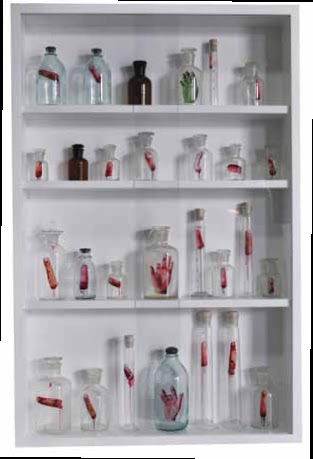
Liu Zhuoquan, Bottles Photographed in the Artist's Studio, Beijing, March 2011


I made a snap decision yesterday to enrol in Mandarin for Semester 2 at Sydney University. Clicked 'submit' with  credit card details to enrol online and then thought "Oh my God, what have I done?" Learning (or attempting to learn) with the kind and gentle Lian in private lessons was one of the most difficult things I have ever done - as Peter Hessler said in his account of learning Chinese in Fuling when he was in the Peace Corps, 'Had a human being ever compressed more wrongness into a single hour? Everything was wrong - tones, grammar, vocabulary, initial sounds.' And now I guess I will be exposing my inadequacy (not to mention my aging and increasingly inelastic brain) to other students in the class....but if I am going back to China, as I hope to do, next year......
With Tony Scott and Liu Zhuoquan in Liu's studio. Beijing, March 2011


I showed images of works by Liu Zhuoquan to my students, and to a group of art teachers at a training course this week - people find them fascinating. Tony Scott from China Art Projects tells meLiu's work was very well received at the Hong Kong Art Fair and he is on his way to international recognition. Liu was mentioned in John McDonald's review in yesterday's Sydney Morning Herald. He will show at Niagara Galleries in Melbourne in 2012. Sometimes it seems like a dream that I was lucky enough to meet all these extraordinary artists, and visit them in their studios....

Liu Zhuoquan, Broken Finger 02, 2010 (image courtesy of China Art Projects)

Friday, June 3, 2011

books books and more books about chinese art

Tao Aimin, Book of Women, Installation and Performance


I am a little bit obsessed with bookdepository.com and cannot seem to stop myself buying books about Chinese contemporary art. I keep telling myself that it is all for the purpose of writing my research paper and summarising the results of my travelling scholarship but really I have just become an obsessive collector of all things related to the Chinese art world. Was thrilled to find that my fabulous book of essays from Timezone 8 in Beijing arrived within a week, and today I came home to find yet another package on my doorstep, 'China Under Construction: Contemporary Art from the People's Republic' edited by curator and critic Maya Kovskaya. It includes fantastic photography by Zhan Wang and documentation of performance art by Han Bing

http://xpia.com/showcaase/a7a_black/series.asp?aa_series_id=49&member_id=24195,

as well as Tao Aimin's 'Book of Women', an installation created of rural women's washboards, tied with jute cord and arranged in unlikely sites.

Zhan Wang, Scholar Rock

Han Bing, Me and My Cabbage at Suma Bay - documentation of performance

Kovskaya's catalogue essay positions post 1990s art as moving beyond the 'easy' exoticism and Mao-era tropes of the Political Pop and Cynical Realist Artists, which she identifies as a kind of colonialist or orientalist discourse. New art in China is art made in and about a world which is 'no longer an insular, autarchic world, but rather a globalising, chaotic world where the old divisions no longer make sense and "signs of the times" engage in regular and bi-directional border crossings.'

I am especially interested in the work of Tao Aimin, given my interest in finding female artists to interview whilst I was in China, and the incomprehension with which my questions about any kind of gender divide were met by most  people I spoke to, both male and female.Here is an article about her from NY Arts Magazine:

http://www.nyartsmagazine.com/index.php?option=com_content&view=article&id=5326:tao-aimins-anthropological-art-luna-fenichel&catid=94:november-december-2006&Itemid=707

 Tao Amin collected hundreds of wooden washboards from rural women, and has used them in a series of installation works relating to the repetitive and exhausting labor of their lives - a kind of homage to their invisibility. They have the appearance of ancient calligraphy scrolls, and in that way her work can be connected to that of Gu Wenda or Xu Bing. They are also a comment about the lack of literacy of the women who used them - this 'book' of women is written with the memory of their labor in the daily objects they used each day.
Tao Aimin, Book of Women, Installation