The ongoing thoughts of an art teacher in China - and home in Sydney

A continuing diary about my travels in China, and thoughts about China and Chinese art from home and abroad

Wednesday, June 22, 2016

Bu Hua: Beijing Babe Loves Freedom

Bu Hua, Beijing Babe Loves Freedom No. 2, 2008, giclee print, 100 cm diameter,
image courtesy the artist and White Rabbit Gallery
With the arrival of my first grandchild (4 weeks old and, of course, completely gorgeous) I have been in a reflective frame of mind. A new baby throws you back forcibly to the long nights you spent cradling your own infant children, and even much further back in time to your earliest memories. Waving knitted toys and rattles at my tiny grand-daughter to amuse her (or, perhaps, just to entertain me), I began thinking about the power of childhood objects to evoke primal responses. 

Before language, before logical thought, these things are imprinted. Digging through cupboards I found rattles, teething rings and slightly moth-eaten teddy bears from the childhoods of my two daughters, and even an antique doll of  my own, with a 1950s plastic perm, eyes fallen back inside its head. It's a kind of time travel, this generational remembering, and it recalled my experience of visiting Bu Hua's extraordinary studio last year, where every wall and flat surface is crowded with old dolls, mechanical and wind-up tin toys, train sets and puzzles. Every conceivable childhood totem is here somewhere, arrayed like devotional objects in a shrine. Indeed, it is a shrine - to the artist's memories of a Beijing long gone, before eight-lane highways tore through the city and the hutongs were almost entirely demolished. 

In Bu Hua's studio, 2015, photo Luise Guest
I have wanted to write a piece about Bu Hua for a while, with a focus on her use of memory, and her nostalgia for her Beijing childhood.


Bu Hua in Beijing, 2015, photograph Luise Guest
1960s meets 1990s in Bu Hua's studio, photograph Luise Guest

Bu Hua was born in 1973, during the Cultural Revolution, but her focus is on a Beijing of memory: bicycles and willow trees; hutong laneways and tight communities. There are certainly dangers in romanticising the past , and Bu Hua's teenage years were times of dramatic change as China opened to the world marketplace, but like many Chinese people, she now sees an unrecognisable place of monstrous greed and unstoppable corruption. It is not surprising that people look back to a time of greater simplicity with a degree of regret.
Bu Hua, Sami, giclee print, 100cm diameter, image courtesy the artist
(I chose this work for an exhibition 'Half the Sky: Chinese Women Artists' shown in Hong Kong and Beijing in April 2016. The Hong Kong Gallery were most upset at the subject matter, but in Beijing it didn't raise an eyebrow!)


Growing up surrounded by artists, Bu Hua ‘learned the language of lines’ from earliest childhood. Her father was a printmaker, painter, and a professor of Fine Arts in Beijing. Connected to the renaissance of printmaking that took place in the years following the Cultural Revolution, influenced by German Expressionists such as Kirchner and Kollwitz, he expected his children to follow in his footsteps. Bu Hua studied the techniques of ‘shui mo’ (water and ink) painting, and attended a specialist art high school before studying at Tsinghua University’s Institute of Fine Art. After her father’s death, she travelled to Germany for a major exhibition of his work. During her European travels, visiting galleries and exhibitions, she discovered the work of international contemporary artists, completing postgraduate study in the Netherlands.
Bu Hua, World 6, 2014, Acrylic on Canvas, 120 x 360 cm, image courtesy the artist
Japanese cartoons were newly available to Chinese TV audiences in her childhood, and Bu Hua loves the vintage nostalgia of ‘Astroboy’, and the wonderful animations made at the Shanghai Film Studios during the 1960s, such as ‘Havoc in Heaven’, an adaptation of the traditional tale of the Monkey King. One of her favourite films is ‘Fantastic Planet’, a French/Czech stop motion animation about a planet ruled by giant humanoid aliens. Now recognised as a significant figure in the vanguard of digital animation in China, an innovator with vector graphics software, she adapts and blends influences from Surrealism, Japanese anime and manga illustration with the strong flat planes and linear qualities of woodblock prints and traditional Chinese folk art. Bu Hua’s practice adroitly navigates the sometimes perilous boundaries between ‘high art’ and popular culture, fine art and graphic design, cuteness and satire. 
Bu Hua, As Soon as China has a Space Station on the Moon, it can Begin to Consider Establishing a Communist Party There, No.3, 2008, giclee print, 100 cm diameter, image courtesy the artist and White Rabbit Gallery
Bu Hua’s happy memories of a secure Beijing childhood provide the source of much of her imagery today. The red corridors and grey walls of traditional architecture, and the white bridges and willow trees of her city recur in her paintings, digital prints and animations. The same protagonist appears in many of her works: a defiantly sassy, pigtailed ‘Young Pioneer’, with her red scarf flying as she navigates a strangely dystopian universe, she represents the artist herself as a child. In Beijing dialect this character is ‘sa mi’ () – a feisty girl with kick-ass attitude. She swaggers and pouts through animations such as Anxiety (2009) and LV Forest (2010), confronting monstrous machines and strange hybrid beasts. Sometimes she takes aim with a slingshot at flocks of birds that morph into fighter jets, sometimes she rides a dinosaur through lush jungles, and in other works she stares into the middle distance, nonchalantly smoking a cigarette.


Bu Hua, What is Left Belongs to You, Acrylic on Canvas, image courtesy the artist
Bu Hua communicates her anxiety about the social transformation and ecological destruction of China, and what she sees as the growing selfishness and narcissism of its citizens, fusing western and eastern traditions of art and design. The rising or setting sun is a recurring motif, reminding us that Mao Zedong was often depicted in propaganda posters, framed by the rays of the rising sun. In Bu Hua’s ironic vision, though, darkness is coming. Her fearless young protagonist, a lonely child in a terrifying universe, confronts a nightmare landscape of marauding machines and hideous skeletal beasts. In Vowing not to Attain Buddhahood until all are salvaged from Hell No.3 (2008) she stands astride the skeleton of a deer in a desolate landscape lit as if by the flash of a nuclear explosion. Red fronds of foliage hang from above like tentacles. Birds, beasts and insects dart around the circular composition, an ironic inversion of the traditional Chinese moon window, designed to frame the serene beauty of a scholar’s garden. In this work only the naked child is calm and unmoved, a witness to the apocalypse.
Bu Hua, Vowing Not to Attain Buddhahood Until All Are Salvaged from Hell No. 3, giclee print, image courtesy the artist
Savage Growth (2008) is an animated allegory of industrialisation, pollution and militarisation. Bu Hua’s Young Pioneer stands atop a building, conducting a flock of birds that morph into pairs of white gloves, flying above a devastated landscape in which distorted trees grow out of pools of oil. Other birds become military aircraft, casting ominous shadows over an abandoned amusement park as they shoot down the flapping hands. A row of sexy foxes (fox spirits, in Chinese folklore, are dangerous seductresses) dance backwards and forwards to a sound track that evokes the rhythmic metallic noise of a factory assembly line. Bu Hua represents the environmental devastation wrought by rapid development in China, the unintended consequences of urbanisation and greed. In contrast, Bu Hua also wants to show beauty and tenderness, through the innocence of a world of memory, of small animals and clockwork toys, harking back to a simpler time.

You can read more about Bu Hua in my book ''Half the Sky: Conversations with Women Artists in China", Piper Press, Sydney, 2016. A detail of her feisty protagonist graces the cover, beautifully designed by John Dunn, an unmistakeable representation of the power of female ambition and achievement against a sometimes stacked deck. 


The book is available in selected bookstores in Sydney and Melbourne, in Beijing through Beijing Bookworm (http://beijingbookworm.com/) and online through the Queensland Art Gallery HERE


Sunday, June 5, 2016

Four Women Went to China


‘Such a journey will lead you to yourself...'
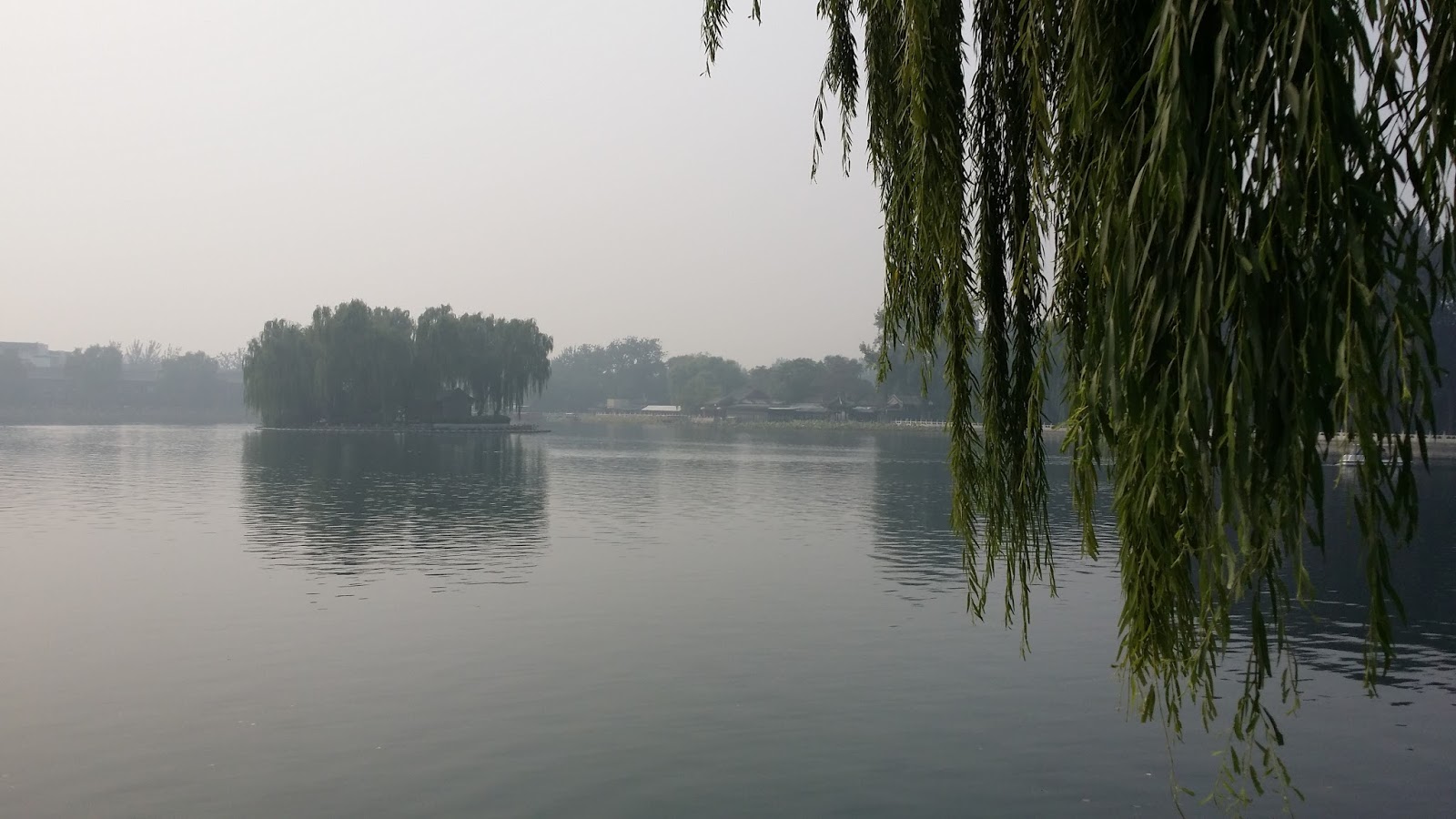
Beihai, Beijing, October 2015, photo Luise Guest
When I was asked to write a catalogue essay for an exhibition of works by three Australian artists, Suzanne Archer, Hanna Kay and Sarah Tomasetti, it was their exhibition title that first grabbed me. 'Three Women Went to China': those five words possess a magical, mytho-poetic resonance. I couldn't stop thinking about them. And as I began to ask each artist how her experiences of China had changed her, and influenced her practice, I began to think about how China has changed me, too. The fourth woman in the title of this post is me.
Near Gulou Daijie, Beijing, October 2015, Photo Luise Guest
I first travelled to Beijing, Shanghai, Guangzhou and Hong Kong at the start of 2011, the recipient of a scholarship through the New South Wales Premier's Office, sponsored by a Chinese company. I thank my lucky stars every day for that opportunity, which literally changed my life. I had been teaching students about contemporary Chinese art for some years, but it had never really crossed my mind that I could actually go there. My plan was to visit artists' studios, galleries, university Fine Arts Departments and schools, and to interview 20 Chinese artists in order to develop teaching and learning materials for senior Visual Arts students. Just before I left Australia, the enormity of my chutzpah hit me and I suddenly felt terrified. But having accepted a largeish sum of the government's money I had to pretend a confidence I did not feel.

I began to study Chinese, and by the time I left Sydney in March I could stumble through a few phrases of limited usefulness. 'I am an Australian.' 'I am a teacher.' 'I would like to buy this.' 'How much is this?' 'I don't want this.' 'Please give me a receipt.' 'Give me a cup of coffee.' I began to have an inkling that these phrases, plus my wobbly ability to count up to ten, would only get me so far. I hired translators for my interviews, and arranged an itinerary of meetings with artists in each city, visits to international schools, galleries and museums, to the Central Academy of Fine Arts, and (the most difficult to organise of all) a visit to a local high school in Shanghai.

Two more phrases from my textbook struck fear into my heart. 'What is this that I am eating?' seemed to me the kind of question to which I may not wish to know the answer. And, 'Please take me to the American hospital!' appeared, just possibly, causally related to the first one. I expected China to be challenging, but in reality I had no idea what I would find. In retrospect, my ill-preparedness and sheer naivety is both hilarious and horrifying.

The thing that most struck me on that first visit, amidst the apocalyptic pollution,the terrifying traffic, the fact that I was constantly lost amidst the grey sameness of Beijing streets and incomprehensible signage, and the chaotic tangle of tumbledown artists' villages on the city outskirts, was the generosity and warmth of the artists, who welcomed me into their studios, took my project seriously, evinced great respect for teachers, and spoke honestly, at length (sometimes, it must be said, at almost unstoppable length), and with surprising frankness, about their lives and work.

I was constantly surprised by their accessibility and openness, and the way that in China one meeting automatically leads to more contacts. Each studio visit resulted in further serendipitous encounters, and through these chance contacts I met artists of a stature that I would not have dreamed of approaching. I had never interviewed anyone before, and with hindsight my earliest encounters make me cringe - poor Hanison Hok-shing Lau in Hong Kong, and Wu Junyong in Beijing were among the first of these L-plated interviews. But I think they could see my genuine interest and enthusiasm, and I find that people generally respond in kind. To date I have visited and interviewed more than 60 artists - adding Xi'an, Chengdu, and Hangzhou to the other cities. I continue to be humbled by these encounters, from Shi Jindian in Chengdu, Bai Ye in Xi'an, Wang Zhibo and Jin Shi in Hangzhou, to all the artists who agreed to feature in my book "Half the Sky: Conversations with Women Artists in China" and the recent exhibition curated for Red Gate Gallery in Beijing, featuring 16 of them. Most recently I have been meeting artists whose work is in the White Rabbit collection, including Zhang Dali, Xu Zhen and Wang Qingsong.

But it was not just the artists whose warmth has struck me and made me grateful - over the years following that first trip I have had so many encounters with Chinese people, in parks, in taxis, on buses and trains, in restaurants, shops and markets, that are genuinely kind and helpful. Sure, as a "laowai" you get scammed every now and then. But now my Chinese is sufficient to argue with pedicab drivers, and to bargain a bit harder in the market. I can even swear, and once shocked a taxi driver so much that he swerved right into oncoming traffic. I have danced with the 'aunties' in Tuanjiehu Park; eaten stinky tofu in Shanghai, donkey pastrami in Beijing, and ducks' tongues in a Chengdu hotpot restaurant whilst watching fire-eating opera performers; travelled across China alone by train; and negotiated my way around far-flung suburbs in black cabs to find obscure artist studios. Did I ever have cause to say "Please take me to the American hospital?" Yes, in fact, but not for myself - and my hair-raising experience of a Beijing ambulance ride in the middle of the night was not for the faint-hearted.
Kite flying at the city wall, Beijing, October 2015, photo Luise Guest
Now, after seven trips to China, both short and long, including a three month stay in 2013 that included a two month Red Gate Gallery residency, living in the local neighbourhood of Tuanjiehu, I can say without any hesitation that China has changed me. I can talk to anybody, anywhere, and I don't care in the least if my mangled Chinese syntax is causing them great amusement. I have become surprisingly adventurous, and would have to agree with Gloria Steinem that when a woman turns 50 she comes into her own, and becomes truly herself. China has given me a job that I love, research that fascinates and challenges me, and a passionate interest that extends beyond art to history, politics and language. China made me a writer.

I understand how the three artists in the exhibition (opening next week) feel they too have been 'imprinted' and changed irrevocably by their experience of China. I started the catalogue essay this way:

‘Such a journey will lead you to yourself,

It leads to transformation of dust into pure gold!’ (Rumi)

Suzanne Archer, Banquet, 2015, oil on canvas, image courtesy the artist 

Three Women Went to China. These five words suggest a mythical journey: a crossing of mountains and oceans; the possibility of danger; adversity overcome and the getting of wisdom. It evokes legendary heroines. Pilgrimage. A fable, perhaps, or a metaphor. Alternatively, it’s a bald factual statement. Three women did go to China, together and separately, more than once. And returned, but not unchanged. 

You can read more, and see more of their work, HERE.