The ongoing thoughts of an art teacher in China - and home in Sydney

A continuing diary about my travels in China, and thoughts about China and Chinese art from home and abroad
Showing posts with label Art Labor. Show all posts

Sunday, April 19, 2020

Doing the Cha-Cha with Marx and Engels: an Ode to Shanghai

Fuxing Park, Shanghai, April 2019. Photo: Luise Guest
In a pre-pandemic world I would have been in Shanghai with my daughters right now, introducing them to the city I have grown to love over the last ten years. Such plans we had, for wandering the streets of the former French Concession, watching the dancers in the park, exploring the tiny shops and all the art galleries, and - of course - eating amazing food. In this grim and fractured time it may seem frivolous or self-indulgent to be remembering an era when travel to China was a (relatively) simple matter of getting a visa and booking a flight: in our new parallel universe that will likely be unthinkable for a long time to come. But in a period of growing xenophobia everywhere across the globe, it's more than ever necessary that we hold on to our dreams of trans-cultural encounters and our hopes that in the future our borders will open and our horizons will expand once more. And my nostalgia helps me with that, in a bittersweet way.
Shanghai laneway, April 2019. Photo: Luise Guest
Instead of being a Shanghai flâneur exploring ever-widening arcs around Maoming Nan Lu, I'm 'sheltering in place' like most people across the planet and wondering whether our world will ever be the same. One year ago I was in Shanghai after a week in Beijing, interviewing artists, visiting exhibitions, and enjoying the frenetic pace of this city with its complicated history. I've been thinking about what it is that I most enjoy about Shanghai, and how it is so different to Beijing. My affection was far from instant - it took quite a few years of learning the rhythms of this mega-city with its population of more than 24 million people before I suddenly realised one day that I had fallen in love with it.
Shanghai street scene, 2017. Photograph Luise Guest. 
On my first visit, arriving by high-speed train after a month spent in Beijing, I became instantly lost in the multiple exits from the station, and found it utterly alienating. I had unwittingly booked a hotel in exactly the wrong part of the city, all 8-lane highways and concrete and glass, impossible to walk around and in a construction zone difficult for taxis to navigate. It was the end of winter, and still bitterly cold and damp. On my second visit the following year, and just slightly more savvy, the taxi driver from the airport decided that a foreigner was just too much mafan and tried to make me get out on the side of the elevated expressway off ramp. Fortunately, by this time my Chinese was just barely good enough to argue, and by midnight I'd arrived at the right (very odd) hotel. Although only after he had tried to drop me at three others, apparently randomly selected.

I hired a young translator for my interviews with artists who introduced himself to me with his chosen English name as 'Troy Sailor'. He was certainly handsome and charming, but on our first trip to an artist's studio he unsmilingly told me that in China, old women like me stayed home to save their money to pass on to their children and didn't gallivant around the world on their own. A great start! But going back through my notebooks I am astonished to remember that on my very first trip, as the recipient of a travelling scholarship for art educators, in a single week I interviewed luminaries Hu Jieming, Yang Zhenzhong, Shi Qing and Pu Jie, as well as Shi Zhiying, Chen Hangfeng, performance artist Wu Meng and Monika Lin. And a very young Lu Yang, who had just recently graduated from the China Academy of Art in Hangzhou. This is evidence of my own chutzpah, for sure, but also reveals the kindness and generosity of the artists and their galleries - I'm grateful to Shasha Liu and Martin Kemble from Art Labor, Lorenz Helbling from ShanghART, and to Art + Shanghai curator Diana Freundl, who had shown Shi Zhiying's beautiful paintings in a group show of women artists.
Lu Yang with 'Biological Strike Back', 2011. Photograph Luise Guest
Leaving the hotel to find somewhere to eat on my first night in Shanghai I remember being too terrified to cross the road, as hundreds of motor scooters revved their engines impatiently at every traffic light. Shanghai taxi drivers were not the chatty, chain smoking 'lao Beijingren'  with their leather jackets and buzzcuts listening to crosstalk on their radios that I had become used to, but surly characters who reversed terrifyingly, at speed, on the elevated freeway and zigzagged in and out of lanes, horns blaring and cigarettes dangling from their mouths as they swore at every other road user. Shanghai driving, it seemed, was a Darwinian exercise where only the most fearless survived. When I showed a Chinese address to one driver, he told me he didn't have his glasses so would have to borrow mine - then proceeded to hurtle down the highway, turned around to face me in the back of the cab, wearing my multifocals. At that point I truly thought I would never see my children again.

In 2012 I was still describing Shanghai as a savage beast of a city - a jabberwock with 'jaws that bite and claws that catch'. When did this change? Perhaps it was in 2013 when I had enough Chinese to feel more confidently independent, or arriving in the Spring of 2014 and realising just how beautiful the old streets are.

Former French Concession street scene, April  2019. Photograph Luise Guest

So what do I love?
The parks with their dancers and singers - of course.  I love the impromptu concerts by students in the tiny park across the road from the Shanghai Conservatorium. On each visit I try to make a very early morning visit to Fuxing Park with its staggering array of activity including the very loud, and often completely tone-deaf, amplified singers belting out anything from Chinese opera, to cheesy karaoke ballads, to Puccini.  I love watching the ballroom dancers doing rather stiff, upright, Latin moves under the watchful gaze of Marx and Engels.
Doing the cha-cha with Marx and Engels. April 2019. Photo Luise Guest
I love the tree-lined streets with their tiny shop windows where gaudy qipao and satin stilettos jostle against windows displaying rows of lacquered roast ducks or dusty mops and buckets in hardware stores. I love the lines of people waiting to buy baozi, pancakes and cakes at the famous places on Huaihai Road. I love the strange fashions in the windows of the 'Shanghai Lady' department  store. I love peering into beautiful but run-down gardens behind walls and fences. I love the sheets, towels, quilts and undies hanging from lines strung from windows, between trees, and on power lines, and the padded jackets waving in the wind on coat-hangers hooked onto street lights.
'Shanghai flags' in the French Concession. April 2019. Photo Luise Guest
Cyclists on Changle Lu, Shanghai, 2017. Photograph Luise Guest
I used to love the uniquely Shanghainese habit of wearing pyjamas in the street - often paired with high heeled shoes, and a tiny dog on a leash, or sometimes worn with fluffy slippers. Younger people found this fashion choice excruciatingly unsophisticated and over the years these sightings have become very rare. I always found it eminently practical and comfortable, if not exactly elegant.  Now that we are all wearing old track pants all day, or switching from our night pyjamas to day pyjamas to start working on laptops in our locked-down interior worlds, it also seems rather foresighted.
Shanghai street scene, 2012. Photograph Luise Guest
I love Shanghai's architecture too, from the art deco around Maoming Nan Lu and Huaihai Lu and the colonial buildings (a reminder of a dark past, but very beautiful) on the Bund. The towers topped with neon-lit, Gotham City-like spires you glimpse as you speed along the elevated freeway coming into the city are visions of a modernity of the past. The stone doorways of shikumen houses and multi-dwelling longtang laneways, whether crumbling and chaotic or restored and gentrified are beautiful. They are endangered, of course, as Shanghai undergoes a constant process of being torn down and rebuilt, like every other Chinese city.
Shanghai Longtang, Neighbours chatting, 2015. Photograph Luise Guest
Shanghai rooftops, 2011. Photograph Luise Guest.
Most of all I love the palpable energy of my conversations with artists in their studios - oftentimes now far outside the city centre - and their sense that anything is possible. Last April I engaged in intense conversations, recording interviews with artists ranging from painter Zhao Xuebing to video artists Li Xiaofei and Qiu Anxiong, and global new media star Lu Yang, almost ten years after we first met.
Zhao Xuebing in his studio, 2019. Photograph Luise Guest
Qiu Anxiong in his studio, 2019. Photograph Luise Guest
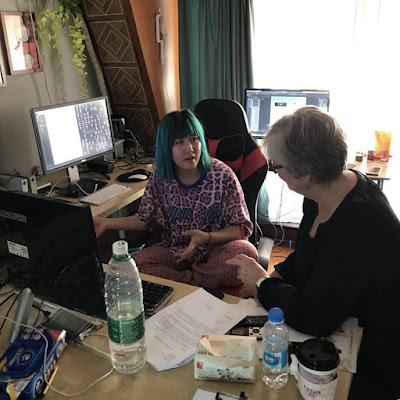
With Lu Yang, Shanghai, 2019
Now, of course, galleries and museums are closed, exhibitions are virtual, and art fairs are cancelled or indefinitely postponed. The future of the artworld, and of artists as nomadic beings participating in a global ecology of fairs, biennales and curated museum shows is anyone's guess. We can probably assume that after this (if there is an after this) then nothing will ever again be quite as it was.
Chen Hangfeng in his Shanghai studio, 2011. Photograph Luise Guest
Last April I travelled to the outskirts of the city to meet once again with Chen Hangfeng in a suburban villa.  I had first interviewed Chen ten years earlier in his tiny, former French Concession studio: changes in the places where artists live and work echo the changes in Chinese society over the intervening time. Chen discussed his new work 'Excited with No Reason'. This video animation was inspired in part by his new life, shuttling back and forth between Shanghai and Amsterdam, and his interest in global trade and its effects - an interest that seems even more compelling in a world brought to its knees by a pandemic that has infected the globe, vectored on planes and cruise ships.

The outcome of that conversation with a wonderful artist who jokingly describes himself as a 'half-assed literati' was published last year as Invasive Species and Global Trade Routes: A Conversation with Chen Hangfeng. Click on the link to read the article in Sydney-based online journal, The Art Life.

Artists, in Shanghai and everywhere, are continuing to work in their studios. Perhaps artists and writers, often somewhat introverted and solitary by nature, are among those whose lives are least altered by our current circumstances. I hope I shall return to see their new work and to wander those streets and laneways once again.
Shanghai street in the rain, 2011. Photograph Luise Guest


Monday, February 20, 2012

Sugar and Spice Sichuan Style: 'China's Decade' at Ray Hughes Gallery

Wan Yang, Game No 2: Fortuitous Encounters in the Forest, 2006, acrylic on canvas, 100 x 150 cm, image reproduced with the permission of Ray Hughes Gallery

Ray Hughes, that somewhat Rabelaisian, larger than life fixture of the Sydney artworld, first travelled to China in 1998. Since then he has been a regular visitor to the studios and galleries of Beijing, Shanghai, Tianjin, and, most recently, Chongqing, that vast city of 38 million people on the Yangtze River in Sichuan Province. It is now well known that it was at an exhibition at Ray Hughes Gallery that Judith Nielson, the founder with her husband Kerr of the White Rabbit Gallery http://www.whiterabbitcollection.org and its significant collection, first encountered contemporary Chinese art. While she has since developed her own networks of artists and advisors, it is due to her chance encounter with artist Wang Zhiyuan and the energy and excitement of Chinese art at Hughes’ Surry Hills Gallery that a new and vital force was unleashed onto the Sydney cultural scene.

Something of a maverick, Hughes’ determination to run his own race in the sometimes pretentiously self-conscious Sydney artworld is what makes him such an interesting character.  He is interested in “the next generation, the next ‘new thing’ “, he tells me when I visit the gallery to see the group show ‘China’s Decade’ together with a show of new work by the painter Li Jun. A curious title for the show, given that many works date from the late 90s, but there is no denying the accuracy of the statement in today’s global context. Hughes was expansive and animated, describing his visits to Sichuan (and the hot pots eaten in the mountains with the artists, teachers and art students, of course!) and the way that the artists he admires there are focused on moving art beyond the limited scope of the ‘Political Pop’ movement of the late ‘90s, re-examining their own pre-revolutionary Chinese history. They are developing a new visual syntax which incorporates Western influences with a confidently global, international outlook.  Their references to Chinese art and craft traditions are sometimes subtle and veiled, sometimes overt.
Luo Brothers, 'Welcome Welcome!', fibreglass and paint.
Image reproduced courtesy of Ray Hughes Gallery
This is not to say, however, that the brash wit of Political Pop is altogether absent. The work of the Luo Brothers, who have been shown in Sydney by Ray Hughes since his first forays into Chinese art, is typical of the style. As well as the highly recognisable icons of consumer desire – such as the gaudy fat ‘good fortune’ fibreglass babies reclining smugly on cans of Pepsi that we see in this show – there is also a series of pencil and charcoal drawings. The three works in ‘The 100 Family Names Primer’ series represent a baby, a young female in Red Army uniform, and an old worker, all with their jackets covered in Mao buttons and backed by revolutionary flags. The title is presumably a reference to the ‘Old Hundred Names’, the ordinary working people of China who propped up the revolution and are now propping up the country’s growing wealth and industrial might in the factories of the Pearl River Delta. Other works by Feng Zheng-jie and Qi Zhilong which date from the late 90s and early 2000s work the familiar seam of Red Army ballet dancers and Maoist imagery with engaging verve and confidence. There are those in China, such as the Canadian Martin Kemble of the respected Shanghai ‘Art Labor’ Gallery http://www.artlaborgallery.com/ who see the continuing popularity of this style in the west as a kind of ‘Chinoiserie’ or orientalism, which Chinese artists are pragmatic enough to happily profit from. There is no doubt some truth in this. However, despite the fact that younger artists (and many of the older generation as well) have moved away from this somewhat obsessive gnawing at the bone of the Cultural Revolution, these works still exert a fascination in their relentless exposure of the contradictions of this ‘new’ China as it moves towards global dominance.

Hang Bo’s series of photographs, ‘No. 6 They’, ‘Middle School’ and ‘No.  5 They’ exemplify a very different approach to the business of ‘being Chinese’ and making sense of history. His method is to take ‘found’ images, poignant group photos of young Pioneers, soldiers or work unit comrades from the time of the Cultural Revolution, and then re-photograph the same (living) subjects in the same arrangements. Quietly arresting and very moving, ‘No. 5 They’ contains a number of empty chairs, and one inevitably begins to speculate as to the reasons for the absences.

Of most interest to me were other more idiosyncratic works such as Wang Yuping’s oddly tentative ‘Untitled’, a mixed media work on paper.  A faceless figure, sketchily and loosely rendered, tenderly holds a small black bird on its hand. Reminiscent of ink drawings by Joy Hester such as ‘Girl with Hen’ or the ‘Lovers’ series, in which faces are partially or totally obliterated, the work can be read on many levels and suggests the vulnerability of both the natural world and of human connections. Ji Dachun’s large canvases, in which mundane objects such as electric light bulbs and shoes appear to float against a light coloured ground, are also strangely compelling, making subtle references to Western modernist conventions of abstraction, colour field painting and expressionism. There is a Zen sensibility though, of weightlessness and quiet meditation, which makes these works repay a second look, and then a third.
Wang Yuping, Untitled, 1998, mixed media on paper, 102 x 69 cm,
 image reproduced with the permission of Ray Hughes Gallery

The highly respected senior painter Liu Xiaodong, who will be remembered by Sydney audiences for his monumental  paintings of migrant workers building the Three Gorges Dam shown at a Sydney Biennale some years ago, is represented here with a work from 2002, ‘Unknown Pleasures’. A solitary figure, seen from the rear, smokes a cigarette, quietly observing a street scene. Large, ornate, brightly coloured floral wreaths are arranged along a bicycle lane in front of the kind of new commercial buildings which look ramshackle and decrepit in China before construction has even finished. There is a melancholy air about this figure observing the ‘new’ China.  Liu was apparently inspired to develop his particular expressive style after he was given a postcard of a work by Lucien Freud. When you look at the way he paints flesh, especially in those earlier paintings of migrant workers at the dam site eating lunch in their underpants, or young girls lying on seedy bare mattresses, this makes perfect sense. There is a sense of melancholy and a hint of menace lurking behind the seductive and luscious painterly surface.

I was intrigued by Zhou Siwei’s mixture of ‘spice and sugar’ in works such as ‘Infection Bambi ‘ paintings, part of a larger series of ‘cartoon nostalgia’ which includes ‘Infection Mickey’ and ‘Infection Astro Boy’. Drops and splatters of paint create stylised images which are intended, the artist says, to return viewers to the state of their wide-eyed and optimistic youthful selves. Rather unnervingly though, Bambi appears to be decomposing, so the work rather suggests the impossibility of returning to that charmed childhood state, and instead suggests that popular culture is toxic to those who consume it. The artist has said that his work is there to be ‘infected’ with all the various interpretations and ideas that the viewer may bring to contemplating it. Zhou studied at the influential Sichuan Fine Arts Institute in Chongqing. This city is, Hughes believes, at the centre of innovative art in China. Zhou represents a generation who have little interest in, or direct experience of, the Cultural Revolution that provided so much of the imagery employed by the first wave of contemporary Chinese artists and avidly ‘consumed’ by Western audiences. In this he reminds me of Lu Yang, a young artist I met in Shanghai last year, who told me she has no interest whatsoever in being identified or defined as a Chinese artist. The limitations of national identity become  meaningless in the age of social media. These young artists are forging a new path, challenging the orthodoxies that have grown up in the last 20 years about what Chinese art ‘should’ look like. Sometimes they may seem to an (older) outside observer to be in denial, however there is no doubting their sincerity, or their determination.

As I chatted with Hughes in the gallery, though, my eye was continually drawn away from him (despite his characteristically brightly coloured shirt and tie) to the works by Chang Xugong hanging above him. Dating from the Late 90s, they represent the ‘Gaudy Art’ movement. Born in 1957 in Hebei Province, Chang uses the tradition of silk embroidery to make comment on the nouveau riche in China and their relentless acquisition of consumer goods and branded products. Like the dramatic imagery of heroic workers from Cultural Revolution Propaganda posters, these new aspirational heroes of ‘Socialism with Chinese characteristics’ appear happy to the point of lunacy, which allows just a little doubt to creep into the mind of the viewer. They  are charming rather than malicious, however -  there is affection in the mockery, rather as one might tiredly acknowledge the foibles of a relative one is really quite fond of. Many of his toothy grinning characters carry the latest accessory of urban China – a fluffy white Maltese terrier or Paris Hilton style pooch. Cars, mobile phones and television sets swirl around like the haloes surrounding Renaissance depictions of saints. These saints, though, are more likely to be performing Karaoke than miracles.
Chang Xugong, Untitled, 2000, machine embroidered satin, 100 x 80cm,
image reproduced with the permission of Ray Hughes Gallery
The delicate and beautiful works of Li Jinhttp://www.li-jin.com/  an artist from Tianjing, are reminiscent of nothing so much as the drawings of George Grosz or Max Beckmann, albeit with a lighter and more humorous touch. Loose, lyrical ink on paper works depicting rather unprepossessing looking men in front of messy  tables scattered with bottles of baijiu and cut sausage, or engaged in strangely unerotic encounters with plump naked girls, they celebrate the everyday lives of ordinary and unbeautiful people – that is, most of us. Affectionate and gentle, his works present a slightly flabby and imperfect cast of characters, drawn lovingly without attempts to idealise, to beautify, or to apply Vaseline to the lens recording daily existence. In a time when the only images of ordinary flawed human beings we see are the grotesque photographs of ‘Celebs without Make-up’, or the sad and desperate on ‘The Biggest Loser’, this is very refreshing.
The exhibition celebrates Chinese art in all its rich diversity. Yes, there is Mao imagery, and the memory of the Cultural Revolution lives on in the work of many artists – how could it not? Yet there are also artists working in new techniques and with imagery that represents the bizarre and the humdrum, the beautiful and the disturbing, the humorous and also the magical aspects of life in China (and everywhere) today.

Li Jin, Accompanying Object, 2007, ink on paper, 46 x 70 cm, 
image reproduced with the permission of Ray Hughes Gallery

Chang Xugong, Untitled, 2000, machine embroidered satin, 100 x 80cm,
image reproduced with the permission of Ray Hughes Gallery