 |
| Fuxing Park, Shanghai, April 2019. Photo: Luise Guest |
In a pre-pandemic world I would have been in Shanghai with my daughters right now, introducing them to the city I have grown to love over the last ten years. Such plans we had, for wandering the streets of the former French Concession, watching the dancers in the park, exploring the tiny shops and all the art galleries, and - of course - eating amazing food. In this grim and fractured time it may seem frivolous or self-indulgent to be remembering an era when travel to China was a (relatively) simple matter of getting a visa and booking a flight: in our new parallel universe that will likely be unthinkable for a long time to come. But in a period of growing xenophobia everywhere across the globe, it's more than ever necessary that we hold on to our dreams of trans-cultural encounters and our hopes that in the future our borders will open and our horizons will expand once more. And my nostalgia helps me with that, in a bittersweet way.
 |
| Shanghai laneway, April 2019. Photo: Luise Guest |
Instead of being a Shanghai
flâneur exploring ever-widening arcs around Maoming Nan Lu, I'm 'sheltering in place' like most people across the planet and wondering whether our world will ever be the same. One year ago I was in Shanghai after a week in Beijing, interviewing artists, visiting exhibitions, and enjoying the frenetic pace of this city with its complicated history. I've been thinking about what it is that I most enjoy about Shanghai, and how it is so different to Beijing. My affection was far from instant - it took quite a few years of learning the rhythms of this mega-city with its population of more than 24 million people before I suddenly realised one day that I had fallen in love with it.
 |
| Shanghai street scene, 2017. Photograph Luise Guest. |
On my first visit, arriving by high-speed train after a month spent in Beijing, I became instantly lost in the multiple exits from the station, and found it utterly alienating. I had unwittingly booked a hotel in exactly the wrong part of the city, all 8-lane highways and concrete and glass, impossible to walk around and in a construction zone difficult for taxis to navigate. It was the end of winter, and still bitterly cold and damp. On my second visit the following year, and just slightly more savvy, the taxi driver from the airport decided that a foreigner was just too much
mafan and tried to make me get out on the side of the elevated expressway off ramp. Fortunately, by this time my Chinese was just barely good enough to argue, and by midnight I'd arrived at the right (very odd) hotel. Although only after he had tried to drop me at three others, apparently randomly selected.
I hired a young translator for my interviews with artists who introduced himself to me with his chosen English name as 'Troy Sailor'. He was certainly handsome and charming, but on our first trip to an artist's studio he unsmilingly told me that in China, old women like me stayed home to save their money to pass on to their children and didn't gallivant around the world on their own. A great start! But going back through my notebooks I am astonished to remember that on my very first trip, as the recipient of a travelling scholarship for art educators, in a single week I interviewed luminaries Hu Jieming, Yang Zhenzhong, Shi Qing and Pu Jie, as well as Shi Zhiying, Chen Hangfeng, performance artist Wu Meng and Monika Lin. And a very young Lu Yang, who had just recently graduated from the China Academy of Art in Hangzhou. This is evidence of my own chutzpah, for sure, but also reveals the kindness and generosity of the artists and their galleries - I'm grateful to Shasha Liu and Martin Kemble from Art Labor, Lorenz Helbling from ShanghART, and to Art + Shanghai curator Diana Freundl, who had shown Shi Zhiying's beautiful paintings in a group show of women artists.
 |
| Lu Yang with 'Biological Strike Back', 2011. Photograph Luise Guest |
Leaving the hotel to find somewhere to eat on my first night in Shanghai I remember being too terrified to cross the road, as hundreds of motor scooters revved their engines impatiently at every traffic light. Shanghai taxi drivers were not the chatty, chain smoking '
lao Beijingren' with their leather jackets and buzzcuts listening to crosstalk on their radios that I had become used to, but surly characters who reversed terrifyingly, at speed, on the elevated freeway and zigzagged in and out of lanes, horns blaring and cigarettes dangling from their mouths as they swore at every other road user. Shanghai driving, it seemed, was a Darwinian exercise where only the most fearless survived. When I showed a Chinese address to one driver, he told me he didn't have his glasses so would have to borrow mine - then proceeded to hurtle down the highway, turned around to face me in the back of the cab, wearing my multifocals. At that point I truly thought I would never see my children again.
In 2012 I was still describing Shanghai as a savage beast of a city - a jabberwock with 'jaws that bite and claws that catch'. When did this change? Perhaps it was in 2013 when I had enough Chinese to feel more confidently independent, or arriving in the Spring of 2014 and realising just how beautiful the old streets are.
 |
Former French Concession street scene, April 2019. Photograph Luise Guest
|
So what do I love?
The parks with their dancers and singers - of course. I love the impromptu concerts by students in the tiny park across the road from the Shanghai Conservatorium. On each visit I try to make a very early morning visit to Fuxing Park with its staggering array of activity including the very loud, and often completely tone-deaf, amplified singers belting out anything from Chinese opera, to cheesy karaoke ballads, to Puccini. I love watching the ballroom dancers doing rather stiff, upright, Latin moves under the watchful gaze of Marx and Engels.
 |
| Doing the cha-cha with Marx and Engels. April 2019. Photo Luise Guest |
I love the tree-lined streets with their tiny shop windows where gaudy qipao and satin stilettos jostle against windows displaying rows of lacquered roast ducks or dusty mops and buckets in hardware stores. I love the lines of people waiting to buy baozi, pancakes and cakes at the famous places on Huaihai Road. I love the strange fashions in the windows of the 'Shanghai Lady' department store. I love peering into beautiful but run-down gardens behind walls and fences. I love the sheets, towels, quilts and undies hanging from lines strung from windows, between trees, and on power lines, and the padded jackets waving in the wind on coat-hangers hooked onto street lights.
 |
| 'Shanghai flags' in the French Concession. April 2019. Photo Luise Guest |
 |
| Cyclists on Changle Lu, Shanghai, 2017. Photograph Luise Guest |
I used to love the uniquely Shanghainese habit of wearing pyjamas in the street - often paired with high heeled shoes, and a tiny dog on a leash, or sometimes worn with fluffy slippers. Younger people found this fashion choice excruciatingly unsophisticated and over the years these sightings have become very rare. I always found it eminently practical and comfortable, if not exactly elegant. Now that we are all wearing old track pants all day, or switching from our night pyjamas to day pyjamas to start working on laptops in our locked-down interior worlds, it also seems rather foresighted.
 |
| Shanghai street scene, 2012. Photograph Luise Guest |
I love Shanghai's architecture too, from the art deco around Maoming Nan Lu and Huaihai Lu and the colonial buildings (a reminder of a dark past, but very beautiful) on the Bund. The towers topped with neon-lit, Gotham City-like spires you glimpse as you speed along the elevated freeway coming into the city are visions of a modernity of the past. The stone doorways of
shikumen houses and multi-dwelling
longtang laneways, whether crumbling and chaotic or restored and gentrified are beautiful. They are endangered, of course, as Shanghai undergoes a constant process of being torn down and rebuilt, like every other Chinese city.
 |
| Shanghai Longtang, Neighbours chatting, 2015. Photograph Luise Guest |
 |
| Shanghai rooftops, 2011. Photograph Luise Guest. |
Most of all I love the palpable energy of my conversations with artists in their studios - oftentimes now far outside the city centre - and their sense that anything is possible. Last April I engaged in intense conversations, recording interviews with artists ranging from painter Zhao Xuebing to video artists Li Xiaofei and Qiu Anxiong, and global new media star Lu Yang, almost ten years after we first met.
 |
| Zhao Xuebing in his studio, 2019. Photograph Luise Guest |
 |
| Qiu Anxiong in his studio, 2019. Photograph Luise Guest |
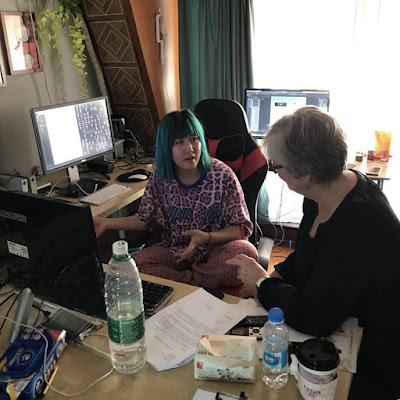 |
| With Lu Yang, Shanghai, 2019 |
Now, of course, galleries and museums are closed, exhibitions are virtual, and art fairs are cancelled or indefinitely postponed. The future of the artworld, and of artists as nomadic beings participating in a global ecology of fairs, biennales and curated museum shows is anyone's guess. We can probably assume that after this (if there is an after this) then nothing will ever again be quite as it was.
 |
| Chen Hangfeng in his Shanghai studio, 2011. Photograph Luise Guest |
Last April I travelled to the outskirts of the city to meet once again with Chen Hangfeng in a suburban villa. I had first interviewed Chen ten years earlier in his tiny, former French Concession studio: changes in the places where artists live and work echo the changes in Chinese society over the intervening time. Chen discussed his new work 'Excited with No Reason'. This video animation was inspired in part by his new life, shuttling back and forth between Shanghai and Amsterdam, and his interest in global trade and its effects - an interest that seems even more compelling in a world brought to its knees by a pandemic that has infected the globe, vectored on planes and cruise ships.
The outcome of that conversation with a wonderful artist who jokingly describes himself as a 'half-assed literati' was published last year as
Invasive Species and Global Trade Routes: A Conversation with Chen Hangfeng. Click on the link to read the article in Sydney-based online journal, The Art Life.
Artists, in Shanghai and everywhere, are continuing to work in their studios. Perhaps artists and writers, often somewhat introverted and solitary by nature, are among those whose lives are least altered by our current circumstances. I hope I shall return to see their new work and to wander those streets and laneways once again.
 |
| Shanghai street in the rain, 2011. Photograph Luise Guest |


