The ongoing thoughts of an art teacher in China - and home in Sydney

A continuing diary about my travels in China, and thoughts about China and Chinese art from home and abroad
Showing posts with label Shanghai. Show all posts

Sunday, April 19, 2020

Doing the Cha-Cha with Marx and Engels: an Ode to Shanghai

Fuxing Park, Shanghai, April 2019. Photo: Luise Guest
In a pre-pandemic world I would have been in Shanghai with my daughters right now, introducing them to the city I have grown to love over the last ten years. Such plans we had, for wandering the streets of the former French Concession, watching the dancers in the park, exploring the tiny shops and all the art galleries, and - of course - eating amazing food. In this grim and fractured time it may seem frivolous or self-indulgent to be remembering an era when travel to China was a (relatively) simple matter of getting a visa and booking a flight: in our new parallel universe that will likely be unthinkable for a long time to come. But in a period of growing xenophobia everywhere across the globe, it's more than ever necessary that we hold on to our dreams of trans-cultural encounters and our hopes that in the future our borders will open and our horizons will expand once more. And my nostalgia helps me with that, in a bittersweet way.
Shanghai laneway, April 2019. Photo: Luise Guest
Instead of being a Shanghai flâneur exploring ever-widening arcs around Maoming Nan Lu, I'm 'sheltering in place' like most people across the planet and wondering whether our world will ever be the same. One year ago I was in Shanghai after a week in Beijing, interviewing artists, visiting exhibitions, and enjoying the frenetic pace of this city with its complicated history. I've been thinking about what it is that I most enjoy about Shanghai, and how it is so different to Beijing. My affection was far from instant - it took quite a few years of learning the rhythms of this mega-city with its population of more than 24 million people before I suddenly realised one day that I had fallen in love with it.
Shanghai street scene, 2017. Photograph Luise Guest. 
On my first visit, arriving by high-speed train after a month spent in Beijing, I became instantly lost in the multiple exits from the station, and found it utterly alienating. I had unwittingly booked a hotel in exactly the wrong part of the city, all 8-lane highways and concrete and glass, impossible to walk around and in a construction zone difficult for taxis to navigate. It was the end of winter, and still bitterly cold and damp. On my second visit the following year, and just slightly more savvy, the taxi driver from the airport decided that a foreigner was just too much mafan and tried to make me get out on the side of the elevated expressway off ramp. Fortunately, by this time my Chinese was just barely good enough to argue, and by midnight I'd arrived at the right (very odd) hotel. Although only after he had tried to drop me at three others, apparently randomly selected.

I hired a young translator for my interviews with artists who introduced himself to me with his chosen English name as 'Troy Sailor'. He was certainly handsome and charming, but on our first trip to an artist's studio he unsmilingly told me that in China, old women like me stayed home to save their money to pass on to their children and didn't gallivant around the world on their own. A great start! But going back through my notebooks I am astonished to remember that on my very first trip, as the recipient of a travelling scholarship for art educators, in a single week I interviewed luminaries Hu Jieming, Yang Zhenzhong, Shi Qing and Pu Jie, as well as Shi Zhiying, Chen Hangfeng, performance artist Wu Meng and Monika Lin. And a very young Lu Yang, who had just recently graduated from the China Academy of Art in Hangzhou. This is evidence of my own chutzpah, for sure, but also reveals the kindness and generosity of the artists and their galleries - I'm grateful to Shasha Liu and Martin Kemble from Art Labor, Lorenz Helbling from ShanghART, and to Art + Shanghai curator Diana Freundl, who had shown Shi Zhiying's beautiful paintings in a group show of women artists.
Lu Yang with 'Biological Strike Back', 2011. Photograph Luise Guest
Leaving the hotel to find somewhere to eat on my first night in Shanghai I remember being too terrified to cross the road, as hundreds of motor scooters revved their engines impatiently at every traffic light. Shanghai taxi drivers were not the chatty, chain smoking 'lao Beijingren'  with their leather jackets and buzzcuts listening to crosstalk on their radios that I had become used to, but surly characters who reversed terrifyingly, at speed, on the elevated freeway and zigzagged in and out of lanes, horns blaring and cigarettes dangling from their mouths as they swore at every other road user. Shanghai driving, it seemed, was a Darwinian exercise where only the most fearless survived. When I showed a Chinese address to one driver, he told me he didn't have his glasses so would have to borrow mine - then proceeded to hurtle down the highway, turned around to face me in the back of the cab, wearing my multifocals. At that point I truly thought I would never see my children again.

In 2012 I was still describing Shanghai as a savage beast of a city - a jabberwock with 'jaws that bite and claws that catch'. When did this change? Perhaps it was in 2013 when I had enough Chinese to feel more confidently independent, or arriving in the Spring of 2014 and realising just how beautiful the old streets are.

Former French Concession street scene, April  2019. Photograph Luise Guest

So what do I love?
The parks with their dancers and singers - of course.  I love the impromptu concerts by students in the tiny park across the road from the Shanghai Conservatorium. On each visit I try to make a very early morning visit to Fuxing Park with its staggering array of activity including the very loud, and often completely tone-deaf, amplified singers belting out anything from Chinese opera, to cheesy karaoke ballads, to Puccini.  I love watching the ballroom dancers doing rather stiff, upright, Latin moves under the watchful gaze of Marx and Engels.
Doing the cha-cha with Marx and Engels. April 2019. Photo Luise Guest
I love the tree-lined streets with their tiny shop windows where gaudy qipao and satin stilettos jostle against windows displaying rows of lacquered roast ducks or dusty mops and buckets in hardware stores. I love the lines of people waiting to buy baozi, pancakes and cakes at the famous places on Huaihai Road. I love the strange fashions in the windows of the 'Shanghai Lady' department  store. I love peering into beautiful but run-down gardens behind walls and fences. I love the sheets, towels, quilts and undies hanging from lines strung from windows, between trees, and on power lines, and the padded jackets waving in the wind on coat-hangers hooked onto street lights.
'Shanghai flags' in the French Concession. April 2019. Photo Luise Guest
Cyclists on Changle Lu, Shanghai, 2017. Photograph Luise Guest
I used to love the uniquely Shanghainese habit of wearing pyjamas in the street - often paired with high heeled shoes, and a tiny dog on a leash, or sometimes worn with fluffy slippers. Younger people found this fashion choice excruciatingly unsophisticated and over the years these sightings have become very rare. I always found it eminently practical and comfortable, if not exactly elegant.  Now that we are all wearing old track pants all day, or switching from our night pyjamas to day pyjamas to start working on laptops in our locked-down interior worlds, it also seems rather foresighted.
Shanghai street scene, 2012. Photograph Luise Guest
I love Shanghai's architecture too, from the art deco around Maoming Nan Lu and Huaihai Lu and the colonial buildings (a reminder of a dark past, but very beautiful) on the Bund. The towers topped with neon-lit, Gotham City-like spires you glimpse as you speed along the elevated freeway coming into the city are visions of a modernity of the past. The stone doorways of shikumen houses and multi-dwelling longtang laneways, whether crumbling and chaotic or restored and gentrified are beautiful. They are endangered, of course, as Shanghai undergoes a constant process of being torn down and rebuilt, like every other Chinese city.
Shanghai Longtang, Neighbours chatting, 2015. Photograph Luise Guest
Shanghai rooftops, 2011. Photograph Luise Guest.
Most of all I love the palpable energy of my conversations with artists in their studios - oftentimes now far outside the city centre - and their sense that anything is possible. Last April I engaged in intense conversations, recording interviews with artists ranging from painter Zhao Xuebing to video artists Li Xiaofei and Qiu Anxiong, and global new media star Lu Yang, almost ten years after we first met.
Zhao Xuebing in his studio, 2019. Photograph Luise Guest
Qiu Anxiong in his studio, 2019. Photograph Luise Guest
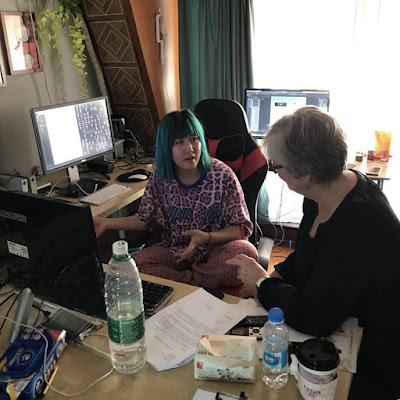
With Lu Yang, Shanghai, 2019
Now, of course, galleries and museums are closed, exhibitions are virtual, and art fairs are cancelled or indefinitely postponed. The future of the artworld, and of artists as nomadic beings participating in a global ecology of fairs, biennales and curated museum shows is anyone's guess. We can probably assume that after this (if there is an after this) then nothing will ever again be quite as it was.
Chen Hangfeng in his Shanghai studio, 2011. Photograph Luise Guest
Last April I travelled to the outskirts of the city to meet once again with Chen Hangfeng in a suburban villa.  I had first interviewed Chen ten years earlier in his tiny, former French Concession studio: changes in the places where artists live and work echo the changes in Chinese society over the intervening time. Chen discussed his new work 'Excited with No Reason'. This video animation was inspired in part by his new life, shuttling back and forth between Shanghai and Amsterdam, and his interest in global trade and its effects - an interest that seems even more compelling in a world brought to its knees by a pandemic that has infected the globe, vectored on planes and cruise ships.

The outcome of that conversation with a wonderful artist who jokingly describes himself as a 'half-assed literati' was published last year as Invasive Species and Global Trade Routes: A Conversation with Chen Hangfeng. Click on the link to read the article in Sydney-based online journal, The Art Life.

Artists, in Shanghai and everywhere, are continuing to work in their studios. Perhaps artists and writers, often somewhat introverted and solitary by nature, are among those whose lives are least altered by our current circumstances. I hope I shall return to see their new work and to wander those streets and laneways once again.
Shanghai street in the rain, 2011. Photograph Luise Guest


Thursday, June 1, 2017

九牛一毛: The Nine and the One: Art in Shanghai

A group of young photographers shoot the work of Liang Shaoji at ShanghART, photo:LG
It's taken a while for the art I saw in Shanghai last month to percolate and for the sediment to settle: images and moments continue to drift in my mind. Meeting artists Lu Xinjian and Shi Yong, and talking with Monika Lin over coffee at the Old China Hand Reading Room about her new body of work, 'From the Bones of the Fish' (watch this space!) Walking to galleries through the tree-lined streets of the former French Concession. The shock of the new on the West Bund. A (somewhat) revitalized M50. Some spaces have closed, some were mysteriously dark, with rumours buzzing like flies, but Shanghai shows every sign of being at the centre of contemporary art in China - at least, at the centre of where the money is right now.
Lu Yang, Uterus Man installation, K11 Art Mall, Shanghai 2017

A classic China moment: I wanted to see a curated group show at a certain very high-profile commercial gallery. It was a Saturday afternoon, and it should have been open. Arriving at the address, I found the door mysteriously locked. A bored guard, dozing over his jar of tea, got up and opened the door, and realised I was in the middle of a fashion shoot, with the paintings as backdrops. The guard assumed that any strange foreigner arriving at the door (no matter my less than fashionista appearance) must somehow be connected. The models, photographers, lighting technicians, make-up artists, hairdressers and runners completely ignored me, so I stayed tolook at the paintings by the light from my mobile phone.
My inadvertent participation in a fashion shoot - as a witness
Now, though, to the sublime, the wonderful, the surprising -- and, frankly, the absolutely awful:

The sublime category absolutely belongs to Song Dong and his survey show, 'I Don't Know the Mandate of Heaven', at Rockbund Museum. Five floors of work from the last four decades was quite stunning - and often very moving. Song's re-purposing of architectural fragments and obsolete objects was much in evidence - an insistence, as Rauschenberg said, on working in ''the gap between art and life.'' More about this important exhibition later.


Tiny wooden stools like those that Song Dong and his friends sat on as children to watch movies shown in the Beijing hutongs - but here they are arranged behind the screen not in front of it.
Another iteration of ''Eating the City" - I overheard a boy strongly (and wisely) advise his girlfriend not to eat the stale cake

The top floor of Rockbund is filled with an installation featuring these tiny mannequins, representing Song Dong's childhood self, engaged in every activity imaginable, including peeing, sleeping, and lying face down in a reference to his famous performance lying in a wintry Tiananmen Square and breathing on the frozen ground
While not quite at the Song Dong level of jaw-dropping wonderment, six other shows/artists/galleries provided intrigue, curiosity, astonishment, and moments of reflection.
He Xiangyu, 'Turtle, Lion and Bear' at Qiao Space was a disconcerting and very moving installation of 25 screens in a darkened space, featuring people in the act of yawning. It's infectious - you cannot not respond with your own yawns - the link between artist, artwork and viewer is complete. There was something quite magical about this sense of shared humanity.
Two exhibitions at ShanghART's new West Bund space fof work by Liang Shaoji and Hu Liu were filled with young student photographers on a Saturday afternoon. These two artists, on the surface so different, are linked by their focus on a very limited and highly specific choice of materials: Liang Shaoji works with silkworms and their silken cocoons, creating immersive sculptural installations,while Hu Liu works with pencil and graphite. Every work takes months, and she uses thousands of pencils on a single large drawing. When you look from different angles they catch the light and what at first appeared as entirely black and featureless reveals itself to be immensely detailed.
Student photographers engage with Liang Shaoji's work at ShanghART
At Bank/Mabsociety Chen Yujun's exhibition was intriguingly titled 'The River Never Remembers, the House Cannot Forget'. Working across multiple forms and navigating different conventions, Chen's work is focused on diasporic experience and personal memory. Like Song Dong, he is interested in the connections between people and the architecture they inhabit, often vernacular and makeshift, even chaotic, yet imbued with the experiences of generations.

Chen Yujun, installation view at Bank/Mabscociety
Chen Yujun, collage, detail, at Bank/Mabsociety

Lu Yang, breaker of taboos and too cool for school, is always fabulous, and 'Delusional Mandala' in an exhibition of young new media artists 'Three Rooms' at Chronus Art Centre did not disappoint. I am rarely willing to stand in uncomfortable, cold gallery spaces on hard floors and watch long artist videos, but I watched this one twice, all the way through. Here's a snippet to tantalise, with commentary, from M Woods Museum in Beijing:


Yin Xiuzhen, Xu Bing, Hong Hao, Chen Yujun and a group of interesting artists in 'Collage: The Cards Players' (sic) at the Shanghai Gallery of Art, provided some strange and unexpected juxtapositions. I was delighted to see another iteration of Xu Bing's 'Background Story' series, where apparent traditional Chinese landscapes are created,not with ink and brush, but from rubbish and debris attached to a backlit screen.


Xu Bing, Background Story, the front and the back

Yin Xiuzhen's rockets - or missiles - parodying the kitsch Pearl Orient TV Tower, all made of old clothing and textiles
All the above artists are represented in the White Rabbit Collection of Contemporary Chinese art in Sydney - so here's a disclaimer: This blog is unconnected, it's a collection of my entirely personal views and general ramblings and ravings: my discovery of exhibitions featuring these artists was purely serendipitous. And how wonderful that Sydney audiences have the opportunity to see their work in the curated shows at White Rabbit Gallery.
Song Dong, "I Don't Know the Mandate of Heaven"
Another discovery provided much needed balm for a great disappointment. On a previous visit the Yuz Museum had been closed, so I was hoping this time to see some of Budi Tek's reputedly very interesting collection. Instead, as perhaps I should have been able to guess from the surprising lines of teenagers and 20-somethings snaking around the block to buy tickets ("How wonderful that they love contemporary art!" I foolishly thought), I was confronted with a museum filled with the vapid 'sculptures' of American graffiti artist, product designer, graphic designer, sculptor and toymaker, KAWS described thus: "His art stands somewhere between fine art and global commerce. KAWS moved beyond the sphere of the exclusive art market to occupy a more complex global market." Really, enough said. This guy makes Damien Hirst look very, very deep. 


After this disappointment, I entered a dimly lit upstairs space to be immersed in the meditative abstract paintings of Zhao Li, in her first solo exhibition for many years. Floating shapes hover on soft grounds of grey, or vivid red and pink. Linear forms overlapping and coalescing suggesting the constant rhythms of the universe and the human body. Zhao is interested in Daoist thought, and the push and pull of yin/yang binaries are evident in the juxtaposition of line and form in these compelling paintings. I was seduced - and calmed - post KAWS. 

The exhibition text is, not unusually in China, full of emotive phrases like this: ''Reasonable romance and bold elegance can both be seen in her works.'' I may be obtuse, but I have no idea what reasonable romance is. But these paintings are absolutely, stunningly, beautiful. Painting in China is alive and well, and if April's crop of exhibitions in Beijing and Shanghai are any indication, it is holding its own amongst the new media, photography, augmented/virtual reality, sculpture and installation.
A ratio of nine strong exhibitions to one that was just silly and shallow  - actually, that's not bad. And there's even a Chengyu, a four character idiom, that fits the situation: ''nine cows, one strand of hair'' 
(九牛一毛 - jiu niu yi mao) refers to something so small and insignificant that it's like one strand of hair in amongst nine cows. Or something. 


Saturday, September 26, 2015

Seven Days in Shanghai


Shanghai is a snarly beast of a city, a monstrous Jabberwock that snaps and snarls: "The jaws that bite, the claws that catch." People are rushed, and stressed, and almost buckling under the pressure, which makes every negotiation - with ticket sellers at the train station, with food vendors, with taxi drivers - a little fraught. If you thought New Yorkers were rude, then think again! But then there are the unexpected kindnesses: a man who gives you a seat on the metro, a smile from a young man who held his umbrella over me at the traffic lights, or a quick chat with the grandmother of a red-cheeked baby. Over many visits I have come rather to love it. People in Beijing say, "Óh Shanghai - it's all about money in Shanghai!" And western friends in Beijing say, "But it doesn't feel like China, it could be anywhere!" Um, no. It couldn't. Let me give you a few reasons:

I walked back to my hotel this evening in the gathering dusk and saw, just behind the big name global brands of Huaihai Road (Prada, Versace, Dolce & Gabbana, Sephora, Starbucks blah blah blah), another world. Barbers and tailors packed up their footpath businesses. A lady with a typically Shanghai frizzy perm mended clothing at an ancient Singer treadle sewing machine on the footpath. A woman fed her baby on a chair set outside the family's small restaurant. Families ate at tables on the road, men (yes, some in pyjamas) lounged smoking in the laneways that characterise old Shanghai architecture, and groups played cards. Tiny children in the traditional split pants ran around shrieking like crazy things. A woman in a frilly nightdress (and high-heeled shoes) directed traffic around her husband's car, laughing. Washing still hung from all the powerlines. Every tiny traditional Shanghai eating place was full. The staff of one restaurant crouched on the footpath, unpacking crates of fish, eggs and vegetables.


Fuxing Park at 6.30 in the morning is a furious hive of activity. Many groups of elderly people practise Qi Gong, or engage in the weirdly frantic exercising that involves a lot of self-slapping. People play vigorous games of shuttlecock and there are already many loud games of cards. Some have brought their jars of tea, and snacks, set out on the grass and the benches. Grannies are dancing (very, very badly.) A man sings opera in the rotunda, and nearby three men practise the saxophone. Women walk babies in prams. Plenty of people are jogging - well, sort of, as many are wearing street shoes and doing a kind of energetic shuffle. Men walk with very loud transistor radios in their "man bags" playing Chinese music. Other men have brought their songbirds and hung their tiny bamboo cages from the branches of trees. A group of women exercise right underneath the statue of Marx and Engels. And three women practise ballroom dancing on their own - getting ready for later.

The contrasts, as always in China, are great. You see young men with the sharpest suits, haircuts and eyes. Beautiful willowy women in floaty dresses and the highest of heels carry designer handbags. They are jostled by countryside women with red cheeks, sparkly T-shirts and socks with high-heels, and men with brown seamed faces wearing dusty suit coats and down at heel shoes. I had lunch with an artist at a tiny, spotlessly clean noodle restaurant run by Uighers from Xinjiang Province, who were eating their family meal but rushed to prepare delicious noodles with egg and tomato. In the same city western and Chinese customers are paying ridiculous prices to eat not very good food with the obligatory western brand names -Wolfgang Puck has a lot to answer for, in my opinion. Chinese cities juxtapose the refined and the tawdry, the handmade and the mass-produced, the old and the new, in a dizzying high/low mash-up.

In homage to Yang Fudong and "Eight Intellectuals in a Bamboo Forest" (I saw the Yang Fudong exhibition at the Yuz Museum, one of the numerous new private museums in China), here are my "Eight Cyclists in a Concrete Jungle":

Eight Things Seen on Motorcycles and Bicycles in Shanghai
  1. A young man wearing very snazzy black and white check pyjamas riding a motorbike narrowly misses a collision with an old man on a motorscooter with a two seater sofa strapped to the back
  2. An old man riding a small motorscooter with 4 crates of eggs balanced precariously in front of him, his arms stretched around them, visibility severely impaired
  3. Ladies of a certain age, often dressed in leopardskin leggings and sparkly T shirts, talking (loudly) on their mobile phones whilst riding motorscooters with shopping bags dangling from the handlebars
  4. A red-cheeked girl sitting sidesaddle behind her husband, zig-zagging through apocalyptic traffic, carrying a sleeping baby slung casually over her shoulder
  5. Old men with tin canteens of soup or dumplings balanced between their legs or tied to the back of their motorscooters
  6. Two children standing up on the back of their father's bicycle, like circus acrobats
  7. Men dwarfed by the stacks of recycled cardboard towering precipitously on the back of their three-wheeled cycles
  8. A girl carrying a cupboard. Yes, a cupboard. On a motorscooter.

In all the chaos and madness of Shanghai traffic - and it is mad, on my taxi ride to catch a train to Hangzhou I truly thought my last hour had come, as the driver chose to zigzag recklessly between lanes on the elevated freeway - older people sail serenely through on upright bicycles. There is none of this lycra-wearing bullshit here, and nobody appears to think they are in the Tour de France, which does make me wonder what on earth is going on with Australian cycle enthusiasts. Road rules, however, are entirely theoretical, and you really have to keep your wits about you if you are not to be flattened by the motorcycles darting through the red lights. 

English phrases are very fashionable although not always comprehensible: the Shanghai Lady Department Store offers me the opportunity to be "Édvonced" - the height of modernity no doubt. And I could have bought a T-shirt that said, "A smile is the only virus that does not destroy the world." Um, what? A small shop selling trinkets and assorted junk near my hotel is called, mysteriously, "My Boxlnn."

About to leave for Beijing, I find myself regretful. Shanghai has grown on me slowly ("man man de'' "慢慢地") over the last five years. And here, in early Autumn, it is particularly beautiful, with the tree-lined streets of the French Concession achingly gorgeous. After a week in China, I am just becoming verbal. A friend once said to me that every time she arrives in China she feels for the first week as if her tongue has been cut out. This alarming metaphor describes my feelings exactly. For the first few days I am almost unable to speak - I can form sentences in Chinese in my head but cannot seem to make them emerge from my mouth. As the days go on I gradually, gradually begin to regain the power of speech, but even after a week I know that I am jumbling the word order and mangling the grammar. "Can you or can you not me a taxi call?" I ask. " That I do not want!" I declare. "Please a coffee to me bring." "Left or right I turn should?" Even as the words exit my mouth I know what I should have said, but it seems I am doomed to communicate in pidgin.

Next week in Beijing, I return to my language school for an intensive three weeks of class, so we shall see if that improves my fluency and my confidence. This week, however, I have interviewed seven extraordinary artists in Shanghai and Hangzhou, including Xu Zhen at his MadeIn Corporation, Lu Xinjian, Yang Yongliang, and Hu Jieming, among others. More of this in a later post. In the meantime, if further proof were needed that Shanghai is not just another global megacity like every other, there is the restaurant called 'More Than Toilet', where diners are seated on toilets and eat from toilet-shaped plates, part of a chain with branches in Taiwan and Hong Kong. Also, the cigarette counter of the Shanghai Lady Department Store is next to the Maternity Wear department. I rest my case.