The ongoing thoughts of an art teacher in China - and home in Sydney

A continuing diary about my travels in China, and thoughts about China and Chinese art from home and abroad
Showing posts with label Hu Jieming. Show all posts

Sunday, April 19, 2020

Doing the Cha-Cha with Marx and Engels: an Ode to Shanghai

Fuxing Park, Shanghai, April 2019. Photo: Luise Guest
In a pre-pandemic world I would have been in Shanghai with my daughters right now, introducing them to the city I have grown to love over the last ten years. Such plans we had, for wandering the streets of the former French Concession, watching the dancers in the park, exploring the tiny shops and all the art galleries, and - of course - eating amazing food. In this grim and fractured time it may seem frivolous or self-indulgent to be remembering an era when travel to China was a (relatively) simple matter of getting a visa and booking a flight: in our new parallel universe that will likely be unthinkable for a long time to come. But in a period of growing xenophobia everywhere across the globe, it's more than ever necessary that we hold on to our dreams of trans-cultural encounters and our hopes that in the future our borders will open and our horizons will expand once more. And my nostalgia helps me with that, in a bittersweet way.
Shanghai laneway, April 2019. Photo: Luise Guest
Instead of being a Shanghai flâneur exploring ever-widening arcs around Maoming Nan Lu, I'm 'sheltering in place' like most people across the planet and wondering whether our world will ever be the same. One year ago I was in Shanghai after a week in Beijing, interviewing artists, visiting exhibitions, and enjoying the frenetic pace of this city with its complicated history. I've been thinking about what it is that I most enjoy about Shanghai, and how it is so different to Beijing. My affection was far from instant - it took quite a few years of learning the rhythms of this mega-city with its population of more than 24 million people before I suddenly realised one day that I had fallen in love with it.
Shanghai street scene, 2017. Photograph Luise Guest. 
On my first visit, arriving by high-speed train after a month spent in Beijing, I became instantly lost in the multiple exits from the station, and found it utterly alienating. I had unwittingly booked a hotel in exactly the wrong part of the city, all 8-lane highways and concrete and glass, impossible to walk around and in a construction zone difficult for taxis to navigate. It was the end of winter, and still bitterly cold and damp. On my second visit the following year, and just slightly more savvy, the taxi driver from the airport decided that a foreigner was just too much mafan and tried to make me get out on the side of the elevated expressway off ramp. Fortunately, by this time my Chinese was just barely good enough to argue, and by midnight I'd arrived at the right (very odd) hotel. Although only after he had tried to drop me at three others, apparently randomly selected.

I hired a young translator for my interviews with artists who introduced himself to me with his chosen English name as 'Troy Sailor'. He was certainly handsome and charming, but on our first trip to an artist's studio he unsmilingly told me that in China, old women like me stayed home to save their money to pass on to their children and didn't gallivant around the world on their own. A great start! But going back through my notebooks I am astonished to remember that on my very first trip, as the recipient of a travelling scholarship for art educators, in a single week I interviewed luminaries Hu Jieming, Yang Zhenzhong, Shi Qing and Pu Jie, as well as Shi Zhiying, Chen Hangfeng, performance artist Wu Meng and Monika Lin. And a very young Lu Yang, who had just recently graduated from the China Academy of Art in Hangzhou. This is evidence of my own chutzpah, for sure, but also reveals the kindness and generosity of the artists and their galleries - I'm grateful to Shasha Liu and Martin Kemble from Art Labor, Lorenz Helbling from ShanghART, and to Art + Shanghai curator Diana Freundl, who had shown Shi Zhiying's beautiful paintings in a group show of women artists.
Lu Yang with 'Biological Strike Back', 2011. Photograph Luise Guest
Leaving the hotel to find somewhere to eat on my first night in Shanghai I remember being too terrified to cross the road, as hundreds of motor scooters revved their engines impatiently at every traffic light. Shanghai taxi drivers were not the chatty, chain smoking 'lao Beijingren'  with their leather jackets and buzzcuts listening to crosstalk on their radios that I had become used to, but surly characters who reversed terrifyingly, at speed, on the elevated freeway and zigzagged in and out of lanes, horns blaring and cigarettes dangling from their mouths as they swore at every other road user. Shanghai driving, it seemed, was a Darwinian exercise where only the most fearless survived. When I showed a Chinese address to one driver, he told me he didn't have his glasses so would have to borrow mine - then proceeded to hurtle down the highway, turned around to face me in the back of the cab, wearing my multifocals. At that point I truly thought I would never see my children again.

In 2012 I was still describing Shanghai as a savage beast of a city - a jabberwock with 'jaws that bite and claws that catch'. When did this change? Perhaps it was in 2013 when I had enough Chinese to feel more confidently independent, or arriving in the Spring of 2014 and realising just how beautiful the old streets are.

Former French Concession street scene, April  2019. Photograph Luise Guest

So what do I love?
The parks with their dancers and singers - of course.  I love the impromptu concerts by students in the tiny park across the road from the Shanghai Conservatorium. On each visit I try to make a very early morning visit to Fuxing Park with its staggering array of activity including the very loud, and often completely tone-deaf, amplified singers belting out anything from Chinese opera, to cheesy karaoke ballads, to Puccini.  I love watching the ballroom dancers doing rather stiff, upright, Latin moves under the watchful gaze of Marx and Engels.
Doing the cha-cha with Marx and Engels. April 2019. Photo Luise Guest
I love the tree-lined streets with their tiny shop windows where gaudy qipao and satin stilettos jostle against windows displaying rows of lacquered roast ducks or dusty mops and buckets in hardware stores. I love the lines of people waiting to buy baozi, pancakes and cakes at the famous places on Huaihai Road. I love the strange fashions in the windows of the 'Shanghai Lady' department  store. I love peering into beautiful but run-down gardens behind walls and fences. I love the sheets, towels, quilts and undies hanging from lines strung from windows, between trees, and on power lines, and the padded jackets waving in the wind on coat-hangers hooked onto street lights.
'Shanghai flags' in the French Concession. April 2019. Photo Luise Guest
Cyclists on Changle Lu, Shanghai, 2017. Photograph Luise Guest
I used to love the uniquely Shanghainese habit of wearing pyjamas in the street - often paired with high heeled shoes, and a tiny dog on a leash, or sometimes worn with fluffy slippers. Younger people found this fashion choice excruciatingly unsophisticated and over the years these sightings have become very rare. I always found it eminently practical and comfortable, if not exactly elegant.  Now that we are all wearing old track pants all day, or switching from our night pyjamas to day pyjamas to start working on laptops in our locked-down interior worlds, it also seems rather foresighted.
Shanghai street scene, 2012. Photograph Luise Guest
I love Shanghai's architecture too, from the art deco around Maoming Nan Lu and Huaihai Lu and the colonial buildings (a reminder of a dark past, but very beautiful) on the Bund. The towers topped with neon-lit, Gotham City-like spires you glimpse as you speed along the elevated freeway coming into the city are visions of a modernity of the past. The stone doorways of shikumen houses and multi-dwelling longtang laneways, whether crumbling and chaotic or restored and gentrified are beautiful. They are endangered, of course, as Shanghai undergoes a constant process of being torn down and rebuilt, like every other Chinese city.
Shanghai Longtang, Neighbours chatting, 2015. Photograph Luise Guest
Shanghai rooftops, 2011. Photograph Luise Guest.
Most of all I love the palpable energy of my conversations with artists in their studios - oftentimes now far outside the city centre - and their sense that anything is possible. Last April I engaged in intense conversations, recording interviews with artists ranging from painter Zhao Xuebing to video artists Li Xiaofei and Qiu Anxiong, and global new media star Lu Yang, almost ten years after we first met.
Zhao Xuebing in his studio, 2019. Photograph Luise Guest
Qiu Anxiong in his studio, 2019. Photograph Luise Guest
With Lu Yang, Shanghai, 2019
Now, of course, galleries and museums are closed, exhibitions are virtual, and art fairs are cancelled or indefinitely postponed. The future of the artworld, and of artists as nomadic beings participating in a global ecology of fairs, biennales and curated museum shows is anyone's guess. We can probably assume that after this (if there is an after this) then nothing will ever again be quite as it was.
Chen Hangfeng in his Shanghai studio, 2011. Photograph Luise Guest
Last April I travelled to the outskirts of the city to meet once again with Chen Hangfeng in a suburban villa.  I had first interviewed Chen ten years earlier in his tiny, former French Concession studio: changes in the places where artists live and work echo the changes in Chinese society over the intervening time. Chen discussed his new work 'Excited with No Reason'. This video animation was inspired in part by his new life, shuttling back and forth between Shanghai and Amsterdam, and his interest in global trade and its effects - an interest that seems even more compelling in a world brought to its knees by a pandemic that has infected the globe, vectored on planes and cruise ships.

The outcome of that conversation with a wonderful artist who jokingly describes himself as a 'half-assed literati' was published last year as Invasive Species and Global Trade Routes: A Conversation with Chen Hangfeng. Click on the link to read the article in Sydney-based online journal, The Art Life.

Artists, in Shanghai and everywhere, are continuing to work in their studios. Perhaps artists and writers, often somewhat introverted and solitary by nature, are among those whose lives are least altered by our current circumstances. I hope I shall return to see their new work and to wander those streets and laneways once again.
Shanghai street in the rain, 2011. Photograph Luise Guest


Tuesday, September 29, 2015

上海日记: Shanghai Diary Revisited

French Concession Shanghai, photo LG
After 7 action-packed days in Shanghai I have arrived in Beijing - as always struck anew by the stark differences between these southern and northern cities. Reflecting on my week interviewing artists in Shanghai, my impression that the Shanghai artworld is growing ever stronger, and more interesting, is reinforced. The influence of the new private museums, the Yuz and Long Museums, now a major force to be reckoned with, is a significant factor.

Bicycle Repairs, Shanghai, Photo LG
My hotel in Shanghai's former French Concession was in a fabulous location for exploring the city on foot, and for navigating the Metro - wonderfully efficient, although not for the faint of heart during the rush hour. It was, however, of a uniquely Chinese type - on the surface very luxe, with glittery lamps, lots of fairly appalling art (for sale), enormous marble bathroom and pseudo-antique Chinoiserie. The room, however, was pitch dark even with all the lights on and the curtains open, the carpets in the corridors were badly stained and often covered with drop-sheets (Why? Who knows!) and the breakfast was beyond appalling - once tried never repeated, which perhaps is their intention. However, as Chinese hotels go, it all ran pretty smoothly.

My most memorable Chinese hotel experience was in Beijing, in the winter of 2012, at a supposedly swanky "art hotel" (now closed, and no wonder!) I had begun to think I was the only guest, when on my second night at about 11.00pm there was an almighty noise of thundering feet and shouting in the corridor, and then a loud banging on my door. Imagine my astonishment when I looked through the peephole to find a young Chinese man, stark naked, beating the door with both fists. Later, safely home again, I told a gay friend this story and he said, "Give me the name of this hotel immediately!" I, however, was a little alarmed. I called the reception fuwuyuan, who said with apparent resignation, "Oh Miss, what we can do? He drink too much!" I suggested that perhaps in fact they they did need to do something, anything, anything at all! whereupon the manager rang back and told me they would move me to another floor. There was nothing to be done about Mr Naked Guy. Reluctantly I agreed, and waited for the manager to accompany me. He knocked on the door, I opened it, and together we stepped over the naked body of the man who was now completely comatose, lying stretched out across my doorway. The incident was never mentioned again for the rest of my stay. (Except when I told my translator, who refused point blank to believe that it could possibly have been a Chinese man - he told me I must be mistaken, as only a "waiguoren", a foreigner, would behave so badly.)

A more ludicrous (and less amusing) Chinese hotel experience happened in Xi'an, where I sent some clothes to the laundry and then waited for their return. And waited. When I rang reception they were most apologetic and concerned. A farce ensued, where I received knock after knock on my door, with staff from the laundry bearing ever more preposterous items of clothing and attempting to persuade me they were mine: mens' leather jackets, assorted tiny dresses for tiny Chinese ladies, and enormous jeans for enormous men. It culminated around midnight, with a staff member who simply could not accept that a sequin-covered blue suit (think Xi Jinping's wife on a state occasion) was not in fact mine. He became argumentative and kept trying to shove it at me through the door, which I eventually closed in his face. I never did get my best David Jones blue sweater back.

And of course, there are the two most bizarre experiences of all: the "Art Hotel'' in Chengdu where I discovered to my surprise - and horror - that I was expected to make a speech at the opening of an exhibition of an Australian and Sichuan artist. With about two hours to write it and have it translated, and with no fancy clothes in my overnight bag (perhaps I should have taken that sparkly suit after all!) I fronted up and discovered that my speech was to follow the local Party chiefs, the Chengdu Art Academy bigwigs, and the Australian Ambassador. I was introduced as a "famous Australian art critic" (ha!) and began in Chinese with an apology for my poor language skills. The artist's son then translated my speech line by line. I began to see my entire life flashing before my eyes as time seemed to stop and then go backwards. Dripping with sweat, I ploughed gamely on, filmed by three local television stations - thank God nobody is ever likely to see that footage.

But the honours for first place must go to the "Vineyard"- and I use those inverted commas advisedly -  about two hours out of Xi'an, where I was taken to see an artist's work. My lunch with the artist, a property developer, and a returned Chinese movie producer from Hollywood is a story for another time. I will just say that the wine, the wisteria and even the fields of grapes stretching into the distance are all fake. The local farmers have been persuaded to stop growing corn and vegetables and instead grow table grapes so that wealthy city people can come on weekends and go grape picking and stay in the "chateaux". Truly a Marie-Antoinette at Le Petit Trianon experience.
Yang Fudong, still from video at Yuz Museum
But back to Shanghai, and to art! On my first visit to Shanghai, back at the start of 2011, a number of artists told me they felt almost like the poor relatives of their peers in the art centres of Beijing. Now, they talk about their independence from Beijing, their capacity to innovate and the ways that each individual artist can pursue a unique vision. One said that in his opinion Beijing artists indulge in way too much "liao tianr" - too much chat and communal thinking. I am quite sure, of course, that artists in Beijing will tell me an entirely different story! However, the fact remains that with a unique history of European Modernist influence, and a sense that Shanghai is a truly global city, artists here work in distinct ways. I was fascinated to be shown the extraordinary studio of Xu Zhen - the 'MadeIn Corporation' - where with the assistance of 40 artists/collaborators/assistants some incredibly ambitious and monumental projects take shape. Some say, with a bit of a sneer, it's merely "art as spectacle". I say, "Bring it on!"

Xu Zhen, Guanyin and 'Shanghart Art Supermarket' at Ullens Center for Contemporary Art, Beijing, 2014, Photo LG
The massive Xu Zhen retrospective at the Ullens Center for Contemporary Art in Beijing last year was one of the most exciting exhibitions I had seen in years, from his enormous fluoro-coloured Guanyin to the Shanghart Art "Supermarket" where all the packaging is empty, and "grannies" shuffled around in slippers, following you through the aisles. "Eternity",  a sculpture for which 3D printing technology created absolutely accurate moulds for casting the replicas of figures from Greek classical sculpture and ancient Chinese Buddha figures, is currently showing at White Rabbit Gallery in Sydney. The artist agrees, without apparent irony, that he is the successor to Andy Warhol and his "factory". He says, "Andy Warhol made a connection between art and commerce, but we recognise that art IS commerce and we aim to make the commercial, artistic." There is a similarly cool Warholian demeanour evident in conversation with this artist, who turned himself, literally, into a brand, recognising the global reach of the art market. At the same time, Xu Zhen supports young emerging artists with the MadeIn Gallery in Shanghai's M50 art district.

Xu Zhen Éternity' at Ullens Center for Contemporary Art Beijing 2014
Artists such as Yang Yongliang, Chen Hangfeng, Lu Xinjian and Hu Jieming reinvent and recontextualise  Chinese tradition and history in different ways, both subtle and overt. From papercutting to "Shui Mo" ink painting, from Gongbi realism to the revolutionary photography of the 20th century, each is taking elements of the past and making work that is absolutely contemporary and reflecting the realities of our world today. Chen Hangfeng is working on a significant project about the notorious village in southern China where most of the world's Christmas ornaments are made, an industry which has filled its waterways with glitter, tinsel and assorted festive crap. It's a village of great historical importance in China, in a most beautiful landscape where significant poems were written. Chen Hangfeng's work is a metaphor for globalisation, a theme which concerns many of these artists. Yang Yongliang continues to make beautiful digital works, and now also narrative films, relating to the destruction of the environment as Chinese megacities eat the countryside, devouring tradition in their wake. He takes thousands of photographs for each digital animation, often choosing to shoot in Chongqing. And no wonder - the greater municipality of Chongqing is now, by all accounts, the largest city in the world. Lu Xinjian continues his ''City DNA" and "City Streaming" series of paintings, inspired by aerial views, Google Maps and Mondrian. And Hu Jieming has begun several new projects, including one for which he has written computer coding that can take a photograph and reproduce it, making subtle and not-so-subtle alterations. From this he makes a painting, then scans it and repeats the process, over and over again. Each painting is further from the original image, more abstract. He is asking questions about the relationship between human observation and artificial intelligence.

With Lu XInjian in front of one of his "City DNA" series
After seven intense conversations with seven artists, a Saturday morning walk around the former French Concession provided breathing space, and time to re-acquaint myself with the idiosyncracies of Shanghai life, from the wearing of pyjamas as streetwear to the washing hanging on every street corner, and from powerlines and railings: "Shanghai flags." The sun shone, the oppressive humidity vanished, good coffee was readily available, the trees were green and beautiful, and life seemed very good. Visits to exhibitions at as many galleries as I could cram into one day, including Chen Zhen at Rockbund Museum, Yang Fudong at Yuz Museum, and an exhibition of work by women artists at Pearl Lam, provided a visual feast.

Chen Zhen Purification Room, 2000 - 2015, found objects, clay, photo LG
Chen Zhen, Crystal Landscape of Inner Body, 2000, crystal, iron, glass, photo LG
Yang Fudong, still from video work, Yuz Museum
Lin Ran "Lesbos Island" - traditional Chinese medicine cabinet with drawers "filled with gifts and mementoes given to the artist by lesbians" at Pearl Lam Gallery Shanghai photo LG
My Shanghai experience concluded with the Zhou Fan exhibition at Art Labor Gallery - beautiful works that appear marbled, or as if pigment has been gently dripped onto the surface with an eye dropper. The artist told me that every nuanced gradation of colour and finest line has been carefully applied with tiny brushes. Zhou Fan's practice exemplifies the subtlety and thoughtful refinement that co-exists with the chaotic frenzy of life in modern China.

Zhou Fan, Mountain #0003, 2014, Acrylic ink and mineral color on paper, 38.3 x 56.7 cm image courtesy the artist and Art Labor Gallery


Saturday, September 6, 2014

COMMUNE-ing at the White Rabbit Gallery

人民 公社 (Renmin Gongshe) is what my Chinese dictionary suggests as the most appropriate translation for the word "Commune". A "People's Collective" of the kind introduced in China in the later 1950s as amalgamations of collective farms. This is the title of the new exhibition at Sydney's White Rabbit Gallery, although the curator is playing her cards close to her chest about whether her intention was to think of the term as a noun or a verb, or possibly both. As is usual with shows at this Sydney gallery, a museum privately funded by the Neilson Foundation and exhibiting works drawn from Judith Neilson's impressive (and growing) collection of contemporary Chinese art, the works and their juxtapositions have much to tell us about China.

Here is an excerpt of my review of the show, published in The Art Life yesterday:
The unveiling of a new exhibition at the White Rabbit Gallery is always an eagerly anticipated event. After the sombre mood of ‘Serve the People’, curated last year by Edmund Capon, and this year’s thought-provoking ‘Reformation’ the new show provides quite a different experience. Curator Bonnie Hudson has selected works which create a complex narrative about collectivism versus individualism; about the joys and sorrows of family; and about the ways in which the past pervades the present.
In the Imperial past, the Confucian ideal of filial piety placed family at the centre of Chinese life. Duty to family was far more important than the desires or freedoms of an individual. Under Mao, collectivism defined each person as a member of their group, whether that was a rural communal farm or an industrial “danwei” or work unit. From the cradle to the grave, the well-being of the group took precedence – people were told who to marry, what university course they were permitted to study and where they could work. Today, very few of those strictures remain. Even the much-hated “hukou” - the household registration system which dictates where people can live and work - is being dismantled, and so is the one-child policy.
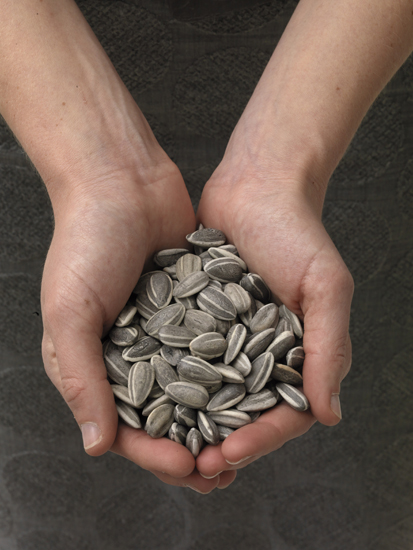
1. Ai-Weiwei-Sunflower-Seeds-2010-ceramic-dimensions-variable
Ai Weiwei, Sunflower Seeds, 2010, ceramic, dimensions variable, image courtesy White Rabbit Gallery
Despite the greater freedom today it can sometimes appear as if the idealism of the revolutionary past has been replaced by a cynical belief in the inevitability of corruption; collectivism by a competitive culture of crass materialism. Young people have no experience of the hardships suffered by their parents and grandparents, and as a consequence there is more than the usual tension between generations. COMMUNE features twenty-three artists, from significant international figures now aged in their fifties, such as Ai Weiwei and Hu Jieming, to younger practitioners such as Gao Rong and Wang Cheng. Together, in clever curatorial juxtapositions, they explore some of the tensions and contradictions of contemporary China. Beyond that, though, the exhibition weaves a narrative about family, belonging, and connectedness. There is a bitter-sweet character to this show that I found immensely moving.
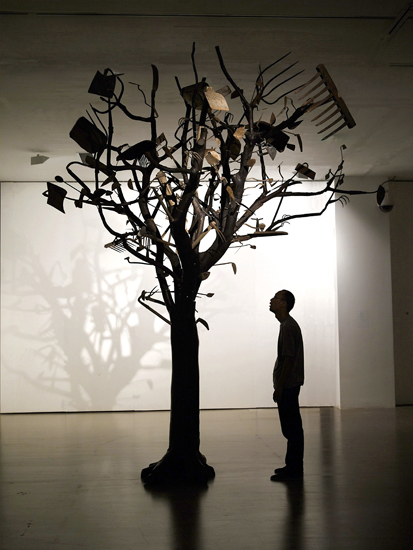
2, Bai-Yiluo-Spring-and-Autumn-1-2007-wood-metal-farm-tools-400-x-350-x-350-cm
Bai Yiluo, Spring and Autumn 1, 2007, wood, metal, farm-tools, 400 x 350 x 350 cm, image courtesy White Rabbit Gallery
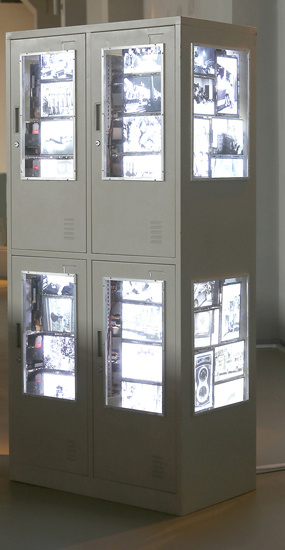
On the top floor of the gallery, new media pioneer Hu Jieming’s ‘Remnant of Images’ fills the gallery space with the sound of filing cabinet drawers and doors sliding open and closed again, symbolising the selective and transient nature of memory. Institutional metal cabinets are filled with flickering animated photographs from China’s past and present. Hu Jieming uses new technologies and media to reveal how we are all now inter-connected in a digital world. “It’s like a socialism of the future,” he told me when we met in his Shanghai studio. His work often reflects China’s past and its uncomfortable and dramatic trajectory into an entirely new society. By combining his own photographs of friends and family with iconic Mao-era imagery, and adding random photographs found on the internet, Hu evokes the presence of history in the now, the interrelatedness of past and present.
5. Hu-Jieming-The-Remnant-of-Images-2013-cabinets-LED-screens-photographs (1)
Hu Jieming, The Remnant of Images, 2013, cabinets, LED screens, photographs, image courtesy White Rabbit Gallery.
What unites the diverse artists represented in this exhibition is an awareness that the past is not “another country” - although it often seems that way – in fact, it shapes our current reality and the ways in which we connect and re-connect with others. Whether you choose to interpret the title of the exhibition as a noun or a verb; as a reminder of the socialist past or as an exhortation, COMMUNE is profoundly moving. Don’t miss it!
To read the whole review, click HERE!
The show includes one of my current favourite artists, Gao Rong, and a beautifully elegiac video by Zhu Jia entitled 'Waltz', embodying in one clever, absorbing and beautifully cinematic work so many of the themes I find in contemporary art from China: a pervasive melancholy, a layering of  past and present, a mixture of nostalgia with an acknowledgement of the betrayal of idealism, a deep cynicism.  There is joy too of course, and it is present here in many works. But 'Waltz' is just beautiful and it haunted me long after I had left the gallery and was walking the currently bleakly rainswept Sydney streets.

Tuesday, April 5, 2011

Tuesday, 5 April: 2 artists, 2 galleries – and an experience of the Chinese medical system

Homage to Duchamp - Wan Liya
Image used with permission of Twin Cities Gallery Shanghai

The last few days have not been easy as I have been struggling with a viral infection that has turned into something worse. Eventually I had to admit defeat and realise that over the counter vitamins (with Chinese packaging, so I am not entirely sure what I have been taking!) and paracetamol was not going to stop the coughing, and began to research how to go about getting some medical attention. The online research suggested 2 public hospitals with 'Foreigner's Clinics' but on ringing one of these I was not encouraged to be told to call an ambulance and go to the general emergency ward. I have heard many stories about peoples' experiences of public hospitals, and I wasn't too keen to have my own first-hand knowledge.  Eventually I found the name of the clinic that services the expat community and found it efficient and accessible, although extremely expensive, with a waiting room full of 'laoweis' such as myself. I was all too aware that the medical care I was provided with so quickly was just not available to an ordinary Chinese person - there is no socialised medicine in this socialist society.

My health dilemma aside, my day also involved 2 separate trips to M50, the Shanghai version of the 798 Art District at 50 Moganshan Road, where old factories have been turned into an art zone of galleries and artists' studios. While there are still numerous shopfront galleries selling Chairman Mao statues and Cultural Revolution style images to tourists, these are not as prevalent as in Beijing, and there are many galleries showing very interesting work.

I visited Art + Shanghai, in another location in the city, and had a long conversation with art director Diana Freundl which ranged across many of the issues which my observations and interviews have thrown up - the status of women artists in the art world in China, the state of art education and specifically of curatorial practice and museology, the differences between the Beijing and Shanghai artworlds, the possibilities and future of a post-'bubble' art market, and the work of specific artists. The exhibition in the gallery, 'A Room of One's Own', of 4 very different and interesting women artists, is another indication of the vitality and freshness of the Shanghai art scene. I am able to arrange an interview for tomorrow with a young painter, Shi Zhi Ying.

Later in the day I visit 'Two Cities' Gallery at M50, and speak with director Eva Ting and curator Shannon Guo.  Shannon is an associate professor in the Fine Arts College of Shanghai University, teaching postgraduate students in the 'Jewelry and Metals Studio'. We talk about the always controversial boundaries between art and craft, form and function. Shannon is a feisty confident woman who says she considers herself a 'warrior' in a battle to ensure that the traditionally 'lesser' artforms of ceramics, glass, and metalwork are given equal status with the 'fine arts' of painting and sculpture. The gallery has presented some very interesting exhibitions which show work by artists who clearly blur these boundaries and work in conceptually interesting ways.

Hu Jieming on studio balcony at M50 old and new Shanghai
My day began with a really great honour: meeting Hu Jieming, a pioneer of digital art in China, a venerable artist whose work has been shown throughout China, and internationally in New York, Chicago, Seattle and the V&A in London. He now also teaches a new generation of artists in new media at the Shanghai Institute of Visual Arts.  Mr Hu welcomes me into his new studio - he has just moved, and the three rooms are completely filled with as yet unpacked artworks, books, furniture, and computer parts.

A gentle and unassuming man, he is happy to talk about his new work to be shown in Shanghai and Shenzhen in June this year. He is developing and applying new computer technologies to create an imaginary world using the internet. He wants to use science and technology to reveal how we are now all connected in a digital world "like a kind of socialism of the future". Like many other artists of his generation (he was in Elementary School during the Cultural Revolution, which affected him most powerfully) his work reflects China's past and its often uncomfortable trajectory into a new way of being. He says he has seen a 180 degree shift in Chinese society in his adult life - things once valued and cherished are no longer considered important and there is an urgent seeking for new values to replace the old. The title of an exhibition in which his work was shown in New York last year, 'Speed and Chaos' seems very apt, we agree. Even looking out the window of his new studio we see the change of the city - the old factory rooftops of M50 are overshadowed by new high rise apartments.

Mr Hu tells me that since he graduated in 1984 he has been a part of the dramatic changes that have swept through China in the 35 years since what Chinese often call 'the opening up'. It was an exciting time in Shanghai, with artists beginning to experiment with new forms as the ideas of the western avant-garde reached them. In the days of the 1989 student movement he remembers the whole city being paralysed, with cars burning in the streets, and the artists became part of an underground world. Later, as newer technologies became available, Hu was one of the first Chinese artists to realise their potential for art, perhaps because he loved mathematics and science as a boy, and wanted to apply these talents to his art practice. He also loved the work of American video pioneer Bill Viola, and this spiritual and lyrical sensibility is evident in some of Hu's works. We talk about the news in today's paper of the record price (HK 79 million) achieved by a Zhang Xiaogang painting as the Ullens Collection went under the hammer at Sotheby's Hong Kong. He laughs and says he thinks this new Chinese art world is a 'kind of miracle', but adds that those artists of the 1990s are already part of China's past, and that the future lies in new media. Young artists such as Lu Yang (and he shows me a work of hers that he has bought) are the future wave of Chinese art, as they can see the possibilities of technology for creating a new kind of art, and are also fully aware of its commercial potential.

Hu Jieming's works, such as 'The Raft of the Medusa' (2002) which was one of the first Chinese works to explore the possibilities of appropriation, or the more recent 'One hundred years in one minute',  layer the past with the present. He shows us the enormity and significance of the past and the way that time is a continuum. This awareness of 'the presence of the past in the now' seems to me to be a thread which connects the work of so many different Chinese artists working in many different forms. As I walk down many flights of stairs from his studio I am hoping that Australian audiences may have the chance to see these works, the product of such a reflective and incisive intellect.

Hu Jieming - 'Raft of the Medusa'
Image used with the permission of the artist and ShanghART Gallery

My next visit, through a red steel door to another new and dusty studio in M50, is to meet with the painter Pu Jie, whose work I have already seen and admired in Beijing at the Redgate Gallery. In fact we met at the fabulous dinner at Middle 8 hosted by Brian Wallace, but the 3 artists were at the centre of an admiring and somewhat boozy entourage on that occasion. Today in the virtually empty studio I am able to look very closely at his paintings, which are always built up in two layers, again representing past and present.

Pu Jie with work in studio

His works are based on 'the opening up' of China to the world, and in fact he defines two exhibitions of foreign art as crucial to his developing practice. One, an exhibition of French art in 1982 which included 3 works by Picasso, was a revelation to him. The other, even more significant, was a Robert Rauschenberg exhibition seen in Beijing in 1983. Pu says these exhibitions were 'unforgettable' and shaped his own practice as he sought new modes of expression in the days following those dark times when artists were told both how and what to paint. In fact, his own work was not shown in China for many years as it was considered too subversive.

Pu Jie small work
Pu Jie work showing underpainted layers
Images used with the permission of the artist and ShanghART Gallery

Today his paintings reveal an interesting tension between their beautiful surfaces and stylised, almost 'Pop Art' linear images, and the symbolism which lies beneath the surface. Every painting has another image hidden beneath it. The yellow painting of two modern young Chinese women is painted over another figure from the days of the Cultural Revolution. Another painting on a red background, the Heavenly Gate in Tiananmen Square represented by curved and straight nails (which themselves represent both violence and construction), is a potent, politically charged symbol of 1989. The gate is painted over another sad recumbent figure of an old man. These are subtle encoded references which allow him to layer past and present and express his own story and that of China generally. In this way his material and conceptual practice are seamlessly woven together to express what he identifies as 'the conflict of all Chinese people', the transition, sometimes painful, from one kind of society to another.


Pu Jie work 2
Image used with the permission of the artist and ShanghART Gallery