The ongoing thoughts of an art teacher in China - and home in Sydney

A continuing diary about my travels in China, and thoughts about China and Chinese art from home and abroad

Sunday, May 27, 2012

Art or Ornithology: Art Melbourne

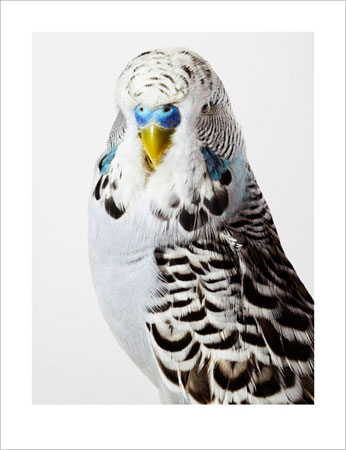
Leila Jeffreys, Suzie

Having spent several hours at Art Melbourne this weekend, I can tell you that the theme du jour is,  unequivocally, 'Birds'. Yes, the feathered creatures feature in works showing at the stands representing serious galleries and those by, hmmm, let's call them 'self-represented' artists. These last tend to the embarrassingly earnest, slightly Easter Show variety of paintings, often featuring clunky collage or very impasto paint surfaces. They sometimes also feature the addition of gold leaf, which is almost always a VERY bad idea and invariably evokes the paintings found in hotel rooms, which I suspect are bought by the metre from Chinese factories.

Once I had identified this 'bird' trope at the first two stands, I was compelled to search the entire Royal Exhibition Hall to see if it was just a coincidence. And discovered that it seems to be compelling subject matter for artists in every conceivable medium. Perhaps Lucy Culliton's rooster series and Craig Waddell's paintings of chooks (both of which are wonderful) have spawned a plethora of followers?

Iain Dawson Gallery was showing a series of large photographic portraits of budgerigars by Leila Jeffreys. These are wonderfully witty, referencing the conventions of serious portrait photography, and suggesting all sorts of human characteristics to viewers with an anthropomorphic bent. I heard one woman say to her companion, "Look, this one's a barrister, and that one's a politician!". The gallery's representative told me that the artist constructed special white boxes to keep the little creatures still enough, but they are terribly vain and love seeing themselves in the mirror. Another human trait.
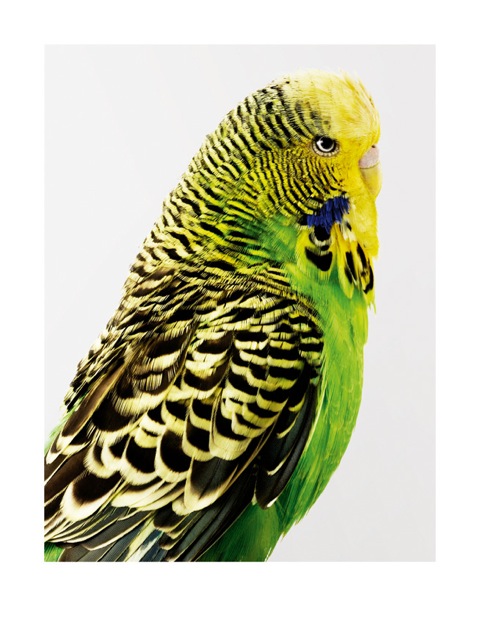
Leila Jeffreys
Brisbane's Lethbridge Gallery showed paintings of birds by Jodie Wells, featuring the kind of impasto that has the quality of cake frosting applied with a spatula. Even Julian Meagher showed a work featuring a bird amongst his usual tattooed male torsos and orchid stems in beer bottles. Bird as a pictorial code signifying masculinity? That's a new bit of visual syntax!

After that I'm afraid it all went very steeply downhill. The artists producing twee images of birds with pretty girls, birds with flowery textile patterns, birds with scrapbooking-style collage and birds with paint laid on with a trowel like spackfilla, had best not be named and shamed.

It was great to see an area of the exhibition space given over to galleries representing artists from Asia, including the Macau based organisation AFA. One of their aims is to build an 'exchange platform' between Macau and Beijing. Last year in 798 one Saturday afternoon I stumbled unwittingly into their Beijing gallery's vernissage of a show by Macau artist Carlos Marreiros, 'Tobacco Wars'. It was one of those rather weird Chinese gallery openings featuring red wine and highly decorative cakes, served by highly decorative girls, but the artist's works are very interesting, combining elements of his architectural training in their structure, together with elements of his Portuguese and Chinese heritage. He explores themes of postcolonialism and contemporary cultural ambiguities. Not a bird to be seen!


Carlos Marreiros, from his Tobacco Wars series


Friday, May 18, 2012

Lindy Lee: making the immaterial visible

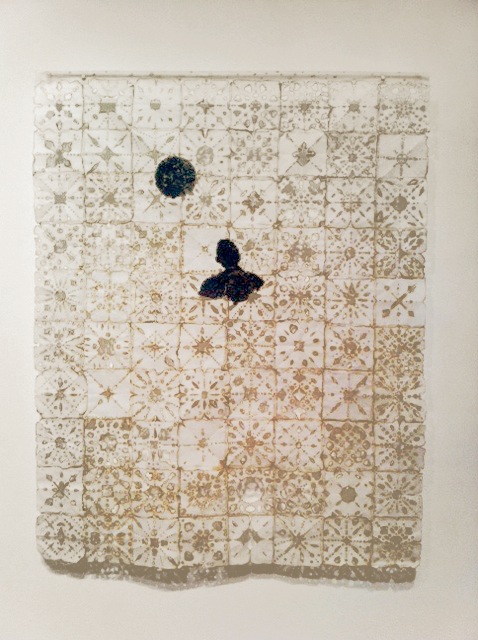
Lindy Lee, 'Conflagrations from the End of Time', 2011, paper, fire, Chinese ink, image reproduced courtesy of the artist and the Museum of Contemporary Art Australia
I loved hearing Lindy Lee talk about her practice to assembled art educators at the MCA today - her long pigtail flying behind her and her disarmingly self deprecating manner somewhat belie her absolute seriousness of purpose and the clarity and sharp intelligence with which she approaches her work. She talked engagingly about her own discovery, some years after she had begun her professional practice as an artist, that it was matter rather than image that was important to her. Even her early choice to photocopy masterworks from the western canon related to her sense that the carbon in the copy contained her intended meaning.  These blurry images suggested a connection with the shadow identity of the hybrid being that she felt herself to be - seeing western art reproductions from the position of an outsider in a culture that was already 'outside' and marginal. Australians have always suffered from the awareness of being on the periphery, never in that elusive 'centre'.
Lee spent years reproducing canonical western works through techniques of photocopying, printmaking and painting, in an investigation of what it means to be an outsider in the '2nd degree culture' of Australia.  She described a dawning realisation that she herself felt like a 'bad copy', alienated from her parents' friends playing mahjong at the Chinese Club, and equally alien as the only Chinese girl in school. After ten years of this practice of appropriation - in fact very successful years as the postergirl of postmodernity -  she began to turn her eyes towards China. This was an aspect of her identity about which she had long been in denial, and in telling us about this personal story today she quoted Jung: "Everything repressed returns as fate". Later, through exploring her family's history and their complex and traumatic migration story, and through her immersion in Buddhist thought and practice, she began to see that in her art practice "the materiality had to hold the essence of what I was trying to do".

Lindy Lee, 'Conflagrations from the End of Time' (detail) 2011, paper, fire, image reproduced courtesy of the artist and the Museum of Contemporary Art Australia
We looked at her recent works,showing in Marking Time at the MCA in which long scrolls of paper are burned and marked by rain and weather, as she spoke of the ways that art brings into visibility "all these wondrous things that make us who we are". This has confirmed for me all my own recent musings about materiality in art practice, and the way that meanings are embedded so deeply into the artist's often unconscious decisions about the physical nature of their work, whether that be Xu Bing's dust from Manhattan streets after 9/11, or He Xiangyu's coca cola transformed to a crystalline substance in his recent show at Gallery 4A.

I wish I had seen these recent works, marked by fire and water, in the 'Forces' exhibition late last year at 10 Chancery Lane in Hong Kong, in which she showed with Carol Lee Mei Kuen, whose practice also includes the mark-making possibilities of fire, water and sun on paper. The show explored the 5 elements of Chinese tradition, a curatorial conceit with so many interesting possibilities. The curator described the way that the 5 elements of Wood, Fire, Earth, Metal and Water constantly act upon and react with each other, and her selection of 5 artists, including Lindy Lee and Carol Lee, as well as Ken Matsubara, William Furniss and Xiao Lu, whose work all incorporates the forces of nature in a tangible way. 10 Chancery Lane Gallery web site This also suggests an interesting connection with the works shown in the Chinese Pavilion at the Venice Biennale last year, which included references to tea and 'baijiu', or white liquor, as two of the essential elements.

Carol Lee Mei Kuen, To Set Fire and Stir Wind 8, image reproduced with permission of the artist
Carol Lee Mei Kuen, paper, fire, Chinese ink, image reproduced with the permission of the artist