A group of young photographers shoot the work of Liang Shaoji at ShanghART, photo:LG
It's taken a while for the art I saw in Shanghai last month to percolate and for the sediment to settle: images and moments continue to drift in my mind. Meeting artists Lu Xinjian and Shi Yong, and talking with Monika Lin over coffee at the Old China Hand Reading Room about her new body of work, 'From the Bones of the Fish' (watch this space!) Walking to galleries through the tree-lined streets of the former French Concession. The shock of the new on the West Bund. A (somewhat) revitalized M50. Some spaces have closed, some were mysteriously dark, with rumours buzzing like flies, but Shanghai shows every sign of being at the centre of contemporary art in China - at least, at the centre of where the money is right now.
Lu Yang, Uterus Man installation, K11 Art Mall, Shanghai 2017
A classic China moment: I wanted to see a curated group show at a certain very high-profile commercial gallery. It was a Saturday afternoon, and it should have been open. Arriving at the address, I found the door mysteriously locked. A bored guard, dozing over his jar of tea, got up and opened the door, and realised I was in the middle of a fashion shoot, with the paintings as backdrops. The guard assumed that any strange foreigner arriving at the door (no matter my less than fashionista appearance) must somehow be connected. The models, photographers, lighting technicians, make-up artists, hairdressers and runners completely ignored me, so I stayed tolook at the paintings by the light from my mobile phone.
My inadvertent participation in a fashion shoot - as a witness
Now, though, to the sublime, the wonderful, the surprising -- and, frankly, the absolutely awful:
The sublime category absolutely belongs to Song Dong and his survey show, 'I Don't Know the Mandate of Heaven', at Rockbund Museum. Five floors of work from the last four decades was quite stunning - and often very moving. Song's re-purposing of architectural fragments and obsolete objects was much in evidence - an insistence, as Rauschenberg said, on working in ''the gap between art and life.'' More about this important exhibition later.
Tiny wooden stools like those that Song Dong and his friends sat on as children to watch movies shown in the Beijing hutongs - but here they are arranged behind the screen not in front of it.
Another iteration of ''Eating the City" - I overheard a boy strongly (and wisely) advise his girlfriend not to eat the stale cake
The top floor of Rockbund is filled with an installation featuring these tiny mannequins, representing Song Dong's childhood self, engaged in every activity imaginable, including peeing, sleeping, and lying face down in a reference to his famous performance lying in a wintry Tiananmen Square and breathing on the frozen ground
While not quite at the Song Dong level of jaw-dropping wonderment, six other shows/artists/galleries provided intrigue, curiosity, astonishment, and moments of reflection.
He Xiangyu, 'Turtle, Lion and Bear' at Qiao Space was a disconcerting and very moving installation of 25 screens in a darkened space, featuring people in the act of yawning. It's infectious - you cannot not respond with your own yawns - the link between artist, artwork and viewer is complete. There was something quite magical about this sense of shared humanity.
Two exhibitions at ShanghART's new West Bund space fof work by Liang Shaoji and Hu Liu were filled with young student photographers on a Saturday afternoon. These two artists, on the surface so different, are linked by their focus on a very limited and highly specific choice of materials: Liang Shaoji works with silkworms and their silken cocoons, creating immersive sculptural installations,while Hu Liu works with pencil and graphite. Every work takes months, and she uses thousands of pencils on a single large drawing. When you look from different angles they catch the light and what at first appeared as entirely black and featureless reveals itself to be immensely detailed.
Student photographers engage with Liang Shaoji's work at ShanghART
At Bank/Mabsociety Chen Yujun's exhibition was intriguingly titled 'The River Never Remembers, the House Cannot Forget'. Working across multiple forms and navigating different conventions, Chen's work is focused on diasporic experience and personal memory. Like Song Dong, he is interested in the connections between people and the architecture they inhabit, often vernacular and makeshift, even chaotic, yet imbued with the experiences of generations.
Chen Yujun, installation view at Bank/Mabscociety
Chen Yujun, collage, detail, at Bank/Mabsociety
Lu Yang, breaker of taboos and too cool for school, is always fabulous, and 'Delusional Mandala' in an exhibition of young new media artists 'Three Rooms' at Chronus Art Centre did not disappoint. I am rarely willing to stand in uncomfortable, cold gallery spaces on hard floors and watch long artist videos, but I watched this one twice, all the way through. Here's a snippet to tantalise, with commentary, from M Woods Museum in Beijing:
Yin Xiuzhen, Xu Bing, Hong Hao, Chen Yujun and a group of interesting artists in 'Collage: The Cards Players' (sic) at the Shanghai Gallery of Art, provided some strange and unexpected juxtapositions. I was delighted to see another iteration of Xu Bing's 'Background Story' series, where apparent traditional Chinese landscapes are created,not with ink and brush, but from rubbish and debris attached to a backlit screen.
Xu Bing, Background Story, the front and the back
Yin Xiuzhen's rockets - or missiles - parodying the kitsch Pearl Orient TV Tower, all made of old clothing and textiles
All the above artists are represented in the White Rabbit Collection of Contemporary Chinese art in Sydney - so here's a disclaimer: This blog is unconnected, it's a collection of my entirely personal views and general ramblings and ravings: my discovery of exhibitions featuring these artists was purely serendipitous. And how wonderful that Sydney audiences have the opportunity to see their work in the curated shows at White Rabbit Gallery.
Song Dong, "I Don't Know the Mandate of Heaven"
Another discovery provided much needed balm for a great disappointment. On a previous visit the Yuz Museum had been closed, so I was hoping this time to see some of Budi Tek's reputedly very interesting collection. Instead, as perhaps I should have been able to guess from the surprising lines of teenagers and 20-somethings snaking around the block to buy tickets ("How wonderful that they love contemporary art!" I foolishly thought), I was confronted with a museum filled with the vapid 'sculptures' of American graffiti artist, product designer, graphic designer, sculptor and toymaker, KAWS described thus: "His art stands somewhere between fine art and global commerce. KAWS moved beyond the sphere of the exclusive art market to occupy a more complex global market." Really, enough said. This guy makes Damien Hirst look very, very deep.
After this disappointment, I entered a dimly lit upstairs space to be immersed in the meditative abstract paintings of Zhao Li, in her first solo exhibition for many years. Floating shapes hover on soft grounds of grey, or vivid red and pink. Linear forms overlapping and coalescing suggesting the constant rhythms of the universe and the human body. Zhao is interested in Daoist thought, and the push and pull of yin/yang binaries are evident in the juxtaposition of line and form in these compelling paintings. I was seduced - and calmed - post KAWS.
The exhibition text is, not unusually in China, full of emotive phrases like this: ''Reasonable romance and bold elegance can both be seen in her works.'' I may be obtuse, but I have no idea what reasonable romance is. But these paintings are absolutely, stunningly, beautiful. Painting in China is alive and well, and if April's crop of exhibitions in Beijing and Shanghai are any indication, it is holding its own amongst the new media, photography, augmented/virtual reality, sculpture and installation.
A ratio of nine strong exhibitions to one that was just silly and shallow - actually, that's not bad. And there's even a Chengyu, a four character idiom, that fits the situation: ''nine cows, one strand of hair''
(九牛一毛 - jiu niu yi mao) refers to something so small and insignificant that it's like one strand of hair in amongst nine cows. Or something.
"So this is Christmas and what have you done/Another year over, a new one just begun..." I have been intending to write a post covering my most recent experiences in China for some weeks, but the frantic busyness of the year's end has conspired against me. Now, as I sit at my kitchen table, with food ready to go into the oven in the heat and humidity of an Australian Christmas - yes, we truly are insane - bright parrots noisily swoop on the red flowering gum tree in front of our house, their cries mixed with the noise of neighbourhood children in swimming pools, lawnmowers and the thrum of cicadas, I finally have a moment to look back at the year just past.
Artist residency outside Jingdezhen - clear air and mountains in the distance
And what a year of change it has been. The first year away from teaching since my second daughter was born in 1990. The year of the first grandchild - such joy! The year my first book was published - a mixture of joy and terror. The year of my first curated exhibition - ''Half the Sky'' - in Hong Kong and Beijing, and speaking about my book to a packed house at the Beijing Bookworm bookshop. The year of navigating a new job that challenges me every day, and allows me to focus entirely on contemporary Chinese art. The year of starting a second graduate research degree - oldest student in captivity? And a year of three trips to China and my first trip to Taiwan to interview artists who think and work in very different ways to those on the Mainland.
First, my best #onlyinChina moment of 2016: In a Jingdezhen restaurant we had almost finished eating a wonderfully spicy meal, and had progressed to the too-much-drinking phase of the evening, when I began to hear the word, "laoshu" - ''mouse" (老鼠). Looking up towards the beam running between wall and ceiling, where a few diners had begun pointing, I saw a very long tail disappearing into a crevice in the wall. Then another creature ran along the timber beam above the table. Then another. Then another. And they were not mice. After some amused conversation about what would happen in Australia if large rats were seen running through a restaurant, it was decided to call the waitresses and express some degree of dismay. The Chinese members of our group were completely unperturbed, as were the assembled flowery-aproned fuwuyuan. Their response: "What's your problem? They didn't eat YOUR dinner!" Back to the art-related highlights of 2016.
In February my book ''Half the Sky: Conversations with Women Artists in China" was published by Piper Press after a 5-year labour of love, researching and writing. The launch at Kinokuniya Bookshop in Sydney, a Q & A with curator Suhanya Raffel, was a moment that I had feared might never eventuate in the end-game struggle to complete the project. More than 40 female Chinese artists invited me into their studios and their lives, and we shared conversations about art, men, children, mothers, Chinese history, and everything else under the sun. I am so grateful to them for their honesty, fearlessness and humour, and regretful that I couldn't include every artist I interviewed. In the end, the book featured 32 of them - and one day I would surely love to produce Volume 2! In April an exhibition of works by women in the book was shown, firstly at Art Hotel Stage in Hong Kong, and then in a different iteration at Red Gate Gallery, Beijing, curated in collaboration with Tony Scott of China Art Projects.
A Line-Up of Artists at the Opening and Book Launch at Red Gate Gallery: L to R Zhou Hongbin, Cui Xiuwen, Li Tingting, Xie Qi, Australian Ambassador to China Frances Adams, Ma Yanling, me, Bu Hua, Tony Scott, Bingyi, Xiao Lu, Lin Jingjing, Han Yajuan, Gao Ping. Not shown: Gao Rong, Dong Yuan, Tao Aimin, Huang Jingyuan
Gao Rong signs a copy of ''Half the Sky"
In October I travelled to Taiwan to interview artists in the White Rabbit Collection. I especially loved visiting the studio of HsuYung-Hsu, and meeting artists Peng Hung-Chih, Shyu Ruey-Shiann and Mia Wen-Hsuan Liu. I discovered a very different Chinese culture and history, reflecting diverse influences from Portugal, Japan, Hakka culture and indigenous Taiwanese histories. It's not 'China-lite', as some had led me to imagine, but something completely unique, despite all the current ongoing tensions.
A work laid out in Hsu Yung-Hsu's studio
In December I was invited to join a research team for the first phase of fieldwork, for a Leverhulme Trust-funded project called 'Everyday Legend', exploring endangered traditional Chinese craft practices and their reinvention and renewal in contemporary art. The week began at Shanghai's Minsheng Art Museum with the exhibition curated by Jiang Jiehong. 'Everyday Legend' included works by many artists represented in Sydney's White Rabbit collection, including Liang Yuanwei, Zheng Guogu, Shi Jinsong, Sun Xun, He Xiangyu and Zhao Zhao. It was tightly curated and engaging, from He Xiangu's alarming installation of teeth to Liang Yuanwei's simulations of textiles in oil paint, from Liang Shaoji's collaboration with silkworms to Yu Ji's dismembered body parts, as if hacked from ancient sculptures.
Liang Shaoji's chains covered and enrobed by silkworms in Everyday Legend, Minsheng Art Museum
Zheng Guogu's carved marble, mostly unreadable, text iinstallation n 'Everyday Legend' at Minsheng Art Museum
Installation View, 'Everyday Legend' at Minsheng Art Museum, with Yu Ji's cement body parts on the wall
We travelled from Shanghai to Suzhou to meet weavers and embroiderers, and then to Jingdezhen, where our itinerary was arranged by conceptual artist Liu Jianhua, recently returned to China after installing his work at the Asian Art Museum in San Francisco - earlier in 2016 his work was shown at the V&A and in Tate Modern's Herzog and de Meuron-designed Switch House. As a young boy Liu was apprenticed to his uncle in a Jingdezhen porcelain factory before eventually attending university at the Jingdezhen Ceramics Institute, later teaching in Yunnan earlier in his career. Like many significant Chinese artists, including Zhang Peili, Liu Jianhua still teaches in Shanghai, where he is a professor in the Fine Arts School of Shanghai University.
''Colouring Tiananmen Square" - porcelain from the 1960s
In Jingdezhen we visited studios, artist residencies, factories, museums and a bizarre ''Cultural Relics Theme Park', as well as the fake market where new wares are carefully aged to appear ancient. Over spicy Jiangxi food we discussed art and Chinese history, and shared ideas for the next phase of the project. We were accompanied by Lv Shengzhong, whose own artistic innovations and profound influence on the curriculum of the Experimental Arts Department at Beijing's Central Academy of FIne Art changed the way that many Chinese artists thought about connections between folk art and contemporary practice. Like a wrinkled grey-bearded elf, wearing a felt hat traditional to Shandong Province, and with an accent so thick you could cut it with a knife, his views on the project and on what we were seeing were fascinating.
Working a loom exactly the same as those used in the Ming Dynasty
Hiu Man Chan, Jiang Jiehong and Sebastian Liang watch Mr Wang in his embroidery workshop
The group was led by Jiang Jiehong, a professor at Birmingham City University's Centre for Chinese Visual Art, and included Sebastian Liang and Nan Nan from the New Century Art Foundation in Beijing, and Professor Oliver Moore from Groningen University in the Netherlands. The trip finished with a discussion/workshop at Minsheng Art Museum focusing on contemporary art in China and whether artists could or should incorporate material practices from China's past. We were joined by artists Yang Zhenzhong, Zhou Xiaohu and Jin Feng, who were more inclined to dismiss the past than to repeat it, taking a refreshingly idiosyncratic standpoint.
Porcelain worker painting the Immortals, Jongdezhen
San Bao Artist Residency and Studios, Jingdezhen
Porcelain emerging from the kiln, Jingdezhen
Apart from the incident of the rat in the dining room, in Jingdezhen I added to my growing collection of Chinese hotel names in English: the "Waiting Hotel", the "Fishing Post Hotel"(in the middle of the city), the ''Continents La Grande Large Hotel" and my favourite, "The OK Hotel" - which may or may not be truth in advertising. In our own hotel, the Jingdezhen Chinaware Hotel ( excellent by the way) a notice in my room advised that by calling reception I could be provided with red wine, coffee, Red Bull, dried beef, shredded squid, chicken feet with pickled peppers, poker and cigarettes.
Meats drying from the eaves, Jingdezhen
In the workshop of Mr Wang - Sebastian Liang, Jiang Jiehong, Mr Wang, Lv Shengzhong, Oliver Moore and myself
As for art seen and experienced in 2016, I won't mention the disappointments - but there were a few. My exhibition highlights this year include, in no particular order:
Hu Qinwu at Niagara Galleries, Melbourne
Liu Zhuoquan at Niagara Galleries, Melbourne
'Ink Remix', a travelling exhibition of works from the PRC, Hong Kong and Taiwan, seen at UNSW Galleries, Sydney
Charwei Tsai's installation of incense in the evocative surrounds of Mortuary Station for the Biennale
Lee Mingwei's poetic Guernica of sand - and its sweeping away - at Carriageworks during the Biennale
Bharti Kher and Chiharu Shiota on Cockatoo Island for the Biennale - although much of the rest here and elsewhere belonged in the disappointments category
Zhang Peili at Australia Centre on China in the World, ANU, Canberra
The Kuandu Biennale, 'Slaying Monsters' in Taipei, and the Taiwan Biennial in Taichung, well-curated shows that excited and challenged the viewer
'Everyday Legend' at Minsheng Art Museum, Shanghai
And, of course, (my partisanship as a newish member of the team freely acknowledged) 'Heavy Artillery' and 'Vile Bodies' at Sydney's White Rabbit Gallery, curated by David Williams from Judith Neilson's extraordinary collection of Chinese contemporary art.
Zhang-Xu Zhan. Inferiority Bat (Hsin Hsin Joss Paper Store Series–Room 003), 2014-2015; 6-channel video animation installation; 5 min. Courtesy of the Kuandu Museum of Fine Arts
In all the misery this year has brought the world, and the fear and despair that many across the globe are now feeling, I look to artists to continue to speak "uncomfortable truths" and to art educators to continue their undervalued work teaching students to think critically and apply their creative minds in unconventional ways.
Charwei TSAI, Incense Mantra, 2013, single channel video. In collaboration with Tsering Tashi Gyalthang.
The ink tradition in Chinese art continues to fascinate the art market and international curators, as well as being a political hot potato inside the Chinese artworld. To some, it's a regressive artform manipulated in the interests of bolstering nationalism. To others, it's part of the reinvention and reclamation of Chinese tradition after thirty years of Maoist suppression. Whatever your stance, contemporary variations on ink painting are not vanishing any time soon. The current exhibition at UNSW Galleries illustrates all the possible variations employed by contemporary artists who are deeply invested in the philosophy of the tradition, but not necessarily in the physical medium itself.
Here is my review, published today in The Art Life after two visits to the exhibition and an illuminating chat with its curator, Sophie McIntyre, in which she explained the long gestation of her research, her interest in the ink phenomenon, and why she chose these particular artists, all of a younger generation than some of those who first began the ink revival in the 1980s and 1990s. We are lucky to see this exhibition in Sydney after its successful launch in Canberra and a second showing in Bendigo. Don't miss it while it's here!
Ink Remix at UNSW Galleries The term ‘ink painting’ evokes mental images of delicately rendered misty mountains, waterfalls, peonies and bamboo. In China today this category of art production does include artists whose work falls within the boundaries of historical conventions, but it has also come to include a younger generation of artists who challenge and subvert the tradition in surprising ways. The highly politicised ‘Contemporary Ink’ movement includes artists with extraordinarily diverse practices. And some of them don’t use ink at all.
Yao Jui-chung,Yao's Journey to Australia, 2015, biro, oil pen with gold leaf on Indian handmade paper, 200 x 546 x 6cm. Courtesy of the artist and Tina Keng Gallery.
The use of ink is deeply embedded in the Chinese sense of nationhood. Fundamental to Chinese calligraphy and painting for more than two millennia, the unique properties of Chinese ink allow artists to produce works of great expressive power with limited means. Whether diluted or ‘black as lacquer’, it is capable of infinitely nuanced and subtle mark-making. Reinventing and transforming traditional modes of expression, artists in China, Hong Kong and Taiwan brought the philosophy and aesthetics of Shui Mo (‘water and ink’ painting) to their sculpture, drawing, video and performance practices, a fresh approach revealed in ‘Ink Remix’ at UNSW Galleries. From a Buddhist prayer written with ink on tofu by Charwei Tsai to Ni Youyu’s reimagined Chinese cosmology made of flattened coins, the exhibition reveals how contemporary artists ensure the ink tradition remains vital and alive.
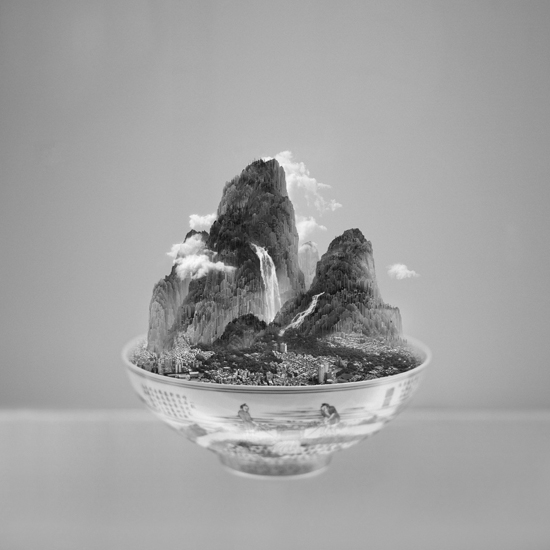
YANG Yongliang, A Bowl of Taipei no. 4, 2012, photographs (Epson Ultragiclee print on Hahnemuhle paper), 100 x 100 cm. Courtesy of the artist.
Sophie McIntyre brings her deep knowledge of contemporary art from China, Taiwan and Hong Kong to the curation of the exhibition. Two years in the making, ‘Ink Remix’ was intended to examine the work of a younger generation of artists, born after 1960. McIntyre says, ‘I was curious about why a lot of young contemporary artists were turning to this phenomenon of ink. But I was most interested in those artists who were critically interrogating an ink tradition and what that means in contemporary society.’ McIntyre was curious to see how artists in the three locations respond differently to this revitalisation of an ancient art practice. What she discovered, in many conversations with many artists, was their desire to reconnect with the tradition in a philosophical sense, rather than as technique, style or medium. And not just to reconnect, but to reinterpret.
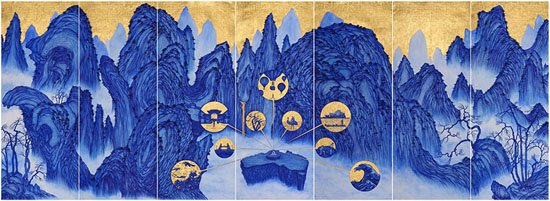
Just as a musical remix could include sampling of tracks by multiple artists, many of the artists in ‘Ink Remix’appropriate the tropes of traditional ink works. Misty mountains do appear, albeit in a much altered form. In Yang Yongliang’s ‘Bowl of Taipei’ series (2012) they are crammed into noodle bowls, suggesting the ‘bonsai-ing’ of nature, squeezed into a new urban world of consumerism and mass production. Yang’s clever animations respond to China’s environmental crisis and the pace of urbanisation. ‘Rising Mist’ (2014) at first appears to emulate a traditional scholar painting of mountains and water. On closer inspection you realise that the mountains are formed by the towering steel and concrete high-rises of an enormous city; construction cranes and electric stanchions rather than pine trees punctuate the horizon line. The entire urban landscape is adrift in a miasma of pollution.
He Xiangyu learned how to paint like masters of the Song Dynasty in order to produce works that appear similar to classical paintings. His vistas of mist-shrouded mountains, tiny temples and tumbling waterfalls, however, are painted with ink mixed with Coca-Cola, a satirical jab at the unstoppable march of globalisation and consumer culture. Part of a much larger project shown at 4A Centre for Contemporary Asian Art in 2012, ‘Cola Project’ also involved the boiling down of 135,000 litres of the soft drink into a smelly tar-like sludge, and the carving of two jade skeletons (made to the exact dimensions of the artist’s, with the assistance of MRI imaging and X-rays) that were then partially simmered in Coca-Cola. The paintings make more sense in the context of that larger body of work, but in pondering their materiality we are forced to consider whether Chinese culture is being overwritten in a destructive process of what used to be called ‘Coca-Colonisation’, or whether, in contrast, they show the enduring nature of those traditions, outlasting the sweet product of consumer desire.
TSAI Charwei, Tofu Mantra, 2005, video still. Courtesy the artist and TKG+
The act of writing is central to the practice of Charwei Tsai, born in Taipei and currently living and working between Taiwan and Vietnam. For many years her work has explored relationships between spirituality and the natural world, using performance, photography and video. She conveys the transience of the physical world in the ‘Mantra’ series, writing a Buddhist prayer onto lotus leaves, mushrooms, flowers and other organic materials. Tsai memorised the important Heart Sutra when she was growing up in Taiwan, and its meditation upon the impermanence of all things continues to inform her practice. For ‘Tofu Mantra’ (2005) she wrote its 260 Chinese characters onto a large piece of tofu. The video documents the process of decay, the tofu liquefying, surrounded by falling insects, an arresting memento mori.
Her choice of tofu, a material so symbolic of Chinese culture globally, has particular significance for an artist straddling cultures and languages. (As, incidentally, was also seen recently in Chen Qiulin’s ‘One Hundred Names’ project at 4A, in which the artist carved the most common Chinese surnames into large blocks of firm tofu.) ‘Incense Mantra’ (2013) is a site-specific work produced in Hong Kong in collaboration with Tibetan Tsering Tashi Gyalthang, inspired by the enormous conical joss sticks burned in the Man Mo Temple. The incense, densely covered with characters written in black ink, slowly burns, turns to ash and crumbles. A soundtrack of chanting monks and the noise of waves (Hong Kong, so closely associated with the maritime world, translates from the Chinese as ‘Fragrant Harbour’) produces a genuinely stilling and meditative experience.
He Xiangyu beside his work Skeleton (2010) Courtesy of Gallery 4A, Pearl Lam Gallery, Shanghai Photography: Garry Trinh
What artwork took 60,000 bottles of coca cola (approximately 135,000 litres) to produce?
He Xiangyu's 'Cola Project' is currently showing at Gallery 4A in Sydney and it reveals a young (25 years old) Chinese artist who has developed an intriguing and somewhat controversial practice. He Xiangyu employed factory workers to boil up all this cola to become a sludgy mass which then crystallises into a coal-like substance which is piled on the floor of the gallery. (Coal/Cola - the basis of life in modern times?) There are almost 2 tonnes of this material in existence, although not all of it is here in the tiny space of the Centre for Contemporary Asian Art in Chinatown. Upstairs in the gallery are the other parts of this ambitious installation - a jade skeleton based on X-rays of the artist's own, with its pelvis and femur boiled in cola; photographic documentation of the workers involved in the production of the material; and museum vitrines containing the workers' uniforms, goggles and gloves, covered in a black viscous tar-like substance. There are also paintings based on Song Dynasty masterworks, created with ink mixed with coca cola - literally embedding the product of global capitalism and marketing into the traditions of imperial China.
The artist, who also made a scarily life like sculpture of Ai Weiwei lying apparently dead face down on the floor for a show early last year (which prompted many calls to police from bystanders who thought there was a dead body lying in the gallery in Bad Ems, Germany) says somewhat disingenuously that he just likes to drink cola. Connections with Wang Guangyi's political pop paintings, or Ai Weiwei and his coca cola logo painted over ancient Chinese urns of the 1990s are inevitable, however the meanings of the works are very different. He Xiangyu's work is less about a clash of cultures and more about the integration of Chinese tradition and culture (the jade, the ink paintings) with the products of western consumerist desire in this new China. An intersection of discourses, and a body of work which reflects on the global experience of consumption and asks us to think about its implications.
I have written about this work for the online journal daily serving.com as a form of reverse alchemy. It becomes more intriguing and thought provoking the more one thinks about its many possible interpretations and layers of meaning. I'm not sure I want to be drinking cola anytime soon, however.
He Xiangyu, Cola Project Installation View in Gallery 4A Sydney, image reproduced courtesy of the artist and White Space Beijing